

No. 007
Famous Skull Art: Skull Paintings and Artworks from Holbein to Hirst
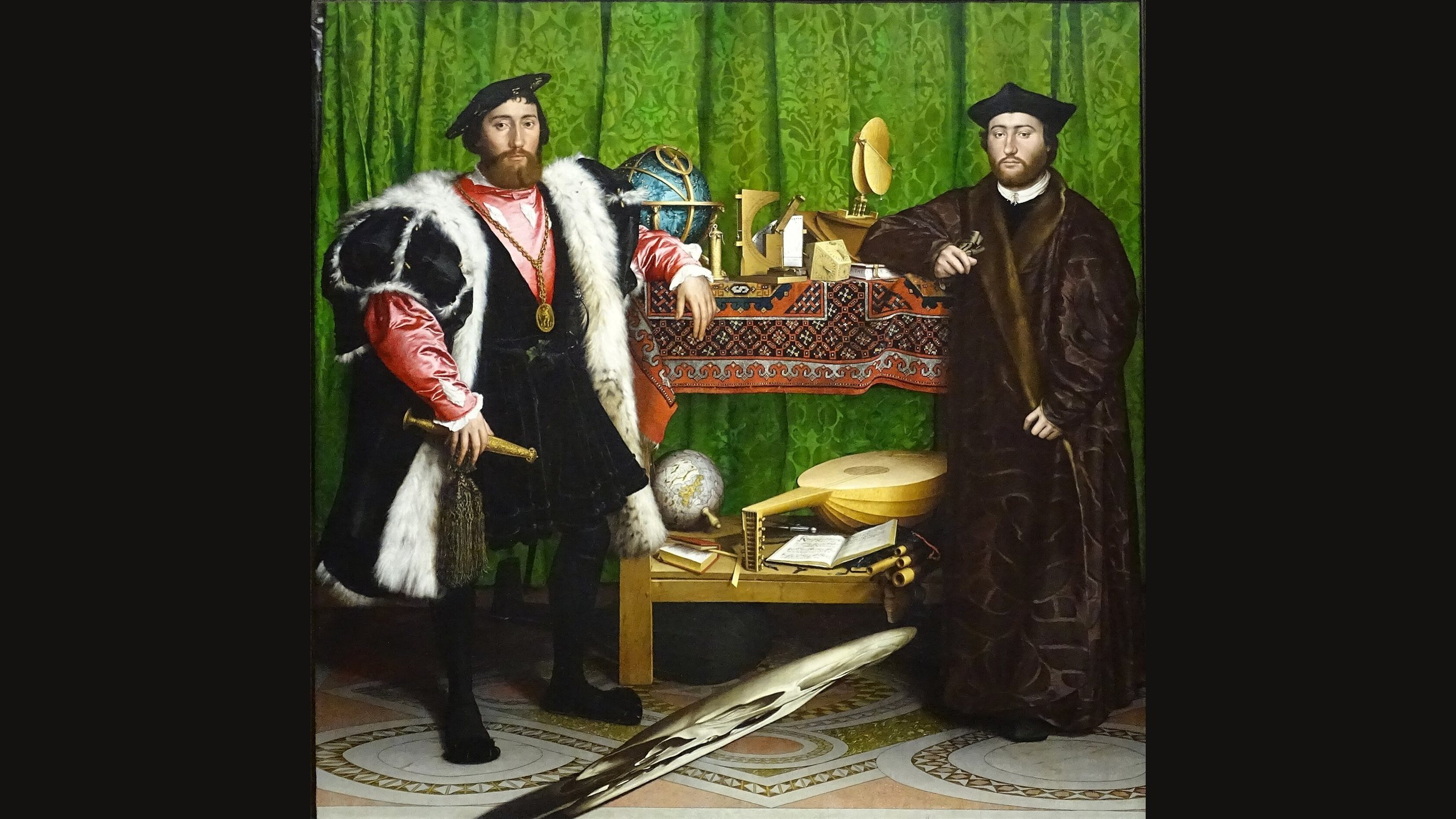
The most famous skull painting is Hans Holbein the Younger's *The Ambassadors*, painted in London in 1533 and now in the National Gallery, London. It is oil on oak, 207 by 209.5 centimeters, and across the foreground floats a stretched, smeared shape that turns into a skull when you look from the side. That is the safest answer to the question, and it is a good place to start a tour. The rest of this list moves through Hamlet's Yorick, Cézanne, Van Gogh, Georgia O'Keeffe, Mexican calavera art, the British Museum's two famous skulls, Warhol, Basquiat and Damien Hirst, with the museum that holds each one.
Holbein's hidden skull
The National Gallery identifies the two men in *The Ambassadors* as Jean de Dinteville, the French ambassador to England, and Georges de Selve, a bishop and diplomat. Around them are globes, books, scientific instruments and musical objects, a table of knowledge and status. In front of them is the skull, an anamorphic image that resolves into a recognizable human skull when seen from an oblique angle. The museum describes it as a memento mori, tying learning, worldly rank and death together in one composition.
The National Gallery's technical studies note that anamorphosis was known in the sixteenth century, though this treatment of a skull is distinctive in Holbein's work. The painting entered the museum's collection in 1890, acquired from the Longford Castle collection. Why is the skull there at all? Because it is the point of the painting: whatever the two men have gathered around them, death is in the room.
Yorick and Hamlet in paint
In Shakespeare's *Hamlet*, Act V, Scene 1, Hamlet meets the skull of Yorick, a court jester he knew as a child, in a graveyard scene with Horatio and the gravediggers. Yorick is not an anonymous skeleton; he is someone Hamlet remembers.
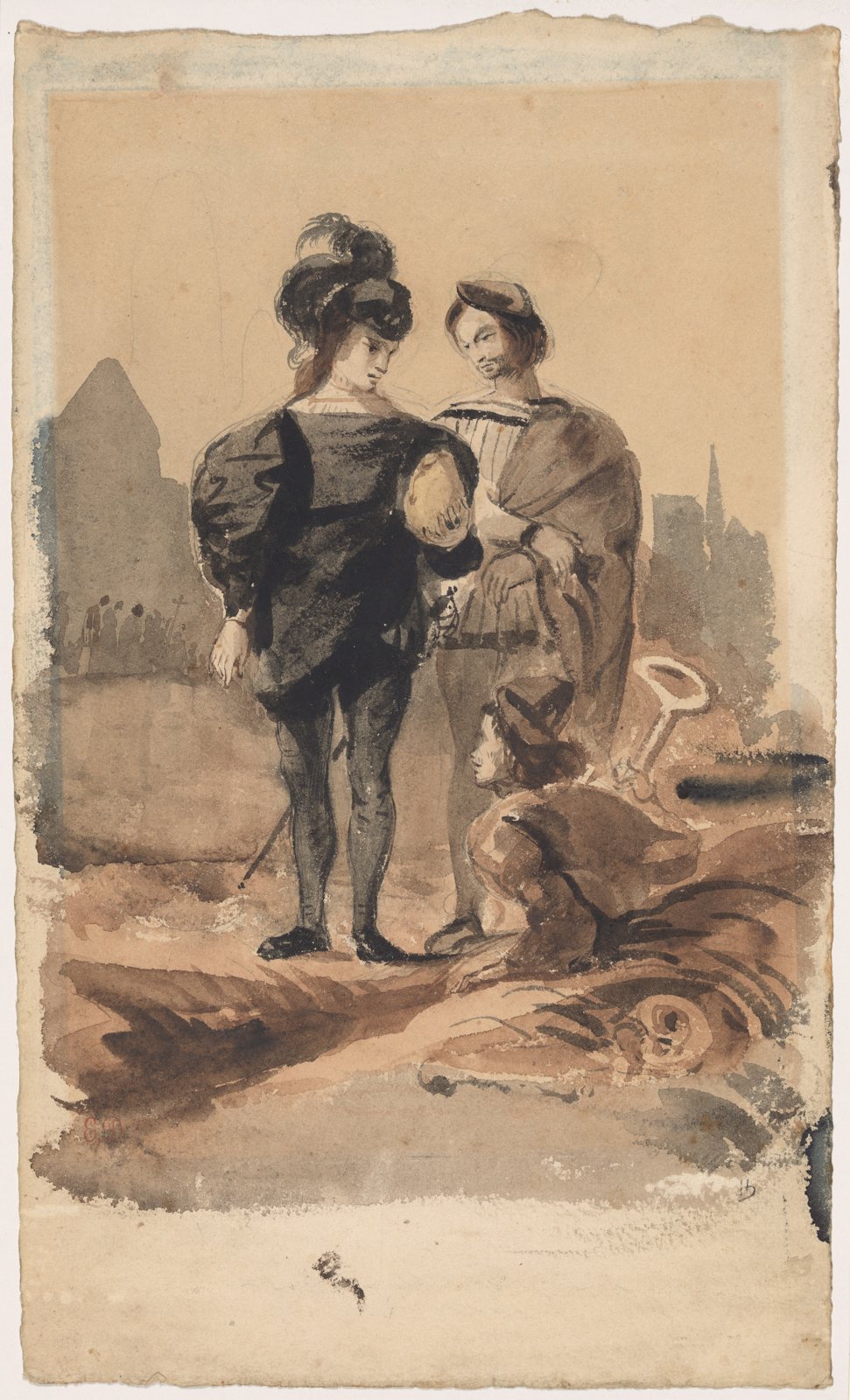
Eugène Delacroix returned to the scene again and again. The Metropolitan Museum of Art holds his *Hamlet and Horatio in the Graveyard*, 1827 to 1828, a brush-and-wash drawing, marked Public Domain. The Städel Museum in Frankfurt holds *Hamlet and Horatio at the Cemetery*, an oil on canvas of 1835 that the Paris Salon jury rejected. The museum reads Hamlet's unsteady footing beside the grave as a sign of his own approaching death. The Louvre holds an oil of 1839, and the National Gallery of Art in Washington holds a related scene with the gravediggers. One note from the National Gallery in London belongs here too: Frans Hals's *Young Man holding a Skull* is not a portrait and not Hamlet holding Yorick, but part of a Netherlandish tradition of mortality images.
The skull on the still-life table
Skulls became a standard object in Dutch and Flemish still lifes. Jacques de Gheyn II's *Vanitas Still Life*, 1603, oil on wood, at the Met, shows a skull, a bubble, flowers and a smoking urn, which the Met says evoke life's brevity and human folly. It is generally considered the earliest known independent still life devoted to the vanitas theme. The full story is in vanitas paintings.
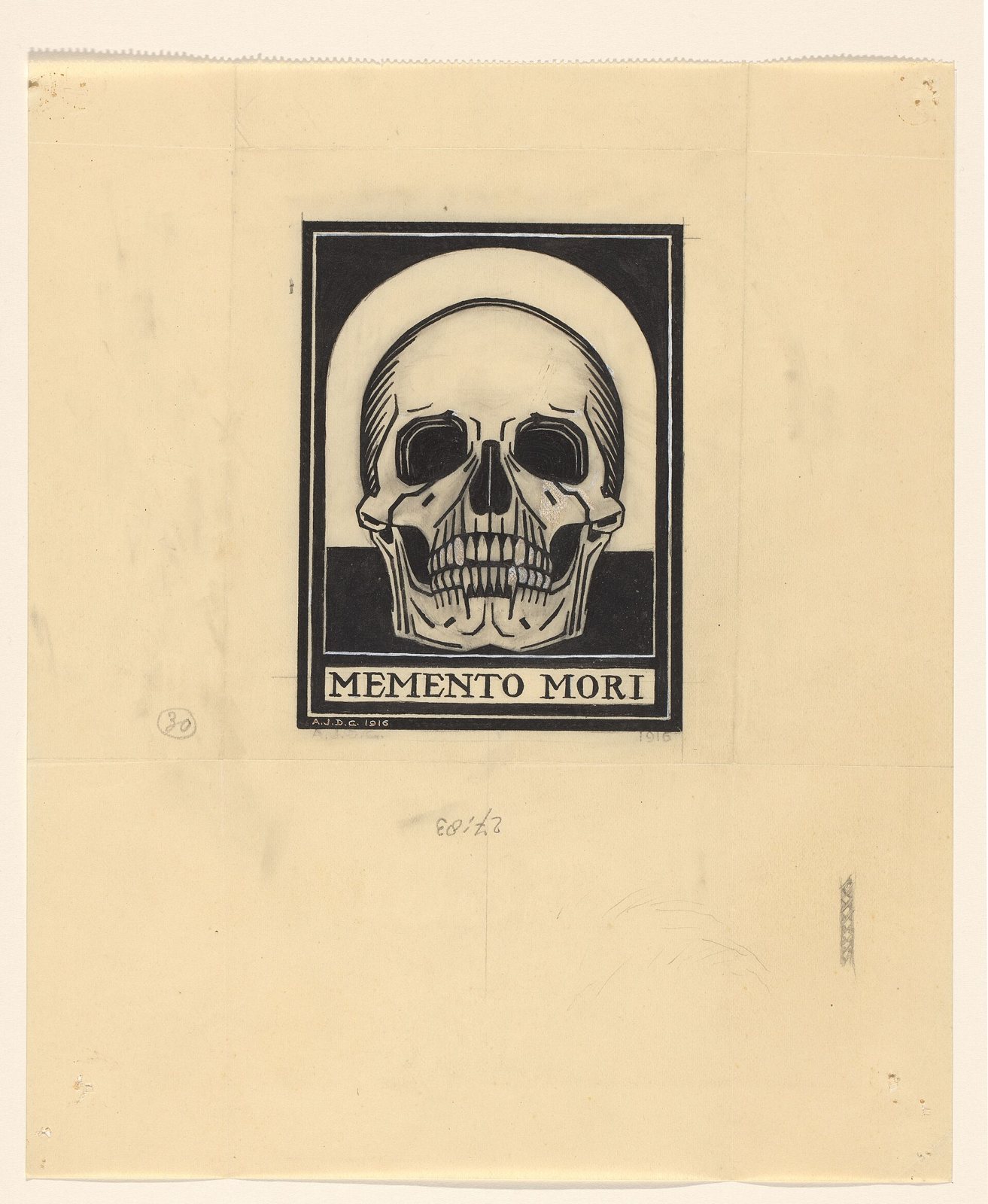
Two smaller works are worth knowing. Barthel Beham's 1529 engraving *Kind met drie schedels* at the Rijksmuseum shows a sleeping child resting on three skulls, with an hourglass completing the message. Julie de Graag's 1916 *Menselijke schedel*, titled *Memento mori* on the object, is a pen, brush and ink work at the Rijksmuseum, filed under "skull as symbol of Vanitas."
Cézanne, Van Gogh and O'Keeffe
Three very different artists looked at bone in three different ways.
Paul Cézanne painted and drew skulls repeatedly between about 1898 and 1906. The Art Institute of Chicago records that he used real skulls as models in his studios in Aix-en-Provence, and its *The Three Skulls* is dated 1902 to 1906. The Detroit Institute of Arts holds another *The Three Skulls*, about 1898, catalogued with vanitas associations, and MoMA's material treats his skull still lifes as an important late subject. Museums connect them to mortality, but his own attention was on form, color and the act of painting.
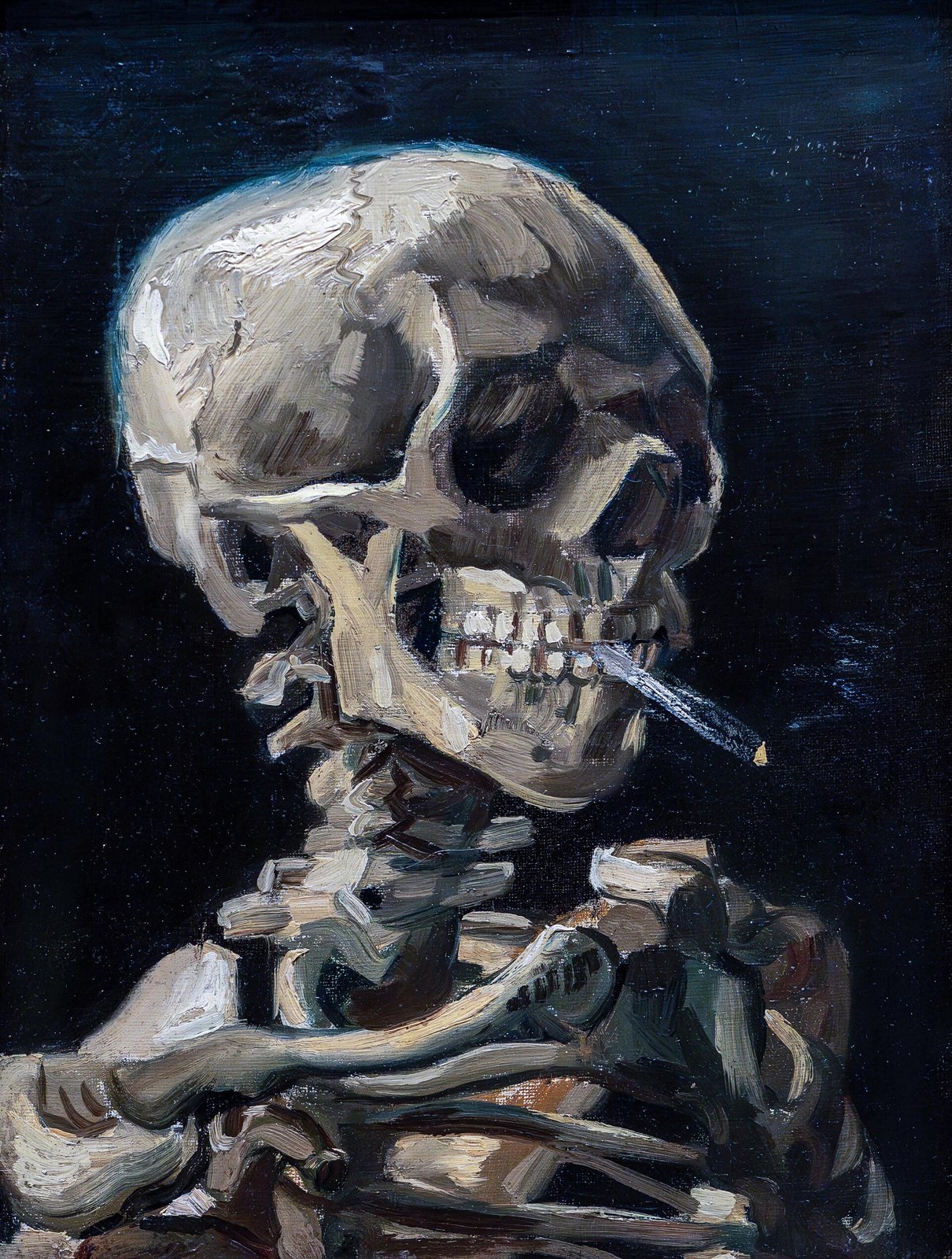
Vincent van Gogh made *Skull of a Skeleton with Burning Cigarette* in Antwerp around 1885 to 1886. It is oil on canvas in the Van Gogh Museum, inventory number s0083V1962. It reads as an anatomical study with a darkly comic cigarette, and the museum's record is the place to confirm its details.
Georgia O'Keeffe made bones and skulls central after visiting New Mexico in 1929. The National Gallery of Art records that she shipped a barrel of bones home in 1931 and began working them into paintings in 1932. The Met discusses her desert bones, including *Cow's Skull: Red, White, and Blue*, as part of her relationship with the desert terrain of New Mexico and northern Arizona. The National Gallery of Art also holds Alfred Stieglitz's 1931 photograph of her with a horse skull.
Mexican skull art, and two skulls at the British Museum
José Guadalupe Posada's calavera imagery is central to modern Mexican visual culture. The Instituto Nacional de Bellas Artes (INBAL) identifies him as the creator of the famous calavera associated with La Catrina, and Diego Rivera later put Posada and La Catrina into his mural *Sueño de una tarde dominical en la Alameda Central*, painted in 1947 and held by the Museo Mural Diego Rivera in Mexico City. You can read more in the stories of José Guadalupe Posada and La Catrina.
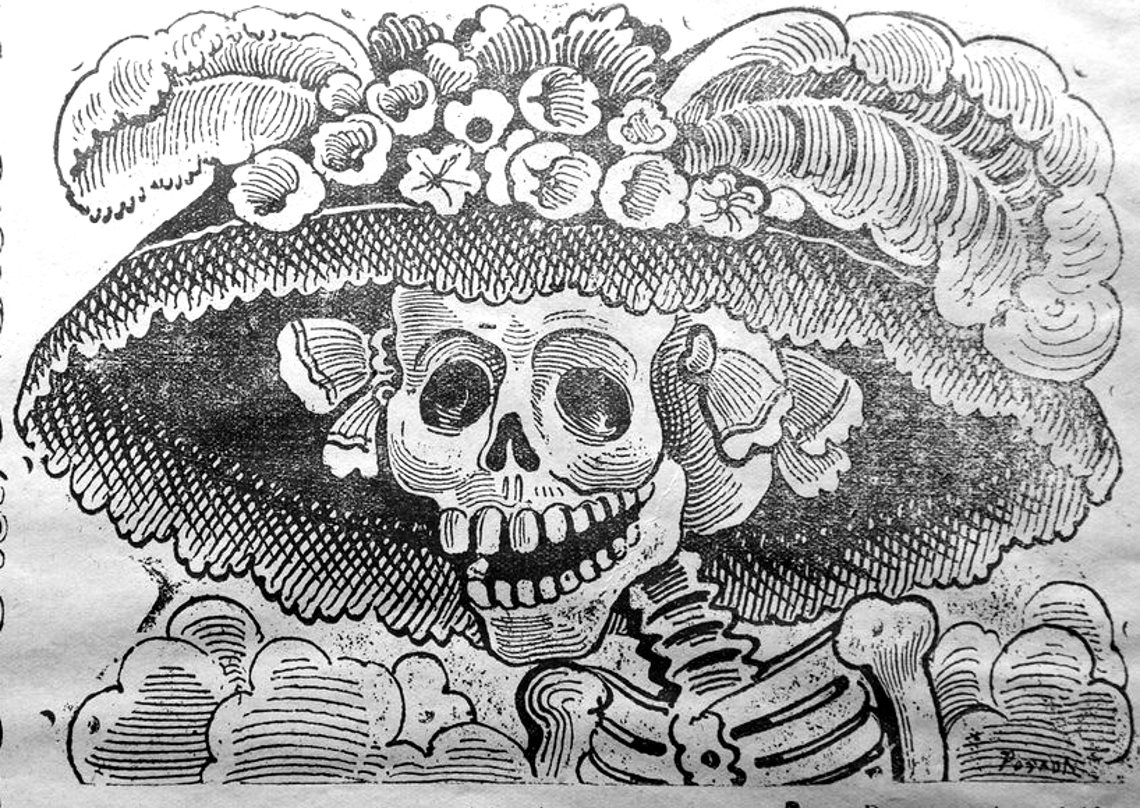
INBAL also records that Rivera and Frida Kahlo collected Mexican popular art, pre-Hispanic objects, Judas figures and calaveras made of cardboard and reed. Kahlo's skull imagery sits within her wider use of Mexican objects, popular culture, mortality and the experience of the body, and it does not have one universal meaning.
The British Museum holds two skulls that people often confuse. The first, museum number Am,St.401, is a turquoise mosaic skull described as Aztec or Mixtec, made in Mexico between 1400 and 1521. It is a human skull covered with turquoise and lignite mosaic, with pyrite eyes, shell elements and pine-resin adhesive. The museum says it is believed to represent Tezcatlipoca and was probably worn as a back ornament. It is displayed in Room 27, and it deserves to be treated as the human remains it is.
The second, Am1898,-.1, is a rock-crystal skull whose history is far less certain. The museum dates it to 1881 or earlier and records that it was bought from Tiffany and Co. in 1898. Its pre-Hispanic Mexican origin is uncertain: laboratory examination showed tooth lines more consistent with nineteenth-century jewelers' tools than with known Aztec stoneworking, and the museum does not treat it as securely Aztec. The wider story is in crystal skulls.
Warhol, Basquiat and Hirst
Andy Warhol made his *Skulls* series in 1976. The National Galleries of Scotland describe it as six paintings repeating one photograph of a human skull. MoMA holds *Untitled (Skull)*, 1976, in pencil on paper, and the Met holds a related *Skull* of 1977 in acrylic and silkscreen on canvas, on view at The Met Fifth Avenue in Gallery 099.
Jean-Michel Basquiat's 1981 *Untitled* at The Broad in Los Angeles is acrylic and oilstick on canvas and joined the collection in 1982. People often call it *Untitled (Skull)*, but The Broad's page titles it simply *Untitled*. The museum describes the skull-like head as existing between life and death and reads it partly as a self-portrait, while also linking Basquiat's masks and skull-like heads to questions of identity and African mask traditions.
Damien Hirst's *For the Love of God*, 2007, is a platinum cast of an eighteenth-century human skull with its original teeth, covered with 8,601 diamonds, including a large pink diamond in the forehead. It was shown at White Cube in London in 2007 and at the Rijksmuseum in Amsterdam in 2008. The Museo Jumex describes it as combining images of death with questions about belief and value. Sotheby's records a reported 2007 sale for $100 million, a figure that is best treated as reported rather than as a public auction result. Where the work is displayed now should be confirmed with Hirst's studio, White Cube or the exhibiting institution before you plan a trip around it.
Tap or hover a row to highlight it.
| Work | Artist | Date | Medium | Collection |
|---|---|---|---|---|
| WorkThe Ambassadors | ArtistHans Holbein the Younger | Date1533 | MediumOil on oak | CollectionNational Gallery, London |
| WorkVanitas Still Life | ArtistJacques de Gheyn II | Date1603 | MediumOil on wood | CollectionMetropolitan Museum of Art |
| WorkKind met drie schedels | ArtistBarthel Beham | Date1529 | MediumEngraving | CollectionRijksmuseum |
| WorkMenselijke schedel | ArtistJulie de Graag | Date1916 | MediumPen, brush and ink | CollectionRijksmuseum |
| WorkSkull of a Skeleton with Burning Cigarette | ArtistVincent van Gogh | DateAbout 1885 to 1886 | MediumOil on canvas | CollectionVan Gogh Museum |
| WorkUntitled | ArtistJean-Michel Basquiat | Date1981 | MediumAcrylic and oilstick on canvas | CollectionThe Broad |
| WorkSkull | ArtistAndy Warhol | Date1977 | MediumAcrylic and silkscreen on canvas | CollectionMetropolitan Museum of Art |
What a skull means in art
A skull most often stands for mortality, the brevity of life and the vanity of worldly achievement. In European vanitas art it works as a memento mori, and Holbein's distorted skull brings the same warning into a portrait full of accomplishment. But the meaning is not universal. A skull can also signify remembrance, human equality, artistic study, violence, religious contemplation or a modern fascination with death.
Three skulls have no fixed meaning either. In Beham's engraving they sit beneath a sleeping child with an hourglass. In Cézanne they are studio models. A number is not a code, and the meaning comes from the surrounding objects and the artist.
Where to see skull art in the United States
- Metropolitan Museum of Art, New York: Warhol's *Skull*, 1977, on view in Gallery 099, and de Gheyn's 1603 *Vanitas Still Life*. Delacroix's *Hamlet and Horatio in the Graveyard* drawing is not on view.
- The Broad, Los Angeles: Basquiat's *Untitled*, 1981.
- National Gallery of Art, Washington: Delacroix's Hamlet and Horatio scene, and Stieglitz's photograph of O'Keeffe with a horse skull, which is not on view.
- Detroit Institute of Arts: Cézanne's *The Three Skulls*.
- Art Institute of Chicago: Cézanne's *The Three Skulls*, 1902 to 1906.
Display status changes, so confirm the museum's current collection page before you visit.
Skull art from 1529 to 2007
Tap or hover a step to follow the order.
1529
Barthel Beham's Kind met drie schedels
1533
Holbein's The Ambassadors
1603
de Gheyn's Vanitas Still Life
1827 to 1828
Delacroix's Hamlet drawing at the Met
1835
Delacroix's Hamlet and Horatio at the Cemetery
About 1885 to 1886
Van Gogh's skull with cigarette
1898 to 1906
Cézanne's skull works
1931
Stieglitz photographs O'Keeffe with a horse skull
1947
Rivera's Sueño de una tarde dominical
1976
Warhol's Skulls
1981
Basquiat's Untitled
2007
Hirst's For the Love of God
Test your skull art knowledge
Answer every question to check.
Quick answers about skull art
What is the most famous skull painting?
Holbein's *The Ambassadors* (1533) at the National Gallery in London is the safest answer, with its anamorphic skull seen from the side. De Gheyn's 1603 *Vanitas Still Life* and Cézanne's late skull still lifes are also famous.
What does a skull image symbolize in art?
Most often it symbolizes mortality and the vanity of worldly success. It can also stand for remembrance, equality, study, violence or religious thought, depending on the artist and period.
What do three skulls symbolize?
Three skulls have no single meaning. In Beham's 1529 engraving they accompany a sleeping child and an hourglass, and in Cézanne's late still lifes they are studio subjects tied to mortality and form.
What do painted skulls represent?
Painted skulls commonly represent memento mori, vanitas and the shortness of life, as in de Gheyn's 1603 still life. The meaning should be read from the artist, place, period and composition.
Is the British Museum crystal skull really Aztec?
The museum does not treat it as securely Aztec. It dates the skull to 1881 or earlier, and laboratory work showed tooth lines more consistent with nineteenth-century tools.
How much is Damien Hirst's diamond skull worth?
Sotheby's records a reported 2007 sale of $100 million, which should be read as a reported figure, not a verified auction result.
Where to go next
If one of these skulls caught your eye, follow it through vanitas paintings, what memento mori means and skull symbolism. The medieval procession behind Holbein's woodcuts is in the danse macabre. If you spend your days around books and art, our Book Crew skull tee is a shirt for you.