

No. 006
Victorian Mourning Jewelry: What Hair, Jet and Memento Mori Rings Meant
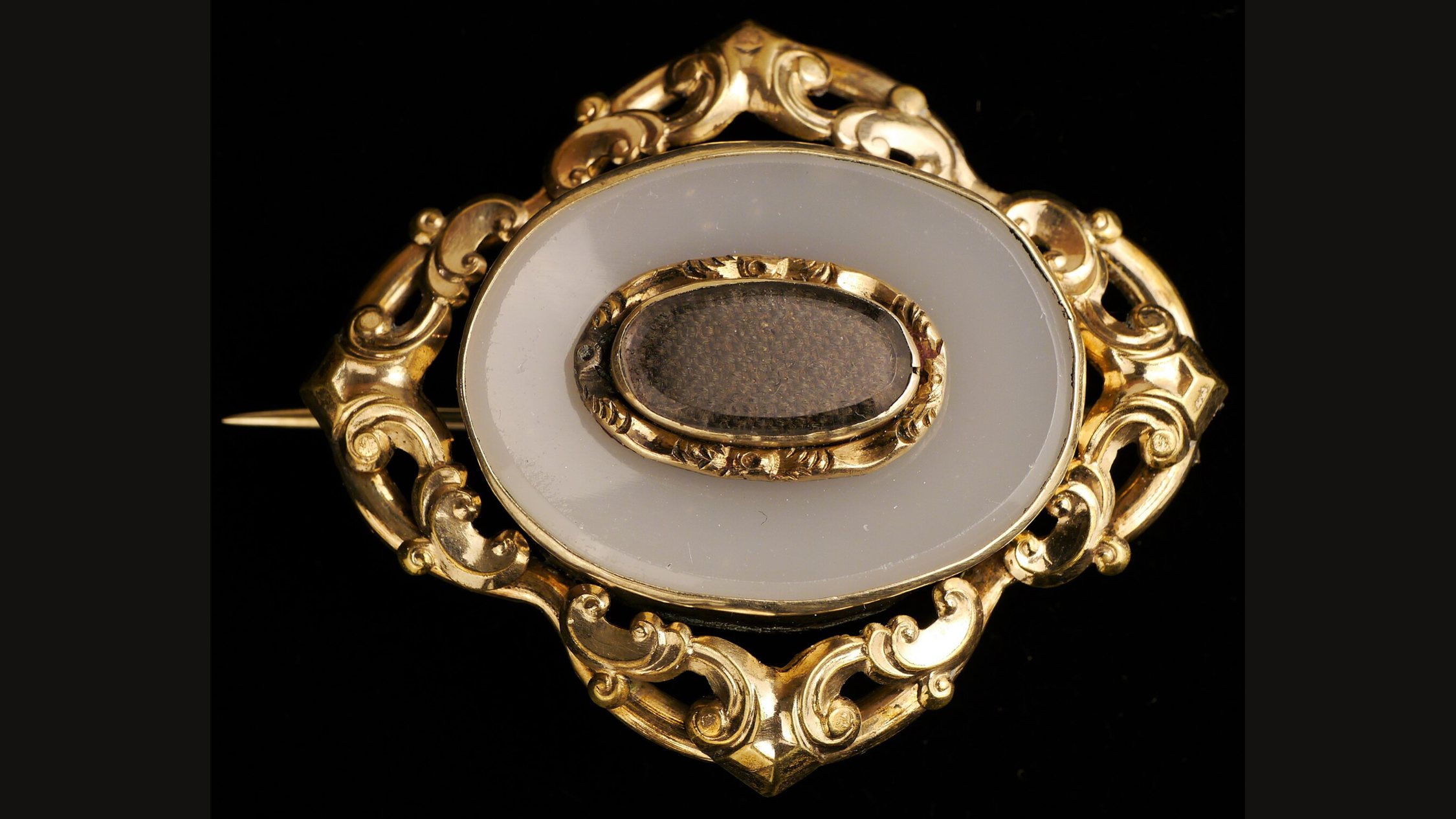
A brooch with a tiny braid of hair under glass, a black ring with a skull, a polished jet pendant: these are the pieces people call Victorian mourning jewelry. It was made or worn to remember one particular dead person, and the piece often carried that person's hair, name and dates. Memento mori jewelry is a related but separate tradition, a general nudge that death comes for everyone. The two overlapped for centuries, and by the time Queen Victoria sat on the throne the fashion had moved from skulls and coffins toward names, hair and black jet. One more thing worth knowing from the start: hair does not always mean mourning. Plenty of hair jewelry was made for people who were very much alive.
Mourning rings and memento mori rings are not quite the same
A memento mori ring speaks to the wearer about death in general. Its usual symbols are skulls, skeletons, coffins, hourglasses and the words MEMENTO MORI. The British Museum holds an English enameled gold ring of the seventeenth century with a skull and that inscription, and a British Museum ring from seventeenth- or early eighteenth-century England shows a crown, a skeleton, an hourglass and the same two words. The tradition clearly predates Victoria by a long way.
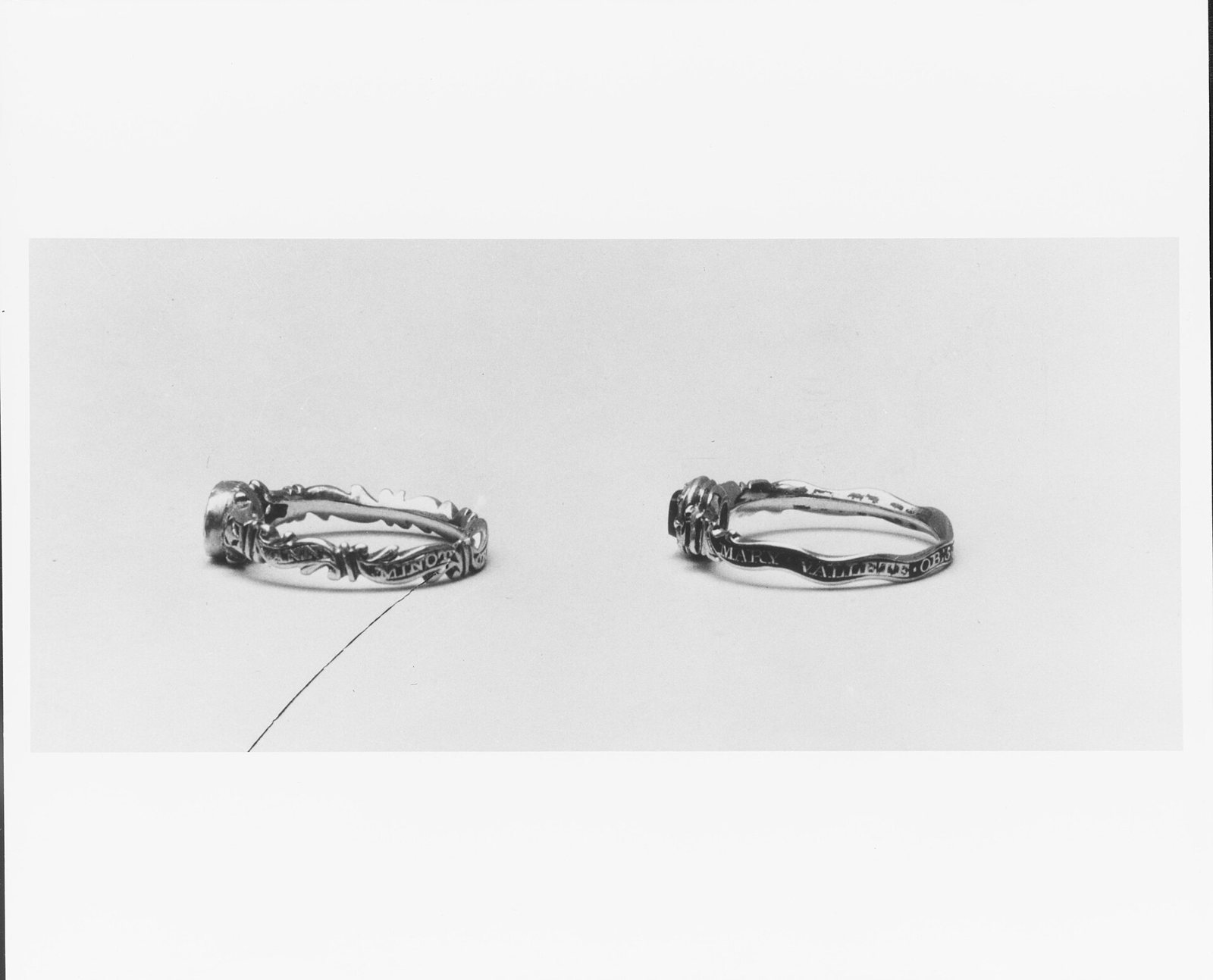
A mourning ring names someone. The Metropolitan Museum of Art in New York holds an American ring dated 1757 that has a skeleton beneath crystal and an inscription for Sarah Rawson, who died on 7 July 1757 at age 26. A skull alone would have been a message to everyone. The name makes it a memorial to her.
A dated tour through museum pieces
Museum objects show how the look changed, one name at a time.
- 1706, Boston: The Met holds a heart-shaped locket containing woven hair, with an engraved skull on the reverse.
- 1733, New York: A Met mourning ring names Abraham and Catherine De Peyster. Hair sits beneath a coffin-shaped bezel, and the inscription records death dates and ages.
- About 1790, England: A British Museum brooch for William Franks holds plaited hair under glass and is catalogued as a memento mori.
- 1826, Leeds: A British Museum locket by John Wilkinson combines curled hairwork, seed pearls, gold wire and enamel, with inscriptions naming Harriet Bower and Caroline Sophia Bower.
- About 1850, United States: A Met brooch pairs plaited hair with cut jet, pearls and crystal. Its inscription remembers Charles T. Evans, who died at sea on 20 September 1852, aged 39.
- 1864, New York: A Smithsonian mourning brooch made that year holds hair beneath glass.
- 1896, Brooklyn: A Smithsonian hairwork memorial records the death of Louisa Ammarell on 20 June 1896.
Tap or hover a row to highlight it.
| Date | Place | Object | Materials | Collection |
|---|---|---|---|---|
| Date1706 | PlaceBoston | ObjectHeart-shaped locket with an engraved skull on the reverse | MaterialsWoven hair | CollectionThe Met |
| Date1733 | PlaceNew York | ObjectMourning ring naming Abraham and Catherine De Peyster | MaterialsHair beneath a coffin-shaped bezel | CollectionThe Met |
| DateAbout 1790 | PlaceEngland | ObjectBrooch for William Franks | MaterialsPlaited hair under glass | CollectionBritish Museum |
| Date1826 | PlaceLeeds | ObjectLocket by John Wilkinson | MaterialsCurled hairwork, seed pearls, gold wire and enamel | CollectionBritish Museum |
| DateAbout 1850 | PlaceUnited States | ObjectBrooch remembering Charles T. Evans | MaterialsPlaited hair, cut jet, pearls and crystal | CollectionThe Met |
| Date1864 | PlaceNew York | ObjectMourning brooch | MaterialsHair beneath glass | CollectionSmithsonian |
| Date1896 | PlaceBrooklyn | ObjectHairwork memorial for Louisa Ammarell | MaterialsHairwork | CollectionSmithsonian |
What the symbols and inscriptions say
Earlier pieces made death explicit with skulls, skeletons, coffins and hourglasses. By the later eighteenth century the Met notes that weeping willows and draped urns had become more standard, and the emphasis moved toward remembrance and grief. Common motifs include:
- Urns: the memorial vessel and funerary remembrance.
- Weeping willows: grief and the continuing bond between the living and the dead. The Cincinnati Art Museum also reads the tree's regrowth as a sign that death was not necessarily understood as the end.
- Forget-me-nots: remembrance, already tied to love and memory before the Victorian era.
- "In Memory Of": a direct memorial formula, usually followed by initials, a name, a death date or an age.
- Black enamel: a visual sign of mourning, especially on rings.
- White enamel: in some Georgian and Victorian pieces, linked to children or unmarried people, though it depends on the period and the object.
- Seed pearls: often read as tears, though that reading belongs to a specific object or documented convention and should not be assumed.
A motif's meaning was not always fixed, and the strongest clues are the inscription and the object's own record. A skull does not automatically make something Victorian mourning jewelry. Hair does not automatically prove the wearer was in mourning. Date, place, inscription, construction and ownership history all count.
Why hair, and how it was made
Hair is durable, personal and easy to keep, which made it a natural material for remembrance. People in Britain and the United States made it into brooches, rings, lockets, bracelets, necklaces, watch fobs, wreaths and framed parlor displays. The Smithsonian describes hair work as a popular home craft in the 1860s, with hair twisted, braided and sewn into flowers, wreaths and jewelry.
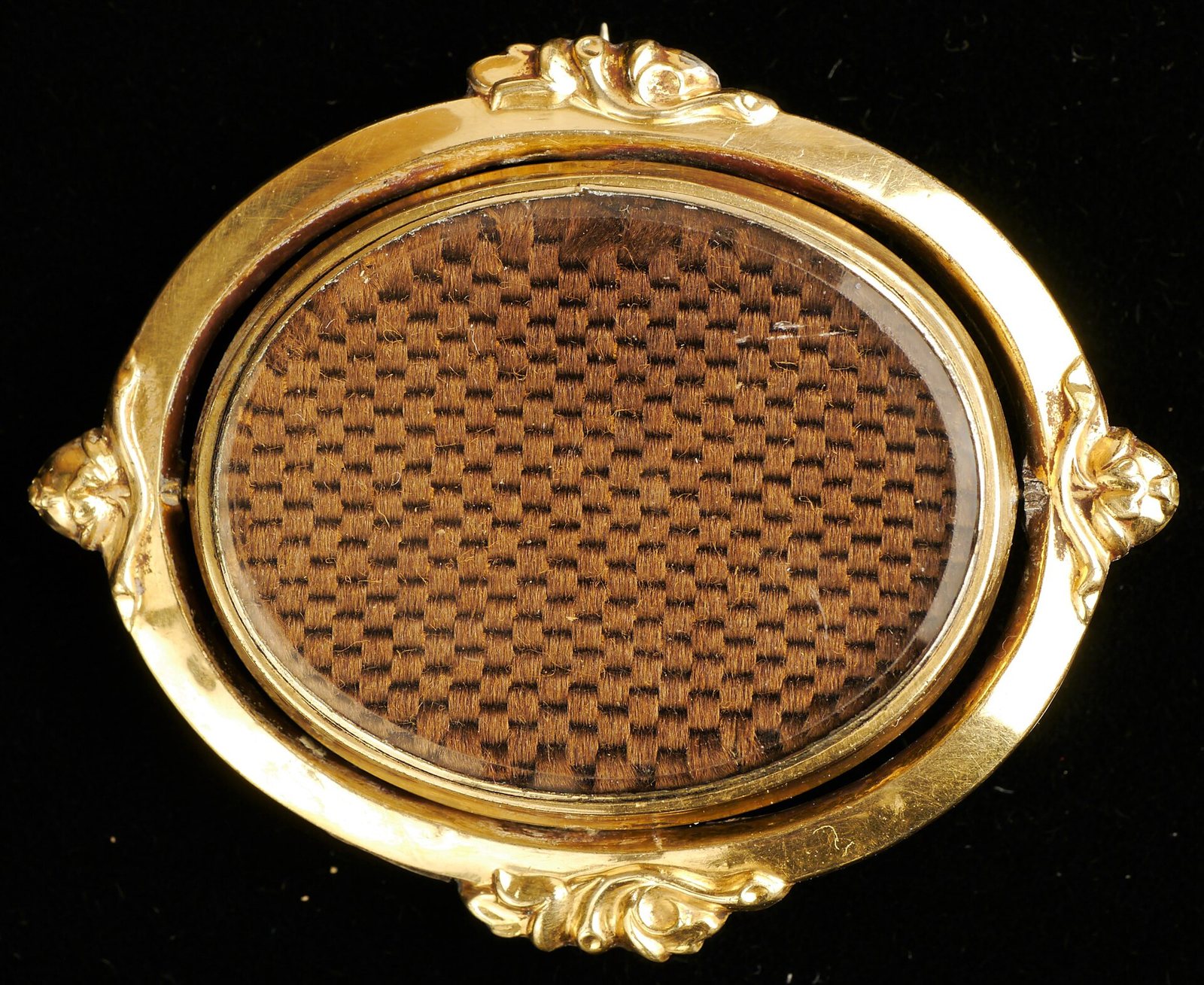
Museums document several techniques. Hair could be tightly plaited, braided or curled, arranged beneath a crystal face, or wrapped around wire and shaped over a form. The Illinois State Museum describes hair wrapped with wire around a knitting needle to make a chainlike coil called a gimp, then twisted into flowers and other designs. The Met records that by the mid-nineteenth century hair was being woven into three-dimensional earrings, charms and watch chains, and the British Museum's 1875 bracelet is made of table-braided hair covering solid segments joined to gold fittings. The British Museum's 1826 Leeds locket notes that hairwork was practiced both professionally and at home, with pattern books and instruction manuals on sale.
Hair was never only for the dead. Museums document hair exchanged among living relatives, friends and sweethearts, so a hair piece can be a memorial, a love token or both. Because hair is a human material, it deserves a respectful description, and nobody should assume that every surviving lock belonged to someone who had died.
Jet and its stand-ins
Whitby jet is a dense, black, fossilized wood from the Lower Jurassic rocks around Whitby in North Yorkshire. Whitby Museum puts its age at about 183 million years. It carves well, takes a high polish and feels warm to the touch. Rubbed on unglazed porcelain, true jet can leave a brown streak.
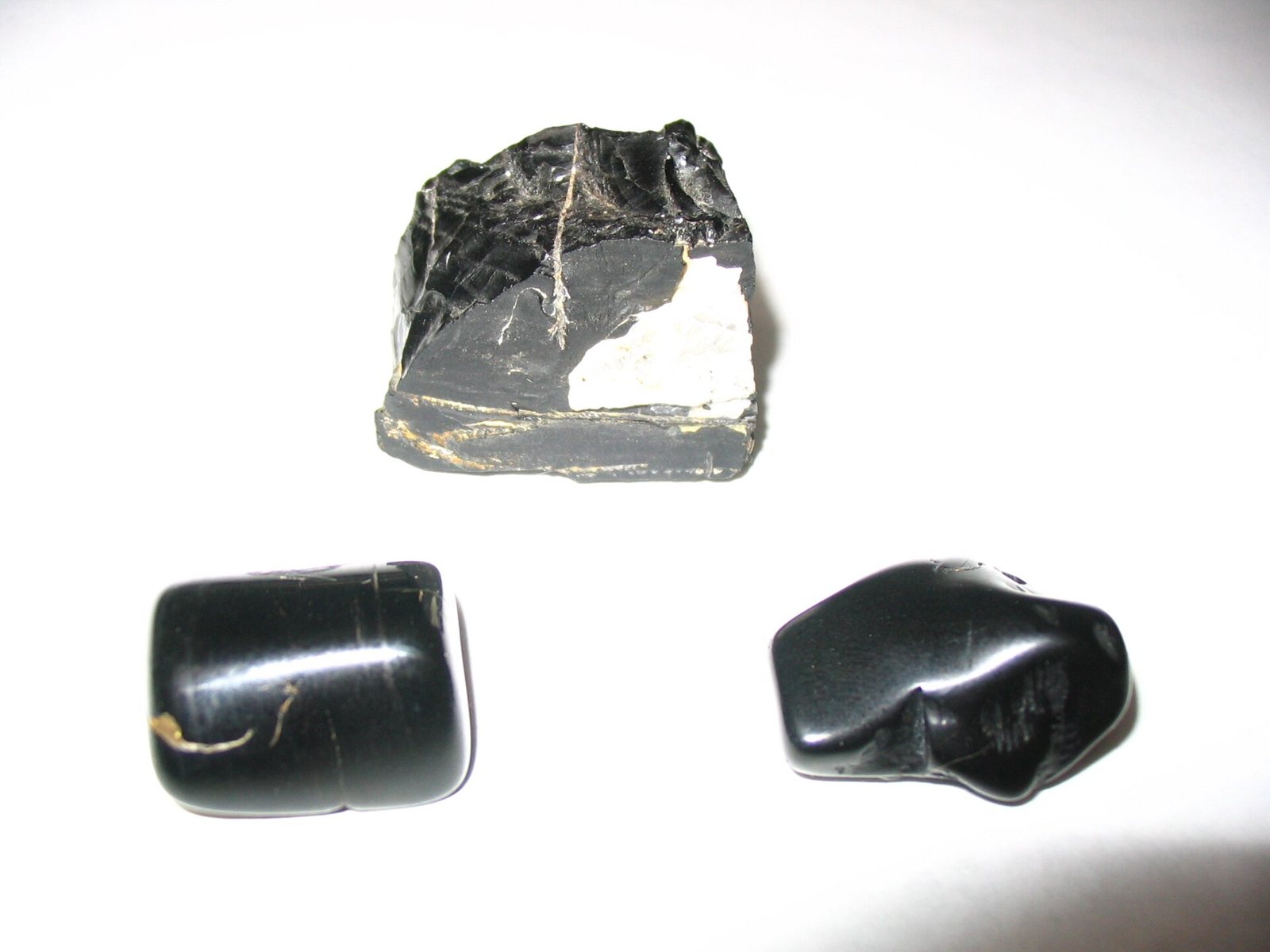
In the nineteenth century Whitby became a major jet-working center. Whitby Museum says that between 1860 and 1880 the industry had more than 200 factories and about 1,500 workers, and the museum holds more than 500 jet objects. One of them is a jet chess table begun in 1895 that took four years to finish and was intended for Queen Victoria's Diamond Jubilee. The railway and the demand for mourning wear helped turn jet jewelry into both a mourning material and a souvenir.
"Whitby jet" is not another name for every black Victorian stone. Makers also used vulcanite, a hard rubber made by heating rubber with sulfur; bog oak, wood preserved in peat bogs and often carved with Irish motifs such as shamrocks; gutta-percha, a rubbery material from Southeast Asian trees; and glass, onyx and black enamel. The Museo del Traje in Madrid names *azabache*, French jet and ebonite in its notes on nineteenth-century mourning dress.
Queen Victoria, mourning dress and the fading of the fashion
Prince Albert died on 14 December 1861. Queen Victoria then adopted a long and highly visible mourning, wearing black until her death in 1901. The Victoria and Albert Museum connects the popularity of mourning jewelry in the nineteenth century with her long mourning for Albert. Her example did not invent mourning jewelry or hairwork, which existed earlier, but it made them fashionable at a time when printing, railways and etiquette books could spread a style quickly. The British Museum notes that some older widows who never remarried also wore black for life, so her practice was influential rather than universal.
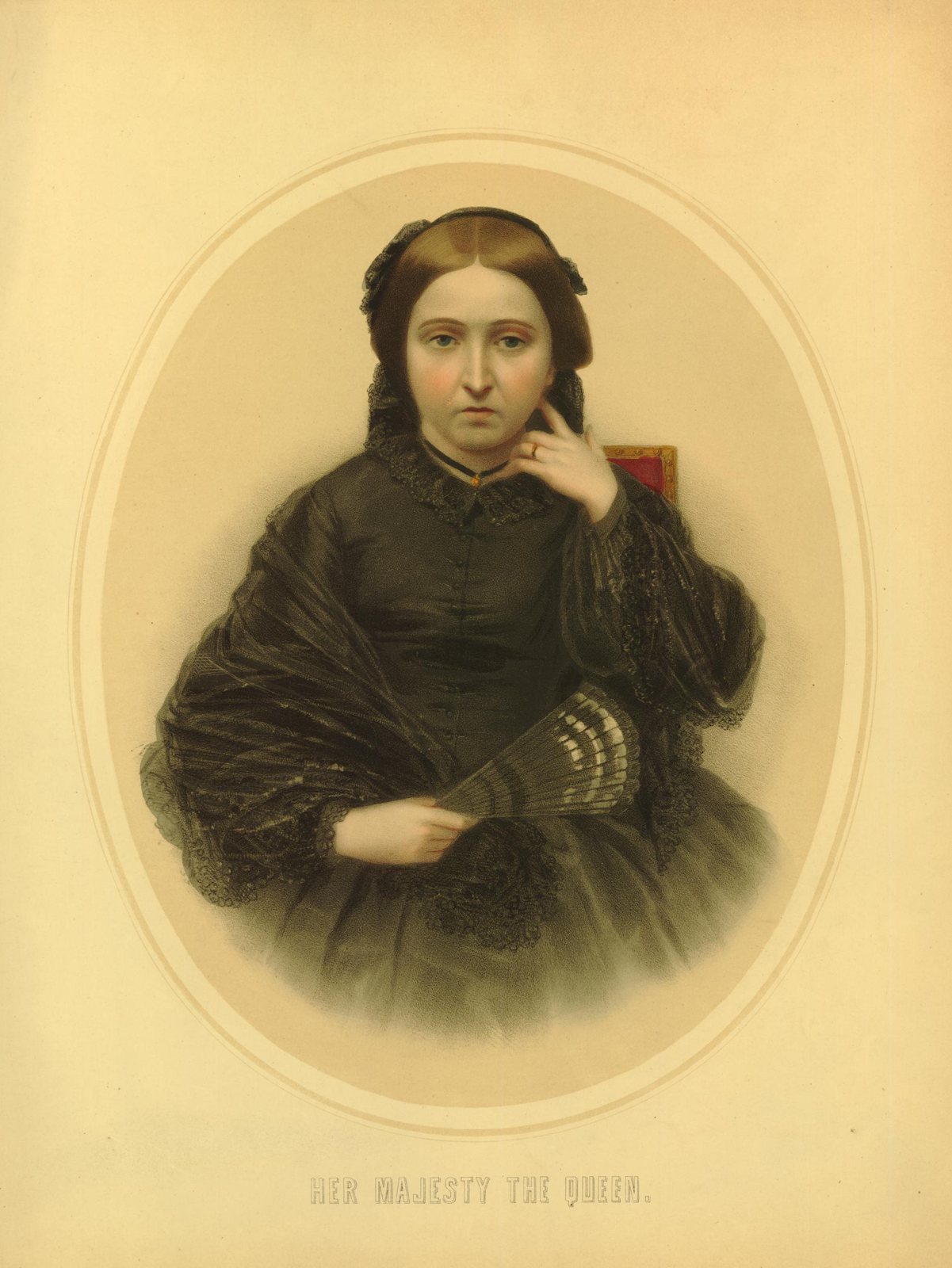
Real mourning varied a great deal. Historian Pat Jalland's study of fifty-five middle- and upper-class British families shows that practice differed with age, gender, illness, religion, family size and class.
The commonly described pattern for a widow began with deep mourning in dull black fabric such as crape, with little shine or ornament. The Science Museum Group describes hairwork jewelry as acceptable in a second stage that began one year and one day after the death. The V&A explains that jet's finish could signal the stage too, with matte jet for early bereavement and shinier jet later. Half mourning allowed gray, mauve, pearls and eventually colored stones to return. These were common conventions, not strict laws. The timing changed with the relationship, the household and the place.
The fashion faded gradually. Longer lives, new attitudes toward public grief, the Edwardian period, photography and the mass bereavement of the First World War all weakened the older codes. Hairwork jewelry was especially popular from about the 1850s through the 1880s and had largely disappeared as a mainstream fashion by the early twentieth century.
Mourning jewelry and the Victorian era, 1706 to the early twentieth century
Tap or hover a step to follow the order.
1706
Boston locket with woven hair and an engraved skull.
1733
De Peyster ring.
About 1790
Franks brooch.
1826
Leeds locket.
About 1850
Evans brooch.
1850s to 1880s
Hairwork is at its most popular.
1860 to 1880
The Whitby jet industry is at its peak.
14 December 1861
Prince Albert dies and Victoria begins prolonged mourning.
1864
New York brooch.
1895 to 1899
Whitby jet chess table.
1896
Brooklyn hairwork memorial.
Early twentieth century
Hairwork is largely gone as a mainstream fashion.
How to tell whether a piece is really Victorian
A black color, a lock of hair, a skull or a seller's description cannot prove a Victorian date on its own. Reliable dating uses several kinds of evidence together: an inscription or death date that fits the object, period materials such as hair, jet, black enamel, gold, glass or onyx, construction that matches dated museum examples, hallmarks read by a specialist, and a documented ownership trail.
If you have inherited a hair piece, leave it as it is. Do not cut, wash, chemically test or take it apart before a qualified appraiser, conservator or museum specialist has examined it.
Hairwork today, and where to see it
Hairwork is still practiced. Zen Hansen of Hair Anthropology teaches historic table braiding, with long hair, weighted bobbins and a braiding table, including a workshop listed by the Royal Alberta Museum. Karen Bachmann is a studio jeweler, teacher and restorer of hairwork, and a cultural-heritage conference paper records her teaching a Victorian hairworking workshop at the Mütter Museum. Leila Cohoon founded Leila's Hair Museum in Independence, Missouri, and her collection has since been dispersed to museums, including the Met and the National Museum of Funeral History. A modern piece may use the maker's own hair, a consenting donor's hair or hair supplied by a family, so it is fair to ask a maker whose hair it is and how it will be handled.
To see old pieces in person, look to the Metropolitan Museum of Art in New York, the British Museum and the V&A in London, Whitby Museum in North Yorkshire, the Science Museum Group, the ASU FIDM Museum, the Cincinnati Art Museum, and the Brontë Parsonage Museum, which displays Charlotte Brontë's hair bracelet alongside mourning jewelry. Check each museum's online collection page for what is currently on display.
Mourning jewelry quiz
Answer every question to check.
Quick answers about Victorian mourning jewelry
What is Victorian hair jewelry and why did people make it?
Victorian hair jewelry is jewelry made with human hair that was braided, woven, plaited or set beneath glass. People in Britain and the United States made it as a keepsake for loved ones, both living and dead. Hair is durable and personal, and it did not automatically signal mourning.
What does a memento mori ring mean?
A memento mori ring tells its wearer that death is certain. Its usual symbols are skulls, skeletons, coffins, hourglasses and the words MEMENTO MORI. Later mourning jewelry used gentler symbols such as urns, willows, black enamel, jet, hair and memorial inscriptions.
How can you tell if mourning jewelry is really Victorian?
No single feature proves it, because black color, hair or a skull appear on many objects. Look at the inscription, materials, construction, hallmarks and ownership history together, and compare them with dated museum pieces. A qualified appraiser or conservator can examine a piece without harming it.
What is Whitby jet?
Whitby jet is a black, fossilized wood from the Lower Jurassic rocks near Whitby in North Yorkshire, England, about 183 million years old. It can be carved and polished into jewelry. It is not the same as every black Victorian stone, since vulcanite, glass and bog oak were used too.
What did a willow or an urn on a mourning piece mean?
Weeping willows and draped urns became common memorial motifs in the later eighteenth century. The willow suggests grief, and the Cincinnati Art Museum notes that its regrowth can also hint that death was not the end. The urn is the memorial vessel.
Where to go next
If the old habit of keeping death close interests you, start with what memento mori means. The same idea shows up in paint in the vanitas paintings of the Dutch Golden Age, and in rings of a different kind in skull rings and their meaning. For a wider look at what skulls stand for, see skull symbolism. If you like the mood of the old memento mori pieces on something you can wear, our Til Death skull tee is a shirt for you.