No. 026
Why Are Skeletons a Halloween Symbol? From Dance of Death Prints to the 12-Foot Yard Skeleton
Skeletons are a Halloween symbol because the holiday grew out of old traditions about death and the dead, and skeletons arrived through European Dance of Death art before printing and mass production turned them into cheap, repeatable decorations. Nobody invented the link in a single moment. Halloween's skeleton is a layered symbol, built over centuries, and skeletons were not documented as an original symbol of the Celtic festival of Samhain. If you are standing in a store aisle or a front yard holding a very tall plastic skeleton, here is how it got there.
Where Halloween's death imagery comes from
Halloween developed from overlapping traditions rather than one origin. Samhain, linked with the end of summer and the Celtic new year around November 1, was described as a time when the boundary between living people and supernatural beings became thin. Irish and Scottish traditions included food and disguises. In the seventh or eighth century, the Christian calendar placed All Saints' Day on November 1, and the evening before became All Hallows' Eve, later shortened to Halloween. The Library of Congress traces the origins of Halloween traditions through these pieces, and Smithsonian Magazine covers the Celtic roots of trick-or-treating. By the sixteenth century, "guising" was documented in Scotland and Ireland, with children disguising themselves and receiving food. Halloween crossed to the United States with Irish and Scottish immigrants, especially from the 1840s onward, and the holiday kept picking up new customs on the way, from parties to costumes to store-bought decorations.
So, are skeletons from Samhain? Not as far as historians document. Death imagery fits a holiday about spirits and the boundary between worlds, but the skeleton's look came from another direction.
The Dance of Death
That direction was European Christian art. Medieval and early modern Dance of Death imagery showed skeletons, or Death himself, leading people of every rank toward the grave. It belongs to the wider tradition of memento mori, art that reminds viewers that life is short. LACMA's exhibition on the danse macabre shows how widely the motif travelled once woodcuts and prints made it reproducible. A documented example is Guy Marchant's printed edition of *La Danse Macabre*, published in Paris in 1485.
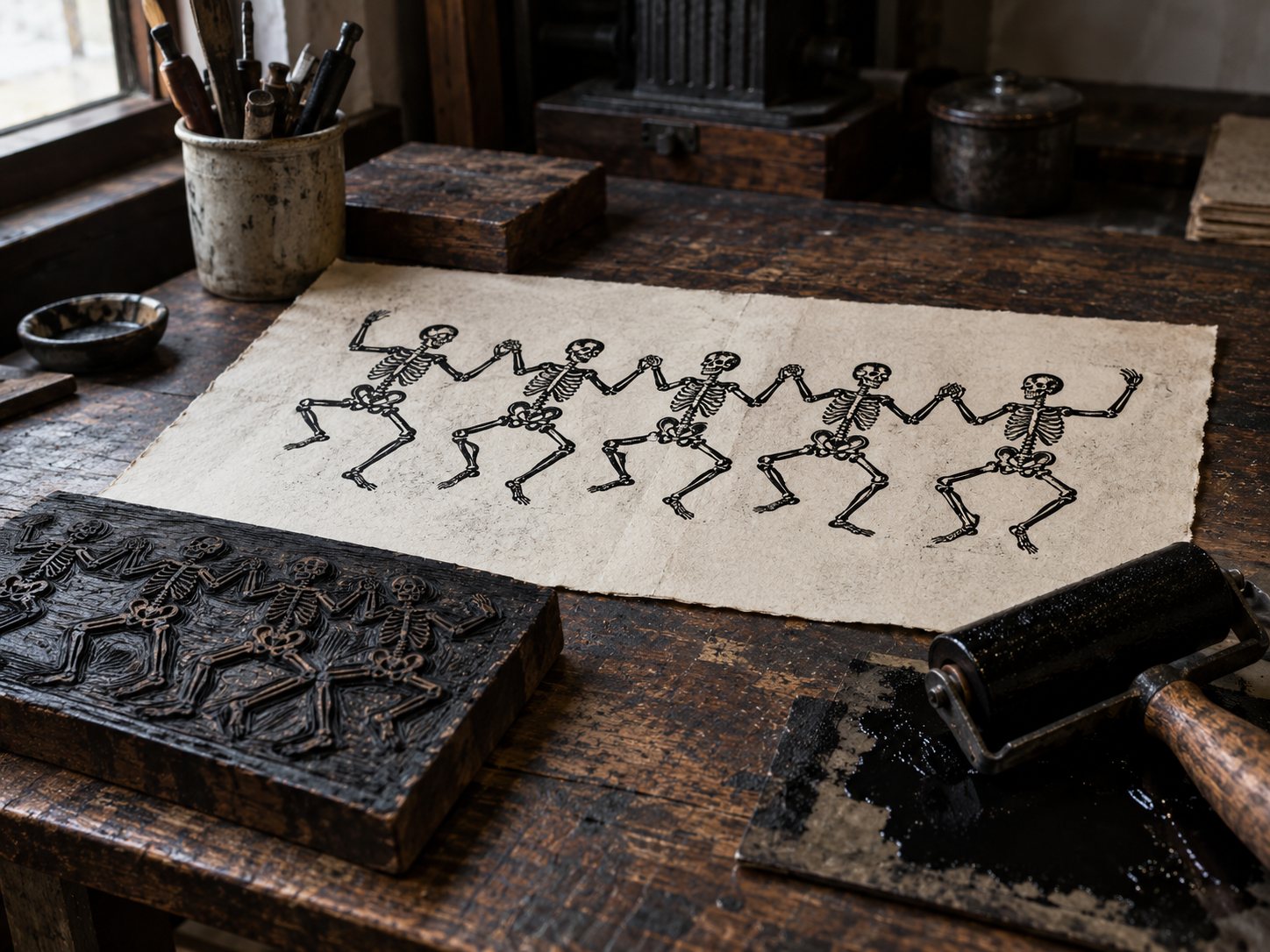
So, what do skeletons symbolize? Mortality, the fragility of life and the idea that death reaches everyone alike. On a Halloween porch, that older message is usually simplified into something spooky and playful, though you can still see a trace of the original: the skeleton does not care who you are. Time's history of Halloween skeletons covers the medieval roots in more detail.
Paper skeletons at American parties
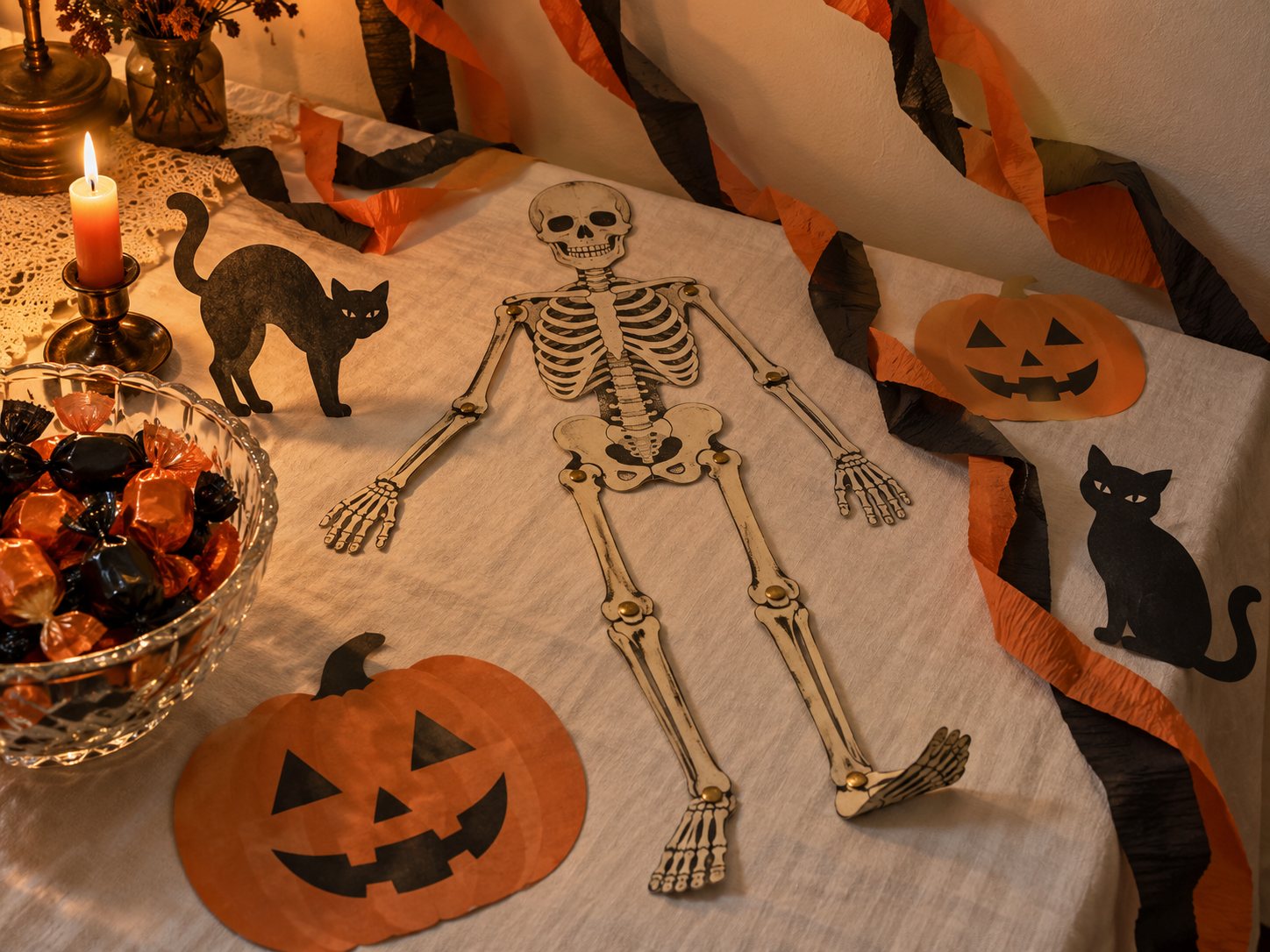
By the late nineteenth and early twentieth centuries, Halloween in the United States was increasingly built around parties, costumes and commercial decorations. Printed decorations made skeletons, witches, ghosts and other figures inexpensive and easy to repeat. The Beistle Company, founded in Pennsylvania in 1900, began making Halloween products in the 1920s after partnering with the Paper Novelty Company, and its line helped spread mass-produced paper decorations across the country. Beistle still lists Halloween cutouts and jointed figures today. The evidence supports Beistle's role in mass-produced Halloween decoration in general, and it does not point to one skeleton die-cut as the first.
A cartoon that taught skeletons to dance
Walt Disney's *The Skeleton Dance*, released on August 22, 1929, was the first *Silly Symphony* cartoon. D23 describes skeletons dancing in a cemetery at midnight and returning to their graves at dawn. It turned the skeleton from a still emblem of death into a comic, musical character, and the cemetery setting and midnight timing made it a natural fit for Halloween entertainment. A Utah State University memento mori exhibit names the film as a twentieth-century continuation of the dancing-skeleton motif, so the older Dance of Death was still at work, just with better music. Disney directed it himself, and the film's midnight cemetery has been a Halloween-season fixture ever since.
How the skeleton became a Halloween symbol
Tap or hover a step to follow the order.
Around November 1
Samhain marks the end of summer and the Celtic new year
Seventh or eighth century
All Saints' Day is placed on November 1, and the evening before becomes All Hallows' Eve
Sixteenth century
Guising is documented in Scotland and Ireland
1485
Guy Marchant publishes a printed Danse Macabre in Paris
1900
The Beistle Company is founded in Pennsylvania
1920s
Beistle's Halloween line spreads mass-produced paper decorations
August 22, 1929
Disney releases The Skeleton Dance
1957
Don Featherstone creates the outdoor pink flamingo blow mold
2020
Home Depot launches its 12-foot skeleton
2025
NRF projects $13.1 billion in U.S. Halloween spending
From blow molds to the 12-foot skeleton
Outdoor decorating took off as lightweight plastics, molded figures, lighting and mass retail made big seasonal displays practical. The Greenbelt Museum explains blow molding as melted plastic blown into a mold, which makes light, hollow shapes that can even be lit from inside. The first outdoor blow-mold lawn ornament was Don Featherstone's pink flamingo, created in 1957 for Union Products, and Halloween blow molds such as pumpkins, ghosts and witches followed. The museum evidence supports the shift from paper, indoor party decorations to lit, molded outdoor figures, and it does not name a first plastic skeleton.
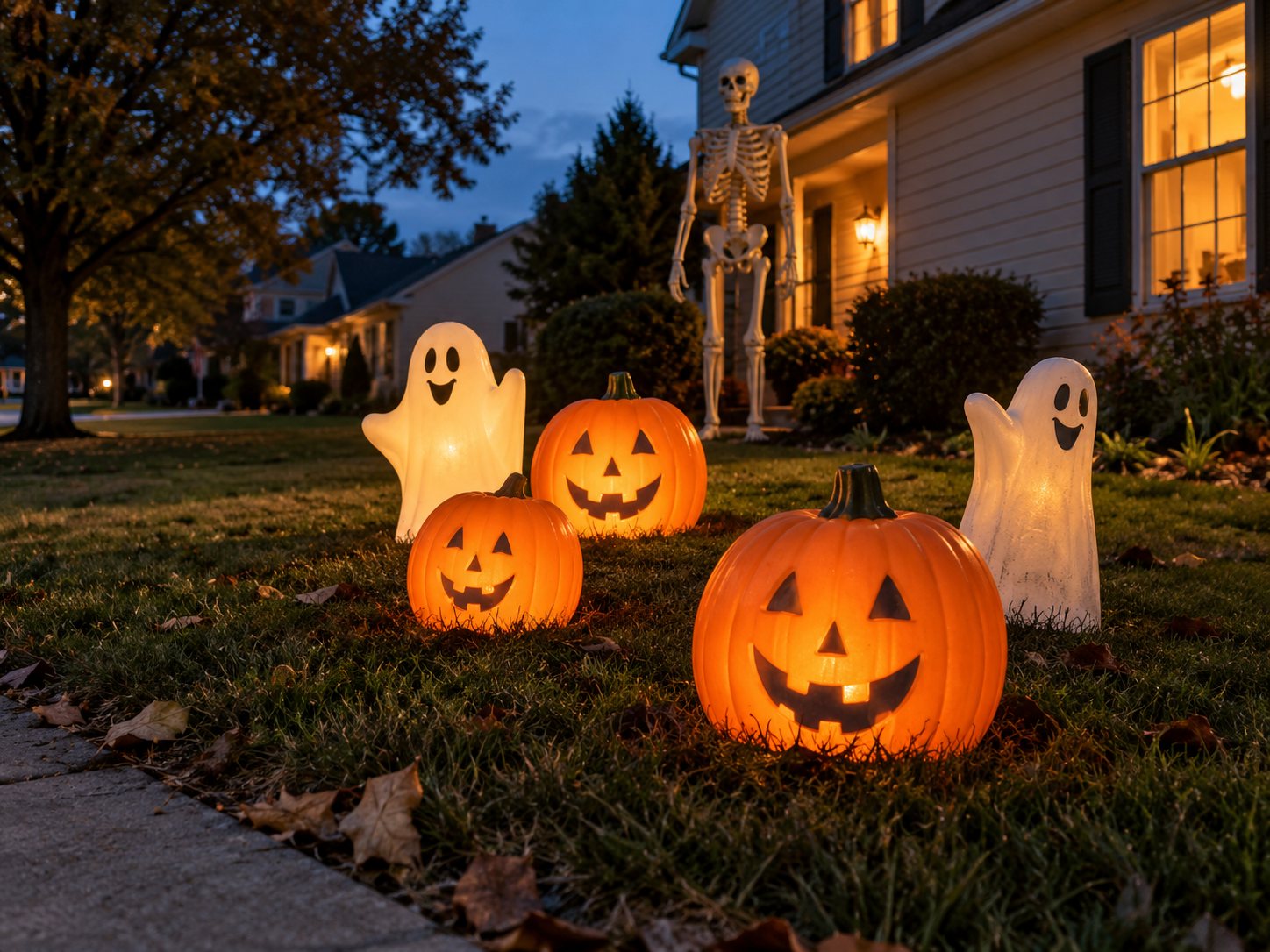
Then came 2020. Home Depot launched a 12-foot skeleton, and Home Depot merchant Lance Allen told the Associated Press that it was planned before the pandemic, though its release coincided with people decorating their homes for entertainment and community during lockdowns. It became known as "Skelly," and other retailers followed with oversized skeletons and inflatables. Google's 2025 Frightgeist report named the 12-foot skeleton as a continuing top decor search. That is why so many yards have one. The full story of that one product is in the 12-foot skeleton.
What Americans spend on it
The National Retail Federation's September 18, 2025 survey, run by Prosper Insights & Analytics, projected record U.S. Halloween spending of $13.1 billion. NRF reported that decorations were expected to exceed candy and named giant skeletons among the major decoration trends. In its survey, 78 percent of consumers planned to buy decorations and 51 percent planned to decorate their home or yard, and decoration spending was projected at $4.2 billion, compared with $3.9 billion for candy. Those are projections for 2025, and each year's survey gives its own numbers.
Tap or hover a row to highlight it.
| Measure | Projection |
|---|---|
| MeasureTotal Halloween spending | Projection$13.1 billion |
| MeasureDecorations | Projection$4.2 billion |
| MeasureCostumes | Projection$4.3 billion |
| MeasureCandy | Projection$3.9 billion |
| MeasureConsumers buying decorations | Projection78% |
| MeasureConsumers decorating home or yard | Projection51% |
| MeasureConsumers celebrating Halloween | Projection73% |
| MeasurePer-person spending | Projection$114.45 |
How to decorate with skeletons
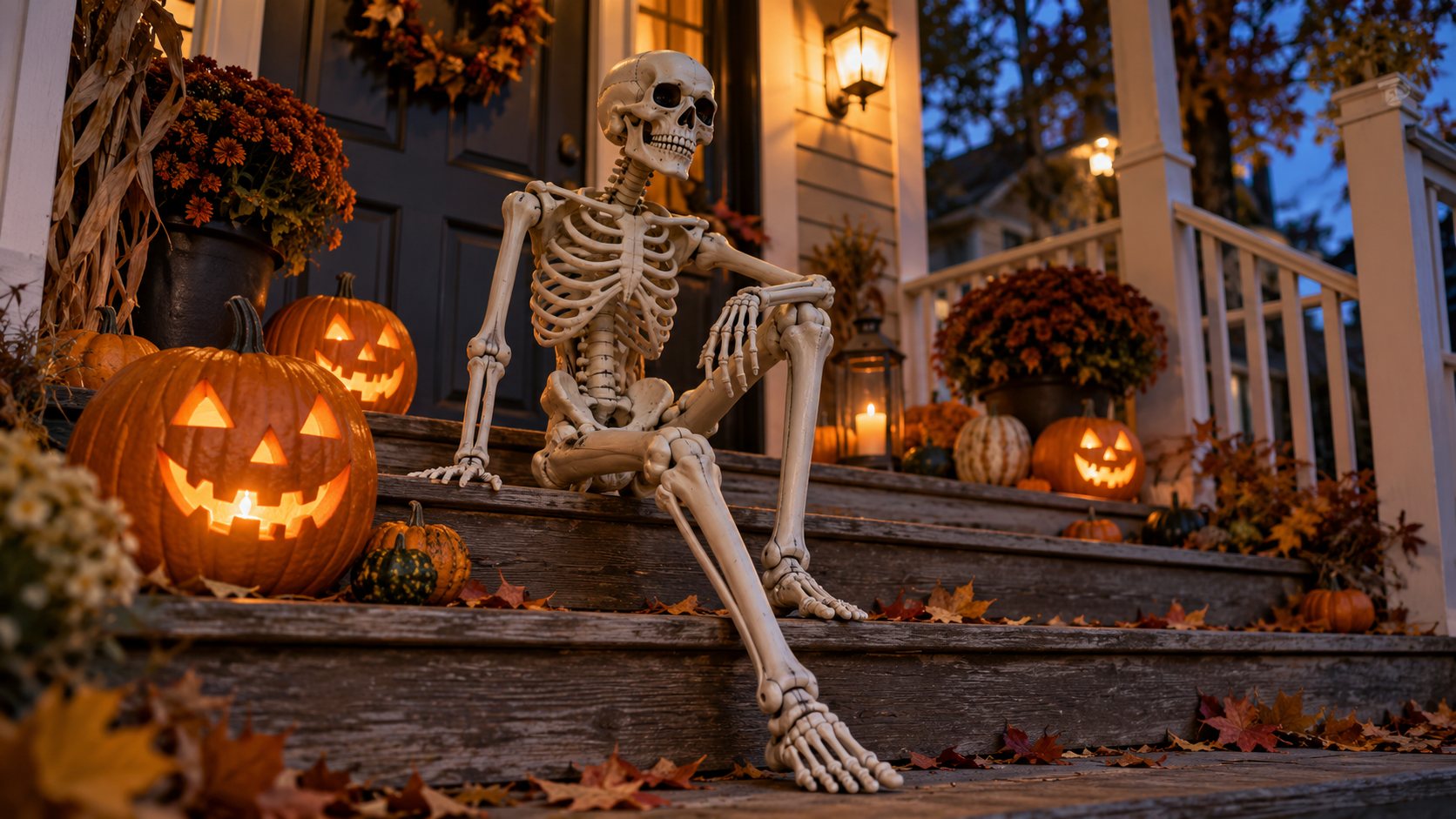
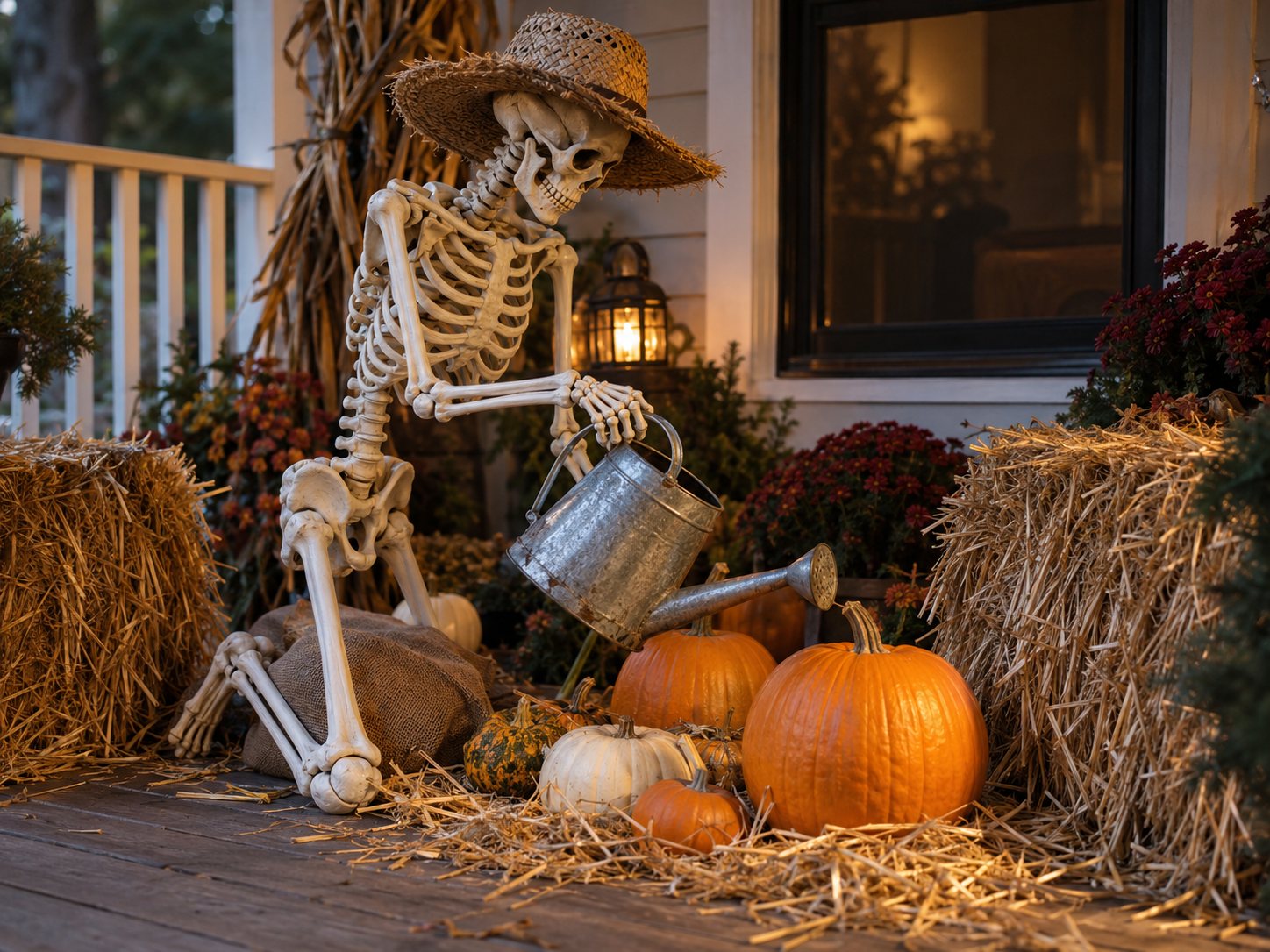
Give each skeleton a scene. One can sit on a porch, climb a doorway, tend a pumpkin patch or lurk among tombstones and autumn leaves. A reliable arrangement pairs one main skeleton with smaller bones, pumpkins, black and orange accents, low lighting and weather-safe supports. Posing several of them as a family, a band, a gardening crew or a party makes the display easy to read and fun to look at. Keep walkways clear, secure big props against wind and use outdoor electrical equipment safely. Skeletons doing something ordinary, such as gardening, suit the playful side of the symbol.
What is the scariest Halloween decoration ever made? There is no agreed answer, because fear depends on the viewer and the setting. Large animatronic figures, haunted-house sets and Skelly are among the best-known modern examples. Skelly's scale made it a cultural moment, but popularity is not proof that it is the scariest.
Skeletons in Día de Muertos
Skeletons and skulls also appear in Día de Muertos, a Mexican tradition with its own meaning, and the images overlap on the calendar because both fall in late October and early November. Día de Muertos is practiced by Mexican and Mexican American communities as remembrance of deceased relatives and friends. Common practices include ofrendas, photographs, favorite foods, candles, flowers and cemetery visits. Rocio Mejia, a Mexican American community organizer in Utah, told Axios it is "the largest celebration of life in Mexican culture."
In Xochimilco, in Mexico City, the AP documented families keeping cemetery rituals on November 1 and 2, with candles, cempasúchil flowers, food, music and storytelling. Antonio Meléndez spoke about preserving family traditions, and Ana Laura Anell Chávez described the celebration as a way to express love for the dead and pass traditions between generations. UNESCO inscribed the Indigenous festivity dedicated to the dead on its Intangible Cultural Heritage list in 2008. For the full account, see our guide to Día de Muertos.
Test your Halloween skeleton knowledge
Answer every question to check.
Quick answers about Halloween skeletons
What do skeletons represent during Halloween?
They stand for death, mortality and the nearness of the spirit world. European Dance of Death imagery gave Halloween its visual language, in which skeletons remind everyone that death comes for every social rank.
Why are skeletons a symbol of Halloween?
Halloween grew from Samhain and All Hallows' Eve traditions about the dead, and skeletons joined it through Dance of Death and memento mori prints, paper decorations and later cartoons and plastic figures. No single origin explains it.
Why are there giant skeletons in yards?
Home Depot launched a 12-foot skeleton in 2020, and it caught on as people decorated their homes during lockdowns. Other retailers followed with oversized skeletons and inflatables.
How do you decorate with skeletons for Halloween?
Give each skeleton a scene, such as a porch, a doorway or a pumpkin patch, and group a main skeleton with pumpkins, low lighting and smaller bones. Keep walkways clear and secure large props against wind.
Are skeletons from Samhain?
Skeletons were not documented as an original symbol of Samhain. Their look came largely through European Dance of Death and memento mori imagery.
Where to go next
Skeletons in costume, in art and on the lawn all connect to older stories. Read the full story of the 12-foot skeleton, the history of the danse macabre and what memento mori means, or see how cultures read the image in skull symbolism. If you like a skeleton crew of your own, our Garden Crew skull tee is one of the shirts in the shop.