

No. 005
The Danse Macabre: What the Medieval Dance of Death Is and Where It Came From
"Danse macabre" is French for Dance of Death. It names a late-medieval European image and story in which Death, or a troop of animated corpses, leads people of every rank toward the grave, from the pope to the peasant to the child. It is a memento mori, a warning that status and wealth do not hold death off. Most people meet the phrase somewhere else first: in Camille Saint-Saëns's 1874 music, in a Holbein woodcut of a skeleton leading a bishop away, or in a Halloween playlist. The same idea also goes by *danza macabra* in Italian and Spanish, *Totentanz* in German and *Dodendans* in Dutch.
What the images showed
The standard layout was a procession, or a series of encounters, between the living and skeletons or corpses. The living figures usually stood for social ranks in descending order: pope or emperor first, then kings, bishops, nobles, merchants, doctors, lawyers, peasants, children and the poor. Viewers recognized each one by clothing, objects and office, so the claim that death treats everyone alike depended on showing how unequal life was. Early examples could also work as satire, aimed at vanity, greed and corrupt authority.
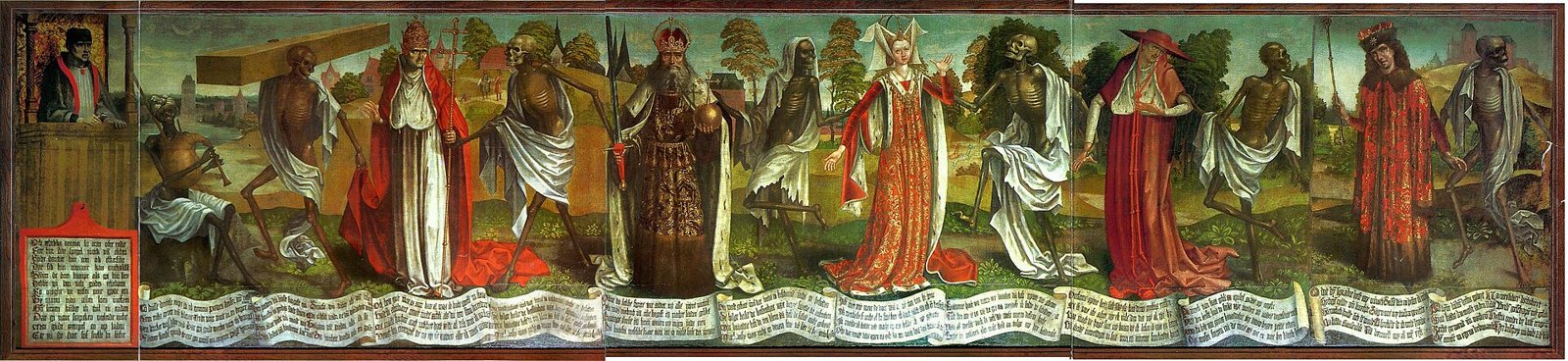
The surviving Tallinn fragment makes the sequence concrete. It opens with a preacher, then Death carrying a coffin and playing a bagpipe, then the pope, emperor, empress, cardinal and king. A Low German verse dialogue runs beneath the figures.
The first big one: Paris, 1424 to 1425
The earliest documented monumental example is usually said to be a mural at the Cimetière des Innocents in Paris, finished in 1424 or 1424 to 1425. It stood in a public cemetery lined with charnel houses and came with verses. It is lost now, but it became a model for later versions and for Guyot Marchant's printed adaptation of 1485. Paris Musées holds records of it, including an Albert Fernique photograph and an anonymous drawing, both marked CC0. The phrase itself appears earlier in writing: Jehan le Fèvre used "macabre la dance" in *Le respit de la mort* in 1376.
Lübeck and Bernt Notke
At St. Mary's Church in Lübeck, Bernt Notke painted a Dance of Death in 1463, explicitly modeled on the Paris example. The church says it was made for a confessional chapel at a time when plague was expected to reach the city. The original was lost, and a copy made in 1701 was destroyed in 1942, so Lübeck is a place to learn the history, not to see the painting.
Why people painted it, and the Black Death question
Artists painted the Dance of Death to remind viewers that death could take anyone and to encourage moral preparation for it. The theme suited churches, cemeteries and devotional spaces because it joined religious teaching to a memorable procession of social types. War, famine, recurring epidemics and high mortality formed the setting.
Plague is part of that setting, but the exact link is debated. Oxford Bibliographies describes the theme as probably developing in the fourteenth century from moral teaching combined with estates satire. The Paris mural dates to about 1424 to 1425, decades after the main Black Death outbreaks of 1348 to 1350, so it is not simply a direct response to those years. Scholars continue to discuss how directly plague experience shaped the genre.
Where to see a danse macabre today
Several medieval examples survive, and each has its own character.
- Tallinn, Estonia: The Niguliste Museum, in St. Nicholas' Church, keeps the opening section of a late-fifteenth-century Dance of Death from the workshop of Bernt Notke. It is painted on canvas, about seven and a half meters long, with thirteen figures. The museum describes it as the only surviving medieval Dance of Death painting on canvas.
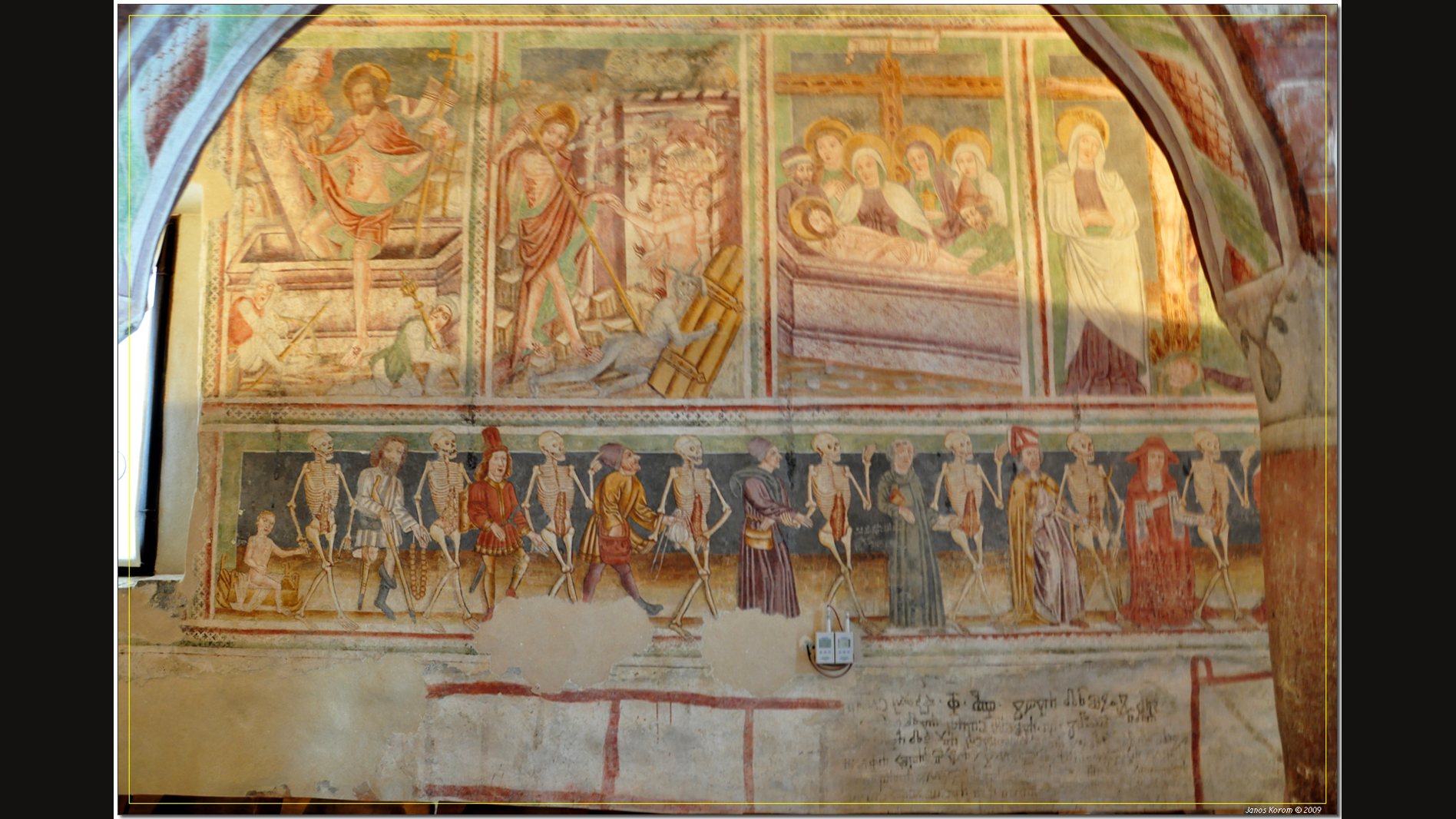
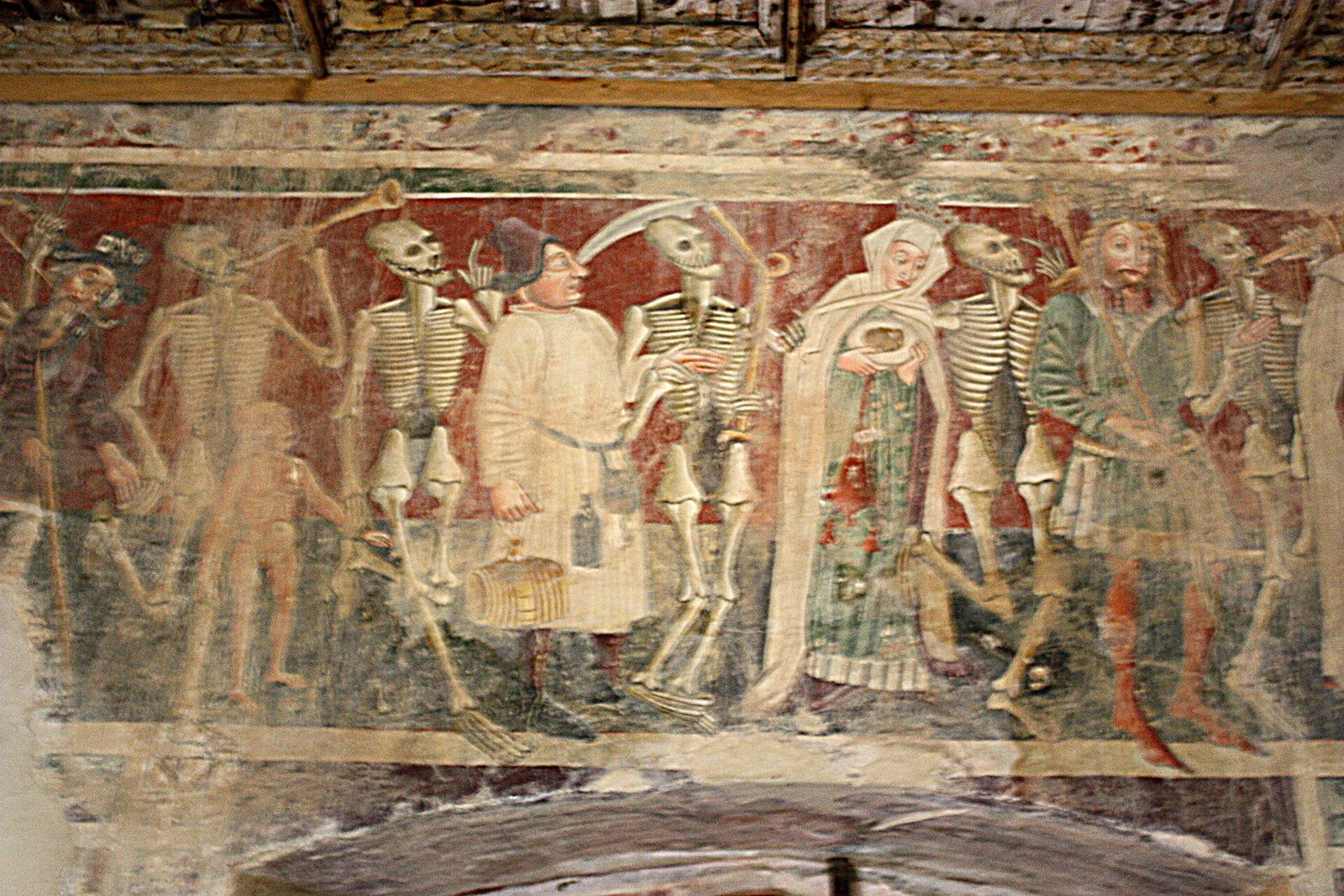
- Beram, Croatia: The Church of St. Mary on Škriljinah has a Dance of Death fresco finished in 1474 by the workshop of Vincent of Kastav. It is part of one of Istria's best-known fresco cycles.
- Hrastovlje, Slovenia: The Church of the Holy Trinity has a Dance of Death fresco painted in 1490 by Johannes de Castua, also called Janez iz Kastva, within a larger cycle of Gothic frescoes.
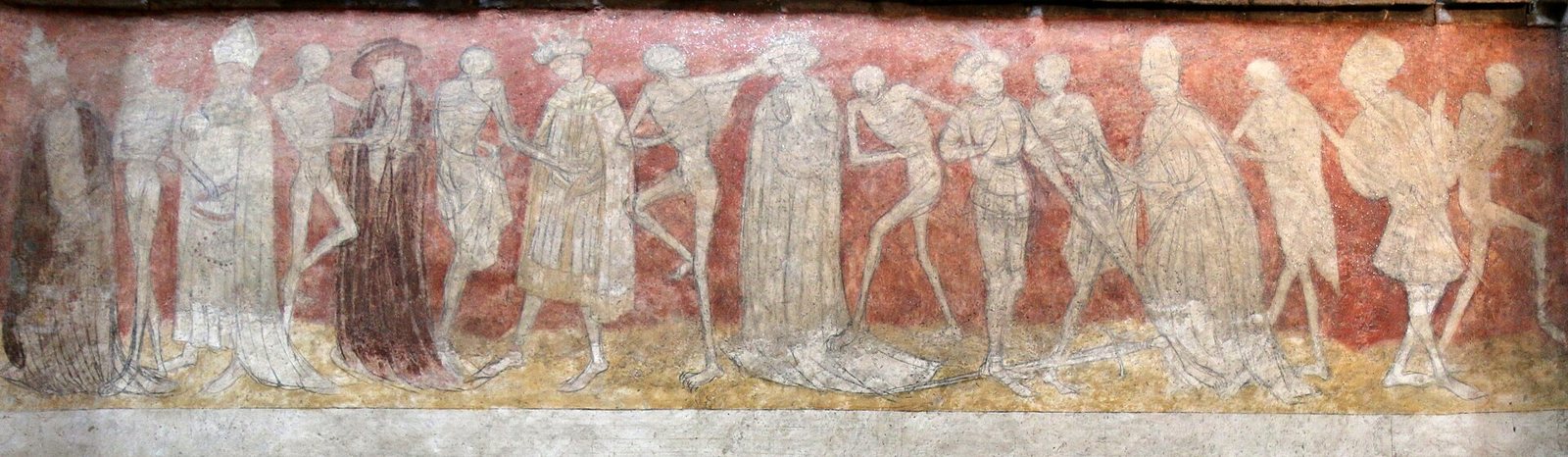
- La Chaise-Dieu, France: The abbey church preserves a fifteenth-century mural in which living figures alternate with partly decayed "transi" corpses, rather than clean skeletons.
- Clusone, Italy: The Oratorio dei Disciplini has a 1485 fresco by Giacomo Borlone de Buschis that joins the Dance of Death to the Triumph of Death and the Meeting of the Three Living and the Three Dead.
Opening hours and access change, so confirm visiting details with each museum, abbey or church before you travel.
Tap or hover a row to highlight it.
| Place | Building | Date | Artist or workshop | Note |
|---|---|---|---|---|
| PlaceTallinn, Estonia | BuildingNiguliste Museum | DateLate fifteenth century | Artist or workshopNotke workshop | NotePainted on canvas |
| PlaceBeram, Croatia | BuildingChurch of St. Mary on Škriljinah | Date1474 | Artist or workshopVincent of Kastav workshop | NoteFresco |
| PlaceHrastovlje, Slovenia | BuildingChurch of the Holy Trinity | Date1490 | Artist or workshopJohannes de Castua | NoteFresco |
| PlaceLa Chaise-Dieu, France | BuildingAbbey church | DateFifteenth century | Artist or workshopAnonymous | NoteMural with transi corpses |
| PlaceClusone, Italy | BuildingOratorio dei Disciplini | Date1485 | Artist or workshopGiacomo Borlone de Buschis | NoteFresco |
| PlaceLübeck, Germany | BuildingSt. Mary's Church | Date1463 | Artist or workshopBernt Notke | NoteOriginal lost and 1701 copy destroyed in 1942, historic site only |
Holbein's woodcuts
The best-known printed version is Hans Holbein the Younger's *The Dance of Death*. He designed it around 1526, the German printmaker Hans Lützelburger cut the blocks, and it was first published in book form in Lyon in 1538. The Metropolitan Museum of Art lists it as a woodcut and holds individual sheets including *The Child*, *The Old Woman* and *Skeletons Making Music, or the Cemetery*, all marked Public Domain.
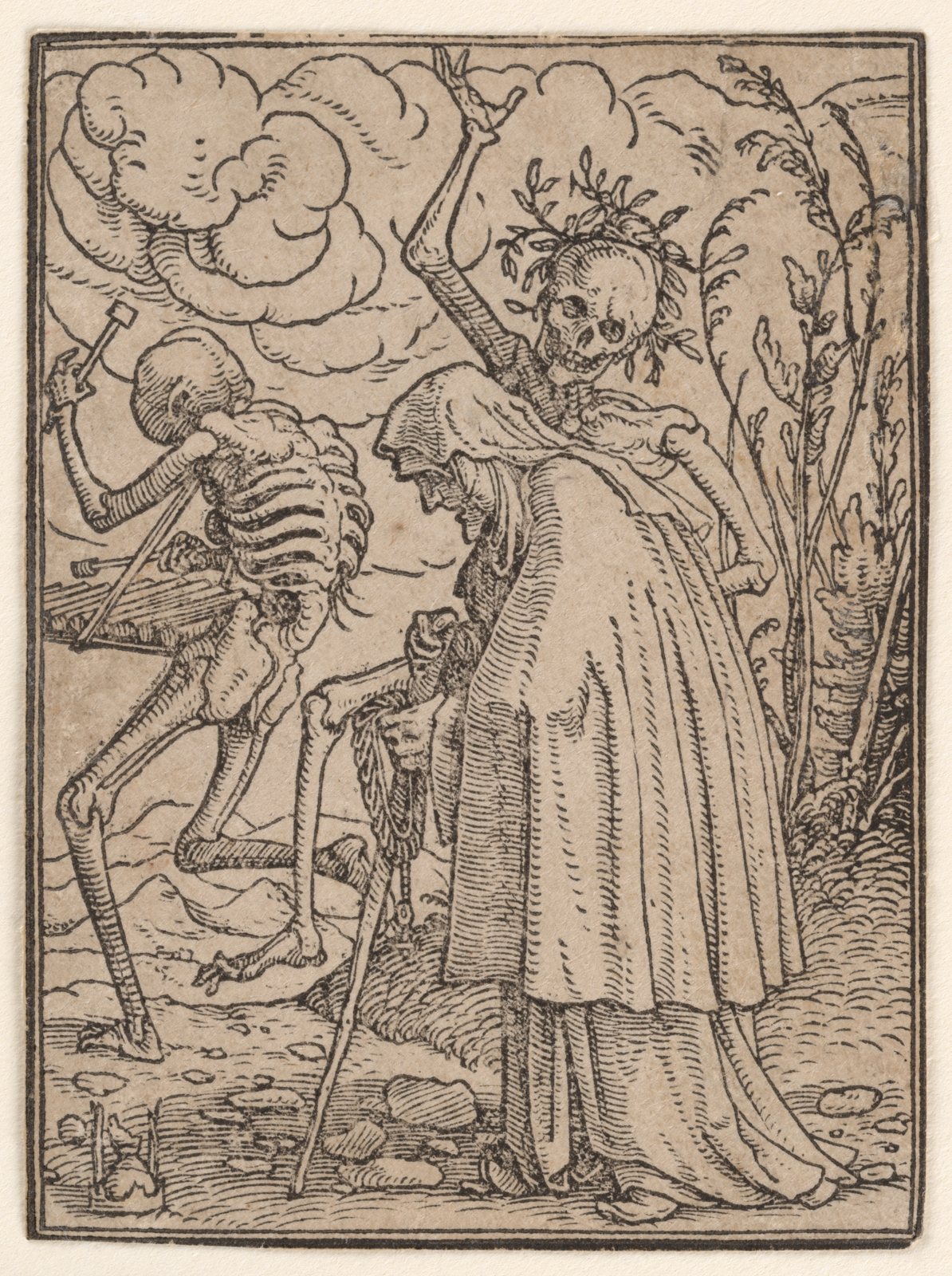
Holbein's scenes are small and sharp. Death interrupts ordinary life as an active intruder, even a trickster, among rulers, clergy, soldiers, merchants, judges, doctors, peasants, children and the elderly. Ulinka Rublack of the University of Cambridge reads the series as social commentary that mocks the hypocrisy of authority figures. The National Gallery of Art in Washington also holds Allaert Claesz's *Dance of Death* engravings of 1562, which show the motif continuing through the Renaissance. Holbein's famous skull in *The Ambassadors* has its own place in the story of famous skull art.
Saint-Saëns and the music
Saint-Saëns's *Danse macabre*, Op. 40, dates from 1874. It began as an art song for voice and piano on a French poem by Henri Cazalis, who wrote under the name Jean Lahor, and then became a tone poem for solo violin and orchestra. In the story it tells, Death tunes his violin at midnight, calls the dead from their graves and leads them in a grotesque dance until a rooster announces dawn. The solo violin is tuned unusually, and a xylophone's rattling figures suggest dancing bones.
Cazalis's poem and Saint-Saëns's performance instructions were printed with the 1875 score, according to the Morgan Library. Franz Liszt made a piano transcription, published in 1876, and the Library of Congress holds the first edition.
Afterlives in film and animation
Dudley Murphy's silent film *Danse Macabre* appeared in 1922 as a visual response to Saint-Saëns's music. Ingmar Bergman's *The Seventh Seal* (1957) ends with an image commonly described as a Dance of Death. That is a visual use of the medieval motif, not an adaptation of the score.
Walt Disney's *The Skeleton Dance* premiered on 22 August 1929 as the first in the studio's long-running series of music-led cartoons. Skeletons dance in a cemetery at midnight and return to their graves at dawn. The cartoon turned the procession into comedy and helped make skeleton dances a familiar Halloween sight. Later works often keep the skeletons, the midnight, the music and the movement without the medieval ranks. For the seasonal side, see skeletons and Halloween.
The Dance of Death, 1376 to 1929
Tap or hover a step to follow the order.
1376
Jehan le Fèvre uses "macabre la dance".
1424 to 1425
Paris mural at the Cimetière des Innocents.
1463
Notke's Lübeck Dance of Death.
1474
Beram fresco.
1485
Clusone fresco and Guyot Marchant's printed Paris adaptation.
1490
Hrastovlje fresco.
About 1526
Holbein designs The Dance of Death.
1538
First book publication of Holbein's series, in Lyon.
1562
Allaert Claesz's engravings.
1874
Saint-Saëns's Danse macabre, Op. 40.
22 August 1929
Disney's The Skeleton Dance.
Danse macabre quiz
Answer every question to check.
Quick answers about the danse macabre
What does danse macabre mean?
It is French for Dance of Death, a late-medieval allegory in which Death or the dead summon people of every rank toward the grave. It expresses how universal death is and how temporary status is. Its origins are still debated, but it spread widely through European art, writing and drama in the fifteenth century.
What is the story of Saint-Saëns's Danse macabre?
It is a tone poem from 1874 based on a poem by Henri Cazalis. At midnight Death tunes his violin and leads the dead in a dance until the rooster crows at dawn. Saint-Saëns first wrote it as a song, then rewrote it for solo violin and orchestra.
Where can you see a danse macabre painting today?
Surviving examples include the Niguliste Museum in Tallinn, the abbey church of La Chaise-Dieu in France, the Oratorio dei Disciplini in Clusone, Italy, and the frescoes at Beram in Croatia and Hrastovlje in Slovenia. Lübeck's original is lost.
Why did medieval people paint the dance of death?
They painted it to show that death can take anyone and to encourage moral preparation. Churches and cemeteries were natural homes for it. Epidemics and war formed the background, though historians do not treat the Black Death as a single proven origin.
Is the danse macabre about the Black Death?
Plague is part of its setting, but the earliest known Paris mural dates to about 1424 to 1425, decades after the main outbreaks of 1348 to 1350. Scholars debate how directly plague shaped the genre.
Where to go next
If the Dance of Death caught your attention, begin with what memento mori means, then see how the same thought turns up in painted still lifes in vanitas paintings. For the Halloween side of the story, read about skeletons and Halloween. If the memento mori idea is one you like to wear, our Memento Mori skull tee is a shirt for you.