
No. 090
Smilodon Skull: How the Saber-Toothed Cat's Teeth Worked
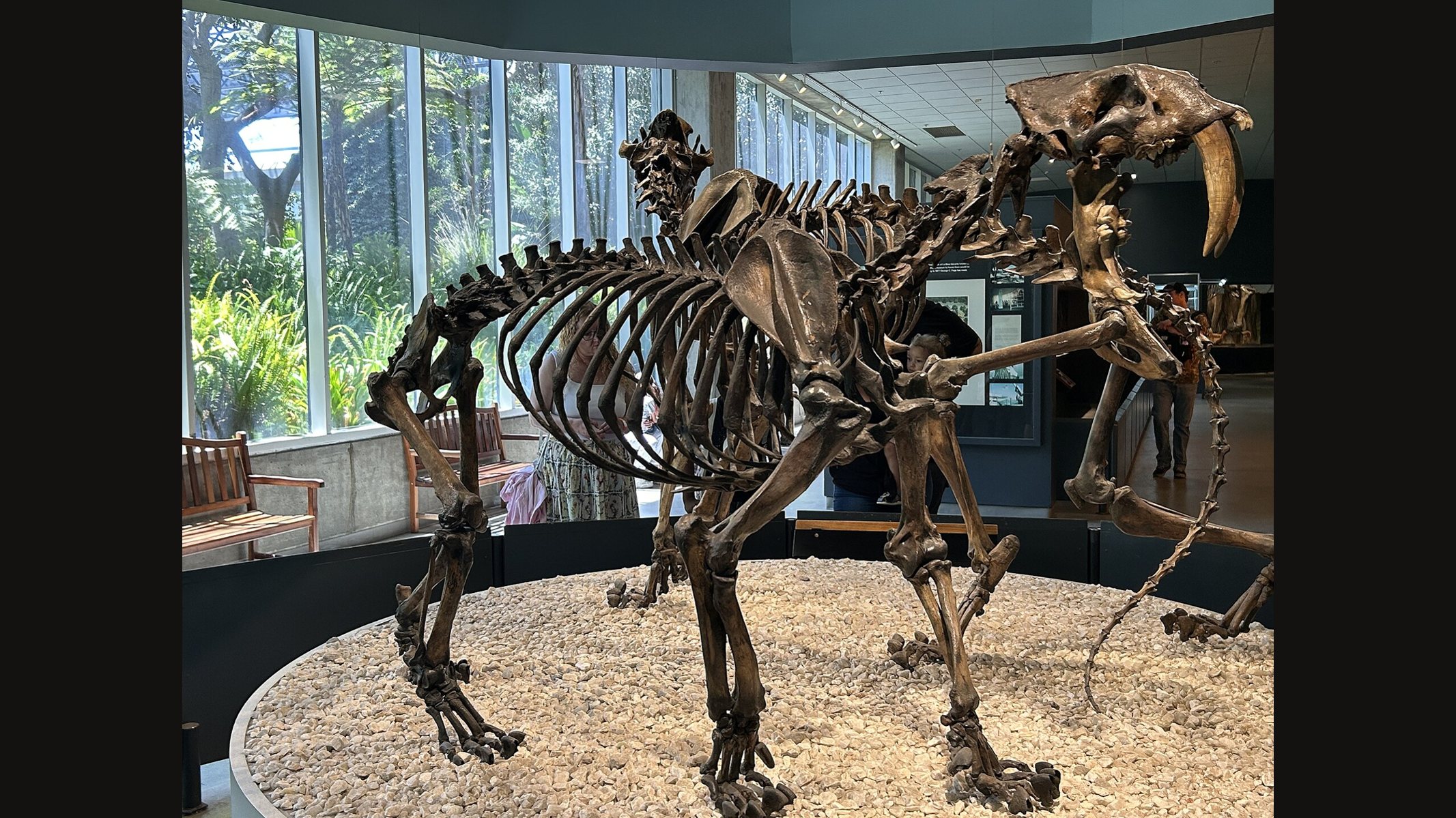
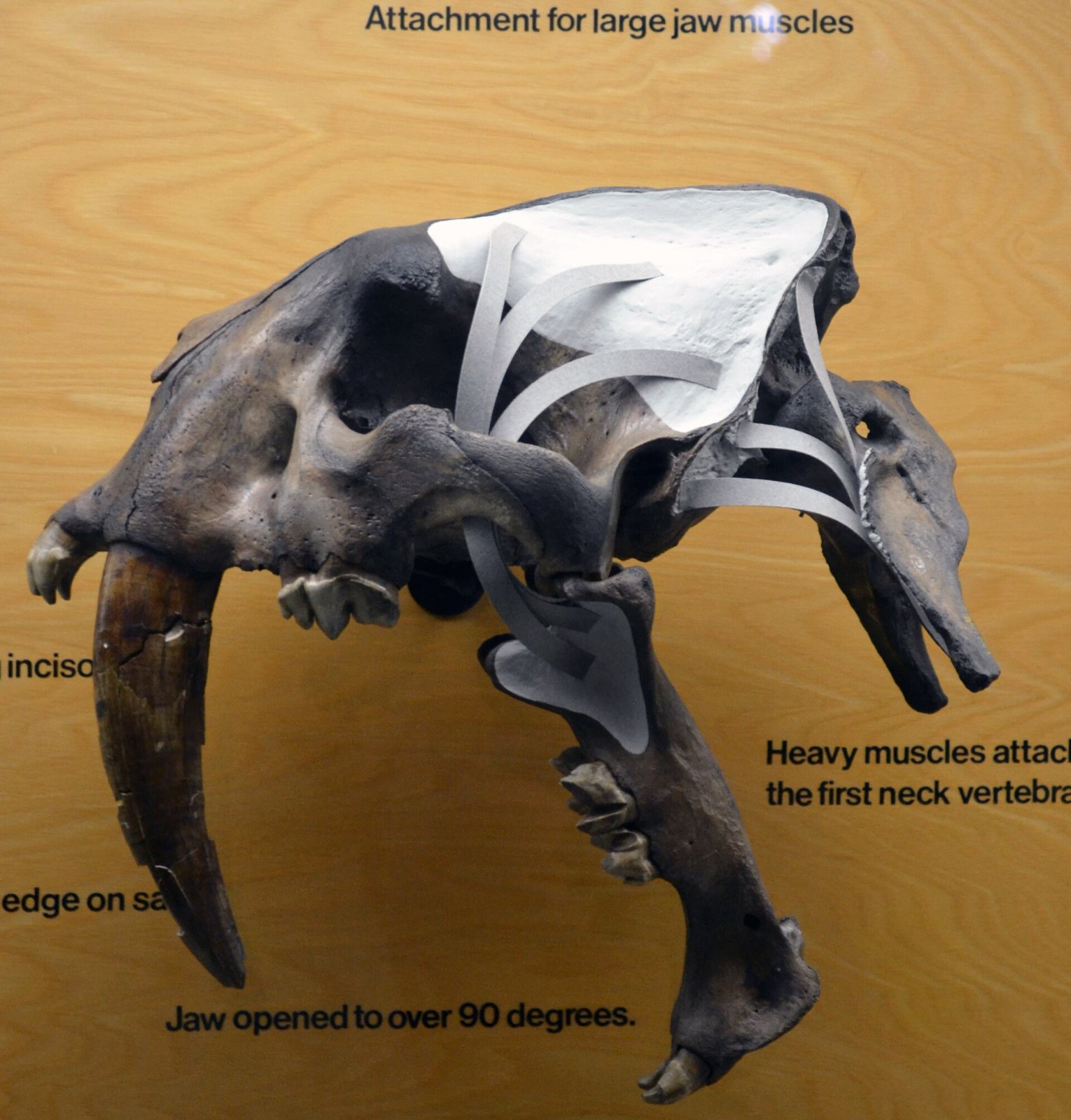
A *Smilodon* skull is short and deep, with two long, flattened upper canines shaped like knife blades and a jaw that could open to about 120 degrees, according to Dr. Emily Lindsey of the Natural History Museum of Los Angeles County. The leading explanation of how those teeth worked is a canine-shear bite. The cat held large prey with its powerful forelimbs, opened its mouth very wide, and drove the sabers into the soft tissue of the throat or neck, keeping them clear of bone because they could snap under sideways force.
That is the short answer to the question the display case raises. The exact killing motion is still debated, and the details of that debate are where the skull gets really interesting.
What you are looking at on a Smilodon skull
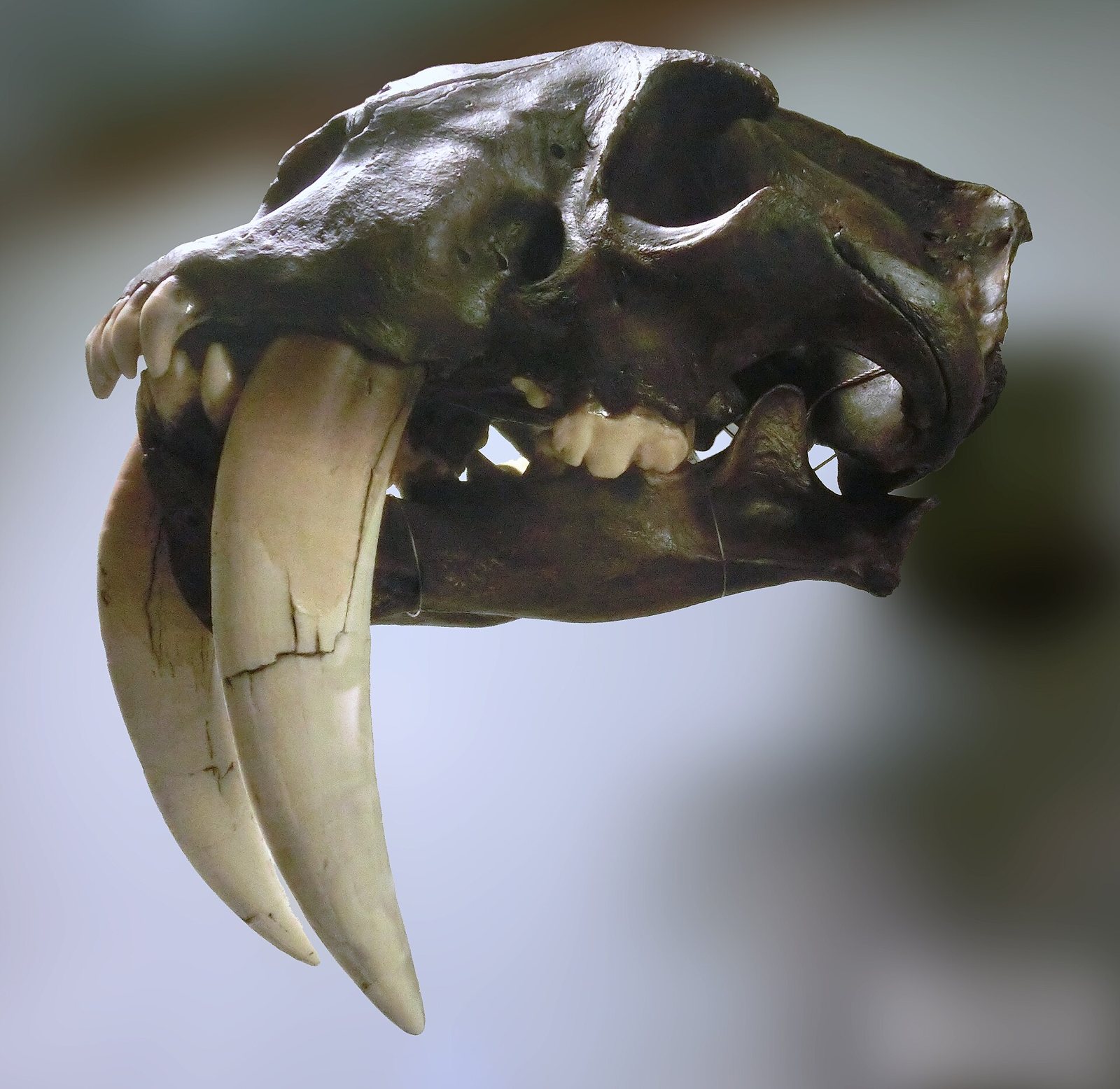
Stand in front of a saber-toothed cat skull and the canines take over the whole view. They hang well below the lower jaw, long and narrow, and flattened from side to side rather than round. The name fits: *Smilodon* means "knife tooth," a reference to those blade-like upper canines, as the Museums Victoria specimen record explains.
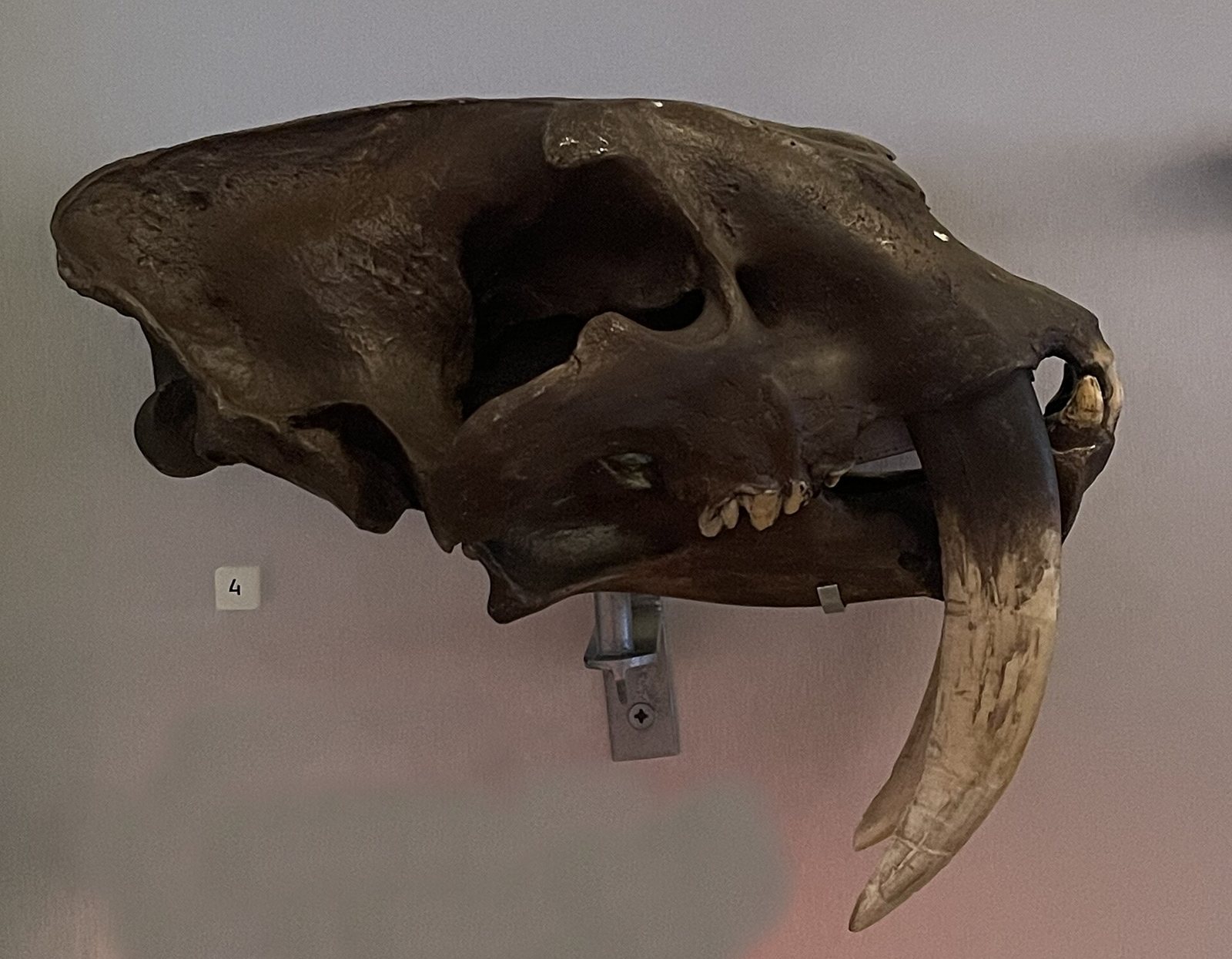
The rest of the skull is built around them. It is short and deep, with strong attachment areas for the cheek and neck muscles. The jaw hinge allowed a gape of roughly 120 degrees, which gave the long canines enough clearance to actually reach their target instead of simply getting in the way. The lower jaw and the front incisors helped control prey once the cat had hold of it.
Dr. Lindsey describes the canines as long and narrow, with a real risk of breakage. That one detail explains a great deal. A tooth that impressive and that fragile shapes how an animal hunts, and the skull shows a predator built for a specialized killing bite, not the ordinary clamp-and-hold bite of a lion or a mountain lion (Natural History Museum of Los Angeles County; La Brea Tar Pits, "Our Research").
How the saber bite worked
The La Brea Tar Pits research team puts the question plainly: how did saber-toothed cats use their canines? The answer most scientists favor runs in a sequence. First the cat restrained large prey with its heavily muscled forelimbs. Then it opened its jaws wide and drove the upper canines into relatively soft tissue around the throat or neck. The canines were poorly suited to sideways forces, so they probably were not used routinely to crush bone (La Brea Tar Pits, "Our Research").
Several named studies built up this account of the bite piece by piece. W. Akersten proposed a functional model for the canines in 1985. Paul Christiansen modeled bite force and canine bending strength in 2007, the same year a study in PNAS used 3D computer modeling of *Smilodon* (PNAS, "Supermodeled sabercat"). Andersson, Norman and Werdelin analyzed how saber-toothed carnivores killed large prey in 2011.
Agreement on the general idea has not settled the details. Studies still differ over how much work the jaw muscles did compared with the neck muscles, how much the forelimbs mattered, and exactly where the bite landed. So, the canine-shear bite after forelimb restraint is the leading interpretation, and the precise killing motion remains an open question.
Growing a saber without breaking it
University of California, Berkeley coverage of Jack Tseng's work asked a question any museum visitor might: "How did North America's saber-toothed cats hunt without breaking their unwieldy saber-like canines?" Part of the answer turned up in how young cats grew their teeth.
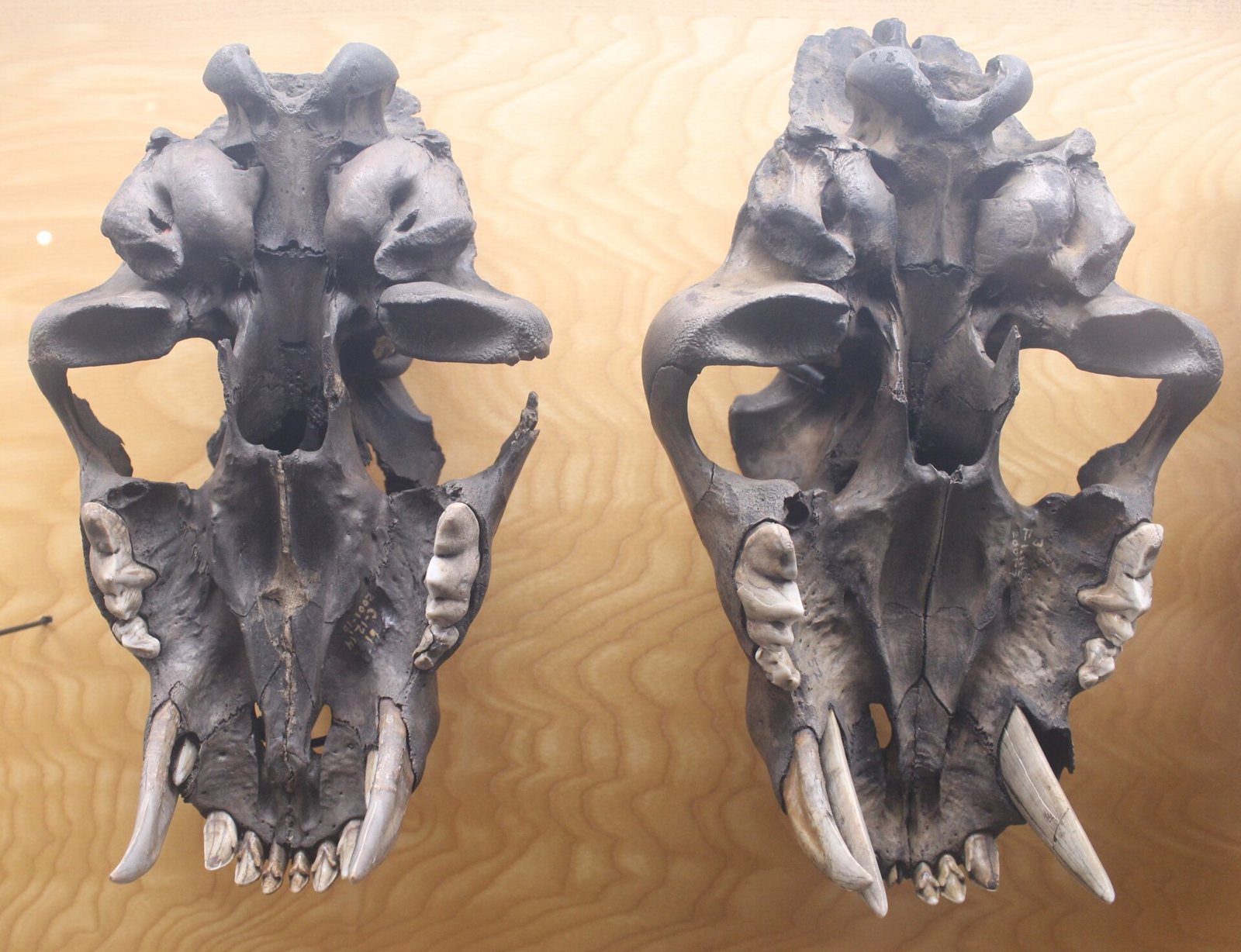
Tseng's 2024 work showed that an adolescent *Smilodon* could keep its milk canine in place beside the erupting permanent saber for up to 30 months. For more than two years, a young cat had two fangs on each side. Tseng interpreted the milk tooth as a support that stabilized the developing saber against sideways bending, the same weakness that shaped the adult bite (University of California, Berkeley).
It is a neat solution to a real engineering problem. A long, thin blade growing out of a young animal's jaw is most vulnerable before it is fully set, and the old tooth seems to have acted as a brace while the new one came in.
Smilodon skull vs a lion or mountain lion skull
Put a *Smilodon* skull beside a lion (*Panthera leo*) or a mountain lion (*Puma concolor*) and the differences line up quickly. *Smilodon* had proportionally longer upper canines, a much wider gape, a shorter and deeper face, and a skull shaped for large neck and forelimb muscles. The Natural History Museum of Los Angeles County puts its 120-degree gape at roughly twice the angle of most modern large cats (Natural History Museum of Los Angeles County).
Living big cats have shorter, conical canines designed for gripping. They use a clamp-and-hold bite and lean more on the force of their jaw muscles. *Smilodon* specialized in positioning long, blade-like canines exactly where they would work, which is a different job entirely (U.S. National Park Service, "The Big Cats"). If you want to see the living comparison up close, our guide to the mountain lion skull walks through a living North American cat, and cat skull identification covers the smallest member of the family.
Tap or hover a row to highlight it.
| Feature | Smilodon | Modern lion or mountain lion |
|---|---|---|
| FeatureScientific group | SmilodonExtinct felid, Machairodontinae | Modern lion or mountain lionLiving felids |
| FeatureUpper canines | SmilodonLong, laterally flattened, blade-like | Modern lion or mountain lionShorter, more conical |
| FeatureMaximum gape | SmilodonAbout 120 degrees, per Dr. Emily Lindsey | Modern lion or mountain lionAbout half that angle, in the comparison cited by the Natural History Museum of Los Angeles County |
| FeatureLikely killing action | SmilodonControlled canine-shear bite after prey restraint | Modern lion or mountain lionClamp-and-hold bite |
| FeatureSpecies | SmilodonSmilodon gracilis, S. fatalis, S. populator | Modern lion or mountain lionLiving species such as Panthera leo and Puma concolor |
Saber-toothed cat or saber-toothed tiger?
*Smilodon* was a saber-toothed cat, a felid in the extinct subfamily Machairodontinae. "Saber-toothed tiger" is a popular nickname that describes the look of the animal rather than its family tree. It was not closely related to the modern tiger (*Panthera tigris*) and was not its ancestor (U.S. National Park Service; Natural History Museum of Los Angeles County, "Saber-toothed Cats").
The genus included at least three commonly recognized species. *Smilodon gracilis* was the older and smaller one; the U.S. National Park Service dates it to about 2.5 million years ago. *Smilodon fatalis* is the North American species, the one found at La Brea. *Smilodon populator* was the larger South American species. According to the Park Service, the genus crossed the Isthmus of Panama roughly 2 million years ago, after which the North and South American forms went their separate ways.
How big was a Smilodon skull?
Skull size depended on the species and the individual, so there is no single length that fits every *Smilodon*. The best-documented big example comes from Uruguay. In 2020, Manzuetti and colleagues described a particularly large *Smilodon populator* skull from the Dolores Formation that measured about 39.2 centimeters, or 15.4 inches, long. The specimen dates to the late Pleistocene to early Holocene (Manzuetti et al., "An extremely large saber-tooth cat skull from Uruguay").
That skull is a standout, not an average. Skulls of the smaller *S. gracilis* and of typical *S. fatalis* were shorter, so a cast on a museum shelf may well be noticeably smaller than the Uruguay giant.
The saber-toothed cats of the La Brea Tar Pits
If the skull you saw was in Los Angeles, you were standing near one of the most important *Smilodon fatalis* collections in the world. More than 2,000 saber-toothed cats, represented by more than 160,000 bones, have come out of the asphalt deposits at La Brea (Museums Victoria; La Brea Tar Pits, "Saber-toothed Cats"). The La Brea Tar Pits and Museum identifies *Smilodon fatalis* as the first confirmed fossil found at the site.
The La Brea fossils date mainly to the late Pleistocene. The collection holds skulls, jaws, teeth and limb bones, and some specimens carry the marks of a hard life: injuries, worn teeth, broken teeth and disease. Bones like these are how scientists piece together the lives of individual animals, a subject we cover more broadly in what bones tell archaeologists.
La Brea is not the only place with a *Smilodon fatalis* on record. The Smithsonian holds a specimen collected in Bee County, Texas, in 1949 by George Klett (Smithsonian Institution). Displays change, so check with each museum about what is on view before you plan a visit.
Smilodon through time
Tap or hover a step to follow the order.
About 2.5 million years ago
Smilodon gracilis lived in North America.
Roughly 2 million years ago
Smilodon crossed the Isthmus of Panama, and North and South American forms followed.
Late Pleistocene
Smilodon fatalis lived across North America, including Rancho La Brea in Los Angeles.
About 11,500 to 10,000 years ago
La Brea's saber-toothed cats disappeared near the end of the Pleistocene.
1949
George Klett collected a Smilodon fatalis specimen in Bee County, Texas, later cataloged by the Smithsonian.
2020
Manzuetti and colleagues described an exceptionally large Smilodon populator skull from Uruguay.
2024
Jack Tseng published evidence that young Smilodon kept a milk canine beside the growing saber for up to 30 months.
Real fossil or cast?
A sabertooth skull on display can be either a real fossil or a cast, and casts are common. The Smithsonian, for example, identifies one educational object as a cast made from a fossilized *Smilodon* skull found at La Brea (Smithsonian, saber-toothed cat educational object). Casts let many museums and classrooms show the same famous shape without risking the original bone.
A genuine fossil held by a museum has a catalog record that names its locality, its species and its collection history, like the Smithsonian's record for the Bee County specimen. If a label leaves you unsure, ask the museum staff which kind of object you are looking at and where the original is kept.
When and why Smilodon disappeared
*Smilodon* died out at the end of the last Ice Age and is known today only from fossils. At La Brea, the saber-toothed cats disappeared around 11,500 to 10,000 years ago, near the end of the Pleistocene (La Brea Tar Pits, "Saber-toothed Cats"). The U.S. National Park Service gives roughly 10,000 years ago for both the North American and the South American species.
The evidence points to a combination of pressures rather than one cause. Climate and vegetation changed, large prey and large herbivores declined, and human impacts grew. In southern California, museum research also discusses catastrophic fires. How much each factor mattered varied from place to place (U.S. National Park Service). For more on how fossils like these are given their ages, see how old are these bones.
How well do you know the Smilodon skull?
Answer every question to check.
Frequently asked questions
A few more questions about the saber-toothed cat, answered briefly.
Is there a saber-toothed tiger still alive?
No living *Smilodon* is known. The North and South American species disappeared roughly 10,000 years ago, and the fossil record places their last populations near the end of the Pleistocene and the start of the Holocene, according to the U.S. National Park Service.
What did the saber-toothed tiger's skull look like?
It was short and sturdy, with very long upper canines that were flattened from side to side like blades. The jaw could open to about 120 degrees, and the whole skull was specialized for hunting large mammals rather than for the grip-and-hold bite of a modern tiger.
Could Smilodon bite through armor or bone?
Probably not as a regular habit. Its canines were poorly suited to sideways force and were vulnerable to bending, so the leading interpretation is that it aimed them at soft tissue around the throat or neck and avoided driving them against bone (La Brea Tar Pits, "Our Research").
Where else can I see a Smilodon skull?
Beyond La Brea, the San Diego Natural History Museum has shown a *Smilodon fatalis* skull cast, the Smithsonian holds the 1949 Bee County, Texas, specimen, and Museums Victoria in Australia holds a *Smilodon* skull specimen in its collection. Check each museum's current displays before you go.
More fossil skulls to look at next
The saber-toothed cat shared the Ice Age with giants of its own. The mammoth skull shows how to tell those huge heads from an elephant's, and the Triceratops skull takes you much further back, to a frill and three horns. For another famous predator, read about SUE the T. rex skull, and for a living cat closer to home, the bobcat skull makes a good small-scale comparison.
Terms in this story
Tap a term to see what it means.
Smilodon. The genus of saber-toothed cats. The name means "knife tooth," after its blade-like upper canines.
---