

No. 263
Triceratops Skull: How Big It Is and What the Frill and Horns Were For
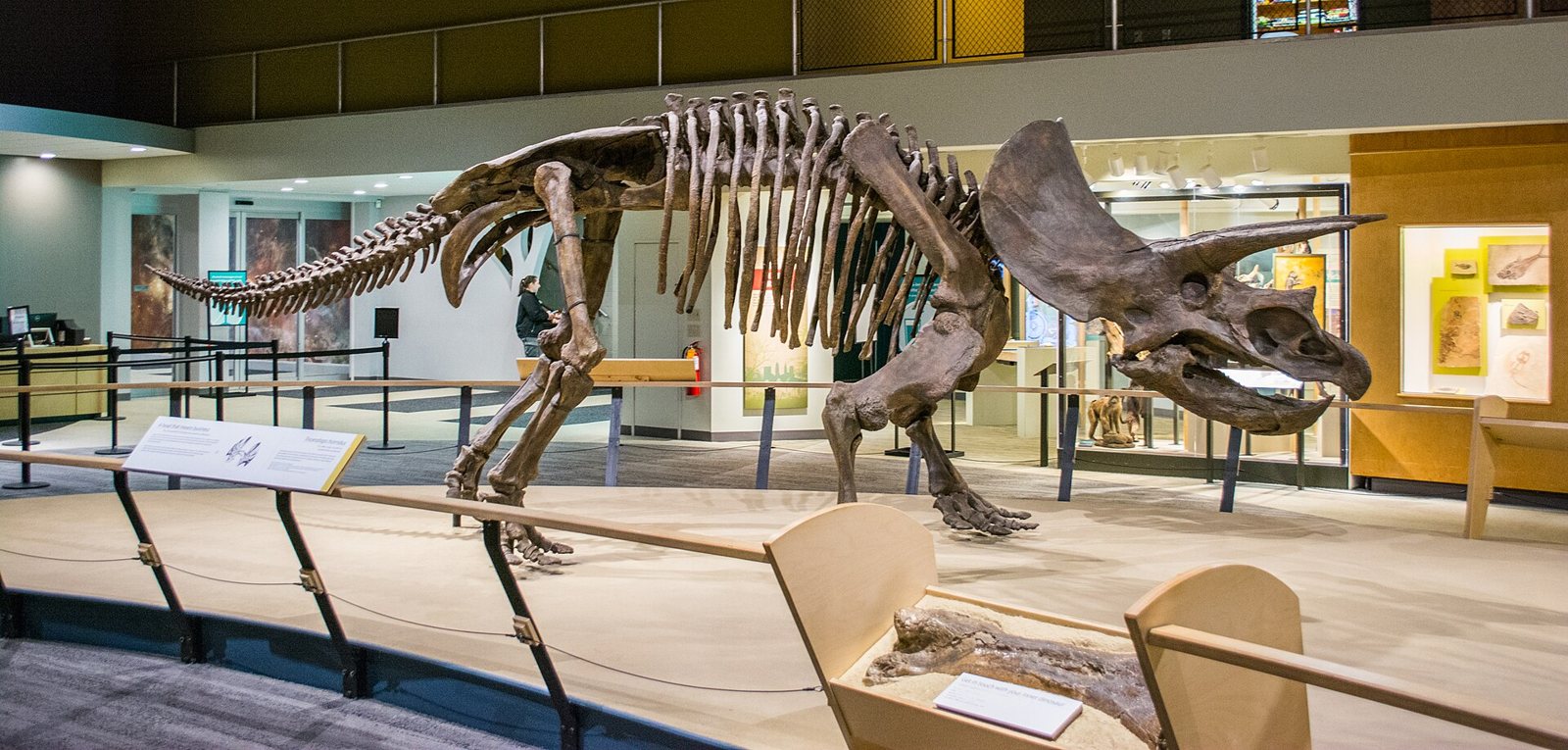
A big adult *Triceratops* skull is about 2 meters long, roughly 6.5 feet, frill included. The Natural History Museum, University of Oslo gives its *Triceratops prorsus* skull, known as "Roar," a length of about 2 meters, with brow horns about 1 meter long (Natural History Museum, University of Oslo). The Natural History Museum in London calls it one of the largest skulls of any land animal (Natural History Museum, London).
As for the frill and the three horns, scientists think they probably did several jobs at once: display, recognizing their own kind, defense against predators, and fights between rival *Triceratops*. The healed scars on real skulls are some of the best evidence, and they make for a good story.
What makes the Triceratops skull so big
There were two species, *Triceratops horridus* and *Triceratops prorsus*, and both carried a skull that was unusually large for the body behind it. The Natural History Museum in London describes the frill alone as nearly one meter across. The North Dakota Geological Survey reports that adult skulls were often at least 1.8 meters long, close to 6 feet (North Dakota Geological Survey). Oslo's Roar comes in at about 2 meters, and a skull catalogued by Sotheby's in 2021 measured 86 inches, or 218 centimeters.
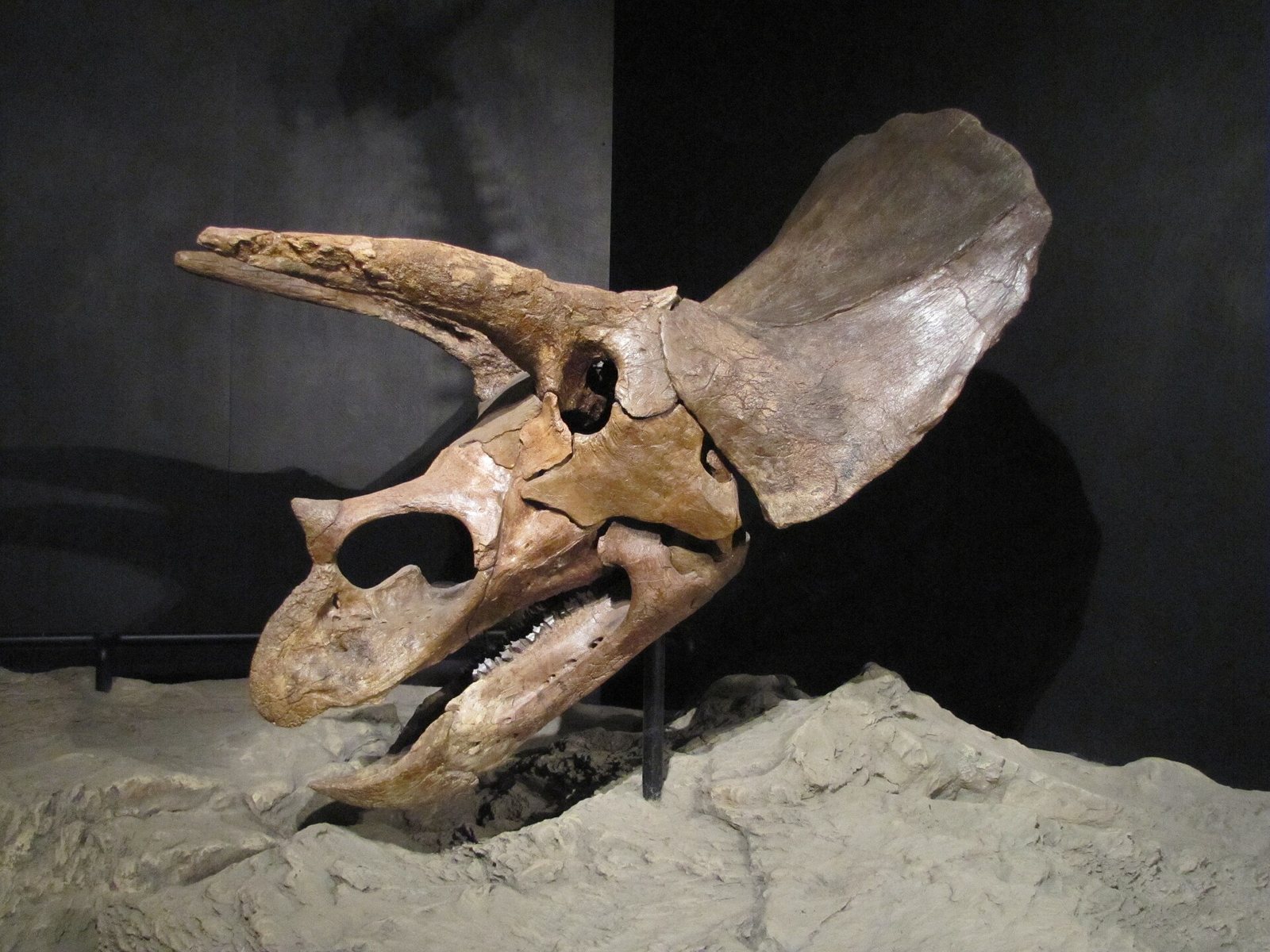
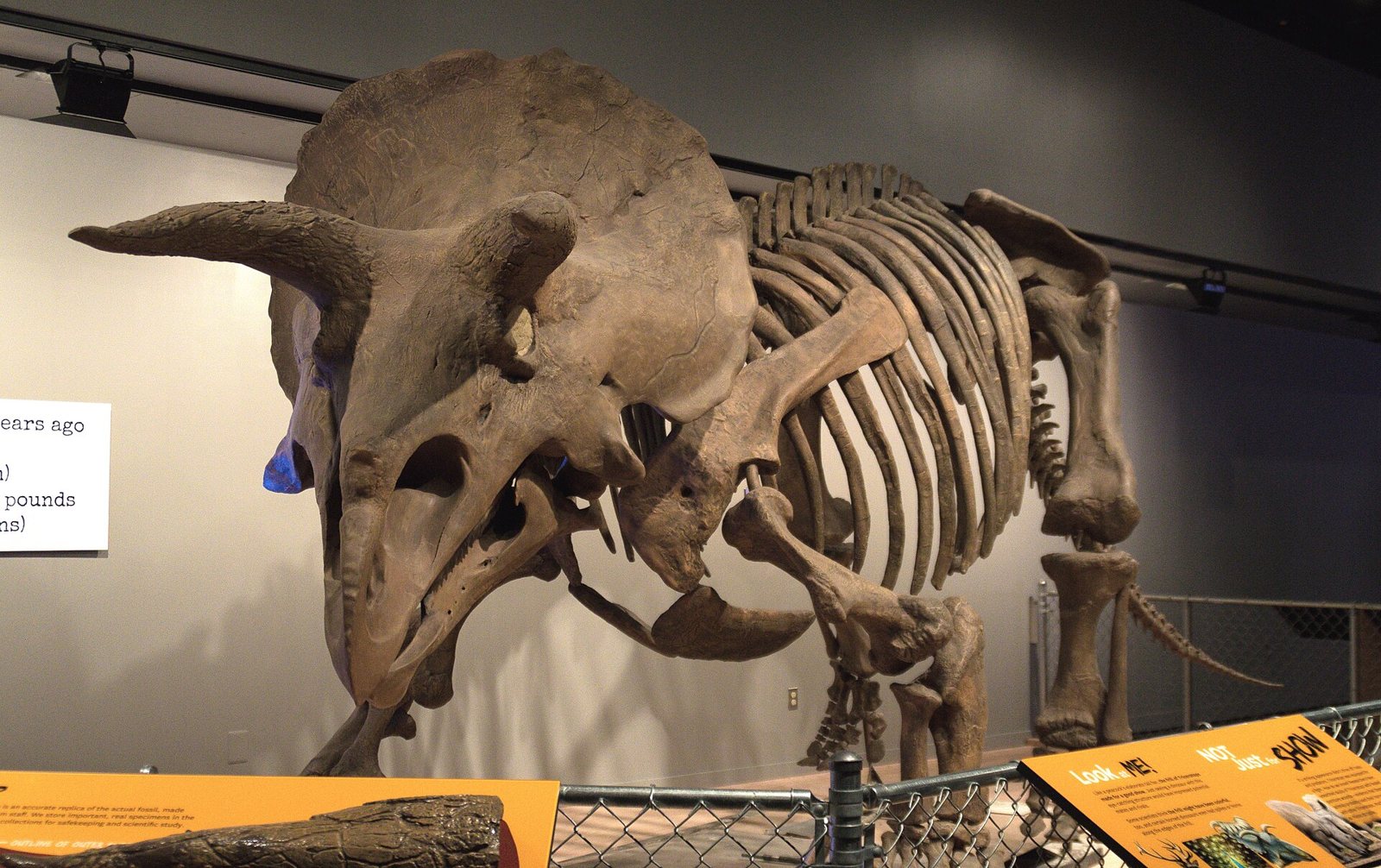
The size came from everything the skull had to carry. At the front was a deep beak backed by batteries of grinding teeth. Above the eyes sat two long brow horns, with a third, smaller horn on the nose, and behind it all spread a broad shield of bone, the frill. A head built like that needs a lot of skull.
Two notes help when you compare numbers. Measurements change from specimen to specimen and depend on whether the frill is included in the length. And while *Triceratops* skulls rank among the largest land-animal skulls, they do not hold the record on their own; the biggest claims usually belong to relatives such as *Pentaceratops* or *Titanoceratops*.
Skulls also matter more than usual for this animal. Complete *Triceratops* skeletons are uncommon, while skulls preserve the horns and frill that identify the species. That is why so many famous *Triceratops* specimens are, first and foremost, heads.
A walk around the skull
Start at the front, where the skull ends in a deep beak. Behind the beak, the jaws held rows of teeth packed tightly into batteries. Move up the face and you reach the short nasal horn, the smallest of the three.
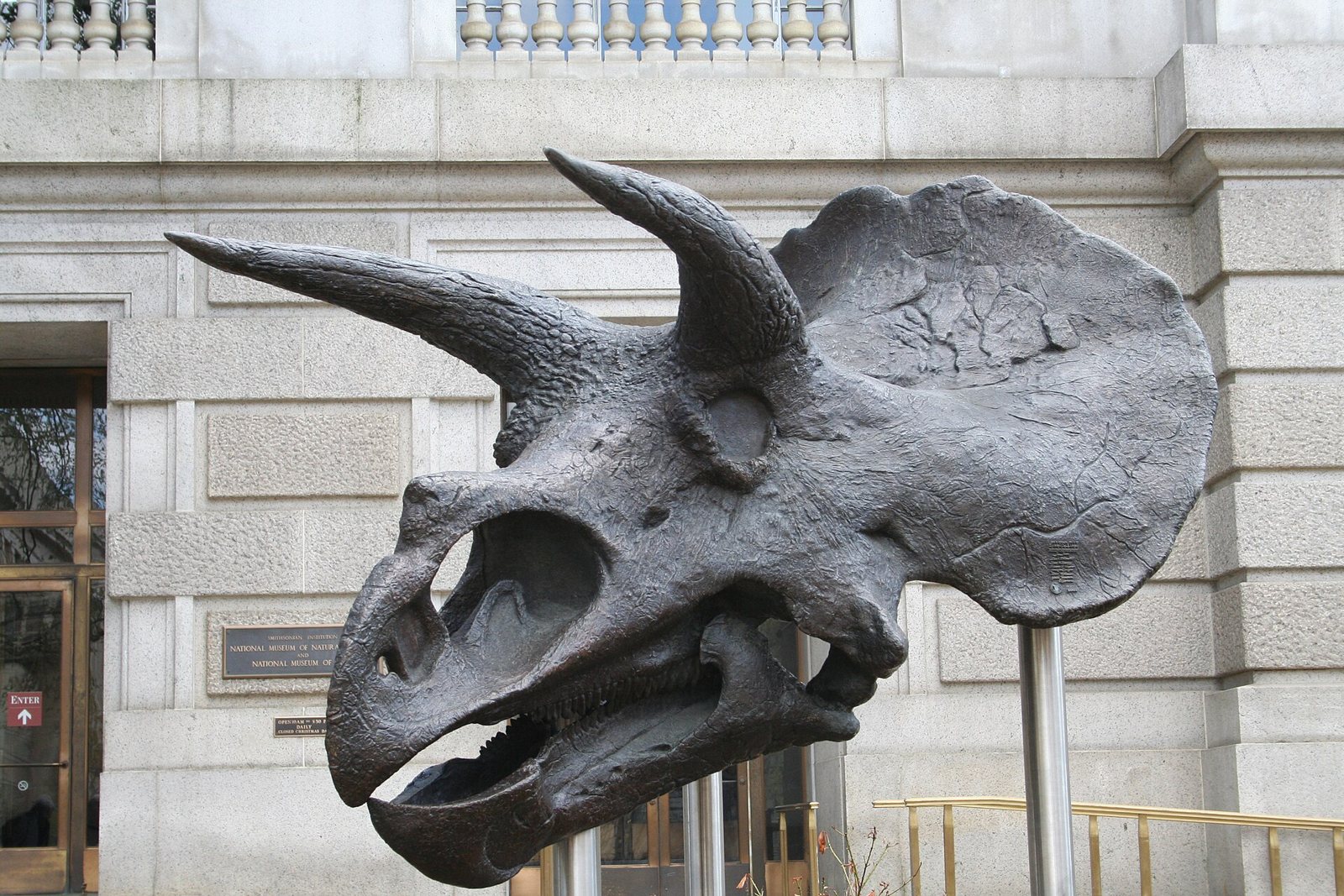
Above the eye sockets rise the two big brow horns. The American Museum of Natural History describes its displayed *Triceratops* with exactly this arrangement: two large brow horns and one smaller nasal horn (American Museum of Natural History). Then comes the frill, sweeping back over the neck. Part of the frill is made of the squamosal bones, which turn out to be important when scientists go looking for battle damage.
Tap or hover a row to highlight it.
| Subject | Detail |
|---|---|
| SubjectSkull size | DetailOslo's Roar skull is about 2 meters long |
| SubjectHorn arrangement | DetailTwo large brow horns and one smaller nasal horn |
| SubjectFrill function | DetailInjury pattern consistent with combat and protection (Farke, Wolff and Tanke, 2009) |
| SubjectGrowth debate | DetailScannella and Horner proposed in 2010 that Torosaurus was a mature Triceratops; Longrich and Field argued for separate genera in 2012 |
What were the frill and horns for?
The short answer is that they probably served several roles, and the evidence for each comes from different places.
The strongest case is for fighting. In 2009, Andrew Farke, Ewan Wolff and Darren Tanke studied healed and healing injuries on the skulls of *Triceratops* and its relative *Centrosaurus*. *Triceratops* had significantly more lesions on the squamosal bones of the frill than *Centrosaurus* did, a pattern consistent with horn-to-horn combat and with the frill acting as protection during those fights (Farke, Wolff and Tanke, PLOS ONE, 2009). Their result supports the idea of physical combat, though it cannot show exactly how two animals locked horns.
The Natural History Museum in London links puncture marks in frills to fights between *Triceratops*, possibly in competition for mates. It also reports a healed horn injury that matches a *Tyrannosaurus* bite, which supports a defensive role for the horns. The same museum lists visual display and species recognition as possible jobs for the frill, a big, distinctive shape being an easy way to tell your own kind from other species (Natural History Museum, London).
Other ideas remain open. In 1998, Bruce Barrick and colleagues proposed that the frill and horn cores helped with temperature control, a hypothesis rather than a settled explanation (Barrick, Showers and Fischer, 1998). A 2023 review by Ali Nabavizadeh sums up the leading possibilities as feeding mechanics, defense, fighting within the species, communication and species recognition (Nabavizadeh, 2023). No single answer covers it, and the frill may well have done several of these things at once.
Scars that tell the story
Some of the best evidence sits in plain view in museum halls. The *Triceratops* at the American Museum of Natural History in New York is roughly 65 million years old, and its skull carries a partially healed injury that may have come from a conflict with another *Triceratops* (American Museum of Natural History). The animal took the hit and lived long enough for the bone to start mending.
The healed horn injury described by the Natural History Museum in London tells a different story, one with a predator in it. A wound that matches a *Tyrannosaurus* bite, and that healed, means a *Triceratops* survived an encounter with a *Tyrannosaurus*. If that matchup interests you, the most famous *T. rex* head of all has its own story in SUE the T. rex skull. Reading old injuries like these is a whole field of its own, and our piece on what bones tell archaeologists covers how scars, wear and healing turn into evidence.
Torosaurus and the growth debate
*Torosaurus* is a horned dinosaur whose frill has large openings, or windows, through it. In 2010, John Scannella and John Horner argued in the Journal of Vertebrate Paleontology that *Torosaurus* was not a separate animal at all but a very mature growth stage of *Triceratops*. Their study looked at more than 50 *Triceratops* specimens, including more than 30 skulls from the Hell Creek Formation. They proposed that late in life the frill bones lengthened and openings developed, producing the form traditionally called *Torosaurus* (Scannella and Horner, 2010).
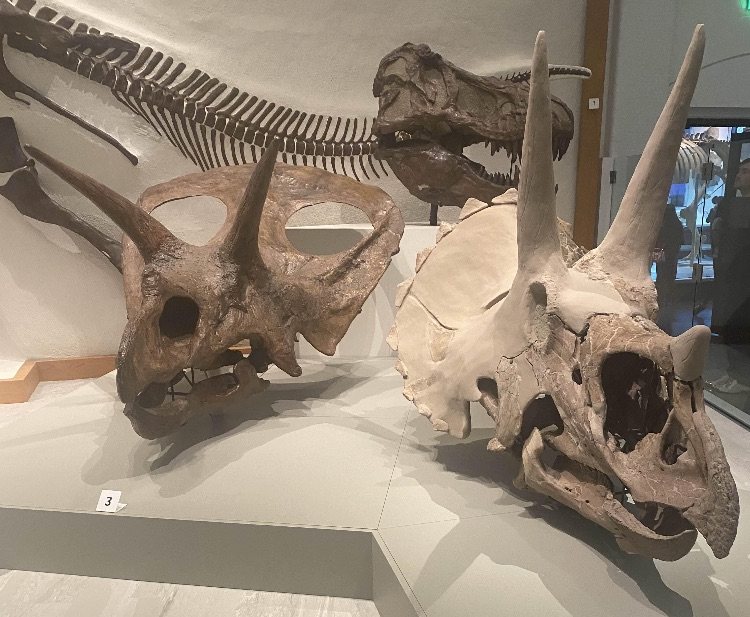
Nicholas Longrich and Daniel Field challenged that idea in PLOS ONE in 2012. They identified both mature and immature specimens assigned to each genus, and argued that the shallow depressions in some *Triceratops* frills are different from the large parietal openings of *Torosaurus*. In their view, *Torosaurus* is a distinct genus, not simply a grown-up *Triceratops* (Longrich and Field, 2012).
Both papers are still part of the conversation, and the question remains open. In practice, that means a skull with a large, open window in its frill should not automatically be labelled *Triceratops*.
Where to see famous Triceratops skulls
Several museums have *Triceratops* skulls with stories attached. Displays change, so confirm what is on view with each museum before you travel.
Smithsonian National Museum of Natural History, Washington, D.C. The museum put up its first mounted *Triceratops* skeleton in 1905. During the dinosaur-hall refurbishment begun in 1998, it used a computer-generated skull model to create its large outdoor bronze head (Smithsonian Magazine). Inside, the Deep Time hall stages a *Tyrannosaurus rex* and *Triceratops* encounter (Smithsonian Deep Time).
American Museum of Natural History, New York. The roughly 65-million-year-old *Triceratops*, with its big frill, three horns and partly healed skull injury.
Natural History Museum, University of Oslo, Norway. Roar, a *Triceratops prorsus* skull found in South Dakota in 2013 and excavated in 2016. The museum describes it as about 80 percent real, with the outer sections of the frill reconstructed, and shows it beside its *Tyrannosaurus* named "Stan."
Denver Museum of Nature & Science, Colorado. In 2024, museum volunteer Casey Thater noticed part of a *Triceratops* frill sticking out of a hillside near Marmarth, North Dakota. The skull was excavated in 2025, named "Triceratops Dreams," and announced in October 2025 as the most complete *Triceratops* skull in the museum's collection. Its preparation takes place in public view (Denver Museum of Nature & Science).
Triceratops skulls through time
Tap or hover a step to follow the order.
1905
The Smithsonian mounted its first Triceratops skeleton.
1998
The Smithsonian began a dinosaur-hall refurbishment that produced its outdoor bronze Triceratops head.
2009
Farke, Wolff and Tanke published injury evidence consistent with horn combat.
2010
Scannella and Horner proposed that Torosaurus was a mature Triceratops.
2012
Longrich and Field argued that Torosaurus was a separate genus.
2013
Roar, a Triceratops prorsus skull, was found in South Dakota.
2016
Roar was excavated.
2024 to 2025
Denver Museum teams found and excavated Triceratops Dreams in North Dakota.
Triceratops skulls at auction
Big *Triceratops* skulls also turn up in the news when they go to auction. In 2021, Sotheby's catalogued a *Triceratops horridus* skull from the Hell Creek Formation of eastern Wyoming. It measured 218 centimeters, preserved about 80 percent of its bone mass, and carried an estimate of $400,000 to $600,000. Christie's has also offered a *Triceratops prorsus* skull from the Hell Creek Formation in Montana. The best-known sale is "Big John," a large *Triceratops* skeleton with a substantial skull, which sold in Paris in 2021 for 6.6 million euros.
The Big John sale drew attention because major vertebrate fossils can leave public collections and become inaccessible to researchers. The Society of Vertebrate Paleontology says scientifically significant vertebrate fossils should stay in accredited museums, universities or comparable public-trust repositories (Society of Vertebrate Paleontology). The American Museum of Natural History says any fossil purchase requires documented legal ownership, provenance, collecting permission and compliance with the laws of the place the fossil came from (American Museum of Natural History). This is general background on the fossil market, not advice to buy one.
Test your Triceratops skull knowledge
Answer every question to check.
Frequently asked questions
A few more questions about Triceratops skulls, answered briefly.
Did Triceratops use its horns to fight?
Very likely, yes. Farke, Wolff and Tanke's 2009 study found that injuries on *Triceratops* frills cluster on the squamosal bones far more than in *Centrosaurus*, a pattern consistent with horn combat between rivals, and the London museum ties frill punctures to fights possibly over mates.
Can a T. rex bite a Triceratops horn?
It seems to have happened at least once. The Natural History Museum in London reports a healed *Triceratops* horn injury that matches a *Tyrannosaurus* bite, and because the wound healed, the *Triceratops* survived. The Smithsonian's Deep Time hall stages the same matchup.
Why does Torosaurus have holes in its frill?
The large openings, called parietal openings, are part of how the *Torosaurus* frill is built. Scannella and Horner read them as a sign of very late growth in *Triceratops*, while Longrich and Field see them as a trait of a separate genus.
Is a Torosaurus head bigger than a Triceratops head?
The two are told apart mainly by the frill, with its large openings in *Torosaurus*, rather than by a simple size ranking. Whether they are even different animals is still debated, which is why the frill windows matter so much when a skull is identified.
More fossil skulls to see next
If the *Triceratops* skull got you hooked, the next stop is its most famous neighbor, SUE the T. rex skull. For another Cretaceous dinosaur with a strange head, read about Citipati. Jump forward to the Ice Age and the Smilodon skull shows how a saber-toothed cat used its blades, while the mammoth skull explains how to tell a mammoth from an elephant. And if you have ever wondered how scientists put a date on bones like these, see how old are these bones.
Terms in this story
Tap a term to see what it means.
Frill. The broad shield of bone that sweeps back from a Triceratops skull over the neck. In London's Natural History Museum description it is nearly one meter across.
---