

No. 211
Mammoth Skull: How to Tell It From an Elephant's
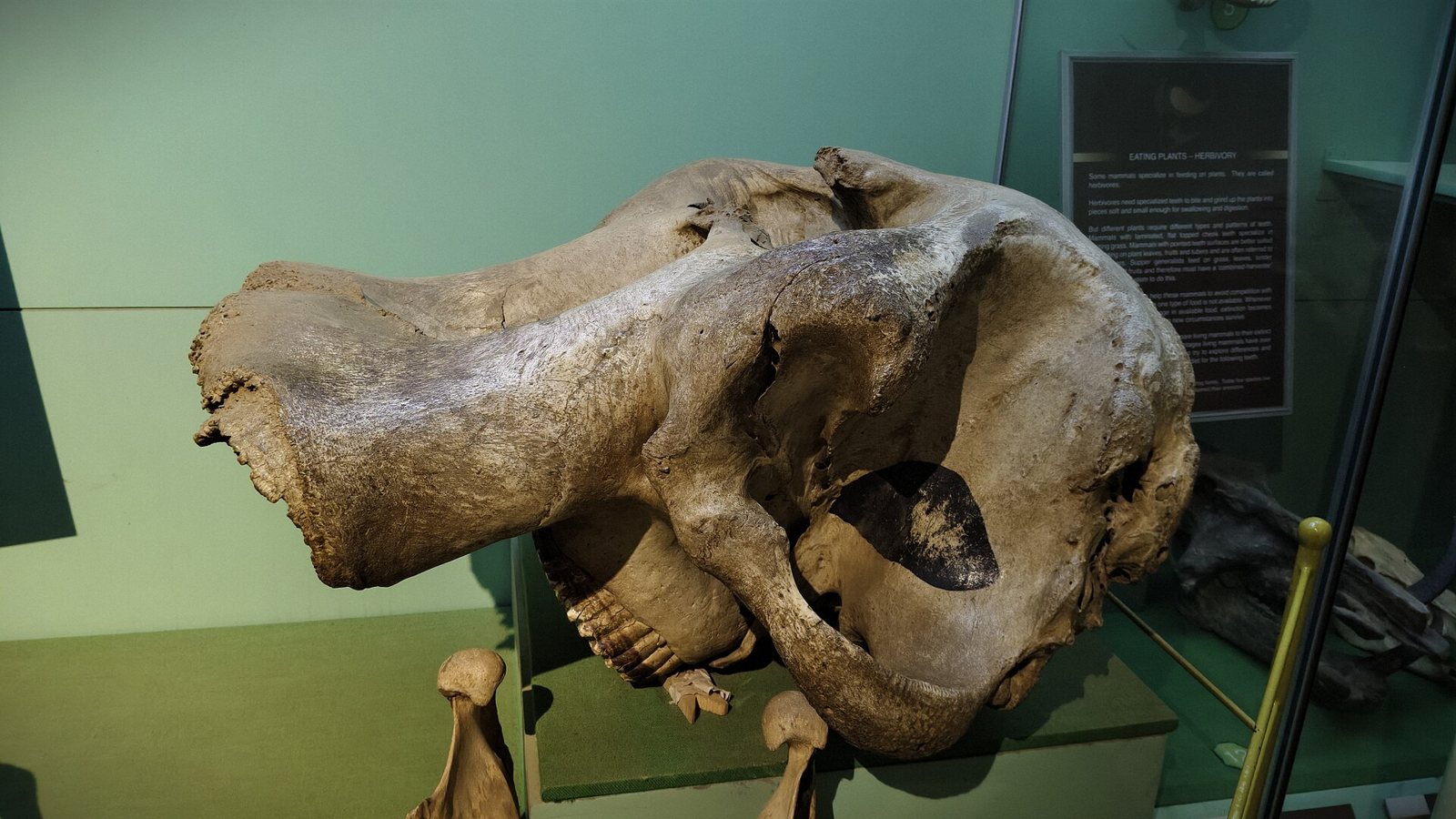
A woolly mammoth (*Mammuthus primigenius*) skull usually has a high, rounded or domed top, a sloping forehead, sockets for large curved tusks, and broad molars covered in many parallel ridges of enamel for grinding grasses. Mammoths and modern elephants are close relatives, so their skulls share a lot, including the big central opening for the trunk and eye sockets set on the sides. The domed profile and the tusks give you a head start, but the teeth are the most reliable clue, especially if the other suspect is a mastodon, whose molars carry rounded, cone-shaped cusps instead (American Museum of Natural History).
One qualifier belongs right up front: skull shape varies with species, age and sex, so no single feature settles it on its own.
Reading a mammoth skull
Start with the outline. A woolly mammoth skull rises high at the top, often into a rounded dome, and the forehead slopes down toward the face. It is a big skull, and much of it is filled with internal air spaces, which keeps the bone lighter than its size suggests (Natural History Museum, London; Natural History Museum of Utah).
Then look at the tusks. They are modified upper incisors, made chiefly of dentine and cementum, and in mammoths they are usually large and curved. Further back in the mouth sit the cheek teeth, broad molars with many parallel enamel ridges, an adaptation for grinding grasses and other abrasive plants. Look at the face straight on and you will also see the eye sockets on the sides and a large opening in the middle for the trunk.
It also helps to know which mammoth you are looking at. The woolly mammoth is the famous one, but the Columbian mammoth, *Mammuthus columbi*, lived in North America and could be larger. The Natural History Museum in London points out that not every mammoth was woolly: Britain had southern, steppe and woolly mammoths. Its Ilford skull belongs to a steppe mammoth and is described as the largest and most complete of its kind found in Britain (Natural History Museum, London).
Mammoth or elephant?
This is the closest comparison, because mammoths and modern elephants belong to the same family. The living species are the Asian elephant, *Elephas maximus*, and the African elephant, *Loxodonta africana*. Mammoth and elephant molars both have ridged enamel plates suited to grinding vegetation, and both skulls have the nasal opening for the trunk at the center of the face (American Museum of Natural History).
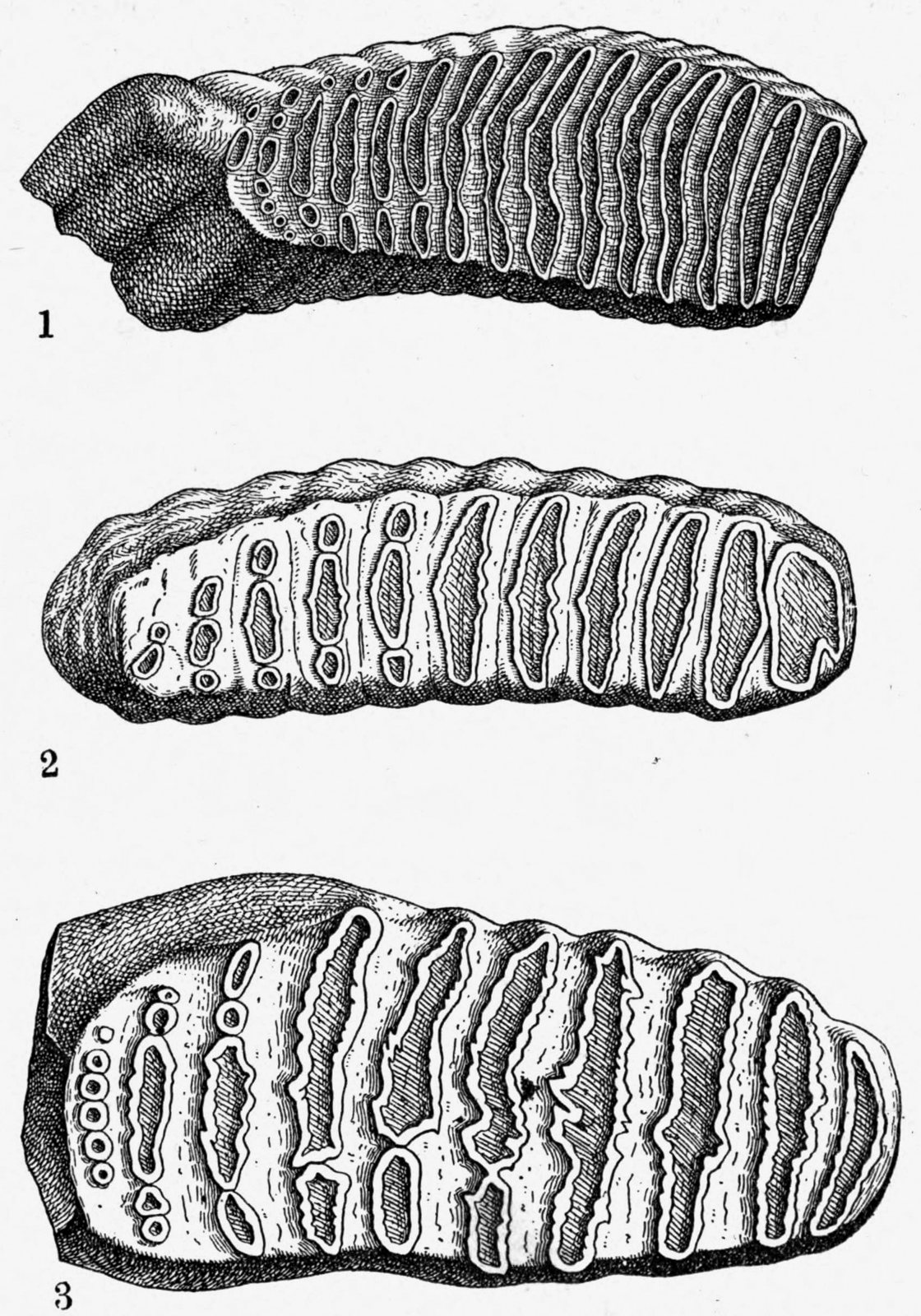
So, what do you look for in a museum hall? First, the profile: a mammoth's high, domed top is one of its strongest signals. Second, the tusks, which in mammoths are usually prominent and curved, though their size and curvature vary by species, age and sex, just as they do in elephants. Third, the molar surface, if the teeth are visible. None of these is a one-glance answer by itself; they work best together, and the specimen label is always the final word.
Tap or hover a row to highlight it.
| Feature | Mammoth | Modern elephant | Mastodon |
|---|---|---|---|
| FeatureExamples | MammothWoolly mammoth, Mammuthus primigenius; Columbian mammoth, Mammuthus columbi | Modern elephantAsian elephant, Elephas maximus; African elephant, Loxodonta africana | MastodonAmerican mastodon, Mammut americanum |
| FeatureMain tooth clue | MammothRidged enamel plates | Modern elephantRidged molars for grinding vegetation | MastodonRounded, cone-shaped cusps |
| FeatureTusks | MammothUsually prominent; size and curvature vary by species, age and sex | Modern elephantModified upper incisors in many individuals, varying by species and sex | MastodonPresent, varying by species and sex |
| FeatureCentral front opening | MammothNasal opening for the trunk | Modern elephantNasal opening for the trunk | MastodonProboscidean nasal opening |
| FeatureBest quick comparison | MammothLook at the molar surface | Modern elephantLook at skull and tooth proportions | MastodonLook for cone-shaped molar cusps |
The hole that looks like one giant eye
Face a mammoth or elephant skull head-on and the first thing you notice is a single big opening in the middle of the face. It looks like one huge eye socket, but it is the nasal opening, where the trunk attached. The real eye sockets sit off to the sides.
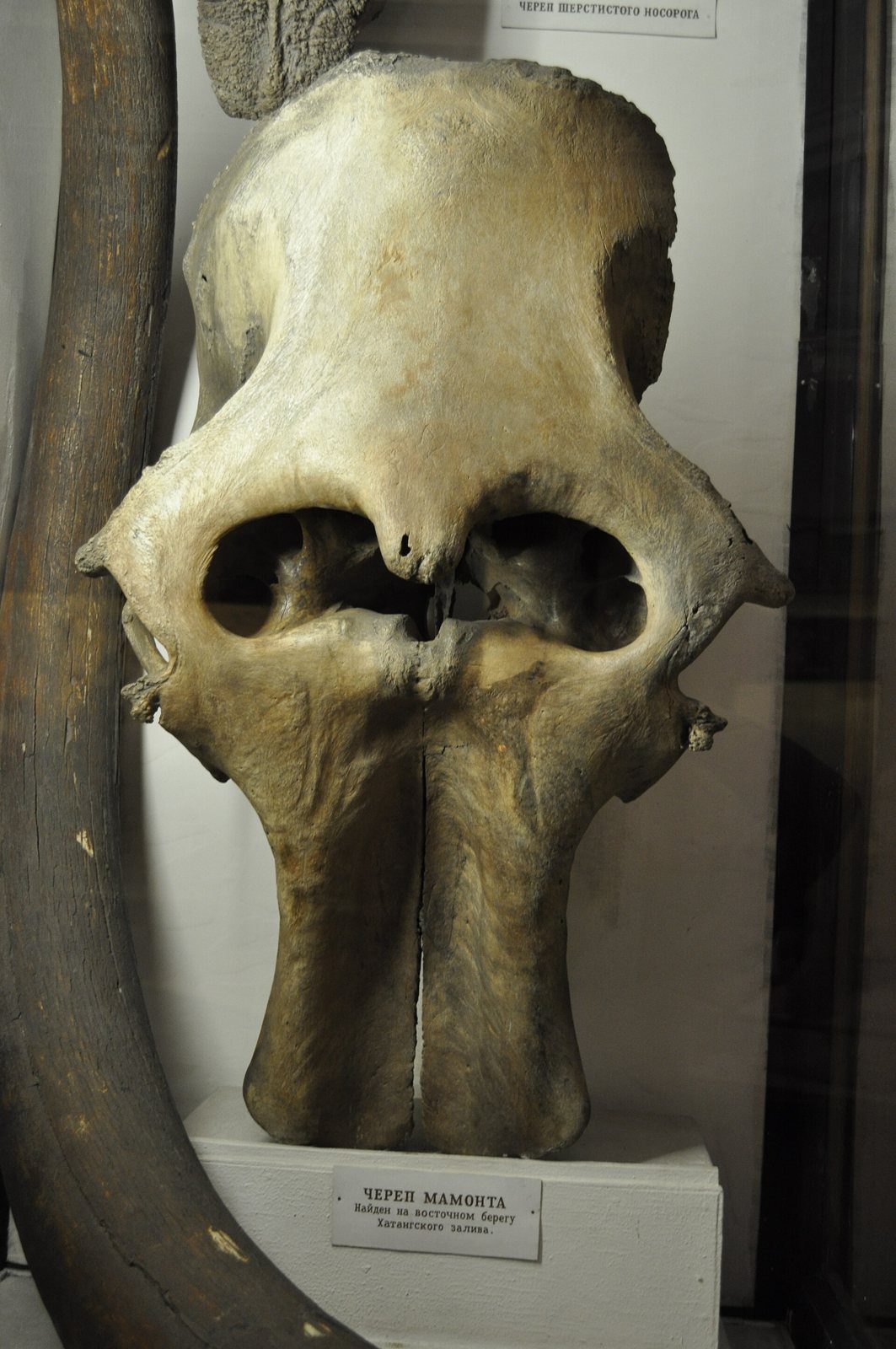
That shape has a famous afterlife. In 1914, Othenio Abel proposed that elephant-family skulls might have inspired the Cyclops legend. It is an appealing idea, and it remains unproven. We tell the full story in did elephant skulls inspire the Cyclops legend.
Mammoth or mastodon?
The American mastodon, *Mammut americanum*, is the other big Ice Age relative people mix up with mammoths, and it is more distantly related to them than elephants are. Here the teeth do most of the work. Mastodon molars have rounded, cone-shaped cusps suited to crushing twigs and other tough vegetation. Mammoth molars have ridged enamel plates for grinding grasses (American Museum of Natural History).
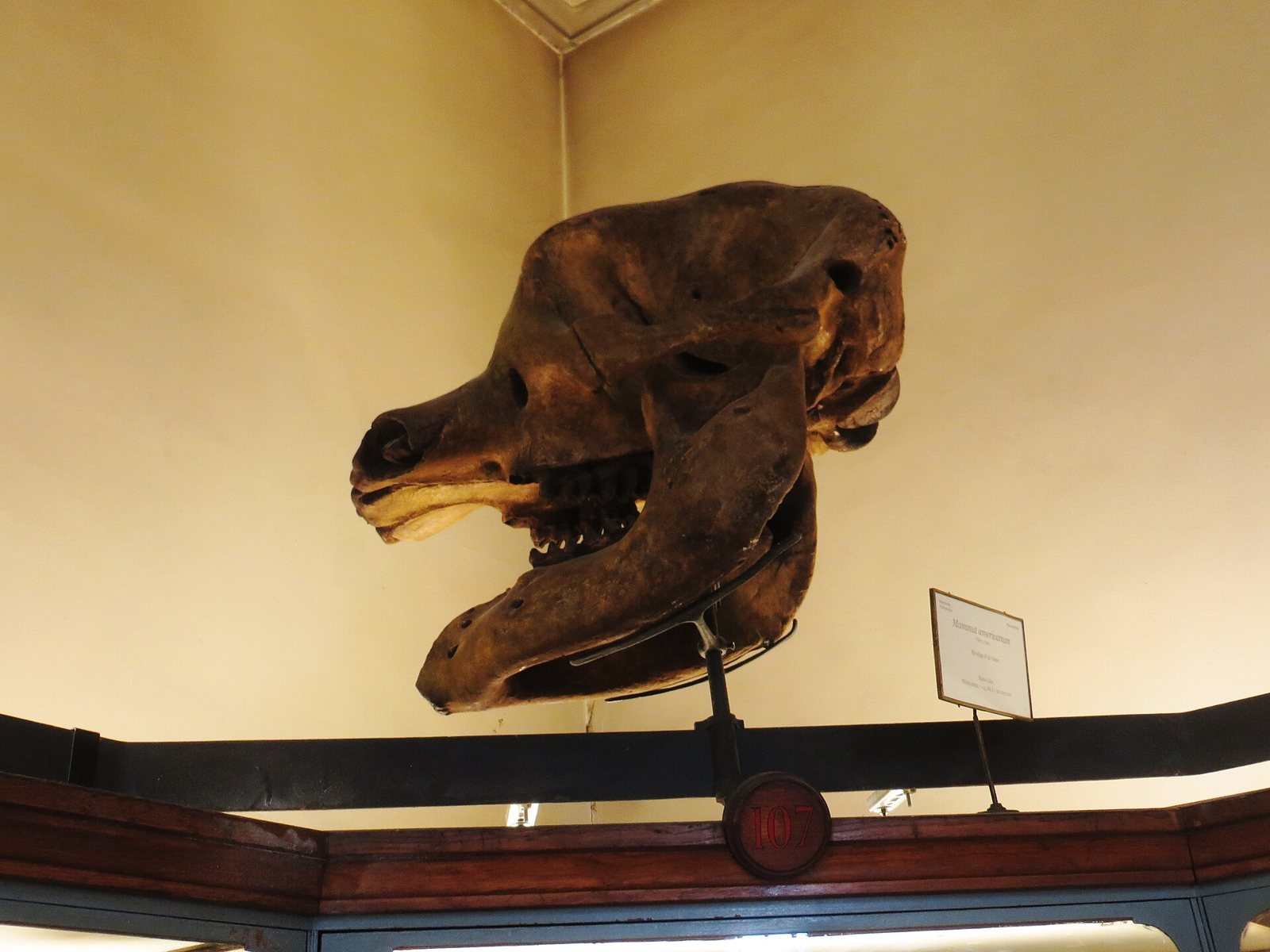
The overall skulls can look similar, because both animals are proboscideans, the group that includes elephants and their trunked relatives. That is why the teeth are usually a better guide than the silhouette. A common question is how to tell mammoth bones from mastodon bones, and the answer is that it can be hard with only one or two bones and no teeth.
How big is a mammoth skull?
Mammoth skulls vary in size by species and by individual, and the Columbian mammoth could be bigger than the woolly mammoth. For a named example, the University of Arkansas Museum catalogs a Columbian mammoth skull as a Pleistocene specimen dated to approximately 126,000 to 12,000 years ago (University of Arkansas Museum). The Natural History Museum of Utah's collection holds a juvenile Columbian mammoth skull and tusk, so not every mammoth skull on a shelf belongs to a full-grown adult (Natural History Museum of Utah).
If you want a measurement for a particular skull, the museum's catalog record for that specimen is the place to find it.
Famous mammoth finds
The Waco story starts with a walk. In 1978, Paul Barron and Eddie Bufkin were hiking near the Bosque River in Waco, Texas, when they came across a large bone. Baylor University identified it as the femur of a Columbian mammoth (National Park Service).
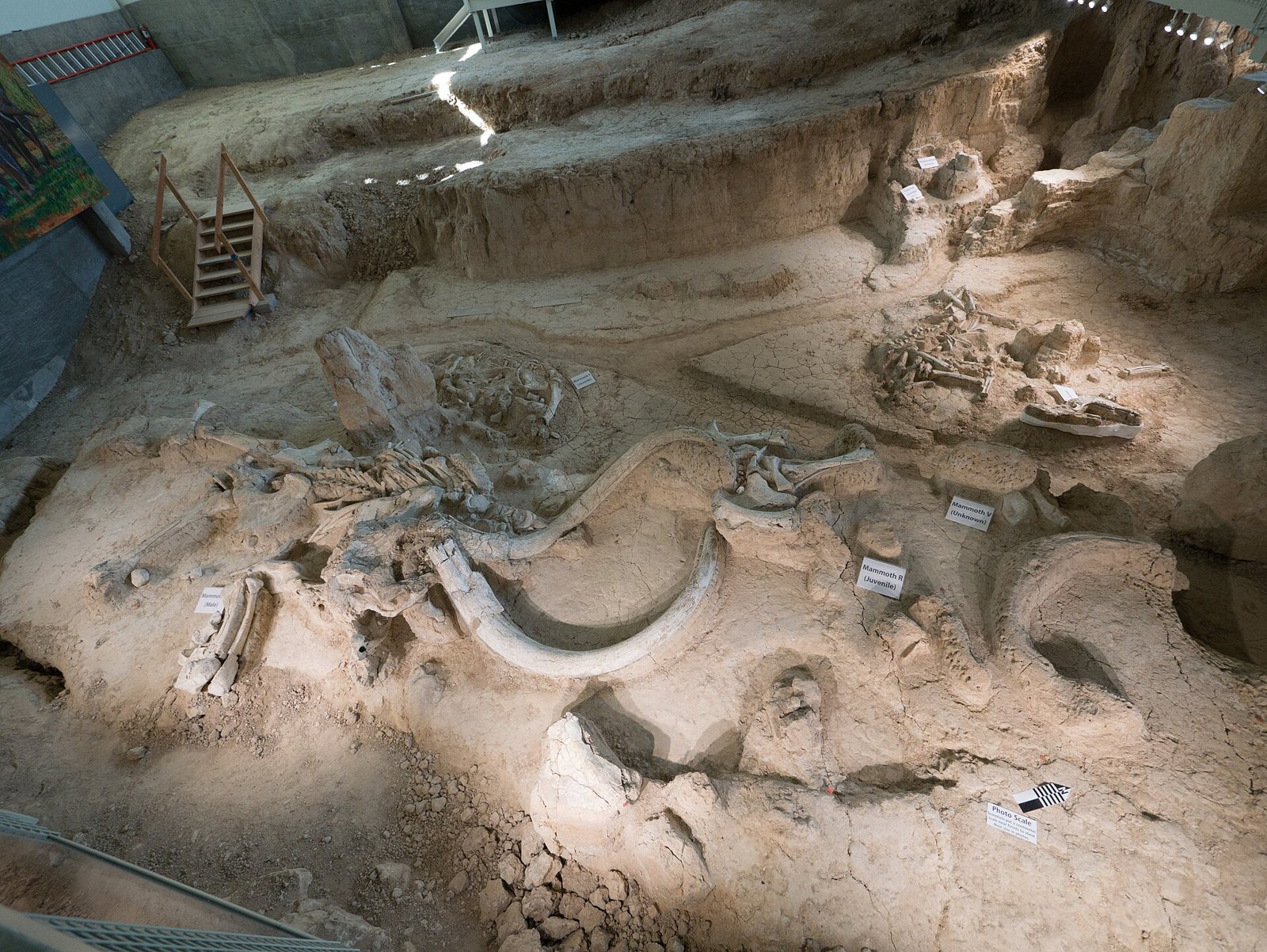
Excavation led by Baylor ran from 1978 to 1997 and revealed at least 24 Columbian mammoths. Nineteen of them were members of a nursery herd, females and young that appear to have died and been buried together. The National Park Service dates that event to approximately 65,000 to 72,000 years ago (National Park Service). The site became Waco Mammoth National Monument in 2015.
Siberia has given up a different kind of find: frozen calves that keep soft tissue, something ordinary fossils rarely preserve. Lyuba and Khroma were woolly mammoths that lived more than 40,000 years ago, according to the American Museum of Natural History. In 2024, a female calf named Yana, found in Yakutia, was presented to the public as about 50,000 years old. She was about one year old, around 120 centimeters tall and over 100 kilograms (Associated Press).
How a mammoth skull gets its age
A mammoth skull can be dated in several ways, depending on how well it is preserved and where it was buried. The oldest approach is stratigraphy: comparing the layer of sediment the skull sat in with the layers above and below. It rests on principles Nicolaus Steno set out in 1669, including superposition, the idea that lower layers are generally older (Smithsonian Human Origins Program).
Other methods date the material directly. Radiocarbon dating can date preserved organic carbon in bone, tooth or associated material when the specimen falls within the method's age range; the results need careful contamination controls and come with stated uncertainty. Electron spin resonance can be used on tooth enamel, which often survives better than bone. Uranium-series methods date suitable mineral deposits or coatings on fossils, and luminescence methods date the sediment around the bones.
Those methods do not always agree, and that can change a site's story. In 2026, Shannon A. Mahan, Jim I. Mead, P. R. Hanson, Emma T. Krolczyk and Christopher N. Jass used infrared-stimulated luminescence to date sediments at The Mammoth Site in South Dakota to approximately 232,000 to 160,000 years. That is much older than earlier radiocarbon-based estimates of approximately 42,000 to 23,000 calibrated years before present (Mahan and colleagues, University of Nebraska-Lincoln).
The lesson for a museum visitor is simple: a date belongs to a particular sample and its context, so a skull's age comes from its catalog record, not from how old it looks. For more on how scientists date remains of all kinds, see how old are these bones.
Mammoth skulls through time
Tap or hover a step to follow the order.
1669
Nicolaus Steno set out the principles of stratigraphy used in relative dating.
1914
Othenio Abel proposed that elephant-family skulls inspired the Cyclops idea.
1978
Paul Barron and Eddie Bufkin found the first Waco mammoth bone in Texas.
1978 to 1997
Baylor-led excavation at Waco revealed 24 Columbian mammoths.
2015
Waco Mammoth became a national monument.
2024
Yana, a frozen mammoth calf from Yakutia, was presented as about 50,000 years old.
2026
Mahan, Mead and colleagues published new luminescence ages for The Mammoth Site in South Dakota.
If you find a mammoth tooth or bone
*This is general information, not legal advice. Rules differ by landowner, state and country.*
A mammoth tooth or bone is a vertebrate fossil, and who may collect it depends on whose land it is on. On U.S. Bureau of Land Management land, vertebrate fossils cannot be dug up, removed or collected without a research permit. The BLM advises leaving a potentially significant fossil in place, photographing it, recording the location and reporting it to the local BLM office (Bureau of Land Management).
State rules vary. In Florida, the Florida Museum of Natural History says a permit is required to collect vertebrate fossils on state lands, including public beaches and some rivers, and finds must be reported to the museum's Division of Vertebrate Paleontology. Fossils on private property belong to the property owner, and county-owned land follows county policy (Florida Museum of Natural History). Wherever you are, confirm the rules with the land manager before you move any mammoth material. If you are not sure what kind of animal a skull came from, see human vs animal skulls.
Mammoth, elephant or mastodon?
Answer every question to check.
Frequently asked questions
A few more questions about mammoth skulls and teeth, answered briefly.
How do you identify a mammoth tooth?
Look at the grinding surface. A mammoth molar is broad and crossed by many parallel ridges of enamel, built for grinding grasses, while a mastodon molar has rounded, cone-shaped cusps. Because tooth enamel often outlasts bone, it is also one of the materials scientists can date with electron spin resonance.
What should I do if I find a mammoth bone?
Leave it where it is, photograph it, record the location and report it. On Bureau of Land Management land that report goes to the local BLM office; in Florida, to the Florida Museum of Natural History. Elsewhere, ask the land manager about the rules before moving anything.
Where can I see a mammoth skull?
Waco Mammoth National Monument in Texas is the site of the Columbian mammoth nursery-herd find. The Natural History Museum in London holds the Ilford steppe mammoth skull, and the Smithsonian National Museum of Natural History has a woolly mammoth from Alaska in its collection (Smithsonian). Check each museum's current displays before you go.
More big skulls to compare
Mammoths shared the Ice Age with a famous predator, and the Smilodon skull shows how a saber-toothed cat used its blades. For a much older giant, the Triceratops skull brings a frill and three horns into the comparison. The hippo skull is another heavy-headed mammal worth a look, and what bones tell archaeologists explains how much a single skull or tooth can reveal.
Terms in this story
Tap a term to see what it means.
Woolly mammoth. Mammuthus primigenius, the Ice Age mammoth with a high, domed skull, known from frozen calves in Siberia.
---