No. 156
Human vs Animal Skull: How to Tell, and What to Do If It Might Be Human
If there is any chance the skull or bone in front of you is human, stop. Do not pick it up, move it, clean it, bury it or take it home. Keep people and pets away, and call the local police. Our story on what to do if you find human bones gives the full step-by-step and explains who takes over.
You do not have to settle the question yourself. Telling human from animal is work for a forensic anthropologist or a medical examiner, and calling about a bone that turns out to be an animal's costs you nothing.
For the curious, the short answer is to look at the whole skull, not one feature. A modern human skull usually has a large, rounded braincase, a short, flat face, forward-facing eye sockets, a projecting chin and an opening for the spinal cord underneath, near the center. Animal skulls more often have a longer muzzle, larger specialized teeth, or that opening farther toward the back.
If it might be human, stop here first
The first steps are the same almost everywhere, and they are simple. Stop handling it. Leave the skull, and any bones or objects near it, exactly where they are. Keep other people and animals away from the spot. Call local police or law enforcement, then follow the instructions of the medical examiner, coroner or state archaeologist when they become involved. Authorities may bring in a forensic anthropologist to look at the remains.
The details differ from place to place. Florida's Division of Historical Resources says to leave remains and nearby items in place and not to allow unauthorized removal. Mississippi's Department of Public Safety tells people to call law enforcement after coming across suspected human remains. In Oregon, ORS chapter 146 bars moving suspected human remains without permission in a death that is being investigated. Wherever you are, the local police, coroner or medical examiner for the place where the remains lie is the right first contact.
It helps to remember who this might be. A human skull belonged to a person, someone's relative or ancestor, and it deserves care while the right people take over. Our found human bones story covers the reporting windows, federal and tribal land, and the rules in Mexico and Latin America.
If a skull might be human
Tap a card to bring it forward.
- Do not pick it up or clean it: Leave the skull exactly as it lies
- Leave nearby bones and objects: Everything around it stays where it is
- Keep people and pets away: Protect the spot until help arrives
- Call local police: Law enforcement is the first call
- Follow the officials: The medical examiner, coroner or state archaeologist takes it from there
What marks a human skull
Once you know what to do, the curiosity question is fair: how do specialists tell? They compare a handful of features, and the University of Hawaiʻi's anatomy and physiology text and the University of Central Florida's anthropology text describe the main ones.
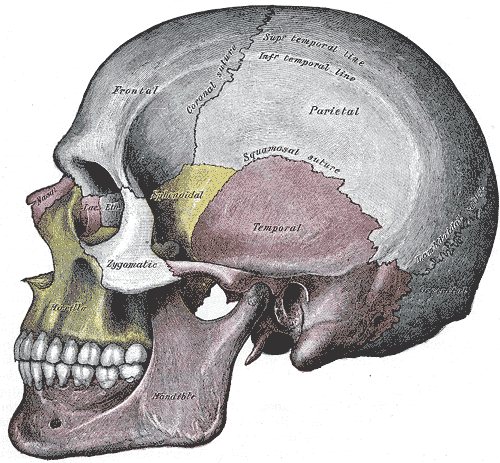
A modern human skull has a large, rounded braincase sitting over a relatively short, flat face. The eye sockets, or orbits, face forward. Below the mouth there is a projecting bony chin, which the University of Central Florida text identifies as unique to *Homo sapiens* among the human species it compares. Underneath the skull, the foramen magnum, the opening where the spinal cord passes through, sits near the center of the skull base.
The position of that opening is worth a closer look. The Smithsonian National Museum of Natural History shows the foramen magnum near the center in a human, and farther toward the rear in a dog and a chimpanzee.
None of these features works as a test on its own. Human skulls vary, and age, ancestry, disease, damage and fossil status can all change how one looks. Treat the list as a way to understand what experts compare, not as a way to rule a person out. For more on the parts of a human skull, see our human skull facts.
Tap or hover a row to highlight it.
| Feature | Human skull | Typical animal comparison |
|---|---|---|
| FeatureBraincase | Human skullLarge and rounded | Typical animal comparisonOften proportionally smaller or differently shaped |
| FeatureFace | Human skullShort and relatively flat | Typical animal comparisonOften a projecting muzzle or snout |
| FeatureEye sockets | Human skullForward-facing | Typical animal comparisonPredators face forward; prey species tend to have more side-facing orbits |
| FeatureForamen magnum | Human skullNear the center of the skull base | Typical animal comparisonFarther toward the rear in dogs and chimpanzees |
| FeatureChin | Human skullProjecting bony chin in modern Homo sapiens | Typical animal comparisonNo comparable modern human-style chin |
| FeatureTeeth | Human skullUsually 32 permanent adult teeth | Typical animal comparisonTooth number and form vary by species and diet |
The animals most often mistaken for people
Forensic anthropologists point to large mammals as the usual cause of confusion. The American Board of Forensic Anthropology says bear bones, especially paws, are commonly mistaken for human bones by untrained people. A forensic anthropology teaching text lists deer, bears, large dogs and pigs as the animals most often confused with adult human bones, and notes that small animals may resemble juvenile or fetal human remains.
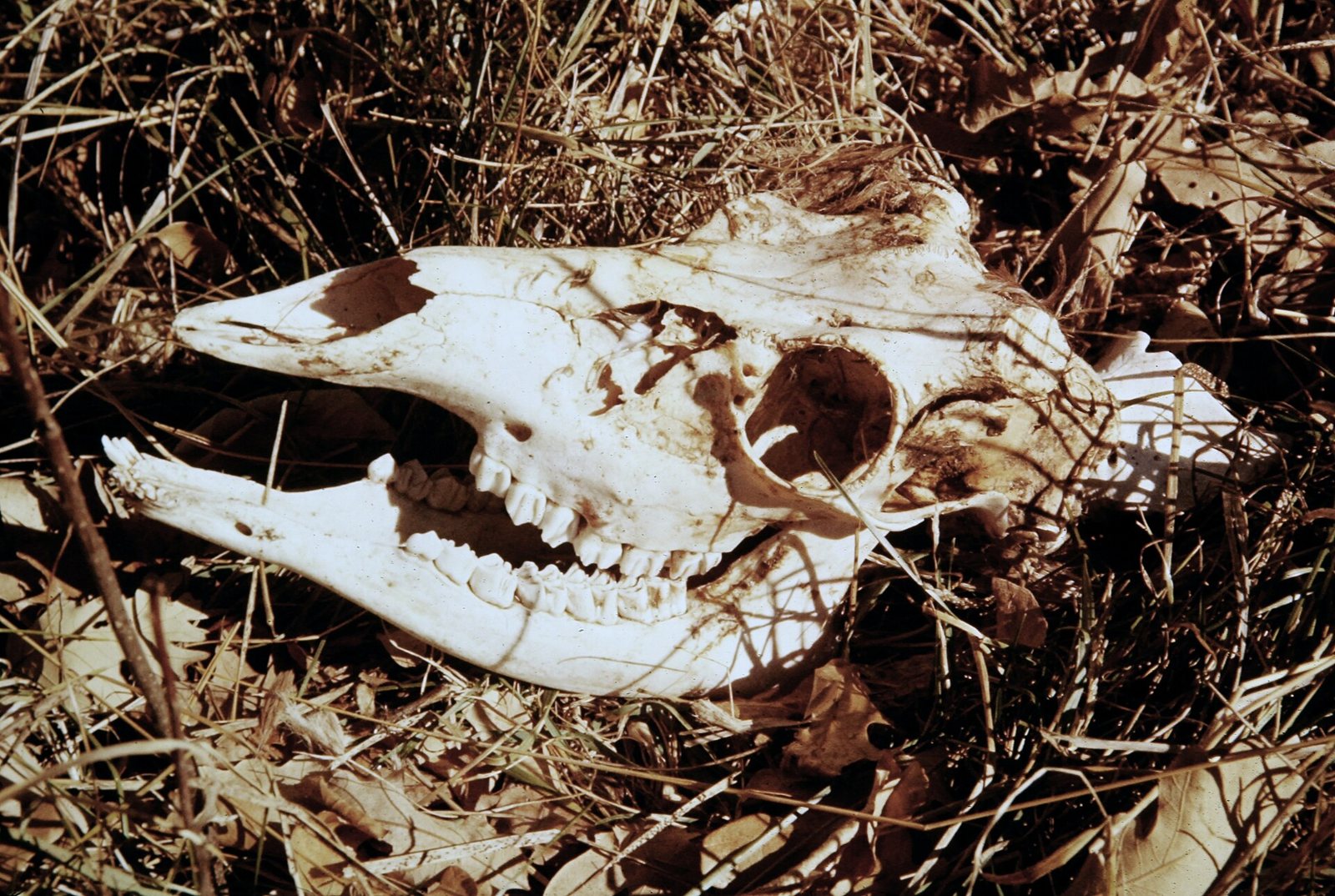
Each of those animals leaves its own clues. A deer skull has no upper incisors, according to the Internet Center for Wildlife Damage Management. In a National Park Service comparison, dog and bear skulls both have carnassial teeth, specialized cheek teeth for shearing and cutting meat, while omnivores such as the bear also have molars with broad grinding surfaces. Our story on the bear skull shows what that heavy, mixed set of teeth looks like.
Cat, dog and the other skulls in this series
Two comparisons come up again and again, and both are easy to make with the whole skull in view.
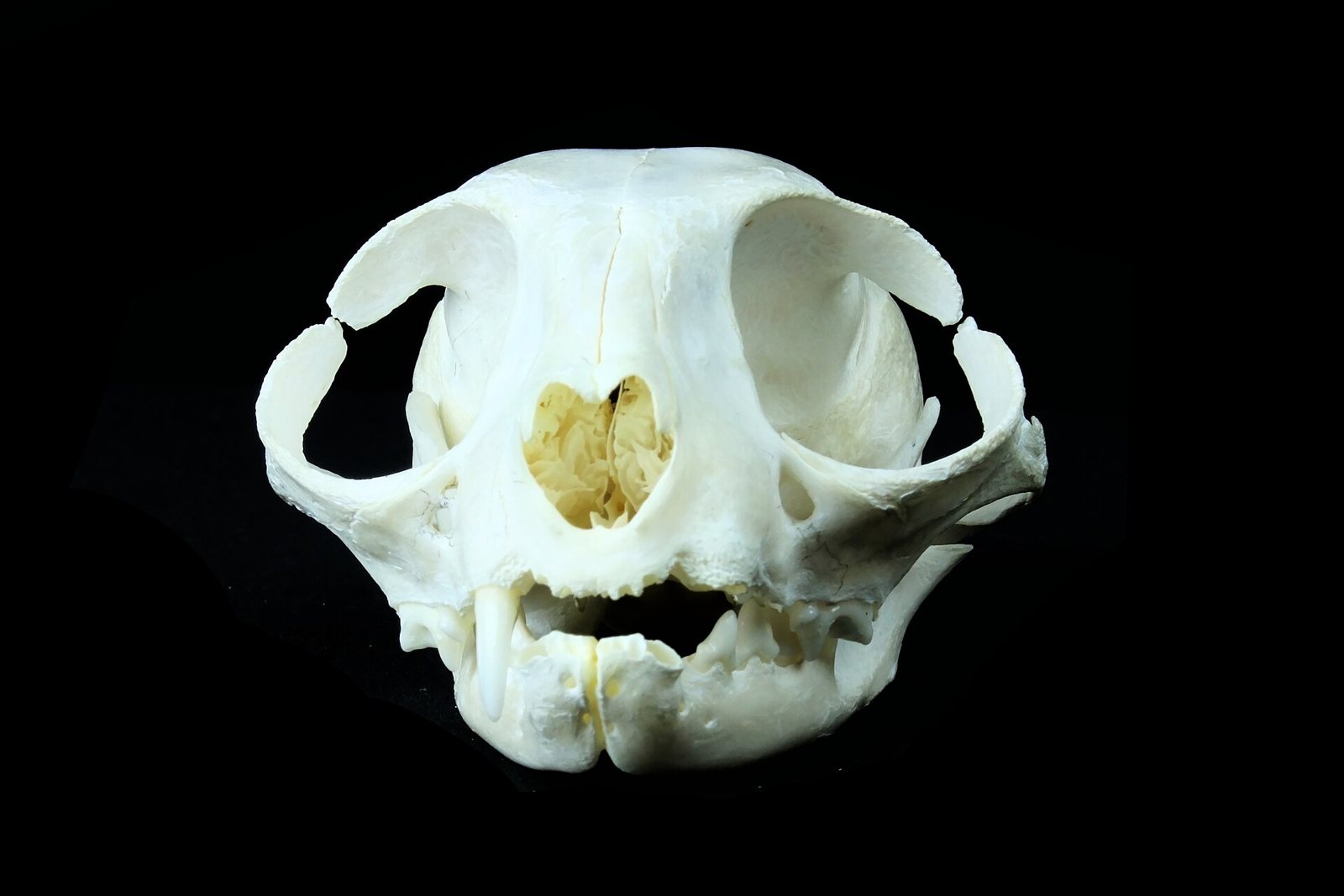
A cat skull is usually much smaller than a human skull. It has a short animal muzzle, large forward-facing eye sockets of the kind predators have, and prominent, sharp canines. A human skull has a far larger rounded braincase compared with the face, small canines and a projecting chin. Cats vary, so comparing with a verified specimen is safer than going by size alone. The cat skull identification story goes further.
Most dog skulls have an elongated muzzle, large canines and a foramen magnum set farther toward the back than in a human. Dogs vary enormously by breed, though, and a greyhound and a pug do not share the same proportions. What stays human is the large rounded braincase, the short flat face and the chin.
If the skull is clearly an animal's, the identification stories in this series pick up from here. The fox skull and coyote skull stories cover two wild relatives of the dog. The opossum skull and raccoon skull stories cover two more skulls people ask about. And the bear skull and beaver skull stories deal with the big skull with heavy teeth and the rodent skull with orange ones.
Teeth as a clue
Teeth are some of the most useful evidence on a skull, and also some of the easiest to misread. Most adults have 32 permanent teeth, according to the Cleveland Clinic: eight incisors, four canines, eight premolars and 12 molars. Written as a dental formula, that is 2.1.2.3 in each quarter of the mouth.
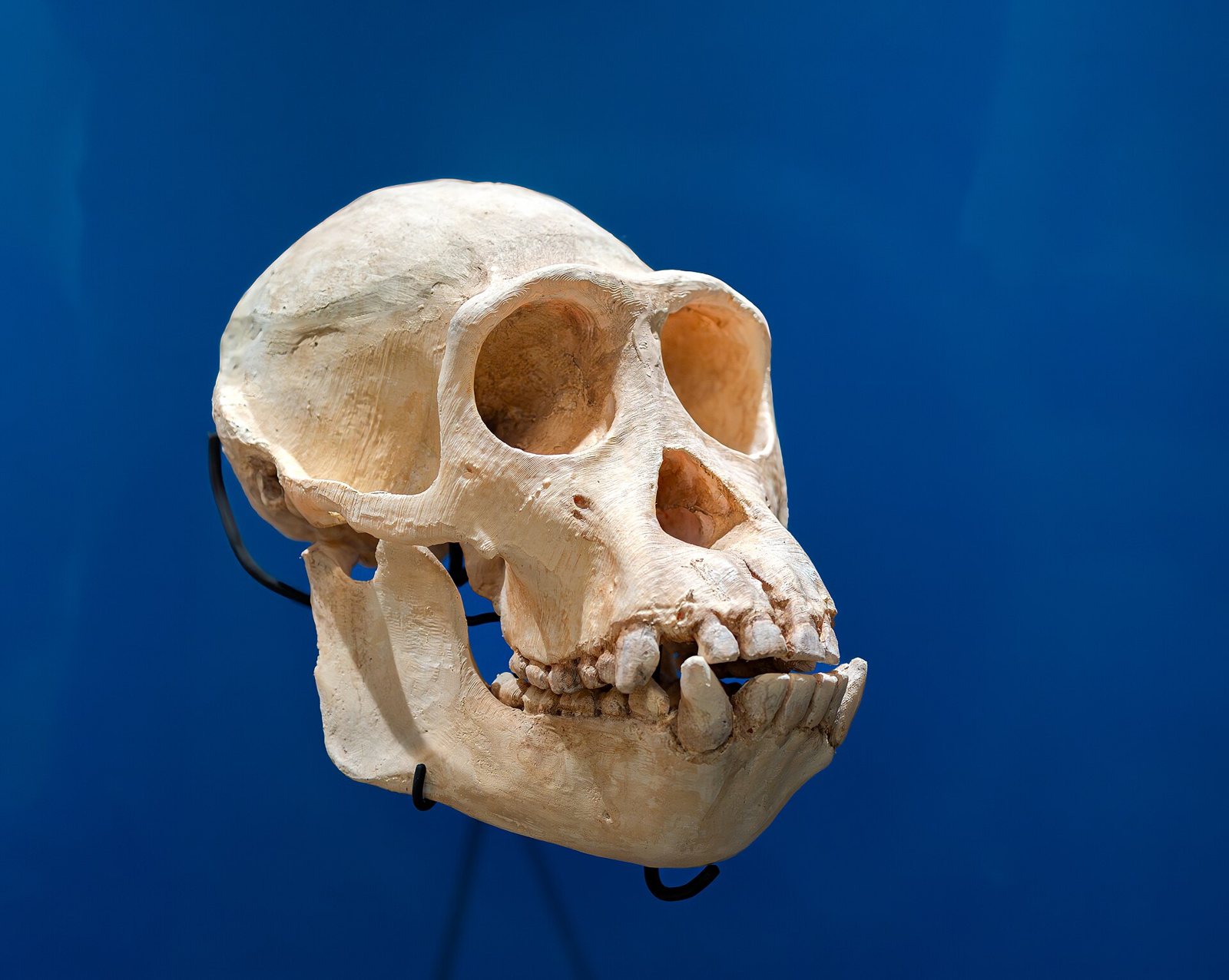
A full set of 32 can support a human identification, but the count alone is unreliable. People lose teeth, wisdom teeth may never come in, dental treatment changes a mouth, and age and damage do the rest. A human skull with 28 teeth is still a human skull.
Animal teeth tend to be more specialized. The Smithsonian's guide and the National Park Service lesson describe carnivores with cutting or shearing teeth, plant eaters with broad grinding molars, and omnivores that combine several kinds. A human skull, by comparison, has smaller canines than a cat or a dog.
Bones beyond the skull
Sometimes the find is not a skull at all but a long bone or a rib, and the same caution applies. Specialists assess a long bone by its overall shape, size, the shape of its shaft, its joint ends, its muscle attachments, its maturity and even its microscopic structure. Human limb bones reflect habitual walking on two legs, and they are generally more slender than the weight-bearing limb bones of many large four-legged animals.
Age can mislead in both directions. A small adult animal may have fully fused growth plates, while a young human may still have unfused epiphyses, the separate ends of a growing bone. A small bone that looks grown-up can belong to an animal, and a bone that looks unfinished can belong to a child.
Ribs carry clues too. A University of New Mexico forensic anthropology teaching module describes human ribs as tending toward a C shape, while many animal ribs are straighter. Humans normally have 12 pairs of ribs, although individuals vary; sheep have 13 pairs.
Fragments and weathered pieces are hard even for experts, and the American Board of Forensic Anthropology advises that suspected human bone be left for a forensic anthropologist. For the full count of what a human skeleton contains, see how many bones are in the human body.
Once you know it is an animal
If the authorities, or the skull's own features, make clear that you are holding an animal's skull, the questions change to what it is and whether you may keep it. Our story on what to do if you found an animal skull covers identification and the federal and state rules, which vary by species and place; it is general information, and the state wildlife agency has the answer for your find. When cleaning is allowed, how to clean an animal skull explains safe methods.
Human or animal skull quiz
Answer every question to check.
Quick answers about human and animal skulls
These questions come up once the first steps are clear.
How can you tell if a bone is human?
Usually you cannot be sure without a specialist. Experts look at a bone's overall shape, size, joint ends, muscle attachments, maturity and microscopic structure; human limb bones tend to be slender and human ribs C-shaped. If there is any doubt, leave it in place and call the police.
What animal is this skull from?
Start with the whole skull and the teeth: the muzzle length, the eye sockets, the canines and the cheek teeth narrow it to a group. Our found an animal skull story walks through the method, and the cat, fox, coyote, opossum, raccoon, bear and beaver stories cover the common finds. If it could be human, stop and call the police first.
How many teeth does a human skull have?
Most adults have 32 permanent teeth, but a skull can have fewer because of lost teeth, wisdom teeth that never came in, or damage. A tooth count supports an identification; it does not prove one.
Who decides whether a skull is human?
The officials who respond to your call do. Local police may involve the medical examiner, the coroner or a forensic anthropologist, and a state archaeologist may also be involved.
Where to go next
If the skull or bone might be human, the next step is a phone call, and found human bones explains what follows. If it is an animal's, found an animal skull and the cat, fox, coyote, opossum, raccoon, bear and beaver skull stories help name it. And for the human side of the comparison, human skull facts shows what a skull is made of.
Terms in this story
Tap a term to see what it means.
Braincase. The vault that held the brain. In a person it is big and domed, and it dwarfs the face below it.
---