

No. 163
Bear Skull Identification: Black Bear, Grizzly or Polar Bear?
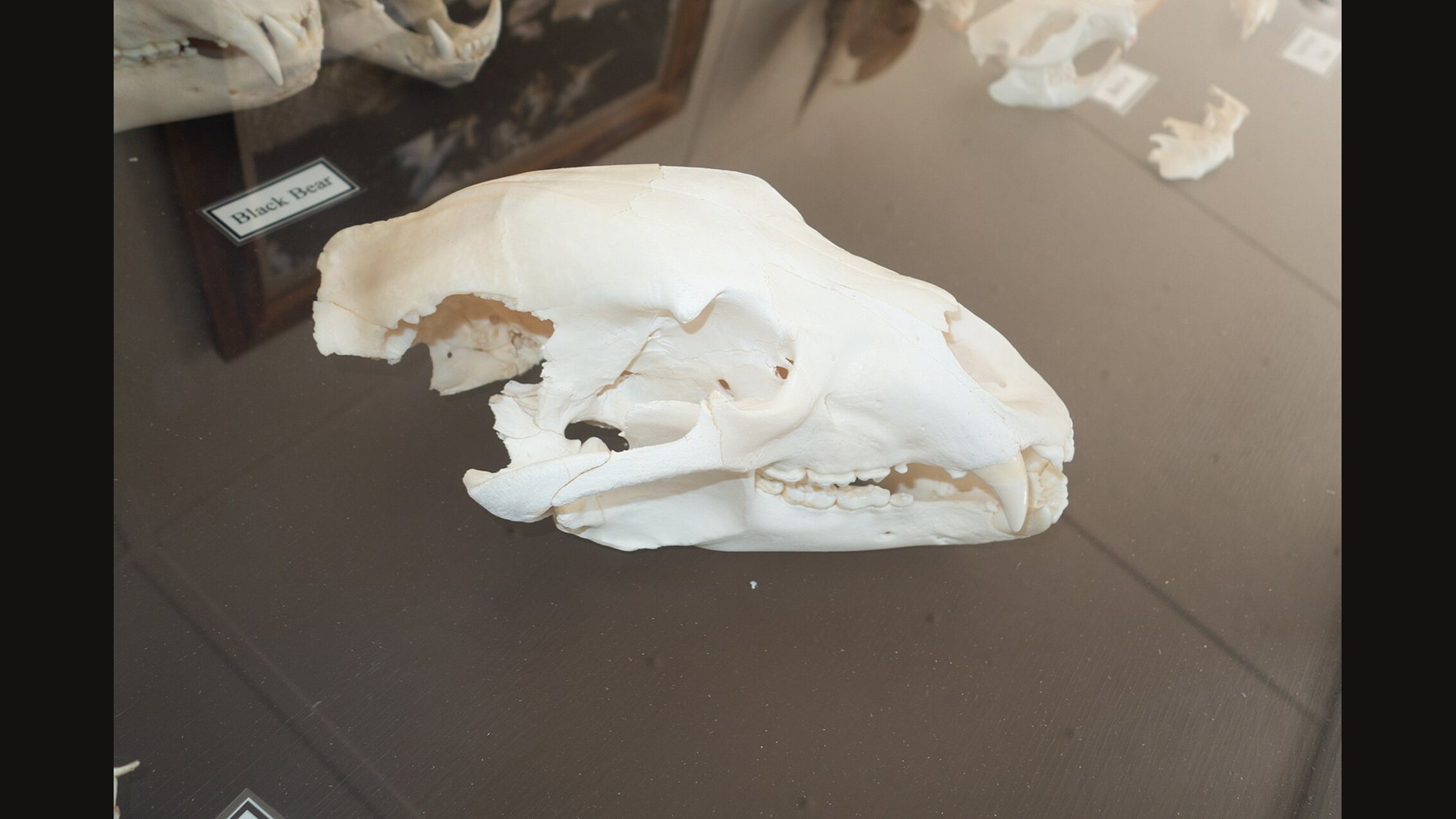
A bear skull is broad and heavily built, with a large braincase, wide cheek arches, strong canines, small or missing premolars and broad molars made for an animal that eats almost anything. Most bear skulls carry 42 teeth when complete, in the pattern I 3/3, C 1/1, P 4/4, M 2/3, though small premolars often drop out in adults.
To tell an American black bear (*Ursus americanus*) from a brown or grizzly bear (*Ursus arctos*), look at the last upper molar and measure the skull. The Alaska Department of Fish and Game skull guide gives about 38 mm or more as typical for brown bears, and black bear molars usually come in shorter.
Whether you may keep it is a separate question. It depends on the species, the state, where the skull came from and the paperwork that goes with it, so the state wildlife agency is the first call.
> Legal note: Bear parts are among the most tightly regulated wildlife items, and this story is general information, not legal advice. Only the agency where you live can say whether a particular bear skull may be kept. For an answer about your skull, contact your state wildlife agency or the U.S. Fish and Wildlife Service.
What makes a skull a bear's
Hold a bear skull and the first impression is weight. The Smithsonian National Museum of Natural History teaches visitors to read a mammal skull through its teeth, eye sockets and nasal cavity, and a bear's tells you a good deal. The braincase is large, the cheek arches are pronounced, and the canines are strong.
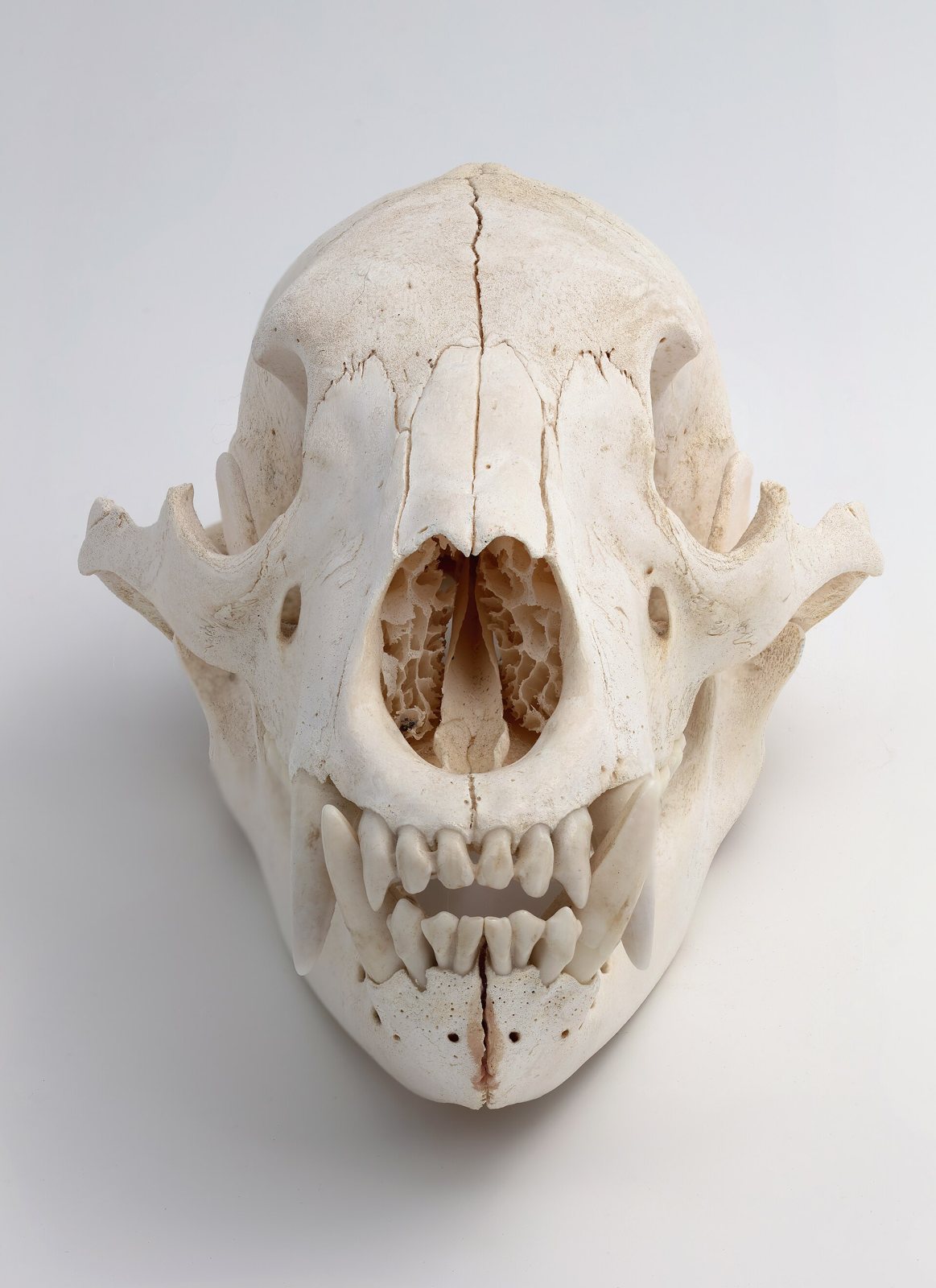
Behind the canines, the story changes. Where a meat specialist would have a row of narrow slicing teeth, a bear has small, reduced premolars and then broad molars suited to a mixed diet. That mix of fangs up front and grinders in back is the signature of an omnivore.
The tooth count helps too. The U.S. Fish and Wildlife Service gives the American black bear's dental formula as I 3/3, C 1/1, P 4/4, M 2/3, which means three incisors, one canine, four premolars and two upper and three lower molars on each side, for 42 teeth in all. Do not be thrown if you count fewer. Small premolars may be absent in adults, so a gap behind the canine is normal.
Size is the last clue, and the least reliable on its own. Skull size varies with species, sex, age and population, so a young brown bear and an old black bear can come out close. If you have a raccoon skull on the same shelf, you will see the same omnivore plan of canines and broad cheek teeth, just at a fraction of the scale.
Tap or hover a row to highlight it.
| Identification point | Supported detail |
|---|---|
| Identification pointAmerican black bear scientific name | Supported detailUrsus americanus |
| Identification pointBrown or grizzly bear scientific name | Supported detailUrsus arctos; the grizzly is a North American form |
| Identification pointPolar bear scientific name | Supported detailUrsus maritimus |
| Identification pointBear dental formula | Supported detailI 3/3, C 1/1, P 4/4, M 2/3, total 42 |
| Identification pointBrown bear skull clue | Supported detailLast upper molar usually about 38 mm or longer |
| Identification pointBoone and Crockett measurement | Supported detailGreatest length plus greatest width |
Black bear or grizzly: the molar that settles it
The two common North American bears are different species. The American black bear is *Ursus americanus*. The brown bear is *Ursus arctos*, and the grizzly is a North American form of that same species. The Alaska Department of Fish and Game says brown, grizzly and Kodiak bears are all one species, with geography as the main thing that separates the names.
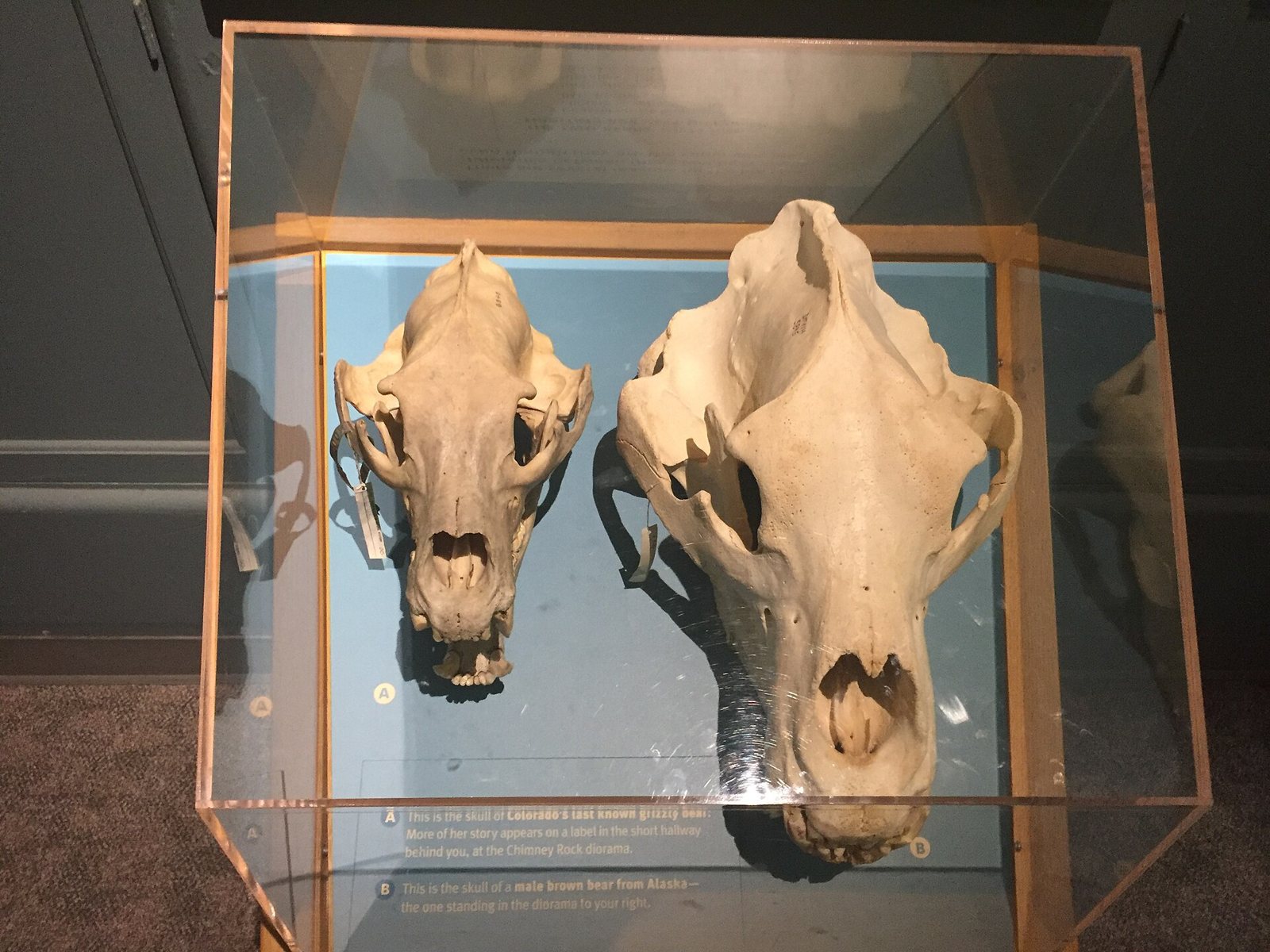
A brown or grizzly skull is generally the bigger of the two. Both species share the same 42-tooth formula, though, so counting teeth will not split them. The more useful clue is the last upper molar. Alaska's skull guide gives about 38 mm or more as typical for brown bears, while the same tooth in a black bear is usually shorter. Measure it along its length with calipers or a ruler, and write the number down.
Be careful with size alone. Large black bears and smaller brown bears overlap, and the National Park Service warns against relying on color and size to identify bears. A single photograph is not enough for a firm answer either.
A skull from Utah shows why the teeth matter. In 1976 a large skull turned up there that was nearly taken for a grizzly. According to the Boone and Crockett Club, the Smithsonian compared it with reference skulls, and the third molar identified it as an American black bear. A big skull had looked like a grizzly, and one tooth told a different story.
The polar bear skull
A polar bear, *Ursus maritimus*, has a skull of its own shape. It is more elongated than a black or brown bear's, with a long nasal cavity. The Smithsonian's polar bear teaching specimen points to large, sharp canines and complex nasal turbinates, the thin scrolls of bone inside the nose, as features you can see on the skull itself.
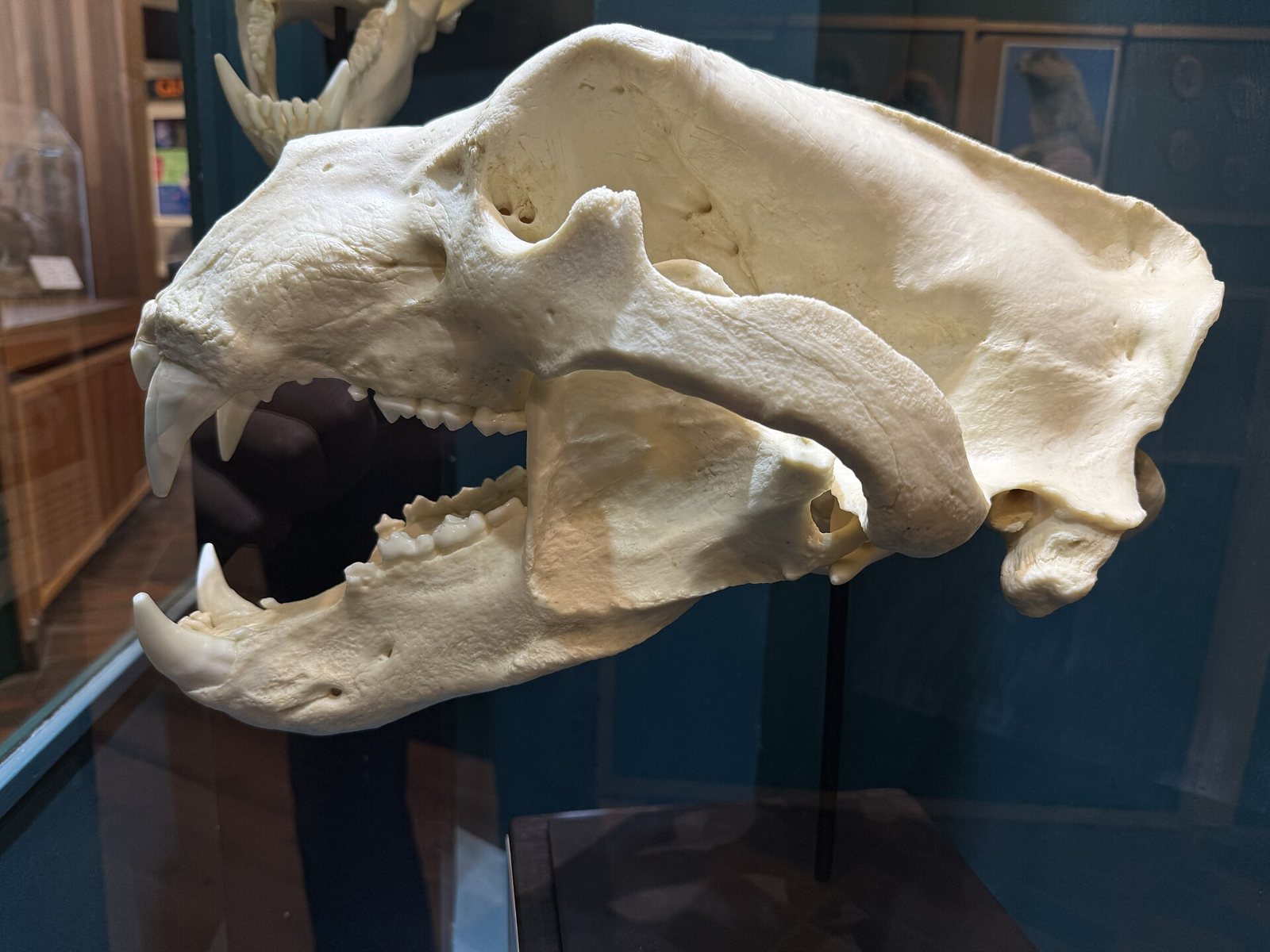
The same specimen shows the foramen magnum, the opening where the spinal cord left the skull, at the back of the skull. If you are wondering whether a large skull or bone could belong to a person instead, the story on telling a human skull from an animal skull covers what to look for, and what to do if there is any doubt.
How a bear skull is measured
Hunters, biologists and record keepers all measure bear skulls the same basic way, and the system comes from the Boone and Crockett Club. Its scoring instructions use two numbers. The first is greatest length, taken without the lower jaw, between perpendiculars parallel to the skull's long axis. The second is greatest width, taken between perpendiculars at right angles to that axis. Malformations are left out. Add the two together and you have the score.
Why the skull and not the hide? The club explains that a hide can change through stretching, drying, tanning and mounting, while a skull keeps its dimensions. A large-looking skull still cannot be scored reliably by eye, which is why measurers use tools.
The Boone and Crockett Club keeps separate categories for different bears rather than treating every big skull as one class. Its minimum entry scores look like this.
Tap or hover a row to highlight it.
| Bear category | Awards minimum | All-time records minimum |
|---|---|---|
| Bear categoryBlack bear | Awards minimum20 inches | All-time records minimum21 inches |
| Bear categoryGrizzly bear | Awards minimum23 inches | All-time records minimum24 inches |
| Bear categoryAlaska brown bear | Awards minimum26 inches | All-time records minimum28 inches |
| Bear categoryPolar bear | Awards minimum27 inches | All-time records minimum27 inches |
Those are record minimums, not typical sizes. For an everyday sense of scale, the Alaska Department of Fish and Game describes a black bear skull from Unit 1C measuring 11 14/16 inches long by 7 1/16 inches wide, for a score of 18 15/16 inches. It reports average scores of about 17.7 inches for black bears in Unit 1C, and about 22 inches for male and 20.3 inches for female brown bears in Unit 1. Remember that each of those figures is length plus width added together, not the length of the skull.
You can take both measurements at home. Lay the skull on a flat surface without the lower jaw, set two straight edges at the front and back, and measure between them; then do the same across the widest point. People who ask for help identifying a skull usually get better answers when they share a few specific things.
What to record before asking for an identification
Tap a card to bring it forward.
- Side photo: A clear view of the whole skull from one side
- Front photo: The face straight on, showing the canines and nasal opening
- Length: Greatest length without the lower jaw
- Width: Greatest width, at right angles to the length
- Teeth: Close views of the canines and molars, with the last upper molar measured
- Location: Where the skull came from, which matters for both species and rules
The skull in the attic
Sometimes a record sits unnoticed for decades. In 1976 a skull turned up near McGrath, Alaska. It was put away in an attic, and there it stayed for about 30 years. When it was finally scored officially, the Boone and Crockett Club recognized it as the world-record grizzly, at 27 13/16 inches.
That number is worth setting beside Alaska's averages. A typical male brown bear in Alaska's Unit 1 averages about 22 inches, so the McGrath skull is a giant among giants. It is also a good argument for measuring an old skull properly before deciding what it is.
The bear skull in Ainu tradition
For the Ainu of Hokkaido and Sakhalin, the bear has carried meaning far beyond its size. The bear is associated with *kamui*, a deity or spirit. The anthropologist Takako Yamada, writing in the *Journal of Northern Studies*, describes the *iyomante*, a ceremony involving a bear cub raised by the community. In it the bear is treated as a divine visitor, and its spirit is sent back to the world of the deities.

The skull had a place in that ceremony and after it. The University of Oregon's Windows to the Ainu World collection describes the skull being decorated and placed on a *nusa*, a ceremonial altar or pole, and skulls displayed at the entrance to the *kotan*, the village, for years afterward. The Smithsonian holds an Ainu bear skull mounted on a Y-shaped stick, associated with the 1999 exhibition "Ainu: Spirit of a Northern People," and describes such a skull as staying on the altar to recall the spirit's visit.
This practice belongs to particular Ainu communities and historical periods. It is not a single rule for all Ainu people, and it does not speak for every culture that has honored bears. For how skulls have carried meaning in other places and times, see our story on skull symbolism.
Bear skulls in four dates
Tap or hover a step to follow the order.
1976
A skull near McGrath, Alaska goes into an attic; decades later it is scored as the world-record grizzly
1976
A large skull from Utah is nearly taken for a grizzly; the Smithsonian identifies it as a black bear by its third molar
1999
The exhibition "Ainu: Spirit of a Northern People" includes a decorated Ainu bear skull now recorded by the Smithsonian
2024
The Alaska Department of Fish and Game publishes a bear-cub identification guide with skull and dental criteria
Keeping, selling or moving a bear skull
There is no single nationwide rule that answers every question about a bear skull. The species, the state, where the skull came from, where it was collected and whether it crosses a state or national border all matter. A few official examples show how much the rules differ, and they are examples, not a list for your state.
In Colorado, the Parks and Wildlife regulations approved in March 2026 prohibit possessing a bear carcass, hide, skull, claws or other part unless the animal was taken by a licensed hunter during an established season or the Division specifically authorized it.
In Alaska, the 2022 to 2024 regulation book requires sealing of certain bear hides and skulls, with skin and skull kept together until sealing where it applies. Wildlife taken in defense of life or property belongs to the state, and the hide and skull of a brown or grizzly bear taken that way must be salvaged and surrendered.
Polar bears carry an extra layer. The Alaska Department of Fish and Game and the U.S. Fish and Wildlife Service describe a narrow case: a polar bear skull found on land within one quarter mile of the ocean in Alaska may be kept if it is registered. Polar bears remain covered by the Marine Mammal Protection Act and CITES, and moving wildlife parts between countries can require permits even when owning them inside a state is lawful.
Selling or shipping any bear skull takes proof that it was legally acquired, plus compliance with the state it came from, the state it goes to, federal law and CITES where it applies. Confirm possession, sale and transport rules with the wildlife agency in the state where the skull was found, and in the state where it will be kept or sold, before you keep or transfer it. Rules change, so check the current version. Our story on what to do if you found an animal skull walks through the federal laws and state examples that apply to skulls in general.
Bear skull quiz
Answer every question to check.
Quick answers about bear skulls
These are the questions that come up most often once a big skull is on the table.
What does a bear skull look like?
A bear skull is wide and heavy, with a big braincase, pronounced cheek arches, strong canines and broad molars behind small premolars. The black bear and the brown bear both usually have 42 teeth, though small premolars may be missing in adults. To name the species, compare the molars and measure the skull against a museum or wildlife agency guide.
Can someone identify a bear skull from a photo?
Sometimes, if the photos are good and come with numbers. Side and front views, close shots of the canines and molars, the length and width and the place it came from all help. Difficult cases should be confirmed by a museum or a wildlife biologist, since size overlaps between species.
How big is a bear skull?
It depends on the bear. Alaska reports average length-plus-width scores of about 17.7 inches for black bears in Unit 1C and about 22 inches for male brown bears in Unit 1, while the world-record grizzly from near McGrath scored 27 13/16 inches.
Is it legal to own a bear skull?
It depends on the species, the state, the skull's origin and its paperwork. Some states require lawful harvest, authorization, sealing or registration, and polar bear parts carry federal and international protections. Contact the wildlife agency for the place where the skull was found before keeping, buying, selling or moving it.
How do I preserve a bear skull?
Start with the legal check, then clean it gently. Our story on how to clean an animal skull covers safe handling, soaking, degreasing and whitening, and how museums clean skulls with dermestid beetles explains the beetle method used for delicate bone.
Where to go next
If your skull turned out to be a bear, the next stop is the rules. Our story on found animal skulls covers the wider federal and state rules, and cleaning an animal skull picks up once you know it is yours to handle. If the bones you have raise a different question, human or animal skull shows how the two are told apart.
Terms in this story
Tap a term to see what it means.
Dental formula. A shorthand for the number of each kind of tooth on one side of the upper and lower jaw. For bears it is I 3/3, C 1/1, P 4/4, M 2/3, for 42 teeth.
---