

No. 146
Bison Skull Meaning: The 1892 Skull Pile, Plains Ceremony and the Herds' Return
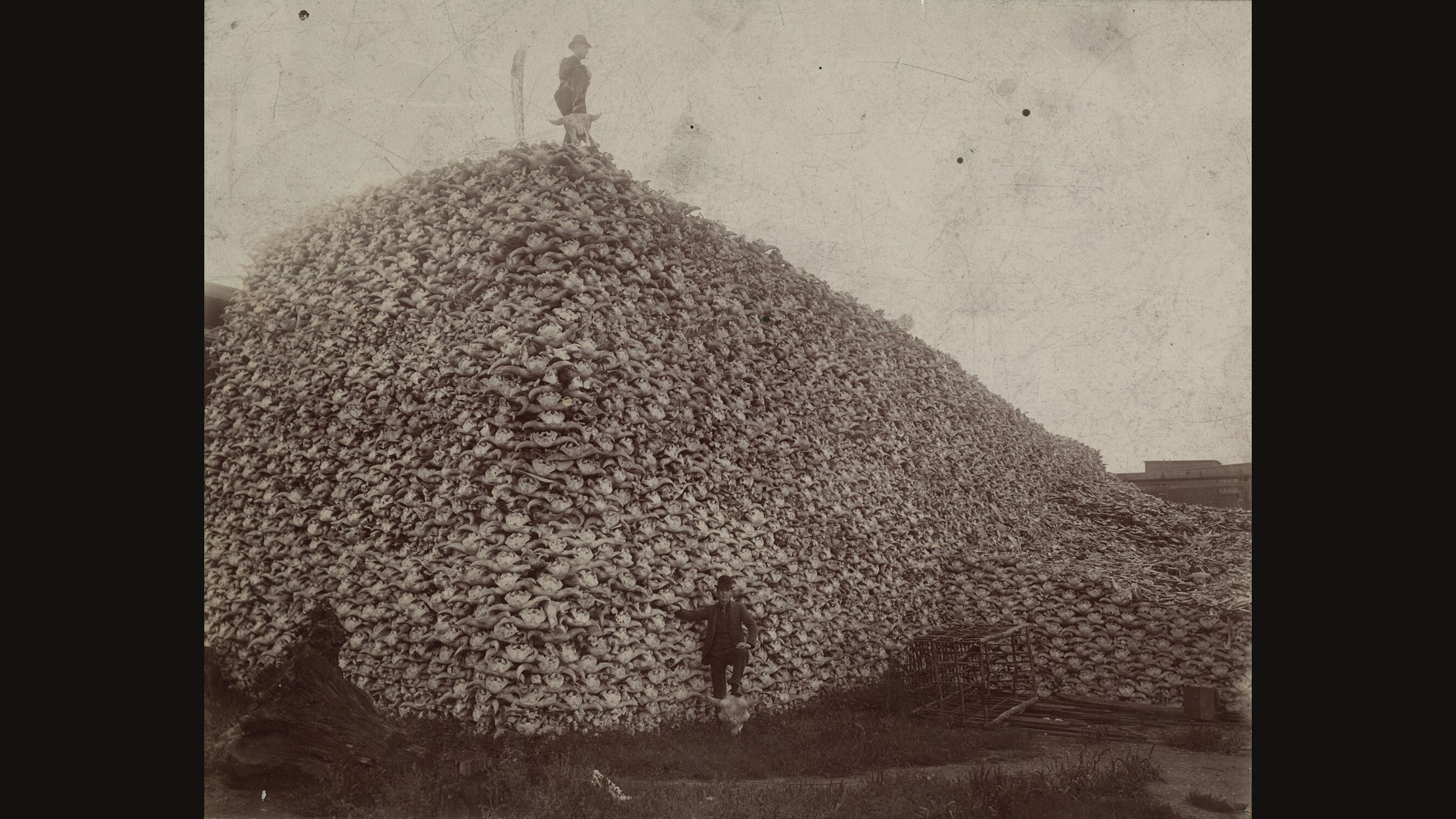
The famous photograph of a mountain of bison skulls was taken at Michigan Carbon Works in Rougeville, near Detroit, Michigan. The Burton Historical Collection dates it to 1892. The men in it are standing beside raw material: those skulls were waiting to be ground and burned into fertilizer, glue, pigment and bone char for refining sugar (Wikimedia Commons, Burton Historical Collection image).
A bison skull itself has no single meaning. In that photo it records the industrial end of the great slaughter of the bison. In documented Lakota ceremony, a buffalo skull has a place on the Sun Dance altar. On a wall or in a tattoo today, its meaning belongs to the person who chose it.
Each of those stories is worth knowing on its own, starting with the pile.
The photograph at Rougeville
The photograph shows men standing beside a huge pile of bison skulls. The Burton Historical Collection at the Detroit Public Library identifies it as an 1892 photograph of Michigan Carbon Works. A handwritten note on the back reads "C.D. 1892 Glueworks, office foot of 1st St., works at Rougeville, Mich." (Friends of the Rouge).
Michigan Carbon Works turned bison bones into fertilizer, glue, pigments, bone black, bone ash and bone char, which was used to filter and clarify sugar. Smaller amounts became buttons, knife handles, fans and umbrella ribs (Friends of the Rouge; JSTOR Daily).
So, the pile was not a monument, a trophy display or a ceremony. It was stock in a factory yard, and every skull in it came from an animal killed on the Plains in the years before.
How tens of millions became a few hundred
Before the slaughter, North America's bison are estimated to have numbered roughly 30 million to 60 million, though estimates vary with the date and method behind them (PBS). By 1889, the population in the United States had fallen to a few hundred animals. The Smithsonian's count from that year is commonly reported as 541.
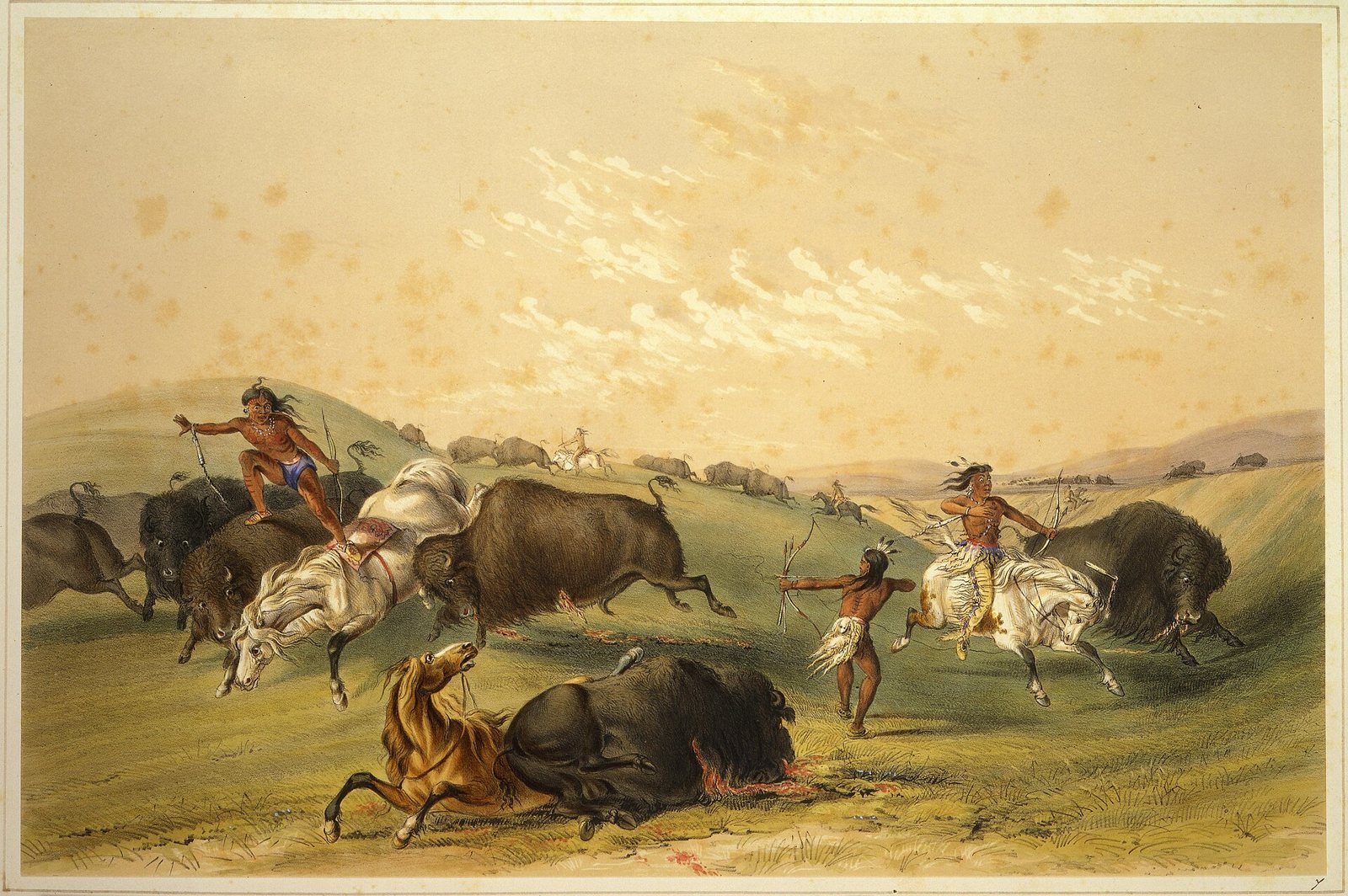
Historian Andrew Isenberg links the collapse to commercial hunting, the markets for hides and meat, the spread of railroads and settlement, weak protection, and federal policies that undermined Plains nations by destroying a central source of their food and livelihood. The US Army and government officials tolerated or encouraged exterminatory hunting while Plains nations were being forced onto reservations (PBS).
For the nations who lived with the bison, this was not only the loss of an animal. It was the loss of a central source of food and livelihood, and of the way of life built around it, taken away within the space of the 1870s and 1880s.
The bone pickers and the bone trade
The killing left carcasses across the Plains, and the bones became a trade of their own. Beginning around 1884, bone pickers gathered the remains and shipped dried bones east (Friends of the Rouge). At the peak of the trade, Friends of the Rouge reports, around 400 trainloads of bones a year went east.
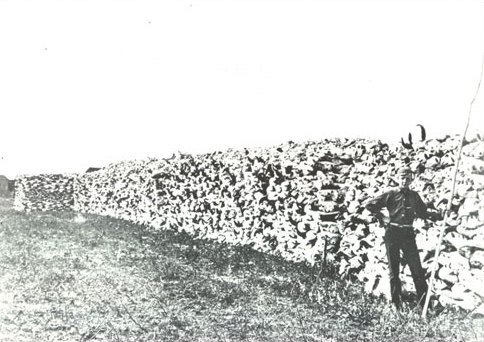
The uses were the same ones the Rougeville plant served. Bone meal and bone ash became fertilizer, bone black supplied pigment and sugar refining, and glue and gelatin makers used bones, hides and hooves (JSTOR Daily).
Historian Casey Pallister describes bone gathering as organized capitalist extraction. Pallister also stresses who did much of the work: Native and Métis people were important participants, often collecting bones for income after their access to other livelihoods had been cut off (JSTOR Daily). The skulls stacked at Rougeville in 1892 were one stop at the end of that long chain, from the Plains to the rail yards to the factory floor.
The bison skull pile and what came after
Tap or hover a step to follow the order.
1870s to 1880s
Commercial and government-supported hunting drives the bison toward extinction.
Around 1884
Bone gathering and shipping from the Plains grows into a major trade.
1889
The US bison population is reported at only a few hundred, commonly given as 541.
1892
A photograph records a huge pile of bison skulls at Michigan Carbon Works in Rougeville, Michigan.
1992
The InterTribal Buffalo Council is established to restore bison to Tribal lands.
2025
Yellowstone National Park estimates nearly 5,300 bison.
The buffalo skull in Plains ceremony
The buffalo skull has a very different meaning in ceremony, and that meaning belongs to particular nations. Our story on cow skull meaning covers the Lakota Sun Dance as the Aktá Lakota Museum describes it, the Hunka ceremony and a 1999 Lakota ceremony connected with the Yellowstone buffalo, so this section adds what other records show.
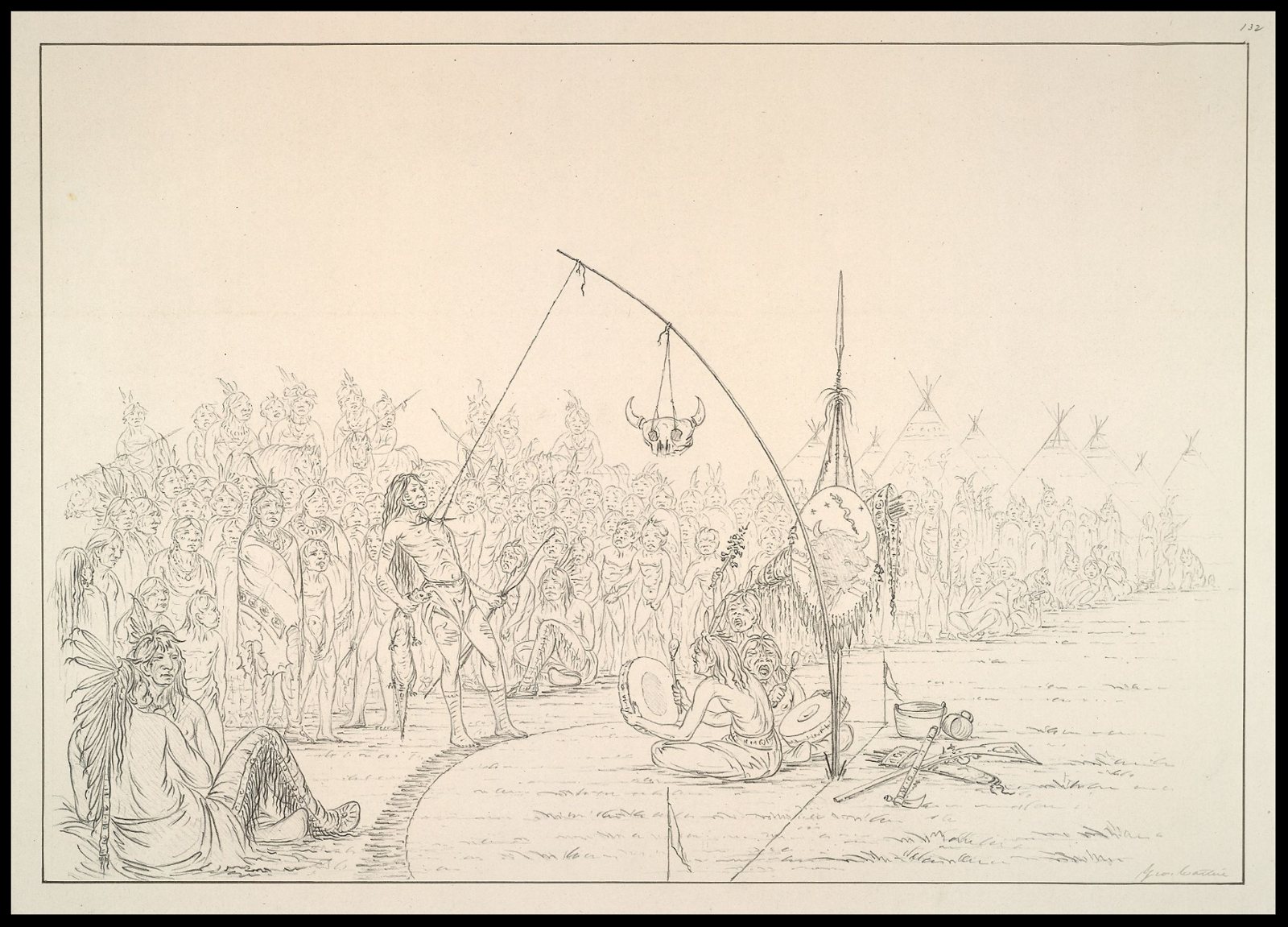
The University of Pennsylvania Museum's account of a Lakota Sun Dance describes the buffalo skull being carried into the ceremonial circle, placed on sage before the western direction, and later removed with the other altar materials. The same account records that interpretation and practice varied (Penn Museum).
The Smithsonian's archive holds a photograph titled "Ceremony, Sun Dance, Third Day: Altar in Medicine Lodge, Consisting of Buffalo Skull, Crescent of Earth, and Branches with Quilts and Blankets Hanging Behind It" (Smithsonian Institution). It documents one recorded Sun Dance, not every nation's ceremony. Older ethnographic records by George Bird Grinnell and James R. Walker describe buffalo skulls in Lakota ritual, and a National Park Service ethnographic overview mentions bison skulls in Plains ceremonial bundles and ceremonies.
These are ceremonies of named, living nations, and their present-day details are held by those communities. There is no single Plains meaning for a buffalo skull. If you want to learn more about a particular nation's practice, the nation's own cultural office or an authorized practitioner is the place to ask.
The herds come back
The bison did not vanish, and the story of their return is one of steady, shared work. Yellowstone National Park describes its herd as the largest bison population on public land. Its 2025 estimate was nearly 5,300 animals, within a management goal of about 3,500 to 6,000 wild, migratory bison. The park manages the herd with federal and state agencies, the InterTribal Buffalo Council and Tribal governments (Yellowstone National Park, Bison Management; Yellowstone National Park, Bison Ecology).
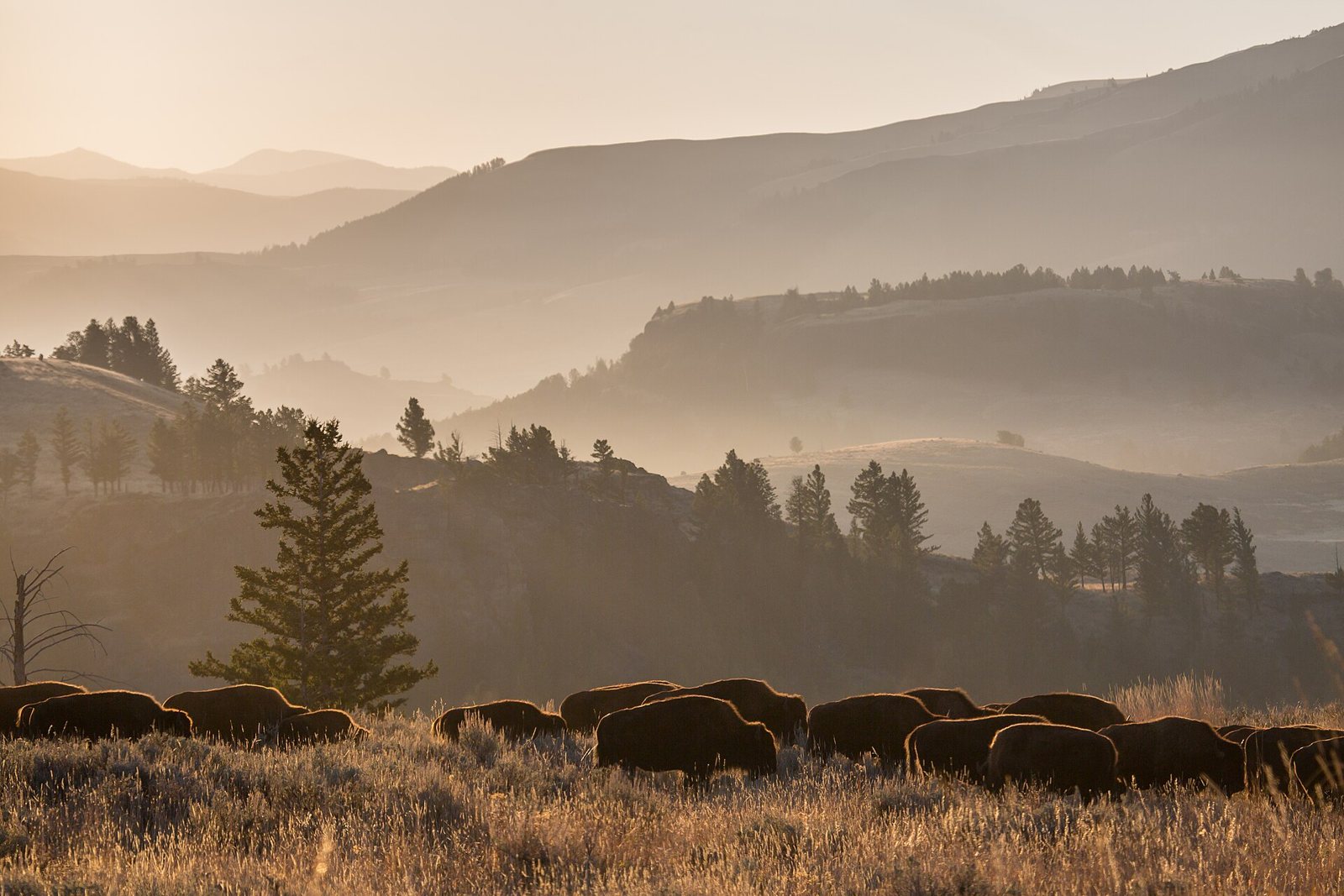
The InterTribal Buffalo Council was established in 1992 to restore bison to Tribal lands (National Park Service). ITBC says that 86 Tribes in 22 states now manage more than 20,000 buffalo across more than 32 million acres of Tribal land, with buffalo restored to nearly 1 million of those acres. It describes that restoration as cultural, spiritual, ecological and economic work, not only a matter of numbers (InterTribal Buffalo Council).
Tap or hover a row to highlight it.
| Figure | What it measures | Named by |
|---|---|---|
| Figure30 million to 60 million | What it measuresEstimated North American bison before the slaughter | Named byPBS |
| Figure541 | What it measuresBison commonly reported in the United States in 1889 | Named byPBS, citing the Smithsonian count |
| FigureAbout 400 trainloads a year | What it measuresDried bones shipped east at the peak of the bone trade | Named byFriends of the Rouge |
| FigureNearly 5,300 | What it measuresYellowstone bison, 2025 estimate | Named byYellowstone National Park |
| FigureMore than 20,000 | What it measuresBuffalo managed by 86 Tribes in 22 states | Named byInterTribal Buffalo Council |
| FigureNearly 1 million acres | What it measuresTribal land where buffalo have been restored | Named byInterTribal Buffalo Council |
Bison skull or cow skull?
If you are looking at a skull on a wall, at a sale or in a field, the shape tells you more than the size. A bison skull generally has a broader, more massive forehead, a pronounced dome, and horn cores that sit fairly close together and low on the sides of the skull. Domestic cattle skulls vary more, but many have a narrower forehead and horn cores that reach farther outward (Western Colorado Bison Project; Oxford University Museum of Natural History).
Age, sex, breed, damage and missing horns can all make a visual identification uncertain. For an unusual or damaged specimen, a museum, wildlife biologist or qualified osteologist can confirm what it is. The cow skull has a history of its own, told in cow skull meaning.
Bison or cow? What to look at
Tap a card to bring it forward.
- Forehead: A bison's is usually broad and heavy; many cattle have a narrower brow.
- Dome: Bison skulls tend to show a pronounced dome on top.
- Horn cores: On a bison they sit fairly close together and low on the sides; on many cattle they reach farther outward.
- Variety: Cattle skulls vary a lot from one breed to another.
- Hard cases: Age, sex, breed, damage and missing horns can make a skull hard to read.
- Who can confirm: A museum, wildlife biologist or qualified osteologist.
Can you own a bison skull?
This is general information, not legal advice, and laws differ by state and country.
The rules depend on where the skull came from and the law of the place where it is kept. A skull from a legally slaughtered, privately owned bison may be treated differently from remains taken from public land, a protected herd, an archaeological site, a national park or Tribal land. Utah gives an example of how this can work: its Division of Wildlife Resources Rule R657-03b prohibits collecting native or naturalized mammals from the wild for personal possession unless authorized, while listing privately owned American bison separately (Utah Division of Wildlife Resources).
Before you collect, buy, sell, import or transport a bison skull, keep a record of where it came from and ask your state wildlife agency, the US Fish and Wildlife Service, or the land-management or Tribal authority involved. If you have come across a skull outdoors, start with our page on what to do when you have found an animal skull. For a skull that is already lawfully yours, how to clean an animal skull covers the practical side.
A bison skull on the wall or on skin today
Modern meanings for a bison skull on a wall or in a tattoo include strength, survival, remembrance and a connection to the Plains. These are contemporary readings, chosen by the people who hang or wear the skull, and they are not a universal Indigenous meaning. For one owner it may be remembrance, for another the Plains, for another simply the heavy domed shape.
The owner's own reason is the meaning that counts. For ideas on displaying a skull, see skull home decor, and for the wider world of skull ink, skull tattoo meaning.
How much do you know about the bison skull?
Answer every question to check.
Frequently asked questions
Short answers to the questions that come up most about bison skulls.
What does a bison skull represent?
A bison skull has no single meaning; it depends on who is using it and where. In documented Lakota ceremony a buffalo skull can form part of the Sun Dance altar, in the 1892 Michigan Carbon Works photograph the skulls stand for the industrial use of slaughtered bison, and on modern walls and skin readings such as strength or remembrance are personal choices. None of those modern readings should be presented as a general Indigenous belief.
What did Native Americans use buffalo skulls for?
Uses varied by nation, community, ceremony and period, so the answer depends on which people you mean. Published Lakota accounts describe buffalo skulls carried into the Sun Dance circle and placed on ceremonial altars, and other Plains nations had their own practices. A nation's own cultural office is the best guide to its present-day ceremonies.
Why were bison skulls piled up?
Bison skulls were piled up because they were collected as raw material after the slaughter, to be made into fertilizer, glue, pigment and bone char. Bone pickers gathered remains from the Plains from about 1884 and shipped them east by rail. Factories such as Michigan Carbon Works stacked them in their yards until they could be processed.
More skulls with their own histories
The bison skull carries three very different stories at once: a factory yard in Michigan, a Sun Dance altar on the Plains and a herd that came back through decades of Tribal and park work. If you like reading animal skulls this way, the horse skull travels from Welsh doorways to New Mexico, and the ram skull and deer skull have their own meanings. For the wider story of what skulls have stood for, start with skull symbolism.
Terms in this story
Tap a term to see what it means.
Michigan Carbon Works. A plant at Rougeville, near Detroit, that turned bison bones into fertilizer, glue, pigment and bone char. The famous 1892 skull pile photograph was taken there.