

No. 022
Skull Home Decor: Ideas That Look Good All Year
The trick to skull decor that looks good all year is to treat the skull like any other focal object in a collected room. Give it one spot to own, on a bookshelf, a mantel or a gallery wall. Surround it with books, framed art, a plant or a few ceramics, keep the palette to two or three colors already in the room, and leave a little empty space around it so it can breathe. Choose a replica in resin, ceramic, glass, papier-mâché or stone, never real human remains. Then borrow a tone from one of the old traditions that kept skulls indoors, such as the cabinet of curiosities, the vanitas painting, the Southwestern ranch house or the gothic library, and the skull reads as a choice rather than a season.
Year-round skull decor checklist
Tap a card to bring it forward.
- Pick the skull: A replica, or a legally documented specimen
- Pick a tone: Vanitas, gothic, Southwestern, natural history or colorful folk-inspired
- Give it company: Books, art, plants or ceramics
- Limit the palette: Repeat two or three colors already in the room
- Leave space: Negative space keeps the skull the focal point
- Protect fragile pieces: Away from heat, damp and direct sun
- Check the rules: Look up wildlife rules before collecting or buying an animal skull
Borrow from the traditions that kept skulls indoors
People have been putting skulls on shelves for a very long time, and each tradition offers a ready-made look.
The cabinet of curiosities. In sixteenth-century European courts, collectors filled cabinets and rooms, called *Wunderkammern*, with natural specimens, marvels, artworks, objects from other cultures, scientific instruments and historical pieces. The Royal Collection Trust notes that Samuel Quiccheberg described the ideal cabinet in 1565. Skulls fit right in, both as natural-history specimens and as memento mori objects that kept mortality in view. To borrow the look, set a skull replica among books, shells, minerals and botanical prints.
The vanitas still life. In seventeenth-century Dutch painting, a skull stood for mortality, the shortness of pleasure and the limits of human ambition. The Metropolitan Museum of Art calls Jacques de Gheyn II's *Vanitas Still Life* one of the earliest independent vanitas still lifes; its skull sits with a bubble, cut flowers and a smoking urn, all pointing to how short life is. The National Gallery of Art notes that a skull placed in a study could prompt thoughts of mortality and salvation. A skull on a desk with a clock and a stack of old books is a direct nod to these paintings, and our stories on vanitas paintings and memento mori tell the rest of that history.
Victorian mourning rooms. In nineteenth-century Britain and North America, a household in mourning might drape its mirrors and windows, stop its clocks, turn photographs face down and wear hair jewelry, according to the Hearthstone Historic House Museum. This was a real mourning practice, not a style, so it is worth knowing about, and better borrowed from lightly than copied wholesale. If the period appeals to you, the story of Victorian mourning jewelry is a good place to learn how people actually lived with it.
Southwestern steer skulls. Steer and cattle skulls are now strongly tied to Southwestern and Western rooms, especially ranch, desert and adobe-inspired spaces. The association is a modern one, built up through ranching and twentieth-century design, and the story of what a cow skull means traces how it got there, from ranch country to Georgia O'Keeffe to Santa Fe showrooms.
Gothic interiors. Gothic rooms draw on nineteenth-century revival buildings, dark wood, carved ornament, religious imagery, taxidermy, antiquarian collecting and memento mori. A skull works as one object within that vocabulary. "Gothic" is a modern design category that pulls from many periods, so it works more like a mood than a rulebook: dark wood, deep color, old books and a single pale skull catching the light.
Skulls indoors, from cabinets to scarves
Tap or hover a step to follow the order.
1565
Samuel Quiccheberg describes the ideal European Wunderkammer
c. 1620
An unknown painter makes Vanitas Still Life with Skull, Wax Taper and Portable Sundial
c. 1650
Dutch vanitas still lifes use skulls to evoke mortality, transience and salvation
c. 1856
Jean-Baptiste Frénet makes A Vanitas, a photograph of a man holding a human skull
2003
The date of an Alexander McQueen skull scarf now in the Kunstmuseum Den Haag
2024
US Fish and Wildlife Service migratory bird salvage rules change on December 31
Día de Muertos ofrendas are their own thing
Sugar skulls and calaveras show up in a lot of skull decor, so it helps to know where they come from. In Mexico, a Día de Muertos ofrenda is a household altar that honors specific relatives who have died, set with their photographs, food, flowers, candles and personal objects. Sugar skulls and calaveras may appear on it, but the ofrenda is a living family and community tradition, and practice varies from region to region. It is not a decor theme.
If you want to build one for someone you remember, our guide to building an ofrenda walks through it, and the story of sugar skulls explains the candy skulls that often sit on the altar. A colorful folk-inspired skull on a shelf the rest of the year is a different, everyday choice, and it is easy to keep the two apart.
Where a skull works: shelves, mantels and gallery walls
None of the designers below were writing about skulls specifically. Their display principles, though, apply neatly to a skull, which is really just a sculptural object with strong opinions.
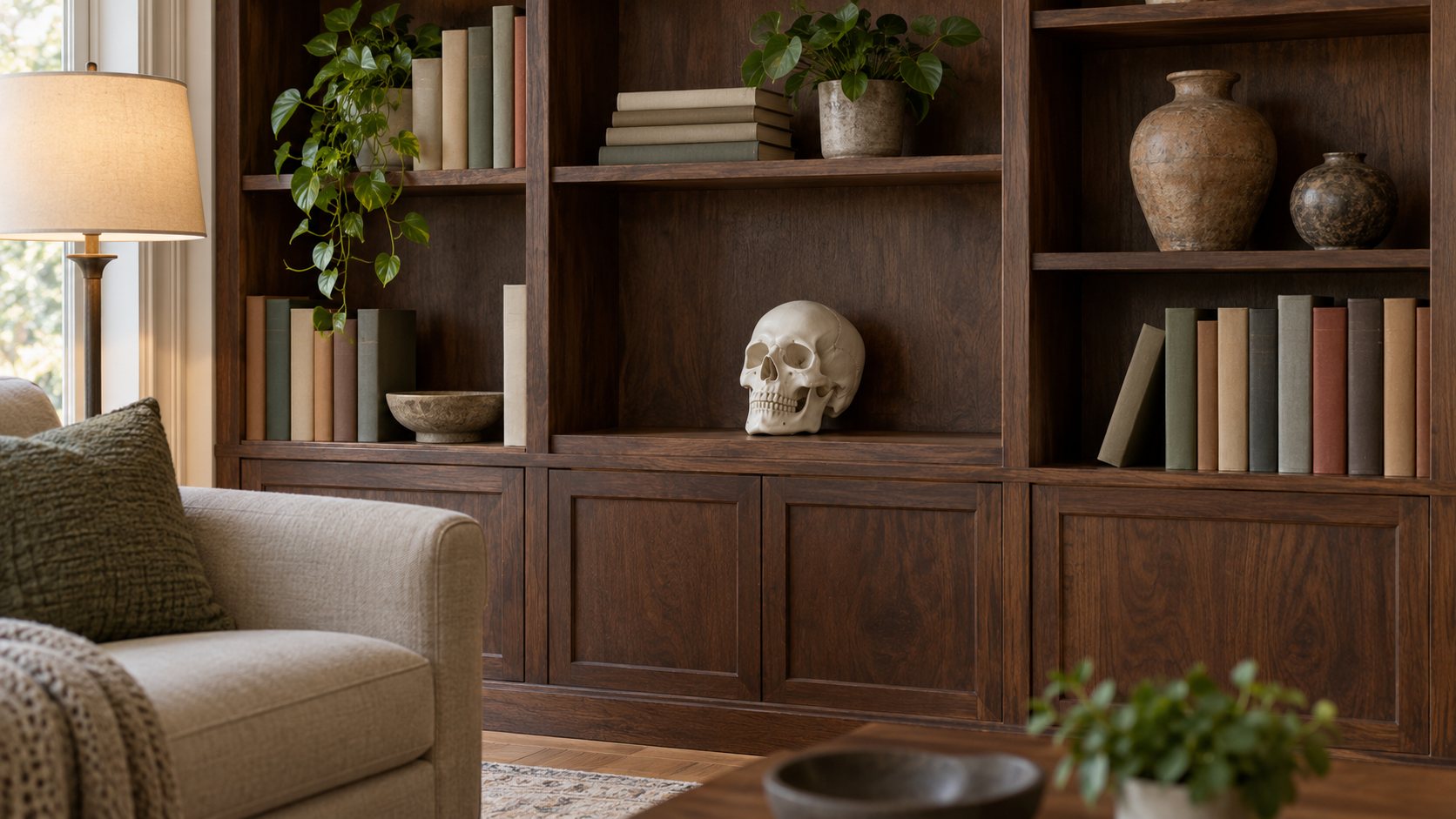
Bookshelves. Vogue's bookshelf advice stresses leaving "air" between objects and using the way books are placed to vary texture and color. For a skull, that means giving it a shelf section with some empty space around it so it stays the focal point, and mixing vertical rows of books with a horizontal stack or two. A skull at the end of a row can work like a bookend.
Gallery walls. Interior designer Jen Hayden, in an interview with Chairish, talks about gallery walls as layered arrangements of framed images and objects. A small skull sculpture or a skull print can sit among botanical prints, maps, portraits and antique-looking frames, and it reads as part of the collection, not a holiday add-on. It can also be the center of the arrangement, with the other pieces radiating out from it.
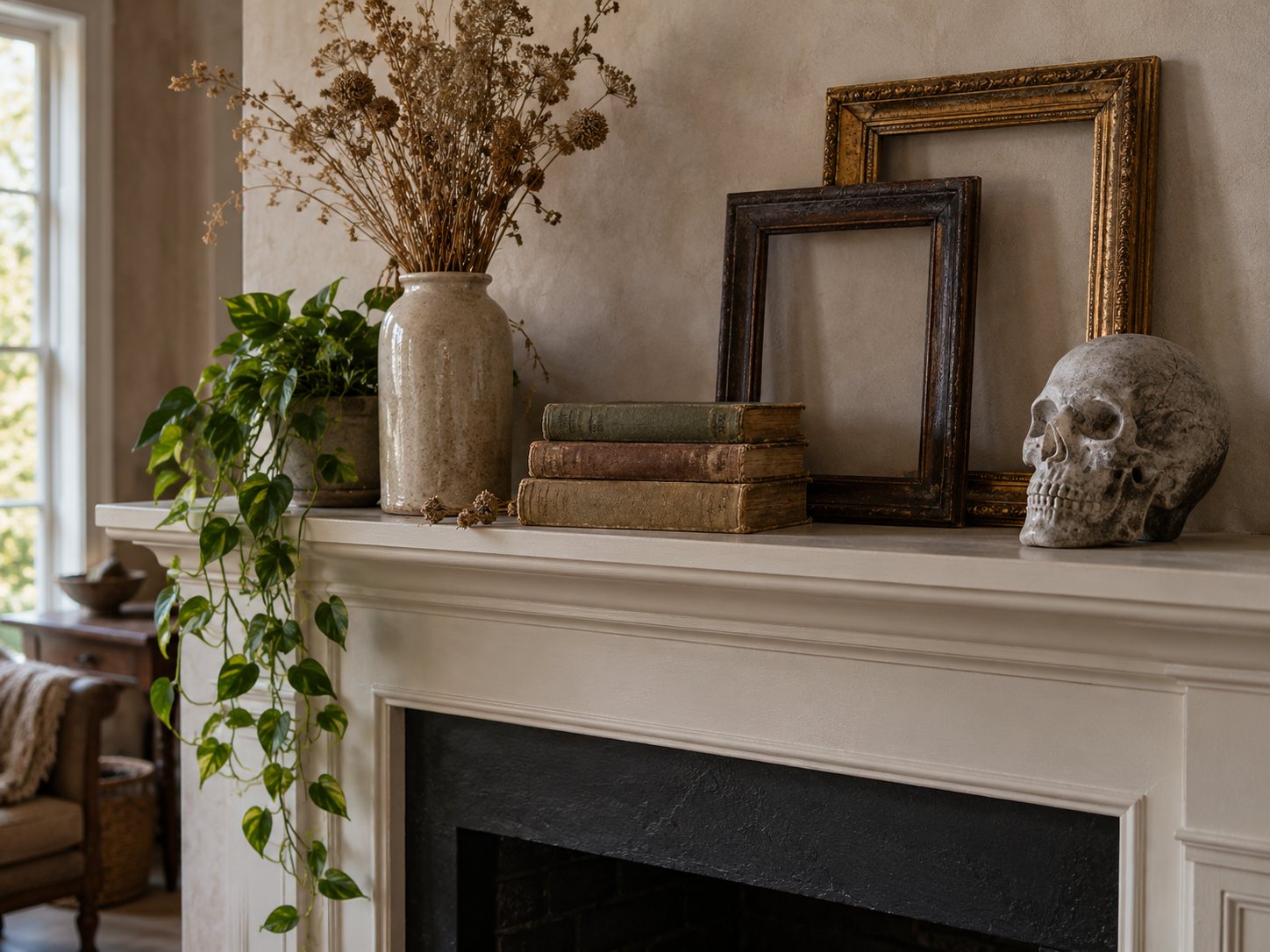
Mantels. In Architectural Digest's mantel ideas, Krysten Ledet Interiors recommends combining old frames and vintage books, and the magazine also suggests ceramics, plants, dried botanicals and gallery walls around a mantel. A skull can take the center spot or sit off to one side, with books, vessels and greenery giving it scale.
Whatever the spot, keep skulls away from open flames and real heat, and keep heavy pieces off unstable surfaces. A wall-mounted replica needs hardware suited to its weight and to your wall type.
Color and plants
Plants are one of the easiest ways to make a skull look lived-with rather than staged. Plant stylist Hilton Carter, writing in House & Garden, advises choosing plant colors as part of the room's overall palette. Judith de Graaff's bookshelf palette in Apartment Therapy runs white, gray, black, green and terracotta, which sits comfortably with bone white, matte black, aged bronze and desert-toned skull replicas.
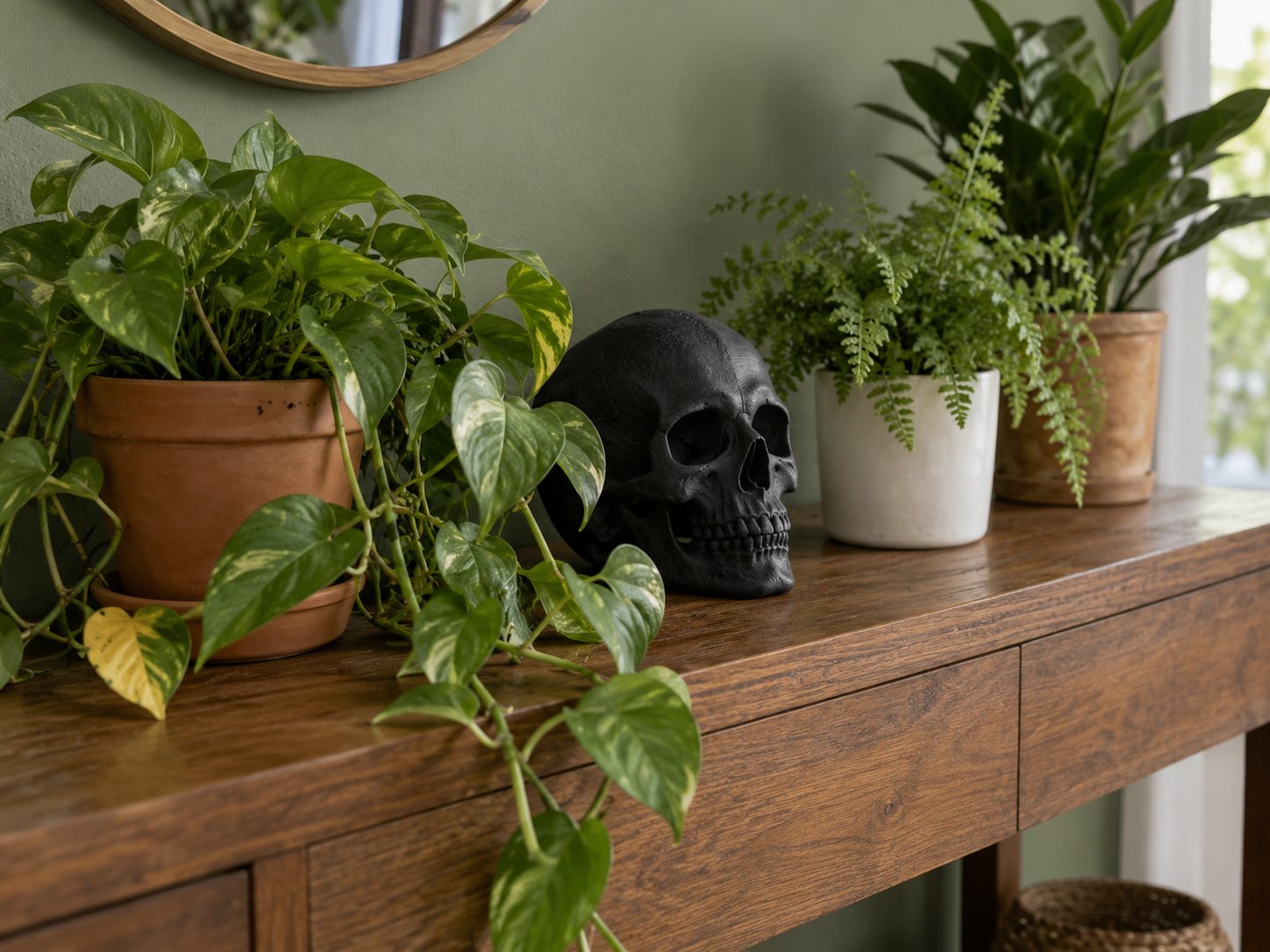
From there, you have two easy routes. For a restrained room, stick to bone, charcoal, brown, cream, muted green and brass. For a colorful room, repeat one accent color that is already in the space on the skull itself or on the object right beside it. A matte skull against a strongly colored wall is another option that does a lot with very little. Either way, a tight palette is what makes a skull look collected rather than seasonal.
Choosing a material and caring for it
Decorative skulls come in many materials, and each one asks for slightly different care. Museum conservators offer a sensible baseline for all of them: handle them as little as possible, keep conditions stable, keep them out of strong light and dust them gently and dry.
Tap or hover a row to highlight it.
| Material | Good to know | Care |
|---|---|---|
| MaterialResin | Good to knowLight and easy to mold | CareKeep out of long direct sun and strong heat; dust with a soft brush or microfiber cloth; follow the maker's label |
| MaterialCeramic | Good to knowDurable when glazed, but chips and cracks are weak points | CareLift with two hands, not by projections; do not soak an unknown or damaged piece |
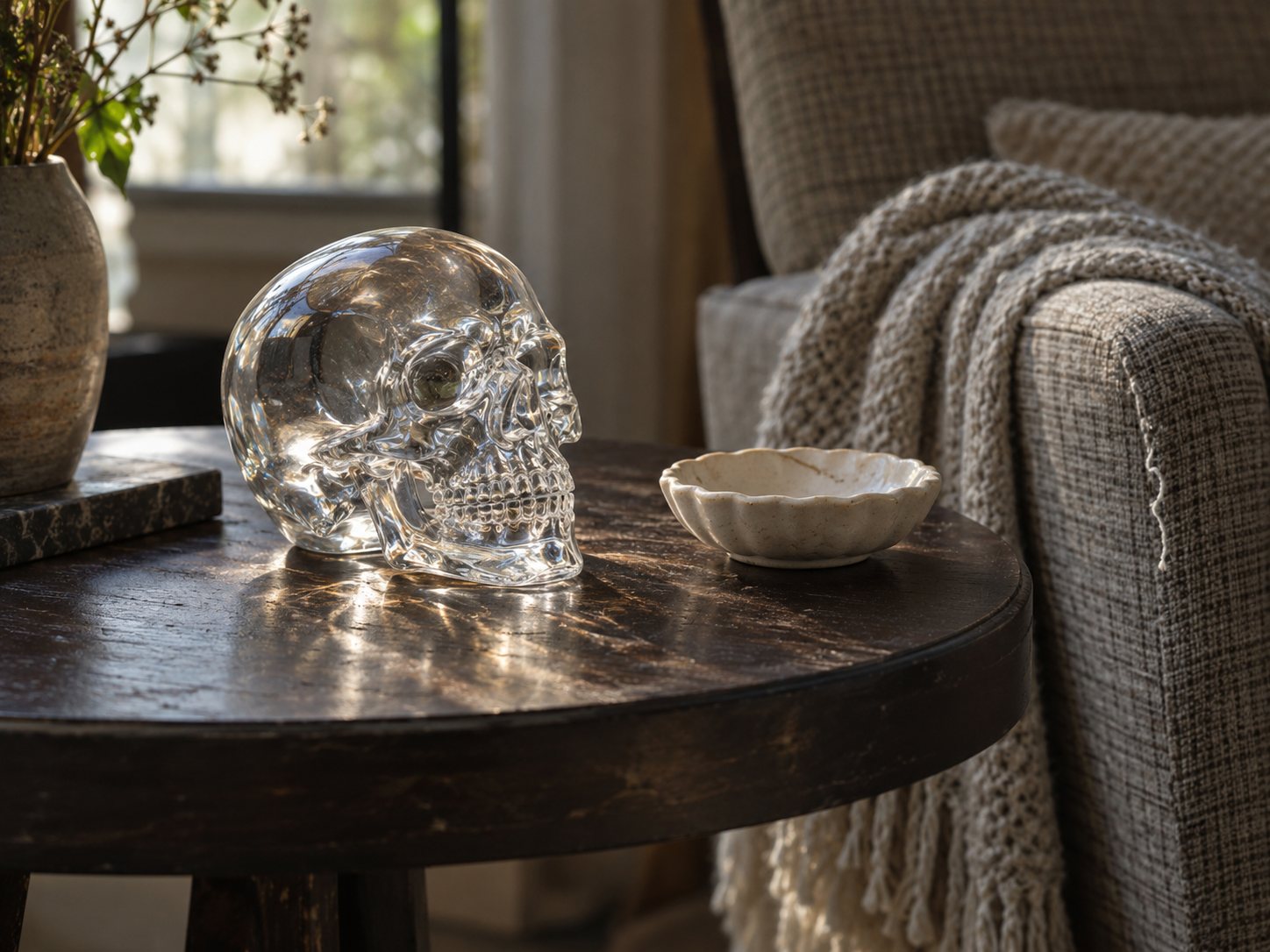
| MaterialGlass | Good to knowSensitive to knocks and temperature swings | CareKeep off wobbly shelves; support from underneath; do not scrub clouded glass |
| MaterialPapier-mâché | Good to knowA paper-based object | CareKeep dry and away from humidity, sun and damp walls; dust lightly, no wet cleaning |
| MaterialCarved stone | Good to knowHeavy; can scratch or stain | CareUse a stable padded base; waxed stone can be buffed with a soft cotton cloth |
| MaterialPainted, gilded or mixed | Good to knowSurfaces vary | CareNo household sprays, abrasives or solvents; ask a conservator if the surface flakes |
A few notes from the institutions behind that advice. The National Park Service warns against wet cleaning ceramic and glass objects without training, because immersion can cause permanent damage, especially to poorly fired or salt-contaminated earthenware. The Canadian Conservation Institute recommends protecting ceramics and glass from direct sunlight, heat, cold and damaging humidity, and its notes on stone carvings say waxed stone may be gently buffed with a soft cotton cloth. Museums Galleries Scotland groups papier-mâché with paper collections, so it needs the same dry, stable conditions as paper. For resin and papier-mâché pieces, the maker's own care label comes first; when in doubt, dust dry. If an old painted or gilded skull starts to peel or turn powdery, or it is rare enough to matter, take it to a conservator.
Skulls on fabric, pillows and walls
Not every skull in a room has to be three-dimensional. Alexander McQueen made the skull a recognizable fashion motif, and the Victoria and Albert Museum ties his skull imagery to the long history of memento mori, noting his use of skeletons, horns and taxidermy as embellishment. A 2003 McQueen skull scarf is held in the collection of the Kunstmuseum Den Haag.
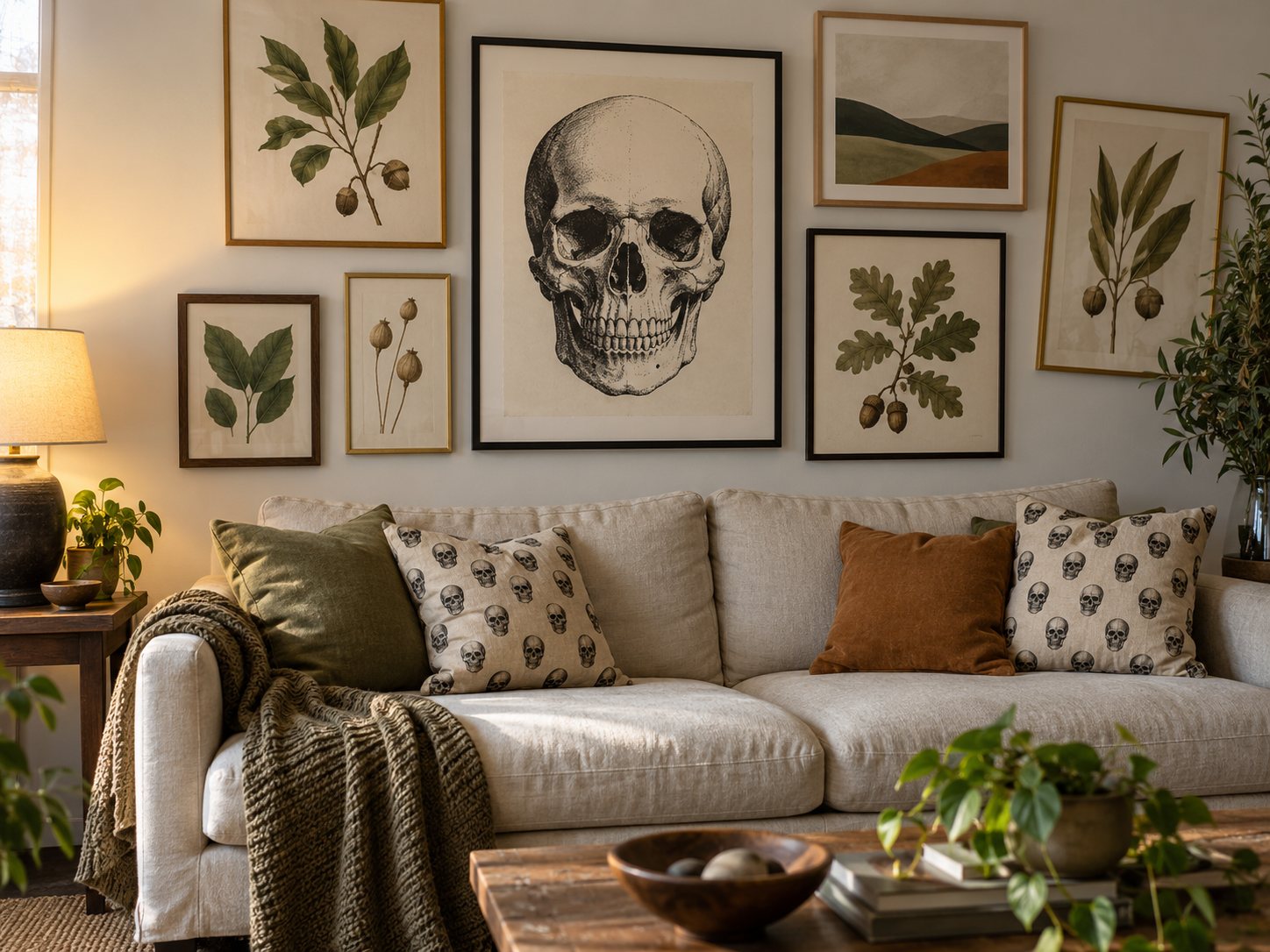
At home, the same motif moves easily into pillows, throws, framed textile panels, curtains and wallpaper. A framed skull-print scarf on a wall is one way to bring the idea in without adding another object to a crowded shelf. When choosing skull wallpaper or textiles, credit the designer by name and look for a maker whose own archive dates the design.
Thinking about a real animal skull?
Some people want the real thing, usually an animal skull from a walk or a shop. That can be done, but the rules come first.
> Legal note: This is general information, not legal advice. Laws differ by state and country, and depend on the species, where it was found, who owns the land and whether you are buying, selling, moving or importing it.
A few examples show how much the rules vary:
- Wisconsin. The Wisconsin Department of Natural Resources allows people to collect clean skulls and bones of deer, elk and unprotected wild animals when the animal was not illegally killed, with permission required on private land. Moose, bear and other protected species need specific authorization, and protected bird skulls and bones cannot be collected.
- Birds, nationwide. The US Fish and Wildlife Service says native North American bird parts are generally protected under the Migratory Bird Treaty Act, and road-killed or naturally molted parts are not automatically exempt. Federal bird salvage rules changed on December 31, 2024, but personal possession and other restrictions still apply.
- Texas. Texas Parks and Wildlife restricts the possession, sale and purchase of protected wild animals and their parts, with specific exceptions for certain lawfully taken inedible parts.
A skull being offered for sale does not prove that every specimen of that species is legal to own. Before you buy or keep one, identify the species, confirm which rules apply where you live, get the landowner's permission where needed and check with your state wildlife agency. Our story on what to do if you found an animal skull covers the rules in more detail, and how to clean an animal skull covers the safe way to prepare one. For most rooms, though, a clearly labeled replica or a legally documented specimen from a reputable seller is the simplest choice.
Skulls at home quiz
Answer every question to check.
Frequently asked questions
These are the questions people ask most often before a skull goes up on the shelf.
How can I decorate with a skull?
Put a skull replica on a bookshelf, mantel or console with books, framed art and a plant or dried botanicals. Use one dominant skull and a limited palette so the arrangement looks deliberate. Secure wall-mounted pieces with the right hardware and keep everything away from heat and open flames.
What are some creative ways to decorate with a skull?
Make it the center of a gallery wall, use it as a bookend-like sculpture on a shelf, set a matte skull against a strongly colored wall, or group a ceramic skull with plants and vintage books. For craft projects such as painting or decorating a skull, start with a replica rather than human remains or an unidentified animal specimen.
Is it bad luck to have skulls in your house?
Views differ, and there is no single meaning. In Dutch vanitas art the skull pointed to mortality and the shortness of worldly pleasure, and in Mexican Día de Muertos traditions calaveras and sugar skulls belong to remembrance and celebration. Some people, through their own religious or personal beliefs, see skulls as warnings, protection, rebellion or bad luck.
What do skulls mean in home decor?
It depends on the setting and the person. A skull can stand for mortality and reflection, remembrance, a family or community tradition, natural history, gothic style, rebellion or simply a love of art and anatomy. The material, the placement and the objects around it are what tell guests which one you mean.
Where to go next
If you are shopping for someone else who likes this look, our list of gifts for skull lovers has more ideas. For the history behind the vanitas desk, read what memento mori means. And if you would rather wear the idea than shelve it, our Memento Mori skull tee has a vanitas-style engraving of a skull beside an hourglass and an olive branch, with MEMENTO MORI above and USE THE DAY WELL below.