

No. 061
The Ankou: The Skeleton Who Collects the Dead in Brittany
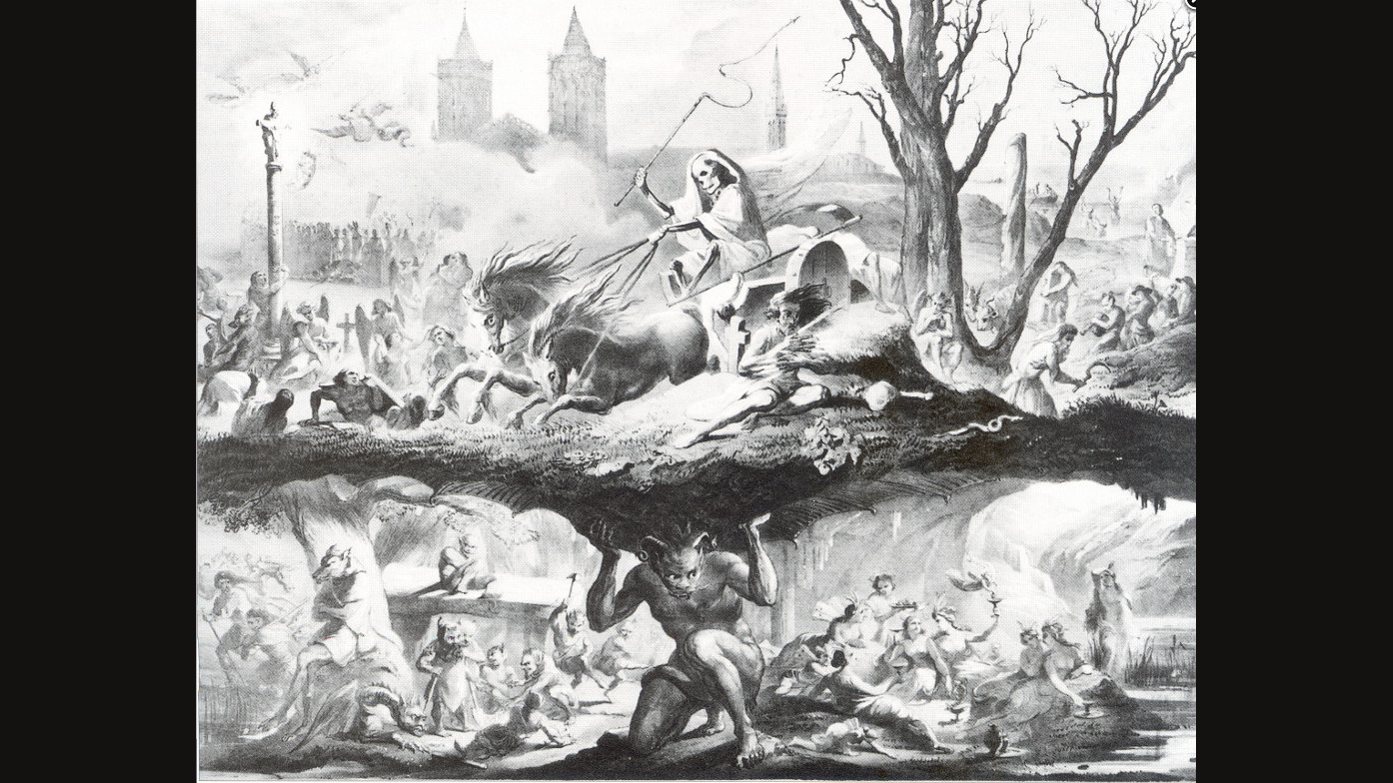
The Ankou is the "worker of death" of Lower Brittany, *oberour ar maro* in Breton: the figure who seeks out the dying and carries them to the other world in his cart. In the legend as Anatole Le Braz recorded it in his 1893 collection, *La Légende de la mort en Basse-Bretagne*, the last person to die in each parish during the year becomes that parish's Ankou for the year that follows. Tellers describe him as a tall, thin man in a broad hat, or as a shrouded skeleton whose head turns constantly to watch over his territory.
Many readers first meet the name in a video game, but the Ankou belongs to the parishes of western France, where he was carved in stone and wood, set beside coffins and remembered in the stories Le Braz wrote down. Here is who he is in those stories, told the way the Breton folklorists heard them.
A parish's own worker of death
What makes the Ankou unusual among figures of death is that the job rotates. In Le Braz's account, he is not a single eternal being but a role filled each year by one of the parish's own dead: whoever dies last before the year turns takes up the work for the next twelve months. The folklorist Daniel Giraudon, writing for the Breton cultural encyclopedia Bécédia in 2023, records a local variation. In parts of Lower Brittany, the role could fall instead to the first person who died in the new year.
His work, as Le Braz and Giraudon describe it, is to seek out the dying, gather the dead and escort them from life to the other world. Breton stories also give him other jobs: messenger, gravedigger and, in some local traditions, a justiciary, a figure who deals out justice, which Giraudon follows in his piece on *l'ankou justicier*. He is less a monster than a parish official whose duties nobody wants.
The name itself is old. Giraudon notes that the word connected with *Ankou* appears in a ninth-century gloss to a Latin text, a note written into the margin or between the lines of a manuscript. By the sixteenth and seventeenth centuries, he adds, the Ankou was appearing in Breton literature as a character on the stage and in poems. When Le Braz wrote down his tales at the end of the nineteenth century, the Ankou already had centuries of Breton history behind him.
The cart and its noisy axle
The Ankou does not walk. Le Braz describes his cart, *karriguel ann Ankou*, as looking like the carts once used to carry the dead. It is normally drawn by two horses and has two helpers: one leads the front horse, and the other opens the gates and loads the dead into the cart. It is a small, practical crew for a grim errand.
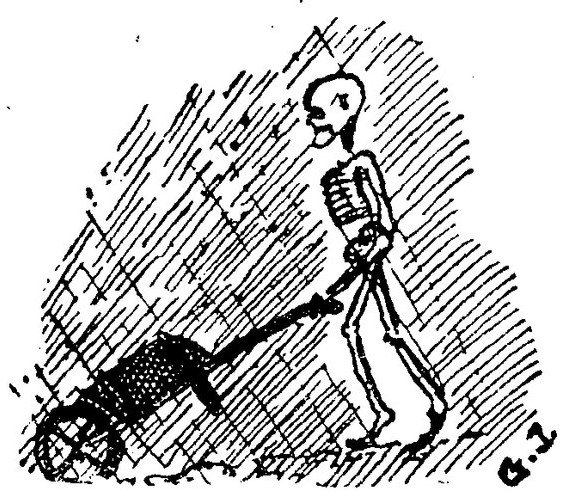
The cart is usually heard before it is seen. In a story Le Braz collected from Françoise Omnès of Bégard in September 1890, a young man from Trézélan hears an axle that badly needs grease: "Wik! wik!" Then he sees the cart stop, because its axle has cracked. He dies the following day.
That sound carried meaning well beyond one tale. Bécédia records a Lower Breton belief that the grinding of the cart's wheels could be heard three days before a death in the family or among the neighbors. So, in these stories, the noisy cart is a warning: someone close is about to be collected.
A scythe turned the wrong way
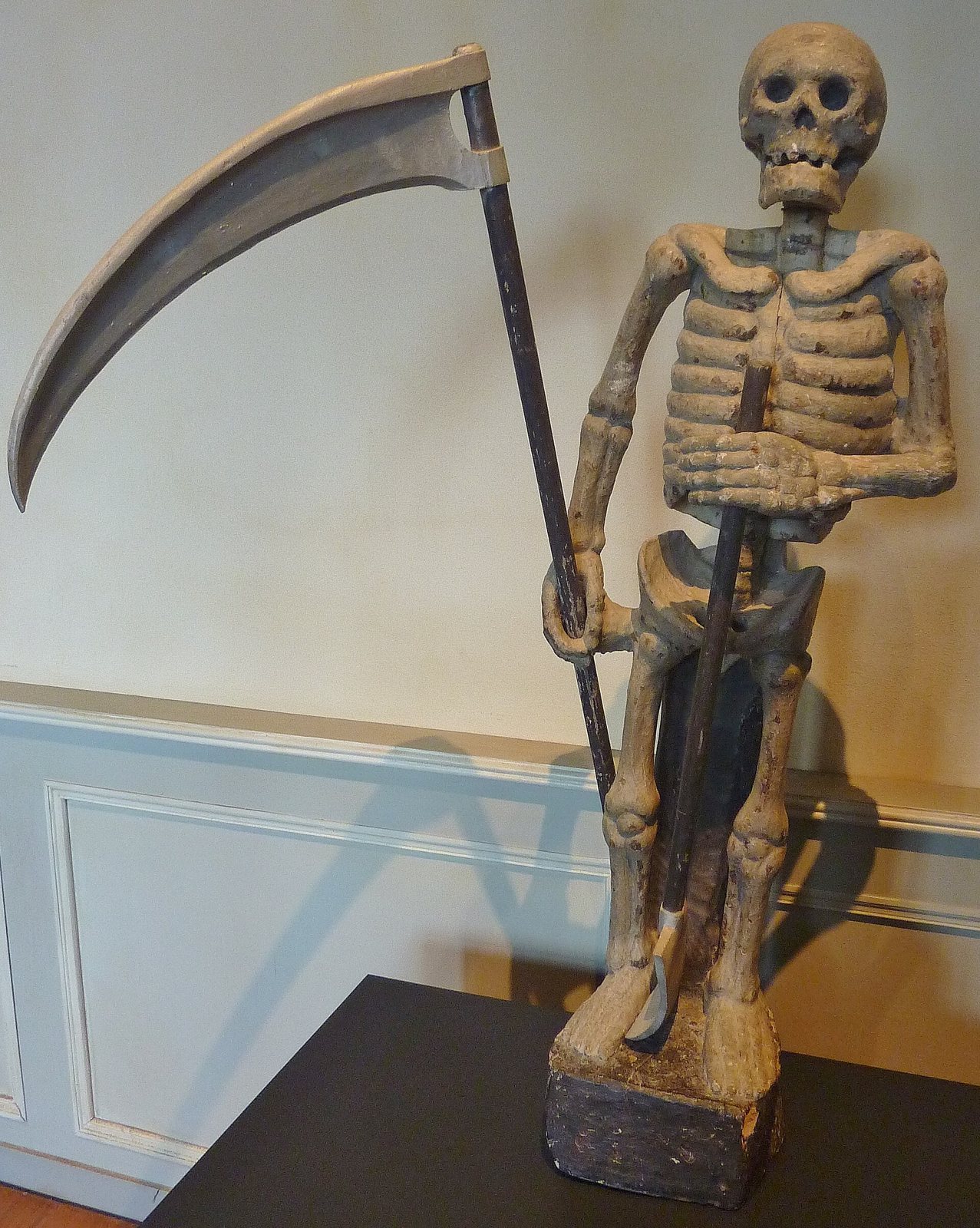
The Ankou's best-known tool has a twist. Le Braz says the cutting edge of his scythe is turned outward, so instead of drawing the blade toward himself like a farmer cutting hay, he throws it forward. He sharpens it with a human bone. It is the kind of detail that makes a listener go quiet, and Le Braz set it down plainly.
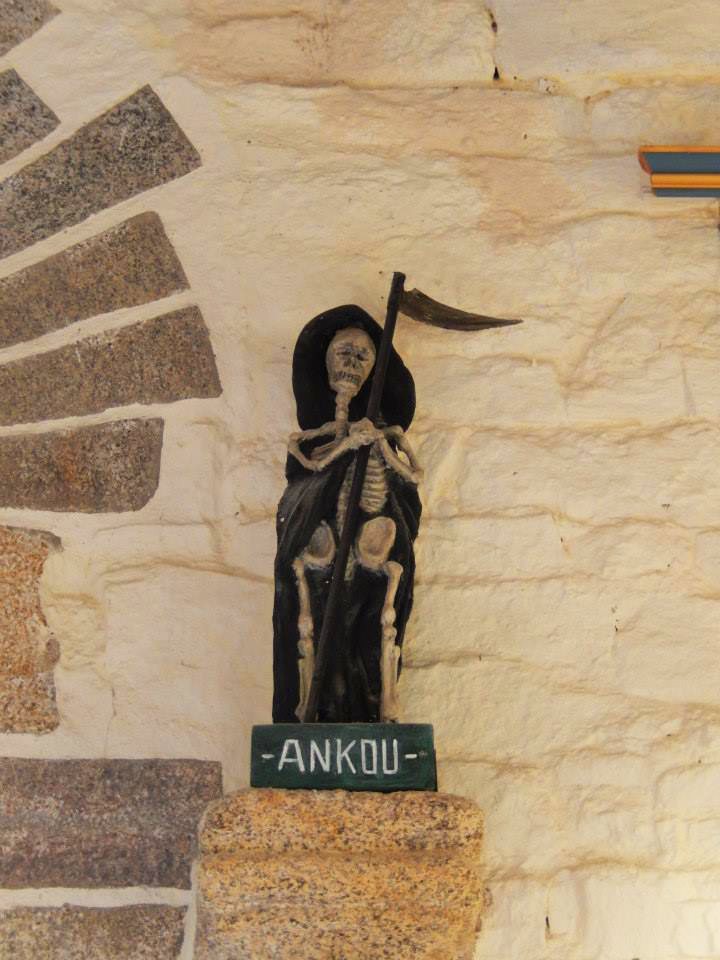
The scythe was not always part of the kit, though. Bécédia cautions that it was not necessarily the Ankou's oldest attribute. Earlier images could show him with a lance, a javelin, an arrow, a shovel, a pick or a hoe. The scythe became prominent in the written descriptions of the nineteenth-century folklorists, which is one reason the Ankou of books and the Ankou of church carvings do not always carry the same things.
The Ankou in stone and wood
Two places in Brittany show the Ankou as carvers made him, and they make an interesting pair.
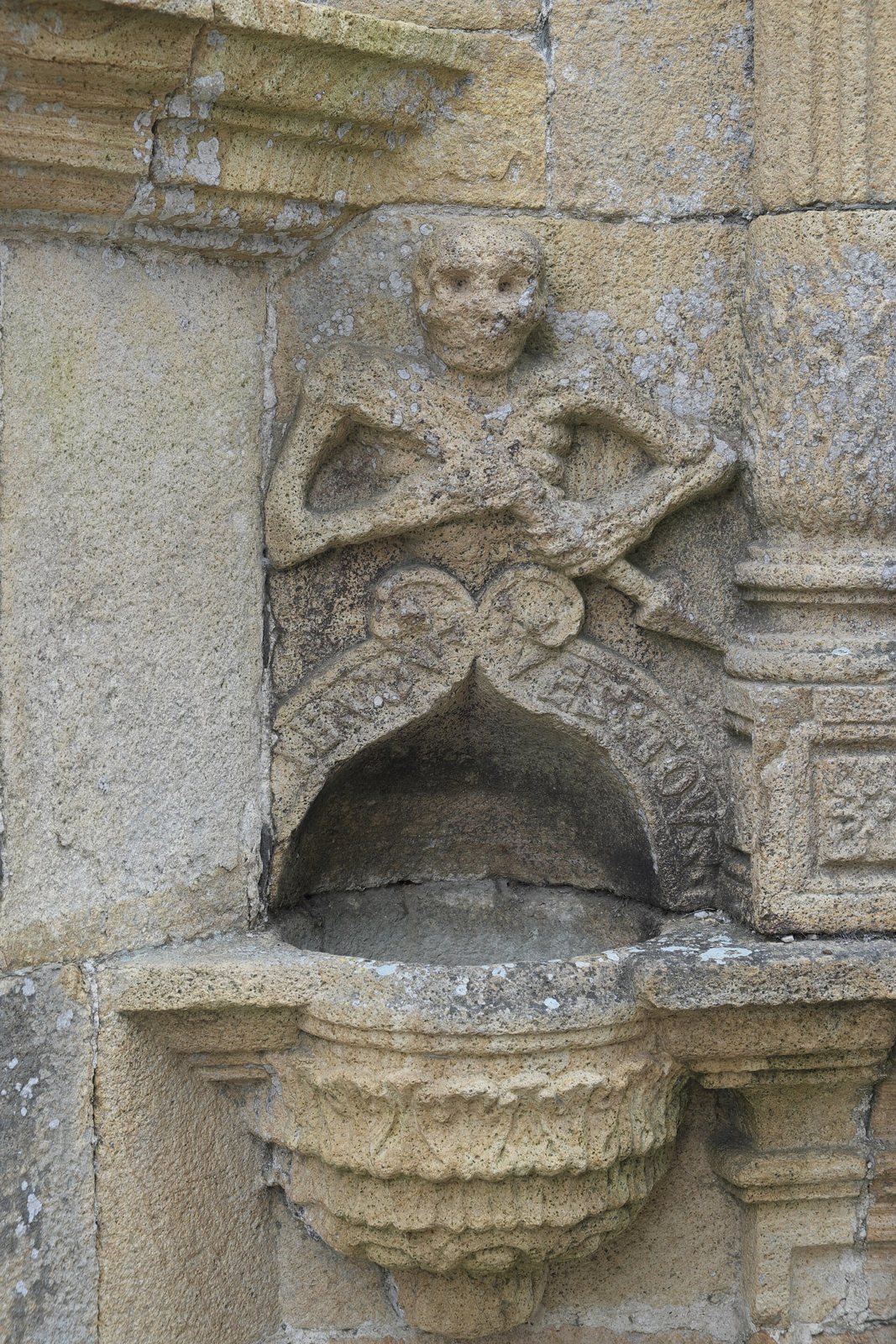
At La Roche-Maurice in Finistère, the parish close, a walled churchyard with its church and buildings, includes a sixteenth- and seventeenth-century complex with an ossuary, a building that once held bones moved from the graves. According to the La Roche-Maurice parish heritage page, a sculpture of the Ankou stands above the holy-water stoup, the basin of blessed water by the door. The Diocese of Quimper heritage description records the date 1640 and the inscription "JE VOUS TUE TOUS," French for "I kill you all." Here the Ankou holds a dart rather than a scythe. It is the old idea of memento mori, keeping death in view, delivered with no softening at all to anyone coming in to pray. The wider tradition of bone houses is gathered in our page on ossuaries around the world, and the place of skulls and bones in church settings in skulls in Christianity.
At Ploumilliau in Côtes-d'Armor, the Ankou is made of wood. The Brittany cultural heritage inventory records a statue 99 centimetres tall, carrying a shovel and a scythe, traditionally dated to the fifteenth century, although that dating is approximate. Two similar statues were reportedly placed on either side of the coffin during funerals. On 18 April 1845, a diocesan representative ordered the statues removed from the church, and the practice was abandoned. Giraudon identifies Ploumilliau's figure as one of the two major surviving wooden Ankou models, and the only one still in a church.
Tap or hover a row to highlight it.
| Detail | La Roche-Maurice | Ploumilliau |
|---|---|---|
| DetailDepartment | La Roche-MauriceFinistère | PloumilliauCôtes-d'Armor |
| DetailSetting | La Roche-MauriceOssuary of the parish close, above the holy-water stoup | PloumilliauSaint-Milliau church |
| DetailMaterial and date | La Roche-MauriceSculpture dated 1640 in the diocesan description | PloumilliauWooden statue, traditionally fifteenth century, approximate |
| DetailWhat he holds | La Roche-MauriceA dart | PloumilliauA shovel and a scythe |
| DetailOther detail | La Roche-MauriceInscription "JE VOUS TUE TOUS," "I kill you all" | Ploumilliau99 centimetres tall; once placed beside coffins at funerals |
A statue that travels
For a figure who carries others away, the Ploumilliau Ankou has done some travelling of his own. The municipality of Ploumilliau records that the statue was shown at Schallaburg in Austria in 1990 and at Château de la Roche-Jagu in 1991. In 2016 it was moved to Château de Kerjean at Saint-Vougay for an exhibition on religion and death in sixteenth-century Brittany, running from 26 March to 1 November, as the town describes in its notice on the Ankou's 2016 exhibition. Seven months away from his church is a long holiday for anyone, let alone a fifteenth-century carving.
The Ankou through time
Tap or hover a step to follow the order.
Ninth century
The word connected with Ankou appears in a gloss to a Latin text, according to Daniel Giraudon.
Fifteenth century
The traditional, approximate date of the wooden Ankou statue at Ploumilliau.
Sixteenth and seventeenth centuries
The Ankou appears in Breton literature as a theatre character and in poems.
1640
The date recorded for the Ankou sculpture and inscription at the La Roche-Maurice ossuary.
18 April 1845
A diocesan representative orders Ploumilliau's two funeral Ankou statues removed from the church.
September 1890
Anatole Le Braz records Françoise Omnès' story of the Ankou's cart and its badly greased axle.
1893
Le Braz publishes La Légende de la mort en Basse-Bretagne.
1990
The Ploumilliau statue is exhibited at Schallaburg, Austria.
1991
The statue is exhibited at Château de la Roche-Jagu.
2016
The statue goes to Château de Kerjean for an exhibition on religion and death in sixteenth-century Brittany.
The Ankou beside the Grim Reaper and other death figures
The Ankou and the Grim Reaper look alike at first glance, since both can appear as skeletal figures with a harvesting tool, and the comparison is a fair starting point as long as it stays approximate. The Ankou is a specifically Breton death worker, guide and messenger, tied to a parish, a cart and a role that passes from one of the dead to the next. The Grim Reaper is a broader Western personification of death whose imagery grew out of medieval European Catholic representations, especially after the plague years of the fourteenth century, as the University of British Columbia summarizes. The Reaper's own story is told in Grim Reaper origin, and the processions of skeletons that helped shape him in danse macabre.
The Ankou is not presented as a god of death. Giraudon records a proposed link with Sucellos, a Gaulish deity associated with a mallet, but states that there is no proof placing the mallet in the Ankou's hands. The closest comparison is with psychopomps, figures across many cultures who guide the dead on their way. Korea's Jeoseung Saja is one such escort, and many more are gathered in our tour of gods of death.
Visiting Ploumilliau and La Roche-Maurice
If a trip to Brittany is what brought you here, both carvings stand in places that are still part of parish life. Ploumilliau's municipal tourism page says Saint-Milliau church is open to visitors during July and August, with guided visits arranged regularly through the town hall. A municipal heritage notice in the Ploumilliau heritage archive gives summer hours of Monday through Saturday, 10:00 to 12:30 and 14:30 to 18:30, and Sundays and public holidays, 14:30 to 18:30.
The town has also opened its church for European Heritage Days. The municipality listed church visits on 21 and 22 September 2024, and its archive listed 19 and 20 September 2026 for Saint-Milliau and Keraudy. Those dates have now passed, so look for the coming year's Heritage Days listing. Confirm current access with the municipality of Ploumilliau before you travel, and for La Roche-Maurice, confirm opening arrangements with the municipality or the parish before visiting.
These are working churches, and their churchyards hold the families of the people who live there. Visiting quietly and respectfully is the best way to see the Ankou where he belongs.
How well do you know the Ankou?
Answer every question to check.
Questions about the Ankou
A few more questions come up often about Brittany's worker of death.
Is the Ankou a god?
The Ankou is not presented as a god in Breton folklore. He is a worker and messenger of death, a role filled by one of the parish's own dead. Daniel Giraudon notes a proposed link with the Gaulish deity Sucellos, but says there is no proof for it.
What does the word Ankou mean?
Ankou is the Breton name for the figure Anatole Le Braz calls *oberour ar maro*, the worker of death. Giraudon traces the word back to a ninth-century gloss on a Latin text, so the name was in writing long before Le Braz collected his stories.
Is the Ankou still part of Breton life?
The Ankou is still part of Brittany's heritage in very visible ways. The wooden statue at Ploumilliau still stands in its church and has gone on exhibition as recently as 2016, and the 1640 carving at La Roche-Maurice still watches over the holy-water stoup. The stories Le Braz wrote down came from tellers he met in the 1890s.
Can the Ankou be someone other than the last to die?
The Ankou can be the first person to die in the new year in some parts of Lower Brittany, according to Giraudon. Le Braz gives the more familiar version, where the last death of the old year fills the role, so the answer depends on which parish is telling the story.
Where to go next
The Ankou is one of the most local death figures there is, belonging to particular parishes, roads and carts. For the wider family he belongs to, start with gods of death, and for everything else the skull and skeleton have meant across cultures, see skull symbolism.
Terms in this story
Tap a term to see what it means.
Ankou. The worker of death in the folklore of Lower Brittany, who seeks out the dying and carries the dead away in his cart.
---