

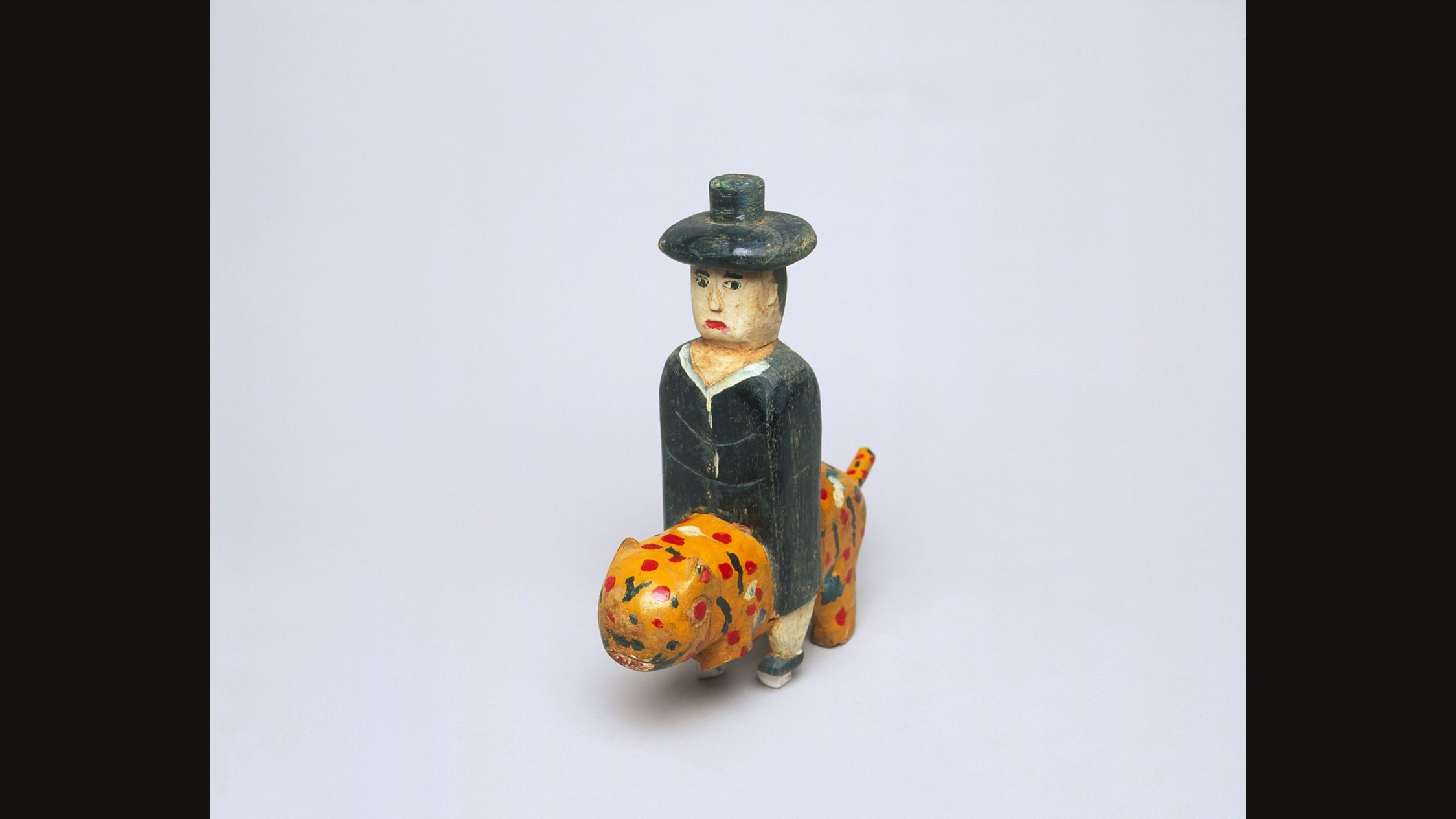
No. 108
Jeoseung Saja: Who Is the Korean Grim Reaper?
The jeoseung saja (저승사자) is the messenger of the afterlife in Korean folklore, the figure who comes for the dead and takes them from iseung, this world, to jeoseung, the afterlife. The Korean folklorist Kim Deok-muk, writing in the Academy of Korean Studies encyclopedia, describes him as an intermediary who escorts the dead and presents the soul before the Ten Kings of the underworld. He is usually not alone: in Seoul gut traditions, the messengers come as a group of three.
If you met him first as the charming man in the black hat in *Goblin*, or as one of the Saja Boys in *KPop Demon Hunters*, you have seen the screen versions. They borrow from a figure who still lives in Korean funeral songs, rites and stories. This story covers who he is in that tradition, what families set out for him, where the black hat came from, and how the folk messenger compares with the skeleton and scythe of the European Grim Reaper.
What does jeoseung saja mean?
Jeoseung saja means "messenger of the afterlife," or "messenger from the world of the dead." Jeoseung is the otherworld, the land of the dead, and saja means a messenger or envoy. Its partner word, iseung, is the world of the living, so the name already tells you the job: someone who travels between the two.
That makes jeoseung saja the name of a role. It does not point to one particular individual with a fixed face and biography, the way a single god of death might. In shamanic and scholarly writing you will also meet the term jeoseung chasa, another way of naming the underworld messenger. When someone asks what the Korean grim reaper is called, jeoseung saja is the answer, and jeoseung chasa is the term that turns up in discussions of ritual.
The messengers in Korean folklore, and why there are often three
In the tradition, the jeoseung saja works inside an ordered afterlife. He is sent to collect a person whose time has come, he escorts that soul, and he brings it before the Ten Kings for what follows. Kim Deok-muk calls the figure a cultural mediator, one who appears across Korean legends, funeral songs, funerals themselves and cheon dogut rites. The National Folk Museum of Korea presents him in the same way, as a messenger of the afterworld.
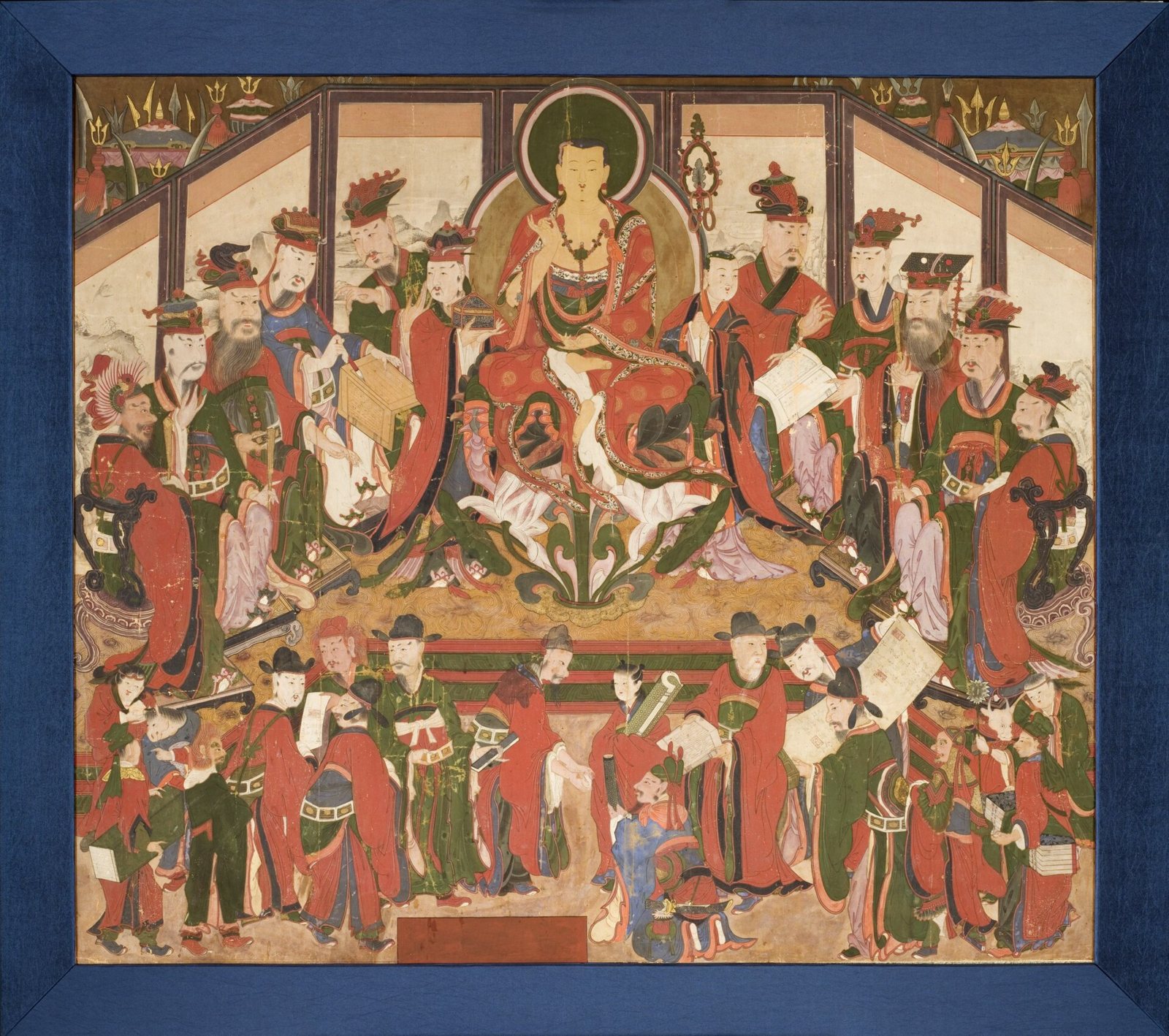
So, are there three Korean grim reapers? In many regional traditions, yes. In Seoul gut, the messengers are understood as three and are called saja-samseong. In Hwanghae traditions, three messengers come for the dead too, while "seven messengers" can stand for the larger number of agents serving the underworld. The number shapes real practice: as the next sections show, families in Hwanghae set out food, sandals and utensils in threes.
These details belong to particular places. Seoul, Hwanghae and Jeju each have their own rites and stories, and the folklore encyclopedia keeps them attached to their regions. That is a good habit to keep when you read about the jeoseung saja anywhere: the messenger is shared, but the way a family meets him depends on where the family comes from.
The Jeju story of Gangnim, the messenger of King Yeomna
What is the myth of the jeoseung saja? There is no single national myth with one fixed plot. Instead, regions carry their own narratives, and one of the clearest comes from Jeju Island.
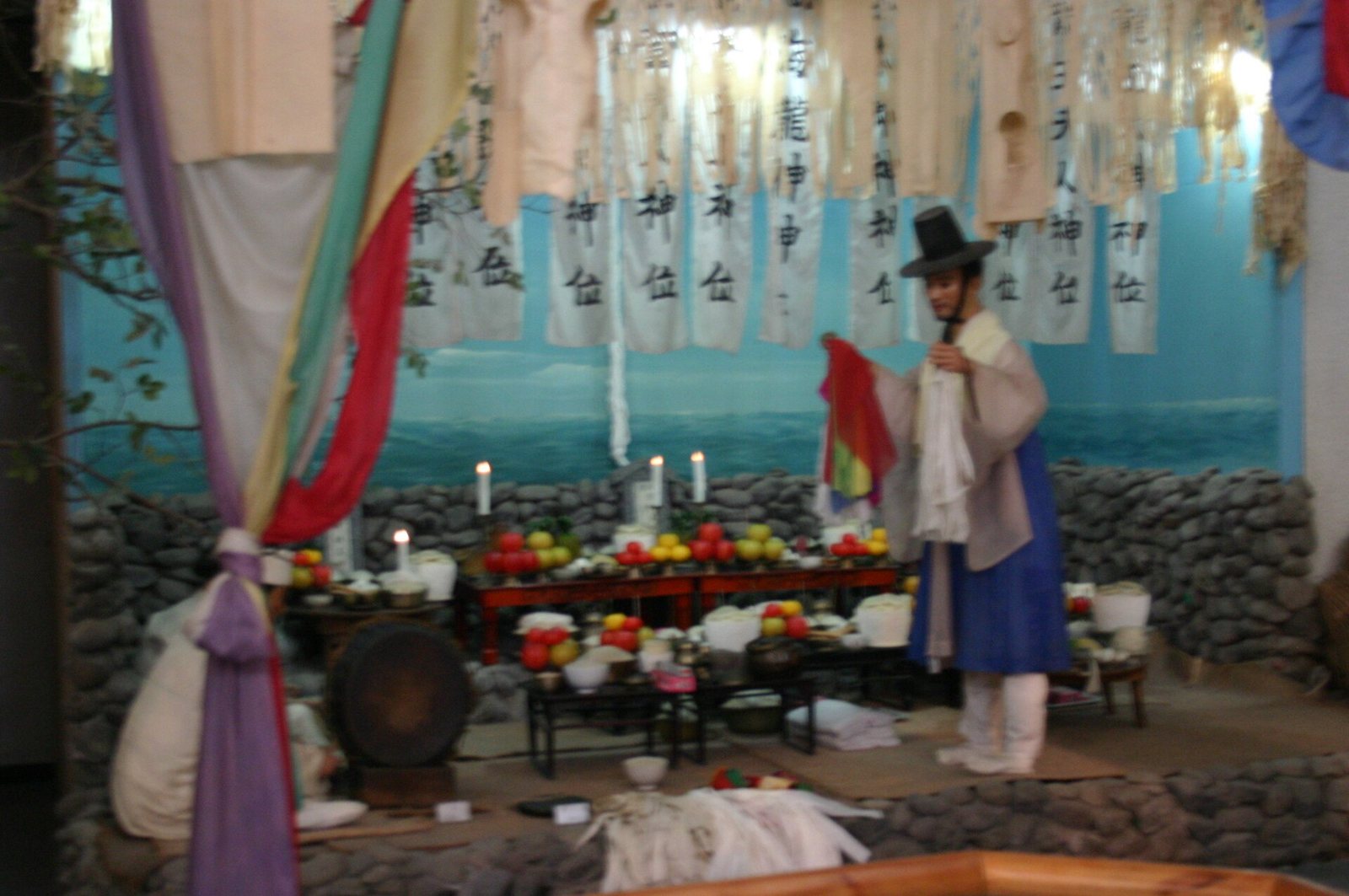
In the Jeju Chasa Bonpuri, Gangnim, originally a figure from the human world, becomes the chasa, or commissioned messenger, of Yeomna, king of the underworld. From then on he is charged with taking the destined dead to the underworld. The Academy of Korean Studies entry on the Chasa Bonpuri tells his story as the tale of how the messenger came to have his job, and it is still sung.
The Chasa Bonpuri is performed in Jeju Gwi-yangpuri and Siwangmaji rites. A shimbang, a ritual specialist, sings how Gangnim became the messenger, then prays that the chasa will take the deceased gently to the afterlife. There is something moving in that order of events: the song first tells who is coming for the dead, and then asks him to be gentle on the road.
Outside Jeju, other regional narratives and rituals show the messengers as a group. They escort the deceased, receive food and gifts from the family, and guide the soul through the passage from life to death.
Saja-bap: a meal for the messengers
If the messengers have a long walk ahead of them, they need to eat. Saja-bap, "the messengers' meal," is the food a family set out for the jeoseung saja at a death. According to the Academy of Korean Studies, it was both ritual hospitality and a request: feed the messengers well, and ask them to guide the deceased safely.
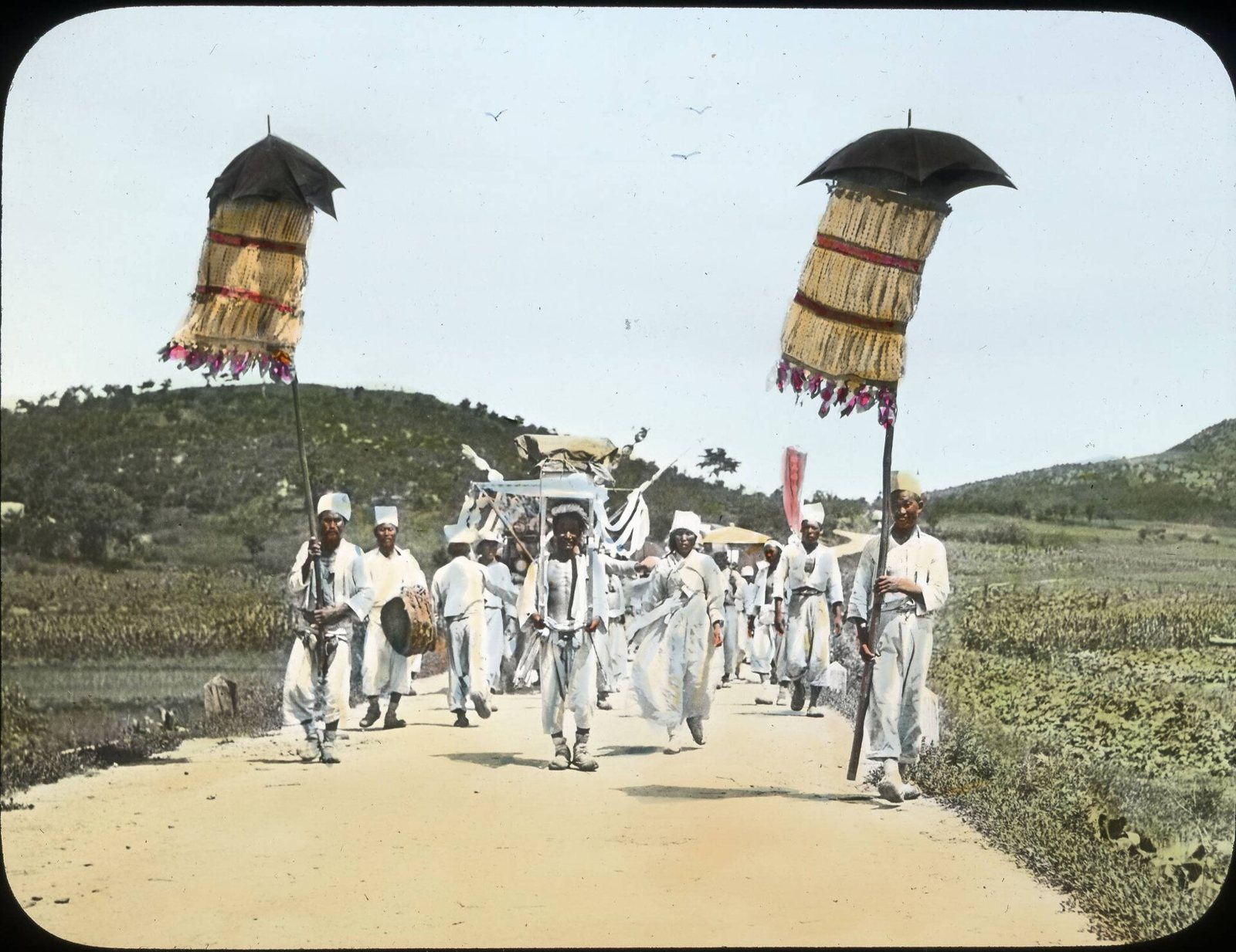
What went into the meal depended on the region. In southern Gyeonggi, saja-bap could be placed outside the gate on a wooden mortar, with a winnowing tray, rice, straw sandals and coins. In Hwanghae death rites, the family set out three bowls of food, three pairs of straw sandals and three pairs of chopsticks or spoons, one set for each of the three messengers. In Seoul gut, the family treats the messengers in the courtyard and keeps them out of the house, because having them indoors was believed to invite further misfortune.
The straw sandals are the detail that sticks. They speak to a messenger who walks, and to a family thinking practically about the road their relative is about to travel with him.
Saja-bap and the messengers, region by region
Tap a card to bring it forward.
- Southern Gyeonggi: Saja-bap could be placed outside the gate on a wooden mortar, with a winnowing tray, rice, straw sandals and coins.
- Hwanghae: Three bowls of food, three pairs of straw sandals and three pairs of chopsticks or spoons, one set for each of the three messengers.
- Seoul gut: The family treats the messengers in the courtyard and keeps them out of the house, since having them indoors was believed to invite further misfortune.
- Jeju: A shimbang sings the Chasa Bonpuri and prays that the chasa will take the deceased gently to the afterlife.
These are named regional customs, kept by particular communities, so a family from Hwanghae and a family from southern Gyeonggi could honor the messengers in different ways.
Why the Korean grim reaper wears a black hat
The black hat comes mostly from television and from the Joseon-period gat. The familiar jeoseung saja, pale-faced in a black durumagi robe and a black gat, was popularized by the television series *Jeonseol-ui Gohyang*, known in English as *Korean Ghost Stories*. The Academy of Korean Studies treats this dignified figure as the dominant modern image, and keeps it separate from older ritual forms.
The gat itself was a men's hat of the Joseon period. Put a black gat and robe on the messenger, and he reads at once as an official carrying out an order, a member of an underworld bureaucracy. That suits a figure whose whole job is to collect the destined dead and bring them before the Ten Kings. The black color and the pale makeup belong especially to this modern popular image. They are one costume among several that the messenger has worn.
In shamanic performances, the messengers can look and act quite differently. There they may appear as low-ranking Joseon guards or soldiers, often comic, argumentative and disorderly, which is a long way from the quiet official on screen. Hwanghae shaman paintings show death messengers in other forms again.
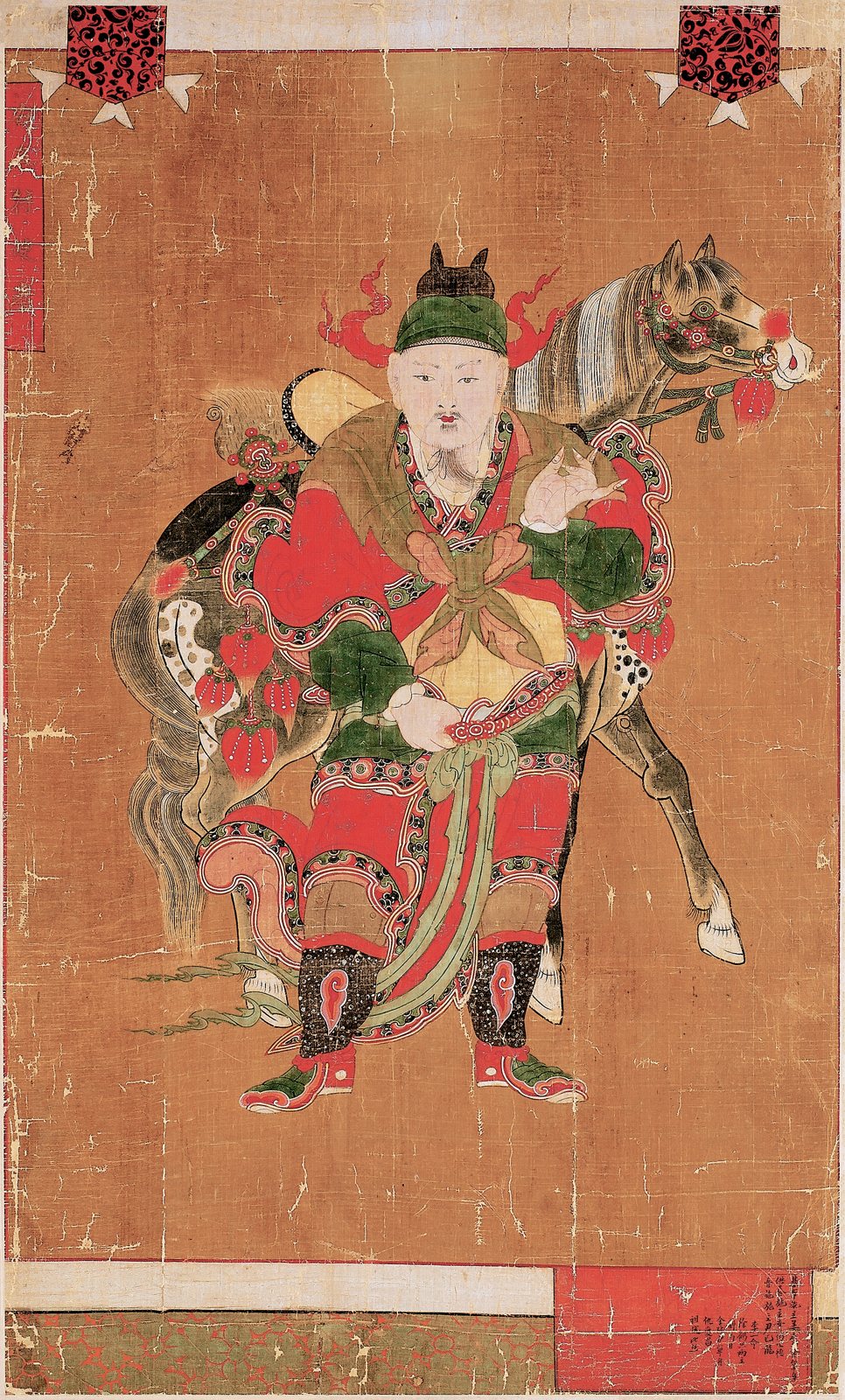
An older Buddhist image survives in a late Joseon painting of Jikbu-saja, a Buddhist emissary of death, held by the National Museum of Korea. A photograph of it is shared on Wikimedia Commons under a CC BY 4.0 licence, and it shows that the messenger had many faces long before he had a television wardrobe.
The jeoseung saja on screen: Goblin, Along with the Gods and the Saja Boys
Drama, film and animation have carried the messenger far beyond Korea. Each of these works is fiction, borrowing the name and the job and building something new around them.
Who is the grim reaper in *Goblin*? He is a jeoseung saja played by Lee Dong-wook in tvN's *Goblin: The Lonely and Great God*, broadcast from December 2, 2016, to January 21, 2017. The tvN history page lists the drama among its major 2016 programs. Lee Dong-wook's messenger is stylish and funny, and he guides souls toward reincarnation or the afterlife. He wears a contemporary black suit and hat, which nods to the gat and robe of the popular image while making him a man of the present day.
Kim Yong-hwa's film *Along with the Gods: The Two Worlds* opened in South Korea on December 20, 2017. It takes Korean imagery of underworld judgment and builds a fantasy action story around underworld judges and the escorts of the dead. The Korean Film Council records that the film passed ten million viewers in January 2018.
Then came Netflix's animated *KPop Demon Hunters*, released on June 20, 2025. What does saja mean in Saja Boys? Saja means messenger, and the band's name points straight at the jeoseung saja. In the film, the Saja Boys are fictional demons disguised as a K-pop boy band, and Netflix describes them as agents sent from the underworld to steal human souls. That job description is darker than the folk messenger's, whose task is to escort the destined dead. The Saja Boys are a pop reinterpretation of the name and the idea, and you can enjoy them on those terms.
The jeoseung saja, from Joseon hats to Netflix
Tap or hover a step to follow the order.
Joseon period
The gat is a men's hat in Korea; it later becomes part of the modern jeoseung saja image.
Jeju oral tradition
The Chasa Bonpuri tells how Gangnim became the chasa of King Yeomna, and it is sung in Gwi-yangpuri and Siwangmaji rites.
December 2, 2016 to January 21, 2017
tvN broadcasts Goblin: The Lonely and Great God, with Lee Dong-wook as a stylish, humorous jeoseung saja.
December 20, 2017
Kim Yong-hwa's Along with the Gods: The Two Worlds opens in South Korea.
January 2018
The Korean Film Council records Along with the Gods passing ten million viewers.
June 20, 2025
Netflix releases KPop Demon Hunters, whose Saja Boys are fictional demons named after the death-messenger term.
Is the jeoseung saja the same as the Grim Reaper?
They are close cousins in job description, and quite different in who they are. Both are tied to death and to the passage from life to whatever comes after, which is why "Korean grim reaper" is such a handy shorthand. The difference lies in rank. The jeoseung saja is a messenger or escort working inside an ordered afterlife, sent by the underworld and answering to the Ten Kings. The European Grim Reaper became a personification of Death itself, usually shown as a skeleton carrying a scythe.
Anthropologist Kate Kingsbury of the University of British Columbia ties that skeletal Death to the fourteenth century and the Black Plague, and describes the Grim Reaper as an image of death harvesting human souls, according to a UBC Department of Anthropology profile of her work. Kim Deok-muk, by contrast, describes the jeoseung saja as a cultural mediator who lives in legends, funeral songs, funerals and cheon dogut rites. A useful shorthand is "death escort" for the Korean figure and "personified Death" for the European one. Both traditions also change from region to region and century to century, so neither figure has ever looked exactly the same everywhere.
If the skeleton side of that comparison is what drew you in, the story of the Grim Reaper's origin follows him from plague-era Europe, and the danse macabre shows personified Death leading people of every rank in a dance.
Tap or hover a row to highlight it.
| Jeoseung saja | European Grim Reaper | |
|---|---|---|
| What he is | Jeoseung sajaA messenger or escort of the afterlife | European Grim ReaperA personification of Death itself |
| What he does | Jeoseung sajaEscorts the dead from iseung to jeoseung and presents the soul before the Ten Kings | European Grim ReaperAn image of death harvesting human souls |
| How many | Jeoseung sajaOften three, the saja-samseong of Seoul gut | European Grim ReaperA single figure |
| Usual look today | Jeoseung sajaPale face, black durumagi robe and black gat, popularized by television | European Grim ReaperA skeleton carrying a scythe |
| Where the look took shape | Jeoseung sajaThe Joseon-period gat and the series Jeonseol-ui Gohyang | European Grim ReaperEurope in the fourteenth century, in the era of the Black Plague |
How well do you know the jeoseung saja?
Answer every question to check.
Questions people ask about the jeoseung saja
A few questions come up again and again once people meet the messenger on screen.
What is the Korean grim reaper called?
The Korean grim reaper is called the jeoseung saja, written 저승사자 in Korean. In shamanic and scholarly writing he can also be called jeoseung chasa, and in the Jeju Chasa Bonpuri the messenger Gangnim is simply the chasa of King Yeomna.
What does jeoseung saja mean?
Jeoseung saja means "messenger of the afterlife" or "messenger from the world of the dead." The name describes a job, so it can apply to several messengers at once, such as the three saja-samseong of Seoul gut.
Are there three jeoseung saja?
There are often three. Seoul gut understands the messengers as three, the saja-samseong, and Hwanghae traditions say three messengers come for the dead; "seven messengers" can stand for the many agents of the underworld as a whole.
Is the jeoseung saja the same as the Grim Reaper?
The two are comparable but not the same figure. The jeoseung saja is an escort sent by the underworld, while the European Grim Reaper stands for Death itself; Kate Kingsbury of the University of British Columbia links the skeletal Reaper to the era of the Black Plague.
What does saja mean in Saja Boys?
Saja means messenger, so the Saja Boys' name refers to the jeoseung saja, the messenger of the afterlife. In *KPop Demon Hunters* they are fictional demons posing as a boy band, a 2025 Netflix invention built on the old name.
Where to go next
The jeoseung saja is one of many figures people around the world have imagined at the threshold of death. For others, from gods to guides, read about the gods of death across cultures, and for another East Asian death legend with very different bones, meet the gashadokuro of Japanese folklore. If you want the bigger story of why skulls and skeletons carry so much meaning, start with skull symbolism.
Terms in this story
Tap a term to see what it means.
Jeoseung. The afterlife, the world of the dead, in Korean folklore.