

No. 024
Grim Reaper Origin: Where the Hooded Skeleton With a Scythe Came From
The Grim Reaper comes from late medieval Europe, and he was put together in stages rather than invented in one go. In fourteenth and fifteenth century art, Death became a skeleton with a personality: he ruled over the living in Italian *Triumph of Death* frescoes, such as Francesco Traini's at the Campo Santo in Pisa in the early 1340s, and he led people of every rank away in the *Danse Macabre*, whose first known major mural was painted at the Cemetery of the Holy Innocents in Paris in 1424 to 1425. The robe, the scythe and the hourglass gathered around him gradually, especially in prints from the fifteenth century onward. The name is far younger than the image. PBS dates the first English literary use of "Grim Reaper" to 1847.
So, the figure on your Halloween porch, your forearm or a movie poster is roughly six hundred years old, and he only picked up his famous English name about 180 years ago. Each piece arrived at a different time, and the order is the story.
When Death became a character
For a long stretch of the Middle Ages, European artists used skeletons and corpses as warnings about mortality: a body that once looked like yours, now bones. What changed in the late medieval period, as Petaros describes in the Journal of Anatomy (2013), is that the skeleton stopped being only a dead body and started acting as Death itself. It walks, it gestures, it speaks, it chooses.
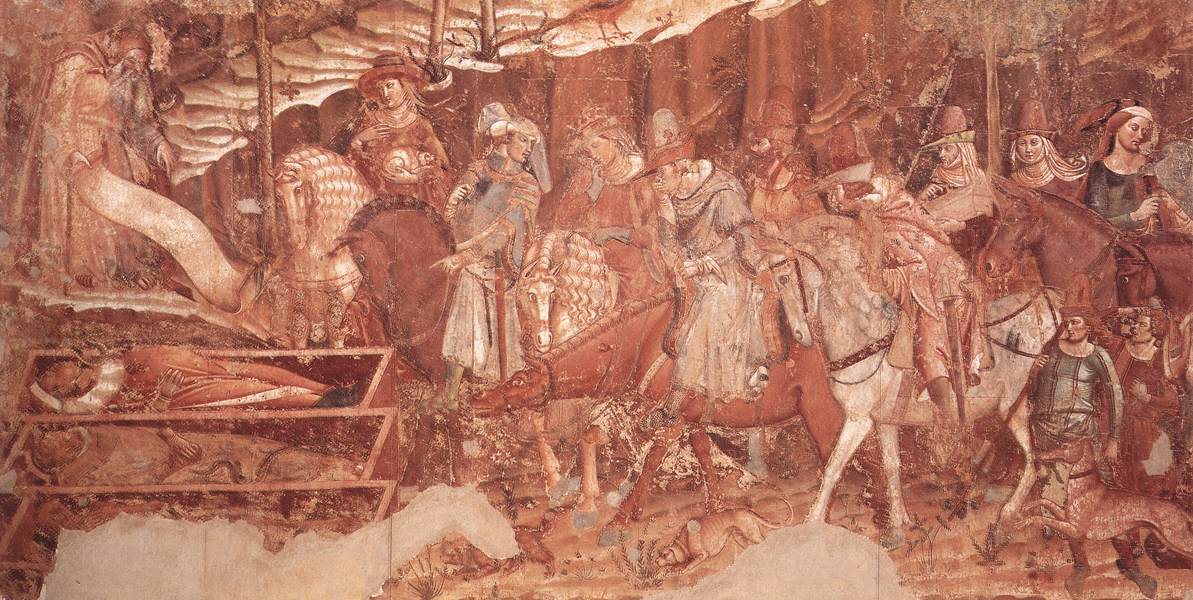
One of the earliest big public examples of this new death imagery is the *Triumph of Death* fresco that Francesco Traini painted at the Campo Santo, the monumental cemetery in Pisa, in the early 1340s. It is crowded with corpses, demons, hermits, aristocrats and hunters. It is not yet the hooded figure we know, and it should not be read as a portrait of him. It is the moment when Europe began giving death a stage, a cast and a plot.
The Dance of Death spreads across Europe
The scene that did the most to make Death a recognizable figure was the *Danse Macabre*, the Dance of Death. The earliest major cycle is generally identified as the mural at the Cemetery of the Holy Innocents in Paris, painted in 1424 to 1425. It is lost, but it set off a chain of others: London around 1430, Basel around 1440, Ulm around 1440, Kermaria sometime around 1430 to 1460, and Lübeck in 1463. In 1485 the Paris printer Guyot Marchant published an influential printed edition based on the Paris mural tradition, and from then on the dance could travel in a book.
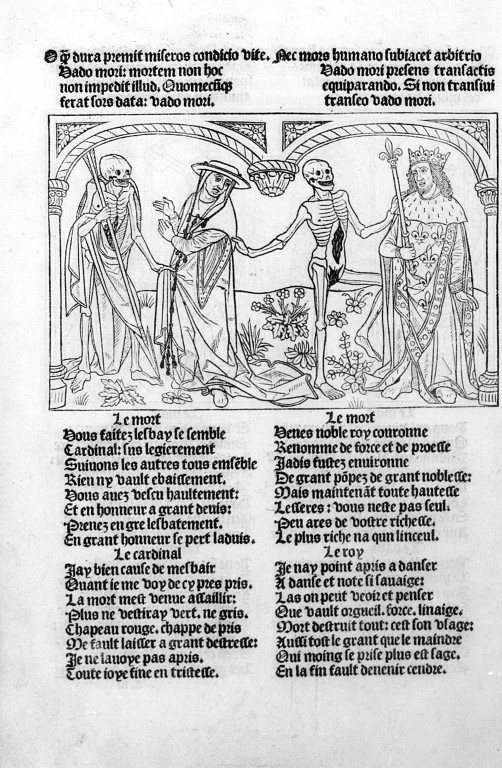
The format was simple and pointed. Death, often as a skeleton, summons kings, clergy, merchants, laborers and children one after another. Oxford Bibliographies sums up the theme as Death's power over every social rank. Mortality was the one hierarchy nobody could climb out of, and the painters made sure everyone recognized themselves somewhere in the line. If you want the full story of the dance itself, its murals and the music it later inspired, read our guide to the danse macabre.
Did the Grim Reaper come from the Black Death?
Partly, but not in the simple way the story often gets told. The Black Death devastated Europe from the mid-fourteenth century, and it intensified Christian meditation on mortality, judgment and the idea that death treats rich and poor alike. Historians have long connected the *Danse Macabre* to the shock of the plague.
Later scholarship adds an important qualification. Petaros summarizes scholarship showing that the first known *Danse Macabre* images appeared decades after the first outbreak, and that the spread of the imagery does not match the spread of the disease. The fairest reading is that the plague helped the motif find an audience and keep circulating, without single-handedly creating it.
The *Triumph of Death* is a close relative with a different mood. Instead of arranging the living in a dance, it usually shows Death attacking them or ruling over them. The two traditions borrowed from each other in paintings, murals, manuscripts and prints, and the Grim Reaper inherited something from both: the leveling message of the dance and the conquering power of the triumph.
Why the scythe, and what the hourglass means
The scythe comes from the harvest. A farmer cuts grain at the end of its season; Death cuts down human lives at the end of theirs. That agricultural metaphor is the whole logic of the word "reaper," and it is why the blade stands for the cutting short of life and the certainty that everyone's season ends.
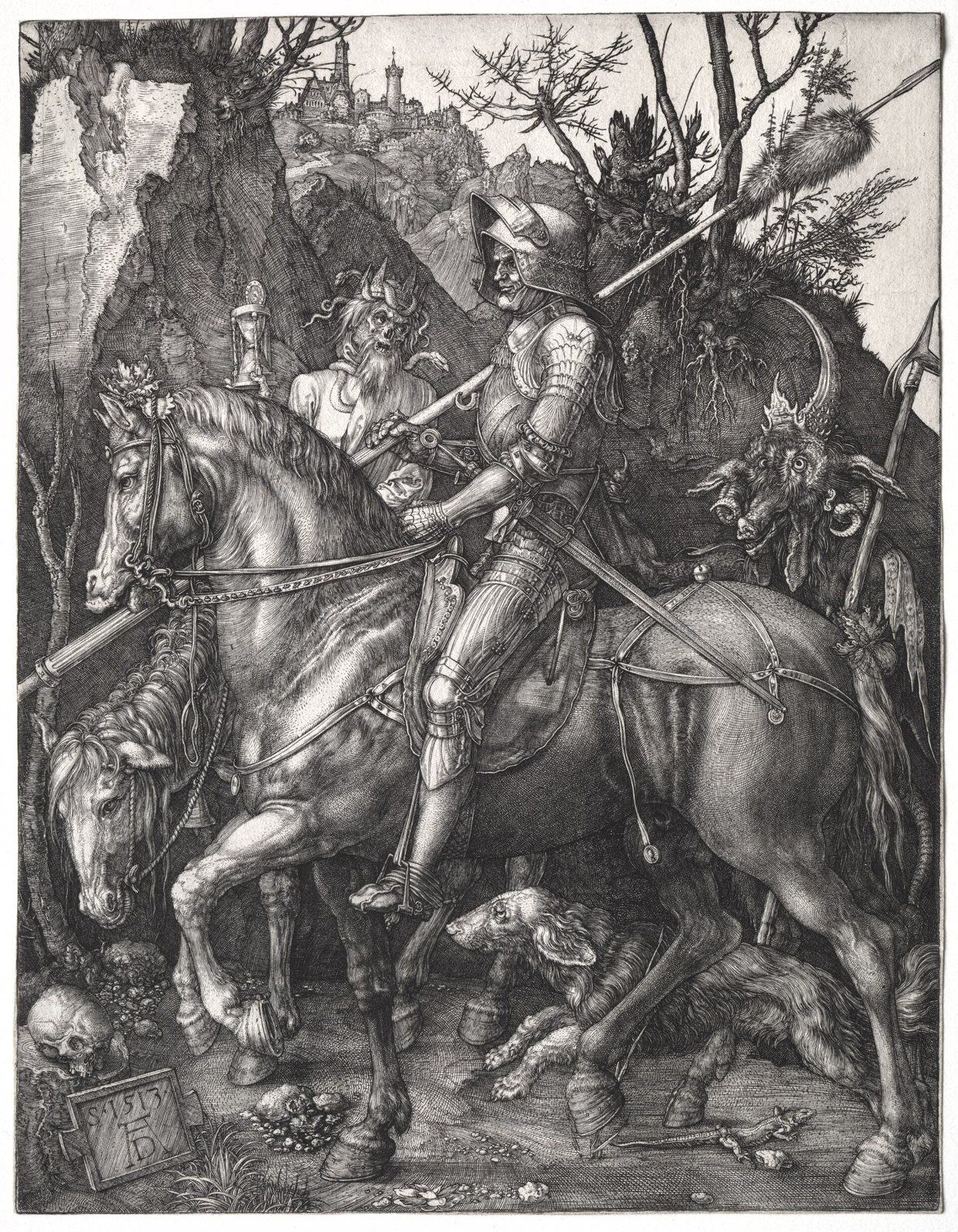
It was not always a scythe. Earlier figures of Death often carry a sickle, a sword, a dart or an arrow. The dart and arrow stand for sudden death, and they turn up in personifications influenced by the Four Horsemen of the Book of Revelation. The British Museum holds Albrecht Dürer's 1505 drawing of Death riding with a sickle, a good example of the shorter harvest tool before the long-handled scythe took over.
That raises a common question: is the Grim Reaper in the Bible? Not by that name. Revelation 6:8, as given on Bible Gateway, describes a rider named Death on a pale horse, with Hades following him. Revelation 14:14 to 20 uses harvest language, including a sickle. Neither passage describes a hooded skeleton with a scythe. Medieval European artists later combined biblical, agricultural and memento mori imagery into something new.
The hourglass stands for limited, passing time. In late medieval and early modern art it works as a *memento mori*, a warning that your allotted sand is running out. Crispijn de Passe's print *Mors Loquitur and Alloquitur Mortem*, from around 1600 and now in the British Museum, is one example of Death and time traveling together. The hourglass is an associated symbol rather than something every European Death carried, and the full kit of skeleton, robe, scythe and hourglass came together only gradually. For the wider idea behind it, see what memento mori means.
Where the name "Grim Reaper" came from
The image is medieval; the name is Victorian. PBS identifies the first English literary use of "Grim Reaper" as 1847, in Robert Menzies's *The Circle of Human Life*, a partial translation of a German devotional work by August Tholuck.
Both halves of the name were old by then. "Grim" had been in English since at least the late tenth century, with meanings such as fierce, cruel, harsh or terrible. "Reaper" turned Death into a field hand with a blade. Put together, they gave English speakers a short, memorable label for a figure their ancestors had been drawing for four centuries. The four-century gap between the image and its name is one of the better pieces of trivia in the whole story.
Is Death a man or a woman?
It depends on where you are standing. Karl S. Guthke's *The Gender of Death: A Cultural History in Art and Literature* shows that French, Spanish and Italian traditions frequently show Death as a woman, while English and German traditions more often make Death a man. The words help explain it: French *la mort*, Spanish *la muerte* and Italian *la morte* are feminine, and Spanish also has *la Parca*. German *der Tod* is masculine, and so is *der Schnitter*, the reaper.
Guthke is careful to say grammar influences the image without dictating it. French *la mort* sometimes appears as a man, and German *der Tod* sometimes appears as a woman. English has no grammatical gender for "death" at all, so the male Grim Reaper of English-speaking culture owes more to habit, literature and repeated images than to the noun.
This is also where people ask what a female Grim Reaper is called. There is no single English name. Writers use "female Death" or "Lady Death," and Spanish speakers have *la Parca* and *la Muerte*. Mexico's Santa Muerte is something else: a living folk-saint devotion with its own devotees, altars and prayers, not another name for the European Reaper. A similar robe and scythe do not make two traditions the same.
From printed cartoons to the movie screen
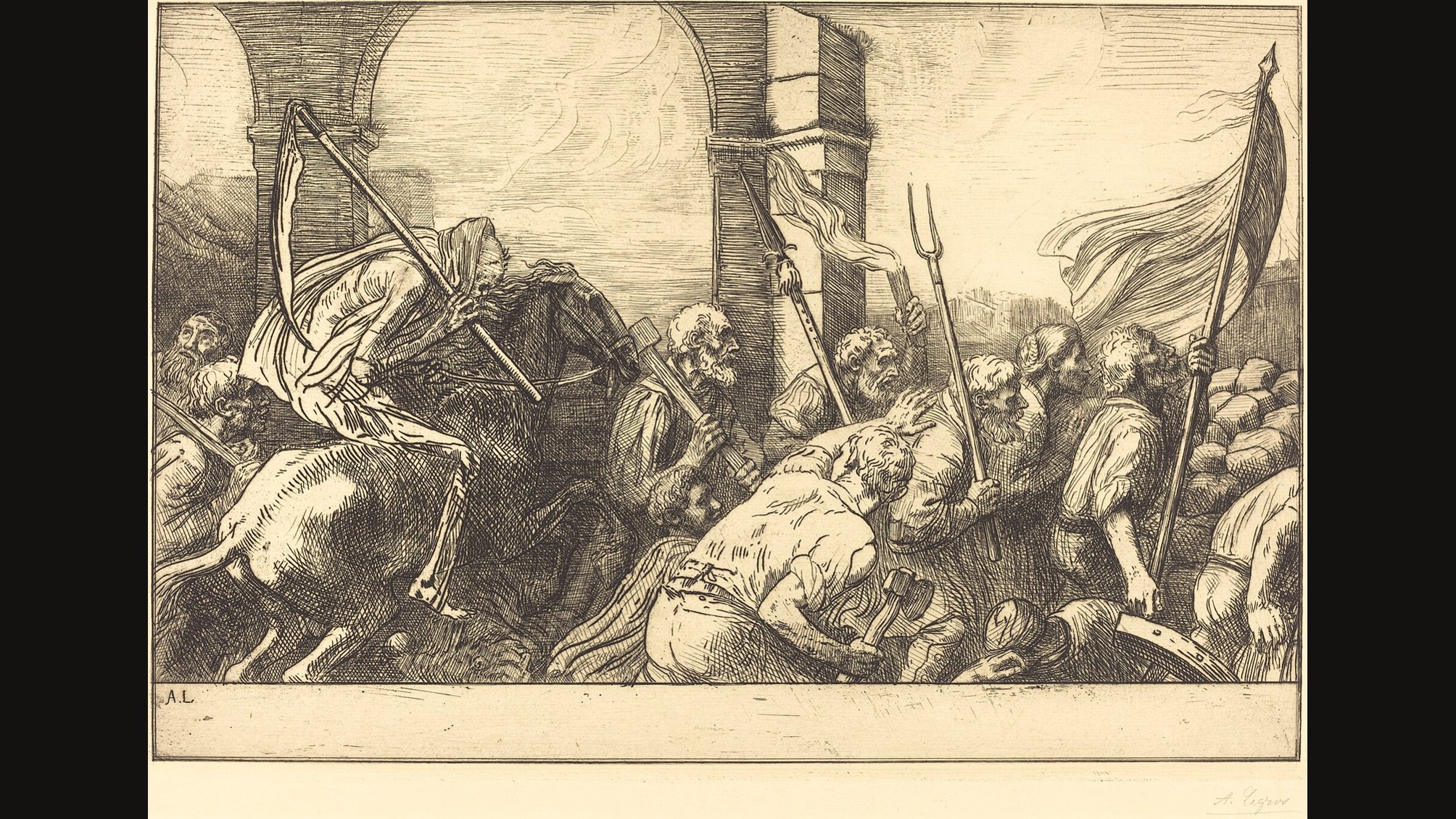
Nineteenth-century print culture made Death easy to copy. Woodcuts, engravings, illustrated books and political cartoons sent skeletons with robes, hourglasses and scythes into homes and newspapers, and the figure could be devout, comic, political or satirical depending on who held the pencil. In *Puck* on January 24, 1883, Bernhard Gillam's cartoon "Gambling with Death" used the Reaper as a character in a joke about insurance, disasters and financial risk. Alphonse Legros's *Le Depart*, part of his *Triomphe de la mort* series from about 1892 to 1900, is in the British Museum and shows the old theme still alive in fine-art printmaking.
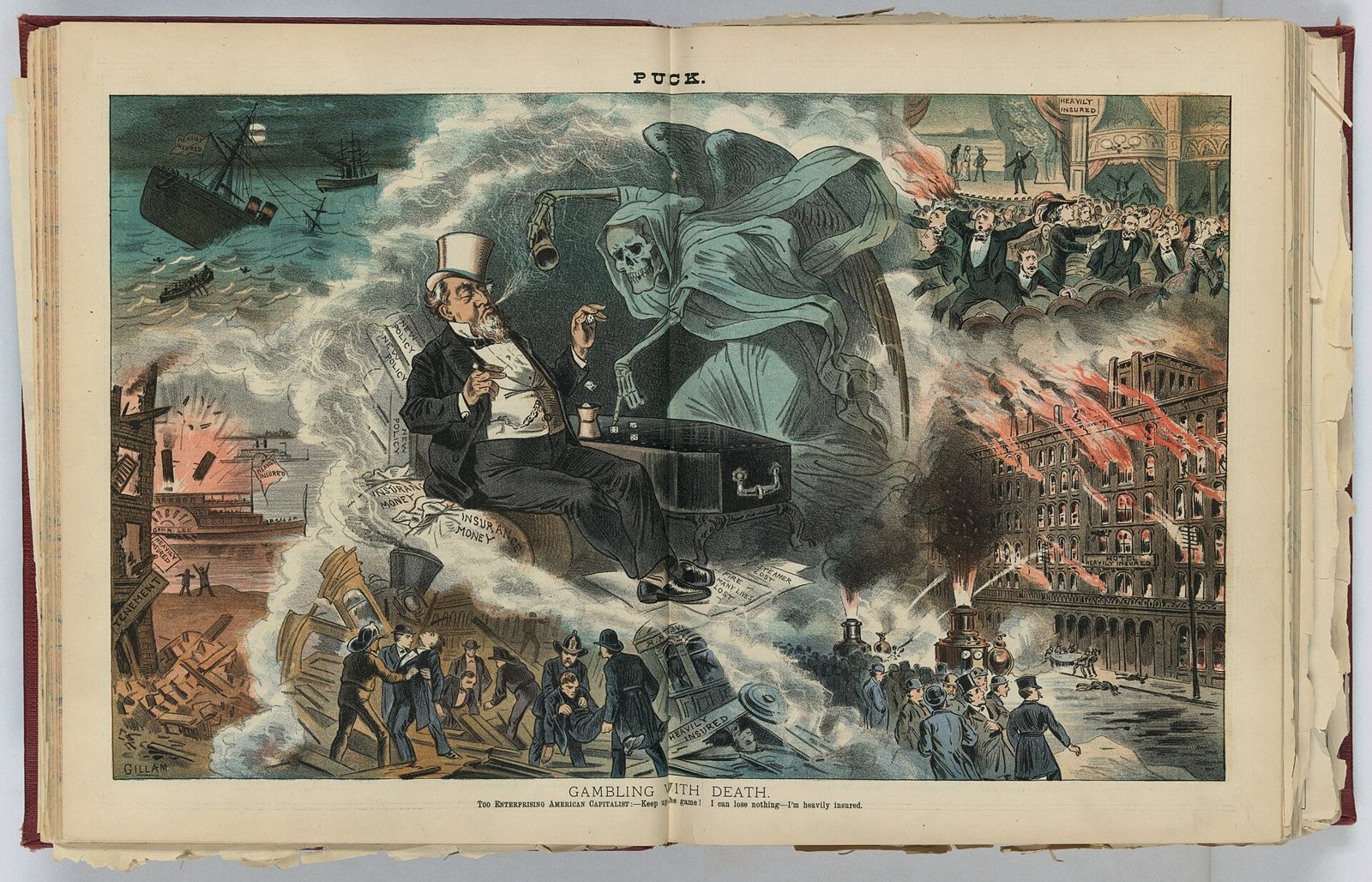
The same century gave Death a romantic and philosophical side. Guthke traces female Death figures, Death and the Maiden scenes, and literary treatments by Théophile Gautier, Charles Baudelaire and Rainer Maria Rilke. Death was no longer only a warning about Christian judgment; he could be a suitor, a muse or a riddle.
Film finished the job of turning him into a character. *Death Takes a Holiday* arrived in 1934. Then came Ingmar Bergman's Swedish film *The Seventh Seal*, released in 1957, in which a hooded, human-looking Death challenges a knight to a game of chess in plague-stricken medieval Sweden (Criterion). That chess game is probably the most famous scene the Reaper has ever played. Later came *Joe Black* in 1998 and the television series *Dead Like Me*, each giving Death more personality and dialogue. The skeleton that once silently led a king away had learned to talk. For his seasonal career on lawns and porches, see skeletons and Halloween, and for the figure in ink, skeleton tattoo meaning.
How the Grim Reaper took shape
Tap or hover a step to follow the order.
Early 1340s
Francesco Traini paints the Triumph of Death fresco at the Campo Santo in Pisa.
1424 to 1425
The first known major Danse Macabre mural is painted at the Cemetery of the Holy Innocents in Paris.
Around 1430
A Dance of Death cycle appears in London.
Around 1440
Major cycles appear in Basel and Ulm.
1485
Guyot Marchant publishes his printed Paris edition of the Danse Macabre.
1847
"Grim Reaper" appears in English in The Circle of Human Life, per PBS.
1957
Ingmar Bergman's The Seventh Seal shows Death playing chess with a knight.
Grim Reaper origin quiz
Answer every question to check.
Quick answers about the Grim Reaper
What is a female Grim Reaper called?
There is no single English name for a female Grim Reaper; writers use "female Death" or "Lady Death." Spanish speakers have *la Parca* and *la Muerte*, and Guthke's survey shows Spanish, French and Italian traditions often show Death as a woman. Santa Muerte belongs to a separate Mexican devotional tradition with its own history and should not be treated as the same figure.
Is the Grim Reaper demonic?
No, the Grim Reaper is not inherently demonic; he is a personification of death, not a demon with a fixed religious identity. Medieval art sometimes placed skeletal Death beside demons and scenes of judgment, as in the crowded Pisa fresco. Other works treat Death as an allegory, a moral warning, a comic character or a partner in philosophical conversation, so the meaning depends on the artwork and its period.
Is the Grim Reaper in the Bible?
No, the Bible has no character called the Grim Reaper. Revelation 6:8 describes a rider named Death on a pale horse, followed by Hades, and Revelation 14 uses harvest imagery with a sickle. Artists combined those passages with other ideas much later to build the hooded skeleton.
Is the Grim Reaper in Greek mythology?
Not as such; Greek mythology has Thanatos, the personification of nonviolent death, who was usually shown as a winged man or youth, according to Theoi. Both figures personify death, but they belong to different periods and visual traditions, and the hooded skeleton is not a renamed Greek god. Other death figures from around the world are gathered in our tour of gods of death.
Where to go next
The Reaper makes the most sense next to the art that raised him. Start with the danse macabre for the processions of the dead, then read about the wider meanings of skull symbolism. If the hourglass is the part of the story that stays with you, our Memento Mori skull tee is a shirt that carries the same idea.