No. 012
What Does a Skeleton Tattoo Mean? Skeleton Hands, X-Ray Designs and What Changes the Meaning
A skeleton tattoo has no single universal meaning. The oldest documented European reading is mortality and the shortness of life, with the dance of death adding that Death treats everyone alike. Mexican calavera imagery adds remembrance and satire. Modern wearers add survival, strength, humor, or simply liking the image. A skeleton hand usually leans on mortality and remembrance, and what the hand holds changes the message. So, the gesture, the objects around it and your own explanation do most of the work.
The old European meaning: memento mori and the dance of death
In Western European art, a skeleton was a reminder, or memento mori, that life is short. The Metropolitan Museum of Art describes skeleton and skull imagery as an image of the "collective condition of corporeal existence", meaning the body everyone shares. The dance of death, or danse macabre, made the point sharper by showing a skeleton leading people of every rank in a dance. Our guide to the danse macabre tells that story in full.
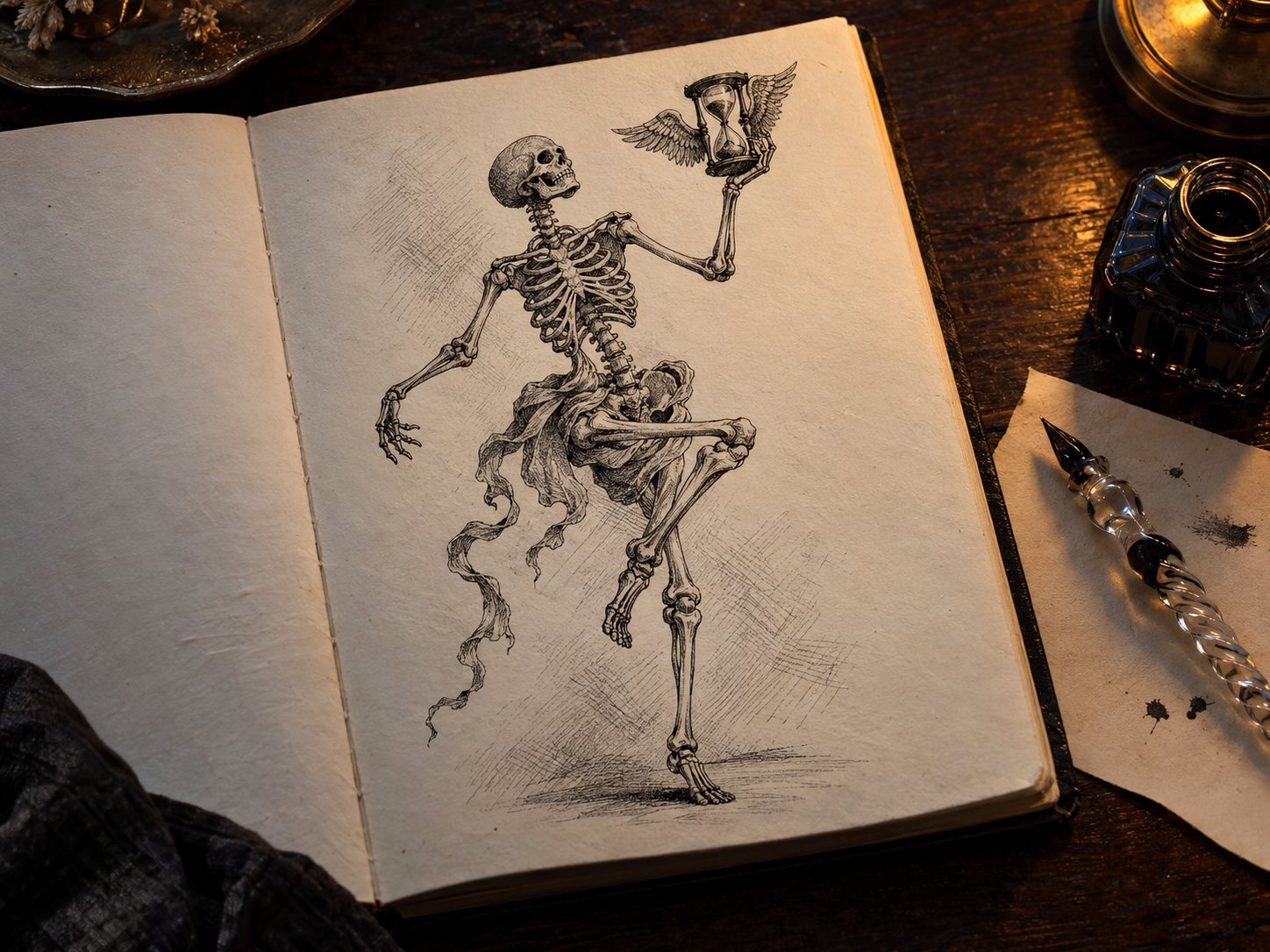
The examples are easy to find in museums. Around 1600, the Dutch printmaker Crispijn de Passe the Elder published a danse macabre print that shows a finely dressed man dancing with a skeletal Death holding a winged hourglass; the British Museum holds it. A German broadside from around 1700 has people of different ranks, from an empress to a fool, dancing with the dead around two skeletons in a coffin. The British Museum also records a sixteenth-century French pendant shaped like a small coffin with a skeleton in high relief under a rock-crystal cover. Much later, Oskar Bangemann's wood engraving of a skeleton on horseback, dated 1900 to 1942 and held by The Met, follows Alfred Rethel's earlier danse macabre imagery.
This is where the idea of equality comes from. A skeleton has no clothes, title or bank account, so it can stand for the fact that rank does not outlast the body. If that reading appeals to you, our piece on what memento mori means gives the background.
Skeleton imagery through time
Tap or hover a step to follow the order.
Sixteenth century
A French memento mori pendant is shaped like a coffin containing a skeleton
Around 1600
Crispijn de Passe the Elder's danse macabre print shows skeletal Death with a winged hourglass
Around 1700
A German danse macabre broadside shows people of different ranks with the dead
Nineteenth century
Posada creates Calavera Garbancera, later renamed La Catrina by Diego Rivera
1895
Wilhelm Roentgen's radiograph of Anna Bertha Ludwig's hand is a visual parallel for bones seen through skin, not a proven ancestor of tattoo designs
1970s onward
Chicano artists and activists use Día de los Muertos celebrations in the United States to build cultural identity
2017 onward
AP reports that Coco increased Día de Muertos visibility and commercialization in the United States
The Mexican calavera tradition: Posada, La Catrina and Día de Muertos
Mexican skeleton imagery has its own history, and it is a mistake to fold it into the European one. The Smithsonian American Art Museum notes that José Guadalupe Posada's calaveras began as illustrations on broadsides with poems and jokes, and later satirized politicians and elites. His most lasting image, the skeleton lady now known as La Catrina, started as the *Calavera Garbancera*, a satire of wealthy Mexican women who adopted European dress and customs, and Diego Rivera later renamed her. See José Guadalupe Posada and La Catrina for the full story.
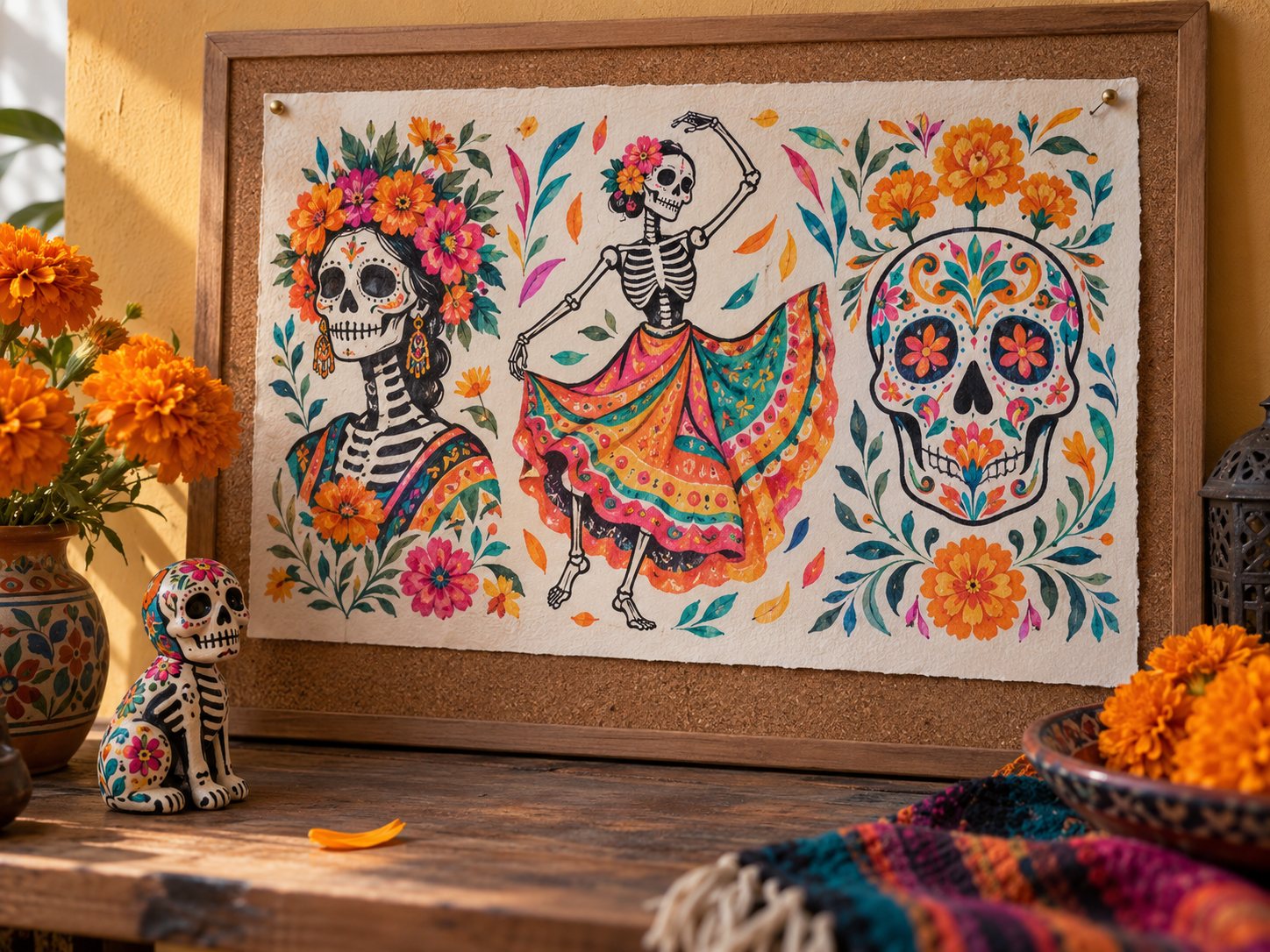
Día de Muertos, observed on November 1 and 2, is a separate matter: families build ofrendas with photographs, candles, food and flowers for relatives who have died. The Associated Press quoted Cesáreo Moreno, chief curator and visual director of the National Museum of Mexican Art, describing it as a Mexican American cultural expression with an important role in grieving. AP reported that skeletons symbolize "a return of the bones to the living world." In the 1970s, according to the Smithsonian, Chicano artists and activists helped turn public celebrations in the United States into a way to claim cultural identity and Indigenous roots.
Mexican American voices also ask that the meaning not shrink to decoration. Ana Cecy Lerma told AP that an ofrenda can hold whatever connects people to loved ones, but that using the imagery just because it looks good can lose the reason for the tradition. Sehila Mota Casper warned that commercialization can become cultural appropriation. For a tattoo, the practical point is to describe the design for what it is: if it draws on La Catrina, calaveras, marigolds or ofrenda imagery, it draws on Mexican or Mexican American Día de Muertos traditions and is not a general stand-in for death. If you are not sure whether your design crosses a line, ask a Mexican or Mexican American cultural practitioner or a tattoo artist who works with these traditions. The guides to Día de Muertos and to the festive skeleton figures called calacas are a good place to learn first.
Skeleton hand tattoos, design by design
Most people searching this topic mean a hand. A skeleton hand is simple to draw, easy to place on the back of a hand, wrist or forearm, and it changes meaning with the object or gesture it carries. The readings below are the ones tattoo-design guides commonly give. They are modern design conventions, and they are not documented universal meanings.
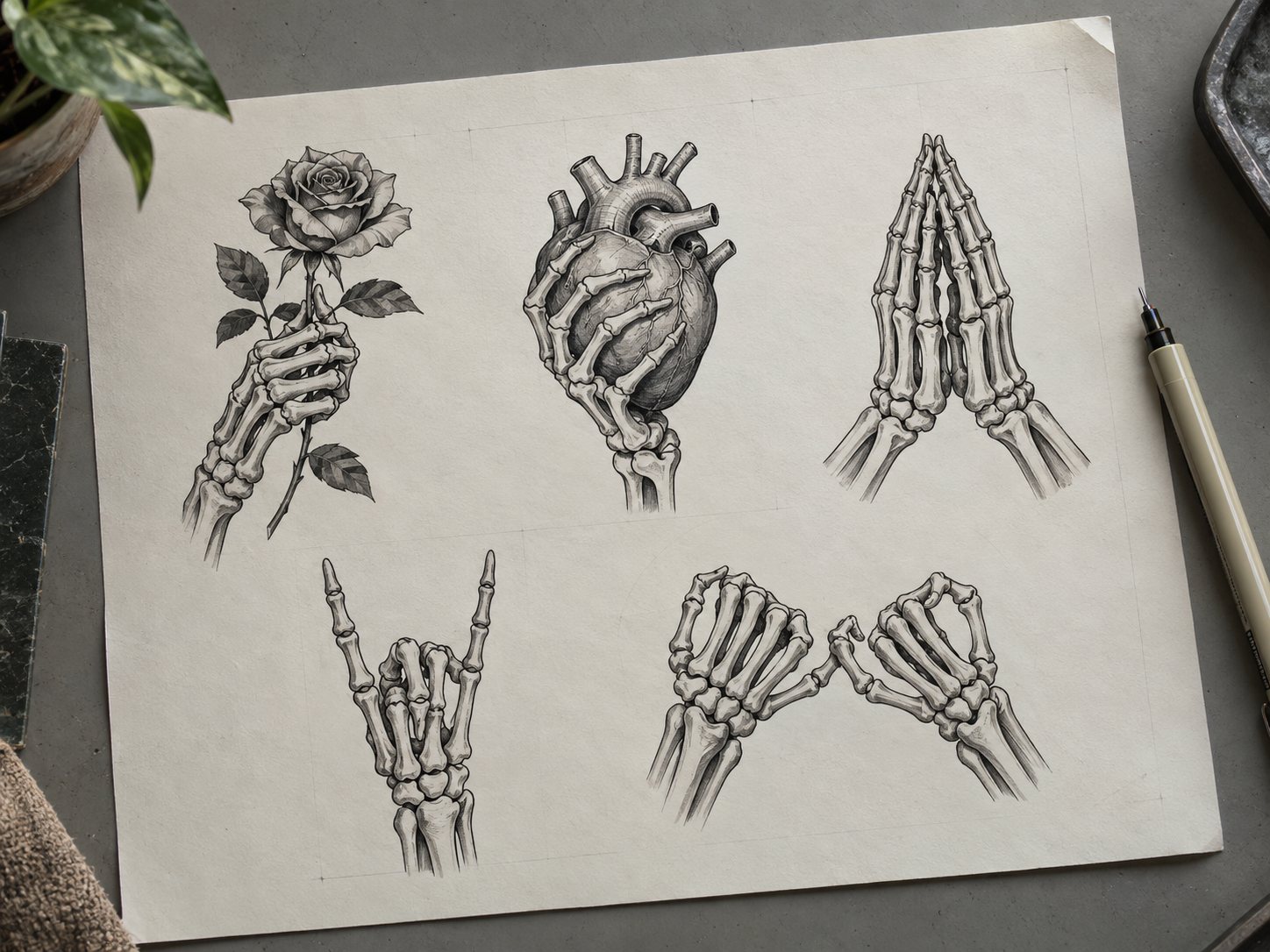
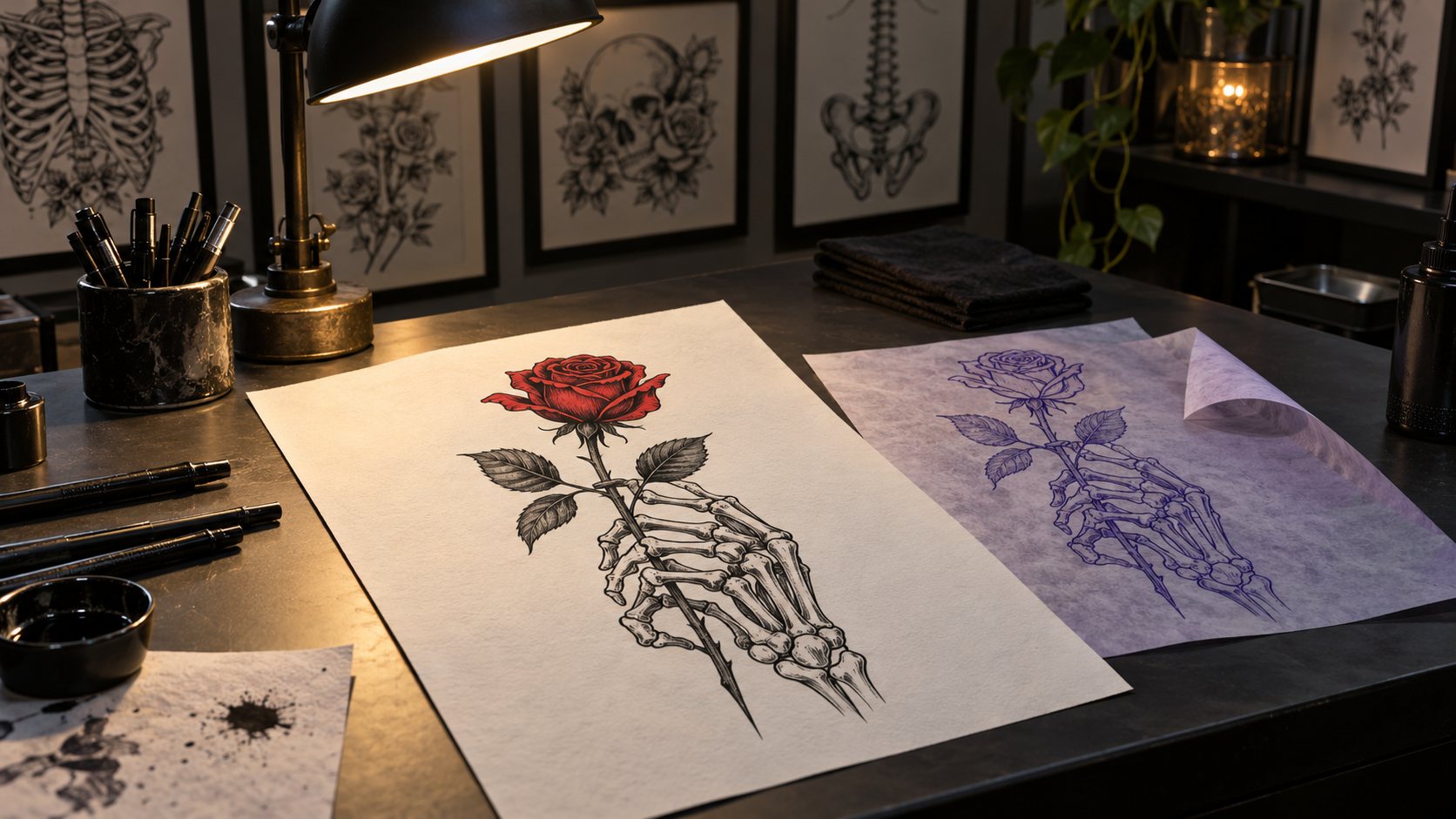
- Holding a rose. Usually read as life against death, beauty against decay, love and loss in one image.
- Holding a heart. Commonly read as enduring love or devotion.
- Praying hands. Commonly read as faith, mortality or spiritual reflection.
- The horns gesture. Tied in tattoo-shop explanations to rock, metal and music.
- A pinky promise. Presented as loyalty, friendship or a promise that outlasts death.
- Two matching hands. Often drawn as two separate tattoos that form a heart, a handshake or a prayer when the wearers stand together.
Brooklyn tattooer Mars Hobrecker told Allure that tattoos do not need a fixed symbolic explanation, and he described choosing his own skeleton tattoo because he liked how it looked. That is a perfectly good reason. If you do want a meaning, choose the object or gesture that reflects your own story and ask your tattoo artist to adapt it.
The X-ray hand: where the look comes from
The X-ray hand is a modern anatomical-overlay design: bones are drawn over your own hand, so the skin seems to be see-through. No tattoo tradition lies behind it. The look is related to anatomical drawing and radiography. Wilhelm Röntgen's 1895 radiograph of Anna Bertha Ludwig's hand, with its bones and a ring visible, is a useful visual parallel, but it does not prove that modern hand tattoos descend from that photograph.
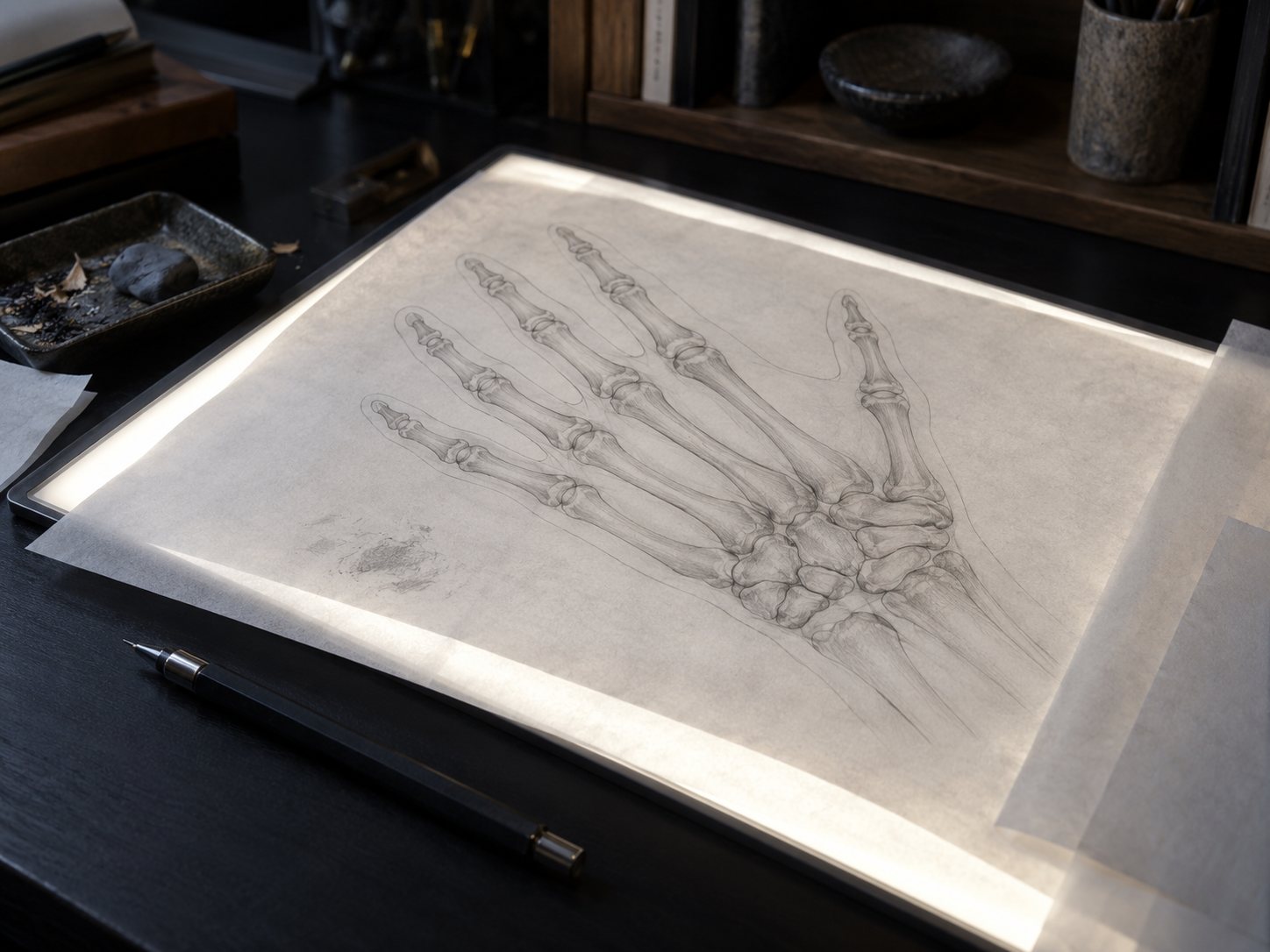
What wearers say it means varies. A patient quoted in a 2021 clinical report by Keith and Klein described a radiograph-based vertebral tattoo as "a symbol of my radical acceptance of my body" and "a celebration of my flaws." That is one person's meaning for an anatomy tattoo, and it shows that body acceptance is a real reason people choose them. If you meet someone with an X-ray hand, ask what it represents before you decide what it means.
Anatomy-accurate skeletons and the people who choose them
Tattoos of accurate bones sometimes come from people who work with bodies. A 2014 study of 400 freely available nursing tattoos concluded that body art in nursing reflects both popular culture and professional nursing culture, with themes such as "embodying the corps." It did not show that nurses broadly prefer skeleton tattoos. At the University of Antwerp, an anatomy educator named Luc has explained his skull tattoo and the phrase "No bones, no body" as a statement about how much anatomy matters to medicine, biomedical science and rehabilitation. He linked the image to what the skeleton does, from shaping the body and enabling movement to protecting organs and producing blood.
The honest summary is that an anatomical skeleton can express science, a profession, a personal experience, or just fascination with how we are built. If you are curious about the real thing, read how many bones are in the human body.
What a skeleton says for a woman, for a man, and whether it means strength
No meaning is reserved for either sex. For a woman, a skeleton can mean mortality, remembrance, equality, renewal or rebellion, or an interest in skeletal imagery. A rose can bring in love or mourning, and an anatomical or X-ray design can stress the body beneath appearances. In Mexican contexts, a decorated skeleton may point to Día de Muertos, but a modern tattoo should not automatically be read as La Catrina or as a specifically feminine symbol.
For a man, the same list applies, plus resilience, music, humor and anatomy. A skeleton can communicate equality because it strips away the marks of status, wealth and identity, an idea that runs through European memento mori and danse macabre art and Posada's satirical calaveras.
Strength is a common modern reading. Bones suggest structure, endurance and what remains after hardship, so many wearers use them that way. But the documented historical meanings are more specific: memento mori, remembrance, the cycle of life and death, and satire of social power. Treat "strength" as a personal interpretation, and let the wearer say so.
Placement, healing and touch-ups
A hand is visible, and it is washed, rubbed and sun-exposed all day. Contemporary tattoo guidance commonly warns that hand tattoos can fade or blur faster than tattoos in less exposed spots, so touch-ups may be needed. Your artist can tell you what to expect for your design and your skin.
For healing, the Mayo Clinic advises thinking about visibility and concealability when you choose a location. It says most tattoos take about two weeks to heal, with variation by size and type, and recommends gentle washing, patting dry, a mild moisturizer, staying out of the sun while healing and avoiding swimming. The European Academy of Dermatology and Venereology advises clean hands before touching a fresh tattoo, no rubbing or picking, and no bathing, swimming or saunas until it has healed. It adds that no single aftercare routine is the gold standard, so follow your tattooist's instructions. See a medical professional for increasing redness, spreading pain, foul-smelling discharge, fever or other signs of infection.
Before you book a skeleton tattoo
Tap a card to bring it forward.
- Pick your tradition: Decide which tradition you are drawing on: European memento mori, Mexican calavera or modern anatomy
- Choose the gesture: Decide the object or gesture the hand holds and what it says for you
- Ask about placement: Ask your artist about placement, fading and touch-ups
- Follow aftercare: Follow your tattooist's aftercare instructions
- Watch for infection: Contact a medical professional for signs of infection
Skeleton tattoo quiz
Answer every question to check.
Quick answers about skeleton tattoos
These are the questions people ask most.
What does a skeleton hand tattoo mean?
It commonly suggests mortality, impermanence, remembrance or facing death, and the gesture or object in the hand changes the reading. A hand holding a rose can blend love, beauty, mourning and mortality, two joined hands can suggest prayer or partnership, and a horns gesture signals music. These are interpretations, not universal definitions.
What does a skeleton tattoo symbolize for a woman?
It has no meaning reserved for women. The wearer may mean mortality, remembrance, equality, renewal, rebellion or an interest in anatomy, and the design, the objects around it and her own explanation decide.
What does a skeleton tattoo mean for a man?
It has no meaning reserved for men either. It can stand for mortality, resilience, remembrance, rebellion, music, humor or anatomy, and in the European tradition it also carries the idea that death makes everyone equal.
Do skeleton tattoos mean strength?
They can, but they do not inherently mean strength. Bones suggest structure, endurance and survival, yet the same image can just as easily signify mortality, grief or humor, so strength is best treated as a modern personal reading.
Does a skeleton tattoo mean something in Mexican culture?
In Día de Muertos, skeletons and calaveras can stand for remembrance, the return of the dead and the way death sits beside everyday life. Spanish-speaking readers search for it as "tatuaje calaca significado" or "tatuaje de esqueleto significado." If your design uses La Catrina, marigolds or ofrenda imagery, describe it as drawing on Mexican or Mexican American traditions, and ask a cultural practitioner if you are unsure.
Do hand tattoos fade?
Contemporary tattoo guidance commonly says hand tattoos can fade or blur faster than tattoos in less exposed places because hands are washed and used constantly. A touch-up may be needed, and your tattooist can tell you what to expect.
Pick the meaning you can say in one sentence
A skeleton is one of the oldest images people have used to talk about time, equality and remembrance. If you can say in one sentence what yours means to you, and you know which tradition you are borrowing from, the design will carry weight. For related reading, see the story of skull tattoos, the meaning of the skull and roses pairing, and the history of vanitas paintings.
If you work with anatomy, or know someone who does, our Night Shift Nurse skull tee is a shirt made for that crowd.