

No. 028
José Guadalupe Posada: The Printmaker Behind the Famous Calavera Prints
José Guadalupe Posada was a Mexican printmaker, born in Aguascalientes in 1852, who worked in León and then in Mexico City, where he died on January 20, 1913. For the publisher Antonio Vanegas Arroyo he drew cheap illustrated sheets, and many of them put skeletons to work as caricature. His calaveras mock politicians, the well-off, craftspeople, lovers and the news of the day, and they return again and again to one idea: death makes everyone the same. If you have seen a skeleton in a wide hat on a poster or a shirt, you have probably seen a descendant of his work. The man himself, and what his prints were for, make a better story than the poster does.
A printmaker's life, from Aguascalientes to Mexico City
Posada was born on February 2, 1852, in Aguascalientes. He studied drawing there and, at sixteen, apprenticed with José Trinidad Pedroza, where he learned lithography. In the 1870s he was working in León, Guanajuato, as a printer, and he eventually took over Pedroza's workshop. From 1884 he taught lithography and bookbinding at León's Escuela de Instrucción Secundaria, according to the Harry Ransom Center's biography.
In 1888 he moved to Mexico City and went to work for publishers and periodicals, among them Ireneo Paz and Antonio Vanegas Arroyo. The Vanegas Arroyo connection became the one that defined him. Posada died in Mexico City on January 20, 1913, while the Mexican Revolution was reshaping the country, and he left little institutional recognition behind. His reputation came later, which is a story of its own below.
Posada's life and legacy, 1852 to 1947
Tap or hover a step to follow the order.
1852
Posada is born in Aguascalientes.
1868
Apprenticeship with José Trinidad Pedroza.
1870s
Works in León, Guanajuato.
1884
Begins teaching lithography and bookbinding in León.
1888
Moves to Mexico City.
1890
Joins the team working with Antonio Vanegas Arroyo.
1900
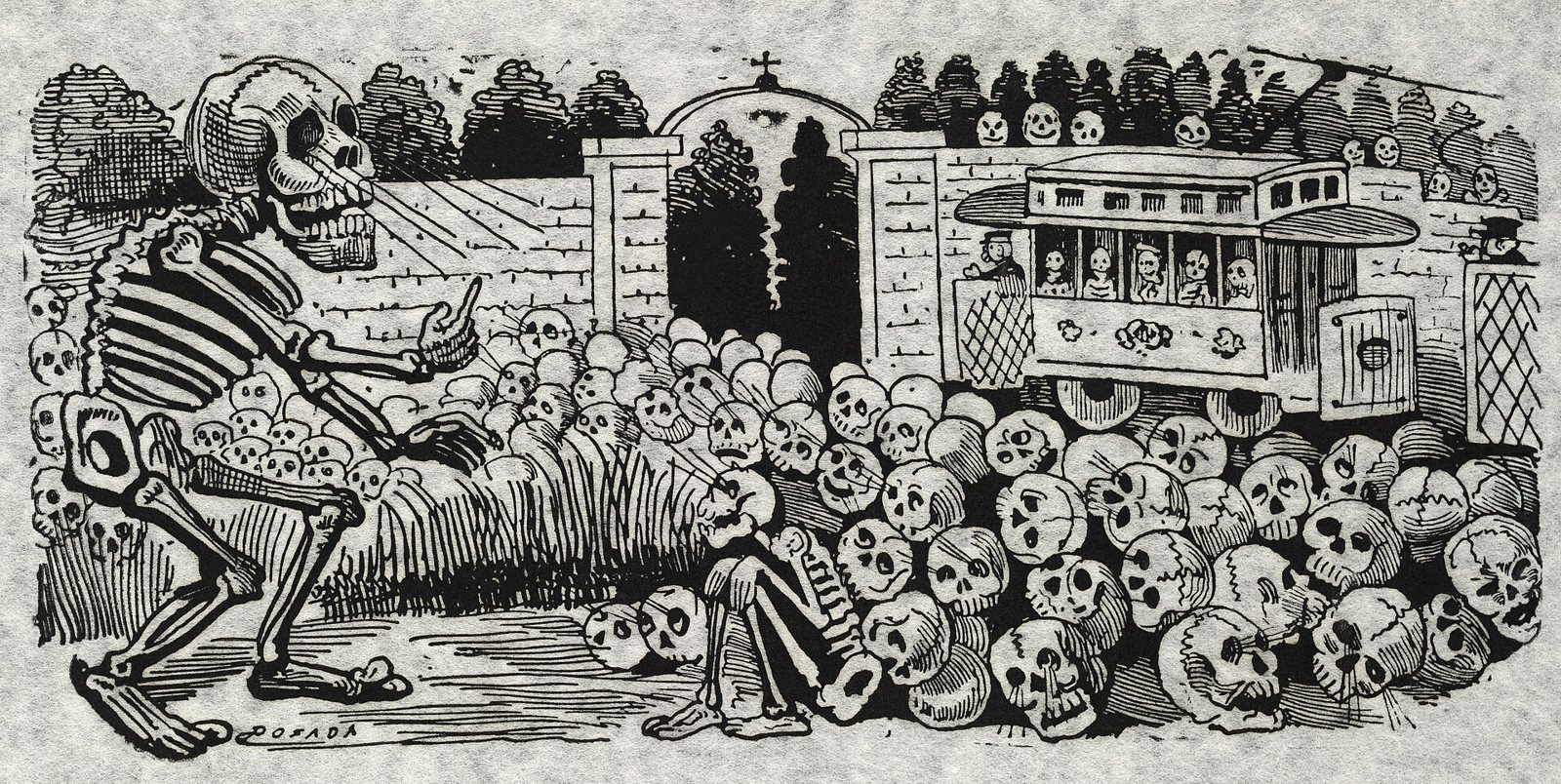
Gran Calavera Eléctrica, dated by the Met.
1902
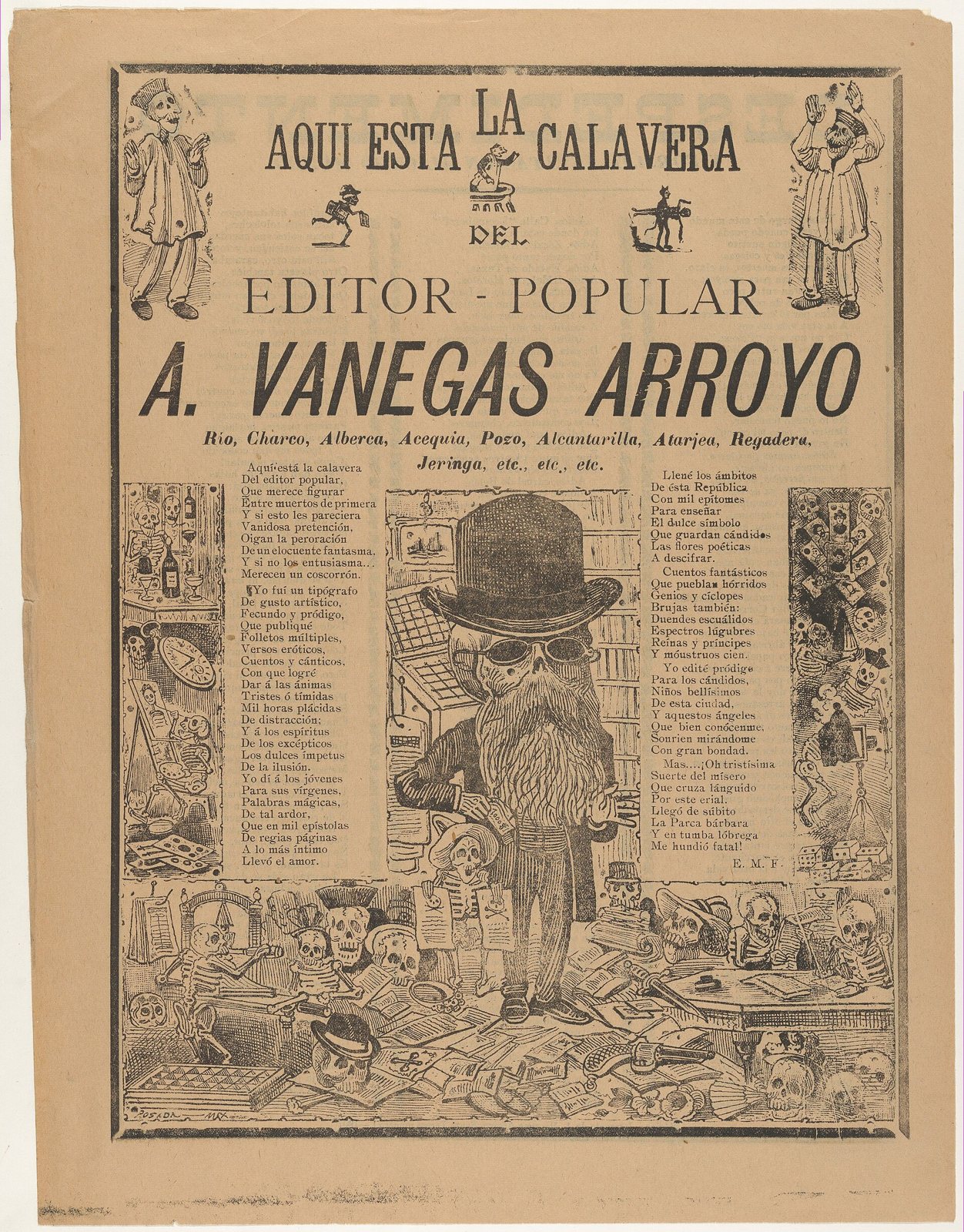
The skeleton of the people's editor, dated by the Met.
January 20, 1913
Posada dies in Mexico City.
August 30, 1925
Jean Charlot's essay appears in Revista de Revistas.
1930
The monograph is published with Diego Rivera's introduction.
1947
Rivera paints Sueño de una tarde dominical en la Alameda Central.
What he made, and how
Posada's work was not a single kind of print. He drew illustrations for newspapers, magazines, books, calendars, advertisements, chapbooks, songbooks and inexpensive broadsides. Vanegas Arroyo's press in Mexico City turned out illustrated sheets for a large popular audience, and the subjects ran from sensational crimes, disasters and supernatural events to politics, social types, moral stories, corridos and calaveras. Posada's images often shared the page with verses or text written by someone else. The sheets were sold in markets, in the street and at festivals, and the calavera sheets sold especially well around Día de Muertos on November 1 and 2.
His methods changed with the city. Posada started in lithography and wood engraving. In Mexico City, lithography was slow and good boxwood blocks were scarce, so he moved toward type-metal engraving, and he also used relief etching, zinc etching and photorelief. Museum records describe his prints with terms like type-metal engraving, zincograph, photorelief and letterpress. The Getty's Posada archive holds some of the material in the form it was sold: newspapers, adult chapbooks, half-sheet broadsides and full-sheet broadsides.
One detail is easy to miss. Posada did not usually title his own work, and editors could change the titles and the printed text from one reprint to the next, according to an INAH publication. That is why the same image can turn up under different names, and why a museum's record of a specific print is worth reading.
What the calaveras were about
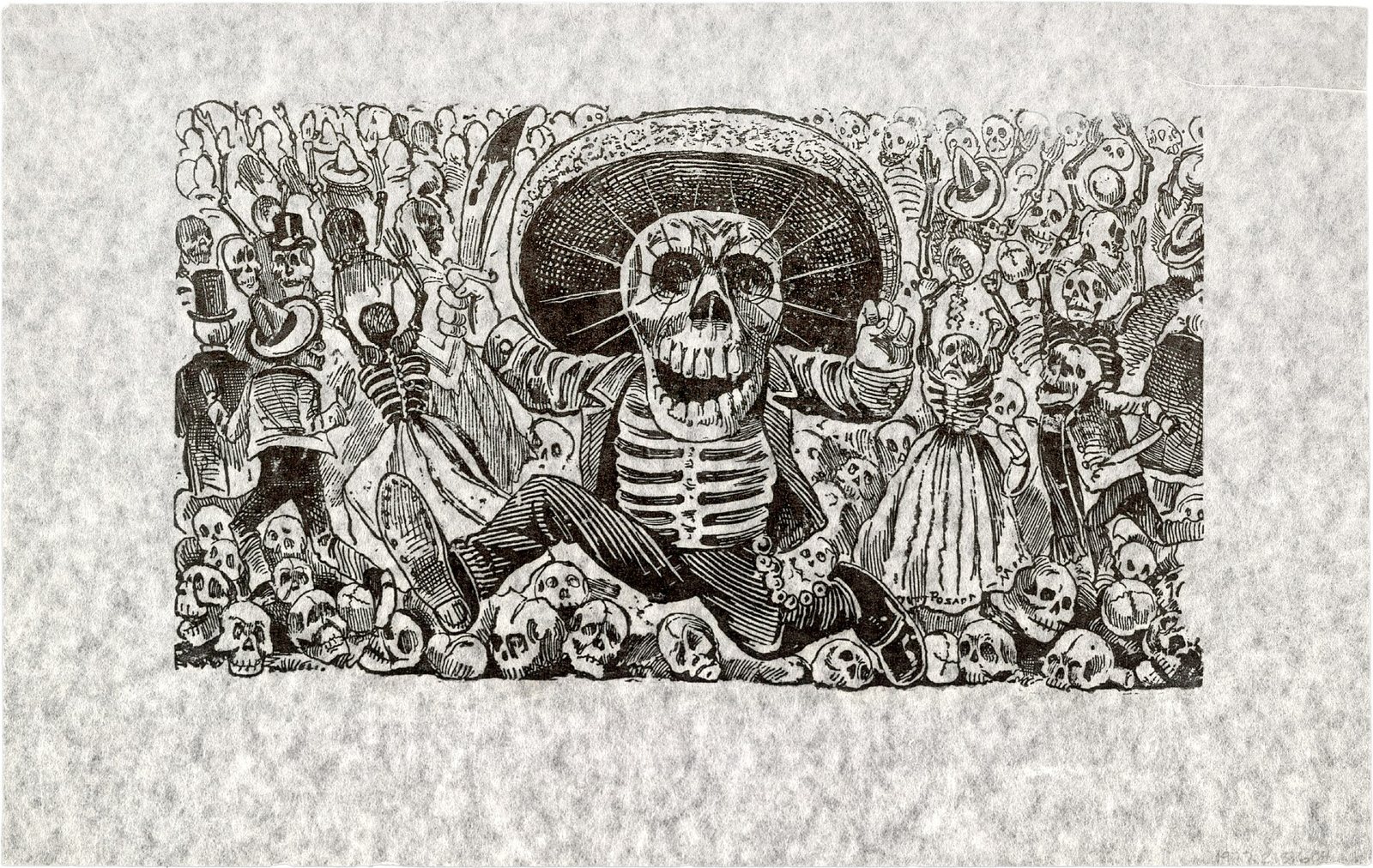
Posada's calaveras are skeletons drawn as caricatures of politicians, aristocrats, workers, heroes, criminals and ordinary people. They dance, work, play music, fall in love, report crimes and parody the people of their day. The recurring message is that death erases rank, and each image could also needle a particular news story, social class or political figure. They were not all made for a religious ceremony, and they are not all the same tradition. They are popular graphic work: journalistic, funny and critical.
The museum records show how wide the range was. Each of these is by Posada and held by the museum named:
- Gran Calavera Eléctrica, 1900, zincograph, type-metal engraving and letterpress, The Metropolitan Museum of Art. Skeletons, skulls and an electric streetcar, modern city life played for comic mortality.
- The skeleton of the people's editor, 1902, zincograph and letterpress, The Met. The Met identifies it as a humorous portrait of the publisher Antonio Vanegas Arroyo, shown as a bearded skeleton among people proofreading and running a press. The man who ran the print shop gets to be the skeleton.
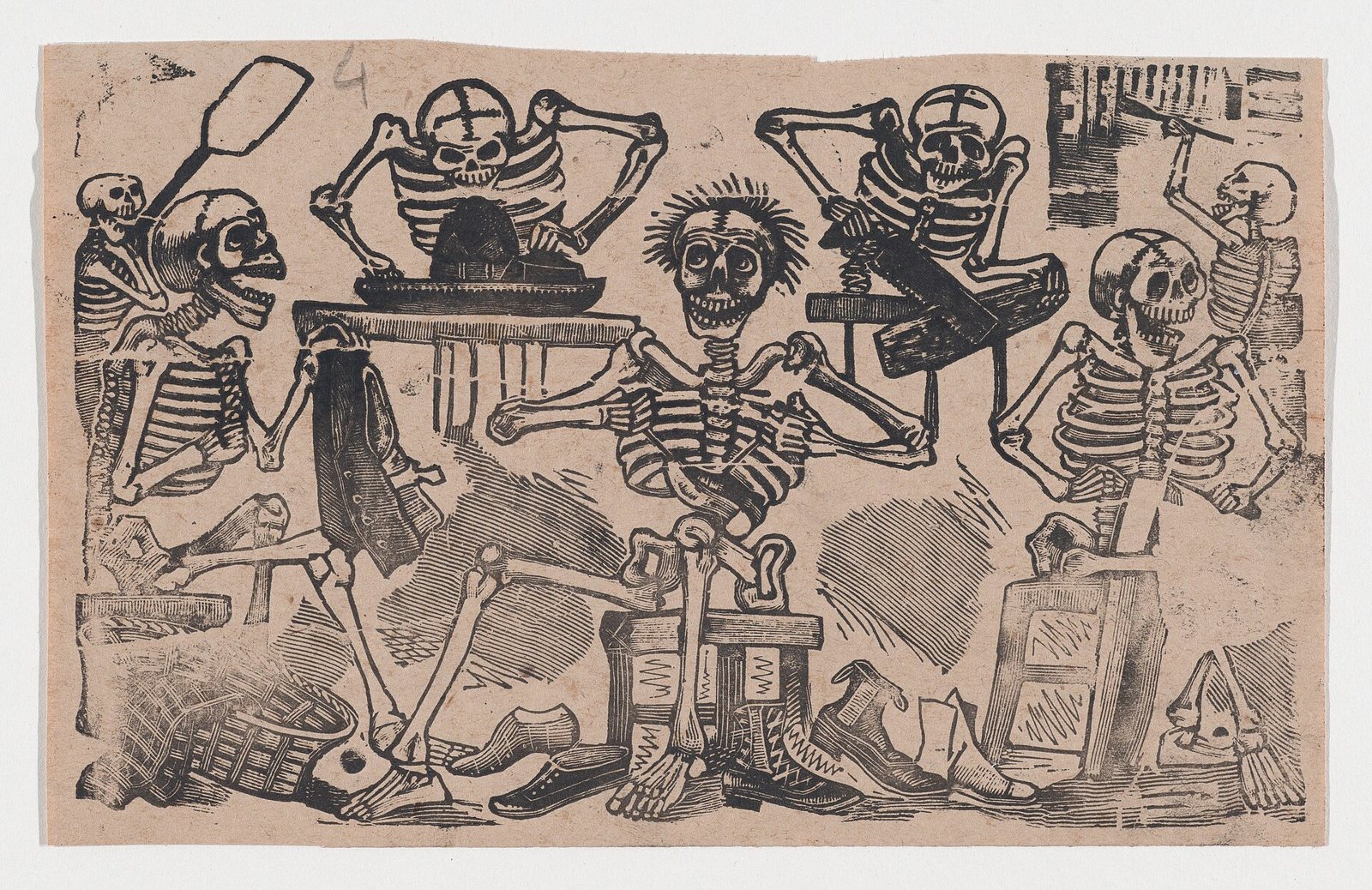
- Calavera de artesanos, about 1892, type-metal engraving, The Met. Skeletons in the roles of working craftspeople.
- La Calavera de Cupido, about 1892, zincograph, The Met. Courtship and fashionable display, applied to the dead.
- Well-dressed male and female skeletons arm in arm, about 1894, type-metal engraving, The Met. It comes from the broadsheet *Aquí tiene a dos muertos*, part of *El gran panteón amoroso*.
- The great pantheon of love, circa 1910 to 1915, type-metal engraving and letterpress on green paper, Elisha Whittelsey Collection, The Met. Twelve scenes with verses about romance.
- A bullfighting calavera broadside, 1908, photorelief and letterpress, The Met, published by Antonio Vanegas Arroyo. The bullfighting world turned into a skeleton spectacle.
- Coloquio de Buenas Calaveras, relief engraving on wove paper, Arts of the Americas, Brooklyn Museum. The museum describes it as a satirical image involving Porfirio Díaz and his circle.
Tap or hover a row to highlight it.
| Title | Date | Medium | Collection |
|---|---|---|---|
| TitleGran Calavera Eléctrica | Date1900 | MediumZincograph, type-metal engraving and letterpress | CollectionThe Metropolitan Museum of Art |
| TitleThe skeleton of the people's editor | Date1902 | MediumZincograph and letterpress | CollectionThe Metropolitan Museum of Art |
| TitleCalavera de artesanos | DateAbout 1892 | MediumType-metal engraving | CollectionThe Metropolitan Museum of Art |
| TitleLa Calavera de Cupido | DateAbout 1892 | MediumZincograph | CollectionThe Metropolitan Museum of Art |
| TitleWell-dressed male and female skeletons arm in arm | DateAbout 1894 | MediumType-metal engraving | CollectionThe Metropolitan Museum of Art |
| TitleThe great pantheon of love | DateCirca 1910 to 1915 | MediumType-metal engraving and letterpress on green paper | CollectionThe Metropolitan Museum of Art |
| TitleA bullfighting calavera broadside | Date1908 | MediumPhotorelief and letterpress | CollectionThe Metropolitan Museum of Art |
| TitleGran baile de calaveras | Date1906 | MediumPrint | CollectionNew York Public Library |
| TitleIncreíble suceso: una mujer que se convierte en piedra | Date1903 | MediumZinc etching | CollectionAmon Carter Museum of American Art |
Politics, labor, crime, entertainment, technology, romance and daily life all show up in those titles. A skeleton on a Posada sheet is as likely to be selling you the news as reminding you of your own end.
The skeleton who got a second name
One print of Posada's has outgrown the rest. *La Calavera Garbancera*, generally dated to the early 1910s, shows a female skeleton in an elaborate hat and no clothing. Mexico's Secretaría de Relaciones Exteriores and the Aguascalientes museum describe it as a satire aimed at a woman of Indigenous background who copied the fashions of Europeanized elites during the Porfiriato. *Garbancera* referred to people who sold garbanzos, and the social criticism of the time said they turned away from their roots to pass as Spanish or French. The sheet carried satirical verses and the thought that everyone ends up as one more skull in the crowd. That is a period caricature aimed at a class and an identity, and it reads that way.
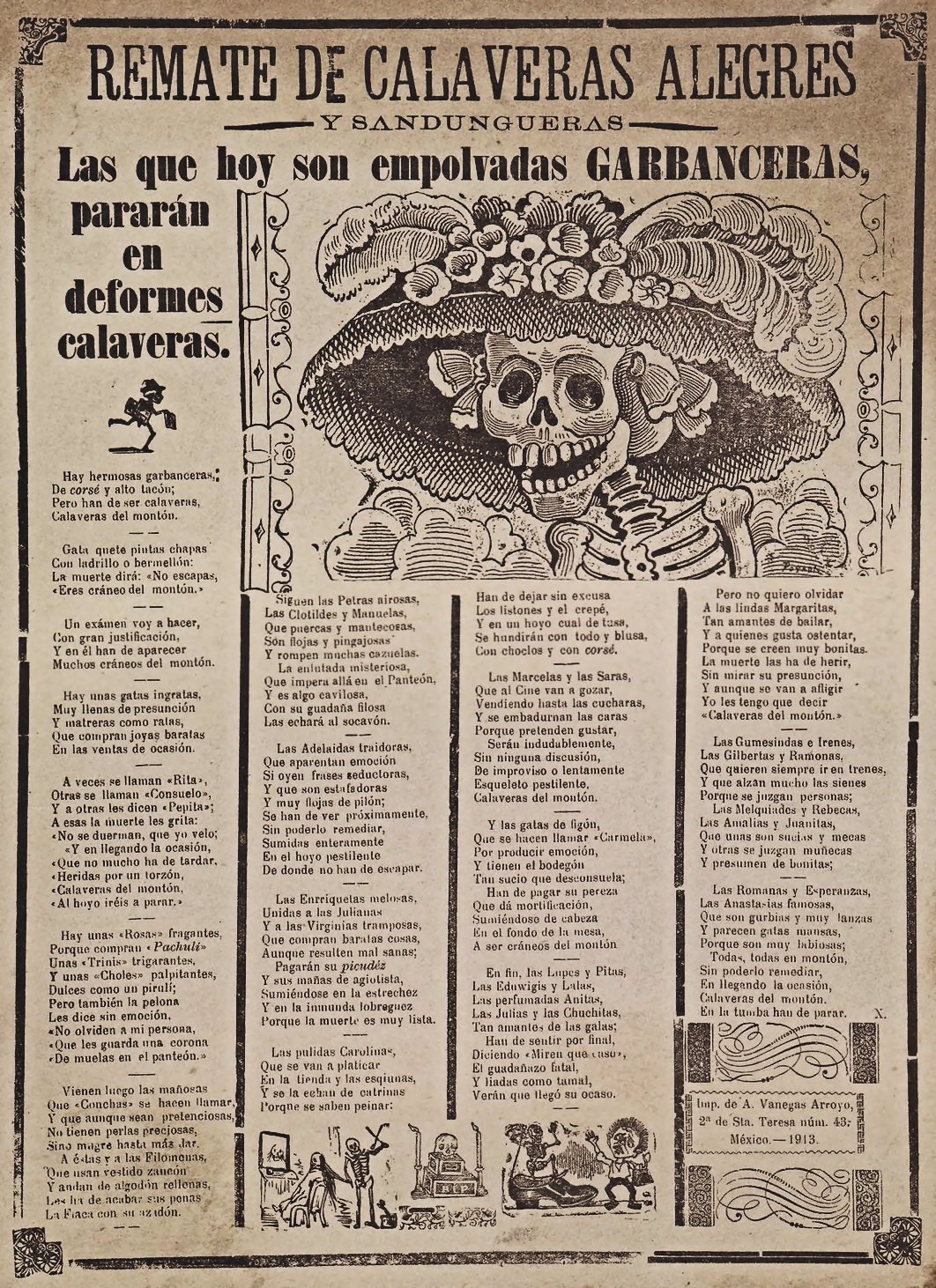
The name La Catrina came afterward. Diego Rivera gave the figure a full gown and a place at the center of his mural *Sueño de una tarde dominical en la Alameda Central*, painted in 1947, and the name stuck. The University of Michigan Museum of Art records a relief engraving of about 1910 under the title *Calavera de la Catrina*, also called "Calavera of the Female Dandy," and reads it as a satire of the upper classes under Díaz. For the full story of the lady in the hat, her mural and her place on Día de Muertos altars, read the guide to La Catrina. The point here is smaller: the engraving is Posada's, and the name and the gown belong to the people who came after him.
How a forgotten printmaker became a precursor
In 1913 Posada had no international reputation. In the 1920s the artist Jean Charlot, working in Mexico, recognized the popular prints as important to the new modern Mexican art. His essay "A Precursor of the Modern Art Movement, the Printmaker Posada" ran in *Revista de Revistas* on August 30, 1925. Diego Rivera, Anita Brenner, Frances Toor and José Clemente Orozco helped move Posada from commercial printing into the history of Mexican art, as the Oxford Research Encyclopedia and the Museo Nacional de Arte tell it. The museum says that by 1930 his imagery was part of the programs of a significant share of the new generation of Mexican artists.
That year Frances Toor, Blas Vanegas Arroyo and Pablo O'Higgins published *Posada: Monografía de 406 Grabados de José Guadalupe Posada*, with an introduction by Rivera. The Met acquired eight Posada works from Charlot in 1929 and about 350 prints in 1930, the start of the museum's large holding. A cheap sheet sold in the street had become something curators wanted on their walls.
So, three moments are worth keeping apart: the prints Posada made, the recovery of his work by the artists of the 1920s, and the national symbol that grew from Rivera's mural.
Where to see Posada's work
- Museo José Guadalupe Posada, Aguascalientes. It opened on September 16, 1972, in the former curial house beside the Templo del Encino, with a permanent Posada exhibition, plates, prints and related work by Manuel Manilla.
- New York Public Library. Its Wallach Division holds more than 600 Posada items, including broadsides, chapbooks, caricatures and print blocks, among them *Gran baile de calaveras*, dated 1906.
- The Metropolitan Museum of Art, New York. Numerous prints, some on view, many in open-access images.
- Amon Carter Museum of American Art, Fort Worth. Its Posada collection includes *Increíble suceso: una mujer que se convierte en piedra*, 1903, a zinc etching.
- Art Institute of Chicago. Prints including *The Spicy Little Calaveras, green and pink*.
- Harry Ransom Center, University of Texas at Austin. The Tinker collection includes 132 broadsides and sheets, with calaveras, corridos and political material.
- Museo Nacional de Arte, Mexico City. It organized *José Guadalupe Posada: transmisor* in 2013, with more than 230 works.
Collections rotate, and not every print is on view all the time, so check each institution's page before you plan a visit. If you want an image for your own project, the Met's public-domain records, the Brooklyn Museum's *Coloquio de Buenas Calaveras* (listed with no known copyright restrictions, to be used with credit) and the public-domain files on Wikimedia Commons are good places to start. The University of Michigan asks for a rights request, so write to the museum first if you want its image.
How well do you know Posada?
Answer every question to check.
Quick answers about Posada
What are José Guadalupe Posada's calaveras?
They are caricature skeletons printed on cheap broadsides and in popular publications, mostly in Mexico City from the 1880s to the 1910s. They stand in for politicians, workers, lovers, criminals and everyday people, and they dance, work and play music, mocking inequality along the way.
How did La Calavera Garbancera come about?
Posada drew it as a satire of a woman who adopted the clothes and manners of the Europeanized elite. Reprints changed its title and text, and the name La Catrina was attached to it after his death.
What is the original name of Posada's Catrina?
*La Calavera Garbancera*. Posada did not call the figure La Catrina, and the full-length gown came from Diego Rivera's 1947 mural, so "La Catrina" names the later figure.
What is the history of the calavera in Posada's prints?
Posada learned lithography in Aguascalientes, worked in León and settled in Mexico City in 1888, where his skeletons ran on cheap sheets from the 1880s to the 1910s. They were largely forgotten after his death and brought back by Charlot, Rivera and others from the 1920s.
Are Posada's prints in the public domain?
Many are. The Met lists several of its Posada prints as public domain, and the Amon Carter Museum lists its 1903 zinc etching the same way. Check the record for the exact print before reusing an image.
Where to go next
If the skeleton in the wide hat is what brought you here, the story of La Catrina follows her from Posada's sheet to Rivera's mural. For the word itself, read what calavera means, and for the holiday most of these skeletons are now tied to, start with the guide to Día de Muertos. The verses that ran beside the images have their own story in the piece on calaveras literarias, and more skull art in museums is covered in famous skull art. If you spend your days around books and print, our Book Crew skull tee is a shirt for you.