

No. 029
Calaveras Literarias: What They Are, Where They Came From and How to Write One
A calavera literaria is a short, funny poem written for Día de Muertos in which Death, called La Calaca, La Flaca or La Huesuda, comes for a person who is treated, as a joke, as if already dead. Mexico's Secretaría de Educación Pública (SEP) describes it as a verse text that introduces a political, social or cultural person or event through a comic, ironic or satirical turn. The usual school form is a four-line stanza, and the quick recipe is simple: pick a person, choose one harmless trait, let Death arrive, and finish with a comic reversal. The poems are often called *calaveritas*, and this page covers examples, the history, what the form means and a step-by-step way to write one.
How the form works
The most common school form is the *cuarteta*, a four-line stanza. The guide from Prepa en Línea-SEP says the first and third lines rhyme and the second and fourth lines rhyme, an ABAB pattern, and it suggests about four or five stanzas. A UNAM study of the form adds that octosyllabic quatrains, with eight syllables a line, are the usual shape, while other forms exist. Schools often accept shorter poems: a 2025 contest at the University of California, Davis asked for 4 to 10 lines, and the Universidad Veracruzana and Oaxaca activities set no single national format.
The ingredients repeat from poem to poem. It is written in verse, with a playful tone, and Death acts as a character. The subject is a living or recognizable target, such as a classmate, teacher, politician, celebrity, family member or institution, with an exaggerated habit, flaw or situation. Near the end comes a turn, such as Death being tricked, delayed or made ridiculous. Treating a living person as dead is a literary device and says nothing about an actual death. School guidance asks writers to avoid humiliation, discrimination, threats and jokes about trauma.
Test your calavera literaria knowledge
Answer every question to check.
Two short examples
The SEP guide for Prepa en Línea publishes this school example, which it ties to a tradition of calaveras associated with José Guadalupe Posada:
> No te descuides, Zocato, > vaya a ser que un toro prieto, > te dé un soberbio sopapo > que te deje hecho esqueleto.
In plain English: don't let your guard down, Zocato, because a dark bull might land a mighty slap that leaves you a skeleton. Lines one and three end on matching vowel sounds, and so do lines two and four, which is the ABAB pattern in action.
The Instituto de la Educación Básica del Estado de Morelos (IEBEM) publishes this classroom example:
> Niños de tercer año > jugaban en el panteón > cuando llegó la calaca > y se los llevó al salón.
It means: third-grade kids were playing in the cemetery when La Calaca arrived and took them back to class. The rhyme here falls on lines two and four, *panteón* and *salón*, and the joke is the reversal at the end, since the scariest thing Death can do is send them back to school. School examples vary, and some modern calaveras use free verse or irregular rhyme. These are classroom models, not rules for everyone.
Where the form came from
Documented explanations place the modern printed tradition in nineteenth-century Mexico, in satirical newspapers, loose sheets and popular broadsides. A Mexican government publication says the verses used to be called *panteones*, began as burlesque epitaphs and were sometimes censored or destroyed because they voiced dissatisfaction with current events and politicians.
The record disagrees on the date. The Secretaría de Agricultura gives 1879 for the first calaveras published in Guadalajara's newspaper *El Socialista*, while a UNAM archival bulletin and a CNDH publication give 1849. Both dates are on record, so treat the start of the tradition as unsettled.
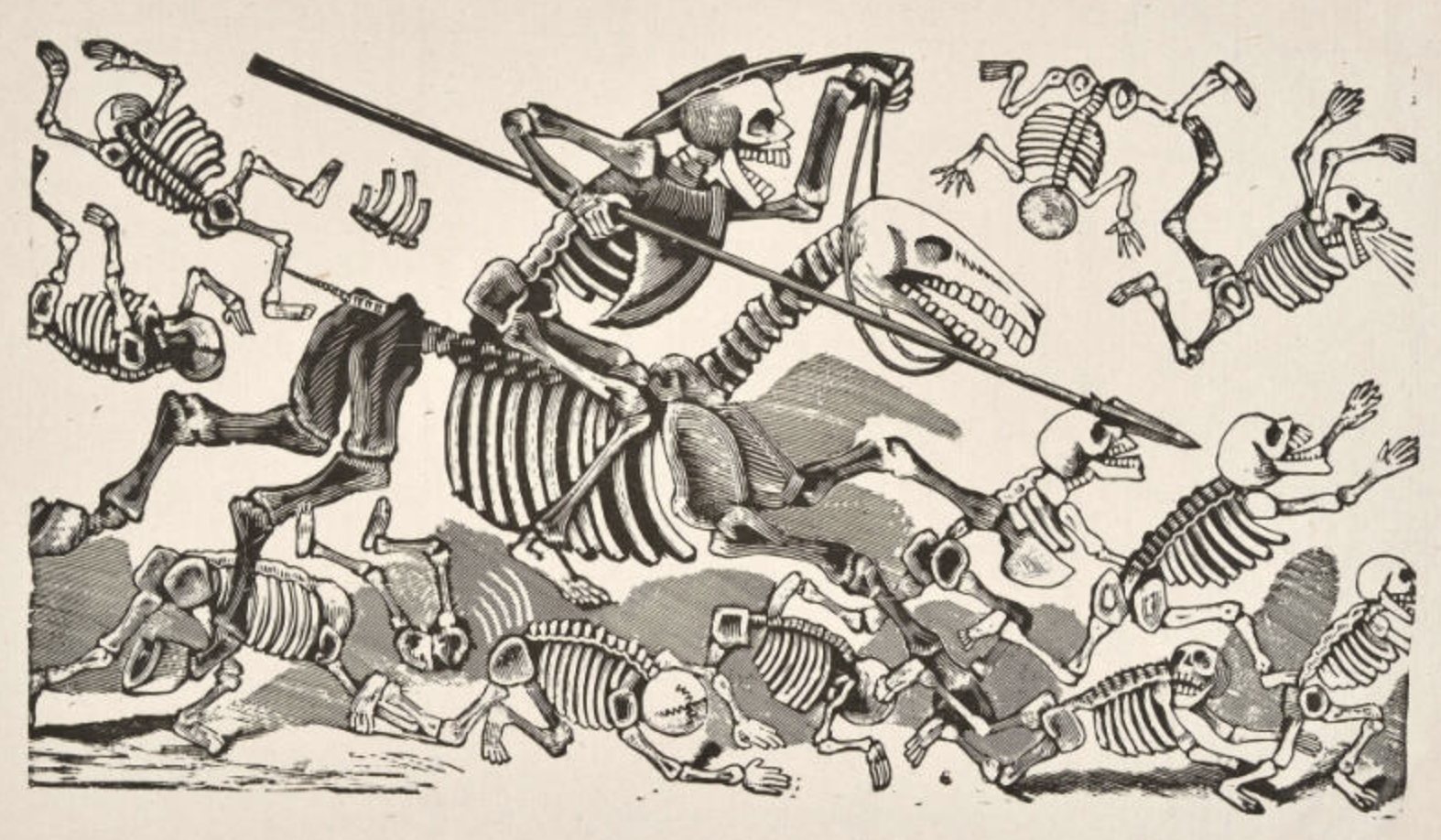
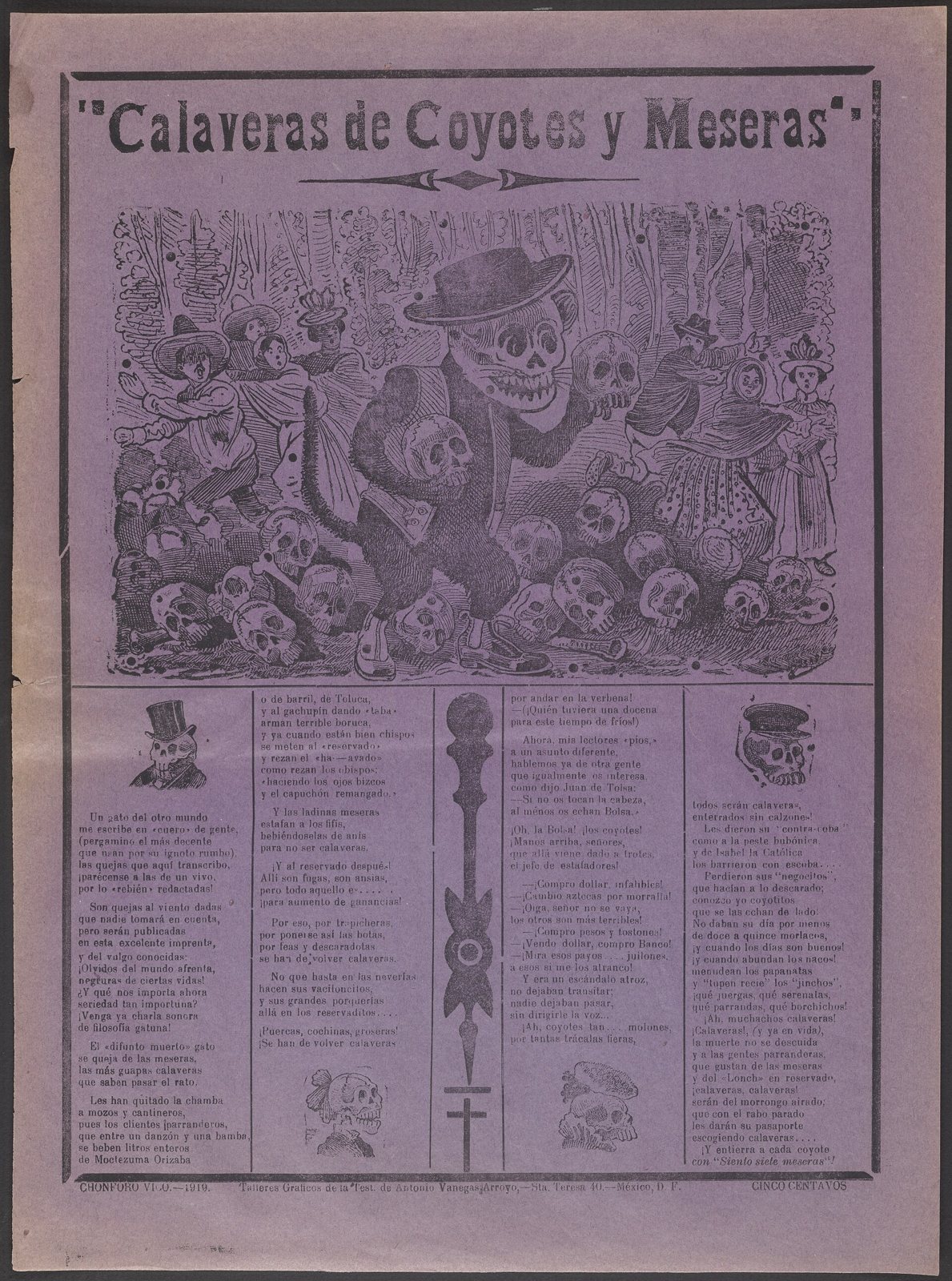
By the end of the century, a Mexico City print shop was turning them into a business. Antonio Vanegas Arroyo published illustrated broadsides with calavera verses, often with engravings by Manuel Manilla and José Guadalupe Posada, and the Library of Congress dates examples from about 1890 to 1917. Posada worked for Vanegas Arroyo, but the press tradition came before his best-known skeleton and is not one artist's invention. His *Calavera Garbancera* and the name La Catrina came later, when Diego Rivera helped popularize the name in the twentieth century. You can read that story in La Catrina and about the printmaker in José Guadalupe Posada.
What the old broadsides made fun of
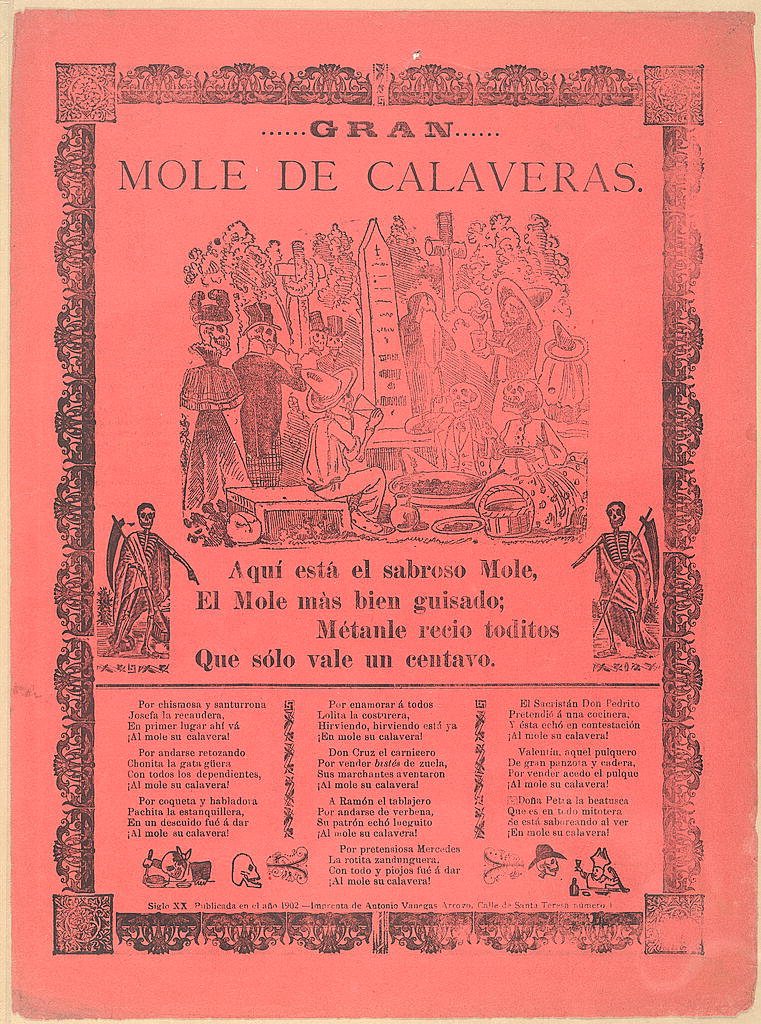
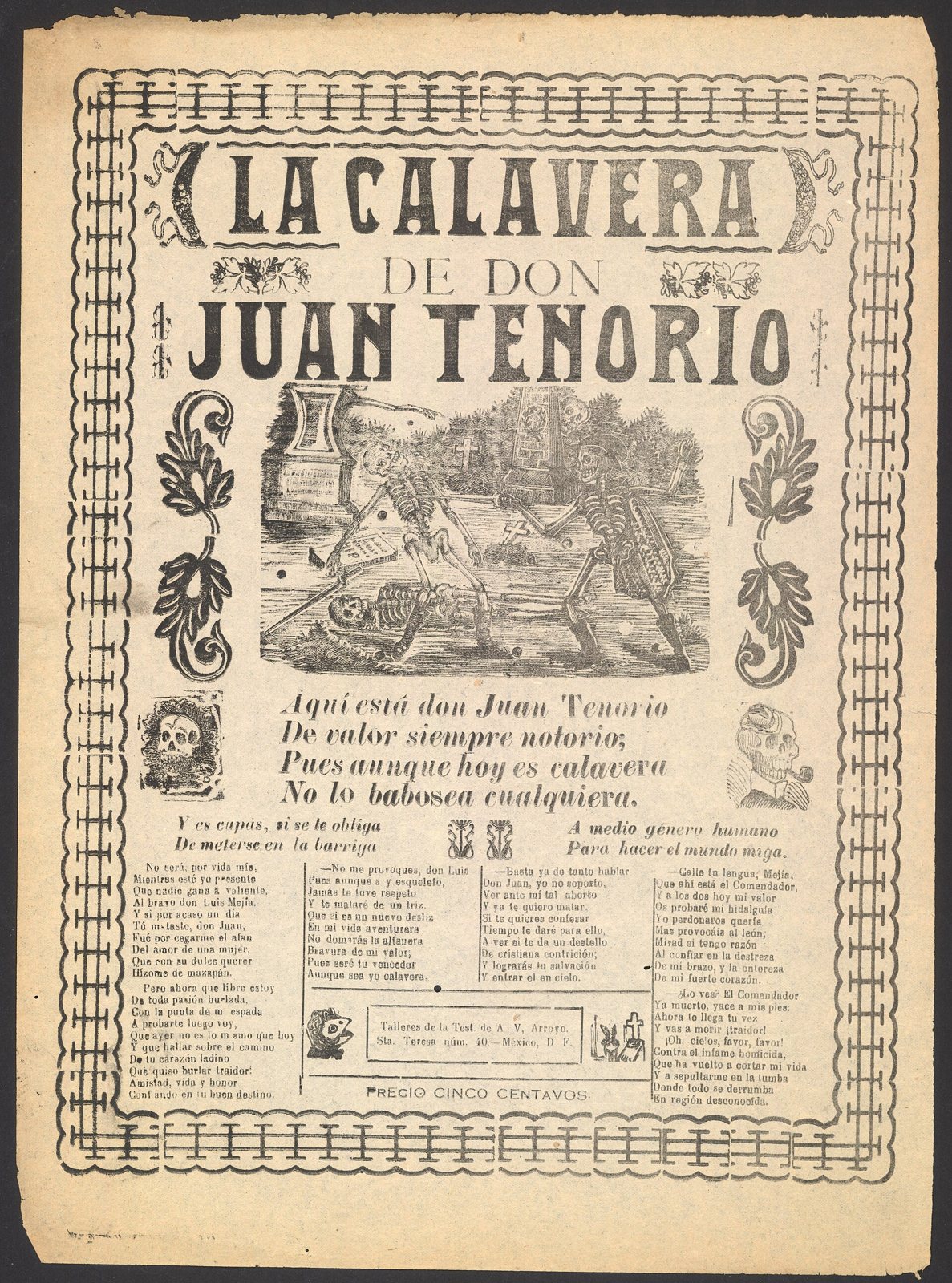
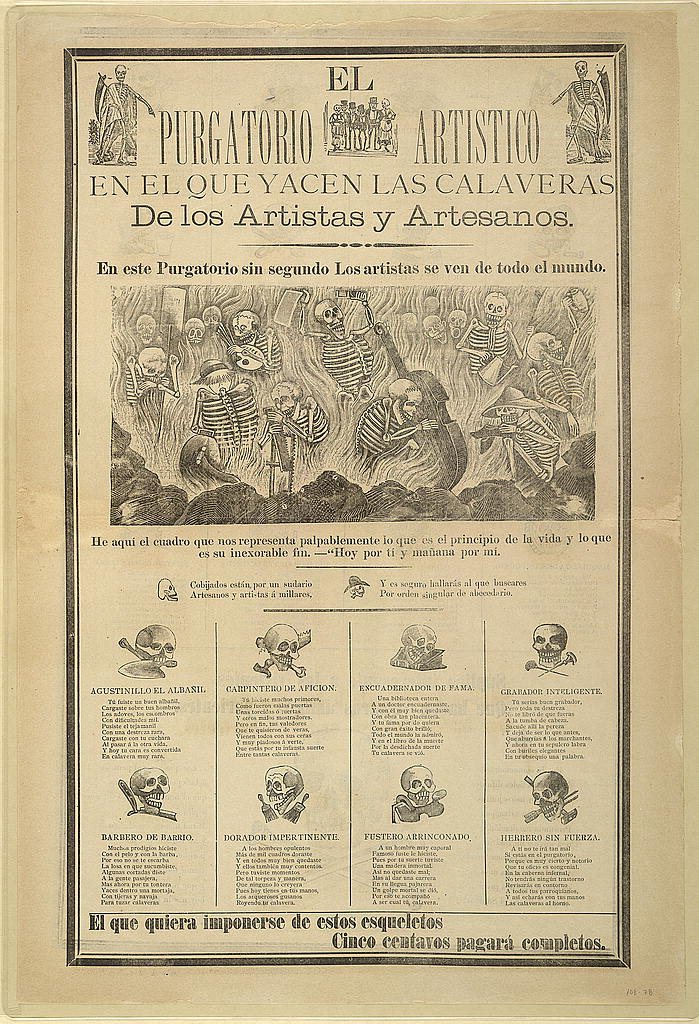
Collection records at the Library of Congress name the targets. *La calavera de Don Juan Tenorio*, published by Vanegas Arroyo between 1909 and 1917, goes after the fictional seducer whose play was often staged around Día de Muertos. *El Purgatorio Artístico*, from about 1890 to 1909, shows artists and artisans as skeletons, with verses naming their trades. *Calaveras de coyotes y meseras*, from 1919, satirizes con men and waitresses who take advantage of drunk customers. *Calaveras del montón, número 2*, from 1910, shows Francisco I. Madero as a drunken peon, with references to his family's maguey plantation and distillery. A sheet from about 1923 targets Francisco Villa, a leader of the Mexican Revolution, and *Gran mole de calaveras*, from 1902, uses a food-market metaphor.
So, printed calaveras could aim at fictional characters, trades, politicians and bad behavior. That does not prove every modern calavera has the same political purpose.
Calaveras literarias through time
Tap or hover a step to follow the order.
1849 or 1879
Institutional accounts disagree on the date of early calaveras in Guadalajara's El Socialista
About 1890 to 1909
Vanegas Arroyo and Posada broadsides, including El Purgatorio Artístico
1902
Gran mole de calaveras published in Mexico City
1910
Calaveras del montón número 2 caricatures Francisco I. Madero
1919
Calaveras de coyotes y meseras
2018
The Museo Nacional de Antropología holds its sixth literary-calavera contest for children and young people
2019
Oaxaca's Archivo General del Estado holds its third annual contest
2025
UC Davis holds a student contest requiring 4 to 10 lines
What a calaverita means
Calaveritas are a funny way to represent death, remember people and criticize behavior or authority. In the schools and communities of Mexico where this is documented, Death works as a literary character, not as a prediction. At UNAM's Colegio de Ciencias y Humanidades, professor Miguel Ángel Landeros called Día de Muertos a "rito social contra el olvido," a social rite against forgetting, and tied calaveritas to the memory of people who died. In the printed political satire of nineteenth- and twentieth-century Mexico City, the skull also levels people of very different power and lets writers mock public figures.
The meaning is not the same across Mexico. Día de Muertos practice varies among states, towns, families, Indigenous communities, schools and the Mexican diaspora, so a school calaverita from Mexico City does not stand for every celebration.
Calaveras in classrooms and contests
Schools use calaveras for language, rhyme and cultural literacy. SEP's primary-school lesson asks children to find the recognizable subject, notice the traits of the person described, compare ending sounds and revise words to keep the rhyme.
Contests give a feel for the range:
- In Oaxaca, the Archivo General del Estado held its third annual contest in 2019 for children, young people and adults, requiring original work and awarding three places, and offered an online workshop in 2021 for all ages.
- At UNAM's CCH Oriente, teachers and students wrote and read calaveritas aloud, including one for victims of the Línea 12 Metro accident, which shows the form can address public events.
- The Universidad Veracruzana's Xalapa campus held a calaveras contest in its 2022 Día de Muertos festival.
- A 2022 contest at UNAM's Faculty of Sciences asked for 3 to 5 stanzas of 4 to 6 lines and said satire could not exceed the limits of respectful coexistence.
- In the United States, the University of California, Davis Department of Spanish and Portuguese ran a 2025 contest with readings and prizes, asking for 4 to 10 lines with humor, death imagery and, preferably, rhyme.
- The Museo Nacional de Antropología held its sixth contest for children and young people in 2018, stressing creativity, imagination and written language.
For younger children, the IEBEM activity asks them to say who the poem is about, separate imaginary events from real ones, swap "niños" for "maestros" and make an illustrated classroom wall called "Muro de los muertos... de risa." Yale's 2024 teaching unit recommends modeling examples, discussing cultural context, analyzing structure and allowing collaborative writing. Teachers commonly ask for a short, humorous poem about a classmate, teacher, school situation, fictional character or public figure, with rhyme and a personified death figure, and requirements shift with the teacher and grade. These examples document particular schools and years, not a national policy.
Writing a calavera literaria
Tap a card to bring it forward.
- Pick a recognizable person or event: The poem needs a clear subject
- Choose one harmless detail: A habit, hobby or catchphrase works; avoid disability, race, body size, grief, illness, poverty, religion or trauma
- Introduce Death as a character: La Calaca, La Flaca or La Huesuda arrives in the poem
- Draft four-line stanzas: The common school form is the cuarteta
- Try ABAB rhyme: Rhyme lines 1 and 3 and lines 2 and 4
- Use a comic reversal: The best calaveras flip the expected outcome
- Read it aloud for rhythm: Check rhythm, pronunciation, rhyme and whether the final joke works
- Remove insults, threats and private disclosures: Keep the humor kind and clear
- Confirm contest rules before submitting: Check that contest's own length, originality, language, deadline and conduct rules
How to write one, step by step
These steps combine the SEP guide, the Universidad de Guanajuato's planning guide and the contest rules above.
- Choose a community and audience: a classroom, family, workplace, campus group or local event.
- Choose a recognizable subject, a known person or event. Ask permission before using a private person's sensitive experience.
- Pick one harmless, observable detail, such as a habit, hobby, subject, job or catchphrase. Do not use disability, race, body size, grief, illness, poverty, religion or trauma as punchlines.
- Set a place, such as a school, house, cemetery or plaza, and bring in Death by name: La Calaca, La Flaca, La Huesuda or La Catrina, though families may use other names.
- Give Death a plan. The SEP guide recommends an introduction, a middle and an ending, so let Death arrive, then try a meeting, a chase, a dance, an argument or an escape.
- End with a surprise. The best calaveras flip the expected outcome.
- Draft in quatrains, aiming for about eight syllables a line, and rhyme lines 1 and 3 and lines 2 and 4. Keep natural Spanish and meaning ahead of mechanical counting.
- Revise for kindness and clarity. Oaxaca's contest rules require personal authorship, and UNAM's Faculty of Sciences rejects satire that goes past respectful coexistence. Cut anything that reads as a threat, harassment or private information.
- Read it aloud. Check rhythm, pronunciation, rhyme and whether the final joke works without explanation.
- Credit any quotation or historical verse, and do not present a published poem as your own. For a public performance or publication, confirm the reproduction terms.
A simple planning line: Death notices [a specific harmless trait], approaches [the person], causes [a comic problem] and ends with [a reversal]. Before you submit to a contest, check that contest's own length, originality, language, deadline and conduct rules.
Quick answers about calaveras literarias
What is a calavera literaria, and what is an example?
A calavera literaria is a short, popular, humorous poem in which Death appears as a character and visits a living, dead or fictional person, especially at Día de Muertos. The SEP example above, the one about Zocato and the dark bull, shows it in four lines, though some modern calaveras use free verse or political satire instead.
Can you give examples of short calaveritas?
Yes, two short school examples with attribution appear above, one from the SEP guide and one from IEBEM in Morelos. For historical models, look up *Calavera oaxaqueña*, Posada's engraving from about 1903, and the broadsides *Calaveras de las elecciones presidenciales* by Antonio Vanegas Arroyo (1919) and *Regalo de calaveras*, from the Vanegas Arroyo press and held in the Museo Nacional de Arte catalogue.
What do calaveritas symbolize?
They symbolize a humorous way of representing death, remembering people and criticizing conduct or authority. In documented Mexican school and community settings, death is a literary character and not a literal prediction.
How do you write a calavera literaria?
Pick a person or topic, choose a recognizable trait, let Death interact with that person and end on a comic or unexpected turn. A common school structure uses four-line stanzas of about eight syllables each, with an alternating rhyme, and a respectful tone toward the person it mentions.
What do teachers ask for in calaveras for teachers and for children?
Teachers usually ask students to write a short, humorous, rhymed poem with a personified death figure about a classmate, teacher, school moment, fictional character or public figure. Students may work alone, in pairs or in groups, read the poem aloud and illustrate it with calacas, bones, bread or altar imagery, while keeping the humor kind.
Where to go next
The poems make the most sense inside the holiday that gives them a reason to exist, so start with the guide to Día de Muertos. For the skeleton figures of folk art, see calacas, and for the printmaker behind the broadsides, read about José Guadalupe Posada. If a calavera is part of a classroom project, you can also build an altar with the guide to making an ofrenda. And for the teacher at the head of the room, our Teacher skull tee shows an engraved skull in reading glasses on a stack of books, with GRADED TO THE BONE across the bottom.