No. 004
How to Make an Ofrenda: Building a Día de Muertos Altar at Home
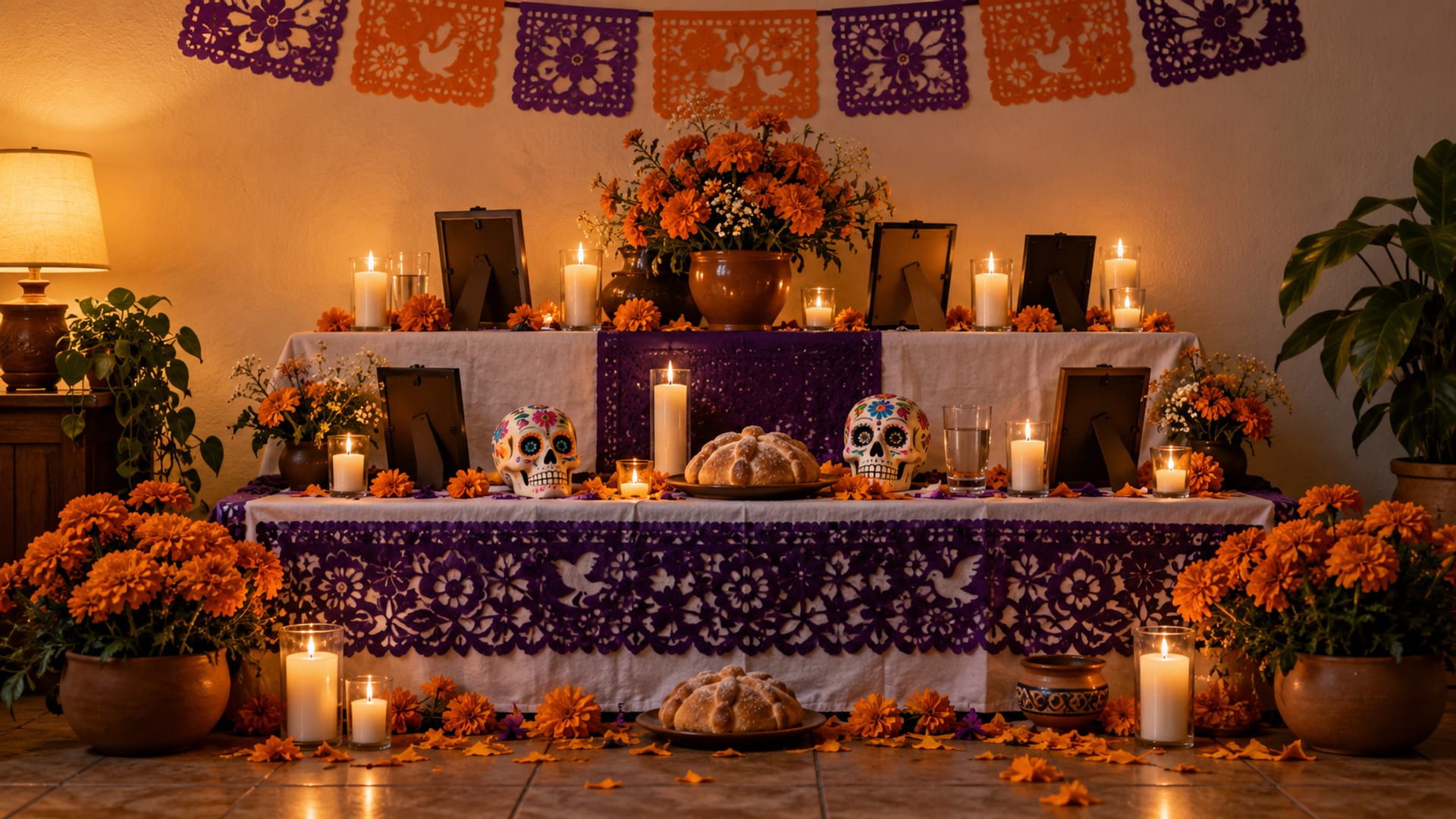
An ofrenda is a home altar made to remember someone who has died and to welcome their memory during Día de Muertos. A simple one is enough: a photograph, a glass of water, a flower, a safe light and one thing they loved. Francisco Soto of San Diego's Sherman Heights Community Center put the purpose in one line: "An ofrenda is a gift, a gift that we give to all the people that have died." You can build one for a grandparent, a friend or a pet, on a shelf, a table corner or a windowsill, and the sections below walk through what to place, how to arrange it, when to set it up and how to keep it safe.
A simple ofrenda starter list
Tap a card to bring it forward.
- A photograph or written name: Who you are remembering.
- Water: For the thirst of the returning soul.
- A candle: A battery-operated one is the safest choice.
- A flower: Cempasúchil, or another flower that fits where you live.
- Their favorite food or drink: What makes the altar personal.
- Bread: Pan de muerto, or another bread that means something to them.
- Salt: A purifying element in many accounts.
- Papel picado: Or another element for air and wind.
- Copal or incense: Only where it is safe and permitted.
- One personal object: Something they loved.
- Optional: A religious image, a pet's item, a toy, fruit, a sugar skull or a regional element.
What an ofrenda is for
The word ofrenda points to a gift. Families make one to remember relatives and friends who have died, and many describe it as a way of welcoming their memory, presence or visiting spirit back home for a short time during Día de Muertos.
Soto, who speaks about the practice from Southern California, also said: "Anyone who feels that they want to honor their deceased, they're more than welcome to set up an altar." In Guadalajara, Alfonso López Fértor described his family's altar to the Smithsonian in 2019 and said: "It's really important to my family and I that we make an altar to remember relatives who have died."
The practice varies by state, town, family, Indigenous community, Catholic tradition and Mexican American community. There is no single national design, so you are free to build the one that fits the person you are remembering.
What to put on it, and why
Each item below comes with the meaning given by the place or person who describes it. These are explanations from particular Mexican and Mexican American settings, not rules for every altar.
- A photograph. It identifies the person being remembered. Smithsonian's Guadalajara example used photographs of deceased relatives and friends, and Mexico City's cultural guide describes the portrait as the image of the deceased.
- Cempasúchil (marigolds). These flowers are widely used in Mexican ofrendas. Their scent is traditionally believed to help guide the dead to the altar, and in some communities the petals are laid out as a path.
- Candles or veladoras. They stand for light and guidance. Mexico City's cultural guide says their light helps the dead find the correct path.
- Water. It is set out because the returning dead are believed to be thirsty after their trip. Mexico City's guide also connects water with purification.
- Salt. Mexico City's cultural guide describes salt as a purifying element that keeps the body from corrupting. In Southern California, salt is also described as keeping the spirit from becoming lost or corrupted.
- Copal or incense. In Mexico City, copal is a fragrant gift and a way of sending prayer, thought and worship upward in smoke. In the Guadalajara altar, copal sat beside marigolds and a bell.
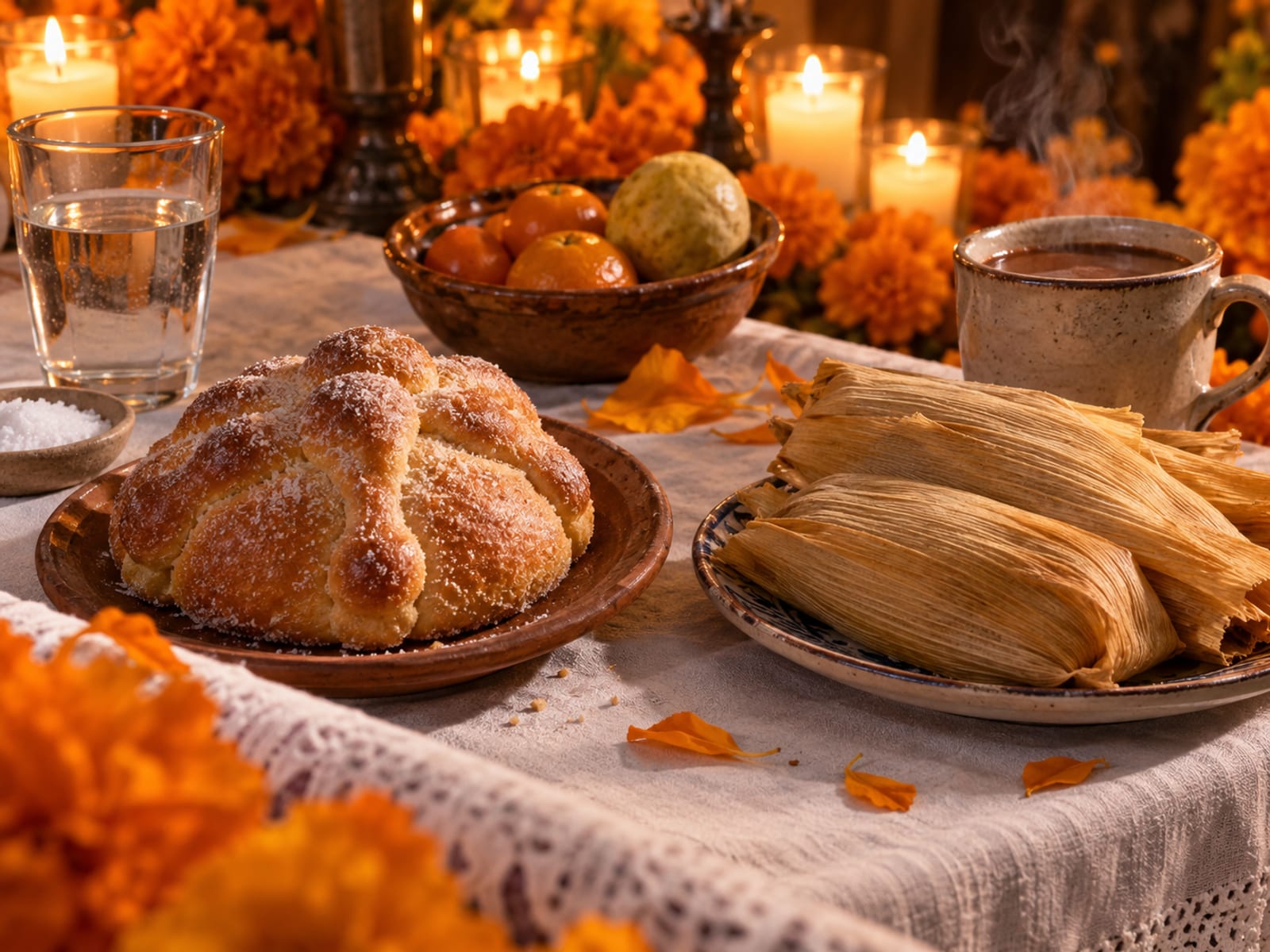
- Pan de muerto. This traditional bread goes on many altars. Mexico City describes regional forms, including the round "gollete" and breads decorated to suggest bones. In central Mexican readings, the bones and skull-like shapes can stand for the dead or for the cycle of life and death.
- Favorite food and drink. These make the altar personal. Mexico City's guide lists seasonal fruit, mole, tamales, sweets, tequila, mezcal and whatever the person enjoyed. Silvia Natalia Islas, speaking to the Smithsonian, said families include favorite foods, water and tequila.
- Papel picado. This is perforated tissue paper. It adds color, and some Mexican American explanations read it as wind or air. In Guadalajara, López Fértor said the openings let souls travel through.
- Sugar skulls, or calaveritas. Islas, of La Casa del Artesano in Tlaquepaque, said they represent the dead receiving gifts, and that the sugar stands for the sweetness of life. Los Angeles altar maker Aldo Cruz said that in parts of Mexico sugar skulls are also used to introduce children to the holiday.
- Personal objects. The Los Angeles Times documented sports memorabilia, music references, lottery tickets, toys for children and favorite drinks on altars.
- Religious objects. Crosses, saints and rosaries appear in many Catholic households, though not every ofrenda includes them. Several documented accounts connect toys with children's ofrendas.
- Petate. Mexico City lists this woven mat as a lower-level element. It can stand for a burial mat and also serve as a surface for food and drink.
None of this is a shopping list. The objects belong to the person, so choose what they loved, and leave out anything that does not fit.
How to arrange it
Here is what particular places have documented.
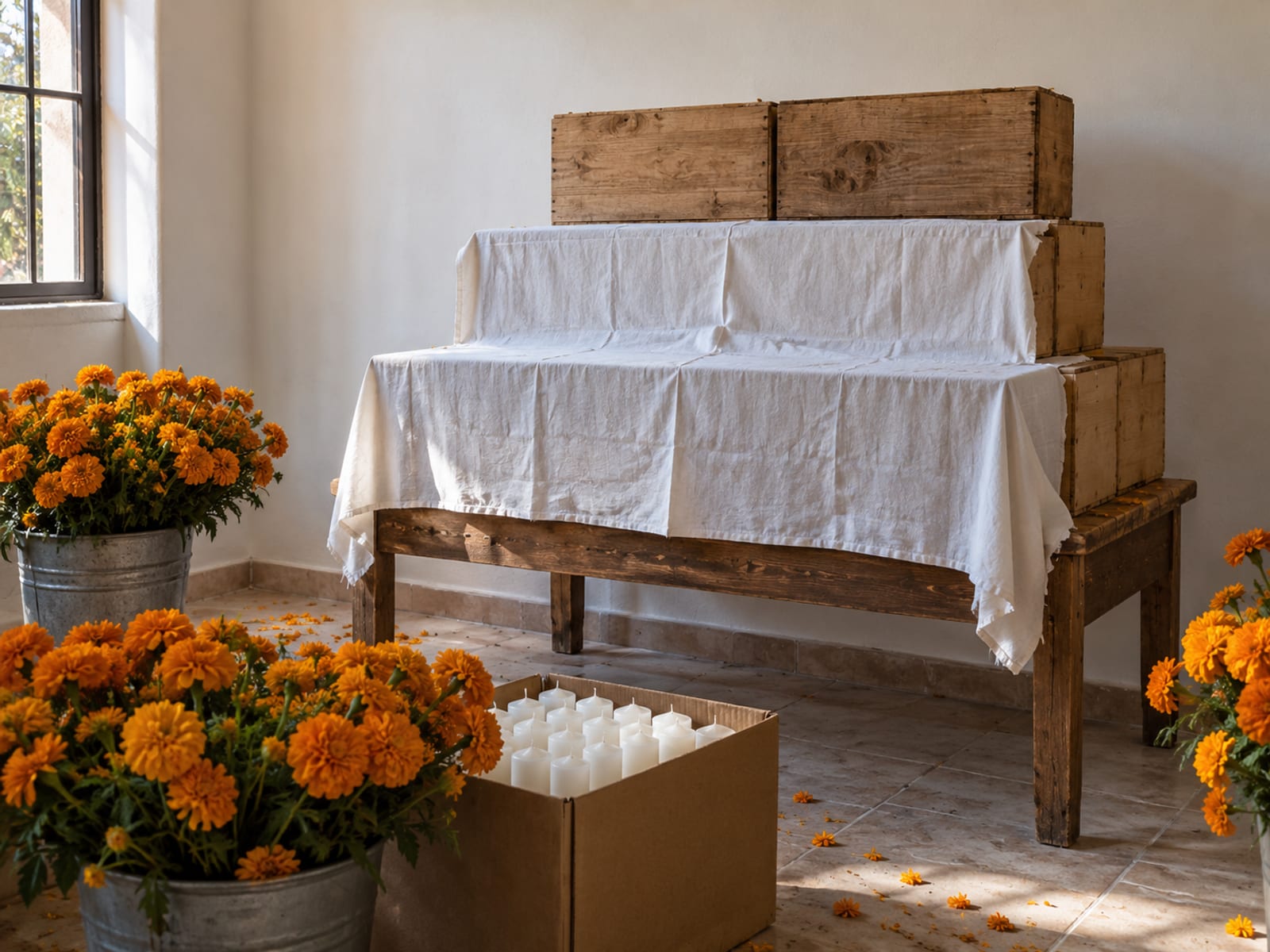
- One platform. Aldo Cruz, an altarista from Oaxaca who worked with Hollywood Forever in Los Angeles, said that in the region of Oaxaca where he is from, altars may be built on a single platform.
- Three levels. In 2023 the Museo Nacional de Antropología documented a three-level altar from Ocotlán de Morelos, in the Central Valleys of Oaxaca. The bottom level held food and drink, the middle level held saints and virgins, and the top level held photographs and images of the deceased. The altar also had a carrizo arch decorated with flowers, fruit and seeds, plus a path of cempasúchil petals ending in a cross.
- Four levels. The museum's documentation of Zinacantán, Chiapas, describes a four-level display with saints and virgins on each level and San Antonio at the top. It included copal, candles, food, fruit, photographs, water, salt and pox.
- Seven levels. Some Mexican cultural and religious teachers describe seven-level altars and give each level a symbolic meaning. Treat that as one teaching or regional variation rather than a rule for all of Mexico.
- Arches. INAH's description of Xantolo in the Huasteca shows an altar framed by an arch of green leaves and cempasúchil. The Ocotlán altar used an arch made of carrizo.
- Marigold paths. The Ocotlán altar led visitors along a path of petals to a flower cross.
For a first altar at home, one shelf, one corner of a table or a single platform is plenty. The number of levels is a variation, not a requirement.
A simple first ofrenda, step by step
These steps use only the elements described above; skip any that do not suit you.
- Choose the person. Decide who the altar is for. It can be a relative, a friend or a group of people you want to remember together.
- Clear a surface. A shelf, a table corner or a bookcase works. Aldo Cruz told the Los Angeles Times that an ofrenda does not need a dedicated table or a specific location.
- Place the photograph. If you do not have one, a written name will do. If the photo shows another person, ask permission before using it.
- Add water and salt. Set out a glass of water, and a small dish of salt if you wish.
- Add flowers. Cempasúchil is widely used; another locally appropriate flower is fine. Petals can make a short path to the photograph.
- Add a safe light. A battery-operated candle is the safest choice. The candle section below covers real flames.
- Add something they enjoyed to eat or drink. It might be a piece of pan de muerto, a piece of fruit, a sweet, or their usual drink.
- Add a personal object. Pick one thing that connects the altar to them, such as a toy for a child or a favorite item for an adult.
- Add color if you like. A strip of papel picado or a sugar skull can be added, but neither is required.
Then sit with it for a while and say their name. A few items on a shelf are enough to remember someone.
When to set it up and take it down
Dates vary by region and by family, so the examples below are attributed to the places that describe them.
- Most widely recognized dates. In Mexico and in Mexican American communities, November 1 and November 2 are the most widely recognized days. The Harvard Peabody Museum describes November 1 as commonly dedicated to children and November 2 to adults.
- Southern California. Francisco Soto said people may begin setting up in October, and his family takes the altar down after November 3. KPBS also documented a local teaching that associates October 28 with people who died through accident, tragedy or violence, October 30 and 31 with children who died unbaptized, November 1 with young children and November 2 with adults. That account belongs to Southern California and is not universal.
- Ocotlán de Morelos, Oaxaca. The Museo Nacional de Antropología says families receive relatives and friends at home on November 2 and also visit the community cemetery.
- Zinacantán, Chiapas. The museum describes preparations from the night of October 31 into November 1, with observances on November 1 and 2.
- La Candelaria, Coyoacán, Mexico City. A report summarized by El País says the altar is removed on November 3, after which food and sweets may be distributed among family and neighbors.
When ofrendas go up and come down, place by place
Tap or hover a step to follow the order.
October 31 into November 1, Zinacantán, Chiapas
Families prepare the ofrenda overnight.
November 1
Commonly associated with children in the Catholic calendar many Mexican and Mexican American communities use.
November 2, Ocotlán de Morelos, Oaxaca
Families receive visitors and remember the deceased at home.
November 3, La Candelaria, Coyoacán
The altar comes down and the food is shared.
If you do not follow a particular community's calendar, the examples above give you a range to choose from, from late October through November 3.
What to do with the food afterward
In several accounts the food is not wasted. The Los Angeles Times describes food and drinks as part of a shared meal, and the Coyoacán account says the food is enjoyed or handed out after the dead are believed to have departed. Perishable food should still be handled the way food safety requires. A family may share it, compost it, throw it away or follow a local custom.
Small spaces, classrooms, workplaces and pets
An altar does not need a big room. Cruz's advice that no dedicated table is needed means a single photograph, water, a flower, a safe light and one meaningful food or object can carry the central purpose without copying a large public altar. A corner of a shelf in a small apartment is a complete ofrenda.
For a classroom, the Detroit Institute of Arts offers lessons in which students study traditional ofrendas, discuss "the act of remembering" and make a classroom ofrenda. Photographs approved by families or simply written names work well. Teachers can let each student decide what to share rather than asking anyone to speak about a personal loss, and should follow the school's rules about food, smoke, flames and privacy.
For a workplace, an ofrenda should be voluntary, with permission from the organization and from the people being remembered. Confirm the rules for candles, incense, food, photographs and removal dates with whoever organizes the display, and avoid presenting a commercial display as an authentic or universal altar.
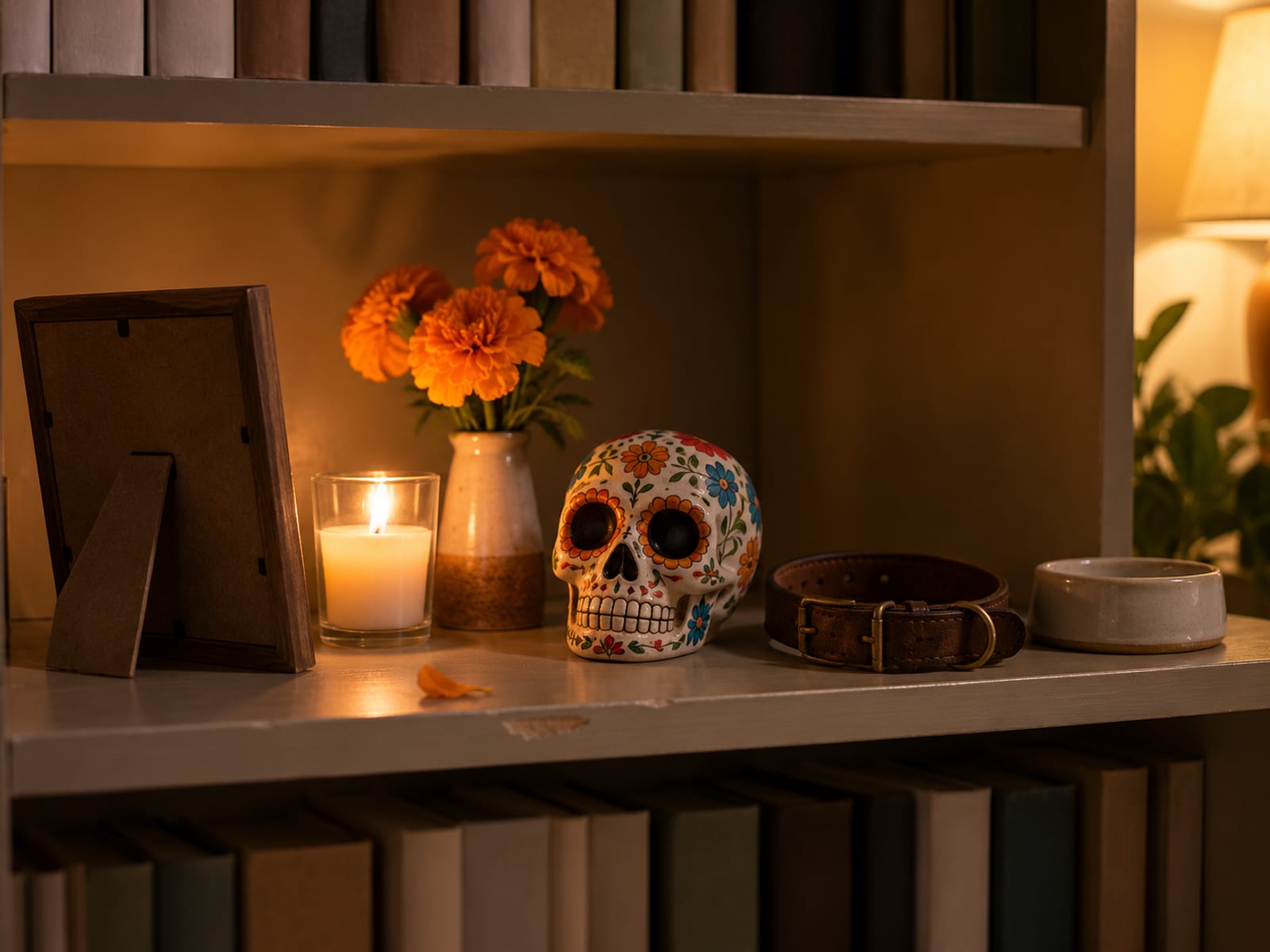
Animals have a place too. The Harvard Peabody Museum shows a Día de Muertos candelabra dedicated partly to the donor's cats, and Mexico's Instituto Nacional de Bellas Artes described a 2023 community ofrenda with a space for pets. A pet ofrenda can use the animal's photograph, name, favorite toy, food or collar. Keep pet food and candles safely separated from living animals.
Candles, copal and keeping the altar safe
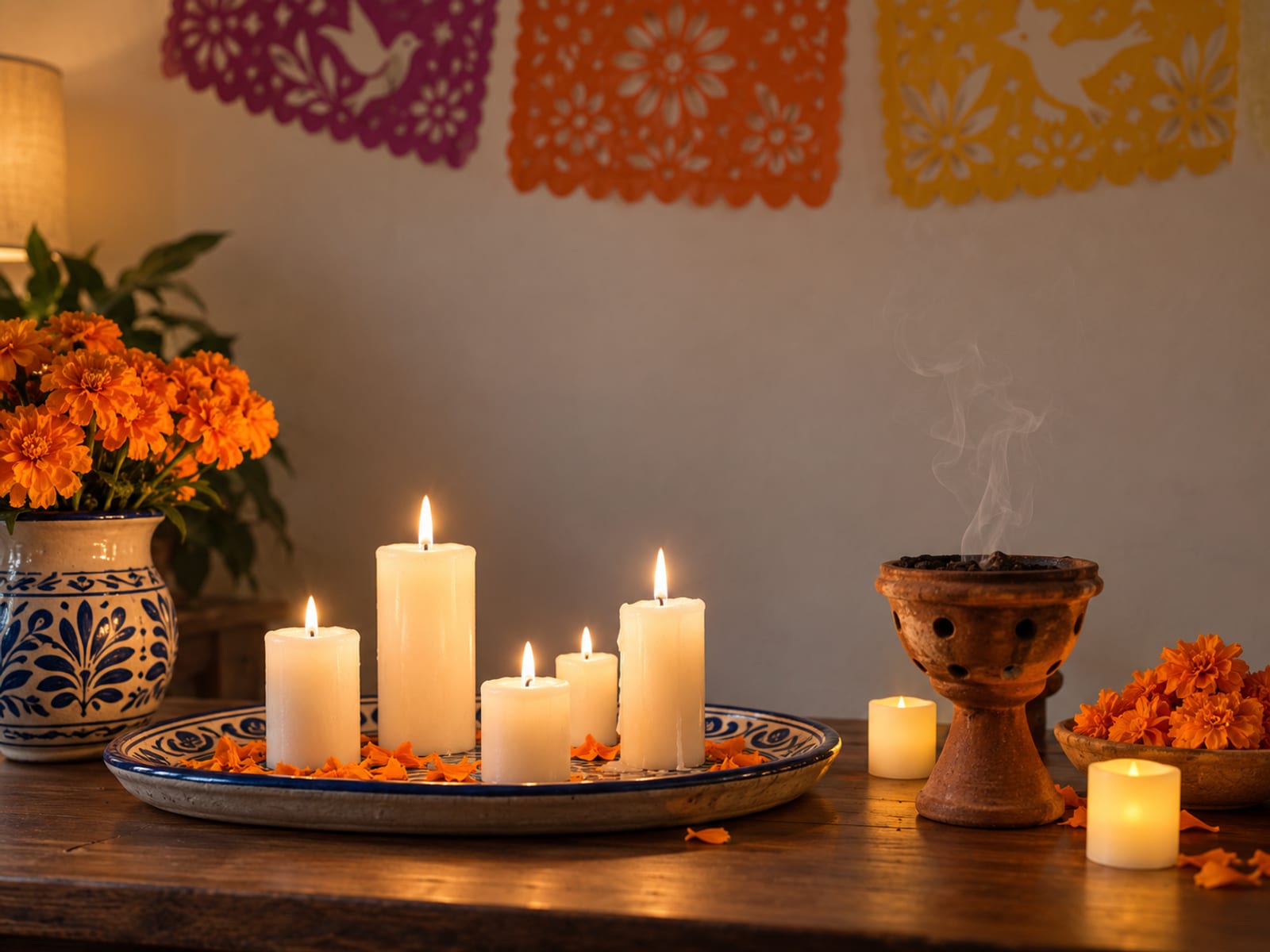
Light is part of the altar, and it needs care. The U.S. Fire Administration recommends battery-operated candles when possible. If you use real candles, its advice is:
- Use sturdy holders.
- Keep candles at least 12 inches from anything that can burn.
- Keep them out of reach of children and pets.
- Put them out before you leave the room, become sleepy or go to bed.
- Keep smoke alarms working on every level and near sleeping areas.
The National Fire Protection Association adds that candles on or near altars must be watched by an adult. If a candle has to burn continuously, it recommends an enclosed glass container set in a sink, on a metal tray or in a deep basin filled with water.
Copal is smoke-producing incense. Burn it indoors only where the space allows it and the smoke, heat, ventilation and fire risk are under control, and follow the product instructions, building rules and local fire guidance. A battery-operated candle can replace an open flame, though it does not give the scent or ritual use of copal.
Where to find supplies in the United States
Look first at Mexican bakeries for pan de muerto, Mexican grocery stores and mercados for seasonal foods, florists or farmers markets for cempasúchil, and Mexican cultural organizations or craft shops for papel picado.
Axios reported that in San Antonio, Alebrije Bakery and La Panadería are local places to buy pan de muerto. These are examples from that city only. Availability is seasonal and depends on where you live, so ask the seller about dates, ingredients and stock before you make a trip.
If this tradition is new to you
You do not have to be Mexican to remember someone you love. Mexican and Mexican American cultural practitioners interviewed by KPBS and the Los Angeles Times describe participation as open to people who want to honor someone who died. Soto said so directly: "Anyone who feels that they want to honor their deceased, they're more than welcome to set up an altar."
Cruz, who designs altars in Los Angeles, said an altar can be made at home for a relative, a friend, a meaningful person or a group of people. He also advised people not to claim they invented the tradition, not to claim they do it better than Mexican communities and not to wear Día de Muertos as a costume.
A respectful home practice can look like this:
- Name the person or people you are remembering.
- Use their actual photograph, favorite food, drink, music, objects or stories where it feels right.
- Learn from Mexican and Mexican American cultural institutions and practitioners.
- Say which region or family practice you are following instead of calling one version "the Mexican way."
- Keep Indigenous and Catholic symbols out of generic Halloween decoration.
- Skip costumes, caricatures and stereotypes, and avoid claiming a commercial display is authentic.
- Ask permission before using another person's photograph, name or family story.
- Treat public community ofrendas as memorial spaces, not photo props.
Quick answers
These short answers cover questions that come up often.
Can I make an ofrenda if I'm not Mexican?
Yes. KPBS and the Los Angeles Times interviewed Mexican and Mexican American practitioners who describe the practice as open to anyone who wants to honor a person who died.
Do I need seven levels?
No. Seven-level altars are one teaching from some Mexican cultural and religious teachers. Oaxaca's Aldo Cruz describes single-platform altars, and the Museo Nacional de Antropología documented three levels in Ocotlán and four in Zinacantán.
Can I make one for a pet?
Yes. The Harvard Peabody Museum displays a candelabra dedicated partly to a donor's cats, and Mexico's Instituto Nacional de Bellas Artes described a 2023 community ofrenda with a space for pets. Use the animal's photograph, name or favorite toy, and keep candles and food out of reach of living animals.
What do I do with the food?
Practice varies. Some families share the food as a meal, as the Los Angeles Times describes, and in La Candelaria, Coyoacán, it is shared among family and neighbors after the altar comes down on November 3. Whatever you choose, treat perishable food as food safety requires, and compost or discard what should not be eaten.
Where to go next
The Día de Muertos guide covers the days, the places and the symbols. For the candy skulls on many ofrendas, read about sugar skulls. And for the well-dressed skeleton lady you will see all over the season, meet La Catrina.