No. 001
Día de Muertos: What It Is, When It Happens and How Families Celebrate
Día de Muertos is a Mexican remembrance tradition in which families honor relatives who have died and welcome their souls back for a visit. They do it with altars, food, flowers, candles, music and trips to the cemetery. It falls mainly on November 1 and 2, and some communities begin on October 31. UNESCO describes the observance as the commemoration of "the transitory return to Earth of deceased relatives and loved ones." If you keep spotting marigolds, painted faces and sugar skulls every autumn, this is the tradition behind them, and at its heart it is about remembering people by name.
What Día de Muertos is and who celebrates it
The tradition is practiced throughout Mexico, and it does not look the same everywhere. Indigenous, regional, Catholic and family customs all shape it. The Peabody Museum of Archaeology and Ethnology at Harvard calls it a yearly celebration that "combines pre-Hispanic rituals and beliefs with Catholic practices and symbols." The Mexican Museum in San Francisco makes a similar point from the other direction: each place has its own distinctive elements, and every altar is unique.
Mexican and Mexican American communities also observe it in the United States, and it is kept elsewhere in Latin America too. In 2008, UNESCO inscribed Mexico's Indigenous festivity dedicated to the dead on its Representative List of the Intangible Cultural Heritage of Humanity.
Practice changes from one family and town to the next, so each custom below belongs to the community named with it rather than to all of Mexico.
The days: October 31, November 1 and November 2
The principal dates are November 1 and 2, which line up broadly with the Catholic feasts of All Saints' Day and All Souls' Day. Many families and communities divide the time like this:
- October 31 is a preparation day in some communities. In others it marks the arrival of souls who died violently or by accident. Mexico City reporting links October 31 with people who died in accidents.
- November 1 is commonly associated with children who have died. It is often called Día de los Angelitos (Day of the Little Angels) or Día de los Inocentes. Families may put toys, sweets, fruit, chocolate, white flowers and a child's favorite foods on the altar.
- November 2 is commonly associated with adults who have died. Families may prepare the person's favorite foods and drinks, visit graves, pray, tell stories and stay overnight in a vigil.
These dates are not universal, and a few named places show how much they shift:
- In San Andrés Mixquic, in the Tláhuac borough of Mexico City, a local account describes children arriving at noon, ahead of the adults, with separate gifts and flower paths for each group.
- In the Pátzcuaro region of Michoacán, the night of November 1 is central to the Noche de Muertos, the Night of the Dead.
- In Yucatán, the related Maya observance is called Hanal Pixán, and it has its own foods and cemetery customs.
If you are planning to visit or join a community, ask the hosts which days they keep and when events begin.
What families do, place by place
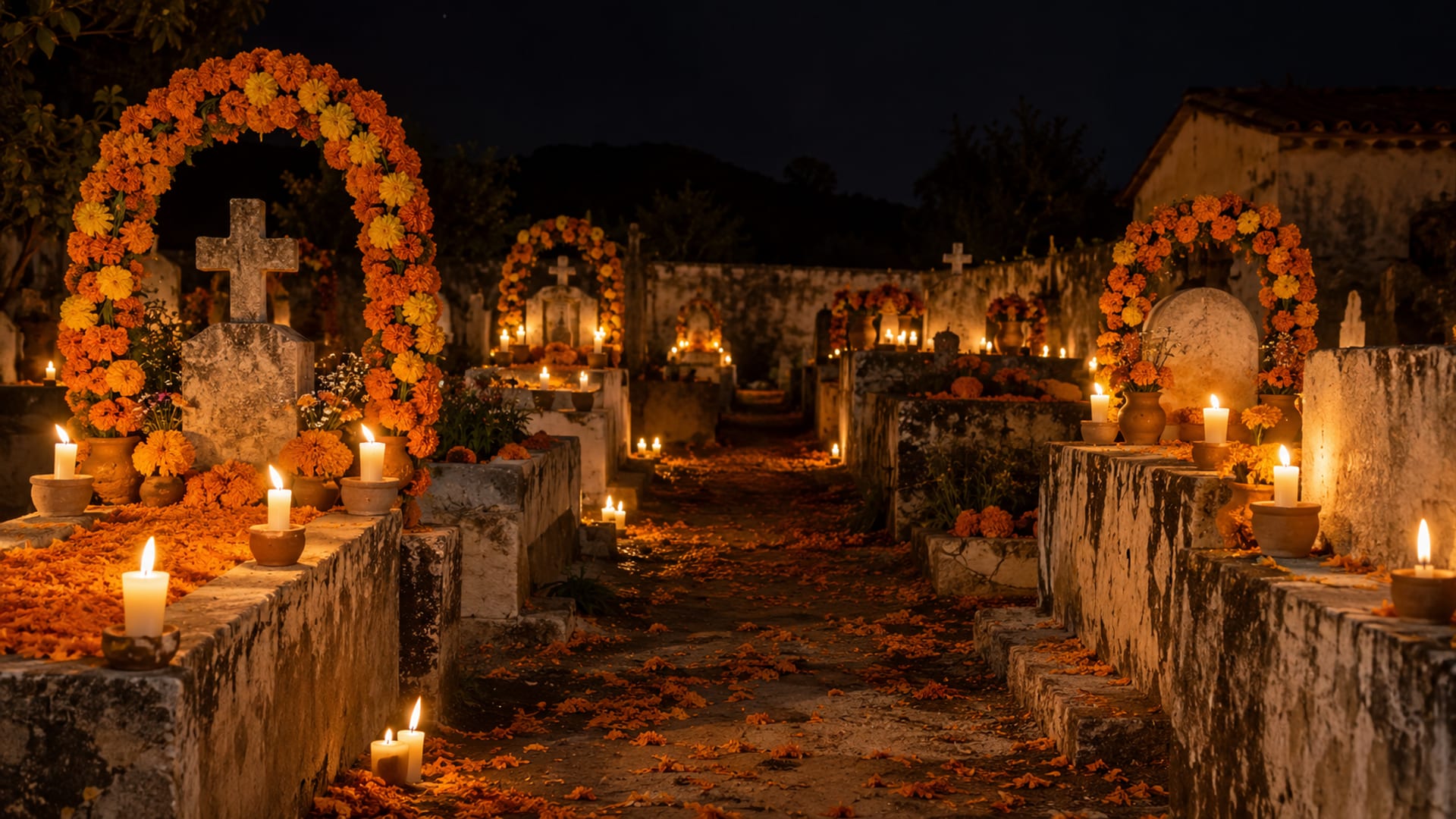
Families build ofrendas, which means altars for the dead, at home, in cemeteries and in community spaces. The usual ingredients include photographs, candles, marigolds, incense or copal, water, salt, favorite foods and drinks, personal objects and religious images. Beyond that, the details belong to each place.
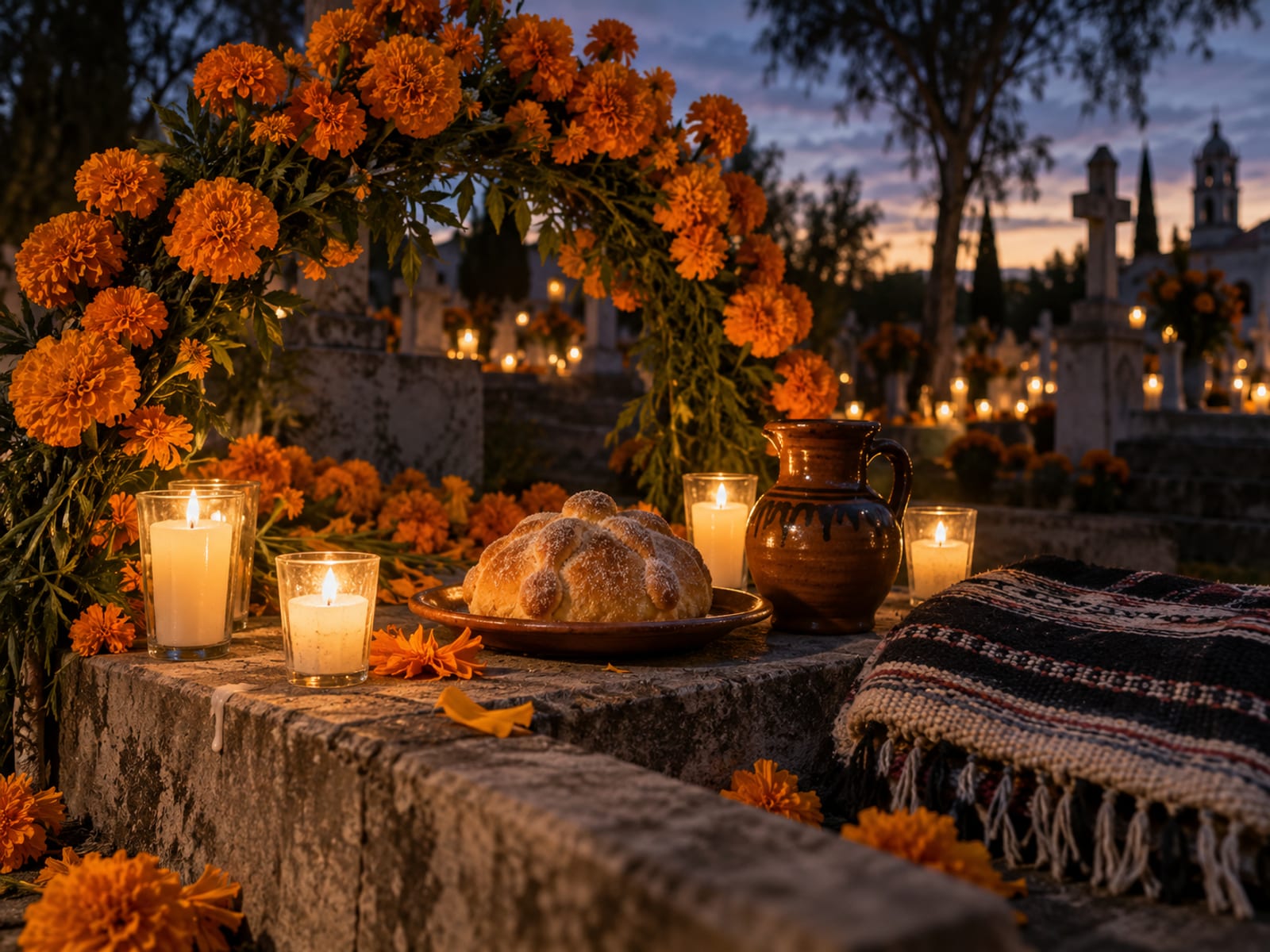
Janitzio and Tzintzuntzan, Michoacán. Families clean and decorate graves, light candles and hold night vigils. The photographic repository of Mexico's National Institute of Anthropology and History (INAH) documents women placing flowers on graves, sitting beside tombs and keeping watch through the Noche de Muertos.
San Andrés Mixquic, Mexico City. According to Mexico City's tourism guide, families clean graves and mark paths with flower petals. They bring copal, candles, sweets, fruit, chocolate and toys, along with mole, tamales, pulque or beer, and some stay at the cemetery until morning during La Alumbrada. Gifts can differ by age: white petals and sweets for children, cempasúchil, mole and tamales for adults.
Oaxaca. Documented traditions include cemetery gifts, food and music tied to local Indigenous practice. The Spurlock Museum at the University of Illinois describes older Oaxacan practices in which the dead were treated as go-betweens with the supernatural world, followed by gifts left at graves after Catholic observances took hold.
Music, prayer and storytelling vary from one family to the next. Some families hire musicians to play the deceased person's favorite songs. Others keep a quiet velación, a vigil of waiting and remembering.
The symbols and what they are said to mean
Many of the images that circulate each autumn come from altars and graves. The meanings below are explanations given by particular museums, cultural institutions and communities. They are not a universal rule for every altar.
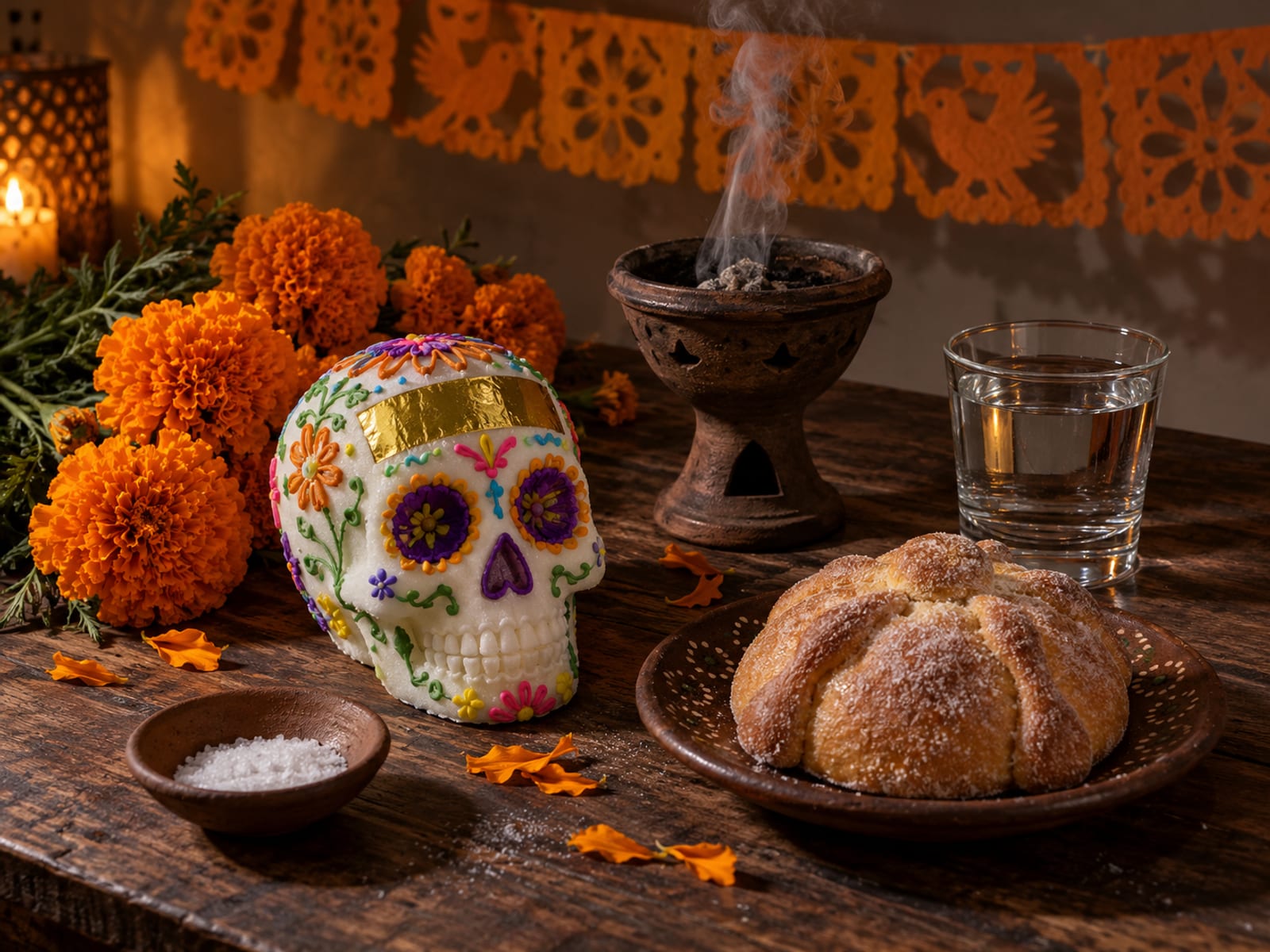
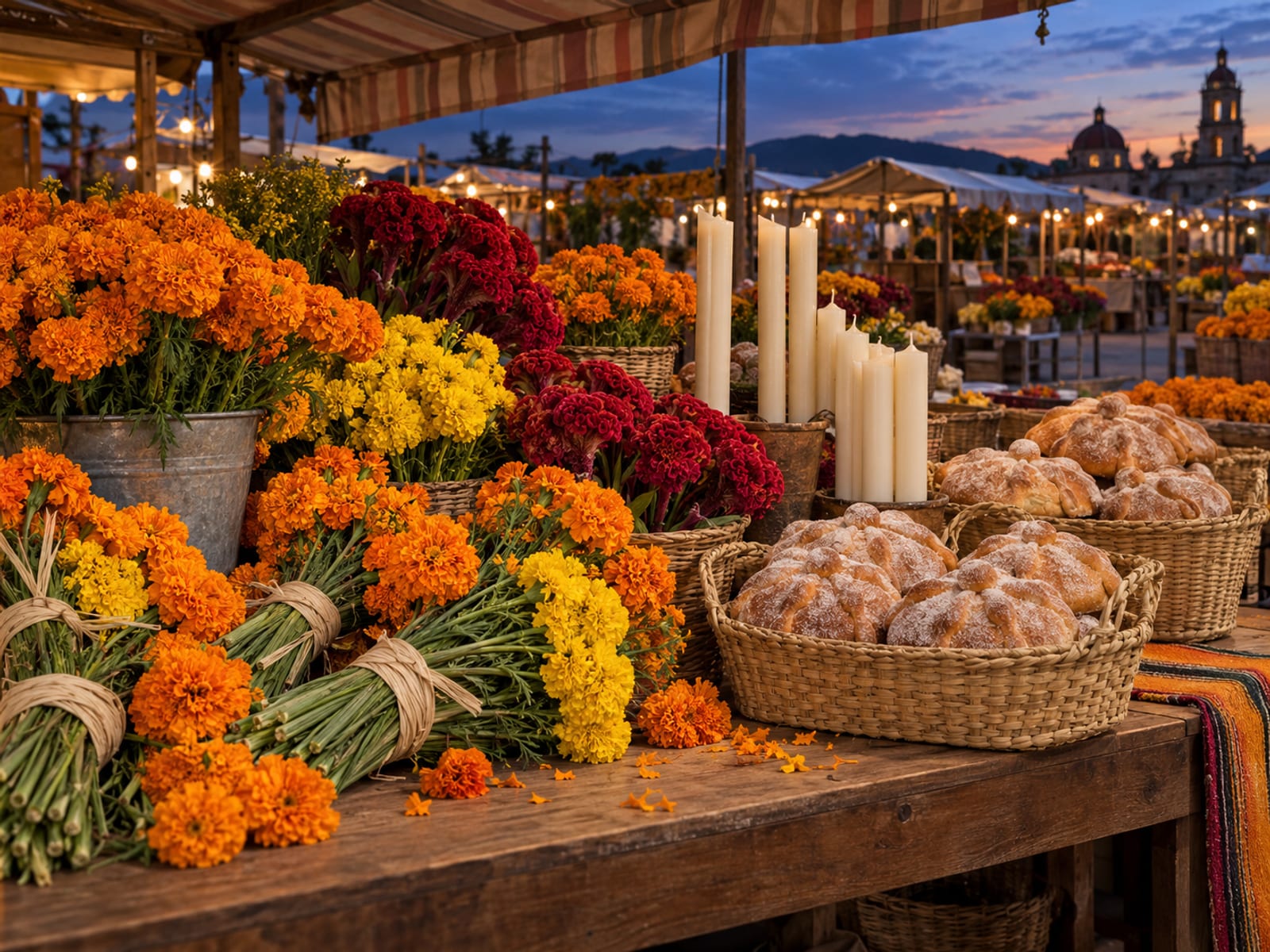
- Cempasúchil (marigold). The Peabody Museum, the Library of Congress and California State Parks say its bright color and scent guide souls to the altar or grave. The word comes from Nahuatl and is commonly explained as "twenty flowers" or "many flowers," according to the Peabody Museum.
- Papel picado. The Mexican Museum and the University of Arizona describe the perforated tissue paper as standing for wind, movement, celebration and the link between life and death.
- Pan de muerto. This sweet bread is left for the dead and shared by the living. The Mexican Museum, the Orange County Library System and the Library of Congress note that its decorative bone shapes are commonly read as the deceased or the cycle of life and death.
- Calaveras and sugar skulls. The Mexican Museum, the University of Arizona and the Library of Congress explain that skulls represent the dead, mortality and remembrance. A sugar skull may carry the name of a person who has died, or be given as a gift.
- Candles. The Mexican Museum, the Library of Congress and California State Parks say candles light the way for returning souls and mark the altar or grave.
- Copal or incense. The Mexican Museum, along with accounts from Mixquic and Michoacán, describes it as cleansing and marking sacred space, and as helping to guide or protect the returning souls.
- Water. The Mexican Museum and California State Parks say it quenches the thirst of souls after their travel and stands for purification.
- Salt. California State Parks and regional Mexican accounts connect salt with purification, and note that it is sometimes set out with the food.
The same item can carry slightly different meanings depending on who explains it, which is normal for a tradition kept alive by families. If you are a guest at someone's altar, it is worth asking what each item means to them.
Where Día de Muertos comes from
The origins have several layers. Indigenous peoples across Mesoamerica held varied beliefs and ceremonies about death and ancestors long before Spanish colonization. The Spurlock Museum documents practices in Oaxaca that included burying ancestors beneath houses, holding feasts and making gifts in search of supernatural guidance.
The Catholic calendar supplied the November dates. All Saints' Day is November 1 and All Souls' Day is November 2. After the Spanish conquest in the sixteenth century, Catholic observances and Indigenous practices developed side by side in different regions.
Historians do not all weigh these layers the same way. Some museums describe a blend of Aztec or broader Mesoamerican and Catholic traditions, and several museum and cultural accounts present continuity between ancestor customs of the past and today's observances. INAH historian Elsa Malvido reads it differently. In her interpretation, the modern celebration is not simply a surviving pre-Hispanic festival; she emphasizes colonial Catholic practice, later regional development and twentieth-century nationalist reinvention.
A fair way to hold both views is to say that modern Día de Muertos has multiple historical layers: diverse Indigenous Mesoamerican traditions about the dead, Catholic All Saints and All Souls observances introduced in the colonial period, regional adaptation, and later Mexican and Mexican American developments.
Skeleton imagery has its own thread. According to the Spurlock Museum, José Guadalupe Posada's skeleton prints from the late nineteenth and early twentieth centuries helped popularize calavera figures, including La Catrina.
Día de Muertos through time
Tap or hover a step to follow the order.
Before the sixteenth century
Diverse Indigenous Mesoamerican traditions honor the dead.
Sixteenth century
After the Spanish conquest, Catholic All Saints and All Souls observances develop beside Indigenous practice in New Spain.
Late nineteenth century
José Guadalupe Posada's skeleton prints help popularize calavera figures.
1970s
Galería de la Raza organizes Día de Muertos altar exhibitions in San Francisco.
1996
Oakland's Fruitvale street festival begins.
2008
UNESCO inscribes Mexico's Indigenous festivity dedicated to the dead on its Representative List.
2015
The James Bond film Spectre opens with a fictional Día de Muertos parade in Mexico City.
2016
Mexico City stages a real parade drawing on the film's imagery.
The Mexico City parade and the film behind it
The large Día de Muertos parade in Mexico City is a modern public event, not an ancient tradition shared across Mexico. The opening sequence of the 2015 James Bond film Spectre showed a fictional Día de Muertos parade moving through Mexico City. In 2016 the city created a real parade that explicitly drew on the film's imagery.
The Associated Press reported that this Hollywood-style spectacle was not part of traditional Día de Muertos festivities in most of Mexico, though Oaxaca has its own festive muerteadas. The parade has since grown into a major tourism event with floats, dancers, giant figures, Catrina costumes, music and big crowds.
Tourism has raised the holiday's visibility and brought economic activity, and it has also shifted the balance between family and community ritual on one side and staged spectacle on the other. Mexican American curator Cesáreo Moreno told the AP that the 2017 film Coco increased the holiday's popularity and commercialization in the United States and northern Mexico.
So, the parade sits alongside older customs rather than replacing them. Households and cemeteries in places like Mixquic, Janitzio and Oaxaca keep their own, much older rhythms.
Día de Muertos in the United States
Mexican American families observe the holiday through home altars, cemetery visits, food, music and family storytelling. Museums, schools, community centers and cultural organizations also build public ofrendas that anyone can visit.
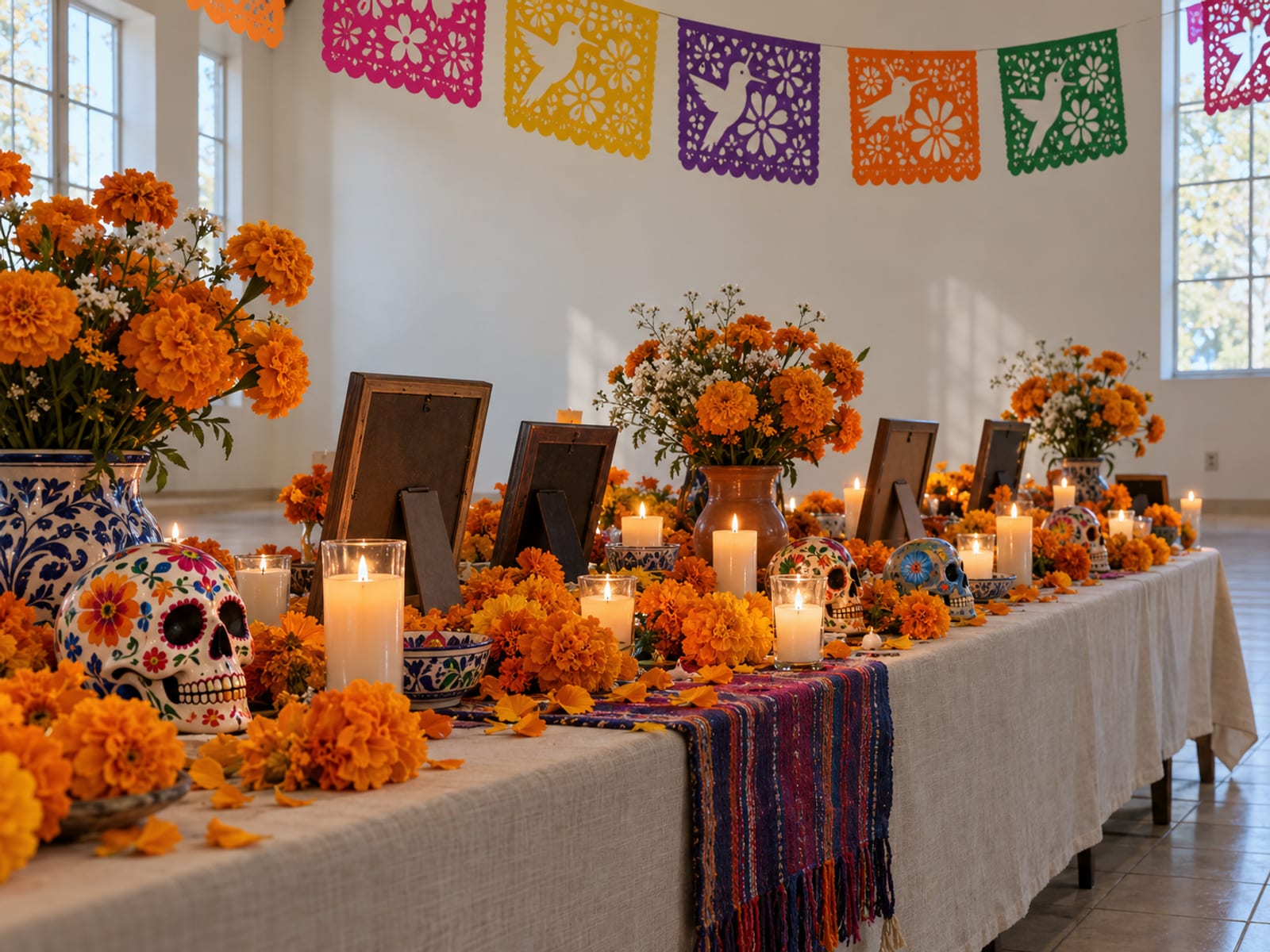
The Mexican Museum explains that the Chicano Movement helped move altar-making from private homes into museums, galleries, schools and community spaces. In San Francisco, the museum identifies early documented Día de Muertos activity in the 1970s, including altar exhibitions organized by Galería de la Raza. In Oakland, the Library of Congress documents the Fruitvale street festival, which began in 1996 as part of neighborhood revitalization.
Several institutions around the country hold Día de Muertos events or exhibitions, and many return to the calendar each year:
- Chicago: the National Museum of Mexican Art has hosted Día de los Muertos Xicágo, with community ofrendas, live music, performances, art activities and an illuminated altar.
- Los Angeles: the Natural History Museum has held a celebration with live music, art activities and an interpretive ofrenda, and LA Plaza de Cultura y Artes has presented a family event with Oaxacan dance and a community altar.
- Sacramento: the California Museum has shown a Día de los Muertos exhibition with contemporary altars and a community altar.
- San Antonio: the City of San Antonio has presented Día de los Muertos: Celebrando las Misiones, with a procession, music, food, workshops, a remembrance slideshow and altars created by Mission descendant families.
- New York City: El Museo del Barrio has included a communal altar, procession, workshops, face painting, mariachi and Mexican dance in its Día de los Muertos Super Sábado.
Dates, hours and programs change from year to year, so check this year's details on each institution's own website before you go.
How to take part respectfully
The most reliable starting point is remembrance. Choose a specific person, and honor them with their name, a photograph, a story, a favorite food or an object that mattered to them. A small altar with a photograph and a candle can be appropriate when it comes from real remembrance. Costume and spectacle are not what the tradition is built around.
Tessa Téllez of the University of Arizona recommends joining a community celebration or creating a simple personal altar with a candle and a photograph. She says, "It's not wrong to want to honor your loved ones," as long as the intention is respectful. Cesáreo Moreno, speaking to the AP, called the tradition a cultural expression and part of grieving. Mexican American altar maker Beth McRae told the AP that she tries to use items from Mexico and keeps her focus on lost loved ones.
A few practical habits cover most situations:
- Learn which community or institution is hosting the event, and join through a Mexican, Mexican American or local cultural institution when you can.
- Treat private altars and graves as sacred or personal spaces. Do not remove anything left there, and do not use graves as photo props.
- Ask before photographing altars, graves, ceremonies or people.
- Follow cemetery rules and event instructions.
- Focus on remembrance, stories and community participation.
- Do not present one regional custom as universal. Ask the family, organizer or institution what is appropriate in that place, since practice differs by region, family, religion and diaspora community.
Quick answers
These short answers cover the questions people ask most.
When is Día de Muertos?
The principal dates are November 1 and 2, with October 31 observed in some communities as a preparation day. Some places keep a different rhythm, such as the night of November 1 in the Pátzcuaro region. Ask local hosts about the days they keep.
Is it a sad holiday?
It holds remembrance and celebration together. Families share favorite foods, tell stories and sometimes hire musicians to play a loved one's favorite songs, and Cesáreo Moreno describes the tradition as part of grieving. Many families also keep a quiet velación, so the mood varies from home to home.
Can I take part if I'm not Mexican?
Yes, with care. Tessa Téllez suggests joining a community celebration or making a simple altar with a photograph and a candle for someone you want to remember. Museums and cultural centers in the United States welcome visitors to their public ofrendas.
How is it different from Halloween?
They are separate traditions with their own histories and meanings. Día de Muertos follows the Catholic days of All Saints and All Souls, November 1 and 2, and centers on welcoming and remembering specific relatives. Cesáreo Moreno stresses that it is a cultural expression, not a generic Halloween theme.
Día de Muertos quiz
Answer every question to check.
Where to go next
If you want to build an altar of your own, start with the guide to making an ofrenda. For the story behind the candy skulls, read about sugar skulls. And for the well-dressed skeleton lady you will see all over the season, meet La Catrina.