

No. 128
The Ambassadors Skull: How to See Holbein's Hidden Skull and What It Means
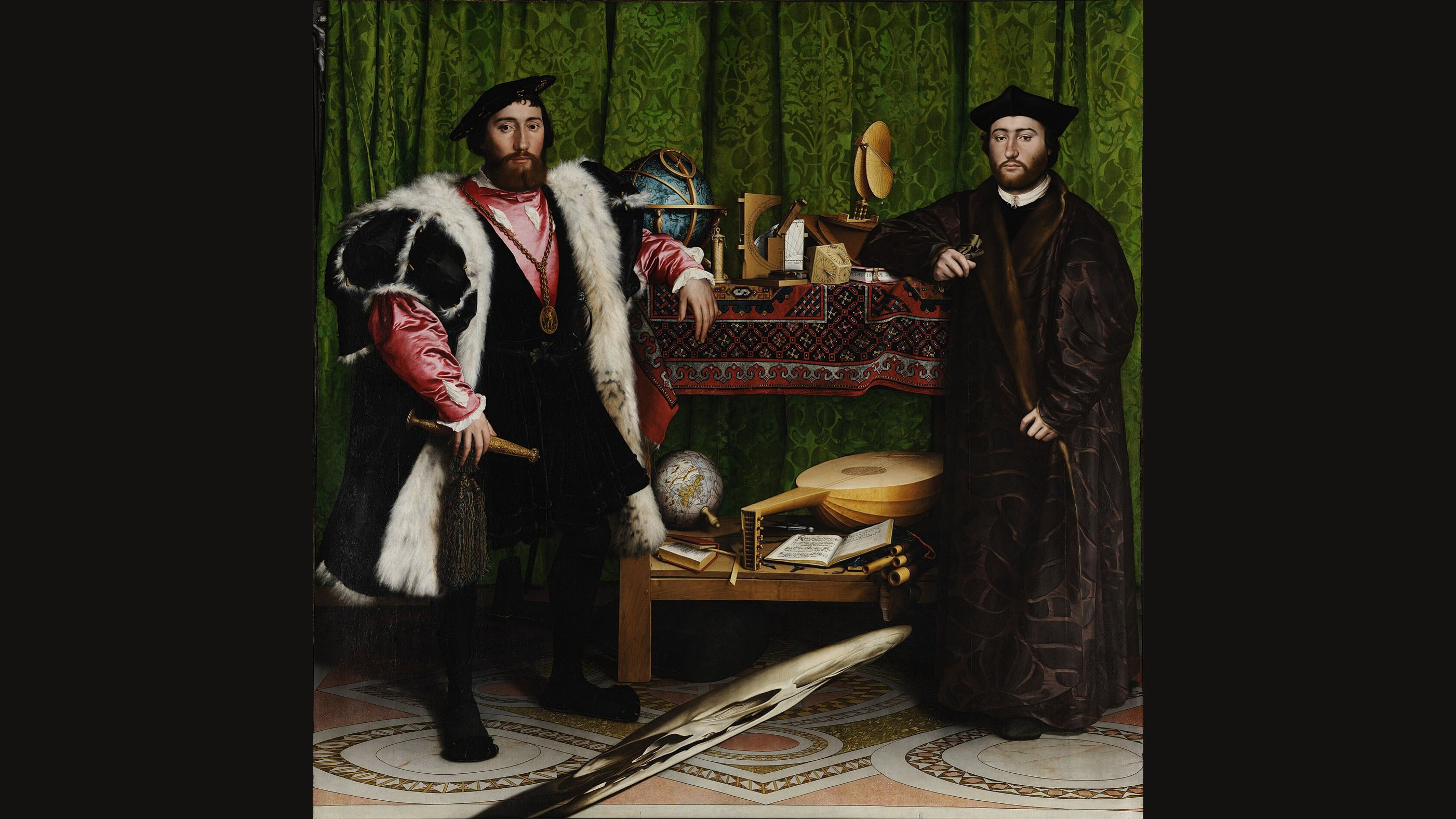
The hidden skull is the long, slanting grey shape that floats across the floor at the bottom of Hans Holbein the Younger's *The Ambassadors*, painted in London in 1533 and now in the National Gallery, London. Seen from the front it looks like a smear. Seen from the right side of the painting, close to the wall, it turns into a naturalistic human skull.
Holbein stretched it on purpose, using a perspective trick called anamorphosis. Historians read the skull as a memento mori, a warning of death set beneath the two men's wealth, learning and diplomatic power, and they pair it with a small crucifix half hidden behind the green curtain in the upper left corner.
That is the short answer. The longer one includes the exact spot to stand, a second skull most people miss, a broken lute string, a Tudor king painted the same way, and a château in Champagne where the painting turns up in 1589.
Where the skull is, and the spot that makes it appear
Start with the whole painting. Two men stand on either side of a two-tiered table, and below them, running diagonally across the marble floor, is the shape that puzzles everyone: a pale, elongated form that seems to belong to nothing else in the room. That shape is the skull.
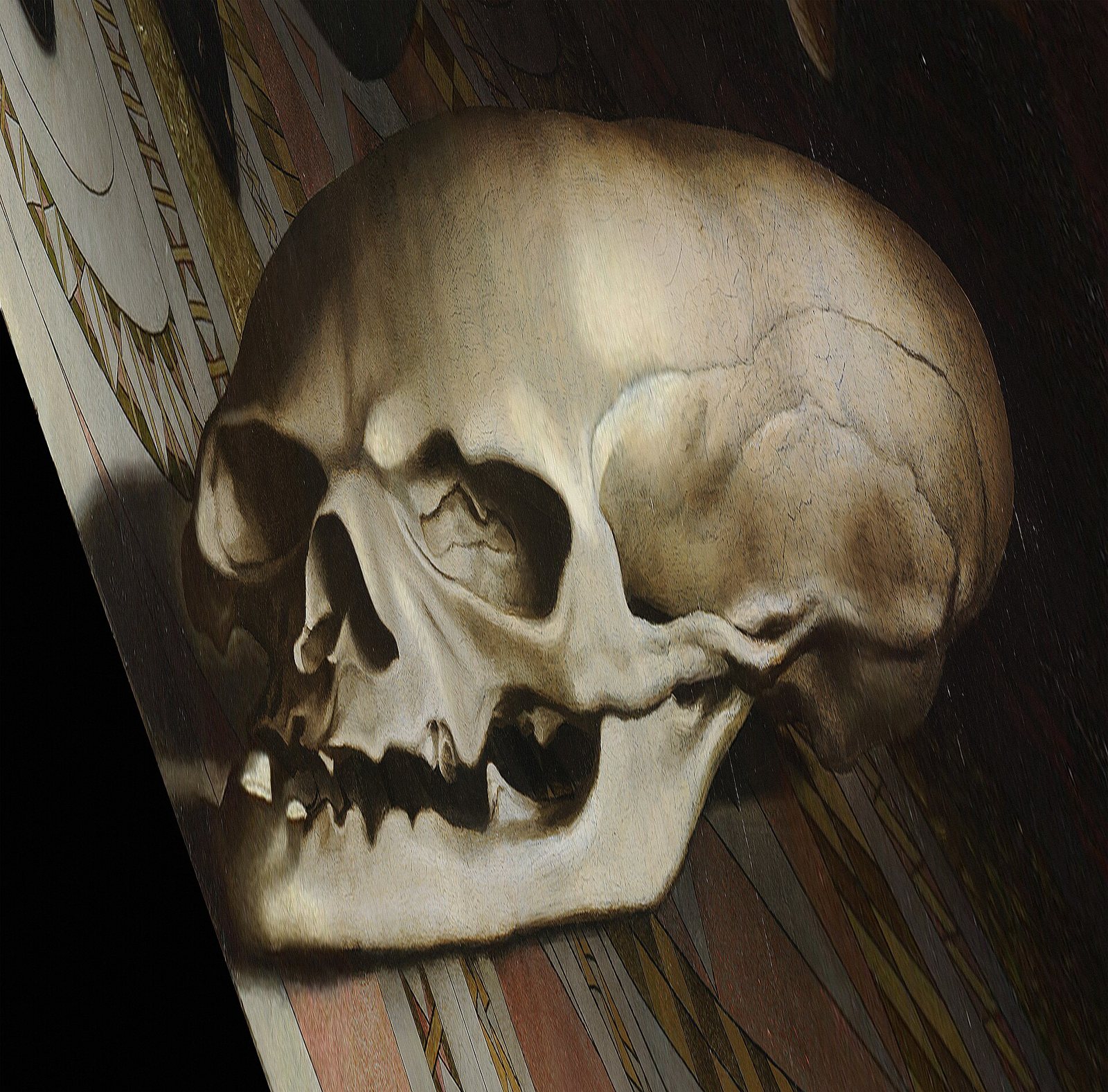
The National Gallery's 2024 catalogue by Susan Foister gives an unusually precise viewing point. Stand to the right of the painting, at a right angle about 12 cm out from the wall, with your eye about 10.4 cm above the bottom edge of the painting and about 79 cm from its right edge (National Gallery catalogue). The skull resolves more easily from the right than from the left. You do not need any device, although a glass cylinder held diagonally can produce a corrected reflection.
In practice, that means the best view is beside the painting, not in front of it. The panel is more than two metres high and wide, so the moment of recognition comes when you have shuffled sideways along the wall and are looking back across the surface almost edge on. The exact angle depends on how the painting is hung, so expect to move your head a little until the shape snaps into a skull. Other visitors doing the same slow sidestep are a good sign you are in the right place.
How to find the skull in The Ambassadors
Tap a card to bring it forward.
- Look at the whole painting first: Find the grey diagonal shape across the floor at the bottom.
- Move to the right-hand side: The skull resolves more easily from the right than from the left.
- Get close to the wall: The catalogue's ideal point is about 12 cm out from the wall.
- Keep your eye low: About 10.4 cm above the bottom edge of the painting and about 79 cm from its right edge.
- Look back across the surface: Shift slightly until the stretched shape becomes a skull.
- No device needed: A glass cylinder held diagonally can give a corrected reflection, but it is optional.
The painting and the two men in it
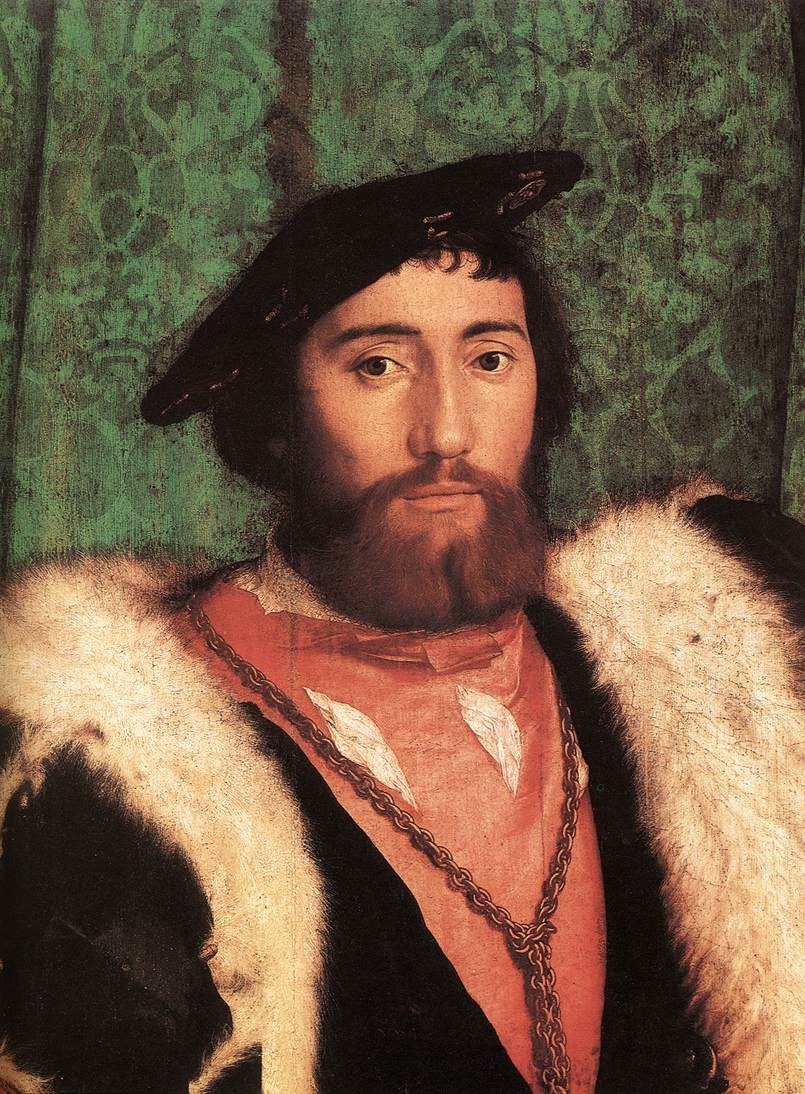
The National Gallery's title for the work is *Jean de Dinteville and Georges de Selve*, though nearly everyone calls it *The Ambassadors*. Jean de Dinteville, on the left, was France's ambassador to England, and he commissioned the painting. Georges de Selve, Bishop of Lavaur, stands on the right (National Gallery).
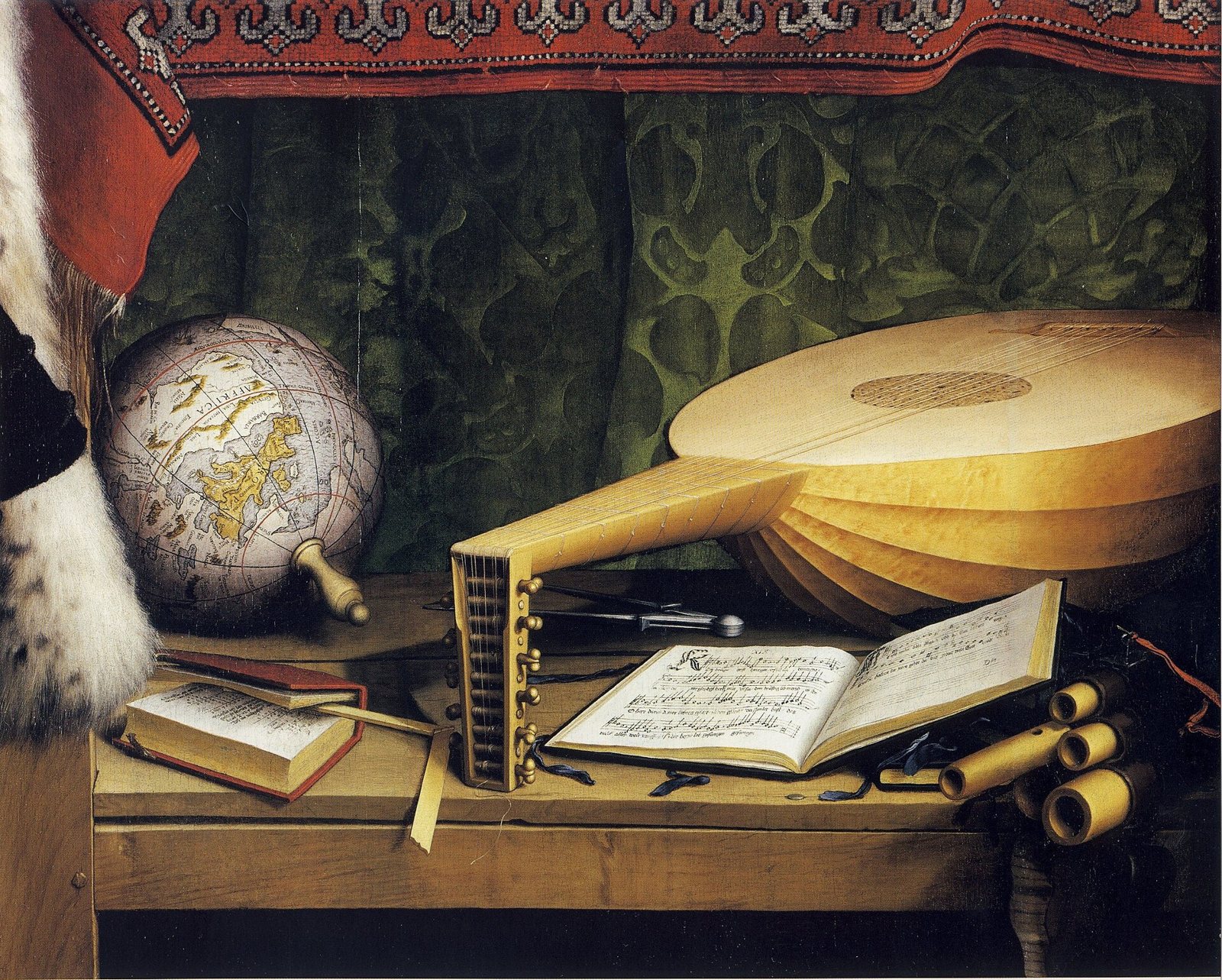
It is oil on oak and measures 207 by 209.5 cm. Between them sits a table of objects: on the lower shelf a globe, a lute and books. Holbein signed the painting and dated it 1533 on the marble floor, the same floor the skull lies across, so artist, date and death share one strip of stone.
Tap or hover a row to highlight it.
| Fact | Answer |
|---|---|
| FactArtist | AnswerHans Holbein the Younger |
| FactDate | Answer1533 |
| FactSitters | AnswerJean de Dinteville and Georges de Selve |
| FactTechnique | AnswerOil on oak |
| FactDimensions | Answer207 by 209.5 cm |
| FactCurrent location | AnswerNational Gallery, London, Room 4 |
| FactHidden object | AnswerAnamorphic human skull |
How Holbein stretched a skull
Anamorphosis is a deliberate distortion. The artist takes an image and stretches it through a system of perspective, so that it only looks correct from one particular angle. From straight ahead, the eye reads the result as a long blur. From the oblique viewpoint the artist planned, the stretching cancels out and the image looks normal again.
Holbein used that system on a human skull. The National Gallery catalogue describes the result as an elongated blur from the front that resolves into a naturalistic skull from the side (National Gallery catalogue). That is why the skull seems to belong to a different painting until you move: it was built for a different position in the room.
The skull, the crucifix, a hat badge and a broken string
The skull is widely read as a memento mori, a call to remember death, placed beneath an impressive display of wealth, learning, science and diplomatic power. Susan Foister's catalogue connects it with the painting's other signs of passing time and earthly vanity, the same idea that runs through Dutch vanitas paintings a century later.
The answer to the skull hangs in the opposite corner. In the upper left, partly hidden behind the green curtain, is a small crucifix. Foister writes that it represents resurrection and hope after death, and the National Gallery's collection entry reads it as a sign of Christian unity, salvation and resurrection (National Gallery).
The art historian Marta Faust, writing in the Journal of Historians of Netherlandish Art, describes skull and crucifix together as symbols of mortality and salvation, with the skull standing both for a life that is temporary and for the eternal life beyond it. Read that way, the painting moves from death at the bottom to hope at the top. For more on that pairing in Christian art, see skulls in Christianity.
There is a second skull, and it is easy to miss. Jean de Dinteville wears a small skull badge on his hat. The National Gallery catalogue is careful here: there is no evidence that it was Dinteville's personal device, so it is best described simply as a skull badge.
Then there is the lute. One of its strings, the sixth, is broken. That detail is certain; its meaning is not. Foister discusses a possible link with Andrea Alciati's emblem book of 1531, which used imagery of discord and broken alliances. Painted in 1533, the snapped string may evoke the religious and political divisions of Europe at the time, including the tensions between Catholic and Protestant communities. Holbein left no explanation, so this is a scholarly reading rather than his stated plan, but it sits comfortably in a portrait of two diplomats with a skull at their feet.
Other anamorphic images from the same years
Holbein did not invent the trick. Marta Faust names Leonardo da Vinci's disproportionately wide drawings of an eye and a child's head, made around 1500 and kept in the Codex Atlanticus, as the earliest known examples of artistic anamorphic distortion (JHNA).
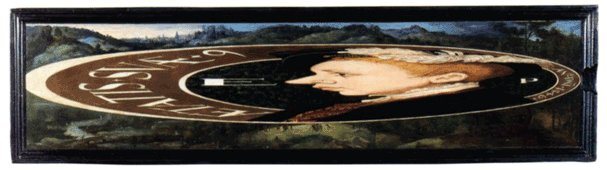
A close relative is the anonymous *Zimmern Anamorphosis*, made around 1535 in southern Germany, whose figures only make sense as the viewer changes position. Faust identifies *The Ambassadors* as the earliest surviving use of anamorphosis in a painting made for an elite social setting, which is part of what makes Holbein's skull special: the trick sits in the middle of a formal portrait of two powerful men.
England produced another famous example a few years later. *King Edward VI*, attributed to William Scrots and dated 1546, is an anamorphic portrait that the National Portrait Gallery describes as designed to amaze viewers. Like Holbein's skull, the distorted image resolves from a position to the right, and the work still has a notch in its frame that helped show viewers where to stand. At the National Gallery, visitors to *The Ambassadors* find the spot the old-fashioned way, by shuffling along the wall.
Later artists hid skulls in other ways. Charles Allan Gilbert's drawing *All Is Vanity* uses a double image rather than a stretched one, and its story is in All Is Vanity, the skull illusion.
Holbein the Younger, and the painting's road to London
Hans Holbein the Younger was born in Augsburg around 1497 or 1498 and died in 1543, according to the National Gallery's biography. He is called "the Younger" to tell him apart from his father, Hans Holbein the Elder, also a prominent painter. The younger Holbein spent a first period in England from 1526 to 1528, returned in 1532 and settled there. *The Ambassadors* was painted in London the following year.
The painting did not stay in England. Its earliest known inventory record, made between 21 and 24 January 1589, places it in the Dinteville château at Polisy, near Bar-sur-Seine in Champagne, France. Where and how high it first hung is not known, so any theory about the room it was made for remains a theory. The National Gallery bought the painting in 1890, and it carries the inventory number NG1314. In 2024 Susan Foister's National Gallery catalogue published the detailed technical and art-historical study that supplies the viewing measurements above.
The Ambassadors and its skull, from Leonardo to 2024
Tap or hover a step to follow the order.
Around 1497/8
Hans Holbein the Younger is born in Augsburg.
Around 1500
Leonardo da Vinci's stretched drawings of an eye and a child's head, in the Codex Atlanticus.
1526 to 1528
Holbein's first period in England.
1532
Holbein returns to England and settles there.
1533
Holbein paints The Ambassadors in London.
Around 1535
The Zimmern Anamorphosis is made in southern Germany.
1546
King Edward VI, attributed to William Scrots, an anamorphic portrait.
January 1589
The painting is recorded at the Dinteville château in Polisy, France.
1890
The National Gallery buys the painting.
2024
Susan Foister's National Gallery catalogue publishes a detailed study.
Seeing the skull in person
The National Gallery lists *The Ambassadors* in Room 4 of its main collection. When you get there, give the whole painting a minute first, then walk slowly to its right-hand side, stay close to the wall and look back across the surface. The catalogue's measurements describe the geometry of the image, and the real angle will depend on how the painting is installed and how much space the room allows.
Paintings move for loans, conservation and rehangs, so confirm the current display status on the National Gallery's website before you plan a trip around it. If you cannot get to London, the public-domain high-resolution scan on Wikimedia Commons shows the whole painting, and a corrected view of the skull on Commons shows what the shape becomes from the right spot.
How well do you know The Ambassadors?
Answer every question to check.
Questions about Holbein's hidden skull
A few short answers for the questions that come up most.
What does the skull mean in The Ambassadors?
It is generally read as a memento mori, a sign that death undercuts worldly status, wealth and learning. The National Gallery's catalogue pairs it with the half-hidden crucifix, which adds the Christian hope of resurrection to the warning.
Why is the skull distorted in The Ambassadors?
Holbein used anamorphosis, which stretches an image so it only looks right from one angle. The skull appears correctly proportioned when you view it from the right side of the painting, close to the wall.
Where is The Ambassadors painting now?
It is in the National Gallery, London, as inventory number NG1314, listed in Room 4 of the main collection. The gallery bought it in 1890.
Why is Hans Holbein called the Younger?
He is called the Younger to distinguish him from his father, Hans Holbein the Elder, who was also a prominent painter. The National Gallery dates the younger Holbein's life to 1497/8 to 1543.
Are there other paintings like Holbein's anamorphic skull?
Yes, the closest are *King Edward VI*, attributed to William Scrots in 1546, and the anonymous *Zimmern Anamorphosis* of around 1535. Leonardo da Vinci's stretched drawings of around 1500 are the earliest known examples of the technique.
More skulls in art
If Holbein's skull has you hunting for more, start with the wider tour in famous skull art, then read what memento mori means and how skull symbolism shifts from one culture to another. Later painters took the skull in very different directions, from Cézanne's skull still lifes to Andy Warhol's bright Skulls. And if you would like to carry a stretched skull of your own, our Anamorphic skull tee has an anamorphic-style skull design inspired by the painting.
Terms in this story
Tap a term to see what it means.
Anamorphosis. A deliberate distortion that stretches an image so it only looks right from one particular angle. Holbein used it for the skull in The Ambassadors in 1533.
---