

No. 101
All Is Vanity: Who Drew the Skull Illusion and What It Means
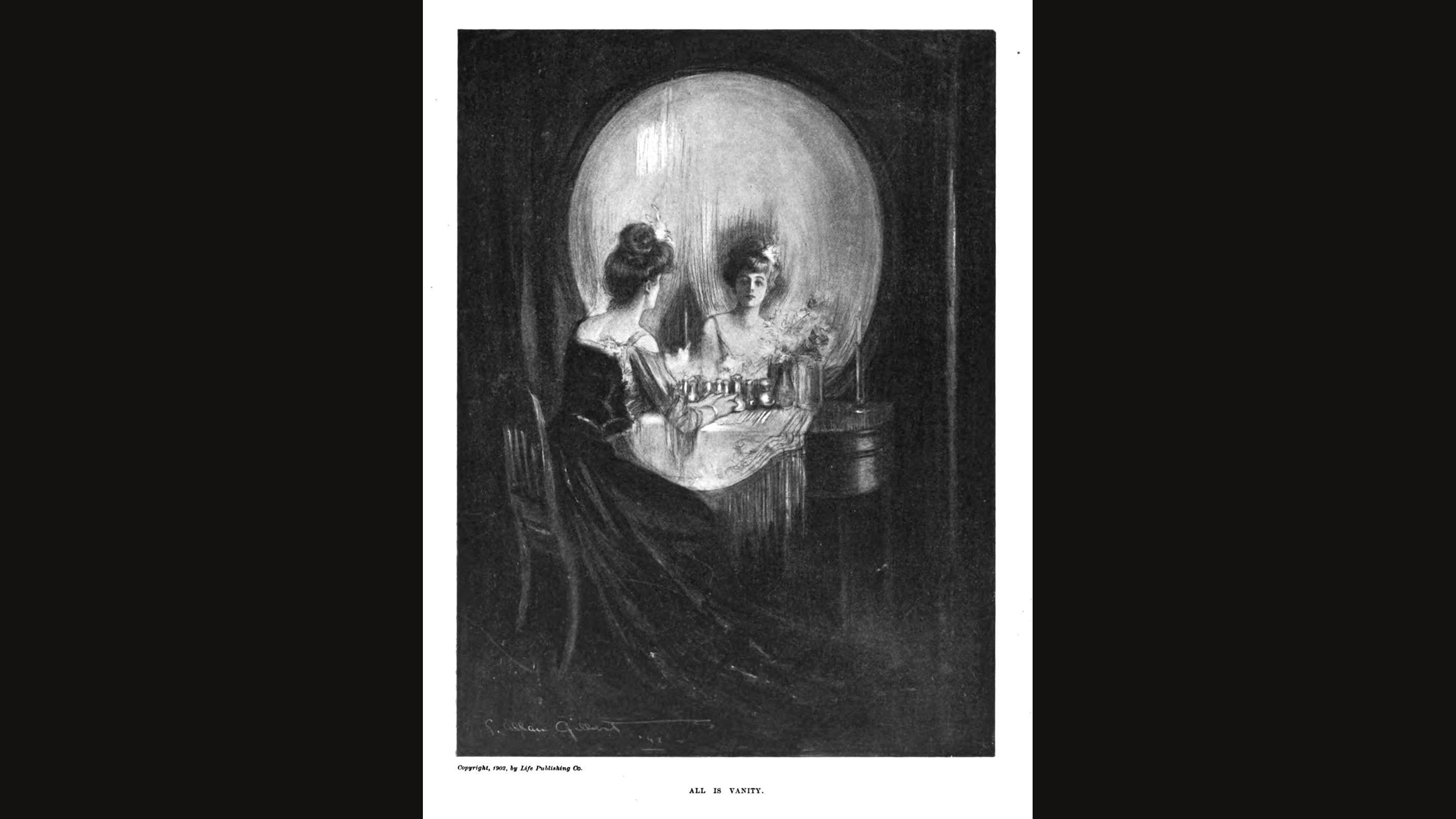
The drawing of a woman at her dressing table who turns into a skull is called *All Is Vanity*. The American illustrator Charles Allan Gilbert drew it in 1892, when he was eighteen and studying at the Art Students League of New York, and *Life* magazine reproduced it on November 27, 1902 (The Metropolitan Museum of Art). Its meaning sits in the double image itself: the woman admiring herself in the mirror and the skull are the same lines, so beauty and the vanity table become a call to remember death. The title echoes a famous verse, Ecclesiastes 1:2, "Vanity of vanities, saith the Preacher, vanity of vanities; all is vanity."
That is the short answer. The longer one takes in a teenage art student, a magazine page from 1902, a line of scripture and a whole tradition of painters who liked to put a skull on the table.
Who drew All Is Vanity, and when
Charles Allan Gilbert was an American illustrator. The Metropolitan Museum of Art identifies it as his 1892 illustration, made while he was a student at the Art Students League of New York, and records its reproduction in *Life* magazine ten years later (The Met).
The printed page survives. It is *Life*, volume 40, number 1048, page 459, dated November 27, 1902. The copy most people see online is the Harvard University Library copy, digitized through Google and HathiTrust and kept on Wikimedia Commons.jpg), where it is marked as public domain and credits Gilbert as the author.
It is worth pausing on the age. Gilbert was eighteen, still a student, when he made it. The idea is simple enough to grasp in a second and clever enough to keep people staring for a minute more.
How to see the woman and the skull
Close up, you see a woman seated at a dressing table, looking into a large oval mirror. Her bottles and little containers stand on the table in front of her, and her reflection looks back from the glass.
Step back, or let your eyes soften, and the same scene becomes a skull. The Met's description of the drawing makes the construction plain: the skull is not a separate object hidden behind the woman. The mirror, the heads, the containers and the tablecloth are arranged so the whole scene can be read as a skull (The Met).
What each part of All Is Vanity becomes in the skull
Tap a card to bring it forward.
- The oval mirror: The rounded dome at the top of the skull.
- The woman and her reflection: The two eye sockets.
- The bottles and containers on the table: The teeth.
- The tablecloth: The line of the jaw.
If you are struggling to find it, try looking at the drawing on a phone held at arm's length, or squint until the fine detail blurs. The skull tends to appear all at once, and after that it is hard to stop seeing it.
Why your brain flips between the two
Perception scientists call images like this ambiguous, and they explain them through figure-ground organization and perceptual bistability. The classic example is Edgar Rubin's vase and faces, in which the same outline can be read as a vase in the middle or as two faces in profile on either side. Your brain picks one reading, then the other, but it does not comfortably hold both at once.
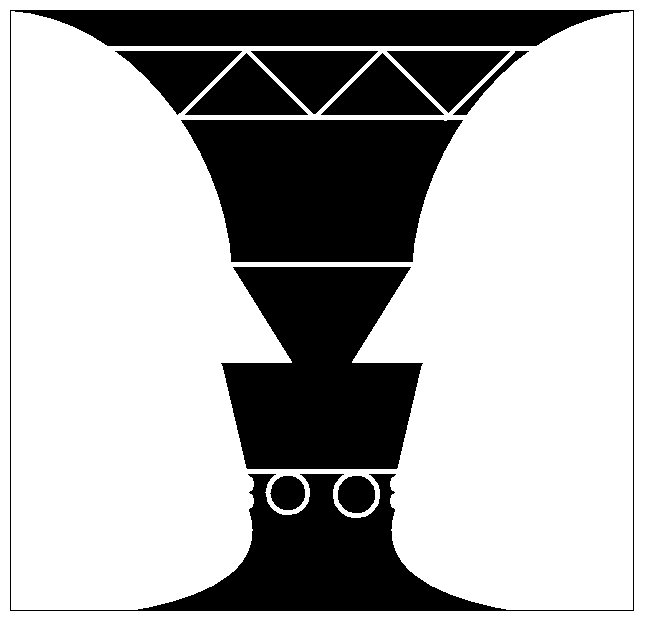
Shaun Vecera, Edward Vogel and Geoffrey Woodman studied how viewers decide what counts as the figure and what counts as the background in displays like these. The American Psychological Association, summarizing their work in 2002, described such images as demonstrations of perception's flexibility (APA).
Gilbert's drawing is more complicated than Rubin's simple outline, because it has two complete scenes rather than two shapes. It still runs on the same principle: one set of lines, two competing interpretations, and a viewer who keeps switching between them.
What the title means: vanity of vanities
The word "vanity" does two jobs in Gilbert's title. It names the piece of furniture, the vanity or dressing table where the woman sits, and it calls up the opening of the Book of Ecclesiastes. The Met describes the drawing as a juxtaposition of vanity and mortality, "at once a vanitas and a memento mori" (The Met).
In the King James Version, Ecclesiastes 1:2 reads: "Vanity of vanities, saith the Preacher, vanity of vanities; all is vanity" (Bible Gateway, KJV). Spanish speakers often know the drawing as *Todo es vanidad*, and the Reina-Valera 1960 gives the same verse as "Vanidad de vanidades, dijo el Predicador; vanidad de vanidades, todo es vanidad," which means "Vanity of vanities, said the Preacher; vanity of vanities, all is vanity" (Bible Gateway, RVR1960).
In Ecclesiastes, "vanity" is a bigger word than self-admiration in a mirror. The text around that verse is about how temporary, elusive and limited human work, pleasure, wisdom and achievement turn out to be. Gilbert's joke, if it is a joke, is that he shrank that whole idea down to a woman checking her hair, and then let the skull do the preaching.
The vanitas tradition behind it
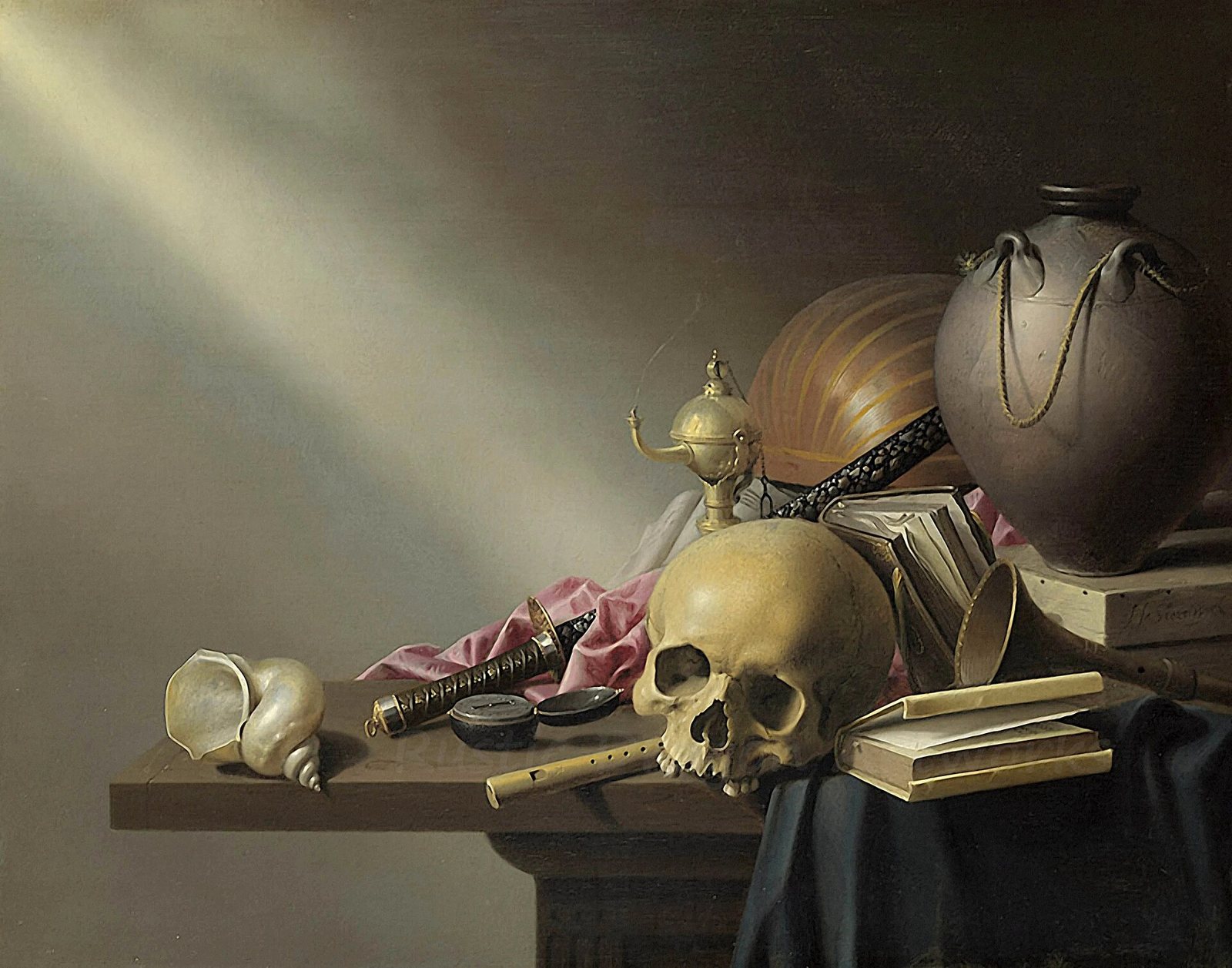
Gilbert was not the first artist to set a skull beside a mirror. Art historians use the word *vanitas* for imagery that stresses how short and unstable earthly life is. Skulls, snuffed candles, hourglasses, bubbles, cut flowers, mirrors, books and luxury objects can all carry that message, although what they mean depends on the particular work and the time and place it was made.
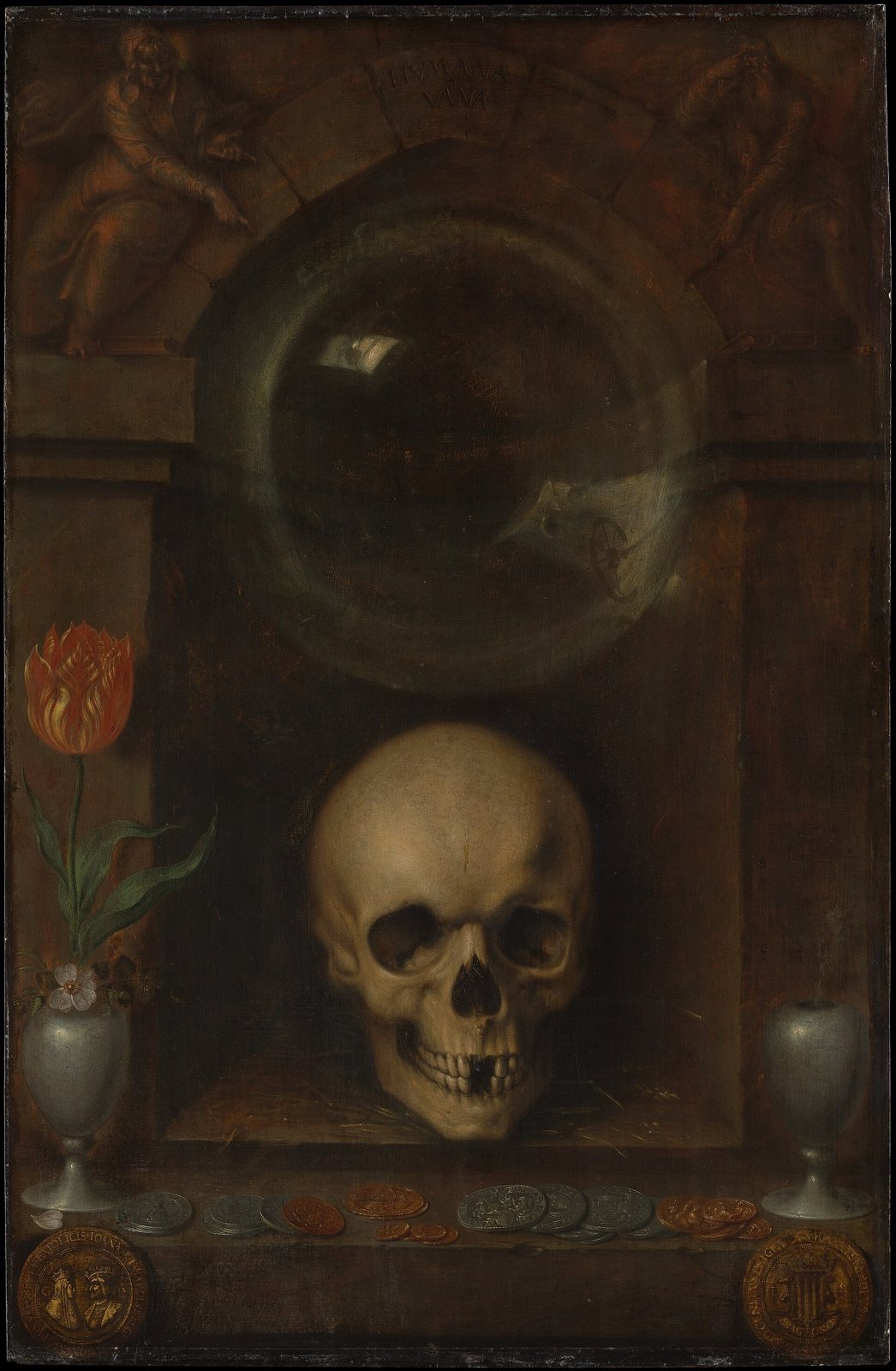
The Metropolitan Museum's record for Jacques de Gheyn II's *Vanitas Still Life* of 1603 points to the skull, a floating bubble, cut flowers and a smoking urn as signs of life's brevity and human folly (The Met). The National Gallery of Art in Washington describes the skull and mirror in Georges de La Tour's *The Repentant Magdalen* as emblems of vanitas that imply life's transience (National Gallery of Art).
*All Is Vanity* borrows that vocabulary of objects and gives it a twist. Instead of placing a skull among the bottles and the mirror, Gilbert built the skull out of them. If you want to see where the idea came from, our story on vanitas paintings walks through the still lifes, and what memento mori means covers the "remember you will die" side of the same coin.
Other famous skull illusions
Two other works often turn up beside Gilbert's, and they use different tricks.
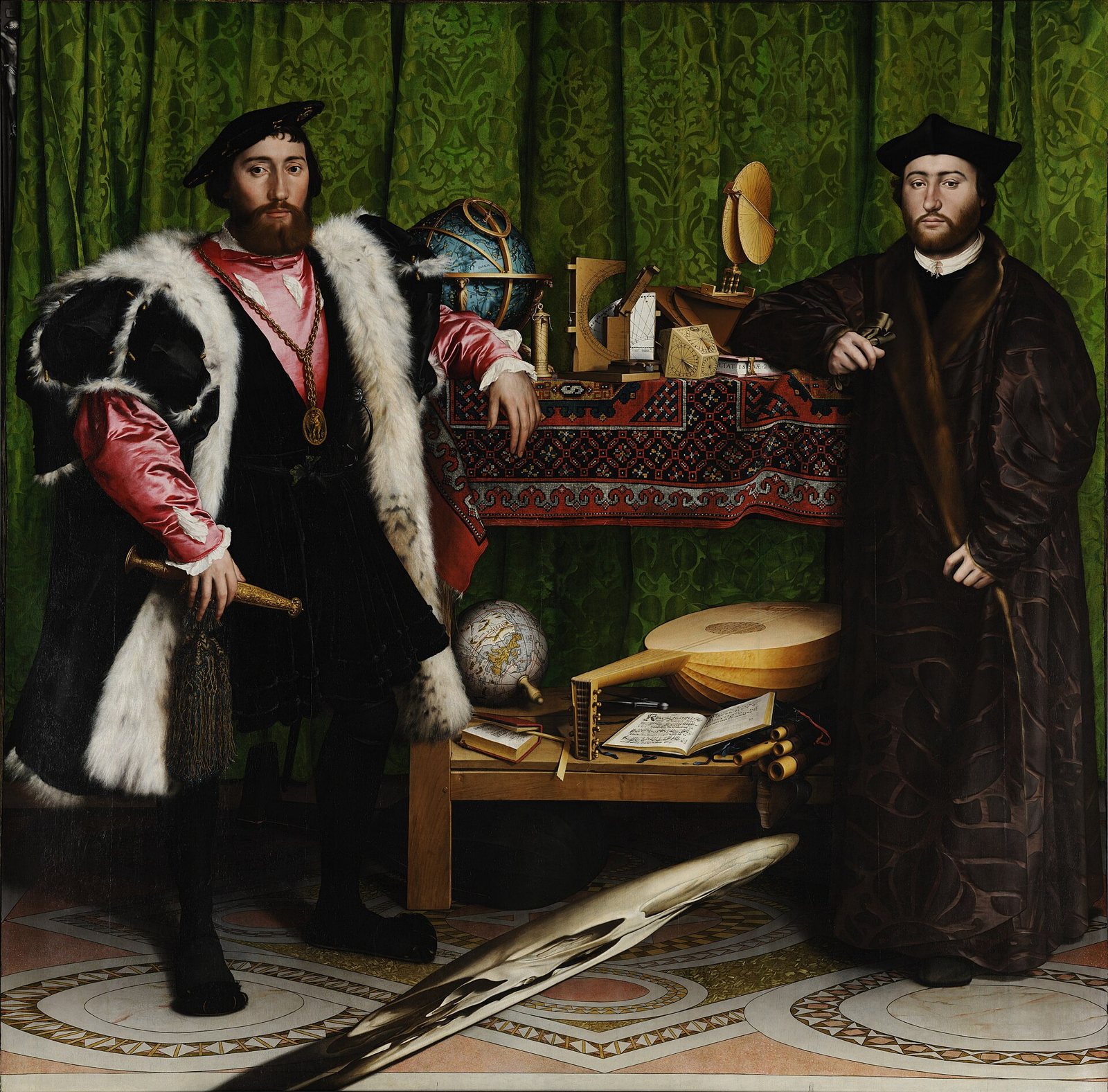
Hans Holbein the Younger painted *The Ambassadors* in London in 1533, and it now hangs in the National Gallery in London. The painting shows two men, Jean de Dinteville and Georges de Selve, surrounded by instruments and books. Across the floor in front of them runs a long, smeared shape that resolves into a skull only when you view the canvas from the lower right. The National Gallery names the technique as anamorphosis (National Gallery), and its technical catalogue records a specific best viewing position to the right of the painting (National Gallery catalogue).
Salvador Dalí's *Slave Market with the Disappearing Bust of Voltaire*, painted in 1940, is a double image like Gilbert's rather than an anamorphosis. The Dalí Museum explains that two Dutch women in a marketplace combine into Jean-Antoine Houdon's 1778 bust of Voltaire: their heads form the eyes, their collars the cheeks and nose, and a sleeve the chin. The museum also notes that *Scientific American* used the painting in 1971 to illustrate perceptual switching (The Dalí Museum). That last one is a face rather than a skull, but it works the same way Gilbert's drawing does.
The difference matters if you are trying to see them. Holbein's skull asks you to move your body to a sharp angle. Gilbert's asks only that you change your distance and your attention, because the skull grows out of recognizable objects. For more skulls in art, see our roundup of famous skull art.
Skulls that hide in plain sight, 1533 to 1971
Tap or hover a step to follow the order.
1533
Hans Holbein the Younger paints The Ambassadors in London, with an anamorphic skull across the floor.
1603
Jacques de Gheyn II paints a vanitas still life with a skull, a bubble, cut flowers and a smoking urn.
1892
Charles Allan Gilbert, eighteen, draws All Is Vanity while studying at the Art Students League of New York.
November 27, 1902
All Is Vanity appears in Life, volume 40, number 1048, page 459.
1940
Salvador Dalí paints Slave Market with the Disappearing Bust of Voltaire.
1971
Scientific American uses Dalí's painting to illustrate perceptual switching.
Where to see it today, from advertising to tattoos
The easiest place to see *All Is Vanity* is the public-domain scan of the 1902 *Life* page on Wikimedia Commons.jpg). The Metropolitan Museum of Art also reproduces it in its publication *Vanities: Art of the Dressing Table*, which the museum publishes as a PDF (The Met). If you want a good copy for a print or a design reference, start with one of those two.
The pairing of a dressing table and death kept turning up after Gilbert. The same Met publication discusses a 1921 film advertisement for *The Affairs of Anatol* that used a vanity setting covered in cobwebs and tied to the image of a skull. That advertisement is a related vanitas image in the same spirit, not a reuse of Gilbert's drawing.
The drawing also has a long life around tattoo art. Yale University Library's catalogue for the Samuel Steward papers lists an undated reproduction of *All Is Vanity* among tattoo designs and related materials (Yale University Library). That places a copy of the image among tattoo-design materials in an archive, and people who come across it online today still say they want it as a tattoo.
If you are thinking about it as a tattoo yourself, the design carries its meaning with it: vanity and mortality, beauty and the skull, read in the same lines. Our stories on memento mori tattoos and skull tattoo meanings cover how people wear that idea today. And if you would rather wear the vanitas tradition on a shirt, our Vanitas Skull Tee puts a skull, a closed book, a tulip, an hourglass and a snuffed candle together in fine engraving.
Questions people ask about All Is Vanity
These are the questions readers ask most often about the drawing.
What does All Is Vanity mean?
*All Is Vanity* means that beauty and self-regard are temporary, and death is always present underneath them. The Met reads the drawing as both a vanitas and a memento mori, linking beauty, self-image, mortality and the passing nature of worldly desires. The title points straight back to Ecclesiastes 1:2.
Who drew All Is Vanity?
Charles Allan Gilbert, an American illustrator, drew *All Is Vanity* in 1892, at eighteen. He made it as a student at the Art Students League of New York, and it reached a wide audience when *Life* reprinted it a decade later, on November 27, 1902.
What is the skull illusion drawing called?
The woman-at-the-mirror skull illusion is called *All Is Vanity*, by Charles Allan Gilbert. Spanish speakers often call it *Todo es vanidad*. It is an ambiguous double image, and the Met counts it as a modern example of vanitas and memento mori imagery.
What does todo es vanidad mean?
*Todo es vanidad* is Spanish for "all is vanity," the last words of Ecclesiastes 1:2 in the Reina-Valera 1960 Bible. Applied to Gilbert's drawing, it carries the same meaning as the English title: the woman at the mirror and the skull appear together, tying beauty and vanity to mortality.
How do you see the skull in All Is Vanity?
To see the skull, move back from the image or blur your eyes until the details fade. The oval mirror becomes the top of the skull, the woman and her reflection become the eye sockets, the bottles become teeth and the tablecloth forms the jaw. Once it appears, your brain tends to flip back and forth between the two readings.
Test yourself on All Is Vanity
How well do you know All Is Vanity?
Answer every question to check.
A skull made of everyday things
The lasting charm of *All Is Vanity* is how ordinary its parts are: a mirror, a few bottles, a tablecloth and a woman doing her hair. Gilbert, at eighteen, saw that those were enough to build a skull, and that a verse from Ecclesiastes was enough to name it. It sits in a long line of artworks that use the skull to talk about time, and it is a good doorway into skull symbolism more broadly.
Terms in this story
Tap a term to see what it means.
Vanitas. A kind of art that stresses how short and unstable earthly life is, often with skulls, candles, hourglasses, flowers or mirrors.
---