

No. 100
Van Gogh's Skull Painting: Why He Painted a Skeleton Smoking
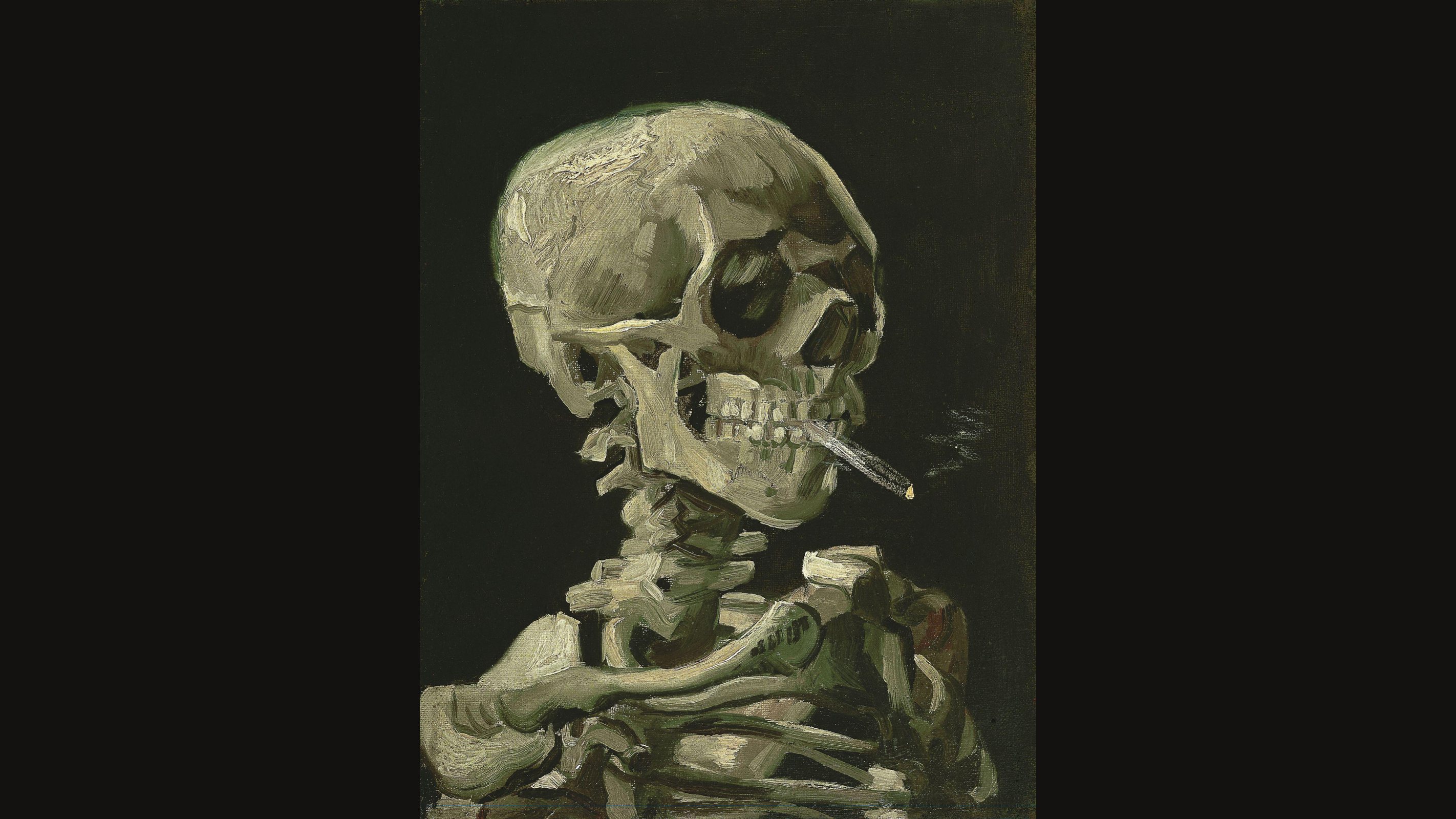
Van Gogh's skull painting is *Head of a Skeleton with a Burning Cigarette*, a small oil he painted in Antwerp in January and February 1886, while he was a student at the city's art academy. The Van Gogh Museum in Amsterdam, which owns it, calls the cigarette a youthful joke: the academy made its students draw skeletons as an anatomy exercise, and Van Gogh turned that serious study into an absurd scene (Van Gogh Museum record). From 22 May to 18 October 2026 it was on loan to the Fondation Vincent van Gogh Arles for the exhibition *SUSPECTS: Van Gogh, Tricksters & Co.* (Fondation Vincent van Gogh Arles).
That is the quick answer. The rest of the story involves an art student, a classroom skeleton, a hungry winter and a few later skulls that look nothing like this one.
The painting itself
The painting shows the head of a skeleton with a lit cigarette in its mouth, as if it had stepped out for a smoke between classes. The museum lists it as an oil painting made in Antwerp between January and February 1886, and it carries the catalogue numbers F212 and JH999, which is how art historians tell one Van Gogh from another in the big catalogues of his work (Wikimedia Commons record).
It is not one of the sunflowers or starry nights most people associate with him. It belongs to his short student stretch in Antwerp, before the brighter colors of his Paris years, which is part of why it surprises people who come across it online.
Tap or hover a row to highlight it.
| Work | Place | Date | Notes |
|---|---|---|---|
| WorkHead of a Skeleton with a Burning Cigarette (F212, JH999) | PlaceAntwerp | DateJanuary to February 1886 | NotesOil painting, Van Gogh Museum |
| WorkPencil drawing of a skeleton and a cat | PlaceParis | DateMarch to May 1886 | NotesSeparate drawing |
| WorkSkull (F297) | PlaceParis | DateWinter 1887 to 1888 | NotesOil on canvas on triplex board, 43 by 31 centimetres, Van Gogh Museum |
| WorkSkull (F297a) | PlaceParis | DateWinter 1887 to 1888 | NotesSeparate painting, Van Gogh Museum |
Van Gogh in Antwerp and the academy's skeletons
In early 1886 Van Gogh was studying at the art academy in Antwerp, Belgium. The academy trained its students in anatomy, and drawing skeletons was a standard exercise. Painting them was not. The Van Gogh Museum notes that painting a skeleton was not part of the curriculum, so this version was likely made between lessons or after them (Van Gogh Museum record).
That detail is the heart of the joke. The skeleton was a study subject, something to be drawn bone by bone. Van Gogh gave it a cigarette and made it do something only a living person would do. The museum reads the result two ways at once: as proof of his command of anatomy, and as a young man poking fun at a very serious kind of schoolwork.
If you like the idea of learning a skull bone by bone, the way those students did, our guide on how to draw a skull starts from the same anatomy.
Why the cigarette? The museum's answer, then the others
The Van Gogh Museum's explanation comes first because it is the best supported: the cigarette is a youthful joke. A painted cigarette turns a dry anatomy study into something silly, and nothing in the record suggests a deeper message he meant to send.
Other writers have added context. The biographers Steven Naifeh and Gregory White Smith place the painting beside Van Gogh's poor health and heavy smoking during this period (TheCollector). His own words back up the health part. In a letter to his brother Theo in February 1886, Van Gogh described being exhausted and eating poorly, and said he was smoking a great deal because tobacco dulled the feeling of an empty stomach (Wikimedia Commons record, with the letter). He was a student without much money, and that winter was a hard one for him.
It is tempting to connect the dots and call the skeleton a self-portrait, or a warning against smoking. The letter does not say either of those things, and neither does the museum. Those are readings people bring to the painting, and they are worth holding loosely. What is documented is a student, a skeleton and a cigarette, put together as a joke.
A dance of death and a vanitas: later readings
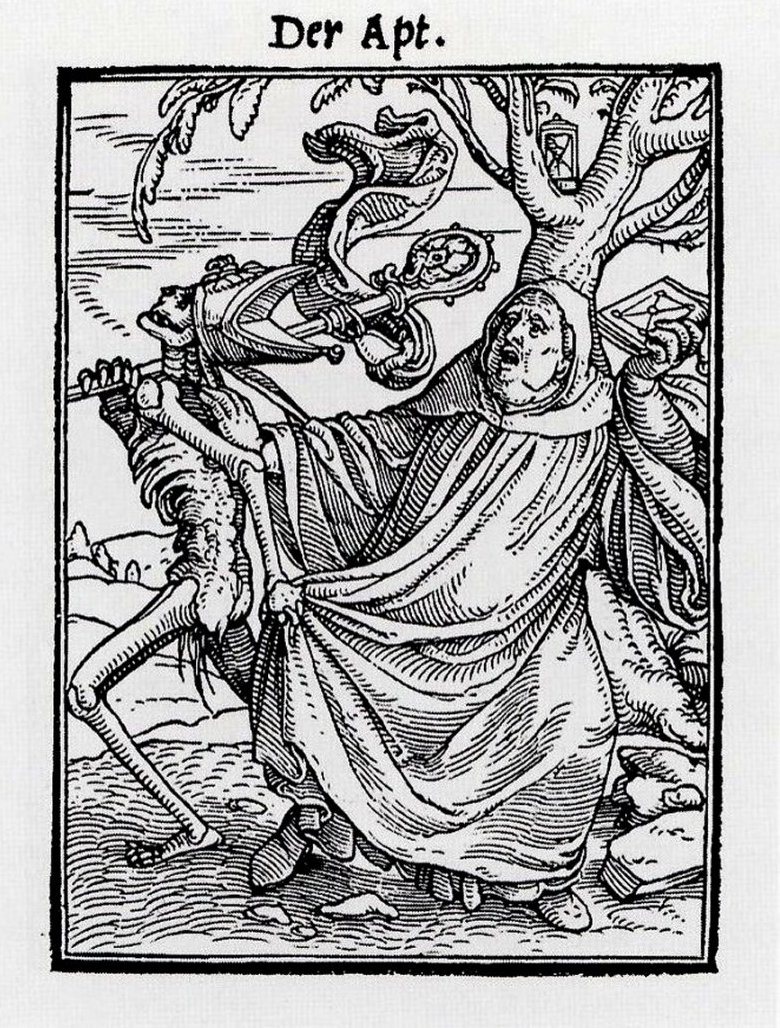
Art historians have also looked at the painting through older traditions. Anna-Maria von Bonsdorff, speaking to The Guardian in 2024, linked it to the Danse Macabre, the dance of death, a tradition she connects with artists including Dürer and Holbein, and to Van Gogh's own interest in Hans Holbein (The Guardian). Seen that way, a skeleton enjoying a smoke is a dead man taking up a living man's habit.
There is also the vanitas reading. The National Gallery of Art describes skulls, snuffed candles and other short-lived objects as established devices in Dutch vanitas painting, a tradition of still lifes about how brief life is (National Gallery of Art). A skull can act as a memento mori, a prompt to remember death, and a cigarette burns down, smokes and turns to ash, which fits that idea neatly.
Keep in mind that these are interpretations. The museum puts the weight on youthful humor and anatomical skill, and Van Gogh left no statement saying he meant his skeleton as a vanitas or a dance of death. If the older tradition interests you, our stories on the Danse Macabre, vanitas paintings and what memento mori means trace where those ideas came from. Another famous mix of skull and joke is Charles Allan Gilbert's All Is Vanity.
Van Gogh's other skulls, painted in Paris
Search for "Van Gogh skull 1887" and you will find very different paintings. After Antwerp, Van Gogh moved to Paris, and in the winter of 1887 to 1888 he painted two separate skulls, catalogued as F297 and F297a. Both are in the Van Gogh Museum collection (Van Gogh Gallery, F297; Wikimedia Commons, F297a).
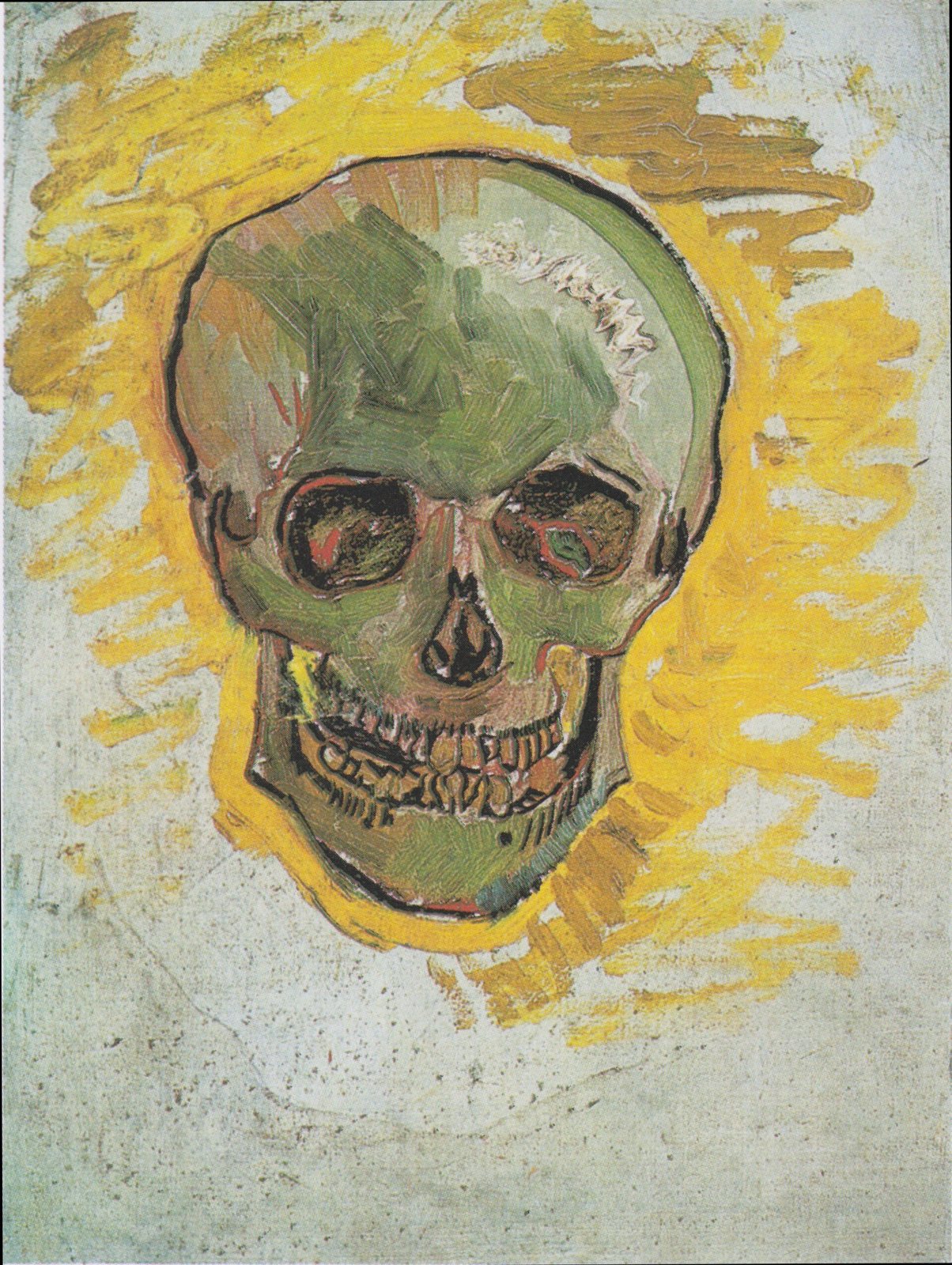
These belong to his brighter Paris period, when he was experimenting with complementary colors, stippling with small strokes and dots, and the influence of Georges Seurat. F297 is oil on canvas on triplex board, 43 by 31 centimeters. F297a is its own painting, not another version of the smoking skeleton (Artfile Magazine).
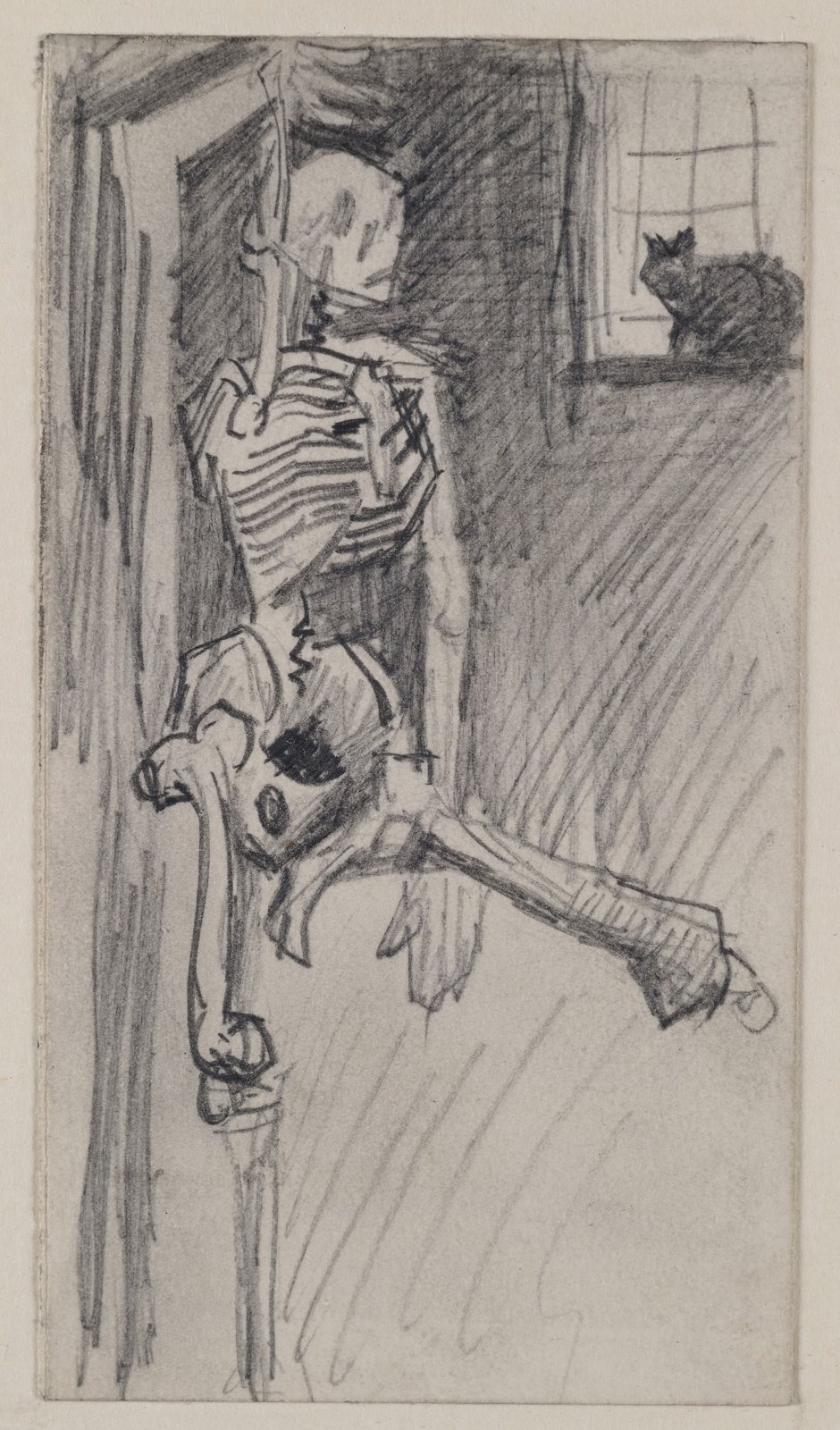
There is one more skeleton in between. A pencil drawing of a skeleton and a cat is catalogued to Paris between March and May 1886, a few months after the Antwerp painting. Put side by side, the Antwerp skeleton and the Paris skulls show how fast his palette changed in less than two years. For more skulls by famous artists, see our roundup of famous skull art.
Van Gogh's skeleton and skulls, 1886 to 2026
Tap or hover a step to follow the order.
January to February 1886
In Antwerp, during his academy period, Van Gogh paints Head of a Skeleton with a Burning Cigarette.
February 1886
In a letter to Theo, he describes exhaustion, poor eating and heavy smoking.
March to May 1886
A separate pencil drawing of a skeleton and a cat is catalogued to Paris.
Winter 1887 to 1888
In Paris, he paints two separate skulls, F297 and F297a, in brighter colors.
22 May to 18 October 2026
The smoking skeleton is on loan to the Fondation Vincent van Gogh Arles for SUSPECTS: Van Gogh, Tricksters & Co.
Where the painting is and how to see it
*Head of a Skeleton with a Burning Cigarette* belongs to the Van Gogh Museum, at Museumplein 6 in Amsterdam (Van Gogh Museum). The museum asks every visitor to book a timed ticket in advance (Van Gogh Museum tickets).

Owning a painting is not the same as always showing it. In 2026 the skeleton went south to Arles, where the Fondation Vincent van Gogh Arles included it in *SUSPECTS: Van Gogh, Tricksters & Co.* from 22 May to 18 October 2026, a fitting show for a painting that is itself a prank (Fondation Vincent van Gogh Arles). If you are planning a trip to see it, confirm its current display status with the Van Gogh Museum before you go.
To see it from home, the public-domain image on Wikimedia Commons is the one to use; the version on Google Arts and Culture is fine for looking at, but its rights belong to the Van Gogh Museum and the Vincent van Gogh Foundation.
Questions people ask about Van Gogh's smoking skeleton
Readers ask these most often about the painting.
Why did Van Gogh paint a skull smoking?
Van Gogh painted a skull smoking as a joke, according to the Van Gogh Museum. At the Antwerp academy, students drew skeletons for anatomy, and he turned that exercise into an absurd scene by adding a lit cigarette. His own heavy smoking that winter is real background, but he never said it was the reason.
Where is Van Gogh's skull painting?
Van Gogh's smoking skull painting belongs to the Van Gogh Museum in Amsterdam, which also owns his two Paris skulls. It spent 22 May to 18 October 2026 on loan in Arles, France, so check the museum's current display information before you visit.
What does the Van Gogh skull painting mean?
The Van Gogh skull painting most securely means a joke: a skeleton doing a living person's habit, painted by a student who knew his anatomy. The skull and the burning cigarette can also suggest mortality and the brevity of life, but those are interpretations, not a meaning Van Gogh confirmed.
Was the smoking skull an anatomy exercise?
The smoking skull grew out of an anatomy exercise but was not one itself. Drawing skeletons was standard at the Antwerp academy, while painting them was outside the curriculum, so the museum believes he made this one between or after lessons.
Did Van Gogh paint it as a warning about smoking?
No statement by Van Gogh presents the painting as a warning about smoking. His February 1886 letter to Theo talks about smoking to dull hunger, not about the painting, and the museum treats the work as humor rather than a health message.
Test yourself on Van Gogh's skeleton
How well do you know Van Gogh's smoking skeleton?
Answer every question to check.
A joke that outlived the classroom
A student in Antwerp, told to draw skeletons, painted one with a cigarette. That small act of mischief now belongs to the Van Gogh Museum in Amsterdam, and it still makes people smile before they start wondering what it means. If you are drawn to skulls drawn with an anatomist's eye, our Anatomy Skull Tee is our shirt in that spirit: a human skull engraved like a plate from an old anatomy book, no cigarette included.
Terms in this story
Tap a term to see what it means.
Antwerp art academy. The art school in Antwerp, Belgium, where Van Gogh studied in early 1886 and where students drew skeletons as an anatomy exercise.
---