

No. 023
What Is Memento Mori? Meaning, Origin and How People Use It Today
*Memento mori* is Latin for "remember that you have to die," or "remember that you are mortal." *Memento* is an imperative, "remember," and *mori* is the infinitive, "to die." Oxford defines the term as an object or symbol that reminds or warns you of death. The idea is ancient, and you will find it in Greek and Roman philosophy, Christian devotion and later European art. These days the phrase turns up in Stoic practice, tattoos, jewelry, songs and online self-improvement talk, which is probably how it reached you.
Where the phrase comes from
Many people have heard that a slave stood behind a Roman general in his triumph and whispered *memento mori*. The ancient text behind that story is Tertullian's *Apologeticus* 33, written in North Africa around 197 CE. Tertullian records the attendant's words as "Respice post te! Hominem te memento!" That is roughly, "Look behind you! Remember that you are a human being." The words are close in spirit, and they are not the phrase *memento mori*. Where the story says otherwise, that is later shorthand and embellishment.
The first English evidence is easier to pin down. The Oxford English Dictionary's cited examples include Shakespeare's *1 Henry IV*, probably written around 1596 to 1598, where Falstaff mentions "a deaths-head, or a memento mori." That shows the phrase was already in English by then, and it does not mean Shakespeare invented it. The safest summary: the reminder of death is ancient, while the fixed phrase became especially visible in later Latin Christian and European usage. It is not a surviving quotation from Marcus Aurelius or Seneca, though both wrote about the idea.
Memento mori through the centuries, second century CE to 2023
Tap or hover a step to follow the order.
Second century CE
Marcus Aurelius writes the Meditations.
Around 197 CE
Tertullian records "Respice post te! Hominem te memento!" in Apologeticus 33.
Late fifteenth century
The engraving Memento Mori: a skeleton in a niche.
1503
Dürer's Coat of Arms with a Skull.
Around 1596 to 1598
Shakespeare's 1 Henry IV mentions a memento mori.
1626
Hendrick Hondius's print Memento mori.
1698
Herman Henstenburgh paints Memento Mori in Hoorn.
1849
John Kenyon uses Memento Vivere in "A Day at Tivoli".
2017
Sr. Theresa Aletheia posts daily skull reflections.
2023
Depeche Mode release the album Memento Mori.
What the Stoics said about remembering death
The Latin phrase is later than the main Greek and Roman Stoic texts, but the practice sits at the center of them. The lines, with the translator named:
- Seneca, *Moral Letters* 26.10, in Richard M. Gummere's translation: "He who has learned to die has unlearned slavery."
- Epictetus, *Enchiridion* 21, in Elizabeth Carter's translation: "Let death and exile, and all other things which appear terrible, be daily before your eyes, but death chiefly; and you will never entertain an abject thought, nor too eagerly covet anything."
- Epictetus, *Discourses* 3.24, also in Carter's translation: when you kiss a child, a brother or a friend, remember that the loved person is mortal. He compares this to the attendants who stand behind a triumphing victor and remind him he is only human.
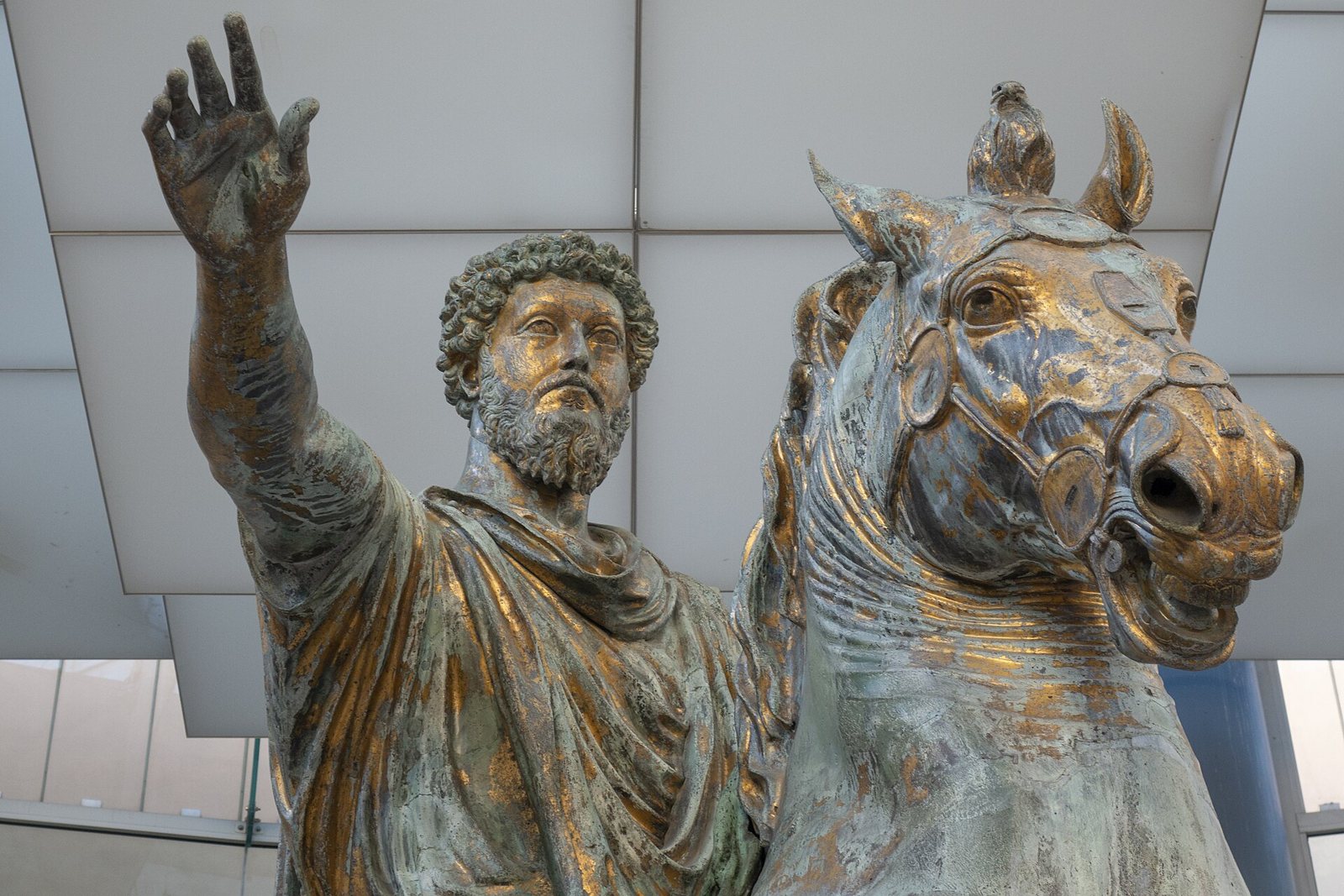
- Marcus Aurelius, *Meditations* 8.47, in George Long's translation: if circumstances make a virtuous action impossible, leave life contentedly. Elsewhere Long's version has him warn against acting as though you had ten thousand years to live.
The point is practical. For the Stoics, keeping death in view is a discipline for dropping vanity, handling fear, valuing the people around you and acting well while life lasts. It was never meant to produce despair. Epictetus did not tell anyone to love their family less; he wanted affection to be realistic and less possessive.
How Christians used it
Christian practice tied the memory of death to repentance, humility, judgment and the hope of resurrection. The clearest example is Ash Wednesday, which uses the words "Remember you are dust, and to dust you shall return." The formula comes from Genesis 3:19. In a 2012 homily, Pope Benedict XVI described the ashes as an invitation to penance, humility and awareness of mortality without despair, set inside a larger story of resurrection.
Monks and religious communities in medieval and early modern Europe kept death in view with skulls, prayers for the dead, inscriptions, ossuaries and devotional objects. The Capuchin Crypt in Rome, established in the 1630s and decorated with the remains of deceased friars, is a major example, and you can read about it in our guide to the Capuchin Crypt. The wider story is in skulls in Christianity.
One popular claim does not hold up: that Trappist monks greeted each other with *memento mori*. Fr. Timothy Scott, a Trappist priest, told Catholic News Agency that Trappists did not use the phrase as a greeting. The story appears to come from the former French Order of the Hermits of Saint Paul, sometimes called the Brothers of the Dead. Trappist communities did use other mortality symbols, including skulls, cemetery inscriptions and prayers for the dead.
Memento mori in art and objects
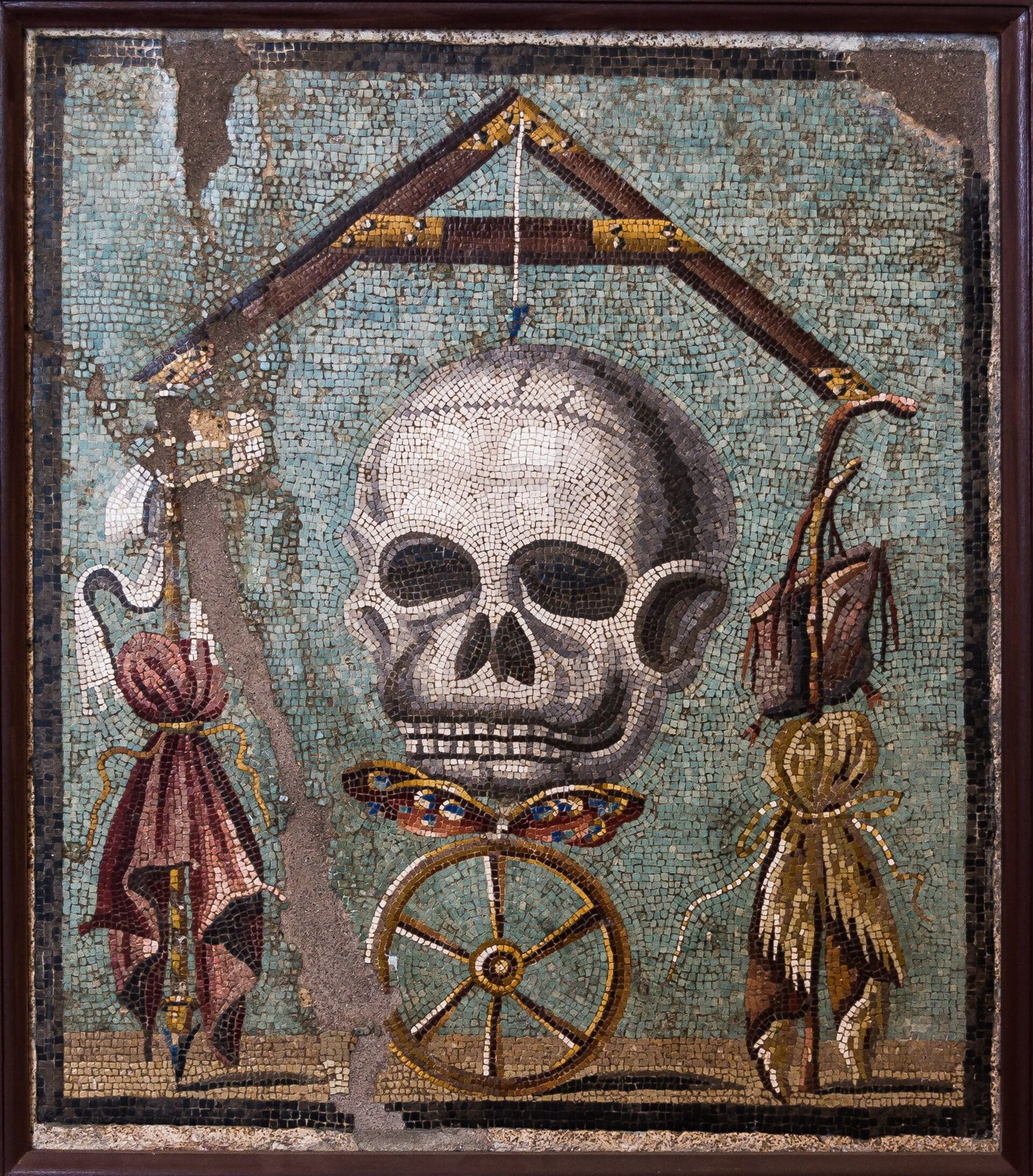
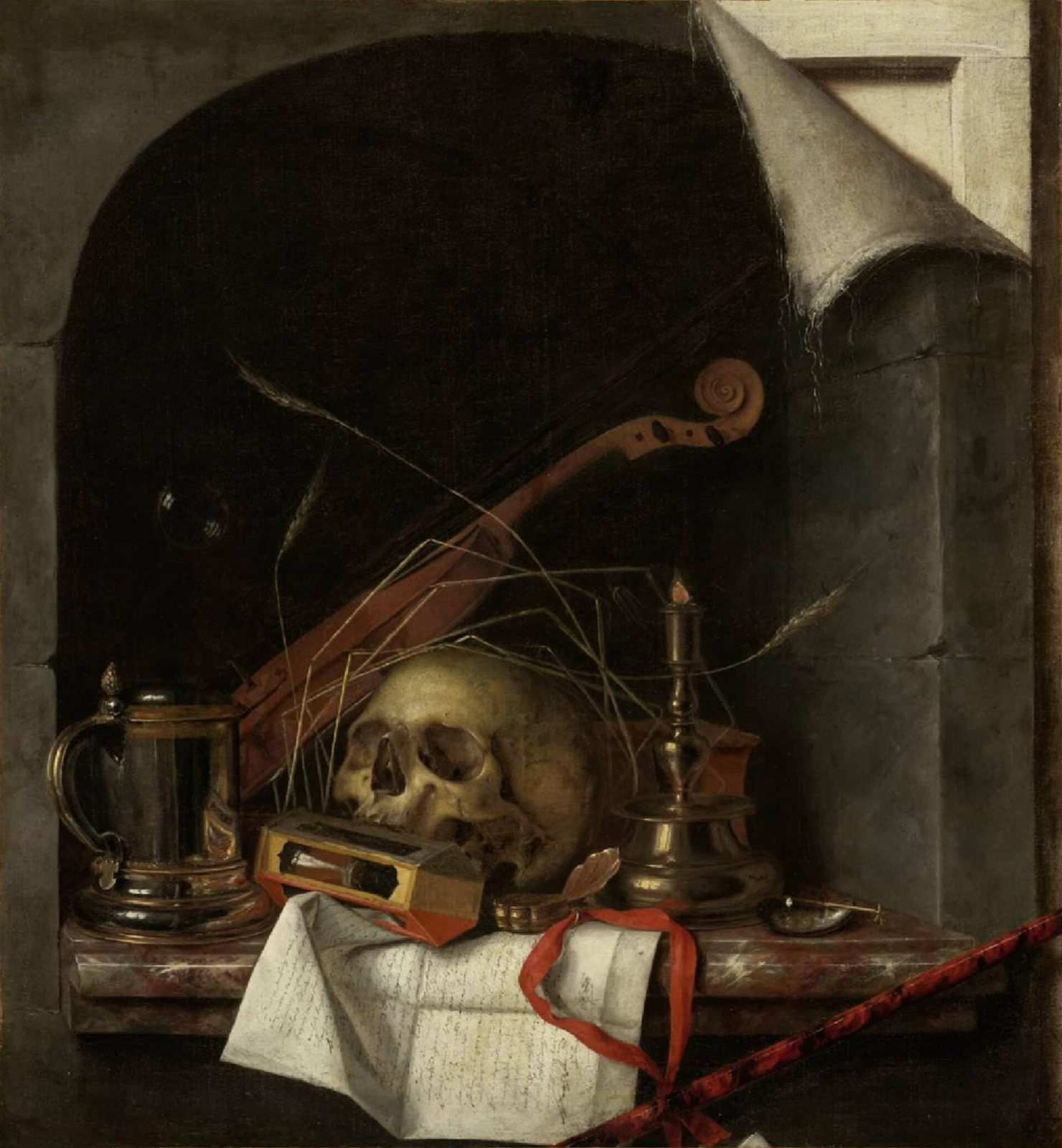
Artists and craftspeople built a whole visual language from the idea. The common symbols are a skull or skeleton, an hourglass or watch for passing time, an extinguished candle, wilting flowers, soap bubbles for the fragility of achievement, and books, coins and instruments for knowledge, wealth and pleasure that cannot last. Seventeenth-century Dutch and Flemish painting made the related genre *vanitas* especially prominent; see vanitas paintings for more.
Museums hold plenty of examples. Each is listed with its maker, date and holder:
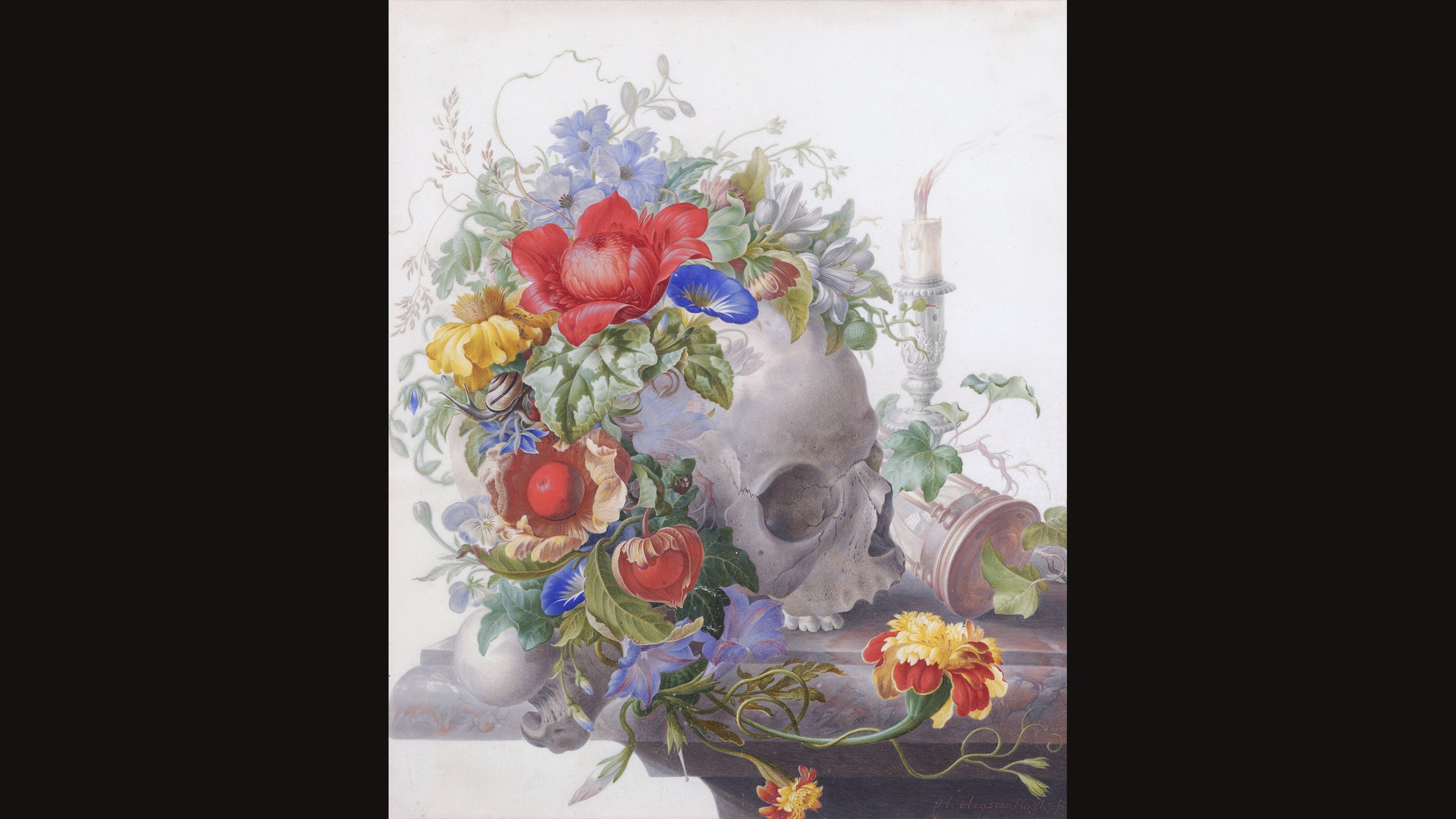
- Herman Henstenburgh, *Memento Mori,* 1698, documented by UNESCO and the Westfries Museum in Hoorn. A skull, an overturned hourglass, an extinguished candle and scattered bones.
- Simon de Passe, *Vanitas,* about 1630, Princeton University Art Museum. A child points toward a skull, with an hourglass and fading flowers.
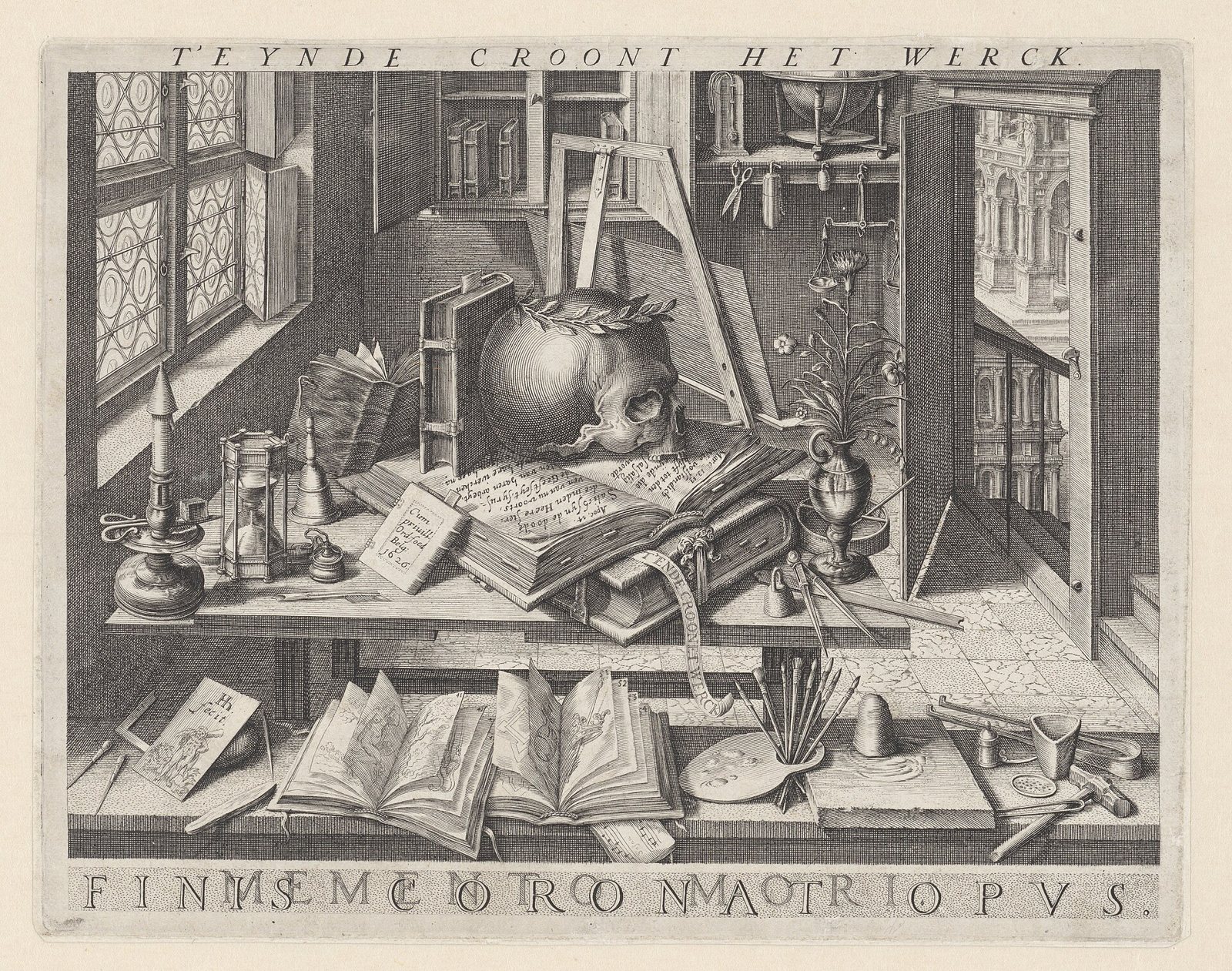
- Hendrick Hondius, *Memento mori,* 1626, Rijksmuseum. The words are spelled out, with a skull, an hourglass, scales, a flower, a candle and a book. The Rijksmuseum identifies the skull as a symbol of vanitas.
- Albrecht Dürer, *Coat of Arms with a Skull,* 1503, The Metropolitan Museum of Art. The Met describes the skull as a surrogate of Death hidden from the bride in a wedding-related scene.
- Julie de Graag, *Memento mori,* 1916, woodcut, Rijksmuseum. A human skull presented as a death's head.
- A Swiss skull-shaped watch, about the seventeenth century, The Met. A silver skull that opens to reveal a watch dial, tied by the museum to the period's interest in watches and sundials as signs of life's brevity.
Tap or hover a row to highlight it.
| Artist or maker | Title | Date | Holder |
|---|---|---|---|
| Artist or makerHerman Henstenburgh | TitleMemento Mori | Date1698 | HolderWestfries Museum, documented by UNESCO |
| Artist or makerSimon de Passe | TitleVanitas | DateAbout 1630 | HolderPrinceton University Art Museum |
| Artist or makerHendrick Hondius | TitleMemento mori | Date1626 | HolderRijksmuseum |
| Artist or makerAlbrecht Dürer | TitleCoat of Arms with a Skull | Date1503 | HolderThe Metropolitan Museum of Art |
| Artist or makerJulie de Graag | TitleMemento mori | Date1916 | HolderRijksmuseum |
| Artist or makerSwiss skull-shaped watch | TitleSkull watch | DateAbout the seventeenth century | HolderThe Metropolitan Museum of Art |
Rings carried the same message. European examples from the sixteenth and seventeenth centuries used skulls, skeletons, black enamel and inscriptions such as "Die to Live" and "Watch thy hour cometh." Some overlap with mourning jewelry, though not every skull ring is a mourning ring. Our pages on skull rings and Victorian mourning jewelry go further, and famous skull art has more paintings and prints.
Why you are hearing it now
The phrase lives in several overlapping circles at once. In modern Stoicism it has become a daily practice; The Daily Stoic, founded by Ryan Holiday and Stephen Hanselman, sells a Memento Mori Medallion meant to be carried in a pocket and linked to Marcus Aurelius's thought that you could leave life at any moment. That is a modern commercial version of the old habit of carrying a mortality symbol. Catholic social media helped too: in 2017 Catholic News Agency reported on Sr. Theresa Aletheia, a Daughter of St. Paul, who posted daily images and reflections with a small skull on her desk.
Tattoos are another reason. The phrase is short, looks good in lettering, and pairs with skulls, hourglasses, flowers, dates and names. One wearer may mean Stoic discipline, another Christian humility, another remembrance of someone who died, another acceptance of mortality or just a taste for historical symbols. The meaning belongs to the person wearing it; our guide to the skull tattoo goes into more. Music helped as well: Depeche Mode titled their fifteenth studio album *Memento Mori* in 2023, connecting the title with mortality and with the death of keyboardist Andy Fletcher in 2022.
Memento vivere and the neighbors
*Memento vivere* means "remember to live," and it is often offered as the cheerful partner of *memento mori*. It is much later and much rarer. The Oxford English Dictionary's cited evidence is John Kenyon's poem "A Day at Tivoli," published in 1849, which sets "Memento Mori" against "Memento Vivere." That makes it a modern parallel, not something to attribute to ancient Stoics or medieval monks.
A few related phrases travel with it: *carpe diem*, "seize the day," from Horace, *Odes* 1.11; *respice finem*, "consider the end"; and *hodie mihi, cras tibi*, "today it is my turn, tomorrow yours," used in some Christian cemetery and monastic settings. The contrast between them is a matter of interpretation. It is not a formal ancient pairing.
Memento mori quiz
Answer every question to check.
Quick answers about memento mori
Why is everyone saying memento mori?
It has become a compact phrase for mortality, intentional living and the shortness of time, and it appears in Stoicism content, tattoos, fashion, jewelry and pop culture. Old vanitas art, with its skulls and hourglasses, helped its visual side. People may mean a philosophy, a religious preparation for death, remembrance, a style or a plain note to use time well.
What is the opposite of memento mori?
No single opposite is historically fixed, though *memento vivere*, "remember to live," is the modern counterphrase most often named. *Carpe diem* is a related idea and not a literal opposite, since both push attention to the present. Someone using *memento mori* leans on limits and humility, and someone using *memento vivere* leans on being alive.
Is there a symbol for memento mori, and what is a memento mori skull?
The skull is the best-known symbol, though nothing makes it the only one: hourglasses, extinguished candles, wilting flowers, clocks, books and skeletons also appear. A memento mori skull is a skull used as a visual reminder that life is finite and death levels everyone. It is an artistic motif, and what it means depends on the setting.
Is memento mori a cringe tattoo?
Opinions are mixed. A January 2025 thread on r/tattooadvice had people calling the design meaningful and recognizable, while others called it overused and suggested making it more personal, since a tattoo is permanent. The phrase alone does not decide how a tattoo reads; the lettering, placement, imagery and the wearer's own reason all do.
Is the Punisher skull a memento mori?
Not by origin. It is the emblem of Frank Castle, Marvel's fictional vigilante, who debuted in 1974, and its meaning comes from that character and from later use by military, police and political groups that scholars have documented. It shares a shape with the skull in vanitas art, but it belongs to a different tradition.
Where to go next
For the wider vocabulary of the skull across cultures, read about skull symbolism. If you like the idea of carrying the phrase, our Memento Mori skull tee is the design in the shop that uses it.