

No. 107
Skull Rock, Joshua Tree: How the Granite Skull Formed and How to See It
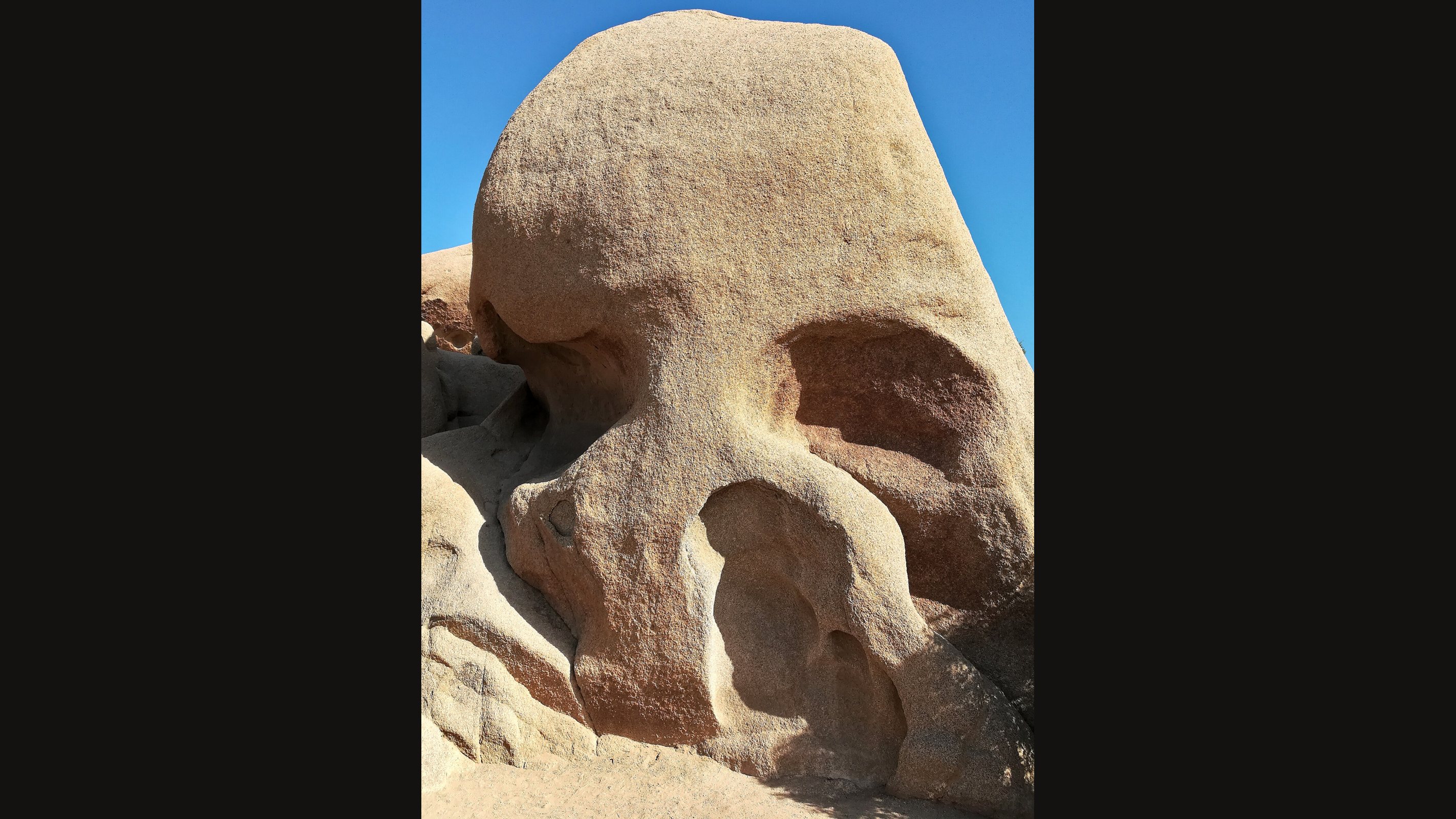
Skull Rock is a natural granite boulder on Park Boulevard, just east of Jumbo Rocks Campground in Joshua Tree National Park. Nobody carved its face. The National Park Service explains that rainwater collected in small dips in the rock and, over a very long time, erosion enlarged them into two hollows that look like eye sockets (NPS, Skull Rock). Getting a look is easy: the rock sits about 70 feet from the road and the Skull Rock Parking Area, so you can see it without hiking at all. If you want more, the Skull Rock Nature Trail is a 1.7-mile loop that the park says takes 1 to 2 hours (NPS, Hike Skull Rock).
That is the quick version. The longer one involves magma that cooled more than 100 million years ago, a mineral that turns to clay, a wetter Mojave that no longer exists, and the part of your brain that cannot help seeing faces.
Where to find Skull Rock
Skull Rock is along Park Boulevard, just east of Jumbo Rocks Campground. The National Park Service recommends the dedicated Skull Rock Parking Area for day use. The park puts it 11 miles from the Oasis Visitor Center and 23 miles from the Joshua Tree Visitor Center (NPS, Hike Skull Rock; NPS, Geology: Skull Rock).
The nature trail has trailheads on both sides of the road, which is handy if you are looking for a trail map: the loop simply starts on either side of Park Boulevard near the rock, and the NPS pages for the trail are the place to check the route before you go. The park's geology page for Skull Rock was last updated on April 1, 2024, and its Skull Rock information page on December 12, 2017, so check them and the park's current alerts for anything newer.
Tap or hover a row to highlight it.
| Fact | Detail |
|---|---|
| FactLocation | DetailPark Boulevard, just east of Jumbo Rocks Campground |
| FactFull trail | DetailSkull Rock Nature Trail, a 1.7-mile loop |
| FactDistance from the road | DetailAbout 70 feet from the road and parking area |
| FactTime on the trail | Detail1 to 2 hours |
| FactFrom the Oasis Visitor Center | Detail11 miles |
| FactFrom the Joshua Tree Visitor Center | Detail23 miles |
The Skull Rock Nature Trail
How long is the Skull Rock hike? The full Skull Rock Nature Trail is a 1.7-mile loop, and the National Park Service lists it as taking 1 to 2 hours. It is not a paved stroll. The park describes a trail of dirt and rock, with stairs, steep sections and narrow spots along the way (NPS, Geology: Skull Rock).
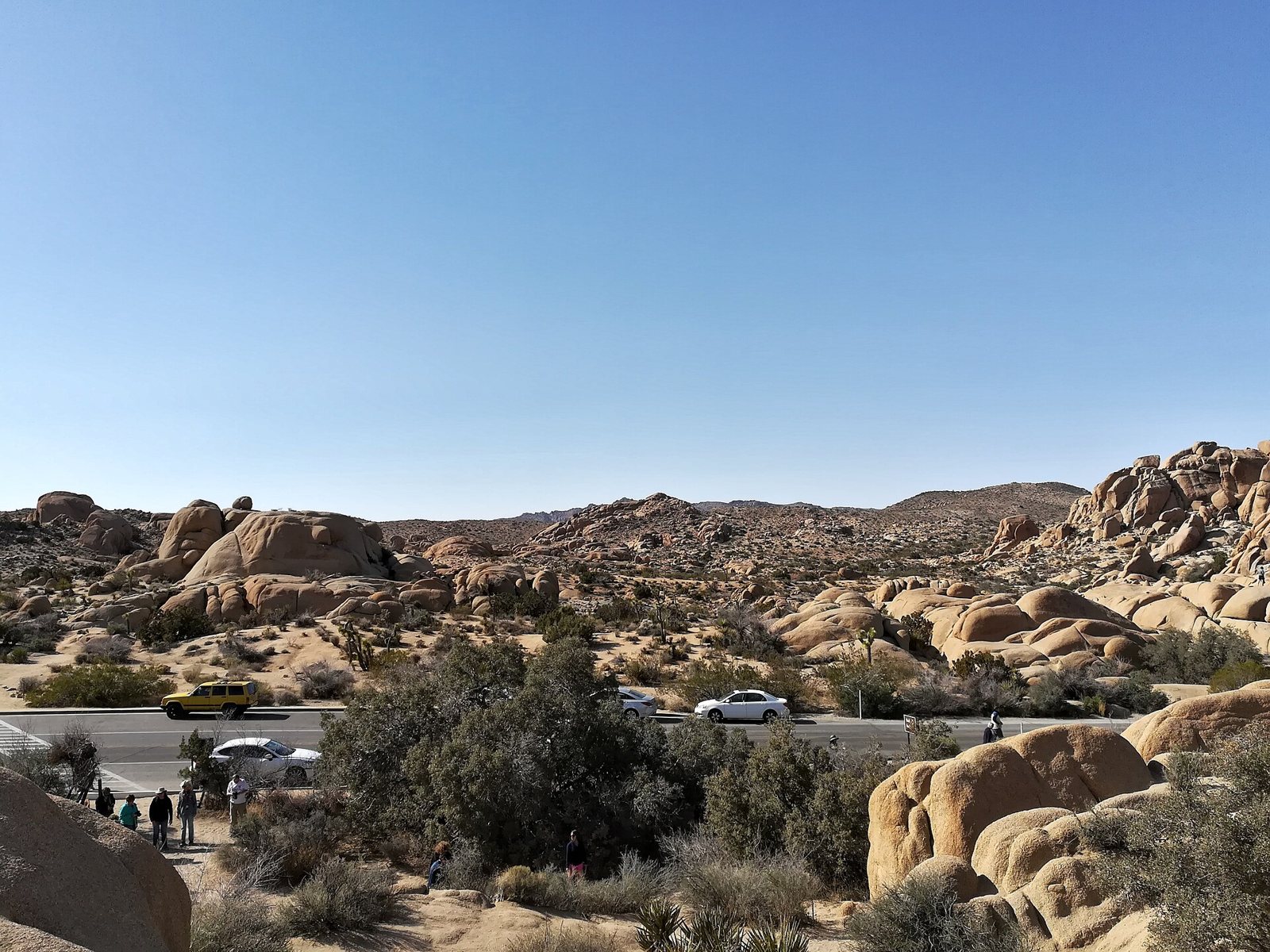
The good news for anyone short on time, or traveling with someone who does not want to hike, is that the famous face does not hide at the far end of the loop. Skull Rock itself is about 70 feet from the road, so a short walk from the parking area puts you in front of it (NPS, Hike Skull Rock). The loop is for the boulder piles around it, which are a big part of why people come to this corner of the park.
A skull made of granite
Skull Rock is made of the same stuff as Joshua Tree's other famous boulders: granitic rock, and in particular monzogranite. The National Park Service describes it forming from magma that cooled underground more than 100 million years ago (NPS, Geologic Formations).
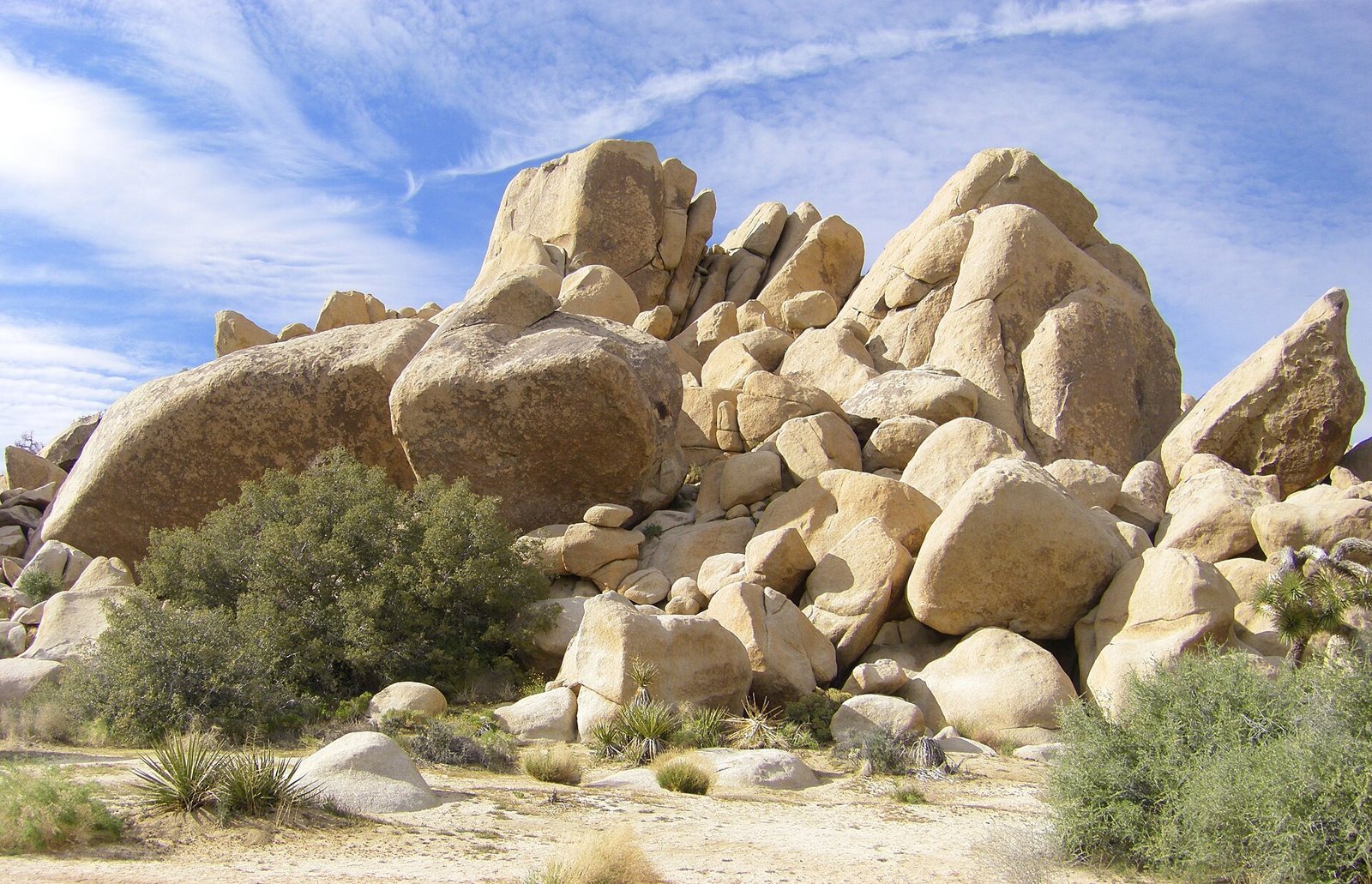
While it was still buried, pressure and erosion left the rock divided by rectangular cracks called joints. Groundwater then moved through those fractures and did something quietly dramatic: it chemically changed some of the feldspar minerals in the granite into soft kaolinite clay. The clay-rich edges weathered faster than the solid centers, so the sharp blocks slowly rounded off (NPS, Geologic Formations; USGS, Geology of Joshua Tree National Park).
That weathering happened under a very different climate. About 7 to 9 million years ago the Mojave was more humid, and groundwater worked on the jointed granite beneath the soil. The park describes much of the scenery you see today as a relic of earlier climates with more rain and lower temperatures. Later, as the region dried out, erosion and flash floods stripped away the soil and debris, and the rounded boulders and boulder piles were left standing in the open (NPS, Geologic Formations).
How a skull grew out of granite
Tap or hover a step to follow the order.
More than 100 million years ago
Granitic magma cools underground and forms monzogranite.
About 7 to 9 million years ago
A more humid Mojave lets groundwater weather the jointed granite beneath the soil, turning some feldspar into kaolinite clay.
Later
As the climate dries, erosion and flash floods strip away soil and debris and expose rounded boulders and boulder piles.
Over a very long time
Rainwater collects in small depressions on Skull Rock, and erosion enlarges them into the two hollows that look like eye sockets.
How the eye sockets formed
So, how did Skull Rock get its face? The National Park Service describes rainwater collecting in small depressions on the boulder. Each time water pooled and moved, erosion enlarged those depressions a little more, until two hollowed areas came to look like the eye sockets of a skull (NPS, Skull Rock).
The US Geological Survey explains the wider process behind Joshua Tree's rock shapes as a mix of chemical and physical weathering: clay forming inside the rock, edges rounding, and thin concentric shells of rock peeling away like the layers of an onion (USGS, Geology of Joshua Tree National Park). The eye sockets are natural weathering hollows made by water working on the rock. Wind did not drill them out on its own, however tempting that story is when you are standing in a breezy desert.
If you like the look of those hollows, our guide on how to draw a skull spends a fair amount of time on getting eye sockets right, and human skull facts covers the real thing.
Why the rock looks like a skull to you
There is a name for the moment a lump of granite stares back at you: face pareidolia, the illusory perception of a face in something that is not a face. In a 2022 study in the journal *Cognition*, Diane Rekow, Jean-Yves Baudouin, Renaud Brochard, Bruno Rossion and Arnaud Leleu reported that the human brain rapidly and automatically sorts face-like objects into the category of faces. Their experiments recorded neural responses to face-like objects, and the responses were strongest among participants who said they consciously saw the illusory faces (PubMed, Rekow et al., 2022).
Skull Rock gives that system plenty to work with: two dark hollows side by side, set in a rounded dome. Your brain does the rest, and it does it fast. It is the same reflex that lets a skull read as a face at all, and people have been giving that shape meanings for a very long time, a story our page on skull symbolism follows across many cultures.
Before you go, in the park's own words
The National Park Service is blunt about summer: conditions on the Skull Rock trail can be dangerously hot, and there is no running water and no cell service on the trail (NPS, Hike Skull Rock). The park's advice is to hike before 10 a.m. in summer, carry at least one gallon of water per person per day, share your trip plan with someone, check the weather, and wear sturdy footwear. Its safety guidelines page was last updated on October 8, 2026 (NPS, Safety Guidelines).
If you have been wondering about the best time to visit Skull Rock, that summer guidance is the clearest answer the park gives: go early in the day when it is hot. Conditions change, so check current weather and park alerts with the National Park Service before you set out.
Skull Rock visitor checklist
Tap a card to bring it forward.
- Parking: Use the designated Skull Rock Parking Area.
- Maps: Download maps before you reach areas with limited cell service.
- Water: Carry at least one gallon per person per day, especially in warm weather.
- Timing: In summer, start before 10 a.m.
- Trails: Stay on designated trails.
- Climbing: Do not climb where signs prohibit it.
- Rock art: Stay at least 50 feet from rock art.
- Conditions: Check current weather and park alerts.
Climbing, rock art and respect for the rocks
Can you climb Skull Rock? Joshua Tree does not ban climbing on every rock, but it does set firm limits, and it asks visitors to follow them. The park asks everyone to stay on designated trails and to use designated parking and pullouts. Climbing is prohibited within 50 feet of rock art, and a "No Climbing" sign must be obeyed even if you cannot see any art nearby. The park also has permanent and seasonal climbing closures, and climbers may not alter rock surfaces by chipping, gluing or making new holds (NPS, Habitat and Rock Art; NPS, Good Climbing Practices; NPS, Superintendent's Compendium).
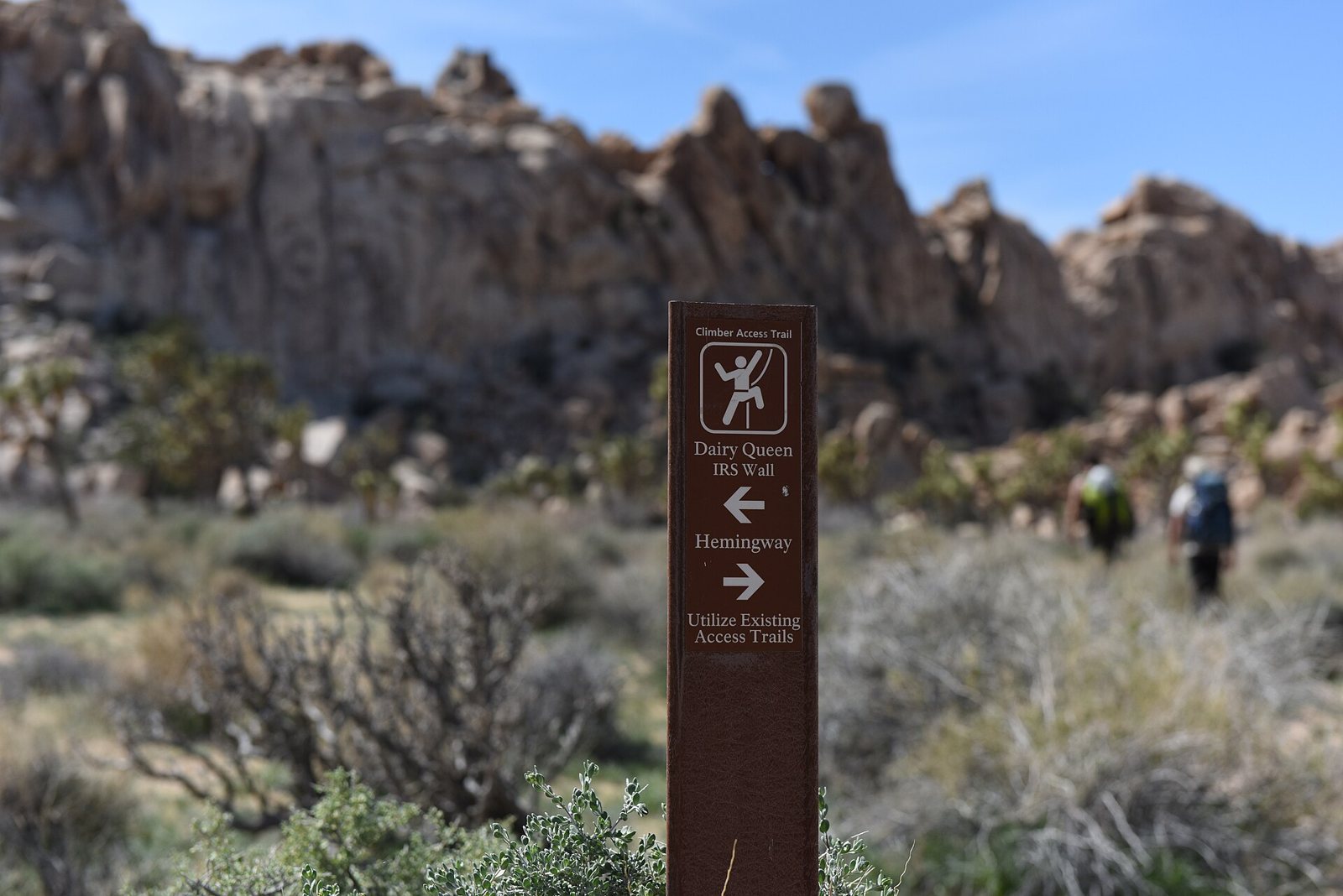
Those rules exist for a reason that matters more than any photo opportunity. The National Park Service describes the park's rock art as living cultural heritage and identifies sacred rock formations within the park (NPS, Good Climbing Practices). Skull Rock is a geological curiosity, while the park's rock art and sacred formations are part of a living heritage, and the climbing limits protect them.
Other skull rocks: one in Utah, one in Neverland
Joshua Tree's boulder is the most famous Skull Rock, but not the only place with the name. In Utah's House Range there is a Skull Rock Pass. Utah Geological Survey Bulletin 133 describes a rock unit called the Skull Rock Pass Conglomerate, named for the pass, and says the pass itself was named for a nearby Skull Rock in local usage. If you want to know what the Utah rock looks like or whether it is a place to visit, the Utah Geological Survey is the authority to ask.
Then there is the Skull Rock that many people think of first, which is pure fiction. Peter Pan and Neverland began with J. M. Barrie's stories, starting with the 1904 stage play and followed by the 1911 novel. Disney's 1953 animated film popularized its own Skull Rock image (D23, Peter Pan premieres). It has nothing to do with Joshua Tree, apart from proving that people have always liked a rock with a face. Pirates and skulls go together for older reasons, which you can read about in our stories on the skull and crossbones and the Jolly Roger. And if places named for skeletons are your thing, the Skeleton Coast of Namibia earned its name the hard way.
How well do you know Skull Rock?
Answer every question to check.
Questions people ask about Skull Rock
Where is Skull Rock in Joshua Tree?
Skull Rock is on Park Boulevard, just east of Jumbo Rocks Campground, inside Joshua Tree National Park. The National Park Service recommends the Skull Rock Parking Area for day use (NPS, Geology: Skull Rock).
How do I get to Skull Rock, and where do I park?
Drive Park Boulevard to the Skull Rock Parking Area, which the park puts 11 miles from the Oasis Visitor Center and 23 miles from the Joshua Tree Visitor Center. From there the rock is about 70 feet away, and the 1.7-mile loop trail starts on both sides of the road (NPS, Hike Skull Rock).
How long is the Skull Rock hike?
The full Skull Rock Nature Trail is a 1.7-mile loop that usually takes 1 to 2 hours. You can see the rock itself without doing the loop, since it is about 70 feet from the parking area (NPS, Hike Skull Rock).
How did Skull Rock form, and what is it made of?
Skull Rock is monzogranite, a granitic rock that cooled underground more than 100 million years ago. Rainwater later collected in small depressions on its surface and erosion enlarged them into the two hollows that look like eye sockets (USGS).
Can you climb Skull Rock?
Joshua Tree has no blanket ban on climbing natural rock, but you must obey every "No Climbing" sign, stay out of closed areas and stay at least 50 feet from rock art. Climbers may not chip, glue or create holds on any rock surface (NPS, Good Climbing Practices).
Are dogs allowed on the Skull Rock Trail?
Check the park's current pet rules with the National Park Service before you bring a dog to Skull Rock. The park's Superintendent's Compendium sets out its current public-use rules (NPS, Superintendent's Compendium).
A face that took a hundred million years
Skull Rock is what happens when a slab of underground magma, a few million years of groundwater, a drying desert and a lot of patient rain all line up, and then a human being walks past and sees a face. The rock never meant to be a skull. We did that part, quickly and automatically, which is maybe the most skull-loving thing about us. Go early, bring water, and say hello from 70 feet away.
Terms in this story
Tap a term to see what it means.
Monzogranite. A granitic rock that cooled from magma underground more than 100 million years ago and makes up many of Joshua Tree's boulders, including Skull Rock.
---