

No. 013
The Jolly Roger: Why Pirates Flew Skull Flags and What Real Ones Looked Like
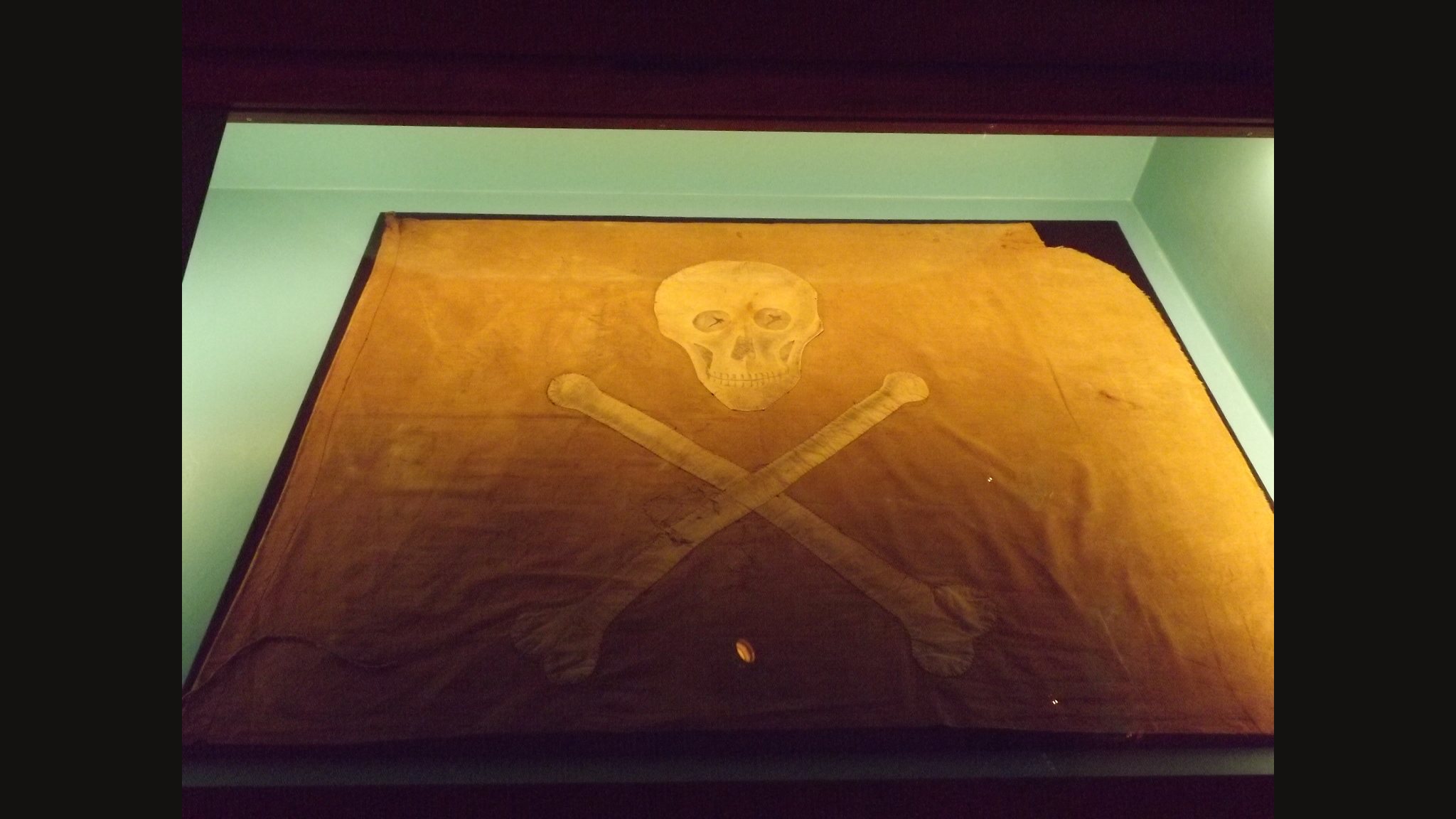
A skull on a pirate flag was a warning, raised at the last possible moment so a merchant crew would give up without a fight. Skulls, crossed bones, hourglasses and weapons all said the same thing in a glance: death is close and your time is short. The classic black flag with a white skull and two crossed bones is one design from that tradition, not the flag of every pirate. Real crews flew many designs, and the best-known ones in films, games and costume shops are often a later artist's idea of what a pirate flag should look like.
How a pirate attack actually used the flag
The flag did not fly for the whole chase. According to Royal Museums Greenwich, pirates often approached under false colors, hiding who they were until the target was too close to escape. Only then did the real flag go up, as a demand to surrender. Captain Snelgrave reported in 1719 that the flag was meant to frighten merchant crews into giving up, on pain of murder if they resisted.
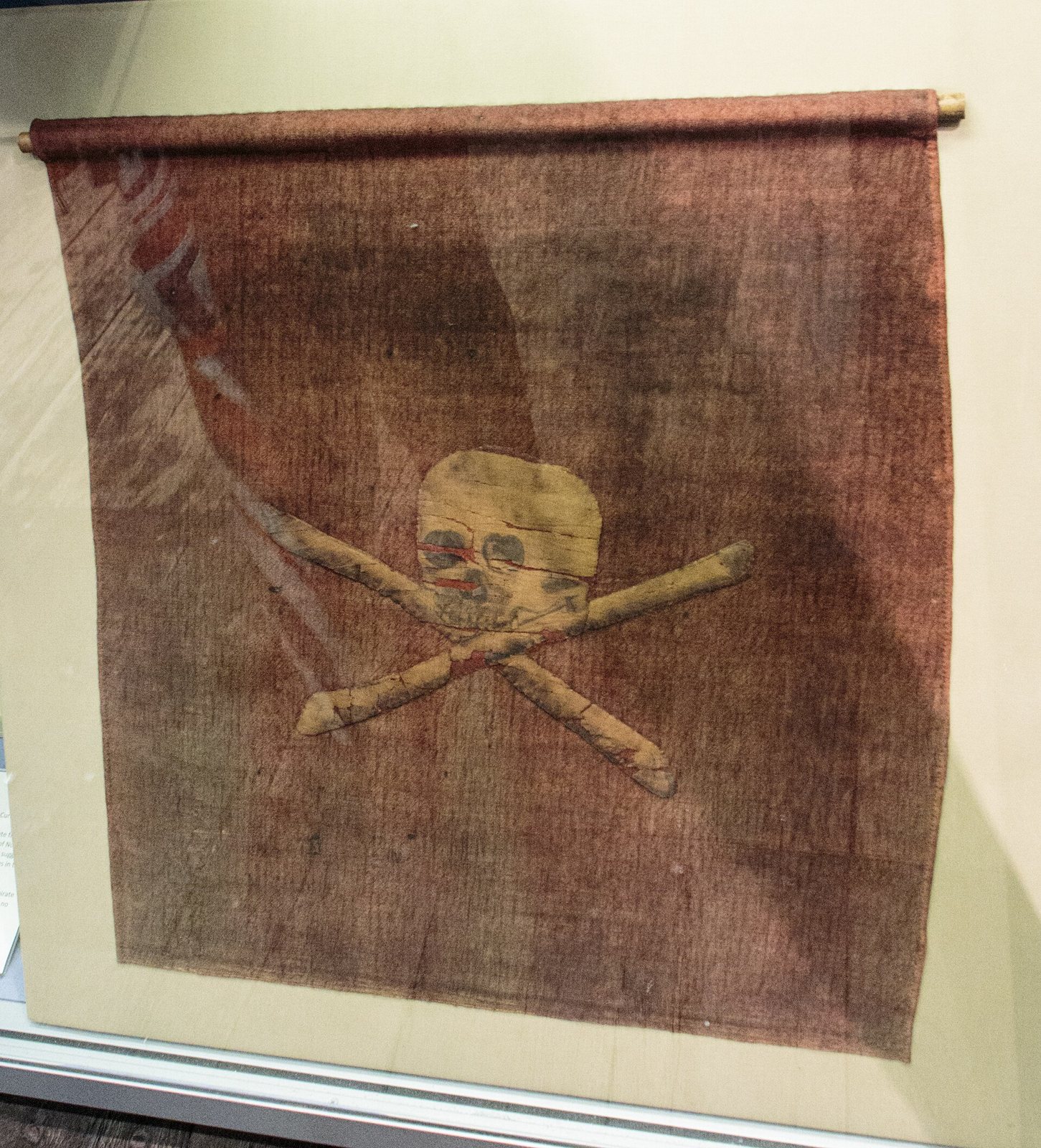
The colors carried a message of their own. A black flag generally told a crew that surrender might bring quarter, meaning their lives would be spared. A red flag, sometimes called the bloody flag, told them no quarter would be given. The Western Australian Museum describes the red flag as an attack without mercy if the target resisted, which is why it was probably the most feared design. There was no single flag everyone dreaded, though. Fear also rode on the reputation of the captain and the ship flying it.
Flags with a paper trail
For a few captains, a witness wrote down what they saw. These are the designs historians can call documented.
In July 1700, the French pirate Emmanuel Wynne was reported near Brava in the Cape Verde Islands flying "a sable ensigne with cross bones, a death's head, and an hour glass." The words come from Captain John Cranby of HMS *Poole*, in a British Admiralty record dated 18 July 1700, as Guinness World Records tells it. Nothing in that account is a surviving flag. It is a written description, and a good one.
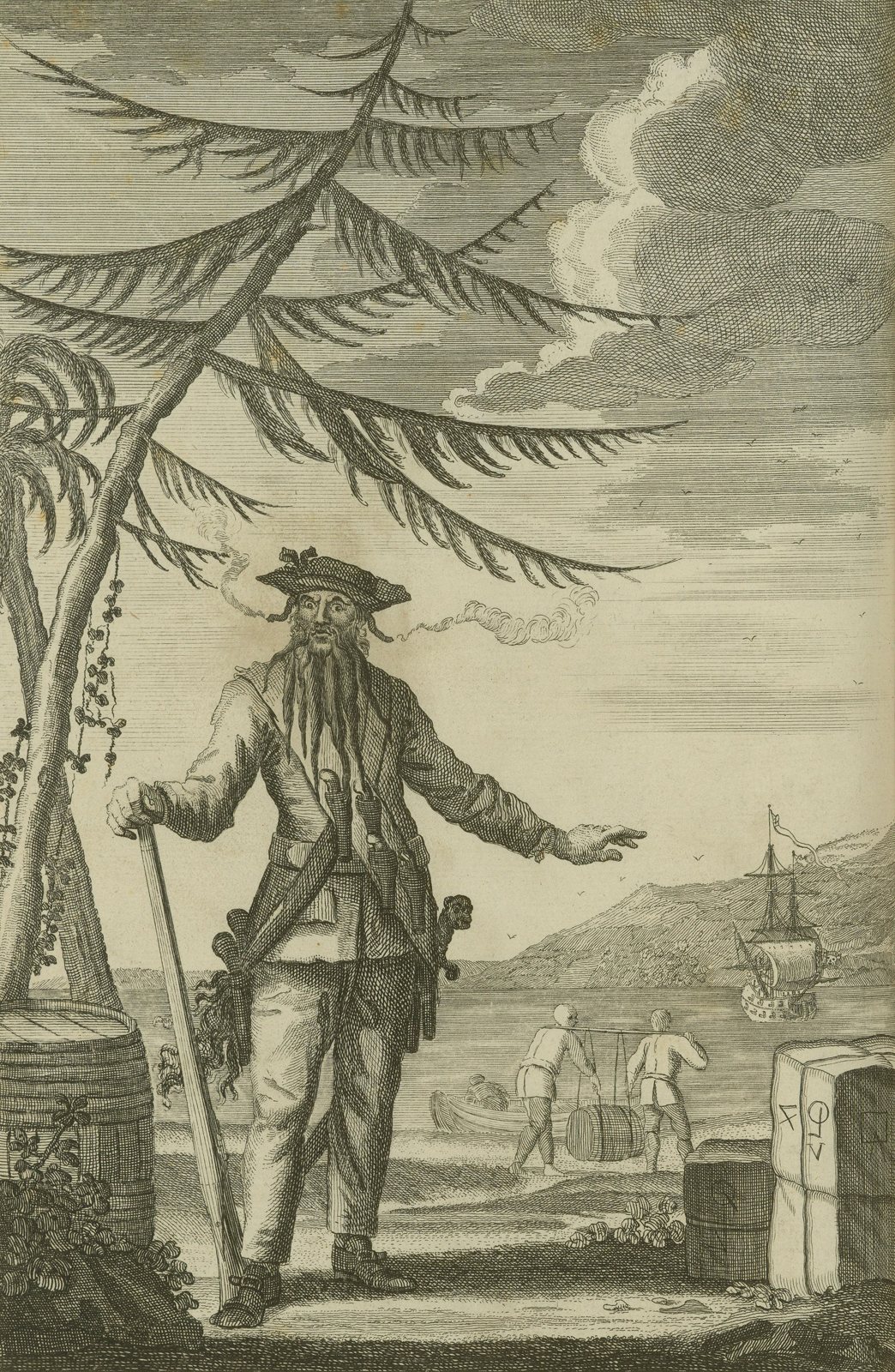
In November 1717, Thomas Knight described Edward Teach, better known as Blackbeard, flying a "Death Head" at his stern. A 1719 account tied to Stede Bonnet describes a flag with a skull, a dagger, a heart and a bone. Accounts of Edward Low describe a black flag with a red figure of Death. Bartholomew Roberts and Francis Spriggs both flew flags that Charles Johnson called Jolly Rogers in his 1724 book *A General History of the Pyrates*, even though the two designs were different.
The Jolly Roger from 1700 to 2026
Tap or hover a step to follow the order.
July 1700
Emmanuel Wynne's flag with skull, crossed bones and hourglass near Brava, Cape Verde Islands
November 1717
Thomas Knight describes Blackbeard's "Death Head"
1719
Stede Bonnet account of a skull, dagger, heart and bone
1721
Bartholomew Roberts's flag, named a Jolly Roger by Johnson
1723
Francis Spriggs's flag, a different design also called a Jolly Roger
1724
Johnson's A General History of the Pyrates
1914
HMS E9 flies a Jolly Roger after sinking SMS Hela
1982
HMS Conqueror after the Falklands War
2003
East Carolina University's new battle flag
2025
One Piece Straw Hat flag at protests in Indonesia and other countries
2026
Minneapolis, Delhi and Mumbai
What the skull, the bones and the hourglass meant
The historian Marcus Rediker, in his essay Under the Banner of King Death, sums up the usual combination as death, violence and limited time. The hourglass in Wynne's design told the target that its time was running out.
Pirates did not invent these symbols. Sailors already marked a death in a ship's log with a skull, and skulls and bones were common in graveyard art and in the older tradition of the memento mori. Pirates borrowed symbols everyone at sea already understood and turned them into a threat and a signature. If you want the wider story of that skull-and-bones pairing, the guide to the skull and crossbones follows it beyond the ocean.
The famous flags that came later
A handy way to sort any pirate flag you meet: an eyewitness or trial description documents a motif, while a later illustration shows how an artist imagined it. By that test, several famous designs turn out to be later work.
Tap or hover a row to highlight it.
| Pirate | What the eyewitness or trial record says | The famous image |
|---|---|---|
| PirateEmmanuel Wynne | What the eyewitness or trial record saysSkull, crossed bones and hourglass in an Admiralty record of 1700 | The famous imageThe classic early design |
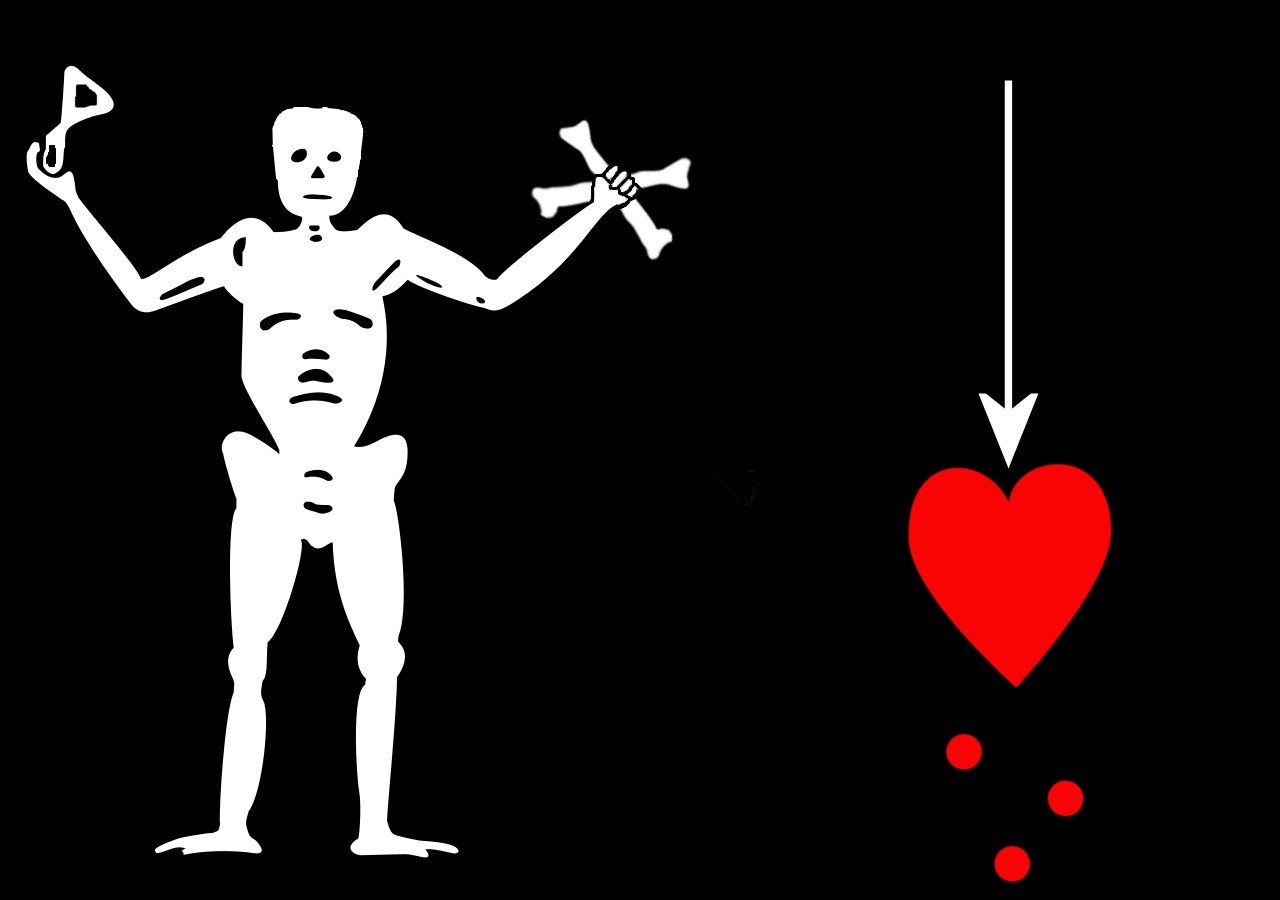
| PirateEdward Teach (Blackbeard) | What the eyewitness or trial record saysA "Death Head" in Thomas Knight's 1717 account | The famous imageA horned skeleton stabbing a heart from later illustrations |
| PirateJohn "Calico Jack" Rackham | What the eyewitness or trial record saysA white pendant in his 1721 trial records | The famous imageA white skull over crossed swords from later tradition |
| PirateBartholomew Roberts | What the eyewitness or trial record saysA flag called a Jolly Roger by Johnson in 1724 | The famous imageA skeleton with an hourglass or standing on two skulls from Johnson and later illustration |
| PirateHenry Every | What the eyewitness or trial record saysNo securely documented contemporary flag | The famous imageA skull in a bandanna with an earring from a later artistic attribution |
Blackbeard's horned skeleton stabbing a red heart is everywhere, yet Knight's 1717 testimony says only "Death Head." The dramatic version comes from later illustrations and modern reconstructions. Calico Jack Rackham is often shown with a white skull over crossed swords, but his 1721 trial records mention a white pendant and no skull-and-swords design. The skeleton with an hourglass or standing on two skulls that goes with Roberts is tied to Johnson's 1724 book and the illustrations that followed it. Royal Museums Greenwich identifies the famous Roberts image as an illustration drawn from Johnson, not an eyewitness drawing. Henry Every's bandanna-and-earring skull is a later artistic attribution too.
The plain black flag with a white skull and crossed bones became the standard popular design through eighteenth- and nineteenth-century storytelling, illustration and, later, film. That does not make it fake. It makes it a design that won.
Where the name Jolly Roger comes from
The earliest securely documented use of "Jolly Roger" as a pirate flag name is in Johnson's *A General History of the Pyrates*, first published in 1724. He applied it to flags tied to Roberts in 1721 and Spriggs in 1723. Because those designs were different, the name probably worked as a general term, not as the label for one fixed flag.
Where the words themselves came from is still open. One theory points to "Old Roger," a period nickname for the Devil or death. Another says it is an English version of the French *joli rouge*, "pretty red," linked to red flags used by French buccaneers. Other proposals include "Roger" as a word for a rogue or vagrant, and a distortion of the name Ali Rajah. Royal Museums Greenwich offers "Old Roger" and *joli rouge* as suggestions, not settled facts, and the *joli rouge* story, popular as it is, lacks clear surviving evidence from the period.
From pirate ships to submarines, stadiums and screens
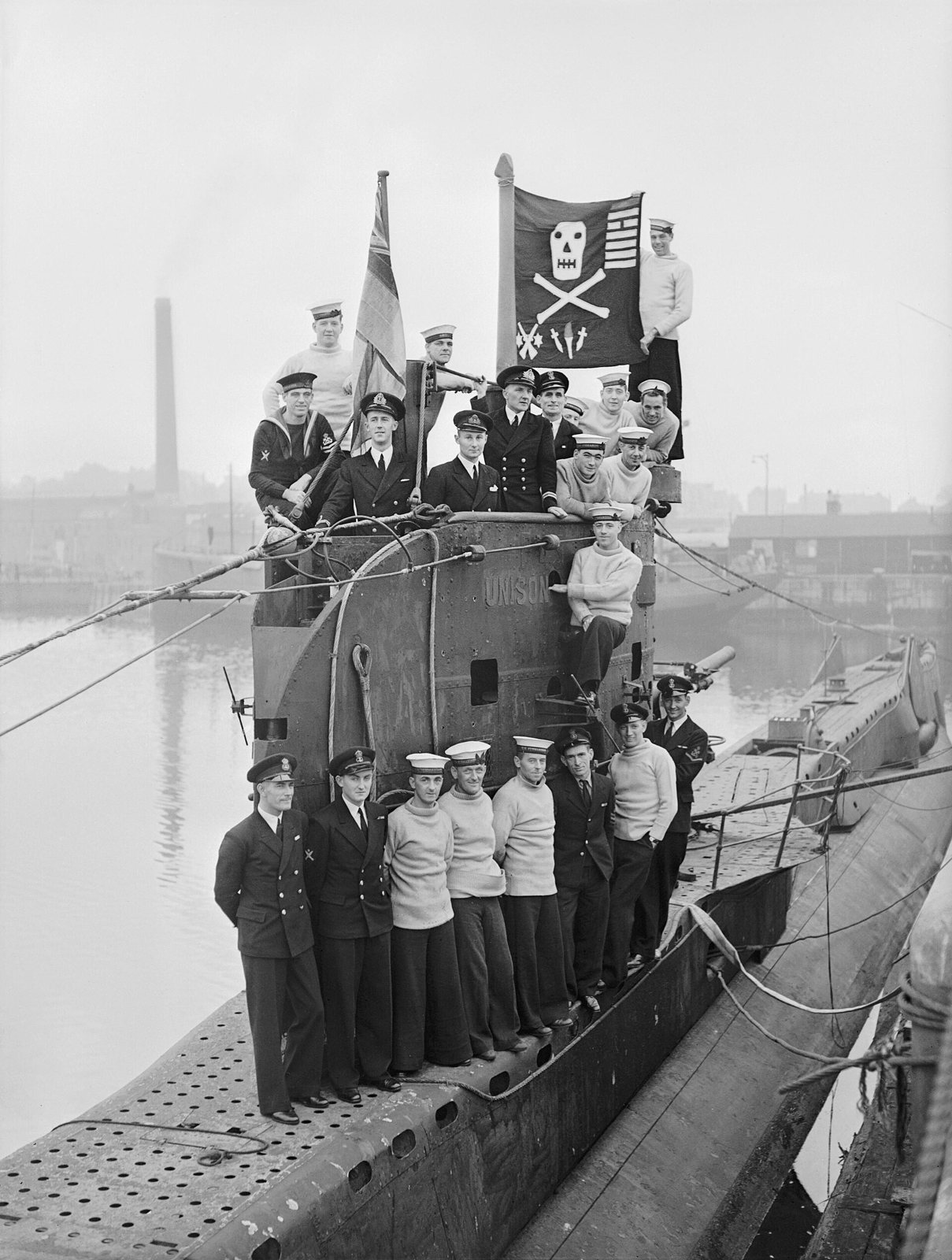
The skull flag found a second life in the Royal Navy. In 1901, Admiral Sir Arthur Wilson said submariners should be treated as pirates and hanged. In 1914, Lieutenant Commander Max Horton answered by flying a Jolly Roger from HMS *E9* after sinking the German warship SMS *Hela*, according to Royal Navy Museums. By the Second World War, British submarine crews made Jolly Rogers that recorded their successes, with bars, daggers, torpedoes and ships standing for sinkings or special missions. HMS *Conqueror* flew one after the 1982 Falklands War, and HMS *Otus* flew one after the 1991 Gulf War. That is the short answer to why submarines fly it.
Sports came next. East Carolina University introduced a new Jolly Roger battle flag in 2003 and began formal flag ceremonies at home football games in 2007. According to ECU Athletics, the school raises the black Jolly Roger before kickoff and a red "No Quarter" flag for the fourth quarter, which is a rare case of the black-flag and red-flag code surviving in a stadium.
Fiction did the rest. R. M. Ballantyne's *The Coral Island* appeared in 1858, and Robert Louis Stevenson's *Treasure Island* was serialized in 1881 and published as a book in 1883. Disney's Pirates of the Caribbean attraction opened in 1967, followed by *The Curse of the Black Pearl* in 2003. Video games including *Sea Dogs*, *Assassin's Creed IV: Black Flag* and *Skull and Bones* kept the look going.
The One Piece flag at protests
If you came here after seeing a grinning skull in a straw hat at a demonstration, that is the Straw Hat flag from Eiichiro Oda's Japanese manga and anime *One Piece*, which launched in 1997. It is the fictional Jolly Roger of Monkey D. Luffy and his crew, a skull wearing Luffy's straw hat above crossed bones. In the story, the crew stands against corrupt rulers and abusive authority, and protesters picked the flag up because it joins a youth-culture symbol to ideas of freedom, solidarity and resistance.
News outlets reported it in several places. In July and August 2025, people in Indonesia flew it before the country's 80th Independence Day and during protests over government policy, lawmakers' allowances and living costs, as reported by The Guardian. The Associated Press and the Philippine News Agency report it in Nepal in September 2025 during anti-corruption demonstrations, and in the Philippines the same month at rallies over alleged misuse of flood-control funds. In Madagascar, in September and October 2025, protesters used it during demonstrations about water and electricity failures, unemployment and corruption, and some adapted the hat to resemble a traditional Betsileo hat. It also appeared in Paris in September 2025 and in Lima in October 2025. In 2026, reporting places it at an ICE Out protest in Minneapolis in January and at student protests in Delhi and Mumbai in July, according to Tagesspiegel and ThePrint.
It is a modern fictional emblem borrowing the visual language of the Jolly Roger. It does not continue anything from eighteenth-century piracy, and it should not be called a historical pirate flag.
Test your Jolly Roger knowledge
Answer every question to check.
Quick answers about the Jolly Roger
Why is the pirate symbol a skull?
A skull stood for death, and a pirate flag used it to scare a target into surrendering before any fighting began. Crews also used skeletons, crossed bones, hourglasses, hearts and weapons, so the skull-and-crossbones was common but never the only choice.
Is the Jolly Roger flag illegal?
No general rule makes it illegal to own or display a Jolly Roger. A boat still has to follow the laws of its flag state, the port state and the coastal waters it sails in, and a pirate flag does not replace a required national flag. For example, U.S. law (14 U.S.C. 933) protects Coast Guard insignia from unauthorized display, and UK merchant-shipping law restricts improper national colours and colours resembling those of His Majesty's ships. This is general information, not legal advice, so check the rules of your flag state and harbor before flying one on a boat.
What is the controversy surrounding the Jolly Roger flag?
Most of the argument is about authenticity and romance. Many flags labeled Blackbeard's, Calico Jack's or Roberts's come from later illustrations, and the real flag was a threat tied to robbery, violence and death. Today the same symbol serves as a costume, a naval tradition, a piece of fiction and a protest sign.
What is the most feared pirate flag?
The red flag was probably the most feared, because it signaled an attack without quarter if the target resisted. No design was universally ranked first, and the black flag worked as a warning meant to avoid a costly fight.
Did Blackbeard really have a flag?
Yes, a 1717 witness, Thomas Knight, described a "Death Head" on his flag. The horned skeleton stabbing a heart that people usually associate with him comes from later illustrations.
Where to go next
If the skull on the flag made you curious about the symbol itself, start with the story of the skull and crossbones. The older tradition of the memento mori shows where sailors got their death symbols, and the guide to skull symbolism follows skulls through the cultures that used them.