No. 076
Why Do Skeletons Look Like They're Smiling? What Makes a Skull Grin
A skull looks like it is smiling because everything that covers the teeth in life is gone. The lips, cheeks, gums and facial muscles decompose, and what stays behind is two full rows of teeth set in the curved upper jaw, the maxilla, and the curved lower jaw, the mandible. A row of bared teeth inside a curved jaw happens to be exactly the pattern human eyes read as a smile.
So, the grin is real in the sense that you are not imagining it, but the skull is not expressing anything. The smile lives in the anatomy and in the way we look at faces. Artists noticed it centuries ago, and they have been putting it to work ever since, from medieval dances of Death to Mexican broadsides, Halloween yards and the 💀 in your group chat.
What a bare skull actually shows
Start with the bones. In the anatomy textbook OpenStax, "The Skull", the upper teeth sit in alveoli, the tooth sockets, in the maxilla. The lower teeth sit in the alveolar process of the mandible, the ridge of bone that carries them. Those sockets hold the teeth in the bone itself, which is why the teeth are still there when everything soft around them has gone.
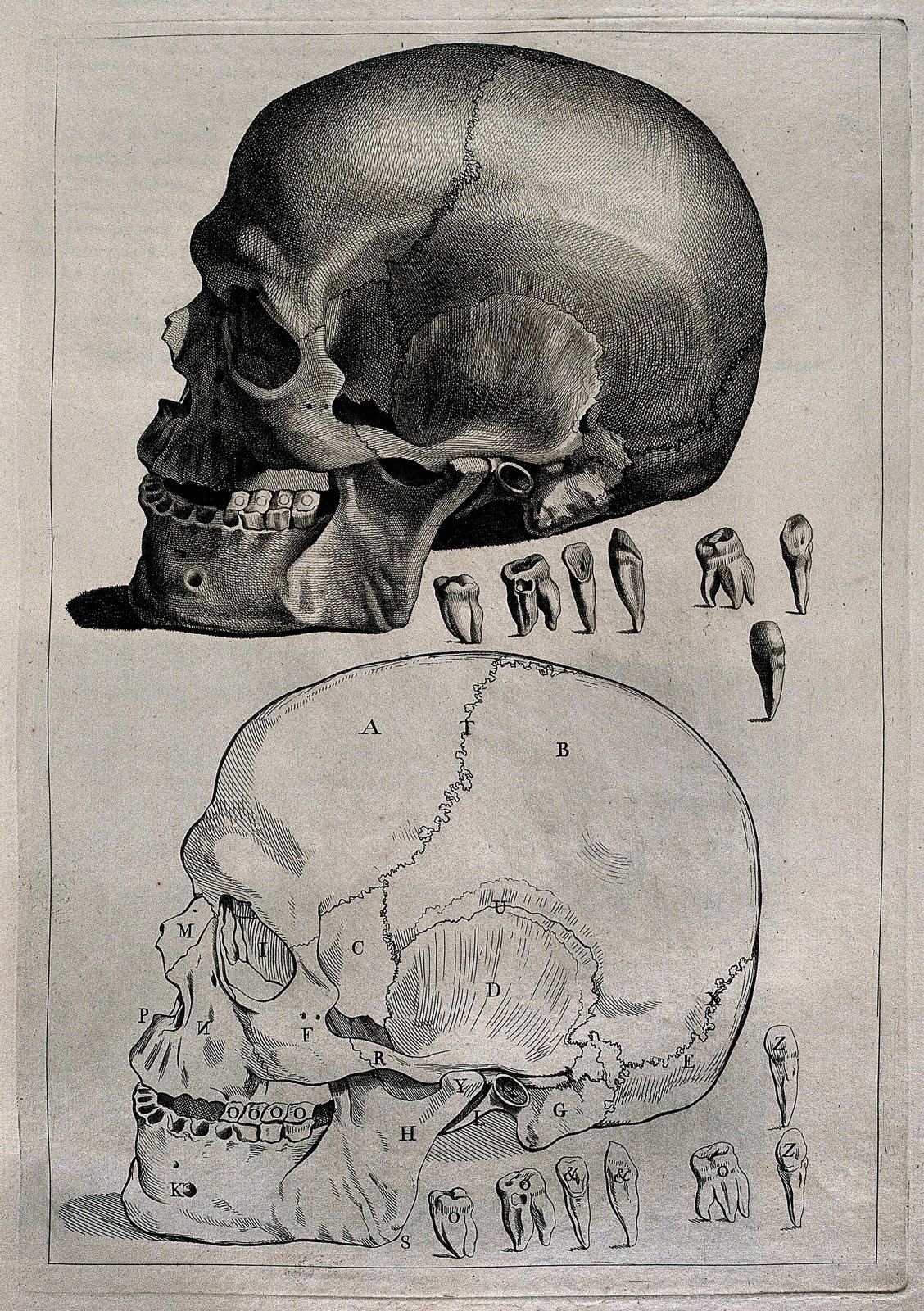
The mandible is the only movable bone of the skull, and that one hinge changes the whole expression. Let the jaw drop a little and the skull seems to laugh; close it and the grin turns tight, almost smug. On a classroom model, whoever wired the jaw decided how cheerful the skull would look. If you like this kind of detail, our human skull facts and the count of how many bones are in the human body fill in the rest of the frame, and how strong a human skull is covers the bone's toughness.
There is one more reason the grin looks so wide. A living smile shows some teeth, framed by lips. A skull shows all of them at once, upper and lower, from one side of the jaw to the other. No living person smiles that broadly, which is part of why the expression feels so fixed and so eager.
Why our eyes read it as a smile
The bones also happen to be arranged like a face. The curved maxilla and mandible, the tooth rows, the nasal opening and the two eye sockets sit in the same layout we see on every person we meet. Our eyes are quick to find a face in that layout, and once they find one, they look for an expression.
Teeth are a strong clue. Psychologists Jeffrey D. Martin, Bridget Waller and colleagues describe smiles as social signals, with effects tied to reward, affiliation and dominance, in their paper "Smiles as Multipurpose Social Signals". Ivan Blanco, Ignacio Serrano-Pedraza and Carmelo Vázquez showed in "Don't look at my teeth when I smile" that visible teeth change how people rate smiling faces and where they look on those faces.
Put those together and the skull's grin makes sense. A full set of exposed teeth in a curved jaw lands on a cue we pay close attention to when we read a face. That is also why the same grin can feel friendly to one viewer, mocking to another and unsettling to a third. The skull is giving the same signal every time; the viewer supplies the mood.
Why the teeth stay put, or sometimes fall out
Teeth are built to last. Enamel and dentin are highly mineralized and resist decay, so they last long after soft tissue has gone. In life, each root is held in its socket by the periodontal ligament, a band of tissue that anchors the tooth to the bone.
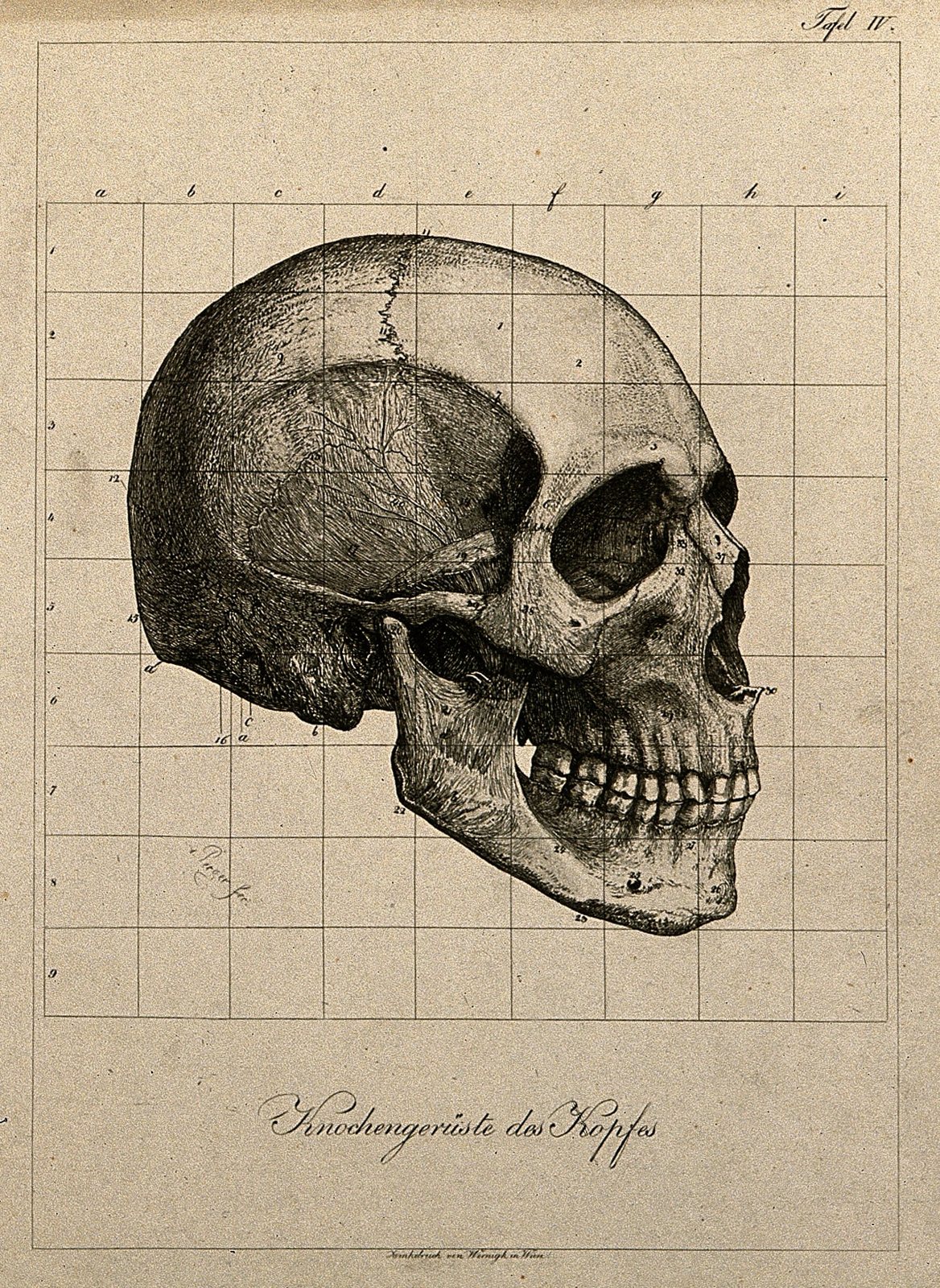
After death, that ligament breaks down along with the other soft tissues. The tooth is then sitting loose in its socket, and it can fall out with movement, excavation, scavenging, injury, burial conditions or exposure to the weather. Forensic anthropologists A. H. McKeown and J. L. Bennett, in "A preliminary investigation of postmortem tooth loss", report that tooth loss after death varies with decomposition, season, sunlight, age, the health of the gums and location. Durić, Rakocević and Tuller also studied the factors affecting postmortem tooth loss.
So, many skulls keep their full grin, and many others have gaps. Teeth staying in place is common, but it is not guaranteed, and a skull missing several front teeth is not unusual at all. If you have been wondering about the wider question of how a body becomes a skeleton, our gentle and factual story on how long it takes for a body to become a skeleton covers it.
Tap or hover a row to highlight it.
| Question | Answer |
|---|---|
| QuestionWhat bone forms the lower jaw? | AnswerThe mandible |
| QuestionWhat bone supports the upper teeth? | AnswerThe maxilla, through its alveolar process |
| QuestionWhat holds teeth in the jaw during life? | AnswerTooth sockets and supporting periodontal tissues |
| QuestionWhy can teeth fall out after death? | AnswerDecomposition weakens the periodontal ligament and other supporting tissues |
| QuestionWhen was the skull emoji approved in Unicode? | AnswerUnicode 6.0, 2010 |
| QuestionWhat does the skull emoji commonly express? | AnswerFigurative death, laughter, frustration, embarrassment, affection or Halloween imagery |
The grinning skeleton in European art
Artists were not slow to see the joke. In late-medieval Europe, the Danse Macabre, or Dance of Death, showed Death as an animated figure confronting people of every social rank. Oxford Bibliographies says the theme probably developed in the fourteenth century, and it dates the Spanish *Dança general de la Muerte* to about 1390 to 1400.
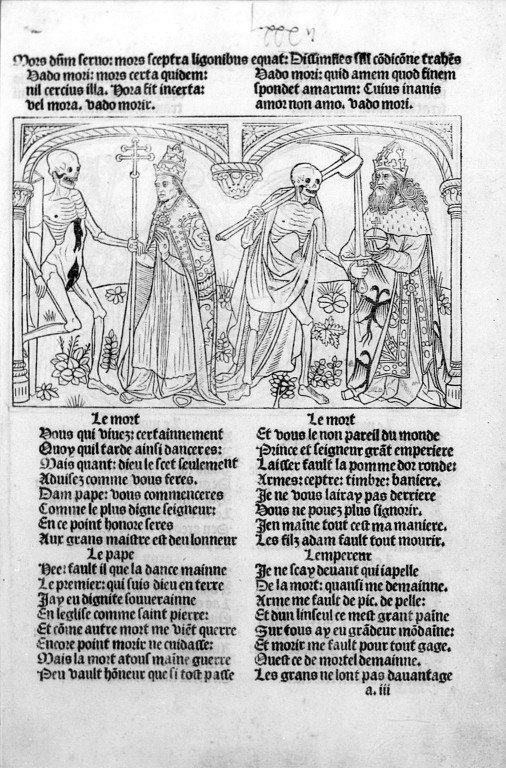
Printing carried the dance further. Guy Marchant printed *La danse macabre nouvelle* in Paris in 1485, according to The Morgan Library & Museum. Two centuries later, in Amsterdam in 1680, Jan Luyken published a skeleton print, *Geraamte van een mens*, now in the Rijksmuseum.
In these images the grin earns its keep. Death leads everyone into the same dance, and the skeleton's smile can read as Death enjoying a joke that the rich and the poor will both share in the end. Many people describe that as equality in death, which is a fair reading of the tradition rather than a rule every artist followed. Our story on the danse macabre follows the dance in full, and what memento mori means covers the wider habit of keeping death in view.
Posada's calaveras and Día de Muertos
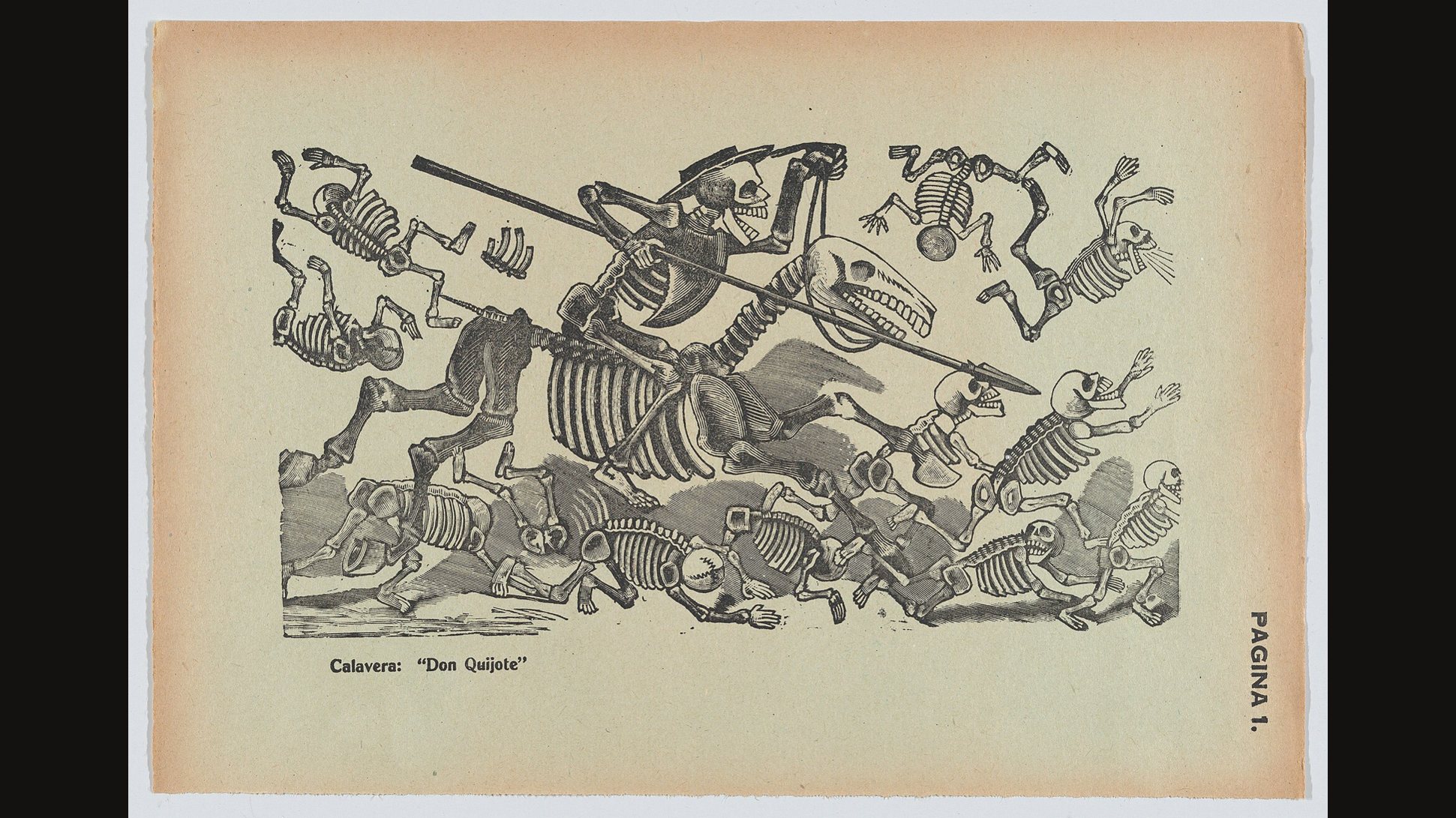
In Mexico, the grinning skeleton took on a different job. José Guadalupe Posada drew skeleton figures, calaveras, for cheap printed broadsides that often carried poems or corridos, and the Library of Congress describes how they satirized politicians, social class and popular culture. One of them, *Calaveras del montón, número 1*, was published in Mexico City in 1910 by Antonio Vanegas Arroyo, according to the Library of Congress.
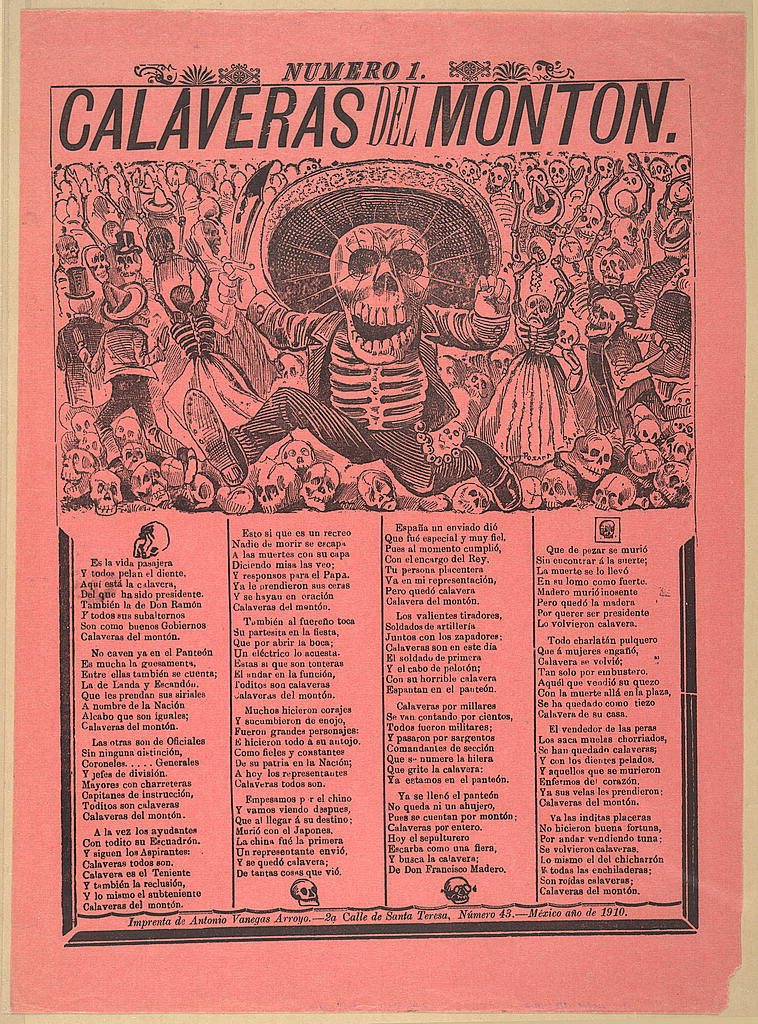
Posada's smiling calaveras became closely tied to Día de Muertos. In that setting, the Library of Congress notes, skull imagery can honor the dead, express mortality and poke fun at social rank. A grinning calavera dressed as a general or a society lady is laughing at pretension, and the joke lands because everyone ends up a skeleton. Our stories on José Guadalupe Posada and La Catrina tell more about the printmaker and the skeleton lady his work gave rise to.
Día de Muertos is a living tradition, and families and towns keep it in their own ways. The smiling calavera is one part of it, alongside the remembrance of relatives who have died. For the many meanings of the calavera itself, see calavera meaning, and for the celebration as a whole, Día de Muertos.
Halloween, cartoons and the cheerful skeleton
Halloween later made skulls and skeletons everyday decorations and costume imagery in the United States and elsewhere, as the Library of Congress's Halloween guide describes. The yard skeleton waving from a lawn chair owes its friendly face partly to anatomy and partly to the long habit of drawing skeletons as good company.
That cheerful grin is an artistic convention. Depending on the community and the setting, it can signal equality in death, satire, remembrance, play or a little fright. Our story on skeletons and Halloween covers the holiday side, and cartoon fans will want The Skeleton Dance of 1929.
The skull emoji
The 💀 on your phone is a cartoon skull, not an anatomical one, and it has its own short history. Emojipedia says it appeared on early Japanese emoji keyboards from SoftBank in 1999, was approved in Unicode 6.0 in 2010 and was added to Emoji 1.0 in 2015.
Its meaning depends on the conversation. Most often it stands for figurative death, as in "I'm dead," something so funny, shocking or embarrassing that the sender has died on the spot. It can also mean frustration, affection, Halloween, danger or real death. The skull, it turns out, gets the last laugh in text messages too. The full story is in skull emoji meaning.
The grinning skull through time
Tap or hover a step to follow the order.
About 1390 to 1400
The Spanish Dança general de la Muerte
1485
Guy Marchant prints La danse macabre nouvelle in Paris
1680
Jan Luyken's skeleton print is published in Amsterdam
1910
Posada's Calaveras del montón, número 1 is published in Mexico City
1999
The skull emoji appears on early Japanese SoftBank keyboards
2010
The skull emoji is approved in Unicode 6.0
2015
The skull emoji is added to Emoji 1.0
Does a grinning skull mean anything?
The grin itself comes from bone and teeth, so any meaning comes from the people using the image. A skull is not universally a sign of evil. Depending on the community and setting, it can stand for death, danger, mortality, equality, remembrance, satire, Halloween or plain humor.
The examples above show how far apart those meanings can sit. In Posada's calaveras, the grinning skull criticized political and social inequality. In Día de Muertos settings, a skull can stand for a person who is being remembered with love. On a Halloween porch, the same grin is there for fun. For the full range, from Dutch still lifes to Tibetan ritual, see what a skull symbolizes.
Questions about the skeleton's smile
A few more short answers about that famous grin.
Why do skeletons smile?
They do not choose to; the grin appears once the soft tissue around the mouth is gone and the teeth in both curved jaws are left exposed. The mandible's position then decides whether the smile looks small or wide, which is why two skulls can seem to wear different expressions.
Why are skeletons always smiling?
Because nearly every skull keeps both rows of teeth on show, and artists from the Danse Macabre to Halloween kept the grin on purpose. A grinning Death made the old dances feel like a joke everyone shares, and a grinning calavera made Posada's satire sharper.
Why does a skull have teeth at all?
The teeth are anchored in the jaw bones themselves, in sockets in the maxilla and mandible, so they belong to the skull rather than to the soft tissue of the face. Enamel and dentin are highly mineralized, which lets them last long after the lips and gums are gone.
Are skulls a sign of evil?
No single meaning is built into a skull, and evil is only one of the readings people have given it. In Mexican calaveras skulls could mock inequality, and in Día de Muertos settings they can stand for loved ones who are remembered.
How well do you know the skull's grin?
Answer every question to check.
Where to go next
The grin has company all over this site. For the dancing dead, start with the danse macabre; for the satirical skeletons of Mexico City, José Guadalupe Posada; and for the bone itself, human skull facts. If you came here from a text message, skull emoji meaning is waiting with a grin of its own.
Terms in this story
Tap a term to see what it means.
Maxilla. The bone of the upper jaw. The upper teeth sit in its sockets.
---