No. 027
What Does Calavera Mean? Skull, Sugar Skull, Poem and Slang
*Calavera* is the Spanish word for skull, and it comes from the Latin *calvaria*. The Royal Spanish Academy (RAE) defines it as the connected bones of the head after the flesh and skin have been removed. In Mexico the same word also names a sugar skull, a humorous verse written for Día de Muertos, a skeleton or figure of death, a gift that children ask for, and the rear light on a car. Said about a person, it can mean someone reckless and fond of a party. Which meaning you have in front of you depends on where you are standing, who is speaking and what they are holding.
The plain meaning, and where the word comes from
The RAE's dictionary gives the etymology in one line: from the Latin *calvaria*, "skull." The American Heritage Dictionary traces *calvaria* back to *calva* and *calvus*, "bald," which links the word to a bare head. You may see a claim that it comes from Latin *cadavera*, "corpses." That one is a folk etymology and not the established origin. The word is feminine in ordinary use: *la calavera*.
The word is old in Spanish writing. Iedra records its first appearance in a Spanish dictionary in 1505 and its first appearance in the RAE's *Diccionario de autoridades* in 1729. Those are dictionary dates, so the word was in use before then.
The RAE lists a few meanings outside the skull, too. *Calavera* is also a death's-head hawkmoth, in El Salvador a square electrical outlet with several connections, and in Mexico either rear light of a vehicle. For a person, the RAE gives a dissipated, party-loving, irresponsible man.
The word calavera through time
Tap or hover a step to follow the order.
Latin calvaria
The Latin word for skull, the source of calavera.
1505
First appearance of calavera in a Spanish dictionary, per Iedra.
1729
First appearance in the RAE's Diccionario de autoridades, per Iedra.
Late 1800s to early 1900s
Calaveras become popular as satirical literature and political commentary.
About 1900
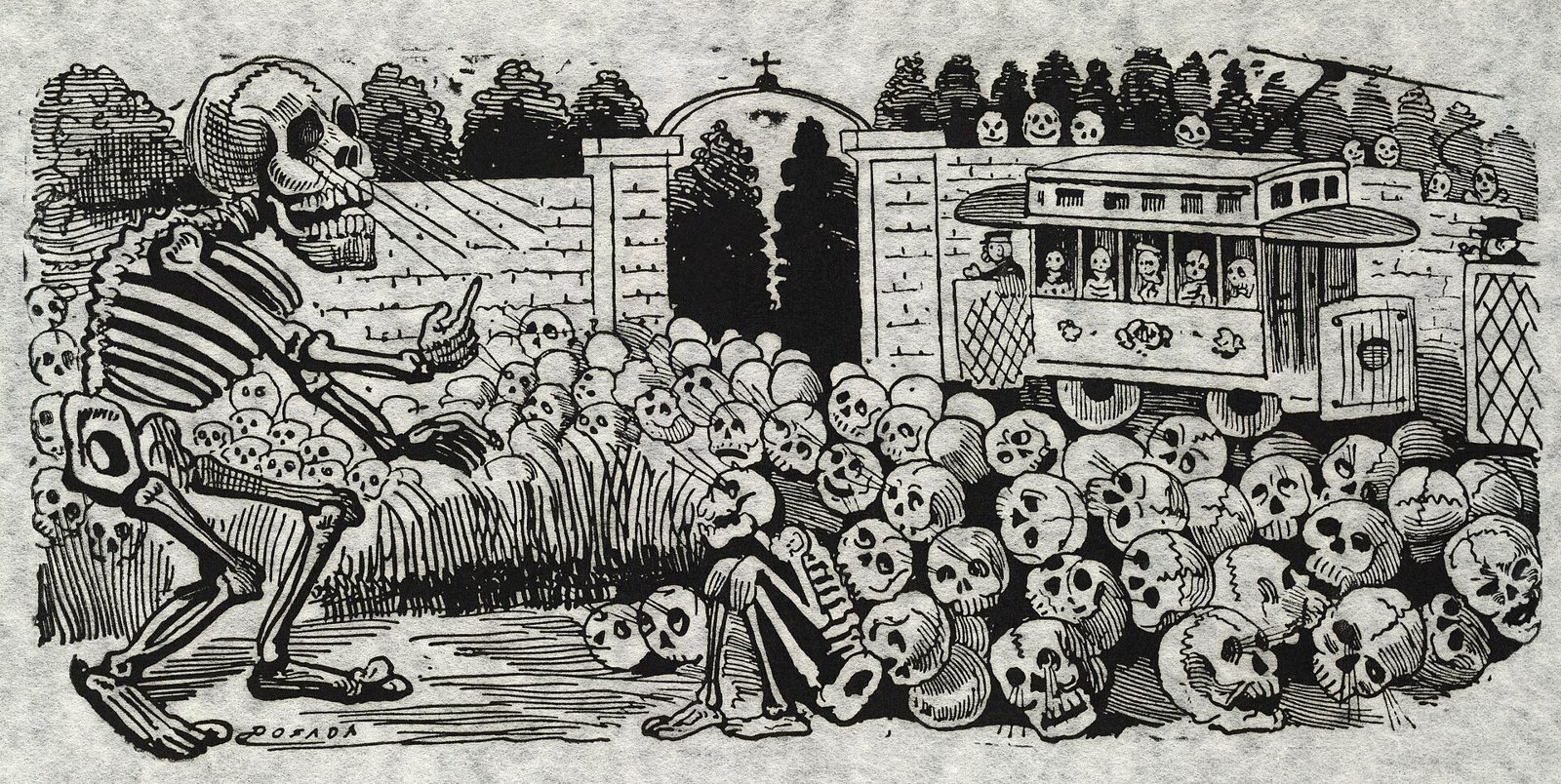
José Guadalupe Posada's Gran Calavera Eléctrica, published by Antonio Vanegas Arroyo.
2008
UNESCO inscribes the Indigenous festivity dedicated to the dead.
What the word means in Mexico
The Diccionario del español de México (DEM) gives the fullest list. In Mexican Spanish, *calavera* can mean:
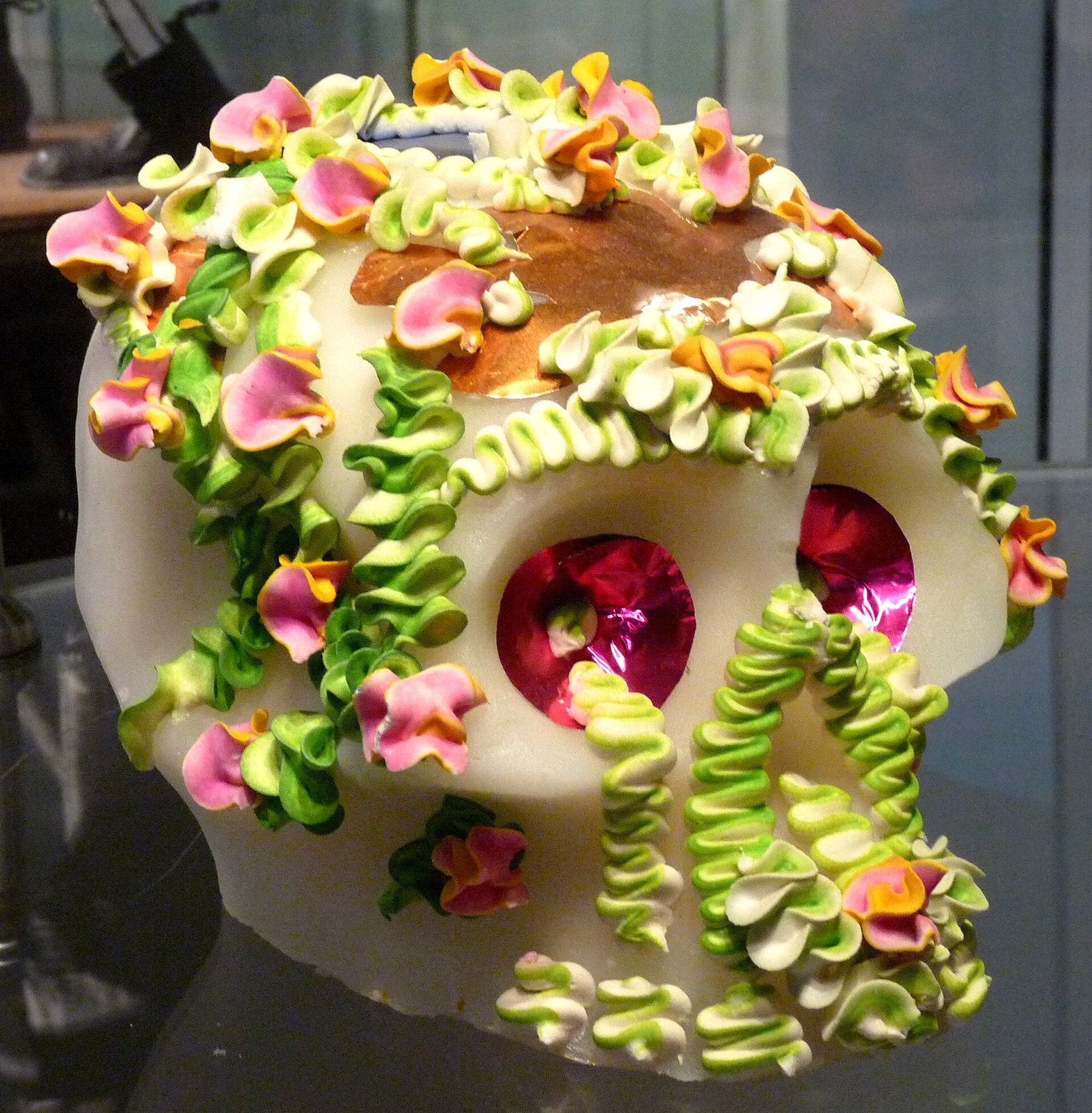
- A skull or the bones of the head.
- The human skeleton.
- A figure representing death.
- A sugar skull made near Día de Muertos.
- A humorous verse written in November as a mock epitaph for a living person.
- Drawings with verses that show living people as skeletons.
- Money or gifts requested by children on Día de Muertos.
- A womanizer or party-loving man.
- A vehicle's rear light.
- A hole worn through the heel of a sock.
Yes, the sock heel is a real entry. Larousse and Collins agree on the main senses, listing the skull, the figurative "madcap" person and, for Mexico, the plural *calaveras* for tail lights. The poem sense is a Mexican one. It is documented by the DEM and by the Association of Academies of the Spanish Language (ASALE).
The Día de Muertos uses
Most of the festive senses come together around November 1 and 2.
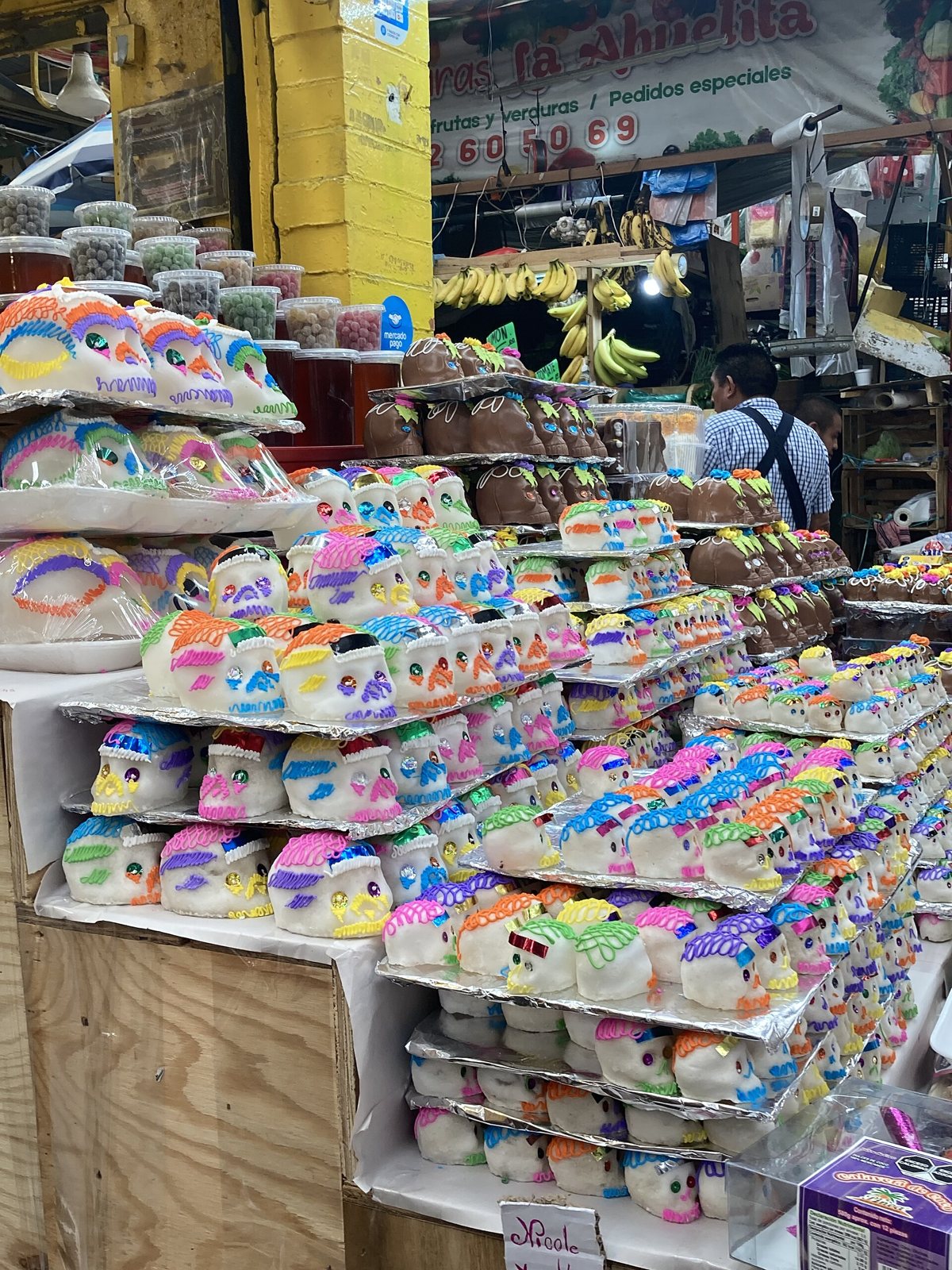
Calaveras de azúcar, or *calaveritas de azúcar,* are decorated skull-shaped sweets, commonly made from sugar paste or other ingredients. The Mexican government describes regional versions, including peanut or pumpkin seeds in Puebla, honey centers in Oaxaca and almond paste in the State of Mexico. They are made for altars and for remembering the dead. The full story of the candy is in our guide to sugar skulls.
Calaveras literarias are short humorous or satirical verses, often written as mock epitaphs for the living. They are tied to November and aimed at friends, relatives, public figures, schools, workplaces and institutions. The DEM and ASALE both record the sense. The tradition has its own page in calaveras literarias.
Pedir calavera means children asking for money, sweets, fruit or another small gift during the Día de Muertos period. The DEM defines *calavera* itself as the money or gift requested on November 2. A Mexican example from Jergas Hispanas: "Los niños les pedían a todos con los que se cruzaban por la calle que les dieran algo para su calaverita." In English, the children asked everyone they met on the street to give something for their little skull. Wording, dates, routes and what children ask for differ from one community to another, so this is not one identical national custom. To describe it for a particular town, confirm the local wording and practice with a community or cultural institution there.
What a calavera stands for
A calavera can stand for death, remembrance, the continuing presence of ancestors, humor about mortality, or the idea that death makes everyone equal, depending on the community and the occasion. UNESCO describes Día de Muertos as a living, community-based tradition shaped by Indigenous communities and Catholic observances, in which families welcome deceased relatives with ofrendas, food, flowers, candles and altars. It inscribed the Indigenous festivity dedicated to the dead on its Representative List in 2008. The meaning is not the same everywhere: a sugar skull, a Posada print, a tzompantli and a personal tattoo each come from a different history.
That also covers the skull on a shelf. A skull in a home can mean remembrance of relatives, taking part in Día de Muertos, a love of the art or a family tradition. On a Mexican ofrenda, skull-shaped sweets sit with portraits, candles, flowers, food, water, incense and personal belongings, as INAH describes. Outside an ofrenda, a skull decoration has no single fixed meaning, and its significance belongs to the household using it.
Calavera, calaca, catrina and cráneo side by side
Four words get mixed up, and Spanish speakers mix them up too, with humor. A Reddit thread in r/AskMexico about the differences between *calaca, cráneo, calavera* and *esqueleto* shows speakers using the words with overlap, not by one fixed rule. Dictionaries still draw some lines:
Tap or hover a row to highlight it.
| Word | Meaning | Place or context | Dictionary |
|---|---|---|---|
| Wordcalavera | MeaningSkull | Place or contextGeneral Spanish | DictionaryRAE |
| Wordcalavera | MeaningSugar skull, verse, children's gift or tail light | Place or contextMexico | DictionaryDEM and RAE |
| Wordcalaca | MeaningFigure of death or skeleton | Place or contextMexico and Honduras, with wider regional senses | DictionaryRAE and ASALE |
| Wordcatrina | MeaningWell-dressed person, and La Catrina as a Mexican cultural figure | Place or contextMexico and neighboring countries | DictionaryRAE and INAH |
| Wordcráneo | MeaningBony case containing the brain | Place or contextAnatomical Spanish | DictionaryRAE |
- *Calavera* is a skull, especially the bare bones of the head, or a skull as an object or image. In Mexico it also covers the festive senses above.
- *Calaca* is a colloquial, regional word. The RAE marks it for Honduras and Mexico as a figure of death or a human skeleton, and in Mexico as a colloquial synonym of *cráneo*. ASALE also records it in Guatemala, El Salvador, Nicaragua and rural Honduras for a skull, and in Honduras for a cemetery in the expression *valle de las calacas*. In Mexico it can mean death itself, an allegorical skeletal figure, a human skeleton or a rear light. Our page on calacas and Day of the Dead skeletons takes up the skeleton figures.
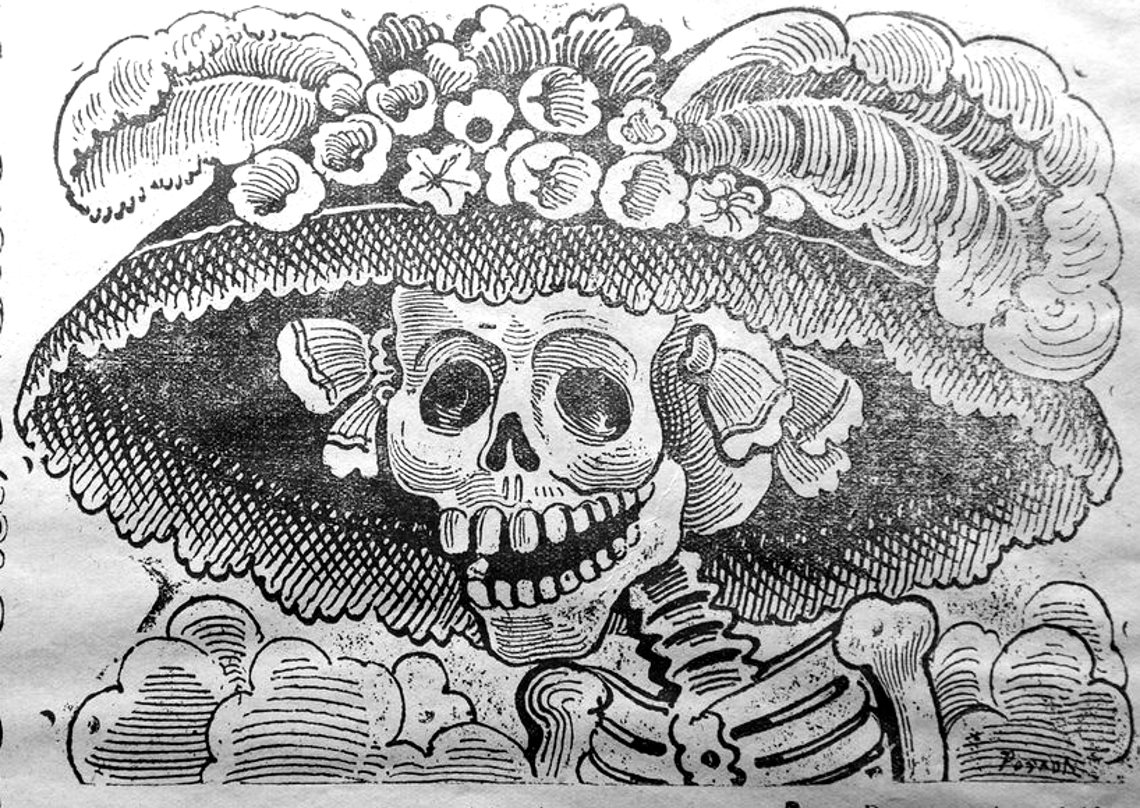
- *Catrina* is the feminine of *catrín*, which the RAE defines in Costa Rica, El Salvador, Guatemala, Honduras, Mexico and Nicaragua as well dressed. As a proper name, La Catrina is the figure that grew from José Guadalupe Posada's *Calavera Garbancera* and was named and expanded by Diego Rivera. Her full story is in La Catrina, and the printmaker behind her is in José Guadalupe Posada.
- *Cráneo* is the anatomical skull, the bony case that holds the brain, and the more technical word. The RAE lists it as a synonym of *calavera* in one sense and also defines it anatomically.
A whole skeleton is an *esqueleto*. The short version: a calavera is not automatically La Catrina, and not every calavera is a sugar skull.
Slang and phrases, country by country
Slang with *calavera* changes at the border, so each expression carries its country:
- Mexico: *calavera* for a dissipated or party-loving man (the DEM gives "hombre mujeriego y parrandero"); *calaverada* for an act typical of such a person, which the RAE defines as colloquial; and a vehicle's rear light.
- Spanish generally: the RAE records *calaverear*, to carry on in that way, for making *calaveradas*.
- Colombia: ASALE records *calavera* for a person who wastes money. The dictionary site Tureng lists *marcar calavera* with meanings that run from receiving death threats to having no choice, depending on the situation.
- Ecuador: *marcar calavera* is colloquial teen slang for "to die."
- Peru: ASALE records *calavera* as a womanizing man.
- Guatemala: *poner cruz y calavera* means to write something off as lost.
- Argentina: *calavera no chilla* is listed as a slang expression meaning that a person gets what they deserve.
- Uruguay and Venezuela: *cráneo*, not *calavera*, can mean a very intelligent person.
- El Salvador: *calavera* can be a multi-connection electrical outlet.
These phrases do not travel well. Translate them by country and by context.
How English speakers use it
In English, *calavera* is a borrowed Spanish word that usually arrives with Mexican visual culture: calavera art, calavera tattoos, calavera makeup, calavera designs, calavera sugar skulls and the calavera Catrina. English tends to hear it as a decorative skull or a stylized Día de Muertos skull. That is a fair reading of a lot of artwork, and the Spanish senses add more. It can be an actual skull, a satirical poem, a gift requested by children, a reckless man or a tail light. If you are choosing a skull tattoo or a design with the word on it, those layers are worth knowing. Our shirts are a small case of this: the Memento Mori skull tee is a design for someone who likes skull imagery with a reminder attached.
Test your calavera vocabulary
Answer every question to check.
Quick answers about calavera
What does calavera mean in Spanish?
It means skull, the bones of the head left after the flesh and skin are gone. In Mexican Spanish it can also mean a sugar skull, a festive death poem, a skeletal figure, a vehicle's rear light or a reckless, womanizing man, depending on context.
What does a calavera symbolize?
It can stand for death, remembrance, the continuing presence of ancestors, humor about mortality or social equality, and the meaning depends on the community and the occasion. In Día de Muertos, skull imagery sits beside ofrendas that welcome relatives who have died. A sugar skull, a Posada print and a tattoo each carry their own history.
What is the difference between calaveras and skulls?
"Skull" is the English anatomical word, while *calavera* can mean an actual skull or several skull-related cultural forms. In Mexico a calavera might be a sugar skull, a drawing, a poem about a living person or a gift children ask for, things English describes with different phrases. Next to *cráneo*, the RAE defines *calavera* more narrowly, as the bones of the head still joined and stripped of flesh and skin.
What does the slang term calavera mean?
About a person, it traditionally means a dissipated, irresponsible man who likes to party, and the RAE records it without limiting it to Mexico. Elsewhere it can mean a person who wastes money in Colombia, a womanizer in Peru, or a tail light in Mexico. Always read it by country.
What does it mean to have calaveras in the house?
It depends on the household. It can mean remembering relatives, taking part in Día de Muertos, enjoying skull art or keeping a family custom. On an ofrenda, skull sweets sit with portraits, candles and flowers, and a skull outside an ofrenda has no single fixed meaning.
Where to go next
For the holiday behind most of these senses, start with the guide to Día de Muertos. The candy has its own story in sugar skulls, the verses in calaveras literarias, and the printmaker whose skeletons filled cheap sheets in José Guadalupe Posada.