

No. 020
The Death's-Head Hawkmoth: The Moth With a Skull on Its Back
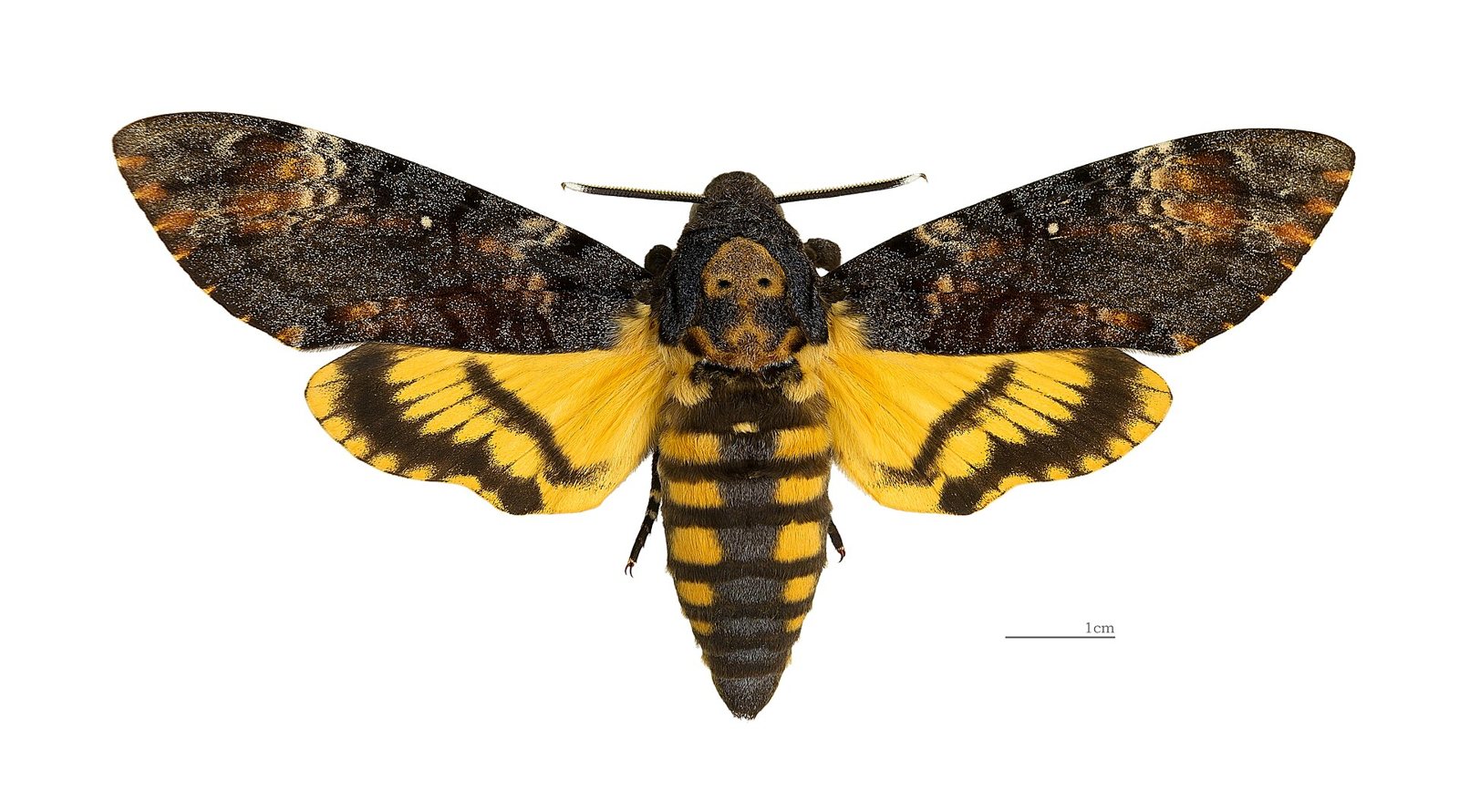
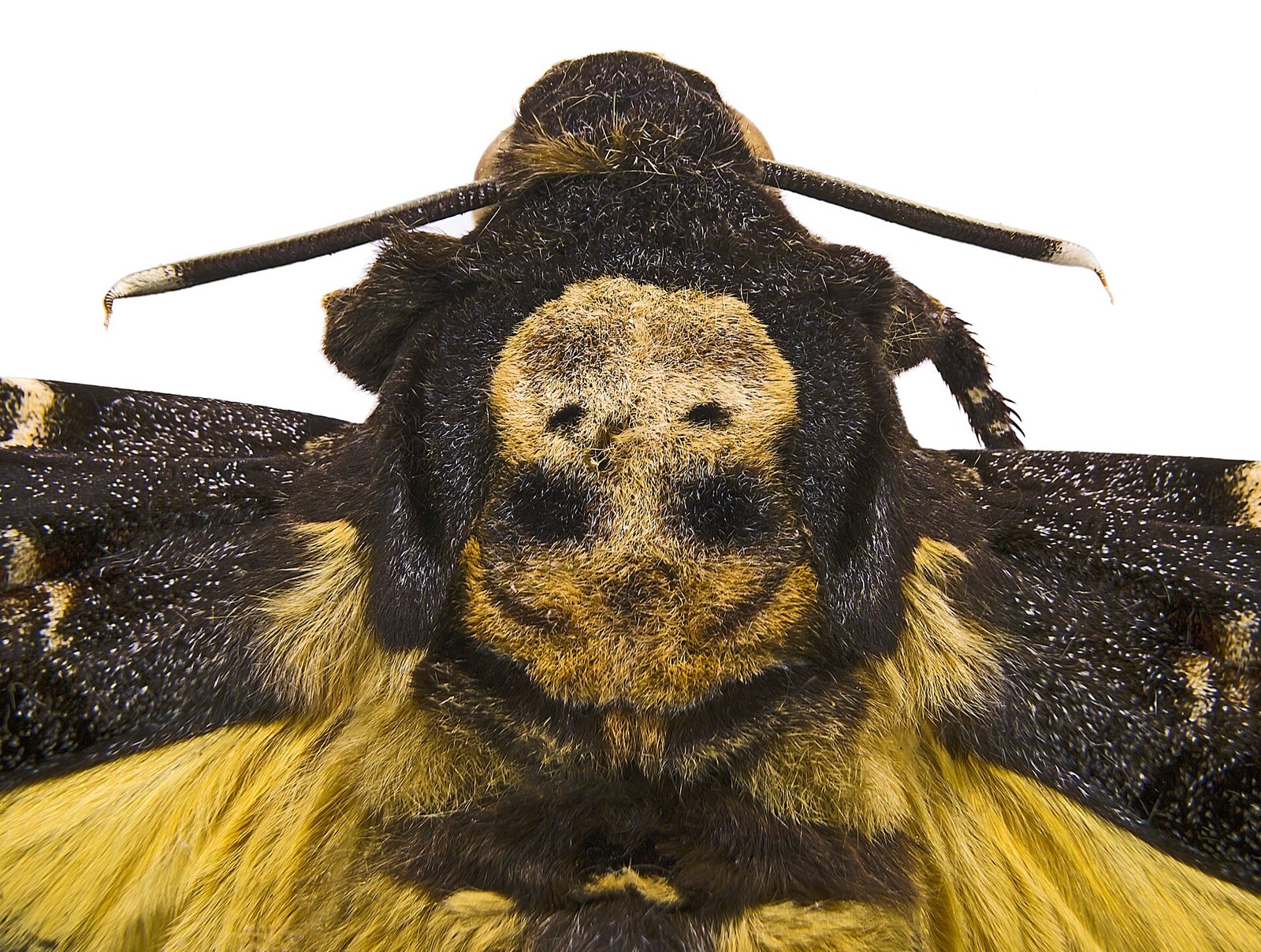
The moth with a skull on its back is a death's-head hawkmoth. The name covers three large moths in the genus *Acherontia*: *Acherontia atropos*, *Acherontia styx* and *Acherontia lachesis*. The skull is a pale marking on the thorax, the part of the body behind the head, and not on the wings. Despite the look, the adults are completely harmless to people, according to the Australian Museum. They have two other habits that make them famous: they squeak when they are disturbed, and they slip into beehives to drink honey. If you met one on a movie poster, that was *The Silence of the Lambs*, and the poster has its own story.
Three moths share the name
When people say "the death's-head hawkmoth," they usually mean one species, but the name belongs to three. All of them are big, heavy-bodied hawkmoths, the family of fast, strong-flying moths that scientists call sphingids, and their ranges overlap in parts of Asia.
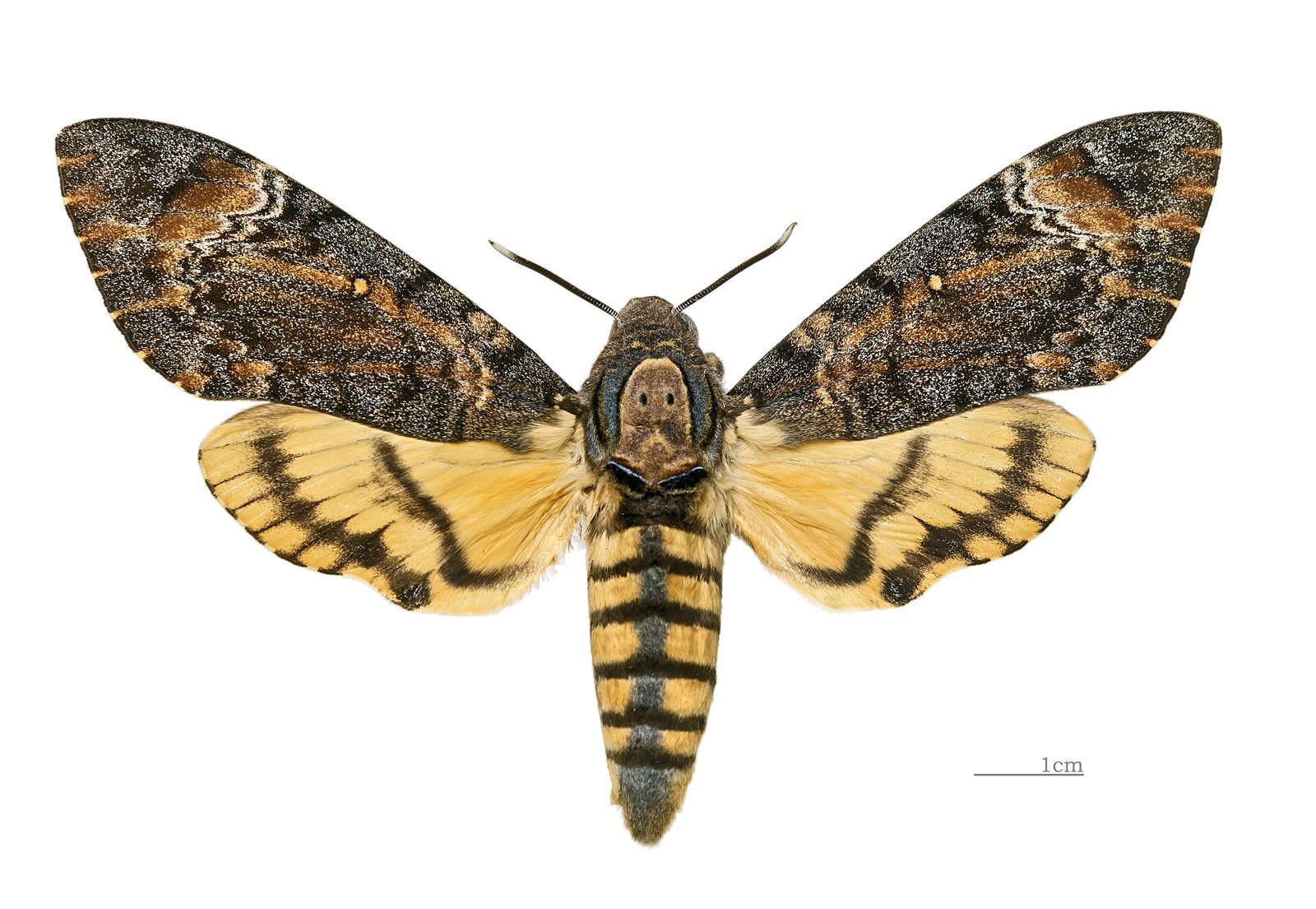
*Acherontia atropos* is the African death's-head hawkmoth. It is native across much of Africa, the Mediterranean region and southern Europe, and it migrates north into Britain and northern Europe. Butterfly Conservation gives it a wingspan of 80 to 120 mm. In European writing, this is the moth people almost always mean.
*Acherontia styx* is the eastern or lesser death's-head hawkmoth. It ranges across tropical and temperate Asia, including India, Nepal, Pakistan, China, Japan, Southeast Asia, the Malay Archipelago, Iran, Saudi Arabia and parts of the Middle East. A. R. Pittaway and I. J. Kitching give a wingspan of 89 to 130 mm, which makes the "lesser" in its name a little unfair.
*Acherontia lachesis* is the greater death's-head hawkmoth. It occurs from Kashmir and India through Sri Lanka and southern and eastern Asia to Taiwan, the Philippines, the Moluccas, Indonesia and New Guinea. Cornell's BirdNET taxonomy describes it as reaching about 13 cm across.
In Spanish, the moth is often called *esfinge calavera* or *mariposa cabeza de muerto*, and some readers will know it by those names first.
Tap or hover a row to highlight it.
| Species | Common name | Main range | Adult wingspan |
|---|---|---|---|
| SpeciesAcherontia atropos | Common nameAfrican death's-head hawkmoth | Main rangeAfrica, the Mediterranean and southern Europe, migrating into northern Europe | Adult wingspan80 to 120 mm |
| SpeciesAcherontia styx | Common nameEastern or lesser death's-head hawkmoth | Main rangeSouth, East and Southeast Asia, west to Iran and Arabia | Adult wingspan89 to 130 mm |
| SpeciesAcherontia lachesis | Common nameGreater death's-head hawkmoth | Main rangeIndia, Sri Lanka and much of South and East Asia | Adult wingspanUp to about 130 mm |
The skull on its back
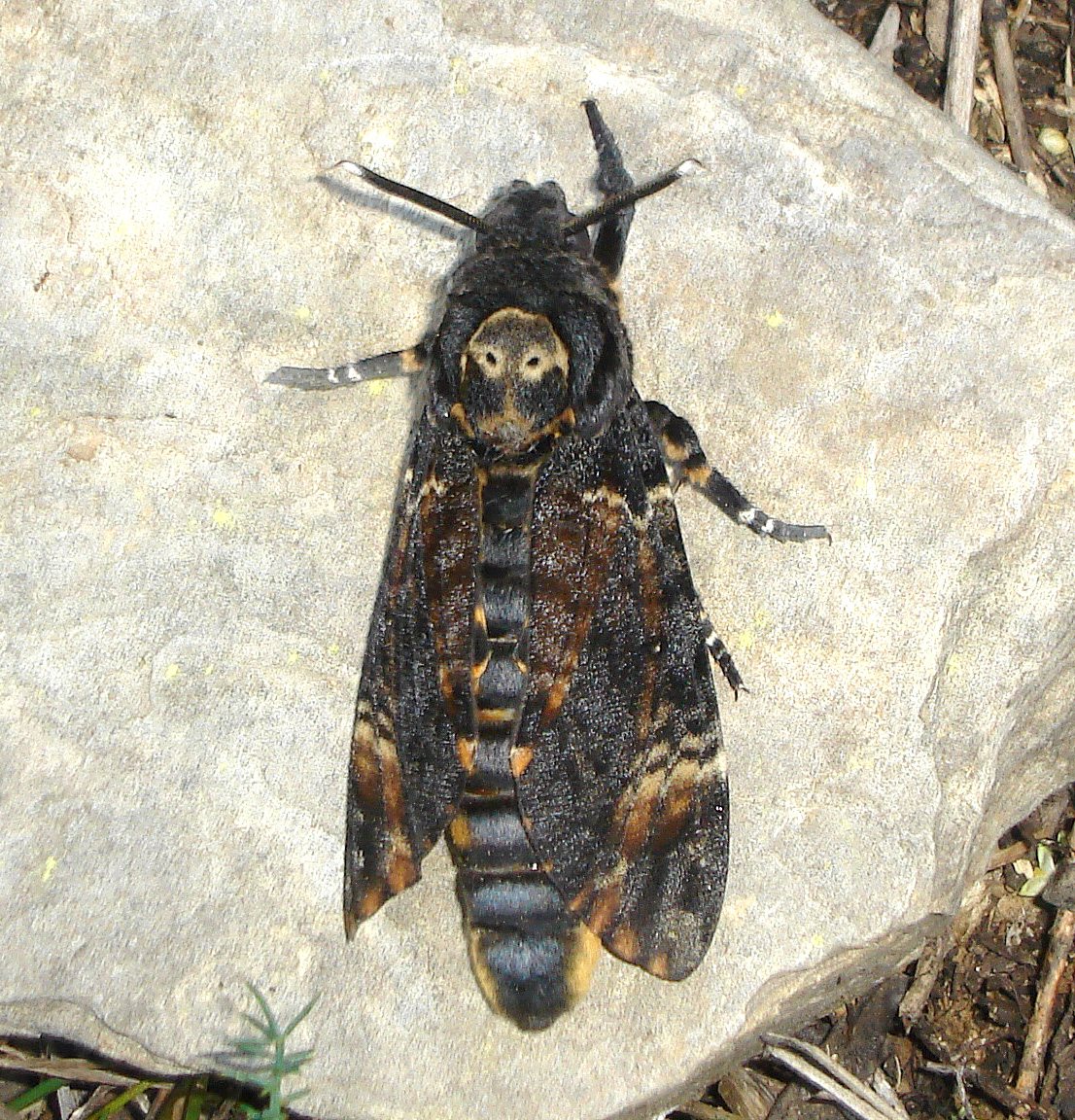
If you have a photo and want to know whether it is the real thing, look behind the head first. The skull-like marking sits on the thorax, the middle section of the body where the wings attach. In *A. atropos* it is usually pale or yellowish. In *A. styx* it is generally darker.
The rest of the moth helps too. The forewings, the ones on top when the moth is resting, are mottled brown or black. The hindwings underneath are yellow or orange with dark bands, so a moth that opens its wings will flash a surprising amount of color. Add a thick body and a large size, and the combination is a distinctive one.
The Natural History Museum in London keeps a species record for *A. atropos*, the one most likely to appear in a European garden.
A moth that raids beehives
The death's-head hawkmoth has a sweet tooth, and it gets its sugar the bold way. Adults walk into beehives to drink honey. Ian Kitching's 2003 review explains part of how *A. atropos* gets away with it in colonies of the western honeybee, *Apis mellifera*. The waxy chemicals on the moth's outer skin, called cuticular hydrocarbons, resemble those of worker bees, so the colony has trouble recognizing the moth as an intruder.
The moth also carries the right tool for the job. Its proboscis, the tube it feeds through, is short and strong, built for piercing the wax cells of a honeycomb rather than sipping from flowers.
Beekeepers do not always find this charming. Kitching records that *A. atropos* has reached pest status in some beekeeping regions because of the honey it takes. The young can cause trouble as well. Caterpillars of *A. styx* have been reported damaging sesame crops in India, and Pittaway and Kitching note that those caterpillars can grow to 90 to 120 mm long.
Why the skull moth squeaks
Pick one up, or bother one, and *A. atropos* may squeak at you. People have been writing about that sound since at least the nineteenth century.
The squeak is a defensive response. The moth draws air into its pharynx, a chamber at the start of the gut, and pushes it back out. In 2015, Gunnar Brehm and colleagues at Friedrich Schiller University Jena published a study of how the squeak works. They report that a single squeak lasts about 200 milliseconds and comes in two phases. The other two species sound different. Kitching describes the call of *A. styx* as hoarser, and the sound of *A. lachesis* as more of a rasp or hiss.
You may have read that the squeak imitates a queen bee and makes worker bees freeze, which would be a tidy explanation for the honey raids. That idea is still an open question. Kitching's review records the queen-bee hypothesis, and it also notes observations in which worker bees did not freeze around the moth. The safest summary is that the squeak may startle predators, and how much it helps inside a hive is not settled.
An omen in old folklore
A moth with a skull on its back was always going to collect stories, and the records show it did. These beliefs belong to particular places and writers, so they are worth keeping attached to them.
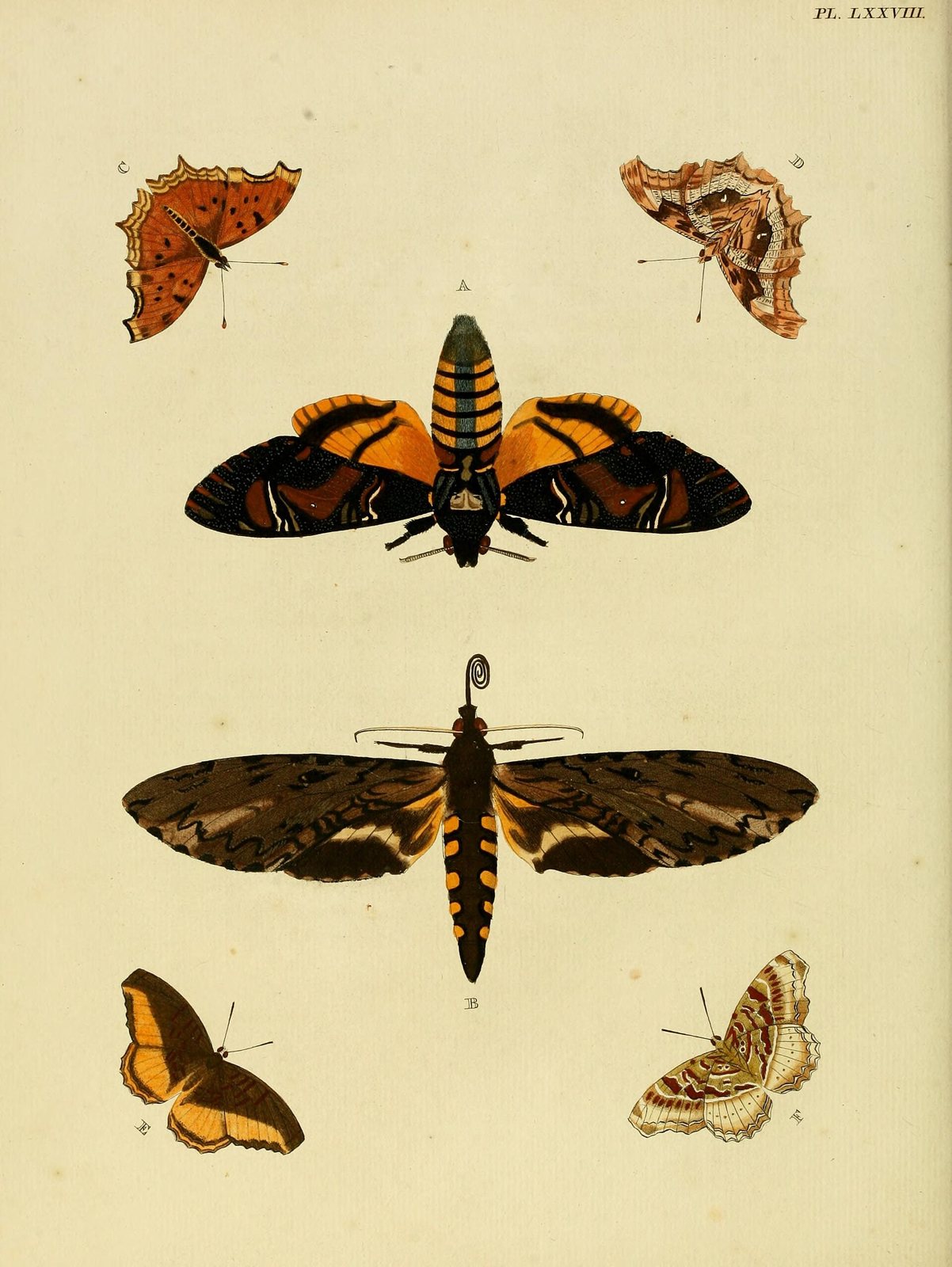
In Germany, the moth was known by names that translate as "Death's Head Phantom" and "Wandering Death Bird." The 1880 book *English Folk-Lore* describes the moth as alarming to superstitious people and reports the belief that one flying into a room in the evening foretold calamity or death. That account cites John Timbs's *Popular Errors*, published in 1856.
The Australian Museum records a European belief that seeing the moth by candlelight was an omen of death, and a French belief that the scales, or "dust," from its wings could cause blindness. In Italy, Giuseppe Montalenti's 1930 entry for *Acherontia atropos* in the *Enciclopedia Italiana*/) connected the skull-like marking and the moth's plaintive cry with its popular reputation as a bringer of misfortune.
These were real beliefs held by real people, and they tell you a lot about how a striking animal gets read. They are history rather than biology. The scales do not blind anyone, and the moth that drifts toward a lamp is looking for its own business, not yours.
The moth in The Silence of the Lambs
For many people, the first death's-head hawkmoth they ever saw was on the poster for Jonathan Demme's 1991 film *The Silence of the Lambs*, sitting over Jodie Foster's mouth. The moth matters in the story too. In the film, the killer known as Buffalo Bill leaves a pupa behind, and the moth becomes a symbol of change tied to his wish to become someone else, as the Staatliche Museen zu Berlin describes it.
The species changed along the way. In Thomas Harris's novel, the pupa is identified as a black witch moth, *Erebus odora*. In the film, the dialogue names it as *Acherontia styx*. Butterfly Conservation reports that the pupae used during filming were actually *Manduca sexta*, the tobacco hornworm moth. So, the moth in the story is a death's-head hawkmoth, and the ones on set were stand-ins.
The poster has the best twist. Poster House records that designer Dawn Baillie photographed a death's-head hawkmoth specimen rented from the Natural History Museum of Los Angeles. The skull you see on that moth, though, is not simply its natural pattern. Demme asked for Salvador Dalí and Philippe Halsman's 1951 photograph *In Voluptas Mors*, which shows seven women arranged to form a skull, to be worked into the design. Because the Motion Picture Association objected to the nude figures, the final poster used models in bodysuits to recreate the skull shape. Look closely at the poster and the skull is made of people.
If skull images in art are your thing, our roundup of famous skull art has more.
The death's-head hawkmoth in print and on screen
Tap or hover a step to follow the order.
1856
John Timbs's Popular Errors records the moth as a bad omen
1880
English Folk-Lore reports the belief that the moth foretold calamity or death
1930
Giuseppe Montalenti's Enciclopedia Italiana entry links the marking and cry to misfortune
1951
Salvador Dalí and Philippe Halsman make the photograph In Voluptas Mors
1991
The Silence of the Lambs is released with the moth on its poster
2003
Ian Kitching publishes his review of the genus Acherontia
2015
Gunnar Brehm and colleagues publish their study of the squeak
Is it rare, and is it dangerous?
Whether the death's-head hawkmoth is rare depends on which species you mean and where you are standing.
In Britain, *Acherontia atropos* is a scarce visitor. It cannot normally survive British winters, and the moths that arrive are migrants from continental Europe and Africa, usually in late summer and autumn. Butterfly Conservation describes only a handful reaching Britain in some autumns, although records have come from as far north as the Shetland Islands and as far west as western Ireland. Across its home range in Africa, the Mediterranean and southern Europe, it is not a rare moth. *A. styx* and *A. lachesis* are widespread across Asia.
As for danger, the adult moth is harmless to humans. It has no venomous sting, and the Australian Museum describes adults as completely harmless to people. The skull pattern and the squeak are defensive or deceptive traits, which is a moth's way of looking more dangerous than it is. The only real damage comes from the honey it takes from hives and, in some places, from caterpillars feeding on crops.
How well do you know the skull moth?
Answer every question to check.
Questions people ask about the death's-head hawkmoth
These are the questions that come up most often.
Are death's-head hawkmoths poisonous?
No, adult death's-head hawkmoths are harmless to people and have no poisonous sting. Their skull marking and squeak are defensive features, not warnings of venom. The Australian Museum calls the adults completely harmless.
Are death's-head hawkmoths rare?
They are scarce in some places but not rare as a group. *Acherontia atropos* is an uncommon migrant in Britain, while it is established across much of Africa, southern Europe and the Mediterranean, and the two Asian species are widespread.
Why do death's-head moths squeak?
They squeak when disturbed, as a defense. In *A. atropos*, air moves into and out of the pharynx to make a squeak of about 200 milliseconds, which may startle a predator. The idea that it calms bees in a hive is still uncertain.
What is the moth in The Silence of the Lambs?
In the film, the moth is identified as *Acherontia styx*, the eastern death's-head hawkmoth, though the pupae used on set were tobacco hornworm moths. The poster's skull includes a version of Dalí and Halsman's *In Voluptas Mors*, made of models in bodysuits.
Do death's-head moths steal honey?
Yes, the adults enter beehives and drink honey. In *A. atropos*, a chemical resemblance to worker bees helps it pass through the colony, and its short, strong proboscis pierces the wax cells.
Where to go next
The death's-head hawkmoth earned its name the same way so many images did: people saw a skull and read a message into it. For how that reading works across cultures, start with skull symbolism, and for the old idea of a skull as a nudge to remember that life is short, see what memento mori means. And for the people who spend their weekends out in the garden, where this moth might one day turn up, our Garden Crew skull tee is one of the shirts in the shop.
Terms in this story
Tap a term to see what it means.
Death's-head hawkmoth. The common name for three large moths in the genus Acherontia, named for the skull-like marking on the thorax. In Spanish it is often called esfinge calavera or mariposa cabeza de muerto.