
No. 021
What Is a Memento Mori Coin? Meaning, Stoic Roots and History
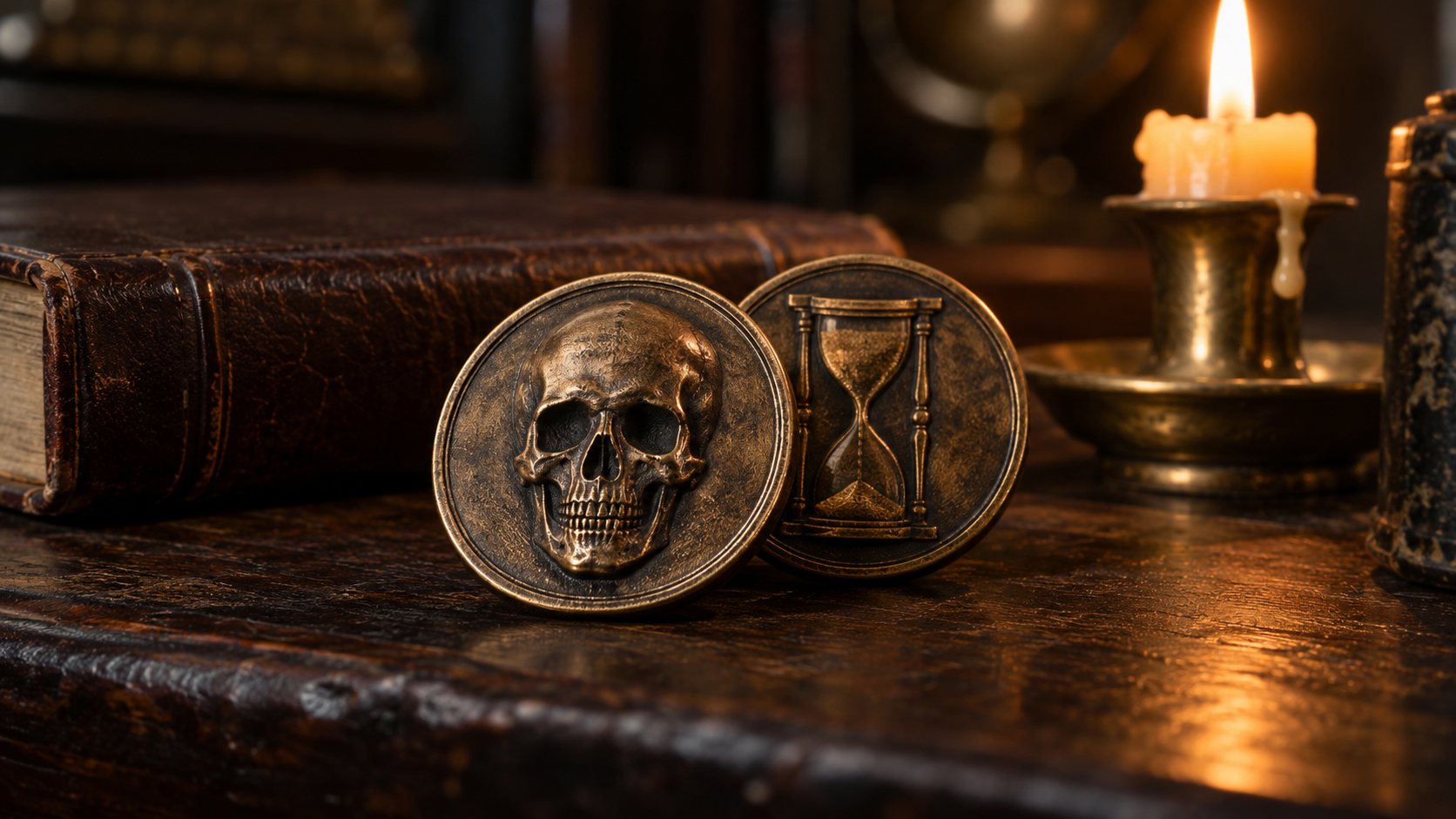
A memento mori coin is a small modern medallion that you carry in your pocket to remember that you will die, and to let that thought shape how you spend today. It is not money and was never meant to be spent. "Memento mori" is Latin for "remember that you must die," and the coin turns that phrase into something you can touch. The idea draws on the Stoic writers Marcus Aurelius, Seneca and Epictetus, and on centuries of European rings, pendants and medals that carried a skull for the same purpose. The pocket coin itself, though, is a recent revival.
What the coin is for
Most memento mori coins are metal medallions with a skull and a short line of text. You keep one in a pocket, on a desk or on a keychain, and the moment your fingers find it, it asks a blunt question: if your time is shorter than you think, is this how you want to spend it?

Daily Stoic, one of the companies that sells them, describes its Memento Mori Medallion as something to carry in a pocket as a prompt from Marcus Aurelius: "You could leave life right now. Let that determine what you do and say and think." The company says the object is meant to pull people away from obsessing over status, wealth, fame, trivialities and plans far in the future. Daily Stoic is one example among many makers; plenty of others sell their own versions, and the meaning does not depend on any brand.
So, the short answer to "what's the deal with the coins?" is that they are a physical cue. The purpose is reflective rather than monetary. Seeing or touching the coin is supposed to bring your attention back to present actions, your values, your relationships and the things you have been putting off.
The Stoic idea behind it
A detail that surprises a lot of coin owners: the exact Latin slogan "memento mori" does not appear in the surviving writings of Marcus Aurelius, Seneca or Epictetus. The practice of thinking about death, though, runs all through their work. Three passages, in named English translations, show how the Stoics put it.

Tap or hover a row to highlight it.
| Writer | Work | Translator | Line |
|---|---|---|---|
| WriterMarcus Aurelius | WorkMeditations IV.17 | TranslatorGeorge Long | Line"Do not act as though you had ten thousand years to live. Necessity hangs over you. While you live, while it is still in your power, become good." |
| WriterEpictetus | WorkEnchiridion XXI | TranslatorElizabeth Carter | Line"Let death and exile and every other thing which appears dreadful be daily before your eyes; but most of all death." |
| WriterSeneca | WorkLetter 26 | TranslatorRichard M. Gummere | Line"He who has learned to die has unlearned slavery." |
The George Long translation of the Meditations keeps Marcus Aurelius plain and direct: no grand speech, just a warning not to act as if time were endless. Epictetus goes further in the Elizabeth Carter translation of the Enchiridion: keep death "daily before your eyes," because doing so trims away petty desires and mean thoughts. Seneca, in Gummere's translation of Letter 26, frames it as freedom; once you have made peace with dying, fear has less to hold you by.
The common thread is practical. For the Stoics, remembering mortality was not meant to be gloomy. It was meant to cut vanity down to size, sharpen priorities and push a person toward acting well now, while it is still possible. A coin in the pocket is a modern way of keeping Epictetus's advice "daily before your eyes."
Older memento mori objects people carried and wore
Long before anyone minted a Stoic medallion, Europeans carried mortality around with them in small, personal objects. Rings, pendants, lockets, rosary beads, prints and medals all carried skulls, hourglasses and coffins, and the British Museum holds English memento mori rings and mourning objects from the sixteenth through the eighteenth centuries, along with a memento mori object dated 1679.
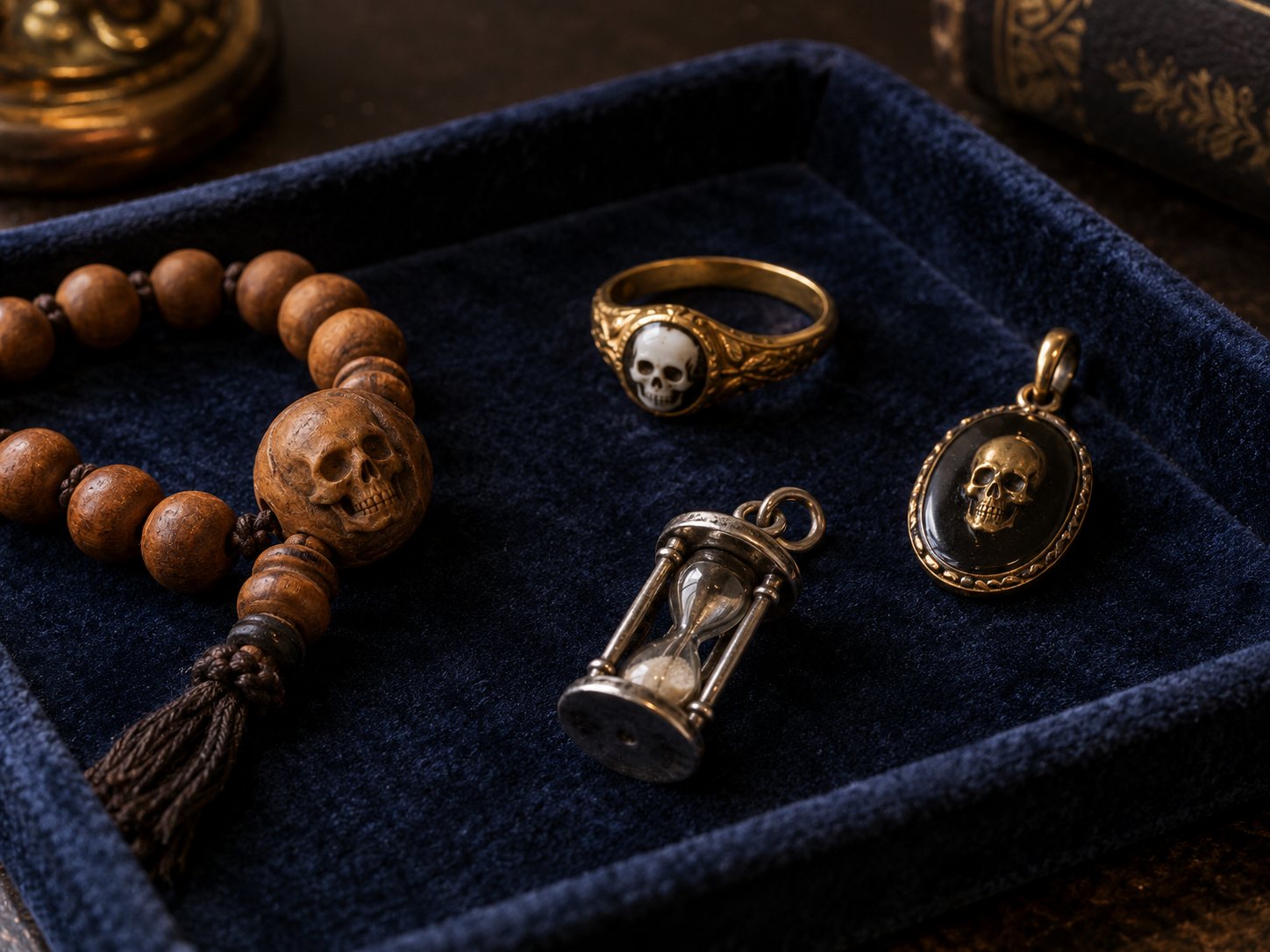
One of the most striking is a rosary terminal bead now at The Metropolitan Museum of Art, made in northern France or the southern Netherlands around 1500 to 1525. It joins a pair of living lovers with a death's head, and The Met describes it as a memento mori because it stresses how close death always is. Someone held it while praying, which is not far from what a coin owner does today: keep a small skull within reach of the fingers.
Prints carried the same message onto paper. In 1612, Simon de Passe made an engraving titled Memento Mori, now at the Princeton University Art Museum. A child points toward a skull, with an hourglass nearby and flowers that will soon wilt. Skull, hourglass and flower still turn up on modern memento mori coins, and the same trio appears in the still lifes covered in our story on vanitas paintings.
Charles I and the memorial medal
The closest historical cousin to the modern coin comes from seventeenth-century England, and it carries grief and politics as well as philosophy. King Charles I was executed in 1649. His supporters, the royalists, mourned him with small objects they could wear or keep close.
The London Museum holds a pendant made in England between about 1636 and 1665 with Charles I on one side and a crowned skull and crossbones on the other. The numbers "16" and "48" refer to the date of his execution as recorded under the old Julian calendar, which equals 1649 in the modern calendar. Royalist jewels like this circulated among the king's supporters after his death. The same museum holds a silver heart-shaped locket made in London in 1649, with inscriptions mourning the king and the monarchy. These pieces show how a memento mori object could hold personal sorrow, political loyalty and a reminder of death all at once.
Then there is the medal. The Met holds a British memorial medal for Charles I, made in the late seventeenth century in silver and gold and 5.9 centimeters wide, and its catalogue files it under coins and medals. That is about as close as history comes to a seventeenth-century memento mori coin. Still, these were medals, pendants, lockets and rings, often made privately to be worn, carried or displayed, not coins in the sense of something you could spend.
From rosary beads to pocket medallions
Tap or hover a step to follow the order.
About 1500 to 1525
A North French or South Netherlandish rosary terminal bead pairs living lovers with a skull, now at The Met.
1576
Michel de Montaigne has a personal medal made, according to Daily Stoic, an early example of carrying a philosophical reminder.
1612
Simon de Passe engraves Memento Mori: a child, a skull, an hourglass and wilting flowers.
1649
A silver heart-shaped locket made in London mourns the executed Charles I.
Late seventeenth century
A British memorial medal for Charles I is made in silver and gold, now at The Met.
1973
Bill Westman of a Minnesota mint makes Alcoholics Anonymous anniversary medallions, according to Daily Stoic.
Today
Pocket memento mori medallions, such as Daily Stoic's, carry a skull, hourglass and flower with a line from Marcus Aurelius.
How the modern coin came about
There is no straight line of memento mori coinage from Rome to your pocket. The modern coin is best understood as a contemporary medallion that borrows from older traditions.
Daily Stoic tells its own version of the story on its page about challenge coins. The company points to Michel de Montaigne, who had a personal medal made in 1576, as an earlier example of carrying a philosophical idea in metal. It also credits Bill Westman, an employee at a Minnesota mint, who in 1973 made Alcoholics Anonymous anniversary medallions for people in recovery. In Daily Stoic's account, the habit of carrying a small medallion as a touchable prompt passed from recovery culture into modern Stoic merchandise.
That is one company's history of its own product, and it is worth reading that way. What can be said more broadly is that the coin grew alongside Stoic publishing, the culture of collecting challenge coins, social media photos of everyday carry, and the many commercial medallions now on sale. No single date marks when the memento mori coin caught on, and no single maker owns the idea.
What people use a memento mori coin for
Ask owners and you get a range of answers. In discussions on Stoicism forums, people describe carrying memento mori objects as a daily prompt, a cue to start meditating, or a physical nudge to act by their principles. One person wrote that a coin helps close the gap between their first reaction and their "best self." Another keeps a memento mori keychain and touches it when leaving home or coming back. In a knife collectors' forum, one owner said they kept a memento mori coin after deciding to get sober, and that coins also make good conversation pieces.
These are individual accounts, and owners do not all use the coin the same way. Some carry it for the philosophy, some for a personal commitment, and some because they like having a small skull in their pocket. That works too; the skull has been doing this job since at least the 1500s and does not mind being admired.
How well do you know memento mori?
Answer every question to check.
Is memento mori against the Bible?
Many Christians ask this before buying a coin, and the history points the other way. The British Museum describes memento mori imagery as a Christian reminder of death and of the judgment to come. The rosary bead at The Met is itself a devotional object, made to be held during prayer.
The Latin phrase is not a quotation from the Bible, but the Bible speaks often about death and judgment. In the King James Version, Hebrews 9:27 says, "And as it is appointed unto men once to die, but after this the judgment." Ecclesiastes 12:14 says, "For God shall bring every work into judgment, with every secret thing, whether it be good, or whether it be evil."
Christian memento mori places mortality inside a larger story of repentance, judgment and the hope of resurrection, which gives it a different emphasis from the Stoic version. Whether a particular coin fits a person's beliefs depends on its imagery and the meaning they give it, and that is a call each reader makes for themselves. For more on how the skull works in Christian art, read skulls in Christianity.
Choosing a coin, or carrying the idea another way
Most memento mori coins share a family of symbols, and knowing them helps you read any design. The skull stands for death itself. The hourglass is time running out. A flower is beauty that fades. Daily Stoic's medallion, for example, puts a skull, a tulip and an hourglass on one side with a shortened Marcus Aurelius quotation. Those are the same symbols de Passe engraved in 1612, which tells you the coin uses an old visual language.
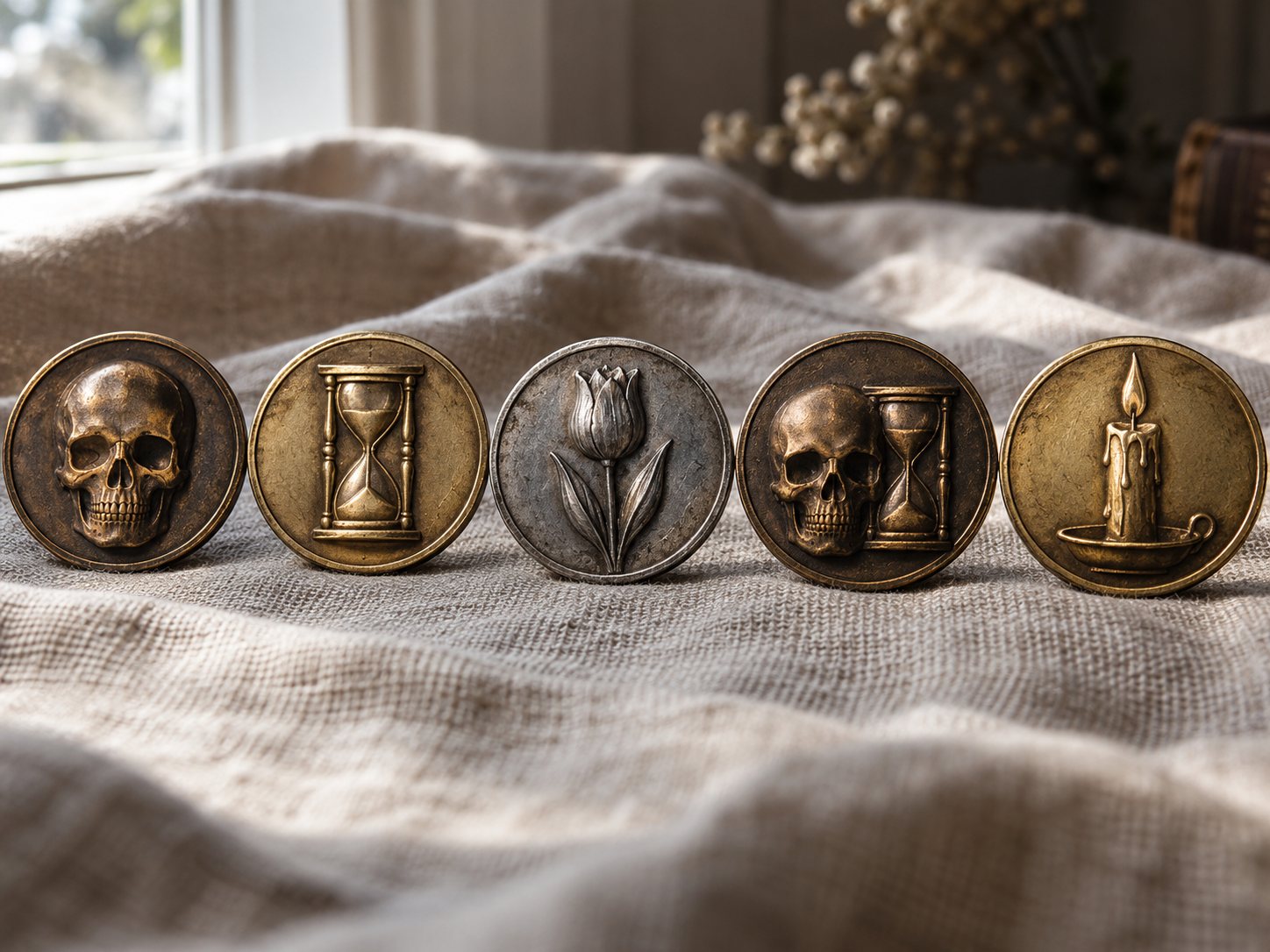
When you compare coins, look at the text as much as the art. A Stoic coin usually quotes Marcus Aurelius, Seneca or Epictetus; a Christian piece may carry a Bible verse; some carry only the Latin phrase. Pick the one whose words you want in your pocket. If you would rather look at historical pieces than buy one, The Met and the Princeton University Art Museum both share public-domain images of the objects mentioned here.
The coin is only one way to carry the idea. Some people wear it as a ring, which has a long history of its own in Victorian mourning jewelry. Some wear it in ink, as covered in our story on memento mori tattoos. And some wear it on a shirt: our Memento Mori Skull Tee puts the same old message on cotton, for anyone who prefers their mortality machine washable. For the wider history of the phrase, from Roman times to today, start with what memento mori means.
Memento mori coin questions
These are the questions people ask most about memento mori coins.
What is a memento mori coin for?
A memento mori coin is for remembering, not spending: it is a pocket medallion that prompts you to remember that life is short and to act on what matters now. Owners use it as a daily cue, a meditation prompt or a reminder of a personal commitment, such as sobriety.
Did the ancient Stoics carry memento mori coins?
The pocket coin is a modern format, and the Latin phrase itself does not appear in the surviving writings of Marcus Aurelius, Seneca or Epictetus. The Stoics practiced the idea in words, such as Epictetus's advice to keep death daily before your eyes, and the coin is a modern way of carrying that advice.
Why is there a skull on a memento mori coin?
The skull is the oldest and plainest symbol of death in European art, and it has carried the memento mori message on rosary beads, rings, prints and memorial medals since at least the 1500s. On a coin it is usually paired with an hourglass for passing time and a flower for fading beauty.
Is it wrong for a Christian to carry a memento mori coin?
Memento mori has deep roots in Christian devotion, and the British Museum describes its imagery as a Christian reminder of death and judgment. Whether a particular coin suits a believer depends on its imagery and the meaning they give it.
Where can I get a memento mori coin?
Memento mori coins are sold by many makers, from Stoic publishers such as Daily Stoic to independent metalworkers. Compare the symbols and the quotation on each design, and choose the words you actually want to carry.
Where to go next
Whether you carry a coin, wear a ring or simply keep the idea in mind, the message has stayed the same for centuries: remember that your time is short, and use it well. For the full history of the phrase, read what memento mori means. The skull, hourglass and flower on so many coins also fill the still lifes in vanitas paintings, and skull symbolism follows the skull through other cultures.
Terms in this story
Tap a term to see what it means.
Memento mori. Latin for "remember that you must die." The phrase names both the idea and the objects made to keep it in mind.