
No. 028
What Does a Memento Mori Tattoo Mean? Designs, Placement and Ideas
A memento mori tattoo means "remember you must die." People wear it to keep their own mortality in view, and through that, to live more deliberately: to value their time, to remember someone who died, or to keep their priorities straight. The idea is often carried by a skull, an hourglass, a candle, a wilting flower or the Latin words themselves. None of those images has one universal meaning, though, so the clearest meaning of any memento mori tattoo is the reason its wearer gives for it. That makes the design choices below worth thinking through before you sit in the chair.
Where the phrase comes from
"Memento mori" is Latin for "remember you must die." The words are short, but the idea behind them shows up in very different places and periods, and that history is part of what a tattoo borrows.
One of the oldest examples is a mosaic from Pompeii, made in the first century CE, with a skull, a butterfly, a wheel and symbols of both wealth and poverty. The National Museum of Ireland reads it as a reminder that death makes everyone equal and as an encouragement to live well. Not far away, the Boscoreale Treasure, buried by the eruption of Mount Vesuvius in 79 CE and found in 1896, includes silver goblets decorated with skeletons representing Greek philosophers and poets. Skeletons on your dinner cups: the Romans clearly did not keep the subject for funerals.
Fifteen centuries later, in Germany in the 1520s, a small boxwood Figure of Death attributed to Hans Leinberger was carved holding a scroll. The Walters Art Museum records its message: "I am what you will be. I was what you are." From the sixteenth through the nineteenth centuries, the Science Museum Group notes, the theme spread to watches, rings, pendants, carved skulls, coffins, hourglasses and mourning jewelry.
You may have heard that a servant whispered "memento mori" to Roman generals during their victory parades. Treat that as a later anecdote rather than a documented origin of the phrase. For the full story of the idea, from Roman art to Christian devotion, read what memento mori means.
Memento mori, from Pompeii to the tattoo chair
Tap or hover a step to follow the order.
First century CE
A Pompeii mosaic shows a skull, a butterfly, a wheel and symbols of wealth and poverty.
1520s
A German boxwood Figure of Death attributed to Hans Leinberger carries the words "I am what you will be. I was what you are."
1612
Simon de Passe engraves Memento Mori in the Netherlands: a child, a skull, an hourglass and flowers that will wilt.
About 1700 to 1800
A European mourning slide pairs a skeleton with an hourglass; such jewelry often held hair from the person mourned.
2013
Milan tattoo artist Jerry Magni documents a memento mori tattoo built around a client's personal cards.
2022
Spanish musician Beret tells LOS40 what the memento mori tattoo on his right arm means to him.
Common memento mori tattoo designs
Most memento mori tattoos are built from a small set of symbols, combined in different ways. Each piece usually carries a familiar idea in tattoo practice today, keeping in mind that every wearer can give it their own spin.
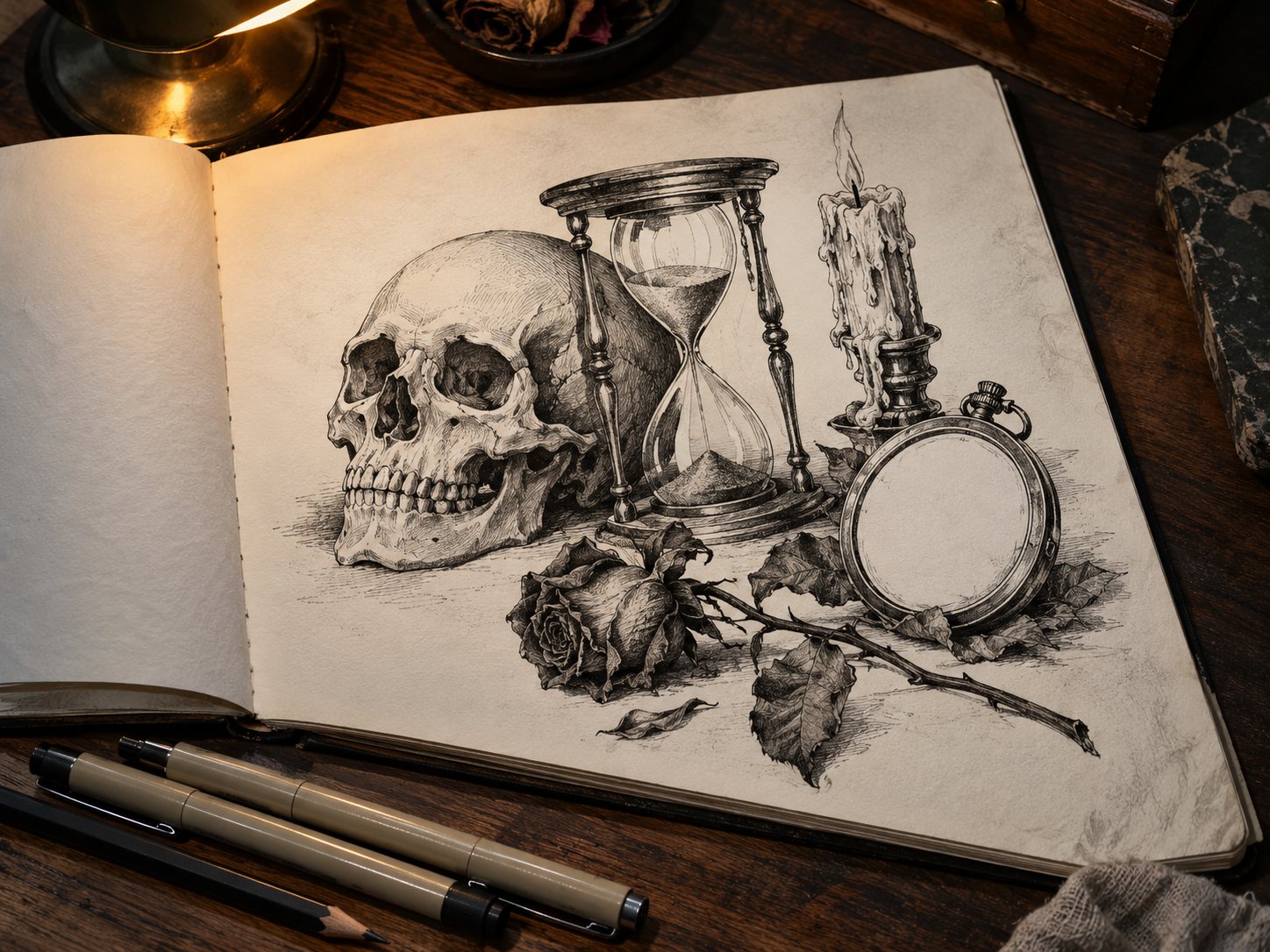
Skull and hourglass. The classic pairing. The skull is death; the hourglass is time running out. Artists often swap in a clock, a candle or a wilted flower for the hourglass, all of them images of time passing. This trio has deep roots in European art: Simon de Passe's 1612 engraving Memento Mori, now at Princeton University Art Museum, shows a child pointing to a skull beside an hourglass and flowers that will soon wilt. Herman Henstenburgh's 1698 Memento Mori adds an overturned hourglass, a snuffed candle and bones. The same objects fill the still lifes in our story on vanitas paintings.
The words alone. Plenty of people skip the imagery and get MEMENTO MORI in lettering: Roman capitals, a serif face, flowing script or blackletter. The style of the letters sets the mood more than you might expect; Roman capitals feel like a carved monument, while blackletter feels older and heavier.
A skull with personal imagery. Roses, playing cards, rings, a face or other objects that mean something to the wearer can sit around the skull. These turn a general idea into a specific life.
A Stoic quote. Some people choose a line from the Stoics instead of, or alongside, the Latin. A popular choice is Marcus Aurelius: "Do every act of your life as though it were the last," from the Meditations. It carries the same idea, though it is a quotation of its own and not the phrase memento mori.
Memento mori and memento vivere. Some designs pair "remember you must die" with memento vivere, "remember to live." It is a modern design choice rather than one historical tradition, and it gives the warning a matching encouragement.
A tattoo built from one person's life
The most interesting memento mori tattoos tend to mix the old symbols with something only the wearer would know. Milan tattoo artist Jerry Magni documented a large piece that brought together a skull, roses, rings, Sicilian playing cards, a woman's face, an hourglass, a clock and a spider. Magni wrote that the cards mattered most to the client because they recalled a dear person. The hourglass, the clock and the spider each returned to the theme of time.
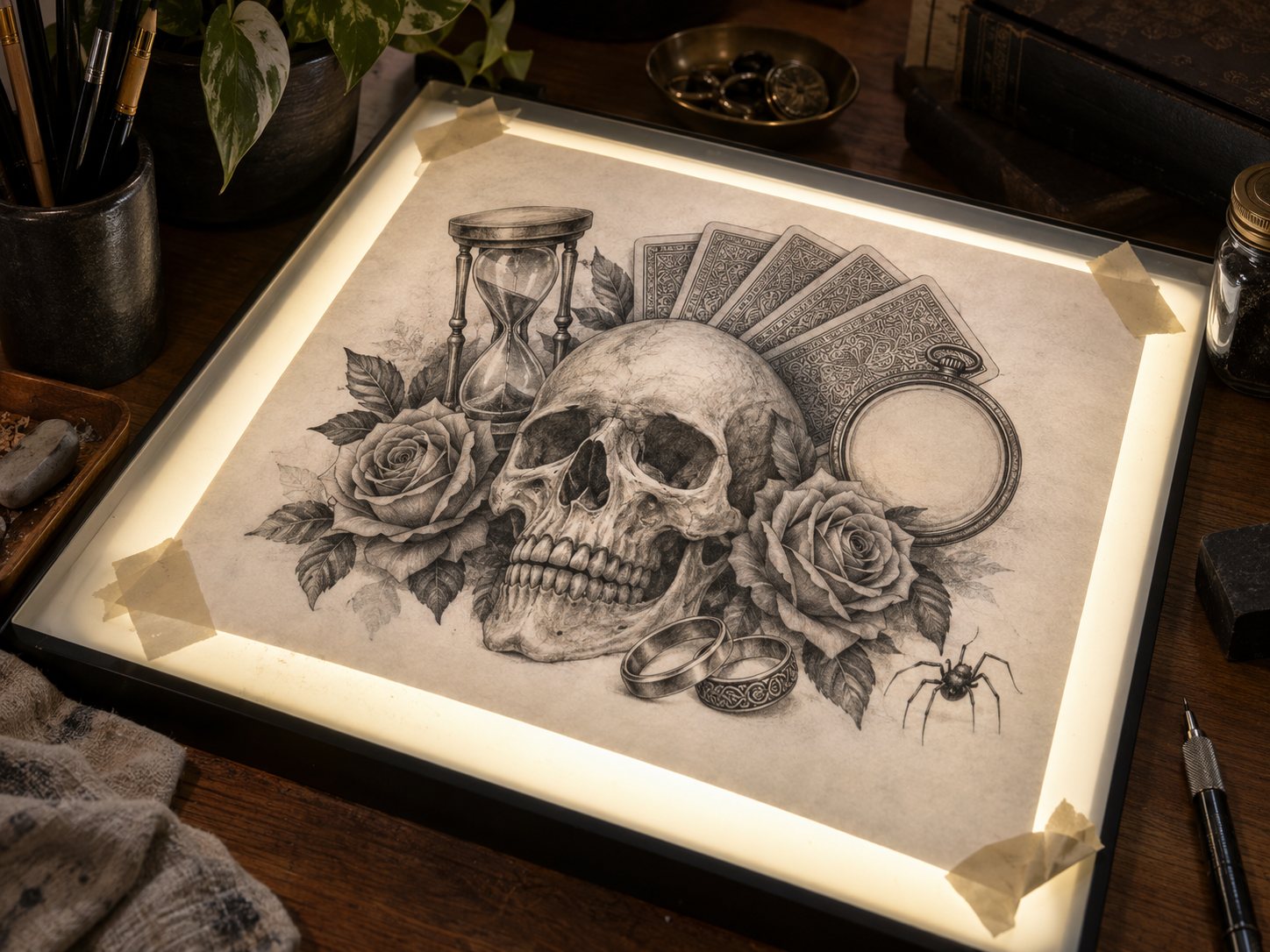
That piece shows how the tattoo can do two jobs at once. It reminds the wearer of their own mortality, and it keeps a particular person close. For many people, that second job is the whole reason for getting it.
Placement and style
Where you put a memento mori tattoo changes how it works in your daily life. Tattoo artist Alex Mendez, quoted by Certified Tattoo Studios, talks about an hourglass on the inner forearm because it stays visible, both to the wearer and to everyone else. Mendez describes working on an hourglass design as balancing technical detail with "an emotion" and "a philosophy." The same article treats the nape of the neck and the area over the heart as more intimate spots, seen only when the wearer chooses.
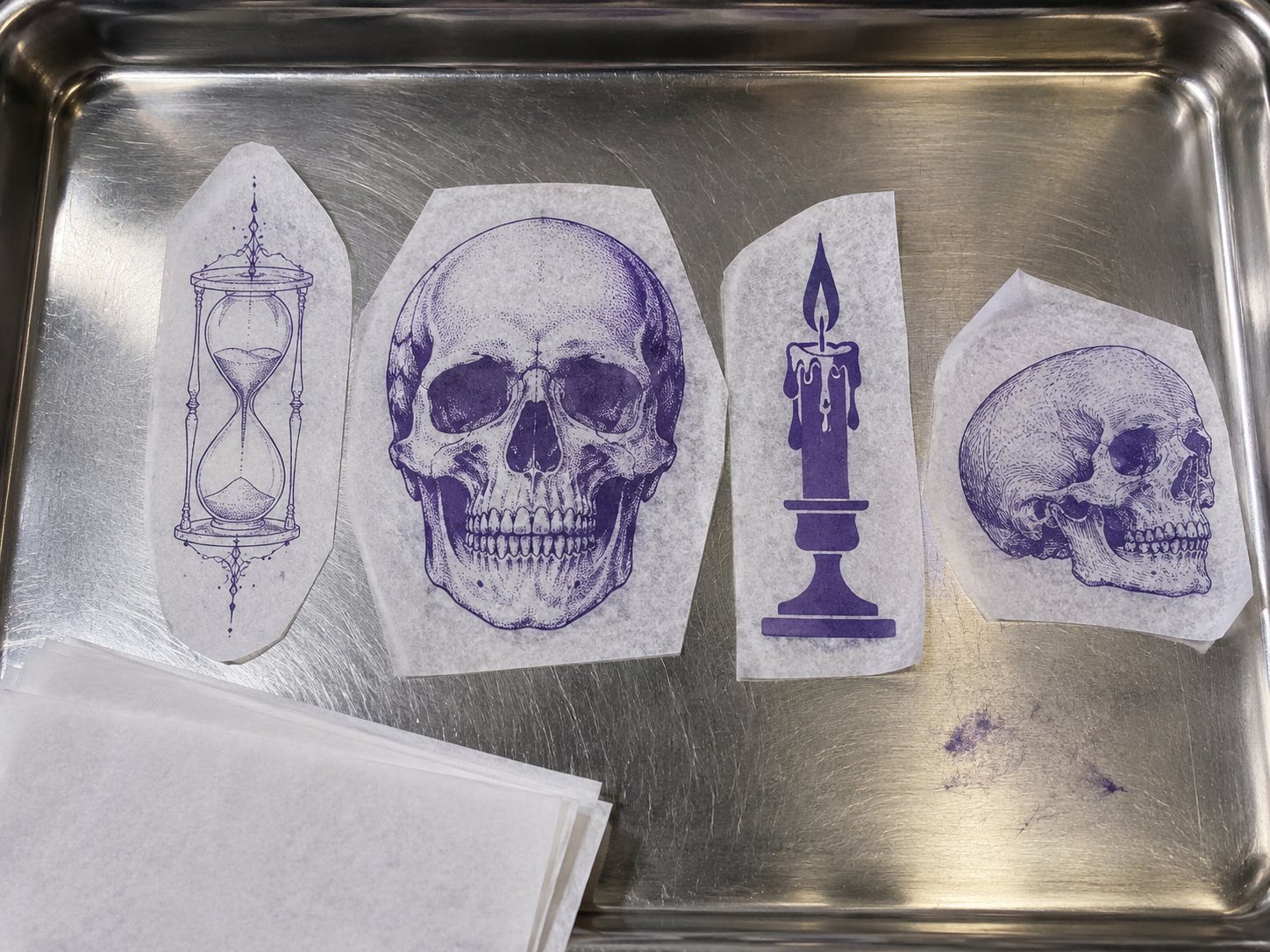
Size and body shape matter too. Ha Trung of Rio Tattoo Studio describes adapting a composition to the body's curves and using fine-line work for detailed skulls, candles and other small elements.
Tap or hover a row to highlight it.
| Placement | What it suits |
|---|---|
| PlacementInner forearm | What it suitsReadable lettering and vertical designs you see every day |
| PlacementNape of the neck | What it suitsA more private piece, seen when you choose |
| PlacementOver the heart or chest | What it suitsAn intimate placement, seen only when the wearer chooses |
| PlacementSternum or ribs | What it suitsPrivate or larger compositions |
| PlacementUpper arm or shoulder blade | What it suitsLarger designs with room for several symbols |
| PlacementCalf or back | What it suitsBig, detailed compositions |
Style is the other big decision. Common choices include blackwork, black-and-grey realism, traditional bold linework, fine-line illustration, designs that imitate old engravings, and minimalist lettering. A realistic skull and a few fine-line letters can carry the same message in very different voices. The style changes the tone; it does not decide the meaning.
What wearers say it means
Ask people with the tattoo and the answers vary. Spanish musician Beret, who wears the phrase on his right arm, explained it to LOS40 in 2022: "recuerda que vas a morir, seas lo que seas todo puede cambiar en cualquier momento." In English: remember that you are going to die; whatever you are, everything can change at any moment. For him, the tattoo is about change as much as death.
Jerry Magni's client wanted the Sicilian cards because they recalled a dear person, which made the piece a memorial as well as a reminder. Between those two examples sits most of the range people describe: philosophical discipline, awareness that life can turn at any moment, remembrance of someone who died, or a promise to themselves to use their time well.
Christian and Stoic readings
A memento mori tattoo can carry a Christian meaning, a Stoic one, both or neither, and the wearer decides which.
The Christian side is old and familiar to anyone who has received ashes. In his Ash Wednesday homily of 8 March 2000, Pope John Paul II quoted the formula "Remember, man, you are dust and to dust you will return," and tied that reminder of death to conversion, prayer and hope in eternal life. The words echo Genesis 3:19, "For you are dust, and to dust you shall return," and Ecclesiastes 3:20, which says humans "were made from the dust, and to the dust they both return." For Christians, remembering death points toward repentance, humility and the hope of resurrection. Our story on skulls in Christianity follows that thread through church art.
The Stoics did not use the Latin phrase as a slogan in their surviving writings, but they practiced the same reflection. Marcus Aurelius wrote "Do every act of your life as though it were the last" in Meditations 2.5. Seneca, in Letter 93, wrote that "we should strive, not to live long, but to live rightly," and said he had "looked upon every day as if it were my last." For a Stoic reader, the tattoo is a discipline: a daily nudge to act well while there is still time.
Is a memento mori tattoo overused?
Calling a tattoo "cringe" is a social judgment, not part of its meaning. In online tattoo discussions, some people say the phrase has become overused, some worry about misspelling it or copying a popular design, and others defend it as meaningful even when it is common. Beret's arm and Magni's client both show that the tattoo can carry a reason that is entirely personal.
So, the useful question is not whether other people have it. It is whether the design, the wording, the placement and your own reason still feel right to you. A practical tip: check the spelling. The word is memento, with an e, not momento.
People searching about memento mori tattoos often ask about 444 too. That number comes from a different place: in modern angel-number and numerology circles, 444 is usually read as a sign of protection, stability, support or spiritual guidance. It has no link to the memento mori tradition, and its meaning on a person's skin is whatever their own beliefs say it is. If you are curious about someone's 444, ask them.
Planning your memento mori tattoo

Before you book: a memento mori tattoo checklist
Tap a card to bring it forward.
- Your reason: Decide what the tattoo is for: your own mortality, a person you lost, a Stoic or Christian practice, or a promise about how you spend your time.
- Your symbols: Pick the images that carry that reason, such as a skull, hourglass, clock, candle, wilting flower or personal objects.
- Your words: Choose the Latin alone, a pairing with memento vivere, a Stoic line or a Bible verse, and check the spelling.
- Your placement: Choose how visible you want it, from the inner forearm you see daily to a private spot over the heart.
- Your style: Choose blackwork, black-and-grey realism, traditional linework, fine-line, engraving style or minimalist lettering.
- Your references: Bring public-domain images such as Simon de Passe's 1612 engraving or Henstenburgh's 1698 painting to show your artist the mood you want.
A good artist will help you combine those choices into one design that fits your body. If you want to see how the same symbols look on other kinds of ink, our stories on skull tattoo meaning and skeleton tattoo meaning cover the wider family.
Not ready for something permanent? The idea travels well in other forms. Some people carry a memento mori coin in a pocket, and earlier generations wore it as mourning jewelry. Our own Memento Mori Skull Tee puts the message on a shirt, which has the advantage of coming off in the wash.
Test your memento mori knowledge
Answer every question to check.
Memento mori tattoo questions
These are the questions people ask most before getting a memento mori tattoo.
What does a memento mori tattoo mean?
A memento mori tattoo means "remember you must die," and wearers use it to keep mortality in view so they live more deliberately. Depending on the person, it can stand for valuing time, honoring someone who died, or a Stoic or Christian practice.
What does a skull and hourglass tattoo mean?
A skull with an hourglass usually means that life is short and time is running out, with the skull standing for death and the hourglass for passing time. The pairing goes back at least to European art such as Simon de Passe's 1612 engraving Memento Mori.
What is the difference between memento mori and memento vivere?
Memento mori means "remember you must die," while memento vivere means "remember to live." Pairing them in one tattoo is a modern design choice that balances the warning with the encouragement.
Is memento mori religious?
Memento mori can be religious, but it does not have to be. Christians link it to the Ash Wednesday words "you are dust and to dust you will return," while Stoic readers link it to Marcus Aurelius and Seneca, and many wearers give it a personal meaning outside either tradition.
Where should I put a memento mori tattoo?
Put a memento mori tattoo where you want to see it: the inner forearm keeps it in view every day, while the nape of the neck or the chest over the heart keeps it more private. Larger designs with several symbols suit the upper arm, shoulder blade, calf or back.
Where to go next
A memento mori tattoo works best when its symbols, words and placement all point back to your own reason for getting it. For the long history behind the phrase, start with what memento mori means. If roses are part of your design, skull and roses meaning covers that pairing, and three skulls tattoo meaning looks at another popular skull design.
Terms in this story
Tap a term to see what it means.
Memento mori. Latin for "remember you must die." It names both the idea and the art and objects made to keep it in mind.