

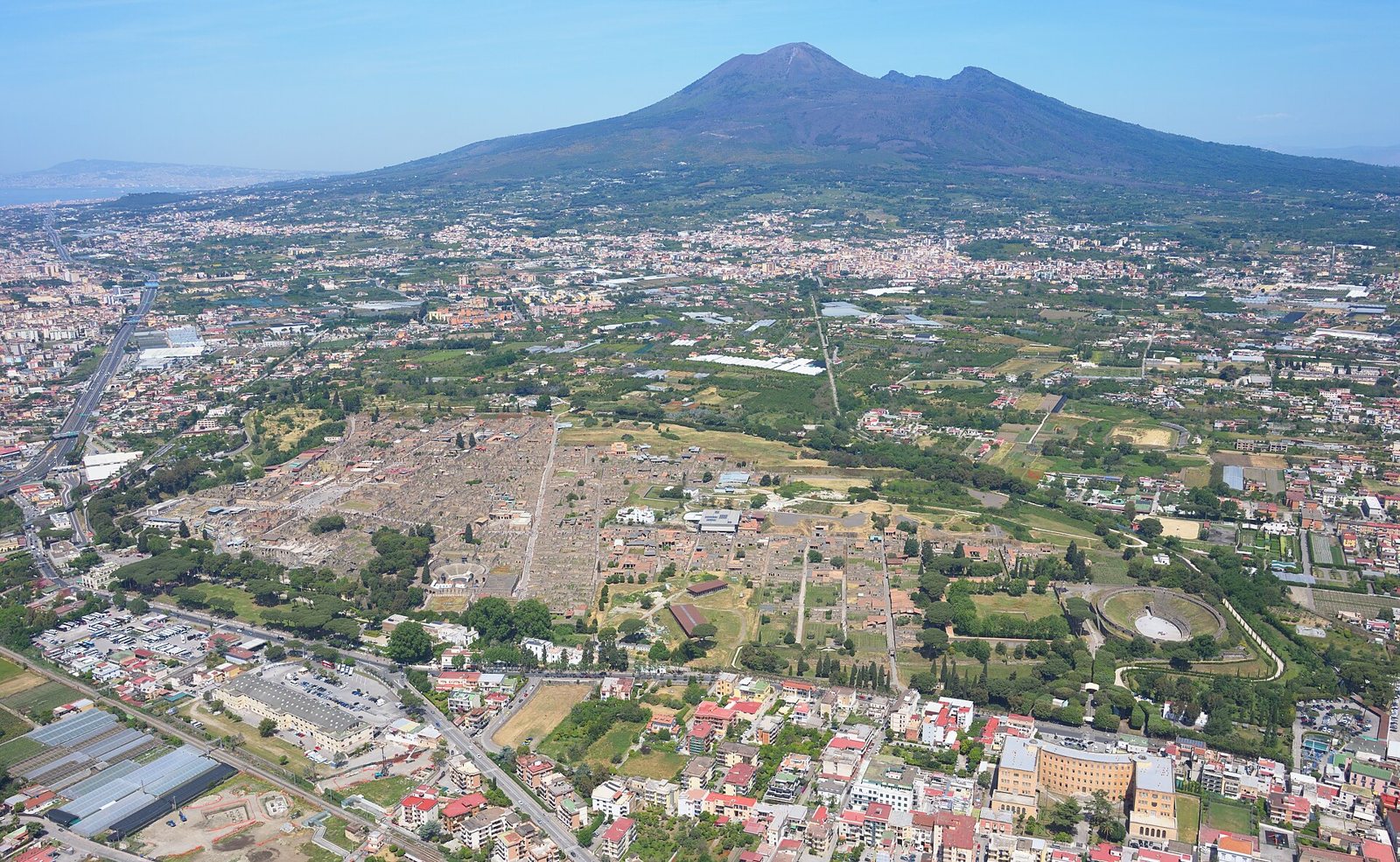
No. 125
Pompeii Skeletons and Casts: Are They Real, and Who Were These People?
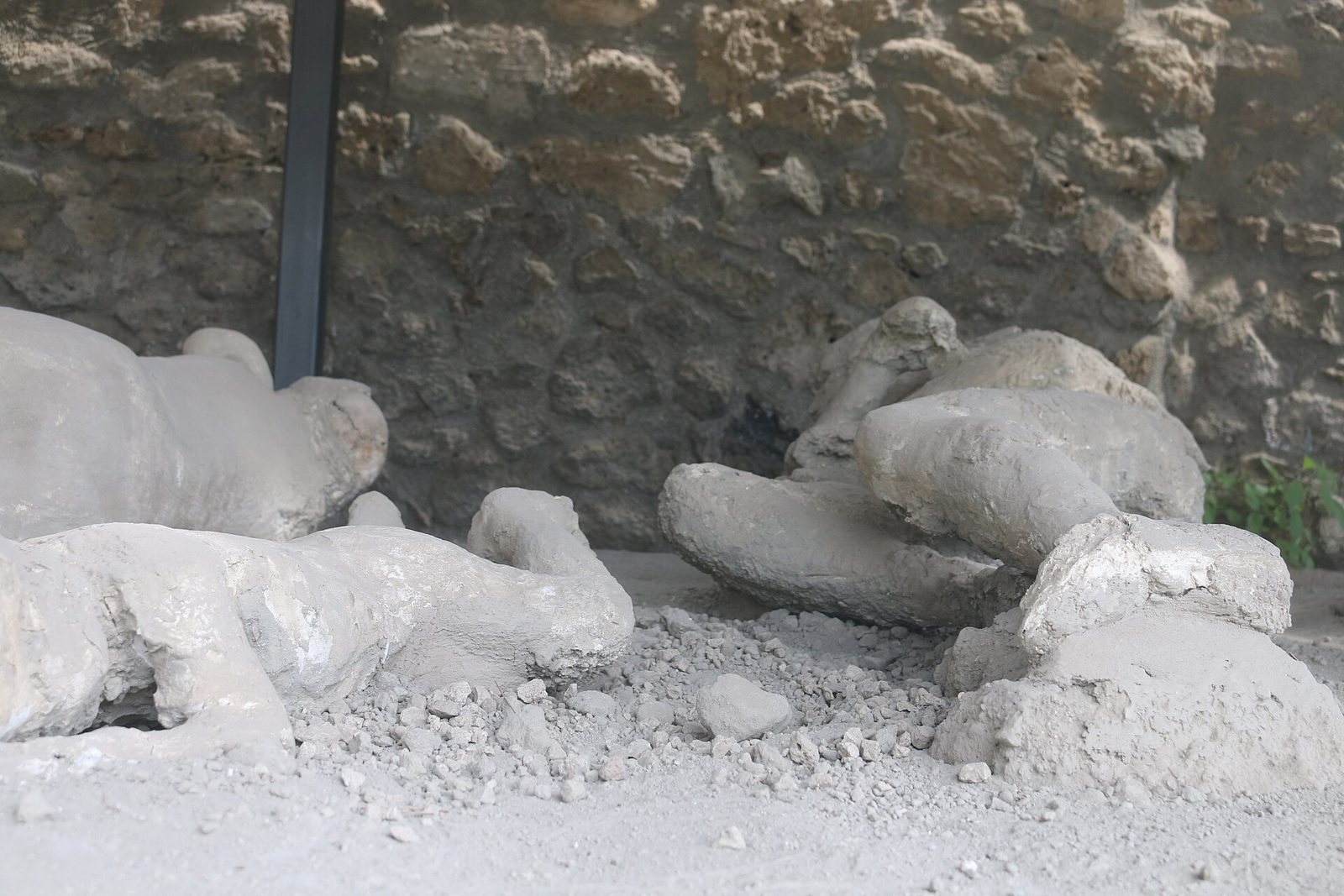
Yes, they are real people. Everyone you see in those photographs died in the eruption of Vesuvius in AD 79. At Pompeii, the crouching white figures are plaster casts, made with a method Giuseppe Fiorelli perfected in 1863: excavators poured liquid plaster into the hollows that bodies had left in hardened ash. The Archaeological Park of Pompeii explains that the people's remains are their bones, and bones or fragments of bone can still sit inside some casts. At Herculaneum, the neighboring town on the coast, the remains are actual skeletons, roughly 300 people uncovered from 1980 onward along the ancient shoreline. Most of them died from the eruption's heat or from buildings collapsing around them, depending on where they were and when.
That short answer leaves plenty to tell. The casts and the bones carry details of who these people were, what they ate, how they lived with their volcano and how, in 2024, DNA rewrote some of the most famous stories told about them.
What the Pompeii casts are
When Vesuvius buried Pompeii, ash and pumice settled around the people who had not escaped. Over time the ash hardened, and the bodies inside it decomposed. What remained was a person-shaped hollow in the ground, with the bones lying inside.
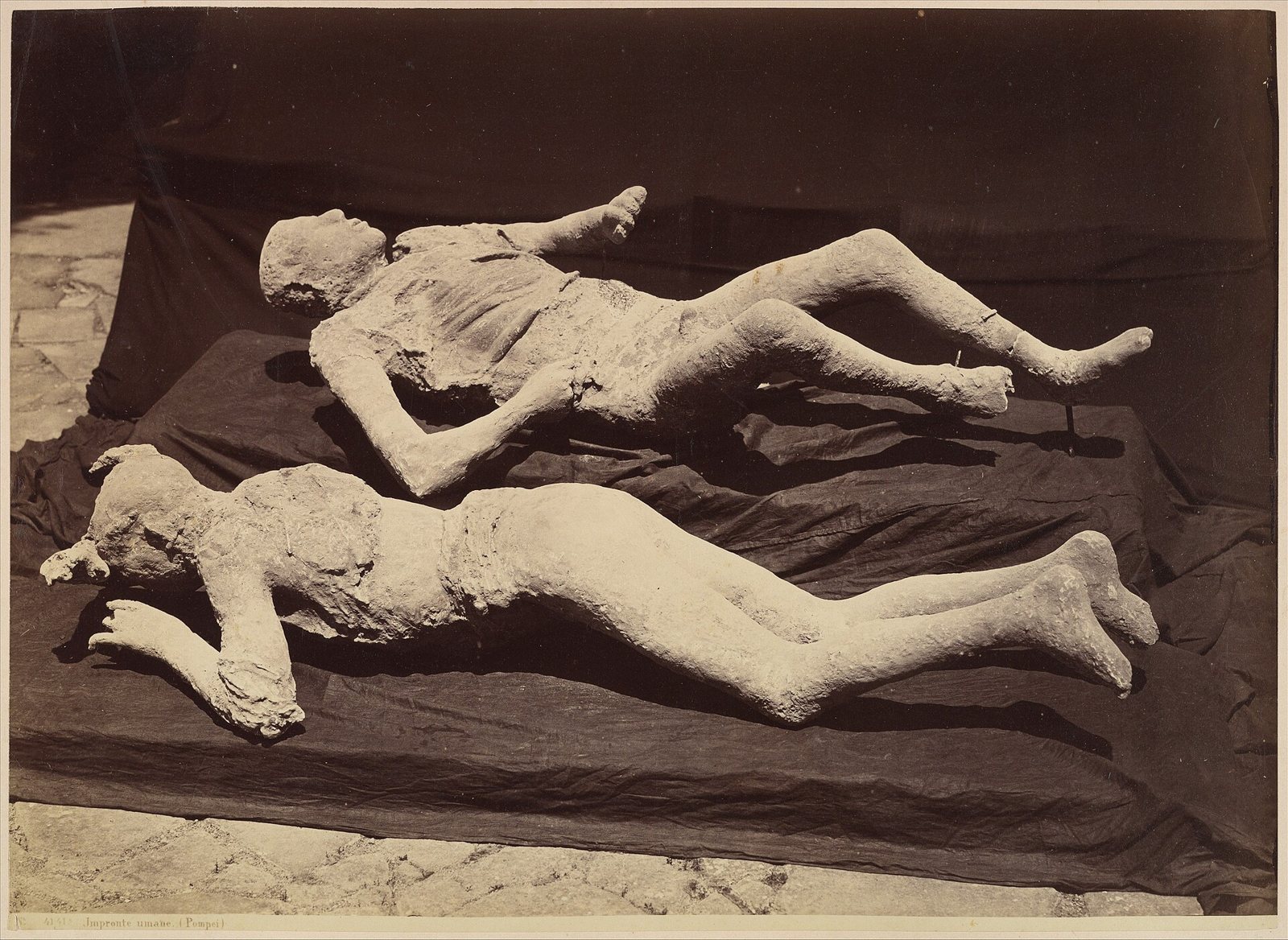
In 1863 Giuseppe Fiorelli perfected a way to recover that shape. When diggers struck one of these hollows, they poured liquid plaster into it and let it set before clearing away the surrounding deposit. The plaster filled the space the body had occupied, so the cast kept the position the person died in, the folds of their clothing and sometimes the objects lying beside them. Later casts were made with resin as well as plaster. According to the Park, slightly more than 100 casts were made with Fiorelli's method.
People often ask how the excavators knew where to pour. The hollow itself was the guide. A cavity in the hardened ash, with bones at the bottom, told them a person had been there.
Real people, real bones: what is inside a cast
The cast is a mold of a person, and the person's own remains are the bones. The Park puts it plainly: the victims' remains are bones, while the cast preserves the body's former shape.
So, are there skeletons in the Pompeii casts? Sometimes there are bones, but you should not expect a complete skeleton lying in order inside the plaster. Bones and bone fragments can remain inside some casts, mixed with the plaster that flowed around them. They are not intact bodies, and they are not complete skeletons in anatomical position. Those fragments matter a great deal, because they are what later scientists could sample for DNA.
It helps to hold both facts at once. A cast is something made in the 1800s or later, by people with buckets of plaster. It is also the exact outline of a man, a woman or a child who stood, sat or lay in that spot nearly 2,000 years ago, and in many cases it still holds part of them.
Tap or hover a row to highlight it.
| Feature | Pompeii | Herculaneum |
|---|---|---|
| FeatureWhat you see | PompeiiPlaster or resin casts of body-shaped hollows in hardened ash | HerculaneumHuman skeletons |
| FeatureWhat is inside or left | PompeiiBones or bone fragments inside some casts | HerculaneumThe bones themselves |
| FeatureNumbers | PompeiiSlightly more than 100 casts made with Fiorelli's method | HerculaneumRoughly 300 people found on the shoreline from 1980 |
| FeatureKey dates | PompeiiMethod perfected in 1863 | HerculaneumExcavations from 1980; Nature study in 2001 |
How the people of Pompeii died
The eruption did not kill everyone in the same way or at the same moment. It came in phases, and the danger changed with each one.
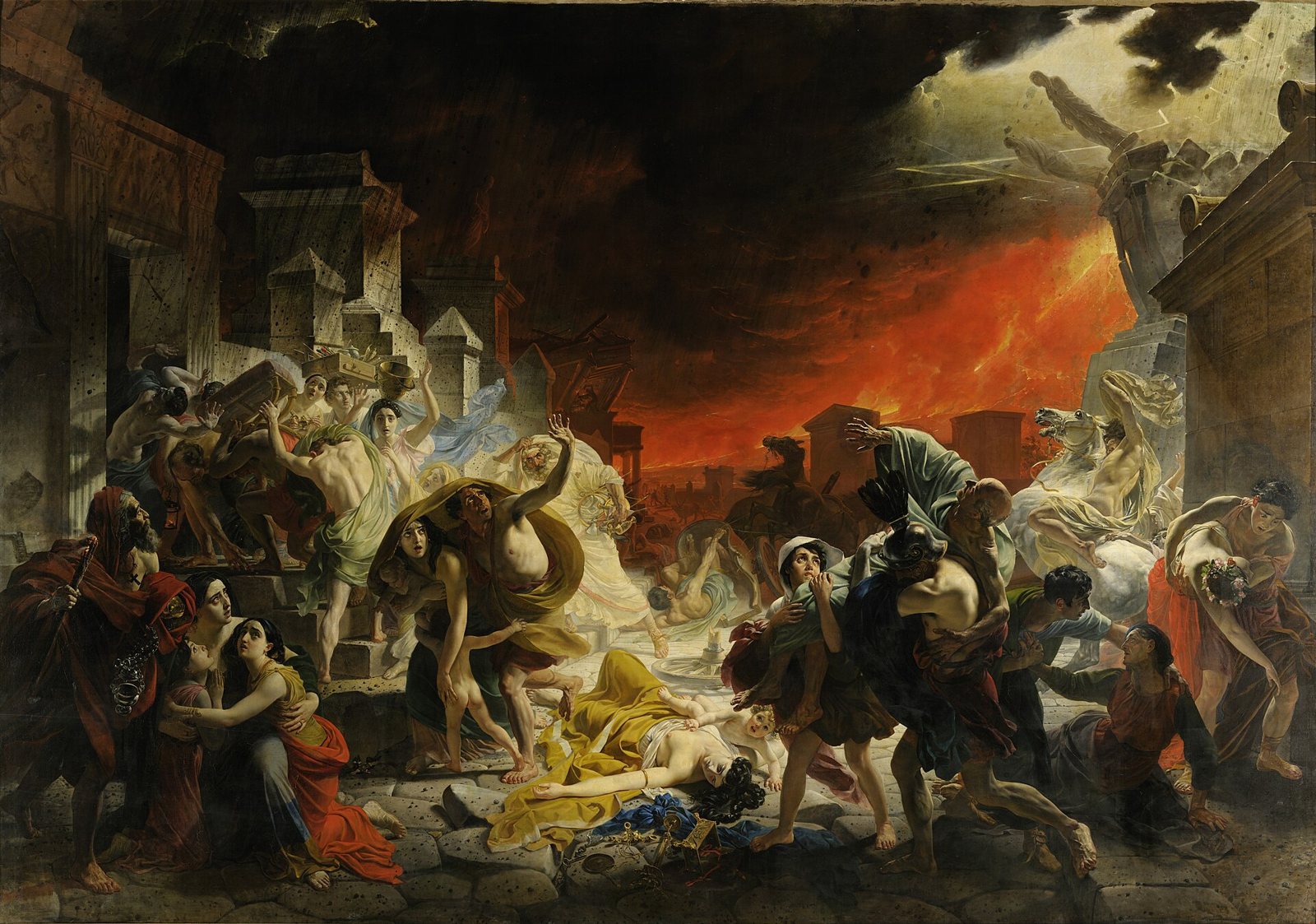
First came a heavy fall of pumice and lapilli, small stones of volcanic rock. It piled up on roofs and in streets, and some roofs and walls gave way under the weight. The Archaeological Park of Pompeii reports that 394 victims were found in these early fallout deposits, and that about 90 percent of them died inside buildings, probably from structural collapse.
Later, pyroclastic density currents swept into the city. These are ground-hugging flows of hot gas, ash and particles, often called surges. In a 2010 study in PLOS ONE, Mastrolorenzo, Petrone, Pappalardo and Guarino concluded that heat was the main cause of death for many people at Pompeii. They calculated that surges of at least 250°C could cause instant death about 10 kilometres from Vesuvius.
The answer to "how did the people of Pompeii die?" depends on the person. Some died under falling roofs in the first hours. Many others died when the hot surges reached them, wherever they happened to be sheltering or trying to leave.
Herculaneum's shoreline and the boathouses
Herculaneum, also buried in AD 79, stood on the coast. Beginning in 1980, excavations at the ancient shoreline uncovered roughly 300 human skeletons, on the beach and inside 12 vaulted chambers at the water's edge.
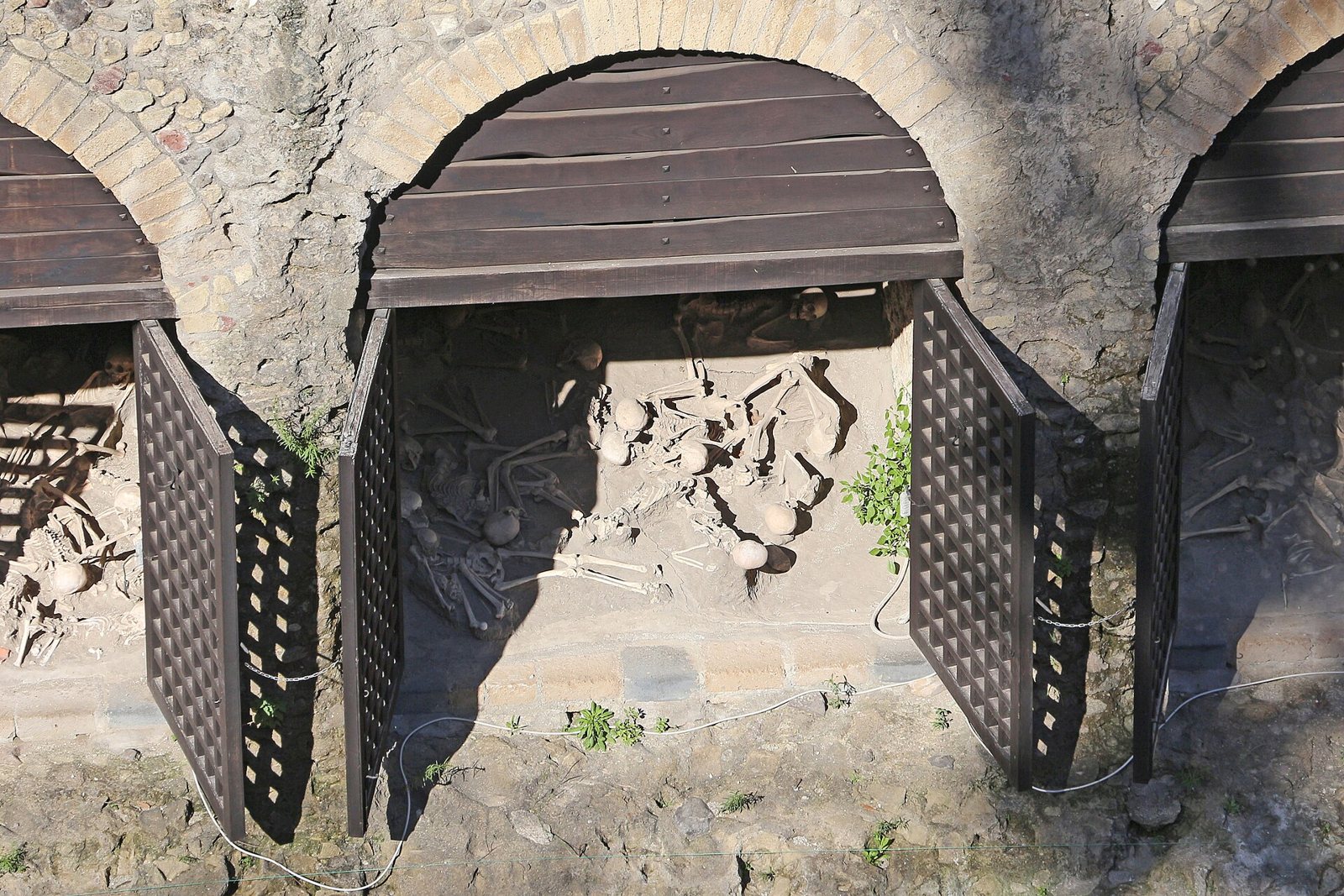
Those chambers are commonly called boat chambers or boathouses. People ask what they were used for. For the story of the eruption, what matters is what happened in them that night: families and neighbors crowded into the arches near the shore, apparently waiting for escape or rescue by sea.
Are the Herculaneum skeletons real? Yes. They are the actual bones of the people who sheltered there, excavated from the eruption deposits. In a 2001 study in Nature, Mastrolorenzo and colleagues reported that 80 of the approximately 300 people had been recovered from the first surge deposit. The bones showed changes linked to heat, including discoloration, fine cracking of bone, cracked tooth enamel and fractures of the skull. The team estimated that the first surge reached the shore at about 500°C, and they read the victims' postures as a sign of instant death from thermal shock, rather than slow suffocation.
Scientists disagree about some of this. Writing in Antiquity, Martyn and colleagues looked at how well collagen and the bone's crystal structure survived in the boat-chamber skeletons. They concluded that the bones show no burning, or burning of low intensity. They reviewed estimates of about 350°C to 400°C inside the chambers, compared with earlier estimates of about 480°C to 500°C outside. The two sides agree that these people died quickly, in a pyroclastic surge. Where they differ is on the exact temperatures and on how heat, the shelter of the vaults, the body's soft tissue and the bone interacted.
What the Herculaneum bones say about everyday life
Because the Herculaneum dead are skeletons, they can tell scientists about the years before the eruption as well as the last hours. A skeleton records diet, illness and work in ways a plaster cast cannot.
One study, by Petrone and colleagues in PLOS ONE, examined 76 skeletons and found evidence that fluorosis was endemic in the population. Fluorosis is a condition caused by taking in too much fluoride over many years. The authors linked it to long-term exposure to fluoride-rich water and soils in the volcanic country around Vesuvius. In other words, the volcano was shaping these people's bodies long before it erupted.
Another study, published in Science Advances in 2021 by Silvia Soncin and colleagues, measured chemical signatures in the bone collagen of 17 adults to reconstruct what they ate. The sampled men ate more food from the sea, while the women ate relatively more food from the land, including plant foods. It is a small sample, so it describes those 17 people well and the whole town only loosely. Still, it is a rare look at ordinary Roman meals, read from the people who ate them.
If you like this side of the story, our piece on what bones tell archaeologists covers how age, health and diet are read from a skeleton, and how scientists date bones explains the clocks behind the dates.
What DNA changed in 2024
For more than a century, guides and books told stories about the Pompeii casts based on their poses, their jewelry and where they lay. A mother holding her child. Sisters. A family gathered in one house. These stories were moving, and many of them were guesses.
On November 7, 2024, Pilli and colleagues published a study in Current Biology, "Ancient DNA challenges prevailing interpretations of the Pompeii plaster casts". The researchers took ancient DNA from bone fragments and teeth associated with 14 casts and obtained genome-wide data for five people. A Harvard Medical School summary walks through the main results.
The best-known change concerns an adult wearing a heavy golden bracelet and holding a child, a pair long described as a mother and her child. DNA showed that the adult was genetically male and was not biologically related to the child. At the House of the Golden Bracelet, three of four people presumed to be a family turned out to have no genetic relationship to one another, up to the third degree. The fourth person's DNA could not be analyzed.
The study also looked at ancestry. Pilli and colleagues report that the sampled Pompeiians largely had ancestry connected to recent immigrants from the eastern Mediterranean, which fits what is known of Pompeii as a cosmopolitan Roman town where people arrived from many places.
None of this makes the people less real. It means we know a little less about the families we imagined for them and a little more about who they were.
The Two Maidens
The "Two Maidens" is a popular name for two Pompeii casts found close together, lying as if holding each other. Over the years they have been described as two women, as sisters, as a mother and daughter and as lovers.
In 2019, Gabriel Zuchtriegel and Massimo Osanna of the Archaeological Park of Pompeii raised the possibility that the pair were young male lovers, and they presented it as a hypothesis, an idea to test. A 2019 feature published by the Park includes Osanna's discussion of it.
The 2024 DNA study found that at least one of the two was genetically male. That rules out the reading that both were women, and with it the sisters and the mother and daughter. It does not prove they were lovers. A pose in the ash cannot tell us their family ties, their gender identity or what they felt for each other. "Two Maidens" remains a popular label for two people whose relationship is still unknown.
Seeing them with care
It is easy to look at the casts as sculptures, because they are white and still and stand in display cases. They are better understood as a record of real people from two Roman towns, people who worked, ate, raised children and tried to find shelter when the eruption came.
The stories told about them for many years said as much about the storytellers as about the dead. The bones, the teeth and the DNA let these people speak a little more plainly for themselves. Some details are now settled, some are argued over by careful scientists, and some, like what two people holding each other meant to each other, may never be known.
Pompeii and Herculaneum, from the eruption to the DNA
Tap or hover a step to follow the order.
AD 79
Vesuvius erupts, burying Pompeii and Herculaneum in pumice, ash and pyroclastic deposits.
1863
Giuseppe Fiorelli perfects the plaster-cast method at Pompeii.
1980 onward
Excavations uncover roughly 300 skeletons on Herculaneum's ancient shoreline and in its vaulted chambers.
2001
A Nature study interprets the Herculaneum victims as dying instantly from thermal shock.
2010
A PLOS ONE study identifies heat as the main cause of death for many Pompeii victims caught by the surges.
2021
Soncin and colleagues reconstruct the diets of 17 Herculaneum adults.
2024
Pilli and colleagues use ancient DNA to challenge long-standing identities given to the Pompeii casts.
Frequently asked questions
The questions people ask most about the casts and skeletons, answered briefly.
Are the Pompeii bodies real, or just casts?
They are real people, recorded as casts. Each figure is plaster or resin poured into the hollow a body left in hardened ash after the AD 79 eruption, so it keeps that person's exact posture, and bones or fragments may remain inside some casts.
What is inside the Pompeii plaster casts?
Some casts contain bones or bone fragments, held in the plaster that flowed around them. They do not contain complete skeletons in anatomical position, and those fragments and teeth are what the 2024 DNA study sampled.
How did the people of Pompeii die?
Some died when pumice and lapilli brought down roofs and walls in the early phase, and many others died in later hot surges. The Park counts 394 victims in the early fallout deposits, about 90 percent of them inside buildings, and Mastrolorenzo and colleagues name heat as the main cause of death for many in the surges.
Was the Pompeii "mother and child" really a mother?
No, DNA showed the adult was genetically male. The 2024 study by Pilli and colleagues also found that the adult was not biologically related to the child they were holding.
Are the Herculaneum skeletons real?
Yes, they are the actual skeletons of about 300 people who sheltered on the shoreline and in 12 vaulted chambers. Scientists have studied their bones and teeth for heat damage, disease and diet.
Pompeii and Herculaneum quiz
Answer every question to check.
More stories about the people the earth kept
Pompeii and Herculaneum sit beside other places where the ground held people for centuries. Read about the bog bodies of northern Europe, the Chinchorro mummies of Chile and the mummies of Guanajuato in Mexico. For one more person found where he fell, read about Ötzi the Iceman, and to see how scientists rebuild a face from a skull, read our story on facial reconstruction.
Terms in this story
Tap a term to see what it means.
Plaster cast. A form made by pouring liquid plaster into a hollow left in hardened ash after a body decomposed, keeping the person's shape and pose.