

No. 003
How Do Archaeologists Know How Old Bones Are?
Scientists almost never read a bone's age by looking at it. They measure something, and what they measure depends on how old the bone is. For a skeleton younger than about 50,000 years whose collagen has survived, laboratories can measure the carbon-14 left in the bone itself. For anything older, they date the teeth, a cave deposit, a layer of volcanic ash, a piece of burned flint or the sediment around the remains, and they read the layers the bone lay in. So, a headline that says a skeleton is 9,000 years old usually rests on one of a few specific measurements, each of which dates a particular thing: the bone, a tooth, a layer or an object nearby.
This story follows that headline back to the lab, method by method, with the range each one can reach.
How a 9,000-year-old bone gets its age
Radiocarbon dating measures the carbon-14 that remains in collagen, the main organic part of bone. Carbon-14 decays into nitrogen-14 with a half-life of about 5,730 years, so the less is left, the longer ago the animal or person died. A laboratory removes the mineral part of the bone and surface contamination, dissolves the mineral with acid, turns the collagen into gelatin, and measures the carbon with accelerator mass spectrometry. The Smithsonian Human Origins Program and a published account of minimally destructive bone dating describe these steps.
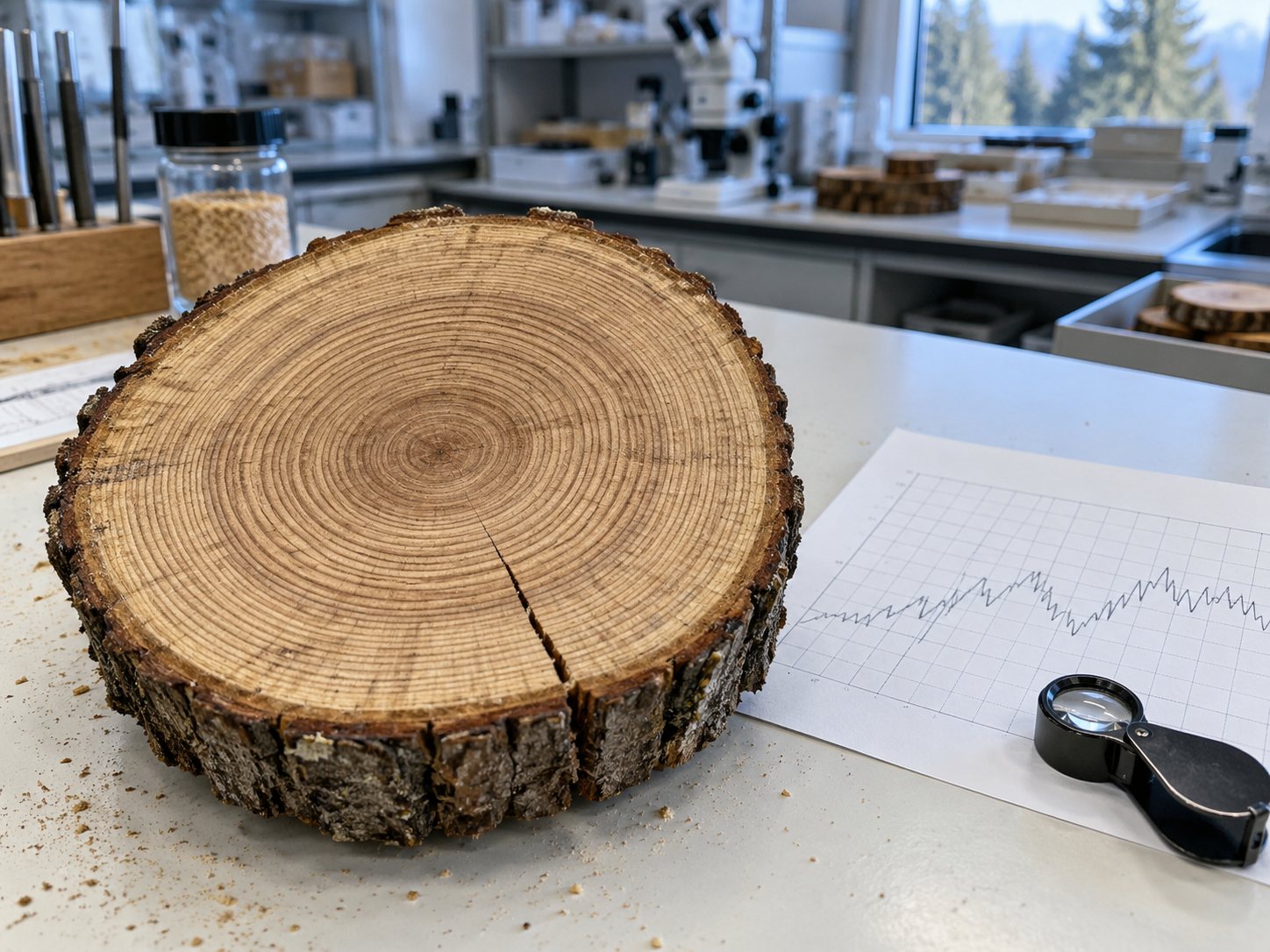
The useful range is roughly 50 to 50,000 years, although some laboratories report dates approaching 60,000 years under favorable conditions. A bone that is 9,000 years old sits comfortably inside it, provided enough collagen survives. That condition matters, because a bone that has lost its collagen cannot be dated this way.
The raw number is not yet a calendar date. Carbon-14 levels in the air have not been constant, so laboratories calibrate each result against tree rings and other independently dated records, using curves such as IntCal20.
Radiocarbon basics
Answer every question to check.
What "9,000 plus or minus 100" really says
A result such as 9,000 ± 100 radiocarbon years BP is an uncalibrated measurement. "BP" means before AD 1950, so it is anchored to a fixed year and not to today. "Cal BP" means calibrated calendar years before AD 1950. Because the calibration curve is irregular, one radiocarbon age can meet it at more than one calendar interval, and the calibrated answer is often written as a range, for example 10,200 to 9,900 cal BP. The Oxford Radiocarbon Accelerator Unit explains the convention.
Those ranges are probability statements. A laboratory may report roughly one standard deviation, often called 1 sigma, or roughly two, called 2 sigma. A wider interval covers more possibilities but is less precise. For electron spin resonance, Historic England notes that quoted errors are commonly around 15 percent of the estimated age, though the real uncertainty depends on the sample and its surroundings.
So, no, dating is not accurate to the year, and it does not claim to be. Researchers build confidence by repeating measurements, using independent methods, testing different materials, checking collagen quality, examining the layers, and rejecting contaminated or reworked samples. When two methods agree, the conclusion is stronger. When they disagree, the disagreement shows where the site's history or an assumption needs a closer look.
When a bone is too old for carbon
Past radiocarbon's limit, scientists reach for other clocks, and most of them date something other than the bone.
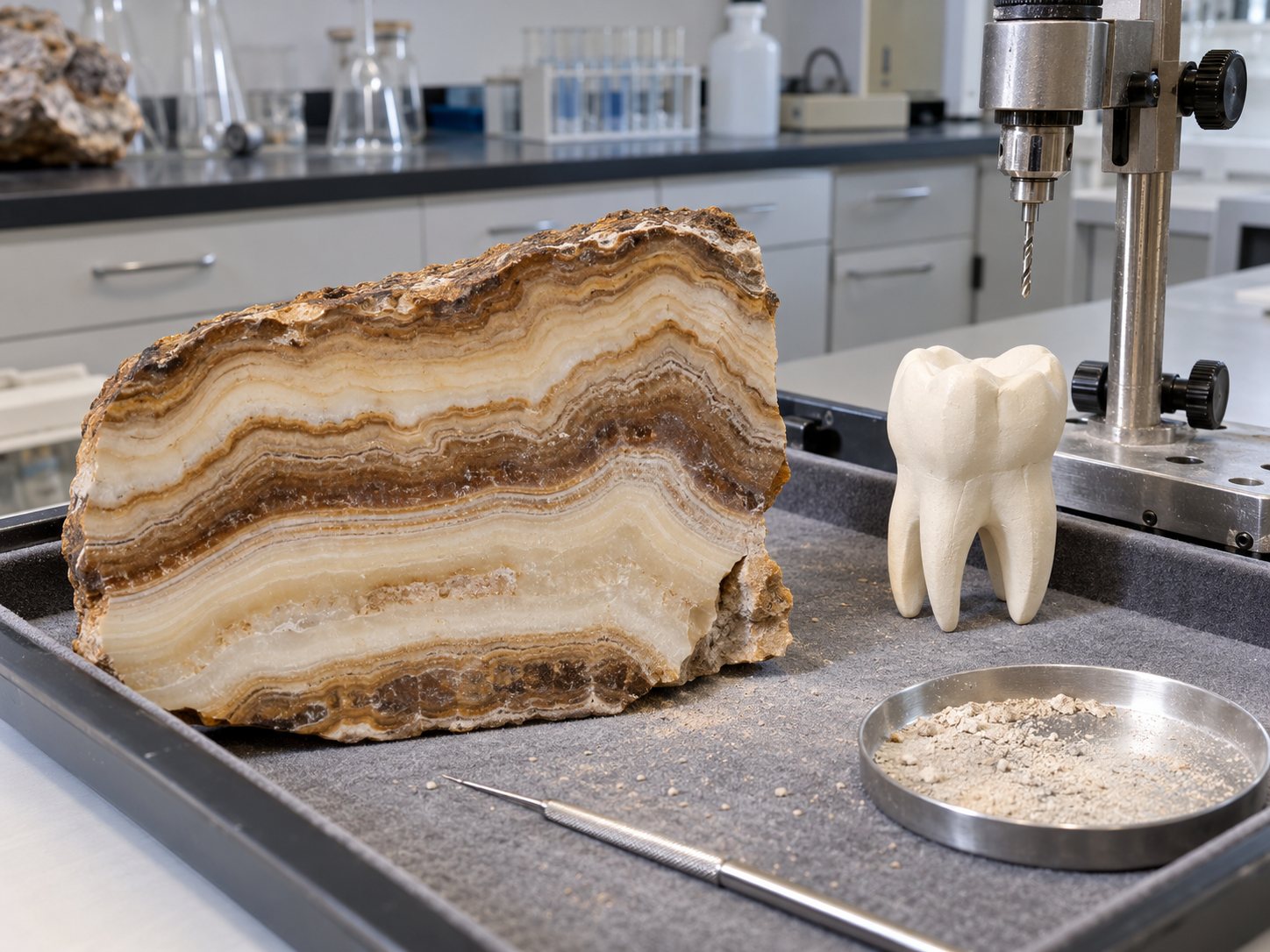
- Uranium-series dating measures changing ratios among uranium and thorium isotopes. Water carries uranium into cave deposits, while thorium is comparatively insoluble, so the method works especially well on cave formations and can reach hundreds of thousands of years, depending on the material.
- Electron spin resonance, or ESR, measures radiation trapped in the crystal structure of tooth enamel. It commonly dates teeth from several thousand to more than a million years, and it is often paired with uranium-series measurements because uranium absorbed by a tooth changes its radiation dose over time.
- Luminescence dating measures energy trapped in mineral grains. Thermoluminescence dates the last strong heating of burned flint or pottery. Optically stimulated luminescence, or OSL, dates the last major exposure of quartz or feldspar grains to sunlight, which usually estimates when sediment was buried, not the age of a bone.
- Potassium-argon and argon-argon dating measure volcanic minerals and ash. They date an eruption or the cooling of a layer, so a fossil sandwiched between two dated ash layers receives a bracketed age instead of a direct date on the fossil.
The Historic England guide to dating Pleistocene sites and the Australian Museum both lay out these methods and what each one dates.
Tap or hover a row to highlight it.
| Method | Typical useful range | What it dates | Qualification |
|---|---|---|---|
| MethodRadiocarbon on bone collagen | Typical useful rangeAbout 50 to 50,000 years | What it datesThe collagen, usually tied to the death of the organism | QualificationNeeds preserved collagen and contamination control |
| MethodUranium-series | Typical useful rangeThousands to hundreds of thousands of years, depending on system | What it datesCave deposits, teeth, bone or other uranium-bearing material | QualificationEspecially useful in caves; uranium movement must be modeled |
| MethodESR | Typical useful rangeSeveral thousand to more than one million years | What it datesTrapped charge in tooth enamel or other minerals | QualificationOften paired with uranium-series for teeth |
| MethodThermoluminescence | Typical useful rangeDepends on site and material | What it datesLast strong heating of flint or pottery | QualificationJebel Irhoud used heated flint |
| MethodOSL | Typical useful rangeDepends on site and material, commonly late Quaternary | What it datesLast major exposure of sediment grains to light, usually burial | QualificationDates the sediment rather than the bone |
| MethodArgon-argon | Typical useful rangeAbout 100,000 years to more than 4 billion years | What it datesVolcanic minerals or ash | QualificationFossils are bracketed by dated layers above and below |
| MethodStratigraphy | Typical useful rangeNo fixed numerical range | What it datesRelative order of layers and objects | QualificationLower undisturbed layers are generally older |
Two famous dates, and what each one measured
At Rising Star Cave in South Africa, the remains of *Homo naledi* sit in cave deposits. A 2017 study in eLife by Dirks and colleagues combined uranium-thorium dating, ESR, radiocarbon, OSL, paleomagnetism and the layering of the cave. The authors constrained the deposits to about 236,000 to 335,000 years ago. Their preferred ESR model gave a maximum age for the deposit, and flowstone lying over the remains gave a minimum.
At Jebel Irhoud in Morocco, the fossils were associated with flint that had been heated, and thermoluminescence on that flint gave an age of about 315,000 years. A uranium-series and ESR result on a tooth gave 286,000 ± 32,000 years, as reported by Hublin and colleagues in Nature. Those dates describe different materials and different events, so the conclusion is that the fossils are roughly 300,000 years old, not that one test measured a whole skeleton. The Smithsonian's summary says our species arose at least 300,000 years ago.
Reading the layers
Long before any lab number, archaeologists work out relative age. Stratigraphy rests on superposition: in an undisturbed sequence, lower layers were laid down before the layers above them. Excavators record the exact layer and position of every bone, then compare it with artifacts, animal fossils, volcanic ash and soil formation. The National Park Service describes this approach.
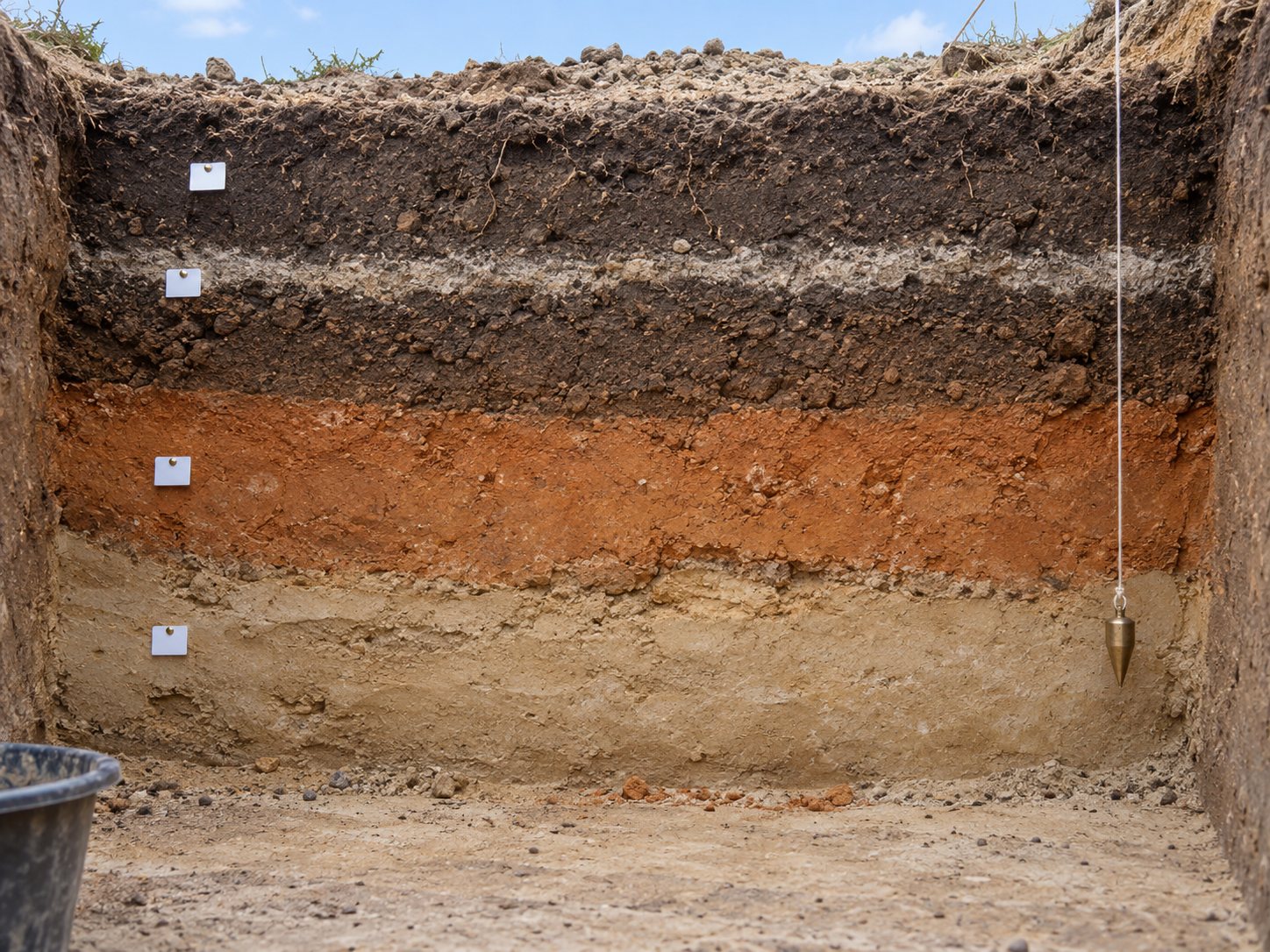
Objects found beside a skeleton can narrow its age, since pottery is dated through typological sequences, seriation, historical dates and sometimes thermoluminescence. Still, a pot next to a skeleton does not automatically date it, because objects can be moved, reused or deposited at different times. The link has to be shown from the way the ground was laid down.
Chemistry offers a second relative clock. Groundwater supplies fluorine to buried bone, and bones from the same deposit tend to absorb similar amounts. The rate varies too much for a universal calendar date, but it can show whether specimens from one site are likely to be the same age.
Piltdown: when fluorine settled an argument
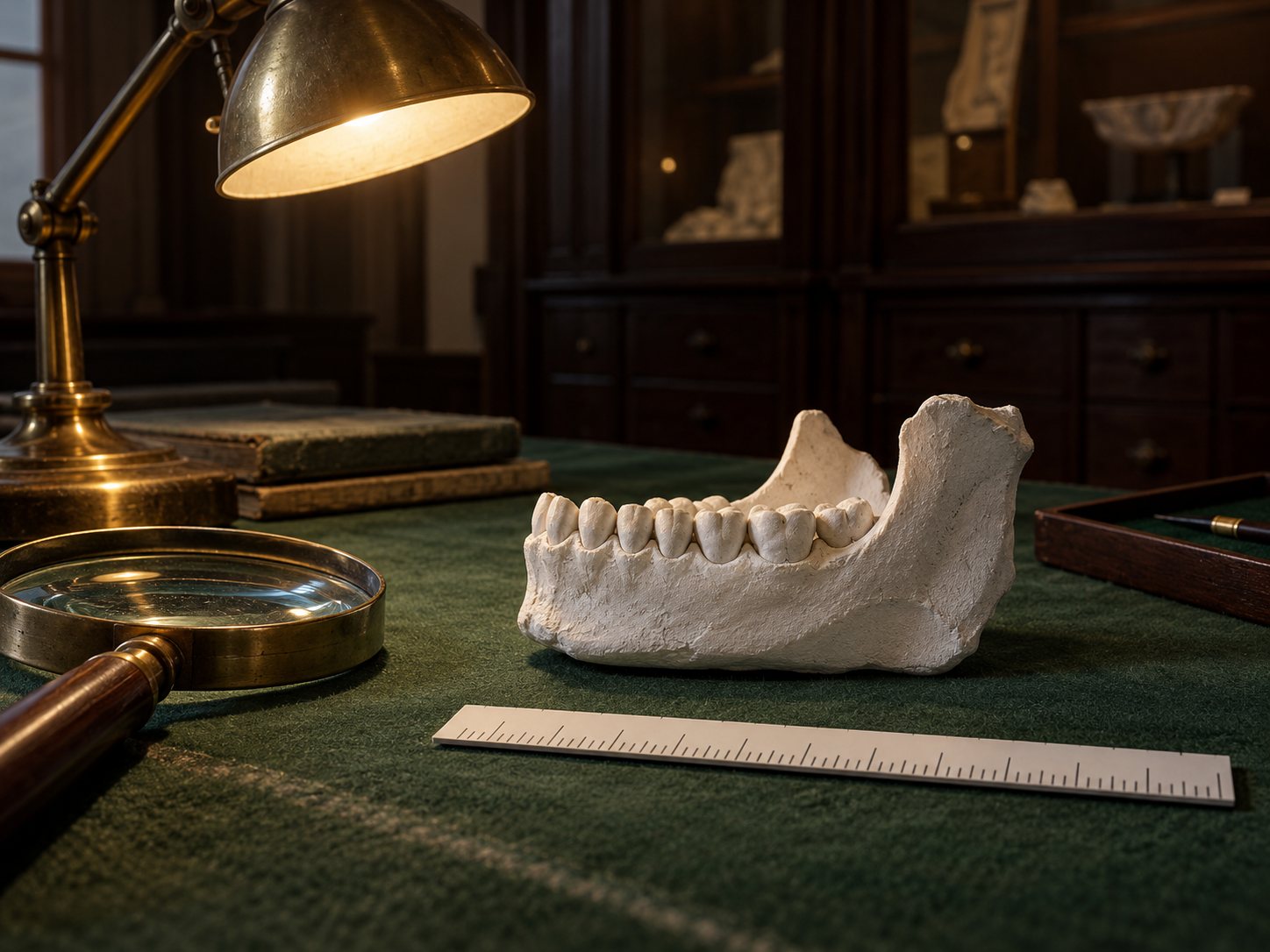
That chemical clock helped end one of the most famous hoaxes in the study of human origins. In 1912, a skull and jaw from Piltdown in England were announced as a possible 500,000-year-old human ancestor. In the early 1950s, Kenneth Oakley of the Natural History Museum used fluorine testing and found the remains were far more recent than claimed. Joseph Weiner and Wilfrid Le Gros Clark then showed that the skull and jaw came from different species, a human and an orangutan. The teeth had been filed and the bones stained. The museum's accounts of the Piltdown collection and the later investigation tell the story.
The bomb pulse and newer remains
Not every dating question is about the distant past. Atmospheric nuclear testing sharply raised carbon-14 in the air after the 1950s, nearly doubling it and peaking around 1963 in the Northern Hemisphere. That extra carbon entered living tissue through the food chain, and it can help separate many post-1950 remains from earlier ones, as FBI Forensic Science Communications describes. Bone collagen turns over slowly and may reflect earlier tissue formation, so the reading depends on the bone type, diet, age of the person and whether the value sits on the rising or falling side of the curve.
How long does a body take to become a skeleton?
There is no single timetable. Forensic studies describe stages from fresh, through early and advanced decomposition, to skeletonization. Warmth, moisture, oxygen, insects, scavengers, clothing, burial depth, enclosure and body size all change the pace. An exposed body in a warm place with insects and scavengers can become substantially skeletonized within weeks, while a body that is cool, dry, sealed, submerged, frozen or deeply buried can take far longer. A coffin, compact soil, wet sediment or cold can preserve soft tissue and slow its loss.
For that reason, skeletonization is a condition of the remains and not a date. Forensic anthropologists estimate time since death by combining the stage of decomposition with the scene, insects, soil, plants, weather records, clothing and chemical changes in bone. Looking at the bone alone usually cannot tell several years from many. If you have come across bones yourself, our story on what to do if you find human bones explains who to call.
Milestones in dating bones
Tap or hover a step to follow the order.
1912
Piltdown remains are announced as a possible 500,000-year-old human ancestor.
1949 to 1955
Fluorine testing and anatomical analysis expose Piltdown as a composite fraud.
1950s to 1963
Nuclear testing produces the atmospheric carbon-14 bomb pulse.
2017
Jebel Irhoud fossils and heated flint are reported at roughly 300,000 to 315,000 years.
2017
Homo naledi deposits at Rising Star Cave are constrained to about 236,000 to 335,000 years.
Questions people ask
These are the questions readers bring to the subject, with short answers.
How are human fossils dated?
If collagen survives and the fossil is younger than roughly 50,000 years, laboratories may date the bone directly with radiocarbon. Older remains are often dated with uranium-series or ESR measurements on teeth, or indirectly through volcanic ash, cave deposits, burned flint or the sediment around them, so the age reported may refer to the bone, a tooth, a layer or an associated object.
Is radiometric dating 100% accurate?
No, it produces an age estimate with an uncertainty. Radiocarbon results need calibration, and every method depends on the right material, a reliable setting and controls against contamination. Independent methods that agree strengthen the conclusion.
What is more accurate than carbon dating?
No method is universally more accurate. Uranium-series, ESR, luminescence, argon-argon and radiocarbon each suit different materials and time ranges. For a 9,000-year-old bone with preserved collagen, carefully prepared and calibrated radiocarbon dating is usually appropriate, while a much older fossil needs another method.
What is the oldest bone ever found?
It depends on the category. The oldest known *Homo sapiens* fossils come from Jebel Irhoud in Morocco, at roughly 300,000 to 315,000 years old. Much older fossilized bones from extinct animals exist, and fossils of human ancestors are older than our species. A fossil's age is also not necessarily the age of the original bone, because fossilization can replace or mineralize it.
Do scientists date the fossil or the layer?
Often the layer. An OSL date usually gives the burial of the sediment, and an argon date gives the volcanic ash above or below a fossil, so the fossil receives a bracket. When collagen survives, radiocarbon can date the bone itself.
How can you know the age of a bone you have in front of you?
Start with whether it still holds collagen and where it came from, since the setting matters as much as the bone. A laboratory can then choose radiocarbon for recent bones or a tooth, layer, ash or flint method for older ones.
Where to go next
Dating is only the first step in reading a skeleton. For more of what bones can say, see our story on what bones tell archaeologists, then browse the human skull facts and the guide to how many bones are in the human body. If you wonder how ancient surgeons worked on living skulls, read about trepanation.
Terms in this story
Tap a term to see what it means.
Radiocarbon dating. A method that measures the carbon-14 remaining in organic material such as bone collagen. It is useful for roughly 50 to 50,000 years.