

No. 123
Why Are Some Ancient Skulls Elongated? Head Shaping From Paracas to the Maya
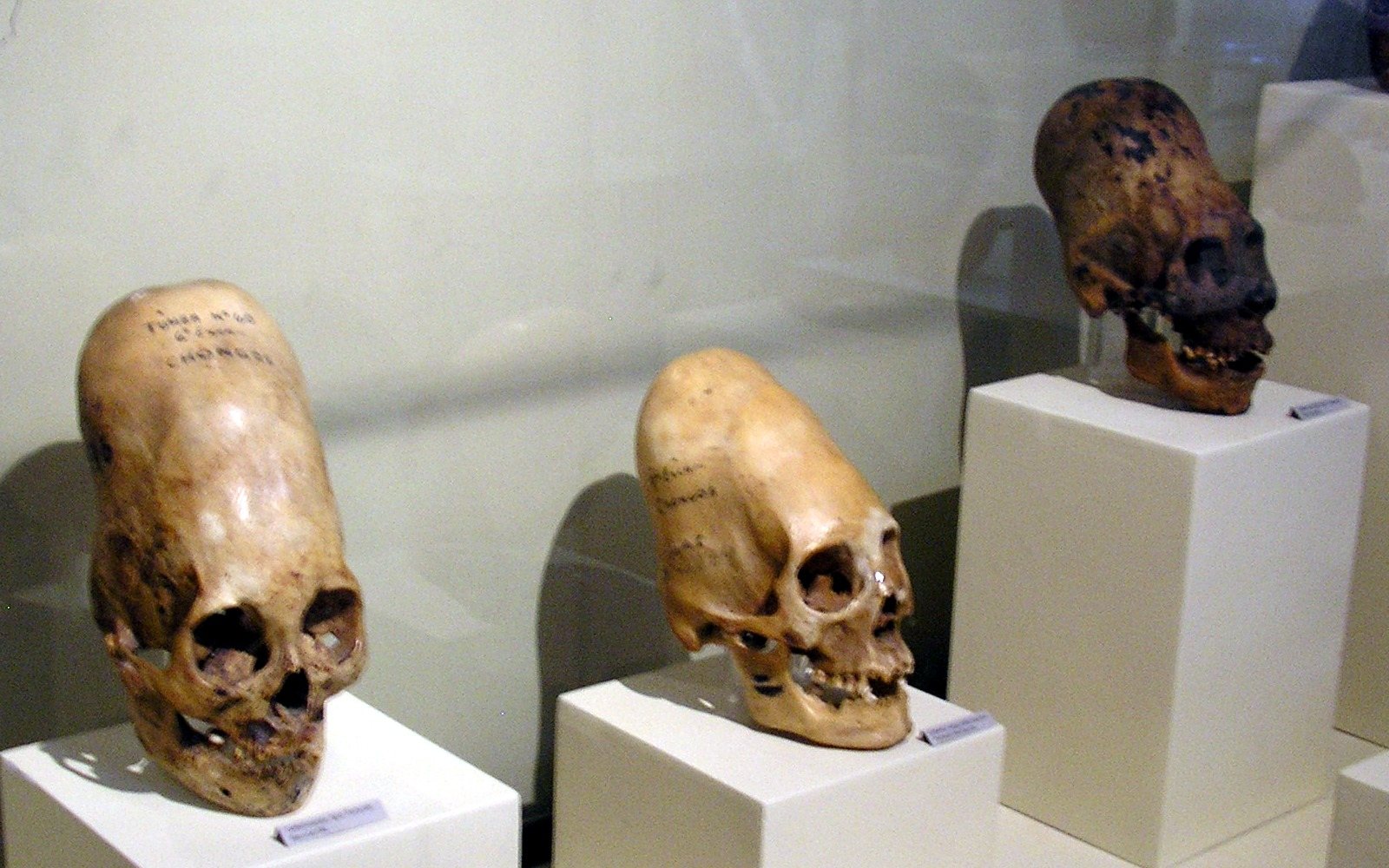
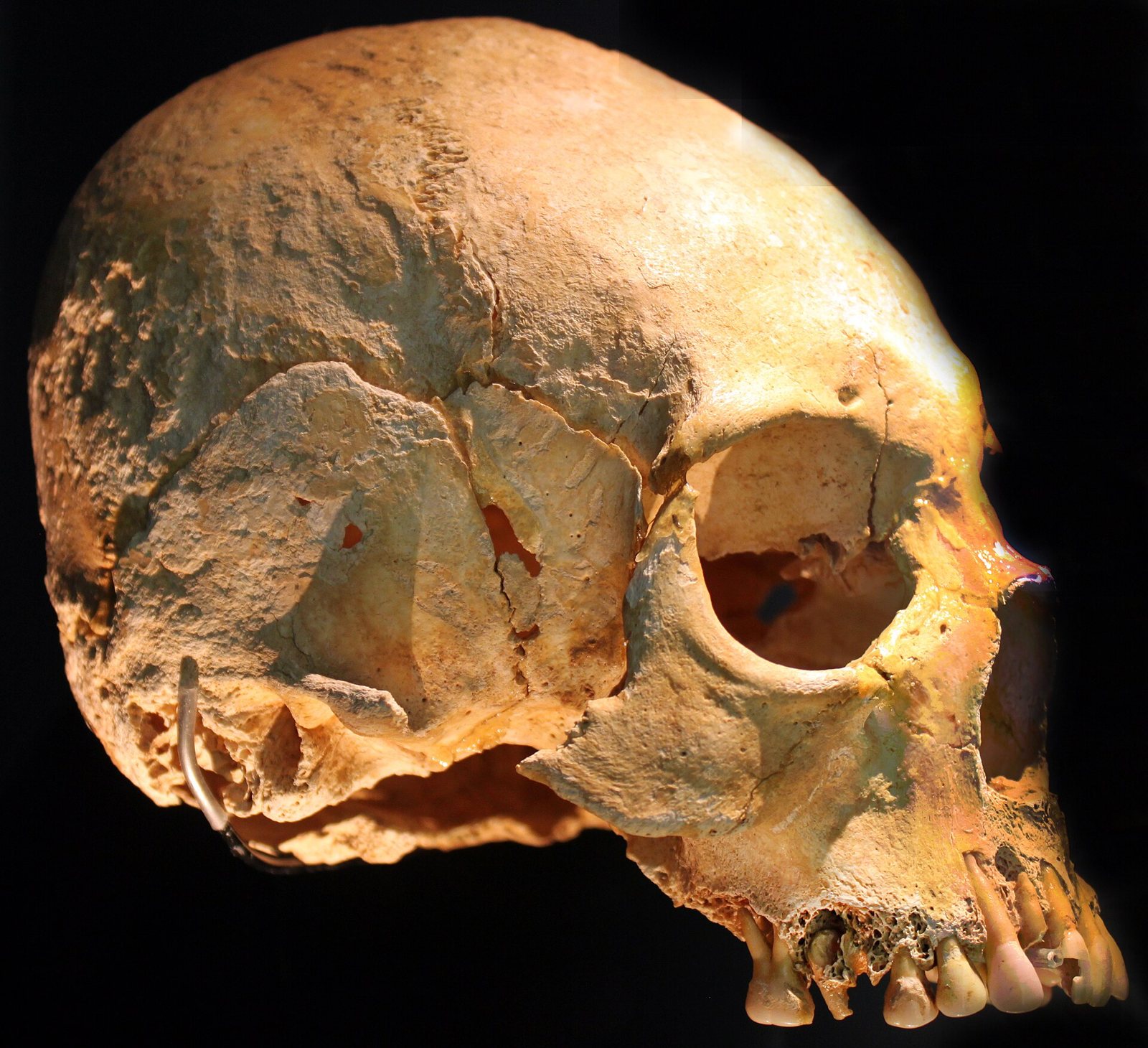
If you have seen a long, cone-shaped skull in a photo, there is a clear answer to what made it that way. Caregivers shaped it on purpose, in infancy, while the skull bones were still soft. They used cloth bindings, boards, pads or cradleboards to apply steady pressure for months or years, and the baby's brain kept growing inside the new shape. Archaeologists call this intentional cranial modification, or head shaping. It was a deliberate practice of named communities, among them the Paracas of Peru's south coast, who lived roughly from 800 B.C. to A.D. 200, and the Maya. The rest of the story covers who did it, where, and what the shape meant to the people who wore it.
How an infant's skull gets reshaped
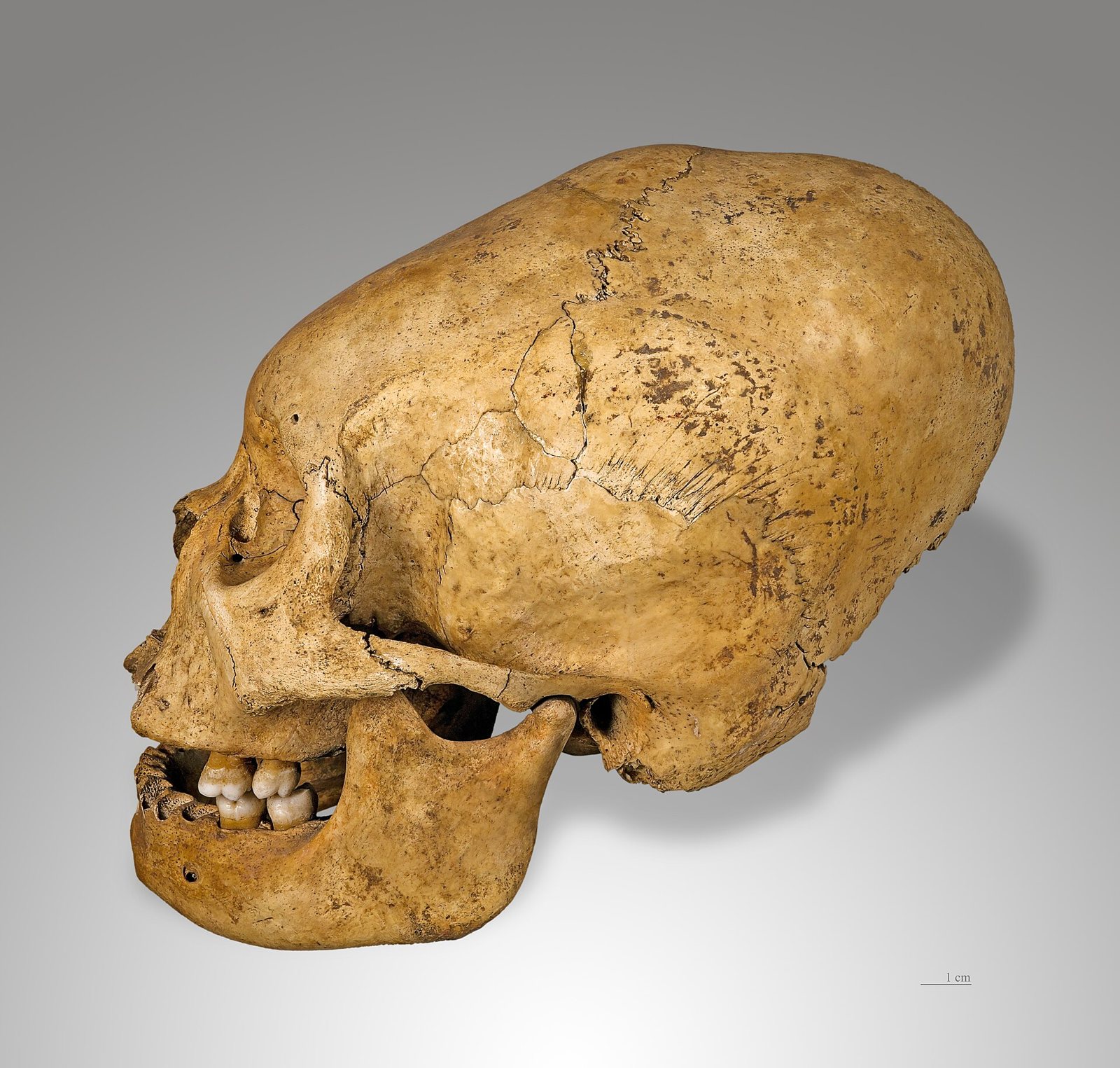
A newborn's skull is made of separate plates joined by flexible seams called sutures. Those seams stay open through early growth, which is what makes reshaping possible. The Smithsonian's Osteoware guide describes two broad forms of cranial modification. In tabular modification, a cradleboard, board, bag or stone presses on the forehead and the back of the head. In circumferential modification, a caregiver winds cloth, cord or another pliable material around the head. The goal could be a flat, broad, rounded, tall or elongated shape, depending on the community.
The work began in infancy and could continue for months or years. A cradleboard might flatten the back of the head, while boards, pads or bindings could flatten the forehead and lengthen the skull upward or backward. The National Park Service shows one real example in a cradleboard from Mesa Verde.
Two ways to reshape an infant skull
Tap a card to bring it forward.
- Tabular modification: A cradleboard, board, bag or stone presses on the forehead and the back of the head.
- Circumferential modification: Cloth, cord or another pliable material is wound around the head.
People who study skeletons use a few names for the result: intentional cranial modification, artificial cranial deformation, head shaping, and in Spanish *modelado craneal*. "Elongated skull" describes a shape only. Disease, injury and natural variation can also change how a head looks, so a photograph alone cannot tell you the cause. Specialists make that call by examining the bones themselves.
The Paracas of southern Peru
The Paracas were a society of Peru's south-central coast, active from about 800 B.C. to A.D. 200. According to the Museo Nacional de Arqueología, Antropología e Historia del Perú, their world took in the valleys of Cañete, Topará, Chincha, Pisco, Ica, Palpa-Nazca and Acarí, with major cemeteries on the Paracas Peninsula. They are known for superb textiles, fine ceramics and elaborate funerary complexes.
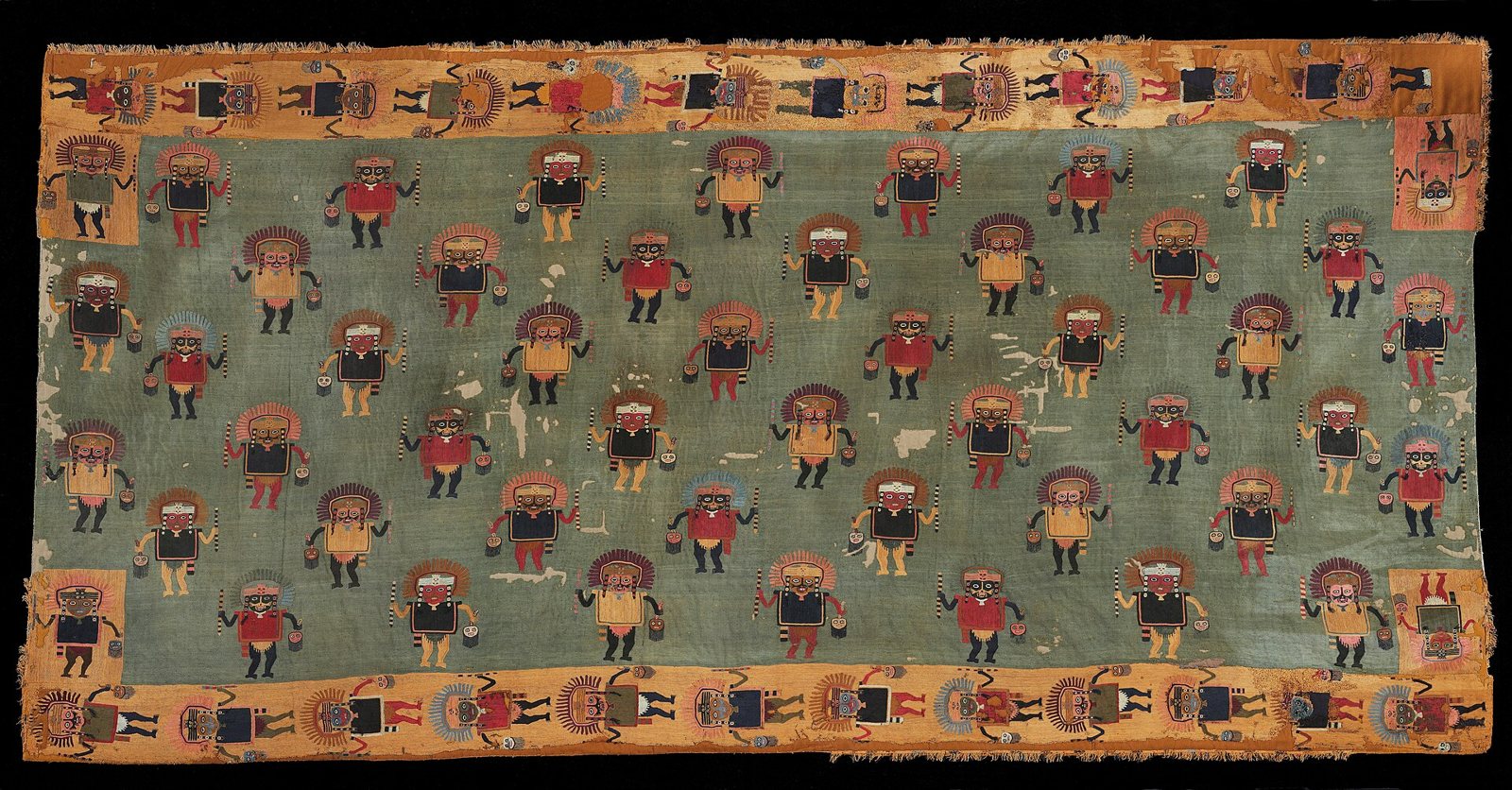
The Peruvian archaeologist Julio C. Tello led the work that brought the cemeteries to wider attention. Working with Samuel Lothrop and local assistants, he identified the cemeteries of Arena Blanca, Cerro Colorado and La Puntilla on July 26, 1925, and excavations ran from August 1925 through 1930, according to the museum's account of Tello's excavations. Tello told apart two burial traditions, Cavernas and Necrópolis, by tomb form and funerary context. His 1927 excavation at Wari Kayan produced richly wrapped funerary bundles, including the one numbered Paracas 298, later studied by the Lima museum in its publication Arqueológicas N.º 30.
So, why did the Paracas shape their children's skulls? A peer-reviewed study of 159 individuals from the Cerro Colorado cemetery looked at modification in the Cavernas period, which the authors date to about 550 to 200 B.C. The study, Intentional cranial modification in Paracas Cavernas, treats the shaped skulls as evidence of a deliberate social practice. The forms varied, and the authors examined whether shaping related to identity, ethnicity, status and burial context. Their evidence does not support a single explanation for every Paracas skull. What it does support is that the shapes come from binding in infancy, which is also the plain answer to whether the skulls are alien: the study treats them as the work of a human community, and the Peruvian museums that hold the material describe them as human remains.
These are the remains of real people, and they are cared for as Peruvian cultural heritage. Describing them as the museums do means keeping their funerary context in view.
The Maya
The Maya practiced head shaping from the Preclassic period through the Postclassic, across much of Mesoamerica. The anthropologist Vera Tiesler has studied about 2,000 Maya skulls and set them beside images and colonial-era descriptions. Her work in Becoming Maya identifies several forms, including erect and oblique modifications, and notes that some coastal communities also used superior flattening.
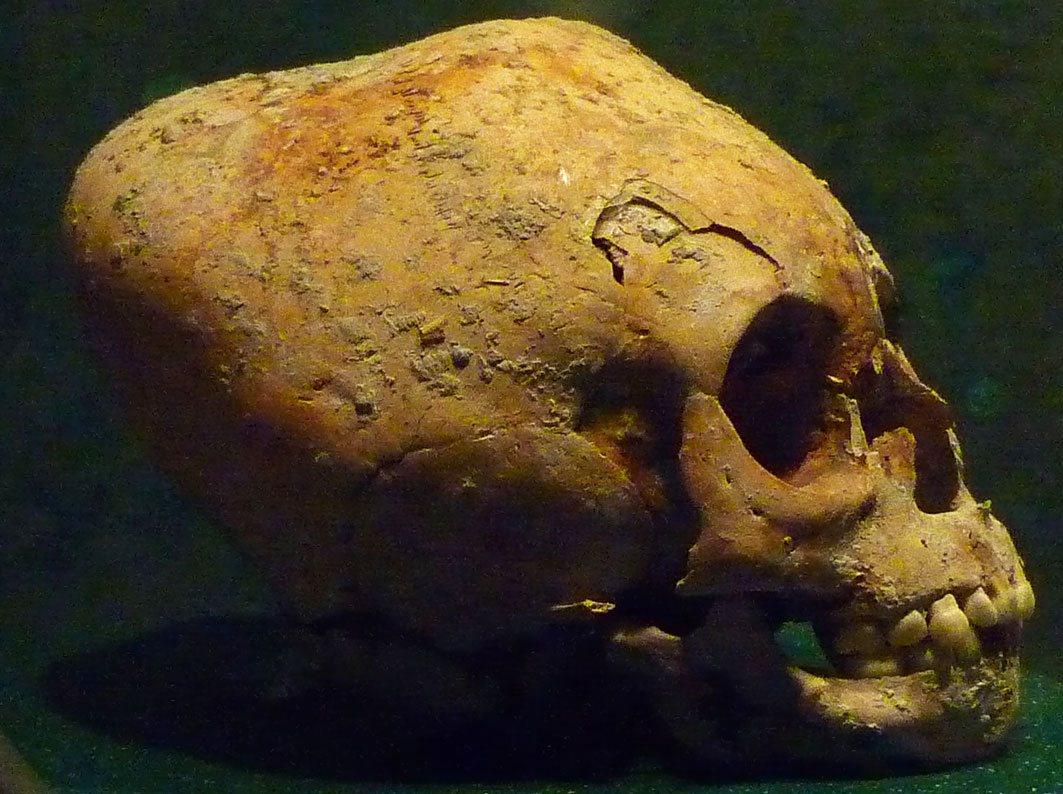
The shape carried meaning. It could signal belonging, ethnicity, social position, gender and upbringing, along with ideas about what a well-formed person looked like. Tiesler argues that head shaping belonged to childhood socialization, one of the ways caregivers passed community ideas about identity and gender to a new member. The practice was not uniform. Forms varied by region, period and community, and shaped and unshaped people could live in the same broader population. Her broader overview, Ancient Mesoamerican Cranial Modifications, lays out those regional patterns.
One caution applies to Maya art. Sculpture and painting sometimes show sloping or elongated heads, but an image cannot prove that the person shown had a shaped skull. The evidence comes from skeletons studied together with their context and dates.
Other places and peoples
Head shaping turns up on several continents. The communities below each have their own place, period and reasons.
Tap or hover a row to highlight it.
| Community | Place | Period | Method and meaning |
|---|---|---|---|
| CommunityParacas | PlaceSouth-central coast of Peru | PeriodAbout 800 B.C. to A.D. 200 | Method and meaningBinding in infancy; forms varied, with no single explanation |
| CommunityMaya | PlaceMesoamerica | PeriodPreclassic through Postclassic | Method and meaningErect, oblique and superior flattening; belonging, status, gender, upbringing |
| CommunityColca Valley peoples | PlaceColca Valley, Andes | PeriodA.D. 1100 to 1450 | Method and meaningCollaguas used longer, narrower forms; Cavanas used wider, squat forms |
| CommunityHun-Germanic period | PlaceCarpathian Basin, including northeastern Hungary | PeriodFifth and sixth centuries A.D. | Method and meaningFronto-occipital deformation |
| CommunityUpper Chinookan peoples | PlaceColumbia River region, including Washington state | PeriodHistoric period | Method and meaningCradleboards; a mark of free birth, beauty and distinction |
| CommunityMangbetu | PlaceNortheastern Democratic Republic of the Congo | PeriodDeclined in the twentieth century | Method and meaningLipombo, binding with braided twine; an admired ideal |
| CommunityArawe | PlaceNew Britain | PeriodInto the 1930s | Method and meaningBark-cloth bindings |
In the Colca Valley of the Andes, the anthropologist Matthew Velasco has studied modified skulls from the years A.D. 1100 to 1450. Cornell University's summary of his work notes that the Collaguas used longer, narrower forms and the Cavanas wider, squat ones, so shape marked group identity.
In Europe, modified skulls appear in the Carpathian Basin during the Migration Period, especially the fifth and sixth centuries A.D. A study of nine crania from northeastern Hungary found fronto-occipital deformation linked to the Hun-Germanic period. The authors suggested the custom may have traveled from the Eurasian steppe through Crimea, while stating that the evidence does not prove every modified skull belonged to a Hun.
Among the Mangbetu of northeastern Democratic Republic of the Congo, the practice was called *lipombo*. Caregivers bound an infant's head with fine braided twine or other wrapping to produce an elongated form. The Metropolitan Museum describes the shape as highly admired and tied to Mangbetu visual culture, seen in elaborate hairstyles and sculpted vessels. Smithsonian records describe lipombo as a status marker among ruling families that grew into a wider ideal of beauty. The custom declined and was outlawed under Belgian colonial rule, reportedly surviving into the mid-twentieth century.
Did Native Americans elongate their skulls? Some did, and some flattened them. Upper Chinookan communities along the Columbia River used cradleboards to flatten an infant's forehead and shape the skull. The National Park Service's ethnohistorical overview describes the form as a visible mark of free-born Chinookans, as distinct from enslaved people. Smithsonian repatriation records document flattened crania associated with Upper Chinookan groups, including remains connected with the Columbia River region and Washington state, and those records note consultation with tribal nations.
King Tut and the Amarna royal family
Many readers come to this subject through Egypt. Statues and reliefs from the Amarna period show Akhenaten, Nefertiti and their daughters with long, sweeping heads, and people often cite those images as proof of head binding.
The skulls tell a different story. A published study of the Amarna royal family reviewed the KV55 skull, widely linked to Akhenaten, and reported that its shape fell within normal variation and gave no support to artificial deformation. Tutankhamun's skull has a cephalic index of 83.9, and the authors found no convincing sign of cranial deformation in the family. They conclude that the unusual proportions in royal art were most likely an artistic and religious convention. The oldest confirmed Egyptian case of artificial cranial deformation they cite dates to the sixth century A.D., long after Akhenaten's reign.
Did it hurt, and does anyone still do it?
The question that follows is usually whether head shaping damaged the brain. The anthropological evidence does not support that claim for the practice in general. Velasco's work on the Colca Valley skulls reports that the brain's volume does not change, although the shape of the cranial cavity does. The Hungarian study found no convincing evidence of chronic neurological disorder among the Hun-period individuals.
That does not make every case harmless. Excessive pressure, bindings that were poorly kept, skin injury or infection could have caused illness or death, and bones cannot give a full medical history for every infant.
Some communities kept the practice well into modern times. The Pitt Rivers Museum records that the Arawe of New Britain used bark-cloth bindings into the 1930s, and Mangbetu lipombo faded during the twentieth century.
Head shaping in time
Tap or hover a step to follow the order.
c. 800 B.C. to A.D. 200
The Paracas society flourishes on Peru's south-central coast
c. 550 to 200 B.C.
Period of the Paracas Cavernas sample studied at Cerro Colorado
A.D. 1100 to 1450
Cranial modification expands in the Colca Valley of the Andes
Fifth to sixth centuries A.D.
Modified skulls appear in Hun-Germanic-period Hungary
July 26, 1925
Julio C. Tello identifies major Paracas cemeteries
1925 to 1930
Tello's Paracas excavation program continues
Twentieth century
Mangbetu lipombo survives into mid-century and Arawe shaping continues into the 1930s
Seeing Paracas material today
Paracas objects are held in Peruvian museums. The Museo de Sitio Julio C. Tello, inside the Paracas National Reserve, has permanent galleries devoted to Paracas material and is run by Peru's Ministry of Culture. The Museo Nacional de Arqueología, Antropología e Historia del Perú in Lima holds Paracas funerary material and has published conservation and research work on Tello's excavated bundles. The Julio C. Tello museum's official page lists its location, hours and prices.
Confirm with the museum which objects are on display before you travel, and before you plan around a particular skull, since display status can change. These are people's remains, and the museums describe them with attention to their funerary setting; that is the spirit to bring to a visit.
Head shaping check
Answer every question to check.
Questions people ask
What causes elongated skulls?
Most of the famous ones come from intentional infant head shaping, using bindings, cloth, boards, pads or cradleboards while the skull was still growing. Disease, injury and natural variation can also change head shape, which is why a specialist has to examine the bones.
Why did the Paracas shape their babies' skulls?
It was part of the social and funerary practices of Paracas society, and there is no single explanation for every individual. Researchers study the shapes, cemeteries, burials and objects together to look for links to identity, community and social position.
Why did the Maya shape their heads?
The reasons were tied to identity, belonging, upbringing, gender, status and cultural ideas about the body. Forms varied by region and period, according to Vera Tiesler's work.
Why was King Tut's skull elongated?
The evidence does not show that it was. A study reports a cephalic index of 83.9 for Tutankhamun and no convincing sign of cranial deformation in the Amarna family. The long heads in royal art are better explained as an artistic and religious convention linked to Akhenaten's reforms.
Did elongated skulls cause brain damage?
Available evidence does not show that ordinary intentional head shaping caused chronic neurological damage. The brain kept growing inside the reshaped skull, though excessive pressure or infection could bring risks.
Do any cultures still elongate skulls?
Head shaping continued into the twentieth century among communities including the Arawe of New Britain and the Mangbetu of the Democratic Republic of the Congo.
What is an elongated skull called?
Anthropologists use the terms intentional cranial modification, artificial cranial deformation or head shaping. "Elongated skull" describes the shape without naming the cause.
Who were the Paracas?
They were a society of the south-central coast of present-day Peru, active from about 800 B.C. to A.D. 200 and known for textiles, ceramics and funerary complexes on the Paracas Peninsula and in nearby valleys.
Where to go next
Head shaping is one of several ways communities have worked on the skull itself. For another Andean practice, read about trepanation, the opening of the skull that surgeons performed in ancient Peru and elsewhere. If you would like to know how specialists read bones, see what bones tell archaeologists, then browse human skull facts and the stories of ossuaries around the world.
Terms in this story
Tap a term to see what it means.
Intentional cranial modification. The deliberate reshaping of an infant's skull by steady pressure while the bones are still flexible. Also called artificial cranial deformation or head shaping.