

No. 004
What Can a Skeleton Tell an Archaeologist About a Person?
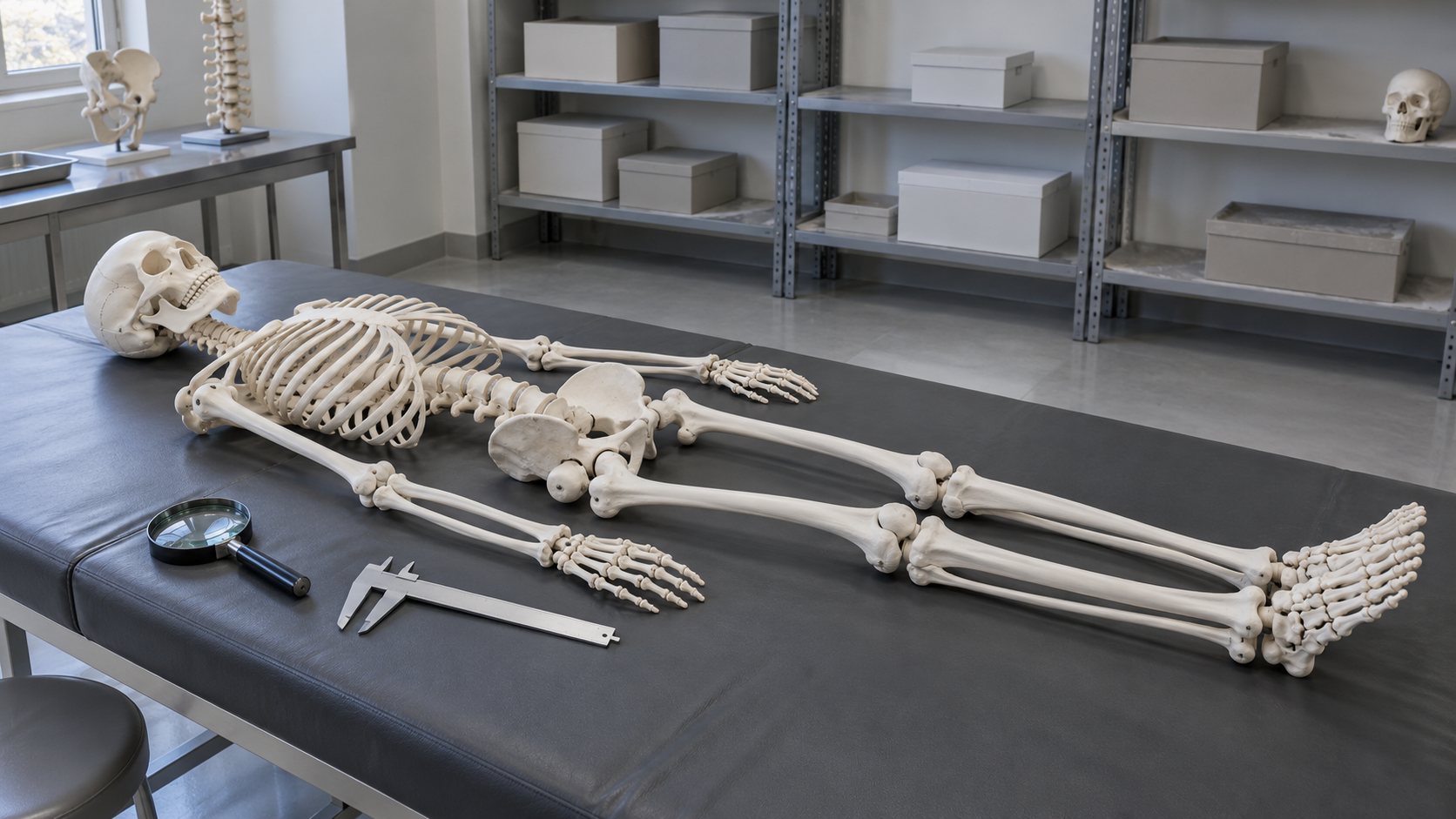
A skeleton can give archaeologists an estimate of a person's age at death, biological sex, injuries, some illnesses, dental health, childhood stress, diet, movement and, with ancient DNA, family ties. Every one of those is an estimate or a probability, and the picture is strongest when several parts of the skeleton agree. So, how does a museum label end up saying a woman was about 40, ate maize and grew up somewhere else? The answer is teeth, a pelvis, a few isotopes and a lot of careful comparison. Teeth are the best diary of all, because enamel forms in childhood and keeps its chemistry for life.
How age is read: a range, not a birthday
Archaeologists do not read an age off a skeleton the way you read a birth date. They read changes in the body and turn them into a range, as described in a review of age estimation in forensic anthropology.
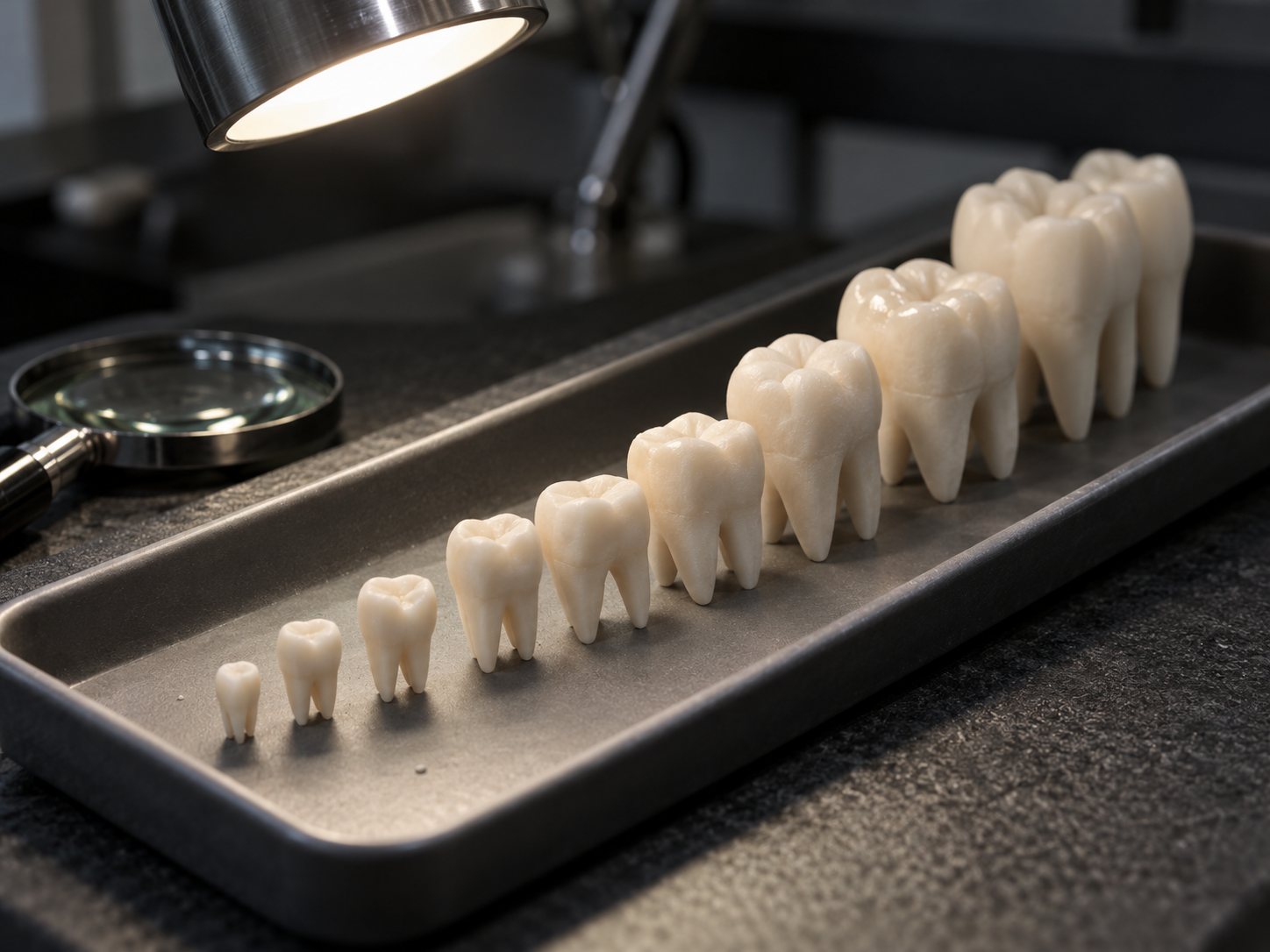
- Children are aged mostly by their teeth: when baby teeth are lost, when adult teeth come in, and how far the roots have formed. Bone size and the growth plates help too.
- Teenagers and young adults are aged by growth plates, the soft joints at the ends of bones that fuse as the body finishes growing. The iliac crest of the hip and the inner end of the collarbone are two. The third molar, or wisdom tooth, gives a broad estimate for late adolescence and young adulthood, though it develops at different speeds in different people.
- Adults are aged by wear and change. Analysts look at the pubic symphysis, where the two hip bones meet in front, along with a joint surface of the pelvis, the ends of the ribs near the breastbone, tooth wear and signs of joint wear. The Suchey-Brooks method scores the changes in the pubic symphysis.
What about the skull? Cranial sutures, the seams between skull plates, tend to close with age, so they can add something to an adult estimate. They close unevenly, though, and some stay open into old age, so a study of suture closure says they should not be used alone. For children, teeth are far more useful than the skull.
The honest result is a range, and it widens with age. Nutrition, disease, hard work and individual variation all change how a body ages. A person described as "about 40" is a range of years, not a birth date.
How sex is estimated: the pelvis leads, the skull helps
For adults, the pelvis is usually the most informative part of the skeleton. Analysts look at the shape of the pubic arch, the notch at the back of the hip bone and the overall form of the pelvis. These features reflect average differences linked to childbearing, but there is overlap between people.
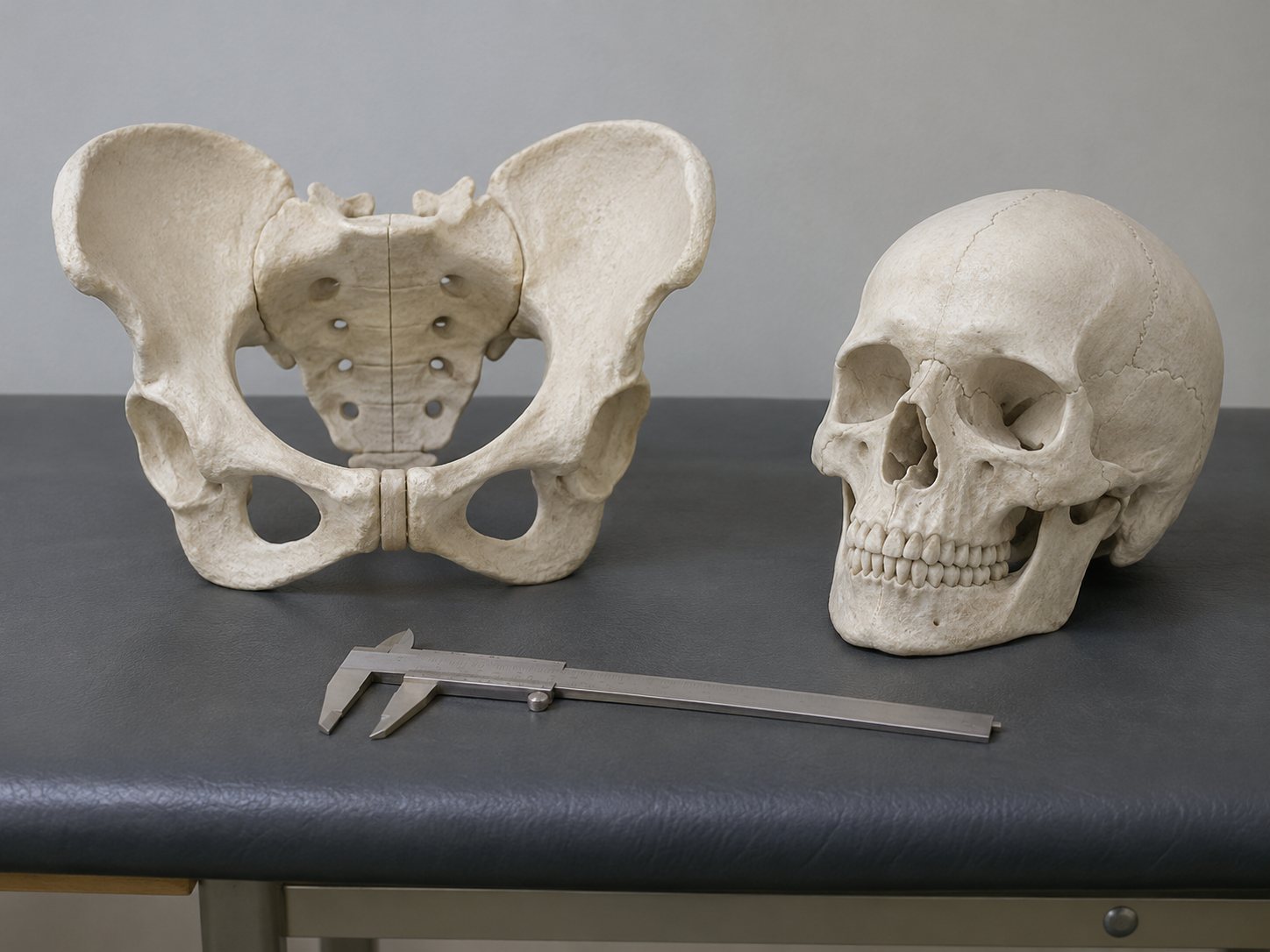
The skull gives a second opinion, from the brow, the bony bump behind the ear, the back of the skull and the jaw. It is less reliable. In a well-known comparison, Spradley and Jantz reported that measurements of the body below the skull classified sex correctly about 88 to 94 percent of the time in their reference data, while the best skull-only models did not go above 90 percent. Long bones also help with stature and sex.
Two cautions matter. First, this is an estimate of biological sex, not of gender identity. Second, the result is a probability. A skeleton may be classed as probable male, probable female or indeterminate, depending on how well it survived, who is looking and which reference collection is used.
What teeth and bone chemistry say about food and home
This is how the "ate maize and grew up somewhere else" part is worked out. Teeth and bone take up chemical signatures from food and water during life, and scientists measure them as isotopes.
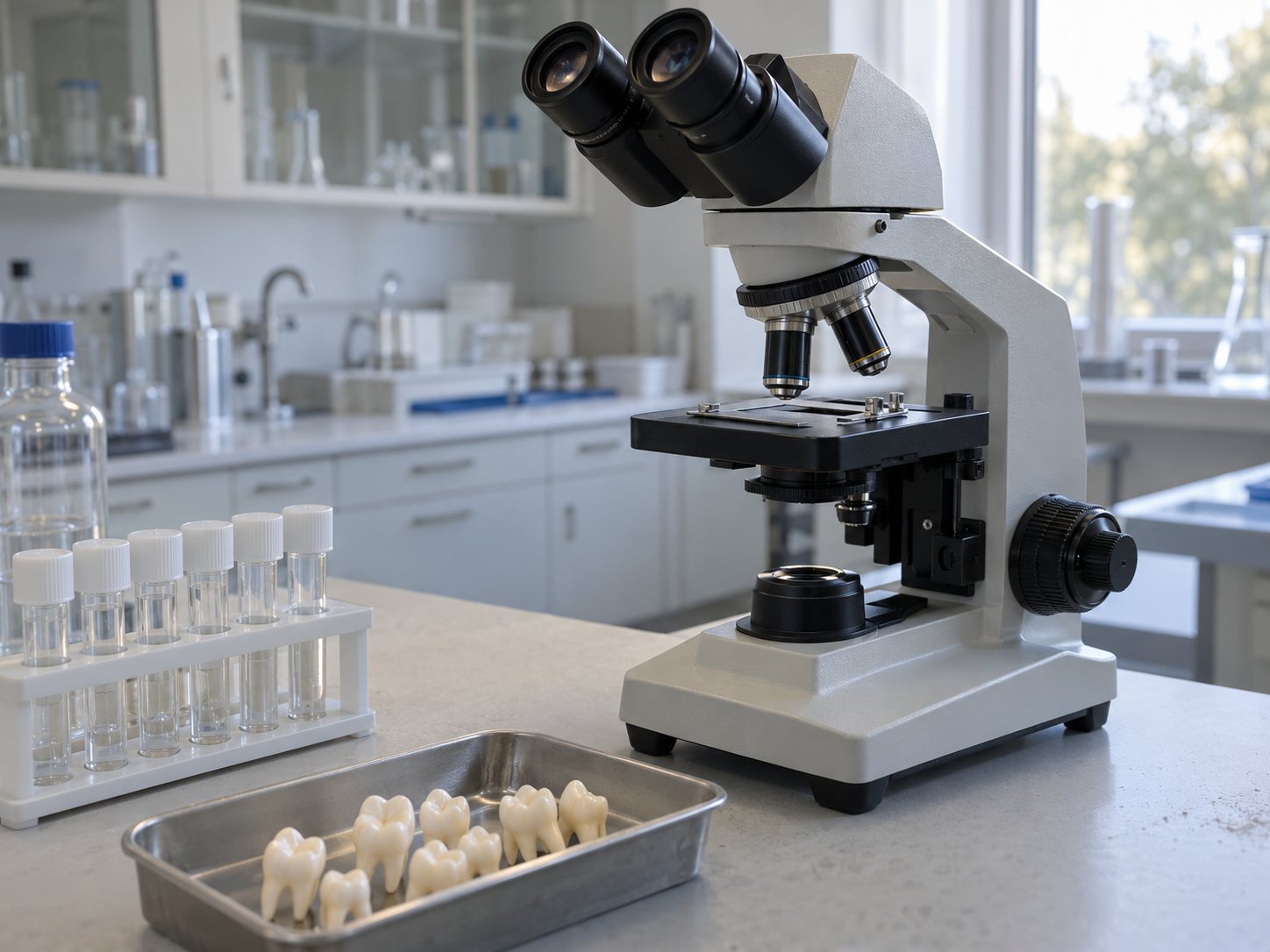
- Carbon can separate plants like wheat and rice from plants like maize, millet and sorghum, and can show marine foods.
- Nitrogen rises as you go up the food chain, so it hints at how much meat, freshwater fish or seafood someone ate. Nursing and dry climates change it too.
- Strontium reflects the local rock, passed on through food and water. Tooth enamel forms in childhood and does not rebuild itself, so it keeps a childhood signal.
- Oxygen reflects drinking water and climate, and supports the strontium evidence when scientists look at movement.
These methods do not name a hometown. Scientists compare a person's values with the local geology, water, plants and animals, and with the rest of the archaeology. Food brought in from somewhere else can imitate a newcomer's signal, and different regions can have overlapping values. So, the label "grew up somewhere else" means the numbers in the teeth do not match the burial place.
Several case studies show how this works. In Roman Gloucester, England, oxygen and strontium values pointed to people with both British and non-British origins. In Roman Winchester, up to a quarter of the people sampled were read as incomers. At Tikal, in Guatemala, strontium and oxygen were used to look at migration. In early medieval County Meath, Ireland, two people were statistical outliers likely to be migrants. And a Late Mesolithic woman from Aizpea, in northern Iberia, was studied tooth by tooth for diet and movement from childhood into adulthood.
Injuries, illness and a life of work
Bone keeps some of the story of what happened to a body, especially when the person lived long enough to heal. The Natural History Museum in London explains many of these signs in Analysing the bones.
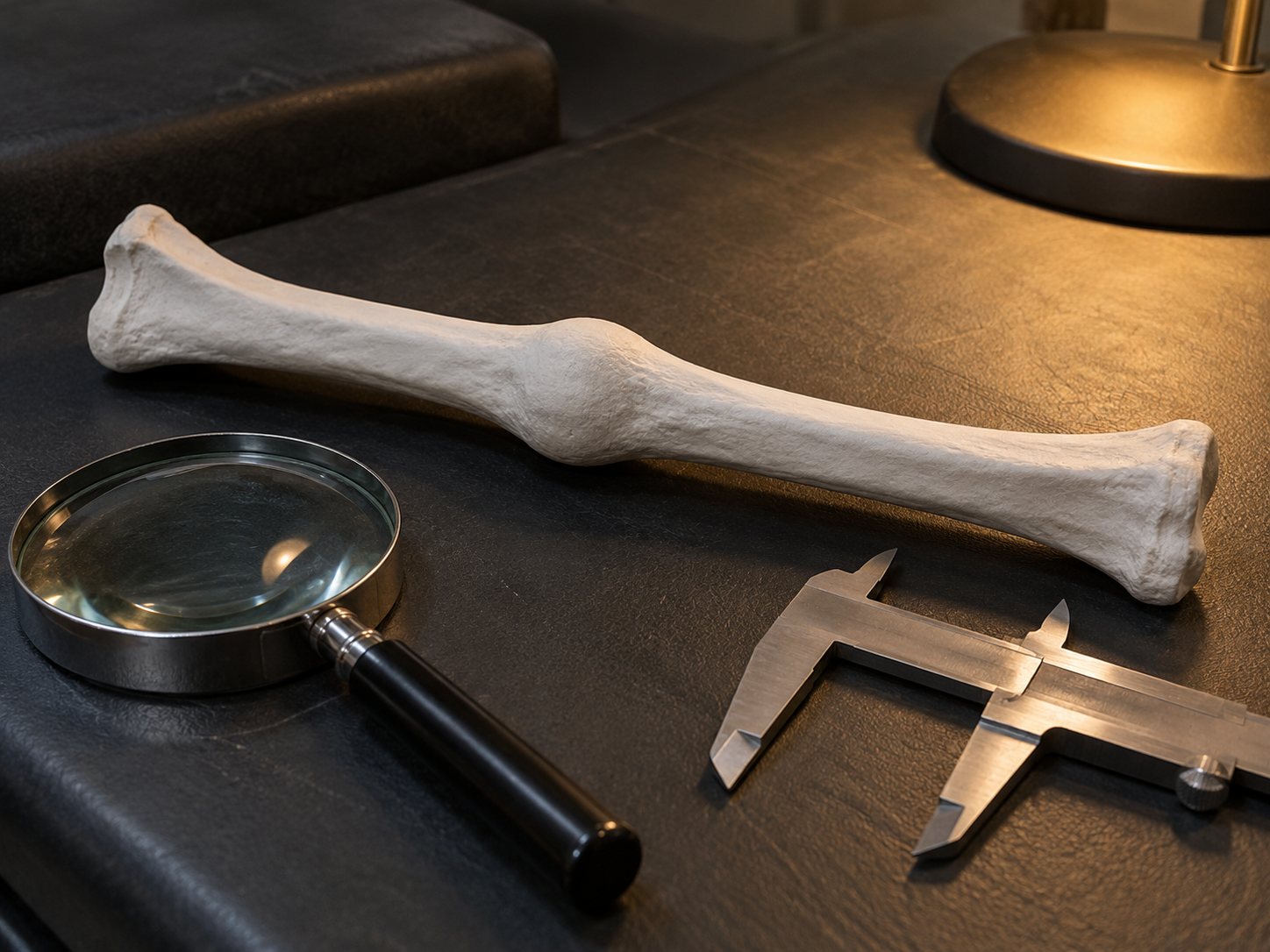
A healed fracture leaves new bone, called a callus, around the break. That shows the person survived the injury. A break with no healing may mean an injury close to the time of death, but working out cause and manner of death takes careful analysis and other evidence. In the Natural History Museum's London collection, many of the fractures had healed, and only a small number showed possible evidence of fatal blows.
Trepanation, a deliberate opening cut into the skull, can be recognised by regular edges and signs of bone regrowth. A Bronze Age skull from Jericho, dated to about 2200 to 2000 BCE, has four openings that had begun to heal, which means the person lived for a time after each one. Our guide to trepanation history tells that story in more detail.
Other signs are quieter. Arthritis can polish and wear joint surfaces. Dental disease leaves cavities, hardened plaque, abscesses and lost teeth. Repeated activity can contribute to tooth wear or larger muscle attachments, but one feature rarely proves a job.
Childhood stress shows up in two places. Linear enamel hypoplasia is a line of interrupted tooth growth, and Harris lines are growth-arrest lines in the long bones. Both can come from infection, poor nutrition or other stress, so they are nonspecific. A study of people from Korea's Joseon period showed Harris lines in 39.4 percent of the sample and cautioned against over-reading the cause.
Family ties and ancestry: what ancient DNA adds
Ancient DNA can answer questions that bones alone cannot. It can show biological relationships such as parent and child or siblings, maternal and paternal lines, ancestry patterns and population movement, some inherited conditions, disease germs when they survive in bone or teeth, and a genetic estimate of sex. Ancestry here means the patterns and relationships that geneticists describe among populations, never a ranking of people.
At Eulau, Germany, burials of about 4,600 years ago included a parent and child and a possible nuclear family. At La Almoloya, in southeastern Iberia, genome-wide data from 68 people built family trees reaching up to five generations. Adult men and women buried together there were usually not genetically related, though some couples were linked through shared children. That changed how archaeologists read double burials once assumed to be couples or relatives. A study of a pre-Columbian Andean community looked at kinship burial patterns too.
There are limits. Old DNA is easily contaminated, may survive poorly and covers only part of the genome. Being related by genes is not the same as being family in a social sense, and genetic ancestry does not by itself tell you someone's language, culture, identity or birthplace.
Is it human or animal bone?
For a whole bone, the first step is shape. Each bone has a characteristic outline, proportions, joint surfaces and landmarks, and analysts compare it with human and animal reference collections. Broken or burned pieces are harder. Then they may use X-rays, microscopy, a close look at the bone's internal structure called histology, DNA or protein methods. The Royal Society's forensic anthropology primer for courts cautions that some fragments can be confirmed as bone without being confidently called human or non-human. Hillier and Bell make a similar point: histology helps, but depends on which species the reference material covers. If you have an animal skull in your hands, our guide to what to do with a found animal skull is the place to start.
What a skeleton cannot tell you
A skeleton is not a biography. Age ranges widen as people get older. Sex is a probability. Diet shows as a broad pattern rather than a menu. Many illnesses leave no mark on bone at all. Even trained analysts may be able to say only a broad age range, a probable sex and general patterns of diet or movement, which is why careful labels say "probably" and "about."
Tap or hover a row to highlight it.
| Question | Main evidence | Qualification |
|---|---|---|
| QuestionHow old was the person? | Main evidenceTeeth, growth plates, pubic symphysis, rib ends, cranial sutures | QualificationAdult ranges widen with age |
| QuestionWhat was the likely biological sex? | Main evidencePelvis, skull, postcranial measurements, DNA or proteins | QualificationProbabilistic estimate |
| QuestionWhat did the person eat? | Main evidenceCarbon and nitrogen isotopes, dental calculus, wear | QualificationBroad dietary patterns, not a complete menu |
| QuestionDid the person move? | Main evidenceStrontium and oxygen in tooth enamel and bone | QualificationRequires local environmental comparison |
| QuestionDid the person survive injury or illness? | Main evidenceHealed fractures, remodeling, lesions, dental disease | QualificationMany diseases leave no skeletal trace |
| QuestionWere people related? | Main evidenceAncient DNA, sometimes supported by burial context | QualificationGenetic kinship is not identical to social kinship |
| QuestionIs the fragment human? | Main evidenceMorphology, microscopy, histology, DNA or proteins | QualificationSome fragments remain indeterminate |
What each part of the body remembers
Tap a card to bring it forward.
- Tooth enamel: Mainly the period when the crown formed, often childhood
- Dentine: Can keep sequential changes during tooth formation
- Bone collagen: An averaged food signal over the last years before death, often about a decade for adult bone
- Remodeling bone: Later-life conditions, though it can erase earlier signals
- Healed fracture: Records an injury and survival before death
- Unhealed trauma: May point to injury near the time of death, but does not automatically prove the cause of death
Read the bones
Answer every question to check.
Questions people ask about skeletons
What can a skeleton tell you about a person?
A skeleton can give estimates of age at death, biological sex, stature, injuries, some diseases, dental health, childhood stress, diet, movement and biological relationships. No single bone gives a complete life story, and each result carries the limits of its method.
How can the skull be used to determine age?
Analysts look at tooth formation and wear, the development of the skull base and how far the cranial sutures have closed. Teeth work best for children, while sutures and wear changes add to adult estimates. The result is an age range rather than an exact age.
What bones are most useful for developing a profile of a person?
The pelvis is usually best for adult sex, teeth for a child's age and for chemical or DNA work, long bones for stature and sex, and the skull for age, sex, injury and dental health. A profile is strongest when several of these agree.
Do archaeologists lick bones?
Some did in the past, as a quick test of whether an object was porous bone or stone, but the habit is outdated. It can contaminate a sample, and it is not appropriate for human remains or anything meant for chemical or DNA testing, as Ancient DNA Comes of Age points out.
¿Qué se puede saber de una persona por su cráneo?
The skull can give estimates of age and biological sex, plus signs of injury, illness, diet and cultural practices such as head shaping or trepanation. These conclusions are probabilities and depend on how well the bone survived and which method was used.
¿Cuáles son los 3 tipos de cráneos?
The traditional shape terms are dolicocéfalo, braquicéfalo and mesocéfalo, meaning long, short and in-between head proportions, from length compared with width. They only describe shape; they say nothing about worth, identity or ability, and scientists do not use them to rank populations.
If you want to keep going, read about the oldest human skull ever found, how scientists work out how old bones are, the bones in the human body and the bog bodies that peat kept for 2,000 years. Our human skull facts cover the skull itself.
Terms in this story
Tap a term to see what it means.
Pubic symphysis. The joint at the front of the pelvis where the two hip bones meet; its changes with age are scored in the Suchey-Brooks method.