No. 022
What Does a Skull Tattoo Mean? Motifs, History and What Changes the Meaning
A skull tattoo does not have one universal meaning. What it says depends on the tradition it comes from, the images drawn around it and the reason the wearer chose it. In American tattooing, the skull belongs to sailor, military and traditional flash vocabularies. In the Mexican and Mexican American celebration of Día de Muertos, a decorated calavera is a memorial image. In older European art, a skull beside an hourglass is a reminder that time runs out. So, the most honest answer is that the skull gives you a vocabulary, and your own reason supplies the sentence.
Where the skull tattoo comes from in American tattooing
Skulls turn up in American tattoo history in the late nineteenth and twentieth centuries, mostly in maritime and military settings. The U.S. Navy describes sailors' tattoos as marks of service, travel, patriotism and personal identity. The San Francisco Maritime National Historical Park names the Honolulu tattooist Norman "Sailor Jerry" Collins, active mainly in the mid-twentieth century, as a major carrier of traditional flash, the ready-made designs that hung on shop walls.
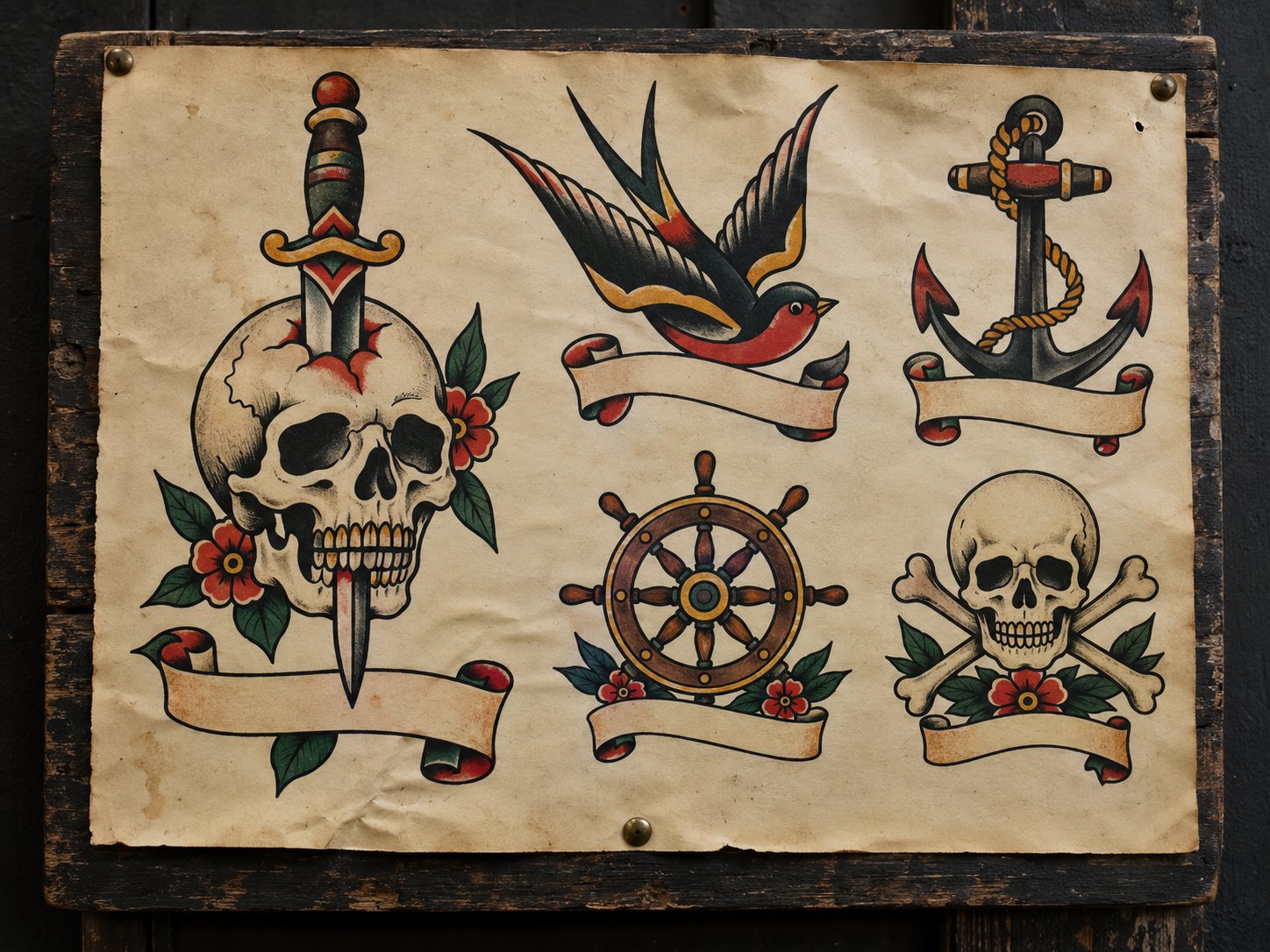
War produced its own skull. A Smithsonian National Air and Space Museum feature on World War II tattoos, drawing on the Lyle Tuttle collection, records the phrase "Death before Dishonor," sometimes shown as a dagger through a skull. It was tied to courage, honor, bravery, morale and comradeship among service members. The Smithsonian American Art Museum also holds twentieth-century tattoo flash with skull and sailor imagery, and lists it as public domain.
So, a traditional skull today can point toward mortality, danger, military identity, maritime culture, remembrance, or simply a love of an old tattoo style. The text around it, where it sits on the body, any service connection and the wearer's own intention all change how it reads.
What the added motifs change
A skull rarely travels alone, and what you pair it with matters. The honest rule for every pairing below is that meanings belong to particular artists, traditions and wearers, and they are not fixed.
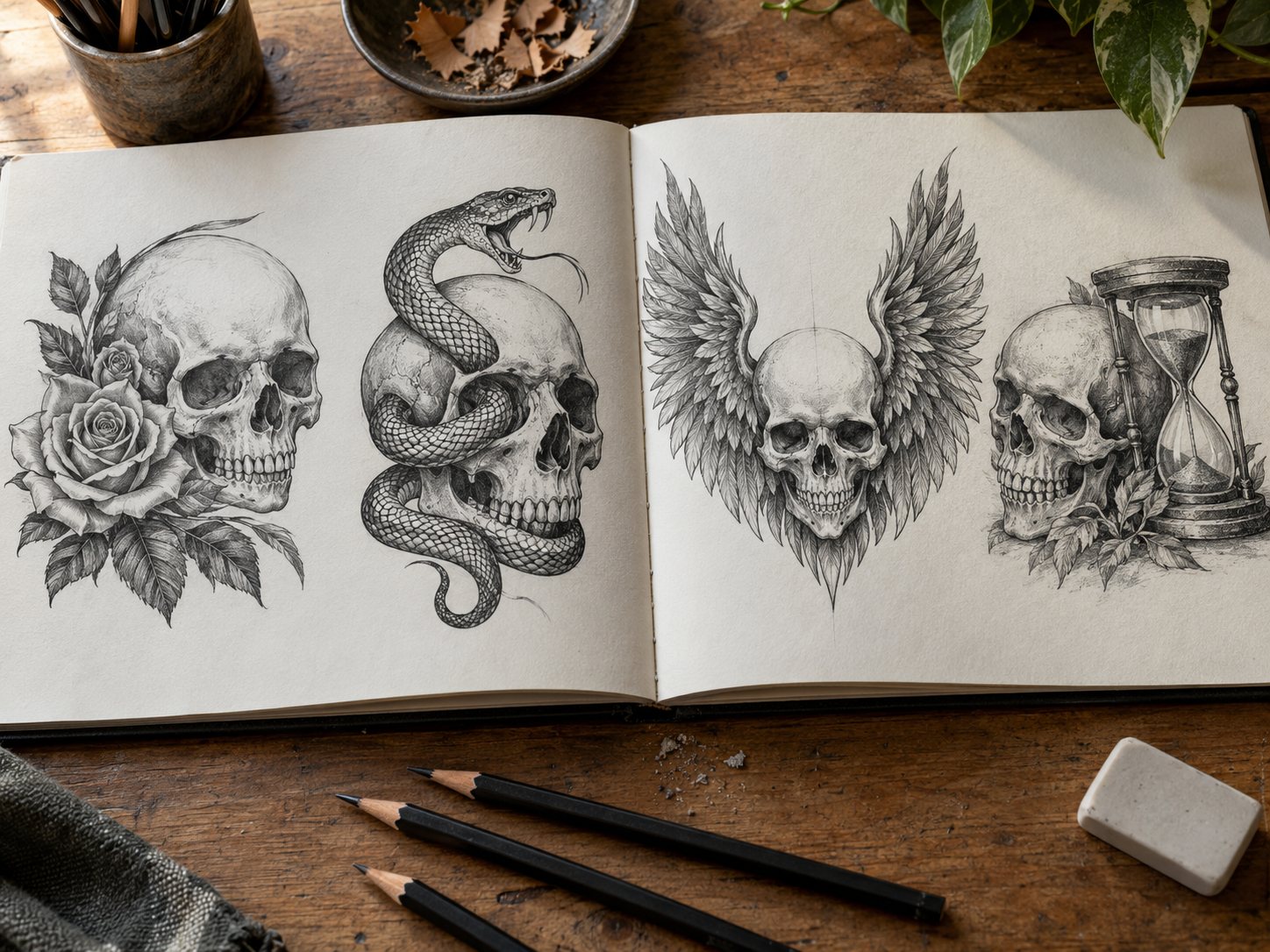
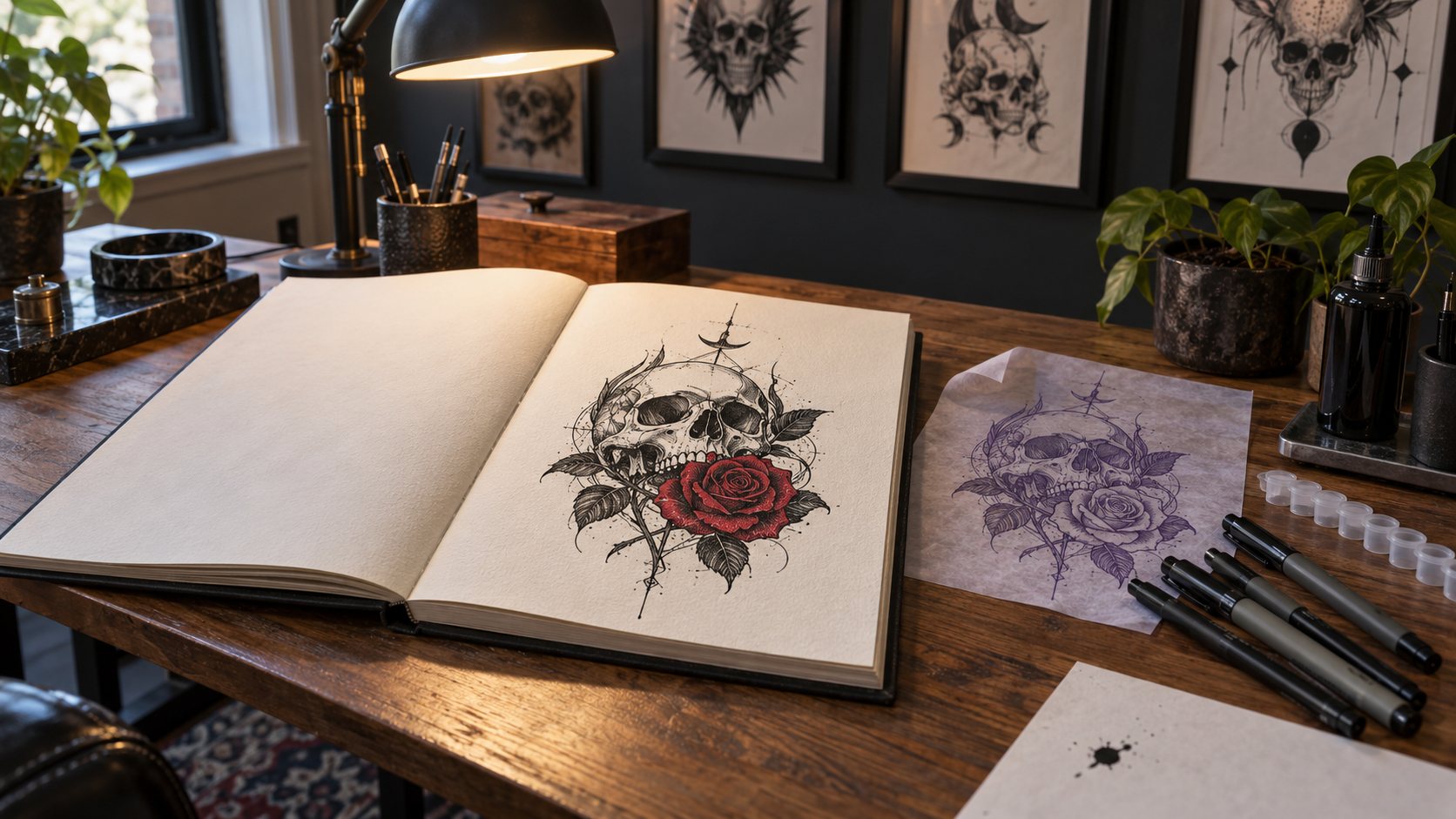
Skull and rose. This is a recurring pairing in modern American traditional tattooing, often read as beauty, love and life set against mortality. It is a common composition, and no single historical meaning is attached to it.
Skull and snake. The meaning shifts with the tradition. In European Christian imagery, the serpent can evoke temptation and death. In other traditions, snakes can stand for protection, renewal or cycles of change. A tattoo shop's reading of the pair is an interpretation, not a record of history.
Skull and dagger. The clearest documented reading comes from the World War II "Death before Dishonor" designs described above.
Three skulls. Singer Kane Brown has explained his three-skull tattoo as a version of "see no evil, hear no evil, speak no evil", using skulls and flowers in place of the traditional three monkeys. That is one wearer's meaning, and it is not a code. Other wearers use three skulls for three people, three memories, a life cycle, past, present and future, or just a balanced look. If you are choosing a number, you are free to decide what yours stands for.
Winged skull. Wings appear on skulls in memento mori and tattoo imagery and can suggest the soul, transcendence or the passage between life and death. No single fixed meaning goes with them.
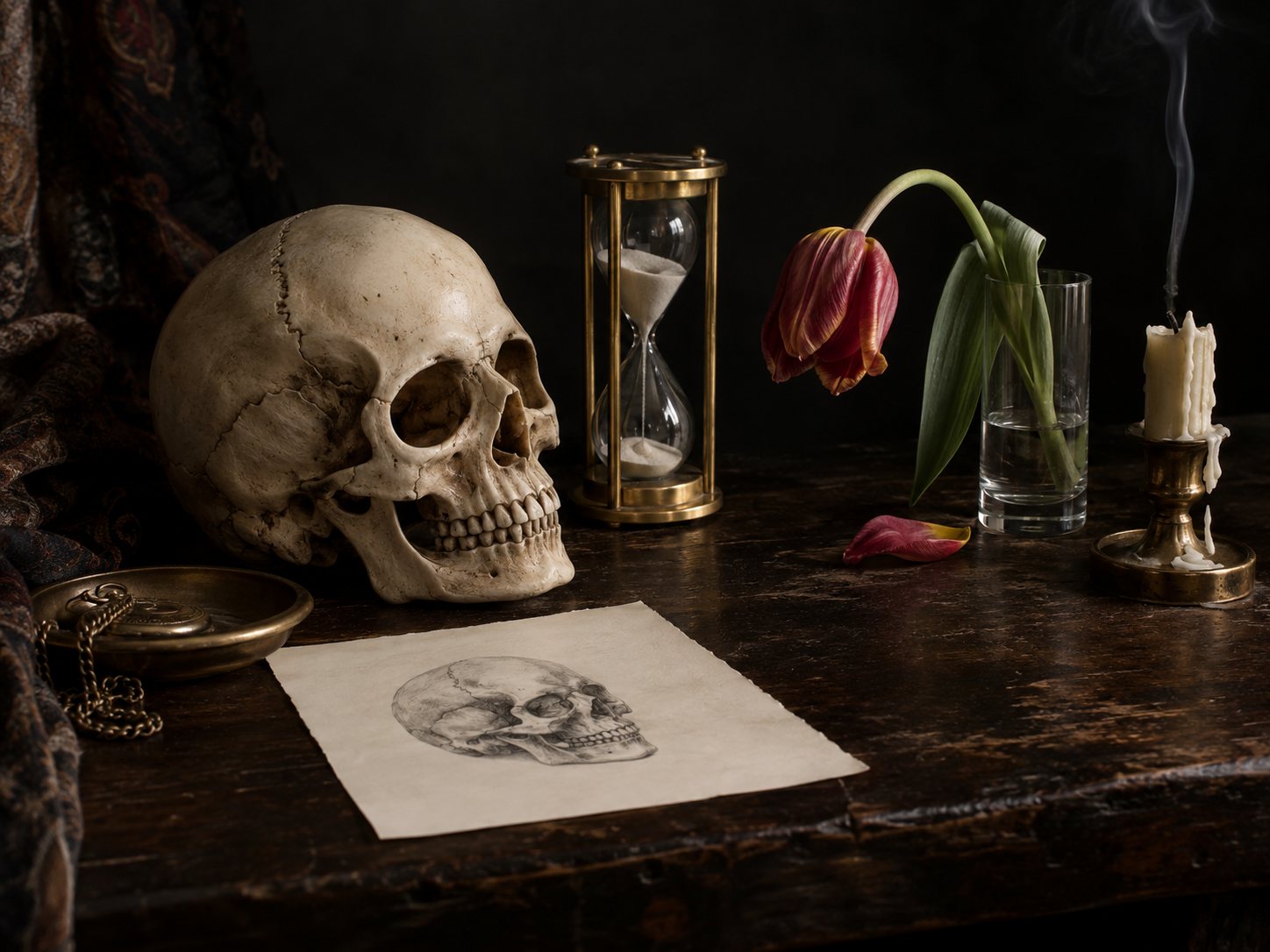
Skull and hourglass. This pairing belongs clearly to the older European tradition of vanitas and memento mori art, where the two objects say that life is short and time is passing. A 1537 anatomical woodcut by Johannes Dryander in the Wellcome Collection already put a skull and an hourglass together. A modern tattoo may borrow that vocabulary or carry a purely personal meaning.
Memento mori tattoos, in the wearers' own words
"Memento mori" is Latin, usually translated as "remember that you must die." People who wear it tend to describe it as a push to live on purpose, and they rarely describe it as a celebration of death. Paul Corgan wrote that his tattoo is "a reminder to never take a day for granted and live life to the fullest." Broadcaster Jake Humphrey described his wrist tattoo in a LinkedIn post: "Remember you will die. Some think that's bleak. It's not. It's freedom."
Memorial meanings run in a different direction. A client named Tauni told Floating Lotus Tattoo that a memento mori-style piece for her late partner was "a sign of acknowledging all the many gifts she gave me." These are personal testimonies and they do not show that every memento mori tattoo means the same thing. If the idea appeals, our story on what memento mori is and the guide to vanitas paintings cover the art history behind it.
The skull was a symbol long before the tattoo
Tattooists did not invent any of these pairings from nothing. Museums hold centuries of skull imagery that tattoo designs still borrow.
Tap or hover a row to highlight it.
| Skull image or tradition | Place and period | Documented association |
|---|---|---|
| Skull image or traditionVanitas skull | Place and periodNetherlands, 1603 | Documented associationBrevity of life and human folly |
| Skull image or traditionMemento mori skull | Place and periodWestern Europe, fifteenth to seventeenth centuries | Documented associationReminder of death and life's transience |
| Skull image or traditionSkull-shaped watch | Place and periodGermany, about 1660 to 1670 | Documented associationPassing time and mortality |
| Skull image or traditionPosada calavera imagery | Place and periodMexico, late nineteenth to early twentieth century | Documented associationSatire, popular print culture and Mexican skull imagery |
| Skull image or traditionDía de Muertos calavera | Place and periodIndigenous communities in Mexico, contemporary practice with pre-Hispanic and Catholic layers | Documented associationRemembrance and the temporary return of deceased relatives |
| Skull image or traditionModern tattoo skull | Place and periodContemporary global tattoo culture | Documented associationPersonal meaning varies by wearer, design and community |
In 1603, the Netherlandish artist Jacques de Gheyn II painted *Vanitas Still Life*, and The Met says its skull, bubble, cut flowers and smoking urn stand for life's brevity and human folly. A rosary terminal bead made in northern France or the southern Netherlands around 1500 to 1525 joins a pair of lovers with a skull, which The Met reads as a memento mori. The British Museum holds a German skull-shaped watch made around 1660 to 1670, from a tradition of skull objects that reminded owners of death and passing time.
Not every skull was solemn. A Japanese netsuke by Rantei, from the late eighteenth or early nineteenth century, shows a skeleton astride a skull, which The Met describes as a humorous statement about how short human life is. Plenty of tattoo wearers would recognize that mood.
Skull imagery and its documented moments
Tap or hover a step to follow the order.
About 1500 to 1525
A rosary terminal bead joins lovers and a skull
1537
Johannes Dryander's anatomical woodcut shows a skull and hourglass
1603
Jacques de Gheyn II paints Vanitas Still Life
About 1660 to 1670
A German skull-shaped watch is made
About 1880 to 1910
Posada skull prints circulate in Mexico
1892
Posada's Cupid's Skeleton is published
World War II
"Death before Dishonor" tattoo designs can include a dagger through a skull
1948 to 1986
Danzig Baldaev documents Soviet prison tattoos at Kresty prison
2008
UNESCO inscribes Mexico's Indigenous festivity dedicated to the dead
Sugar skull and calavera tattoos, with care
This is the style where the meaning belongs to a living tradition, so it deserves the most care. In Mexico, calaveritas de azúcar are part of Día de Muertos, held especially on November 1 and 2. Mexico's Secretaría de Cultura explains that the skull is tied to remembrance, to death as part of a continuing life cycle and to the altars built for the dead. Sugar skulls sit on altars and often carry the name of the person being remembered. UNESCO inscribed Mexico's Indigenous festivity dedicated to the dead in 2008, and describes the temporary return of deceased relatives and gifts of flowers, candles and food.
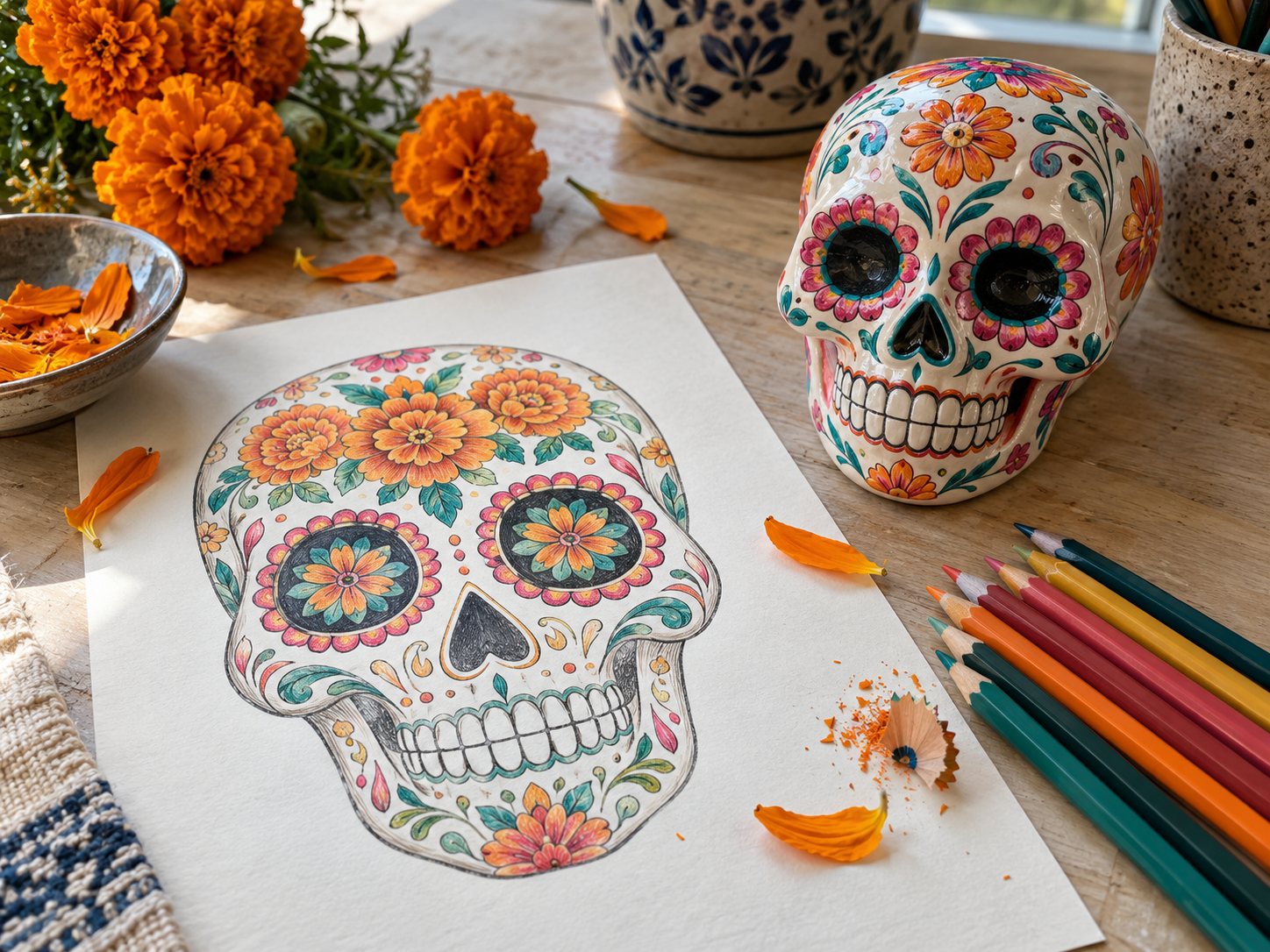
Mexican American families keep the tradition too. The Associated Press quoted sociologist Regina Marchi describing the Mexican American observance as a cultural expression and reported that taking part can be respectful when the meaning is not lost.
For a tattoo, the most grounded use is as a memorial image: a calavera that honors a particular person, perhaps with their name or a date. That makes the intention plain. If you have no connection to the tradition, ask a Mexican or Mexican American cultural practitioner or a tattoo artist familiar with Día de Muertos before you settle on a design. It also helps to know that the Posada calavera and La Catrina belong to a specific Mexican history, so a tattooed calavera is not automatically a religious or community statement. For the full story, start with Día de Muertos, sugar skulls and the story of José Guadalupe Posada.
Skulls with darker associations, and how to tell
A decorative skull does not mark someone as a criminal or an extremist. A few specific designs, though, carry histories worth knowing before you copy them.
The clearest is the SS Totenkopf. The Anti-Defamation League explains that the SS adopted a particular skull-and-crossbones design during the Nazi era, used by the SS-Totenkopfverbände, who guarded concentration camps, and by the 3rd SS "Totenkopf" Panzer Division. Neo-Nazis and other white supremacists later revived it. The ADL also stresses that not every skull-and-crossbones is a hate symbol; the exact design, the symbols around it, its placement and the surrounding statements all matter. Our piece on the skull and crossbones covers the wider history of the motif.
Prison tattoos have their own codes. Between 1948 and 1986, Danzig Baldaev documented more than 3,000 tattoos among prisoners at Kresty prison in Leningrad, and his archive describes tattoos as a coded language of status, offenses and prison experience. In that system a skull could mean something very different from an American traditional skull. Scholars also caution that the archive depends heavily on one collector and can carry uncertain dating or interpretation. The practical step is to ask your artist about the history of any design that looks like SS insignia or a prison code before you wear it.
Religion and skull tattoos
Most religious responses are about tattooing itself, not about skulls in particular, and each tradition speaks for itself.
In Judaism, Leviticus 19:28 is traditionally read as prohibiting permanent tattoos. In his Conservative responsum, Rabbi Alan Lucas argues that voluntary permanent tattooing remains prohibited, and he notes that tattoos forced on Holocaust victims are not the wearer's wrongdoing. My Jewish Learning adds that Jewish law does not generally bar a tattooed person from synagogue life or Jewish burial.
Sunni authorities commonly prohibit permanent tattoos. Islam Q&A states that permanent tattooing is prohibited whether or not it causes pain. Interpretations vary among Muslim communities and schools, so a Muslim considering a skull tattoo should ask a trusted scholar from their own tradition.
Christian views vary by denomination. Some Protestants apply Leviticus 19:28 as a continuing prohibition. Other traditions read the verse in its ancient setting, and they do not treat tattoos as forbidden for everyone. Skulls also have a long place in Christian art as a reminder of mortality and repentance, which our guide to skulls in Christianity covers.
Buddhism is not uniform. In Southeast Asia, sak yant tattooing is used for protection and devotion, sometimes under the direction of monks. That does not make every tattooed religious image welcome in every Buddhist community, so local custom and respect matter. If your faith matters to your decision, your own tradition's teachers are the ones to ask.
Quick answers about skull tattoos
These are the questions people type most often.
Is a skull tattoo a sin?
No religion or denomination gives a single ruling on skull imagery. Christian views differ, and GotQuestions, a Christian site, argues that the Christian scriptures do not directly address tattoos and that the decision turns on conscience, subject matter and motive. Leviticus 19:28 appears in a passage about mourning practices in ancient Israel, and how it applies to modern tattoos is a matter of interpretation.
What does a three skull tattoo mean?
It has no documented universal meaning. Kane Brown uses his three skulls for "see no evil, hear no evil, speak no evil," and other wearers choose three for people, memories or time. The design, the symbols around it and the wearer's own explanation decide.
What does a skull tattoo mean on a woman?
It has no separate meaning from the same tattoo on a man. It can express mortality, remembrance, personal style, survival, rebellion, cultural identity, or just a liking for the design. A floral skull, a portrait skull and a Mexican calavera draw on different visual traditions, but gender alone does not decide the meaning.
What does a skull tattoo on the hand mean?
It usually signals deliberate, visible self-presentation, not a fixed code. The Tattoo History Atlas notes that the style of the skull and the imagery around it matter more than the placement. A skull and crossbones can be read through pirate, military or extremist imagery if other distinctive elements are present.
¿Qué significa una calavera en el brazo?
Una calavera en el brazo puede expresar recuerdo, mortalidad, identidad personal, resistencia o gusto estético. With flowers, color and sugar-skull features, it can also allude to Día de Muertos, though the Posada calavera and La Catrina belong to a specific Mexican history and a tattoo is not automatically a community statement.
Does a tattoo have to have a meaning?
No. Some wearers pick a skull because they like how it looks, and that is a perfectly good reason. If you want a meaning, the traditions above are there to borrow from with care.
Skull tattoo meanings quiz
Answer every question to check.
Choosing the meaning you can stand behind
The skull is an old, flexible image, and it has been used by sailors, soldiers, painters, mourners and satirists. Learn where your design comes from, ask the artist about it, and decide what it says for you. For a closer look at one corner of this world, read about the skeleton tattoo, the skull and roses pairing, and the wider question of what a calavera means.
If you like the idea of remembering your mortality in everyday clothes, our Memento Mori skull tee is a shirt in that spirit.