No. 223
The Death Card in Tarot: What It Means and Where the Skeleton Came From
The Death card is number XIII, or 13, among tarot's major cards, and the people who write about reading tarot usually treat it as a card of endings, passage, release and renewal rather than a forecast that someone will die. A. E. Waite, whose deck gave the card its best-known image, wrote of change, renewal and rebirth when he explained it. If the skeleton just turned up in your spread, that is the reading most tarot authors would start from.
The skeleton itself is much older than fortune-telling. It began as one of the trump cards in a fifteenth-century Italian card game, took a different shape in the French decks of the Tarot de Marseille, and was redrawn in 1909 by the artist Pamela Colman Smith as the armored rider on a pale horse that most people recognize today.
What the card means to the people who read it
Tarot authors do not agree on one fixed meaning, and the differences are worth knowing, because they explain why two readers can look at the same card and say different things.
A. E. Waite gave the card a short list of keywords in his 1910 book, The Pictorial Key to the Tarot: "end, mortality, destruction, corruption." Those words sound grim, and he meant them seriously. In his longer explanation, though, he presents Death as a passage from a lower state to a higher one, with rebirth and renewal among the ideas attached to it. Waite's card, in other words, is about something finishing so that something else can begin.
The tarot writer Rachel Pollack treated tarot as a spiritual and psychological guide rather than a machine for telling the future. In her approach, what Death means comes through the question being asked, the spread it lands in and the reader's own relationship to the image.
The tarot author Yoav Ben-Dov went further. In his open-reading method, a card does not have a single meaning learned in advance. Meaning comes from what actually appears on the card and from its position among the other cards on the table. Read that way, "ending," "release" and "renewal" are interpretations that modern readers have settled on, not facts printed on the card.
Is the Death card bad, and does it mean someone will die?
It can be a heavy card. In many readings it speaks to grief, loss or an ending nobody asked for, and Waite's own keywords include "mortality" and "destruction," so there is no point pretending the card is cheerful. Modern readers also read it as change that has to happen, the close of one chapter before the next. Whether it lands as good news or bad depends on the question, the cards around it and the approach of the person reading.
What the card is not, in the work of any of these authors, is evidence that a person's physical death is coming. Waite's longer reading points toward passage and renewal, and Pollack and Ben-Dov both put meaning in the reading rather than in a fixed prediction. Drawing it, especially more than once, can be unsettling, and that is a natural reaction to a skeleton on a card. The card's long history is mostly a history of artists and card players, not of omens.
A skeleton born in an Italian card game
Tarot started as a game. According to the V&A, it developed in northern Italy during the fifteenth century as a trick-taking game called *tarocchi*, and Death was one of the game's trump cards.
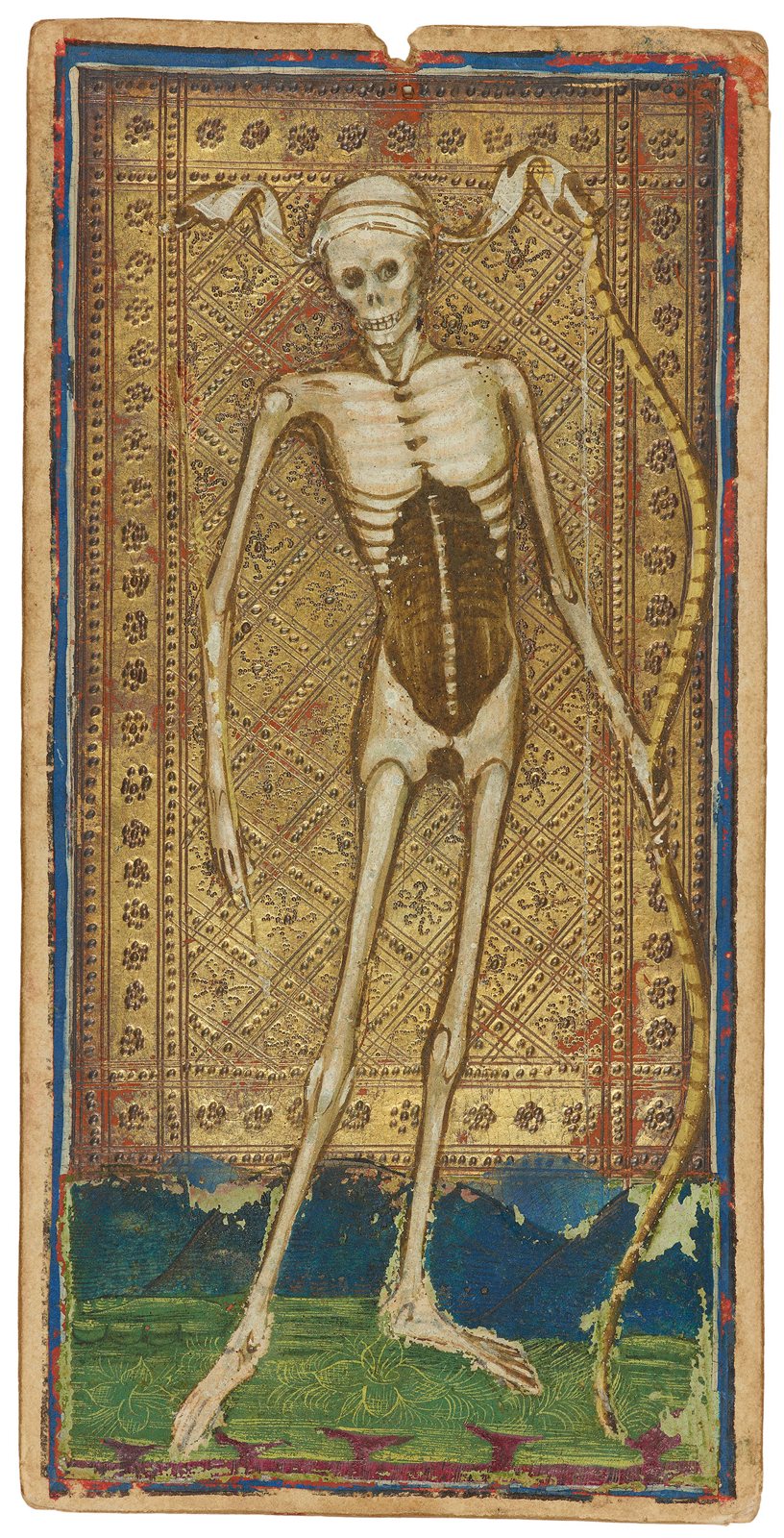
The most famous early deck is the Visconti-Sforza tarot, made in Milan shortly after 1450 for a courtly world tied to the Visconti and Sforza families. Death is among its trumps. The Metropolitan Museum of Art notes that in the Visconti-Sforza order Death ranked below the Sun, the Moon, the Star and Temperance. Early luxury decks like this one did not use the Roman numeral sequence that later printed decks made standard, so the "13" on today's card is a later habit.
The V&A holds an Italian Death card, hand-painted and gilded, made around 1490. It is a museum object from the same world of card games, decades before anyone read the cards for meaning. The occult and divinatory use of tarot came much later, especially in eighteenth-century France. For most of its first three centuries, the skeleton was simply one of the cards you could win a trick with.
Why is the Death card unnamed in the Tarot de Marseille?
The Tarot de Marseille is a French tradition of tarot decks. In the pattern printed by Nicolas Conver, card XIII shows a flesh-colored skeleton swinging a scythe through a field of grass, bones, hands, feet and heads. It has its number, but the cartouche at the bottom of the card, where every other major card carries its name, is blank.
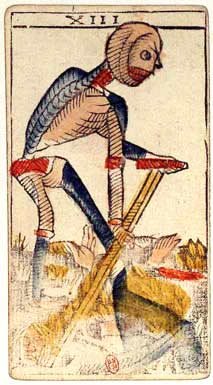
The French Ministry of Culture's Joconde record for a Conver Tarot de Marseille, reprinted around 1795, notes exactly that: all the trumps have titles except XIII. The card is called "Death" because of what it shows and because later tarot authors gave it that name.
Why the printers left it blank is not known. It is tempting to read it as a superstition, a name too dangerous to print, but the cards themselves only show that the title is missing, not the reason. The blank was not universal either. Jean Noblet's Parisian tarot, made around 1650, names the card plainly: "La Mort."
The Death card through the centuries
Tap or hover a step to follow the order.
Around 1450
The Visconti-Sforza tarot is made in Milan, with Death among its trumps.
Around 1490
An Italian Death card, hand-painted and gilded, is made; it is now in the V&A.
Around 1650
Jean Noblet's Parisian tarot names card XIII "La Mort."
Around 1795
A Nicolas Conver Tarot de Marseille is reprinted with every trump titled except XIII.
1909
The Rider-Waite-Smith deck is first issued in London, with artwork by Pamela Colman Smith.
1910
Waite's guide gives the card's upright and reversed meanings.
Pamela Colman Smith's rider on a pale horse
The Death card most people know today was drawn by Pamela Colman Smith for Arthur Edward Waite's deck, first issued by Rider in London in December 1909. Museum records often date the surviving cards to 1910. The deck is usually called the Rider-Waite or Rider-Waite-Smith, and Smith's name is the one that tends to get dropped, even though every image is hers.

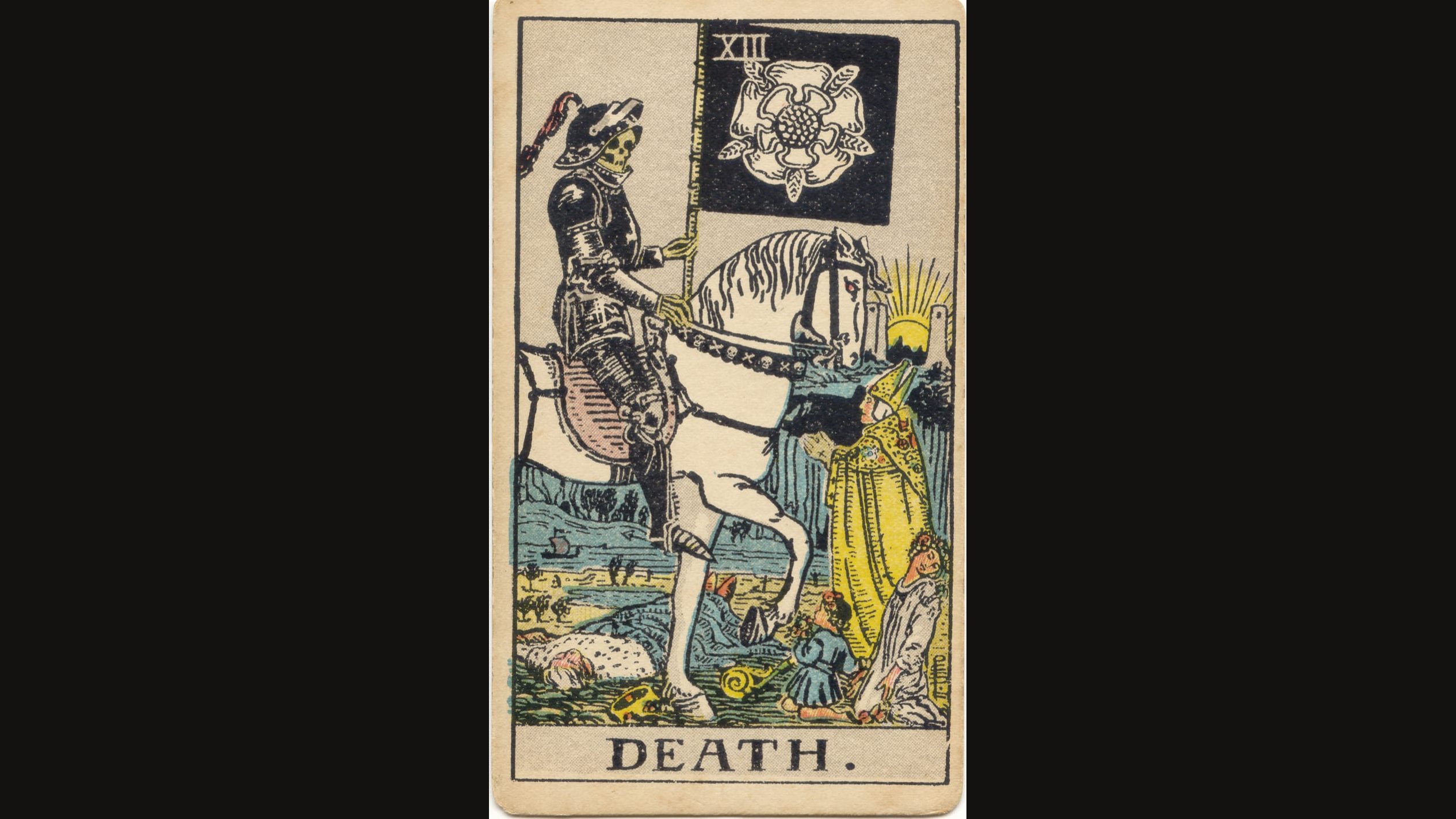
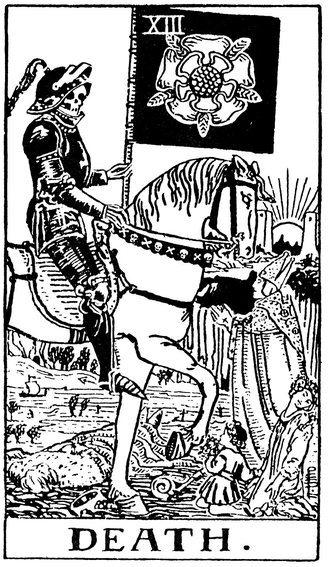
Smith did not keep the Marseille mower. Her Death is a skeletal rider in black armor on a pale horse, an image that draws on the horsemen of the Apocalypse. He carries a black banner bearing a white rose. In front of him a king has fallen, and a bishop, a young woman and a child face him. Waite called the rose the Mystic Rose and linked it with life, and he read the sun rising between two pillars in the distance as a sign of immortality.
So, the card carries two ideas at once. Everyone on it, from the king to the child, meets the rider, while in Waite's reading the rose stands for life and the rising sun for immortality. You can see the 1909 card on Wikimedia Commons, where the scan is in the public domain.
Tap or hover a row to highlight it.
| Deck | Place and date | Number and title | What stands out |
|---|---|---|---|
| DeckVisconti-Sforza | Place and dateMilan, shortly after 1450 | Number and titleNo standard numbering | What stands outDeath ranks below the Sun, Moon, Star and Temperance |
| DeckJean Noblet | Place and dateParis, around 1650 | Number and titleXIII, titled "La Mort" | What stands outThe card is named outright |
| DeckNicolas Conver (Marseille) | Place and dateReprint around 1795 | Number and titleXIII, title left blank | What stands outA flesh-colored skeleton with a scythe |
| DeckRider-Waite-Smith | Place and dateLondon, 1909 | Number and titleXIII, titled Death | What stands outA skeletal rider in black armor with a white rose banner |
Reading Death in love, as yes or no, and reversed
In questions about love, readers usually apply it to a relationship ending, a big change within a relationship, letting go of an old pattern or the start of a different phase. On its own it does not prove a breakup, a reunion or anything else. Ben-Dov's point applies here: the meaning depends on the question, the card's position and the cards next to it.
Some readers use tarot for yes-or-no questions, and there is no universal rule for Death. A reader who does use it that way may treat it as "no" to keeping a situation as it is, or "yes" to a change that needs to happen. That is a reading convention, not a historical fact about the card.
A card that comes up upside down is read "reversed," and Waite gave Death a separate set of keywords for that: inertia, sleep, lethargy, petrification, somnambulism and destroyed hope. Modern readers often sum those up as resistance to change, an ending that keeps getting put off or difficulty letting go of the past. Reversed meanings vary by author and reading system, so the book or reader you trust will shape what you hear.
The Death card as a tattoo
A Death card tattoo is a modern, personal use of a very old printed image. Tattoo History Atlas describes tarot card tattoos as a chosen archetype, and says people commonly pick Death for change, the end of one cycle, release and a new beginning, rather than for death itself.
Most Death tattoos copy Smith's 1909 rider, so a tattoo can also be a way of admiring her artwork, a sign of interest in tarot, a mark of personal change or something private about closing a chapter. The person wearing it is the real authority on what it means. If you are curious about someone's Death card tattoo, ask the wearer, and if you are planning one, talk it through with your tattoo artist so the design says what you want it to say.
A Death card tattoo is also its own thing. It is not automatically the same as every skull tattoo, a Día de Muertos design or a memento mori piece, each of which comes from its own tradition. If a full skeleton is what draws you, our story on skeleton tattoo meaning covers that ground.
How well do you know the Death card?
Answer every question to check.
Death card questions, answered
A few more questions come up once the history is on the table.
What number is the Death card?
Death is XIII, or 13, in modern tarot decks. The earliest Italian decks, such as the Visconti-Sforza, did not use the later standard numbering, and the Tarot de Marseille shows the number XIII but leaves the card's name off.
What does Death mean in the Tarot de Marseille?
In the Tarot de Marseille, Death is the unnamed card XIII, a skeleton with a scythe cutting through grass and human remains. Modern readers may read it as a necessary end, letting go or renewal, but those meanings belong to later authors and reading practices rather than to one historical definition from the printers who made the deck.
Who drew the Death card in the Rider-Waite-Smith deck?
Pamela Colman Smith drew it, along with the deck's other card images, for Arthur Edward Waite. The deck was first issued by Rider in London in December 1909, and its familiar name, after the publisher and Waite, often hides her part in it.
Why does the Death card show a white rose?
Waite called the white rose on the black banner the Mystic Rose and linked it with life. Together with the sun rising between two pillars, which he read as immortality, it points past the rider toward what Waite saw as renewal.
Where to go next
The skeleton with a scythe has a long life outside tarot. Our story on the Grim Reaper's origin follows that figure, and the danse macabre shows the older European habit of bringing Death face to face with kings and clergy, much as Smith's rider meets a king and a bishop. For Death as a character in film, read about The Seventh Seal and its chess game with Death. If the card has you thinking about mortality in a wider sense, start with what memento mori means.
Terms in this story
Tap a term to see what it means.
Tarocchi. The Italian card game, developed in the fifteenth century, in which tarot began; Death was one of its trump cards.
---