

No. 116
The Seventh Seal: Why the Knight Plays Chess with Death
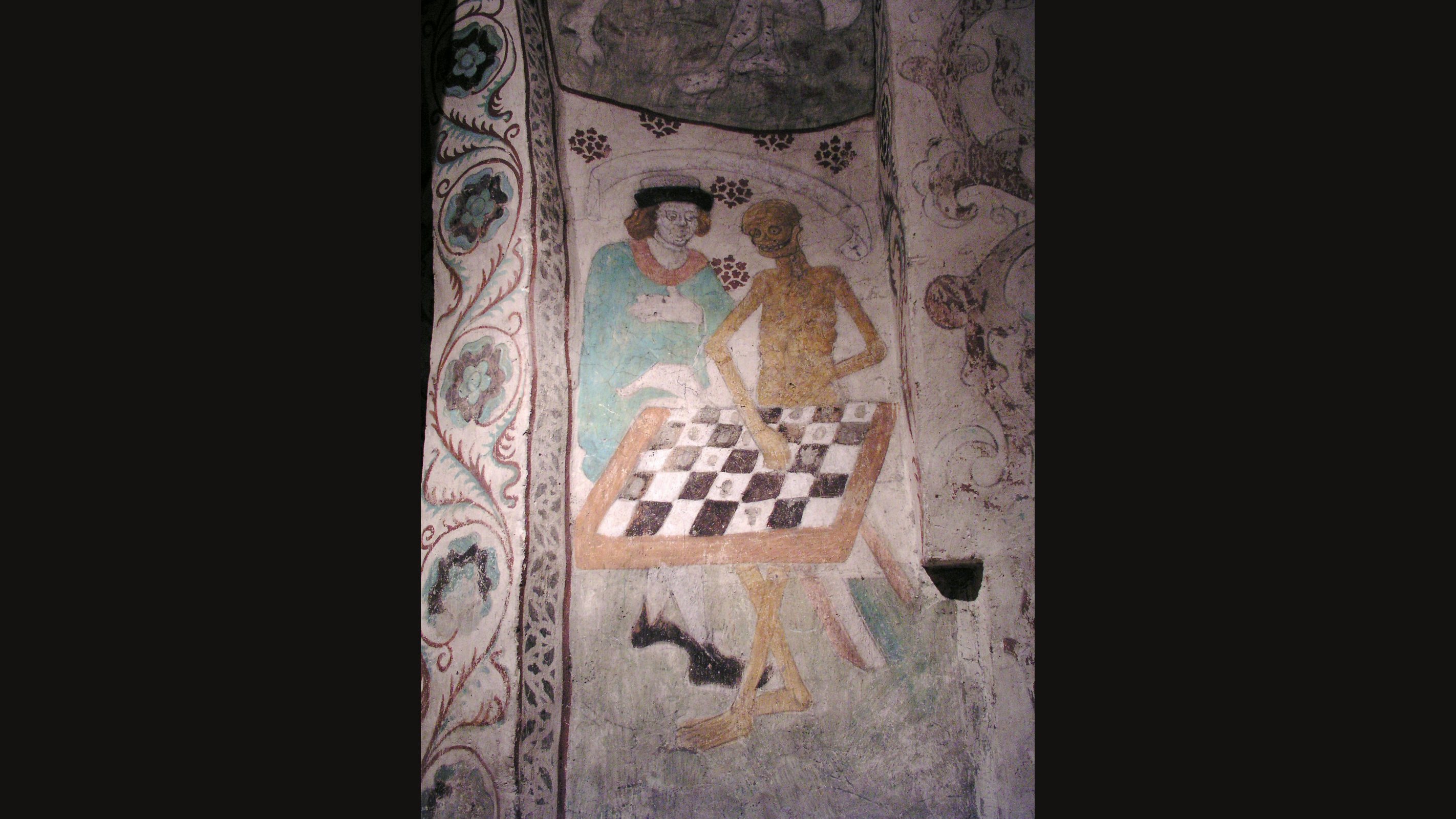
The knight playing chess with Death comes from Ingmar Bergman's Swedish film *The Seventh Seal* (*Det sjunde inseglet*), released in Sweden on February 16, 1957. A knight named Antonius Block, played by Max von Sydow, comes home from the Crusades to a fourteenth-century Sweden struck by plague. Death, played by Bengt Ekerot, comes for him, and Block challenges him to a game of chess. He knows he cannot win forever. He plays for time, long enough to do what the screenplay calls "one meaningful deed" (Ingmar Bergman Foundation). Bergman did not invent the image from nothing, either. He took it from a real painting of Death at a chessboard on the wall of Täby Church in Sweden, made in the 1480s by Albertus Pictor and his workshop (Church of Sweden).
So, the image has two lives: a medieval church painting with a moral lesson, and a 1957 film that carried it into cinema history. Both stories are worth knowing.
The film and its story
Ingmar Bergman wrote and directed *The Seventh Seal*, and Svensk Filmindustri produced it. The cast at its center is small: Max von Sydow as the knight Antonius Block, Gunnar Björnstrand as his squire Jöns, and Bengt Ekerot as Death (Ingmar Bergman Foundation).
The three figures at the heart of The Seventh Seal
Tap a card to bring it forward.
- Antonius Block: The knight, played by Max von Sydow, home from the Crusades and playing chess with Death for time.
- Jöns: Block's squire, played by Gunnar Björnstrand.
- Death: Played by Bengt Ekerot, a pale-faced figure in a black cape and hood who comes for Block.
The film grew out of a stage piece. Bergman first wrote a play called *Wood Painting* for actors at the Malmö Municipal Theatre, around 1953 to 1954, and developed the film from it (Ingmar Bergman Foundation). Filming ran from July 2 to August 24, 1956, mostly at Råsunda Film Studios, with key beach scenes shot at Hovs hallar in Skåne (Ingmar Bergman Foundation).
The title reaches back to the Bible. The film's opening text refers to the silence in heaven after the seventh seal is opened in Revelation 8:1 to 2 (Ingmar Bergman Foundation). That silence matters, because silence is exactly what Block keeps meeting.
From a church wall to the screen
Tap or hover a step to follow the order.
1480s
Albertus Pictor and his workshop paint Death playing chess in Täby Church, Sweden.
1953 to 1954
Bergman develops his play Wood Painting, the forerunner of the film.
July 2, 1956
Filming of The Seventh Seal begins.
August 24, 1956
Filming ends.
February 16, 1957
The Seventh Seal opens in Swedish cinemas.
Why the knight plays chess with Death
The chess game is borrowed time. Block cannot beat Death for good, and the film never pretends he can. What the game gives him is a reprieve, and he spends it looking for answers and trying to do one thing that matters. In the screenplay he says the reprieve lets him arrange "one meaningful deed" (The Seventh Seal screenplay).
That turns the chessboard into a kind of clock. Every move keeps the game going a little longer, and while the game goes on, so does Block's life. The critic Peter Bradshaw, writing in *The Guardian* in 2007, reads the match as a metaphor for humanity's attempt to hold off mortality through meaningful accomplishment, including art that might outlast the person who made it (The Guardian).
The game also frames Block's crisis of faith. He wants knowledge of God, and what he meets is silence (The Guardian). The match against Death keeps that question open for as long as the game lasts.
What The Seventh Seal symbolizes
Taken as a whole, the film is about the human struggle to find meaning while facing death, plague, uncertainty and the silence of God. It turns abstract questions about faith and mortality into things you can see: a hooded figure, a chessboard, a road through medieval Sweden (Ingmar Bergman Foundation; The Guardian).
The Ingmar Bergman Foundation presents the film as an exploration of faith and human existence. Bergman's own later explanation puts it more personally. He described a tension between a childish religious faith and a rational acceptance that human holiness belongs to earthly life (Ingmar Bergman Foundation).
The line everyone quotes
The film's most quoted line belongs to Block, spoken as he reaches for the certainty he cannot have: "I want knowledge, not faith, not suppositions, but knowledge" (The Seventh Seal screenplay). It sums up his whole problem in one breath. He wants proof, and the God he asks stays silent.
The church painting behind the chess game
Bergman's chess scene has a medieval ancestor that is still on a church wall. In Täby Church, in Täby kyrkby, Sweden, a wall painting known as *Dödens schackspel*, "Death's Chess Game," shows a man playing chess with Death. The Church of Sweden dates the church's paintings to the 1480s and attributes them to Albertus Pictor, also known as Albrecht Ymmenhusen, and his workshop (Church of Sweden; Church of Sweden, Täby Church).
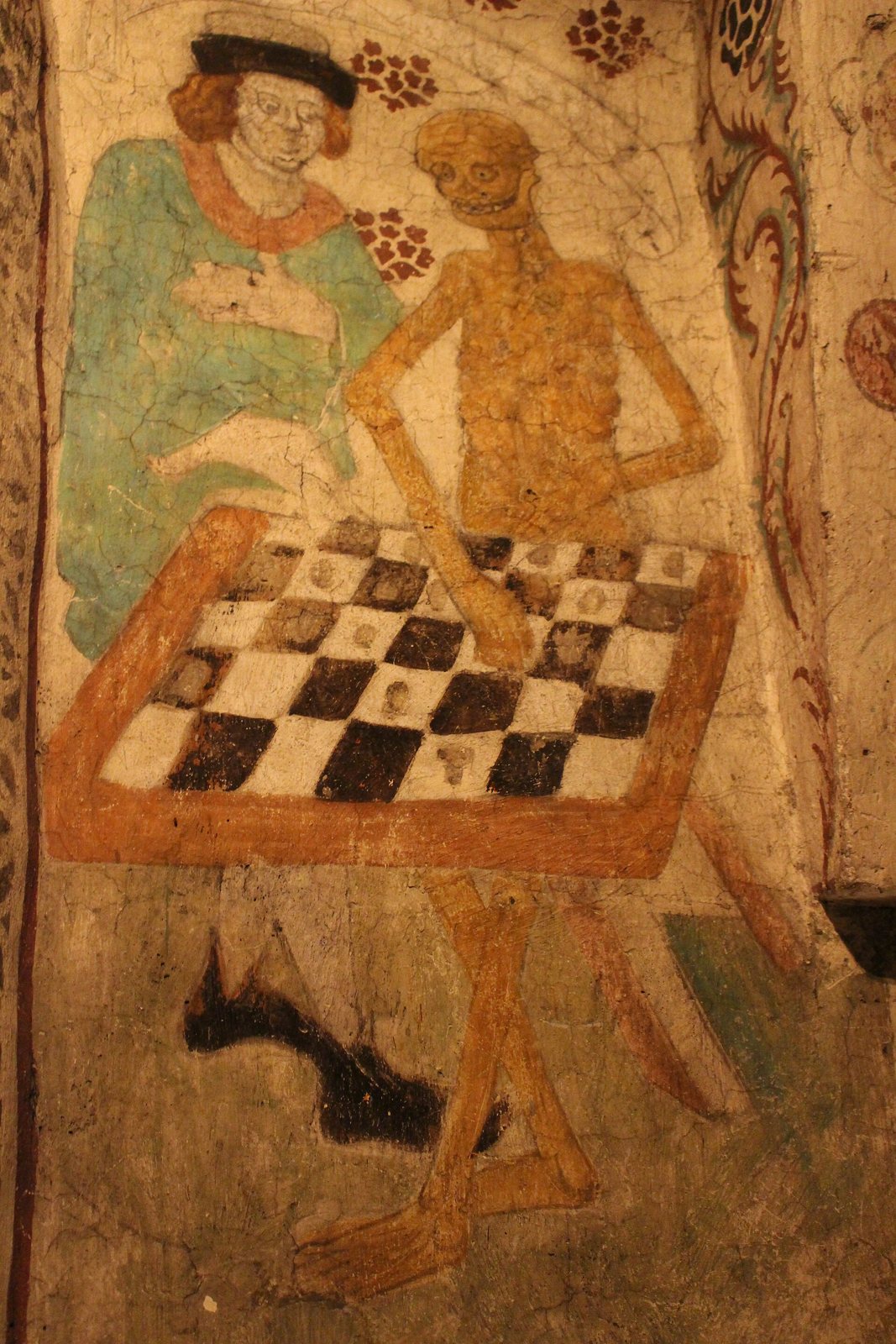
The painting once carried words. Its faded Swedish inscription was recorded as "Jak spelar tik mat," meaning "I play you checkmate" (Church of Sweden mural catalogue). Death, in other words, already knows how the game ends.
For the people who stood in that church five hundred years ago, the image was a lesson. The church explains that medieval chess imagery could carry moral teaching, and this one invited viewers to think about how their actions might be rewarded or punished after death (Church of Sweden). It is the same thought that runs through memento mori art and the skull-filled vanitas paintings, where an image of death asks the living to think about how they live.
The Stockholm County Museum identifies the Täby mural as the image Bergman later used in *The Seventh Seal* (Stockholm County Museum). The subject is also rare. It is unusual among Albertus Pictor's surviving paintings, and the church describes it as unique to Täby (Church of Sweden).
Death's face: Bengt Ekerot's performance
Bengt Ekerot plays Death as a pale-faced figure in a black cape and hood. The performance is restrained: this Death is courteous, patient and inevitable (Ingmar Bergman Foundation).
The Ingmar Bergman Foundation calls Ekerot's portrayal one of cinema's most powerful creations and notes that the image moved from European art cinema into international popular culture (Ingmar Bergman Foundation). The clearest proof is how often other films have borrowed it. The Foundation lists paraphrases and parodies in Woody Allen's *Love and Death*, Monty Python's *The Meaning of Life*, *Bill and Ted's Bogus Journey* and *The Last Action Hero* (Ingmar Bergman Foundation). When a comedy can get a laugh simply by putting a pale man in a black hood across a game board from its hero, the original has become part of the shared language of film.
Ekerot's Death is one figure in a long line of personified deaths. For how the hooded figure with the scythe took shape, see our story on the origin of the Grim Reaper, and for death figures around the world, our piece on gods of death.
The dance of Death at the end
Near the end of the film comes its other famous image. Death leads Block and several other characters across a ridge in a silhouetted procession against the sky (Ingmar Bergman Foundation).
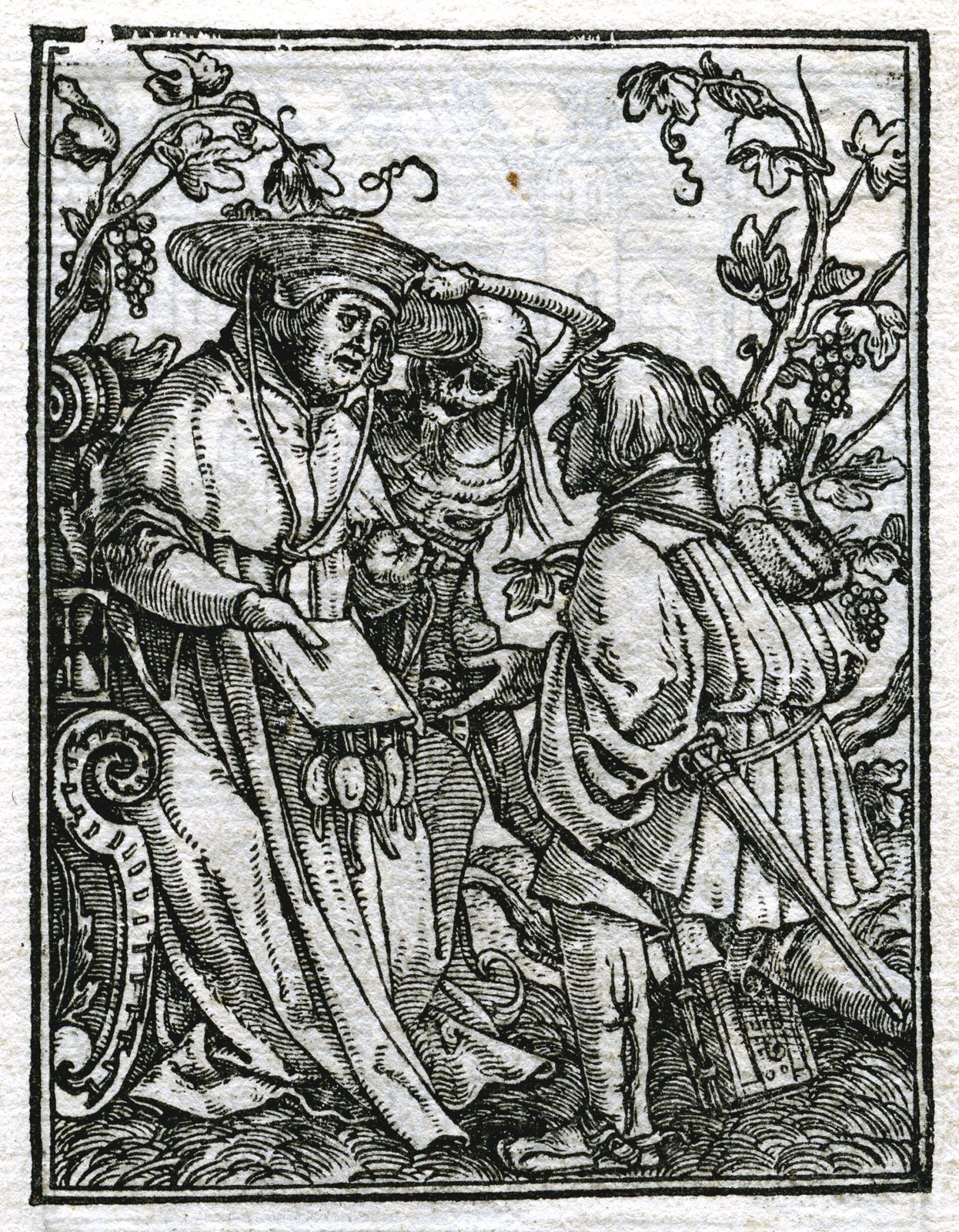
The scene calls up the medieval danse macabre, or Dance of Death, an artistic and literary tradition in which Death leads people away regardless of rank. The Metropolitan Museum of Art describes Dance of Death imagery as processions that pair Death with figures such as the pope and other members of society (The Met). Bergman did not copy one particular medieval mural for this shot. He made a film version of the broader Dance of Death idea, fitted to a story about the death that comes to everyone (Ingmar Bergman Foundation).
The shot itself came together in a hurry. Gunnar Fischer recalled that the crew had packed up because a storm was coming in at Hovs hallar, then quickly reset the camera when Bergman saw a striking cloud. The sequence was improvised, and some of the actors in the line were replaced by crew members and tourists (Ingmar Bergman Foundation). One of the most famous images in film history includes a few tourists.
Questions people ask about The Seventh Seal
A few quick answers about the film and the painting behind it.
What is the meaning of the chess game in The Seventh Seal?
The chess game gives the knight Antonius Block borrowed time. He cannot defeat Death for good, so he uses the reprieve to seek answers about God and to do "one meaningful deed," as the screenplay puts it (The Seventh Seal screenplay).
Who plays Death in The Seventh Seal?
The Swedish actor Bengt Ekerot plays Death. His pale face, black hood and calm, courteous manner became one of cinema's best-known images of Death (Ingmar Bergman Foundation).
Is The Seventh Seal based on a real painting?
Yes. The chess game with Death comes from *Dödens schackspel*, a 1480s wall painting by Albertus Pictor and his workshop in Täby Church in Täby kyrkby, Sweden. The Stockholm County Museum identifies it as the image Bergman used (Stockholm County Museum).
Is the dance at the end a danse macabre?
Yes, in spirit. The silhouetted procession evokes the medieval Dance of Death, in which Death leads people away regardless of rank, though Bergman created his own version and did not copy a single medieval image (The Met).
What is the most famous quote from The Seventh Seal?
Block's line "I want knowledge," from the speech in which he sets knowledge against faith and suppositions, is one of the best known. It expresses his need for certainty in a world where God stays silent (The Seventh Seal screenplay).
The Seventh Seal quiz
Answer every question to check.
Where to go next
The knight and Death at the chessboard belong to a much larger family of images about mortality. Follow the dancing dead in our story on the danse macabre, see how artists used skulls to the same end in vanitas paintings, and read what memento mori means. For the figure across the board, start with the origin of the Grim Reaper.
Terms in this story
Tap a term to see what it means.
Det sjunde inseglet. The Swedish title of The Seventh Seal, Ingmar Bergman's 1957 film.