

No. 173
Coyote Skull: How to Identify One and What It Means
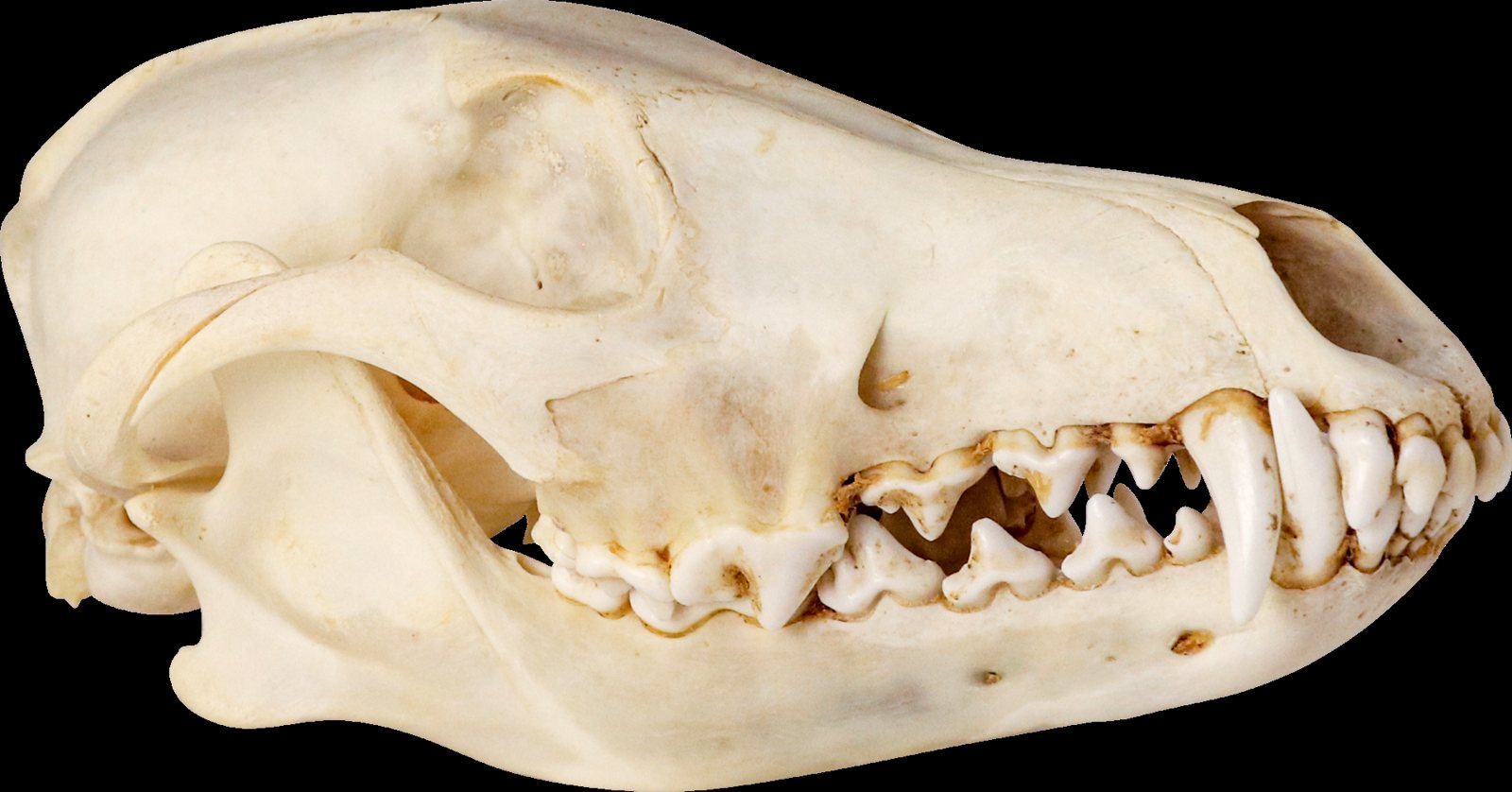
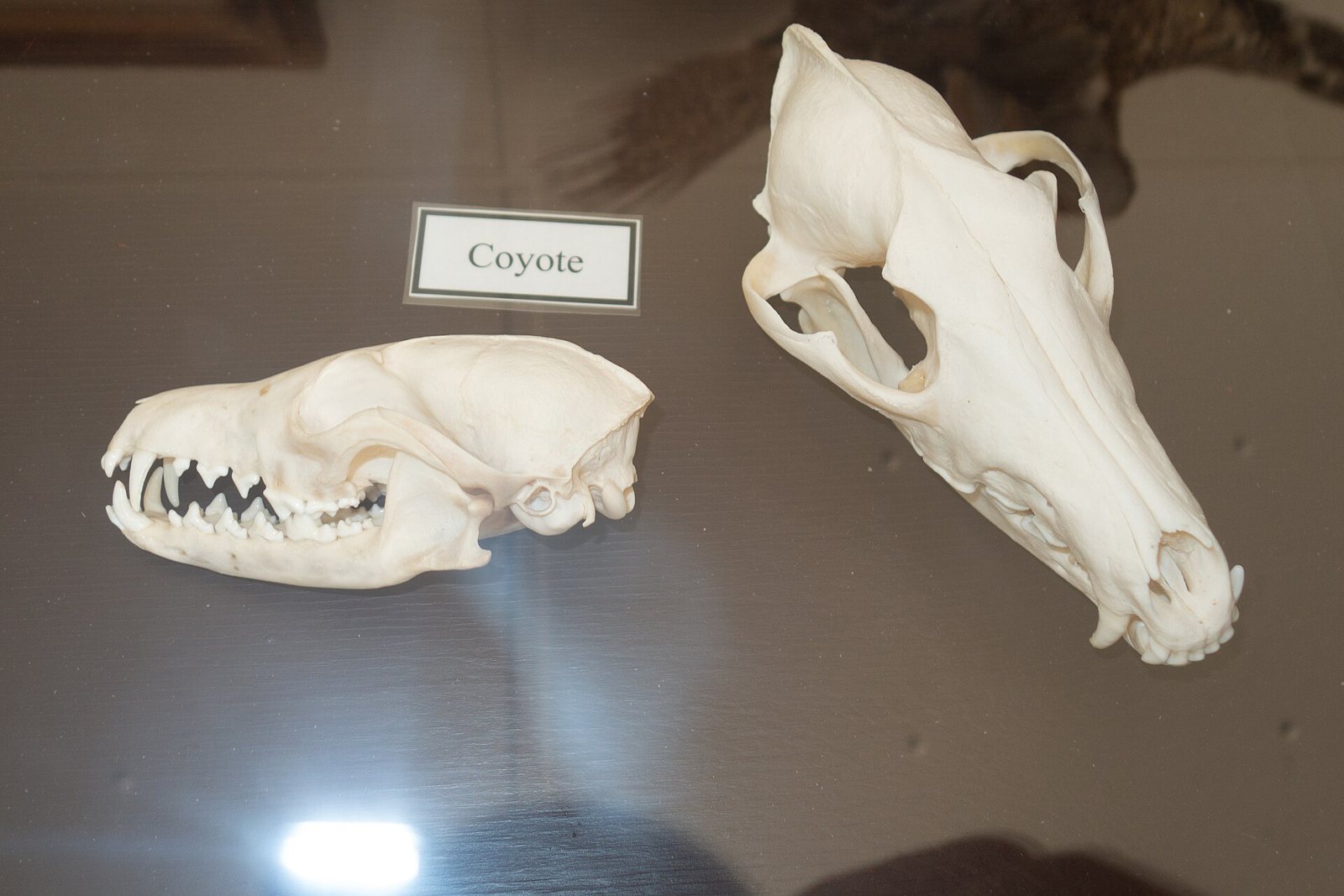
A coyote skull, *Canis latrans*, is long and narrow, with a gently sloping forehead, big canine teeth, a bony crest along the top, forward-facing eye sockets, blade-like cheek teeth and 42 teeth in all. The San Diego Natural History Museum says coyote skulls are usually longer than 160 millimeters but rarely over 200. Wolf skulls usually run over 225 millimeters, and in Maryland's state skull key, fox skulls stay under 200.
Against a dog, a coyote's muzzle is longer and narrower, its bones are thinner and its lower row of teeth runs nearly straight. That makes four common look-alikes: dog, wolf, red fox and gray fox. A ruler and a careful look at the teeth sort out most of them.
What a coyote means is a separate question, and the answer belongs to particular peoples and periods, from the Navajo and the Plains nations to the Mexica figure Huehuecóyotl.
Reading a coyote skull
The West Texas A&M University species account and the Arizona-Sonora Desert Museum's skull guide describe the same skull. The rostrum, the snout part in front of the eyes, is long and narrow. Along the top runs a well-developed sagittal crest, a ridge of bone that anchors the jaw muscles. The zygomatic arches, the cheekbones, are medium-wide, the orbits face forward, and the carnassials, the big cheek teeth, are shaped for shearing meat.
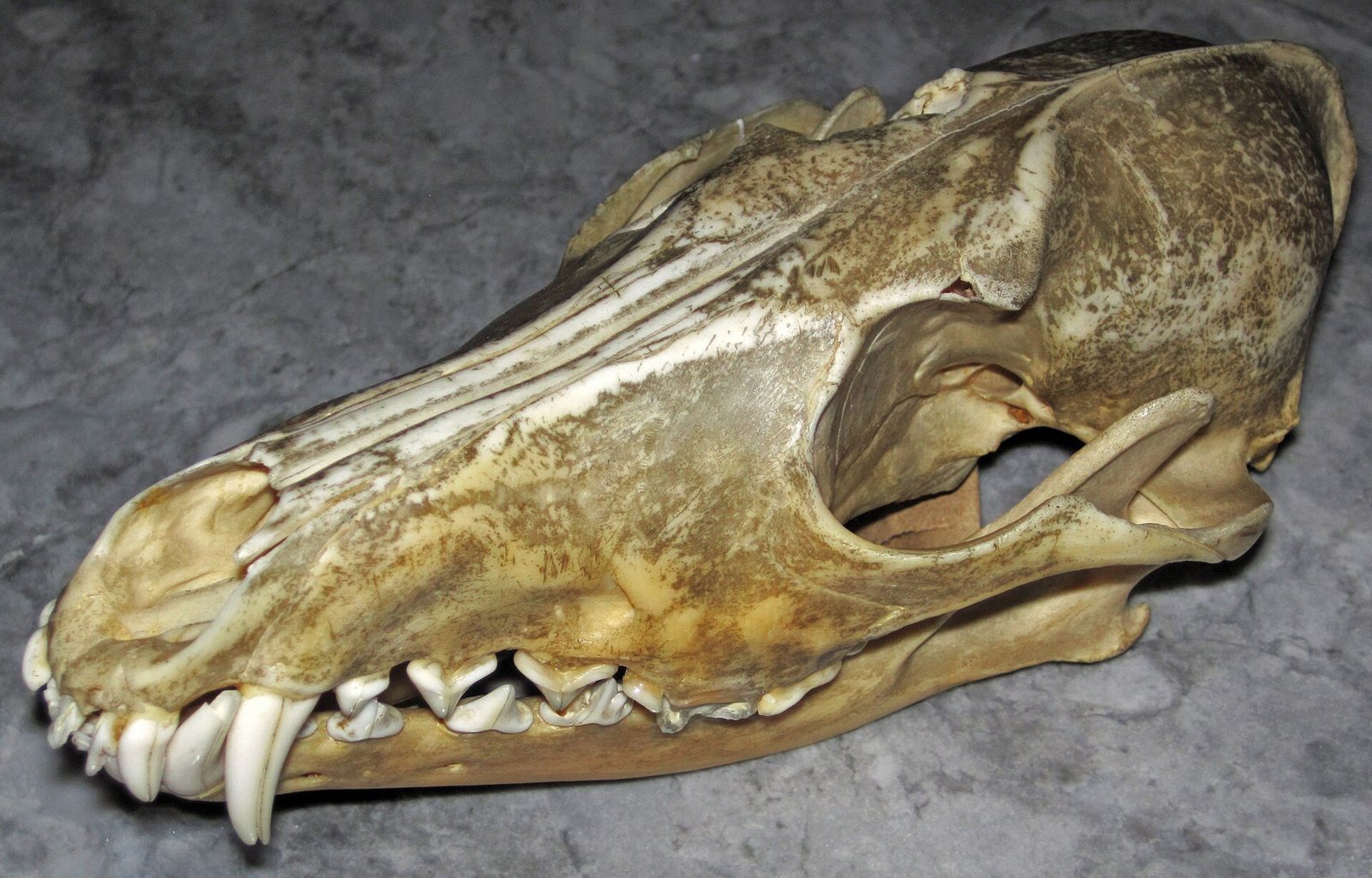
The teeth follow the dental formula I 3/3, C 1/1, P 4/4, M 2/3. On each side of the upper jaw that means three incisors, one canine, four premolars and two molars. On each side of the lower jaw it is three incisors, one canine, four premolars and three molars. Add both sides together and you get 42.
For size, the San Diego Natural History Museum's canid skull comparison gives the useful range: usually longer than 160 millimeters, rarely over 200. Measure the greatest length, from the tip of the snout to the very back of the skull. Expect some spread, though. Size varies with region, sex and age, so a young coyote or a big one from another part of the country can sit at either end of that range.
Coyote or dog?
A dog is often the hardest comparison, because dogs come in so many shapes. A paper in the University of California, Berkeley digital collections, *Distinctions Between the Skulls of Coyotes and Dogs*, lists the coyote's tendencies: a longer, narrower muzzle, thinner bones, sharper crests, longer and more complex teeth and a nearly straight lower tooth row. A dog skull of similar size is often heavier and broader, and it varies far more, because people have bred dogs into so many skull shapes.
Texas Tech University's account of the domestic dog gives a test you can do at the kitchen table. Turn the skull over and look at the palate, the bony roof of the mouth.
- Measure the length of the upper tooth row.
- Measure the width of the palate.
- Divide the first number by the second.
If the tooth row is about 3.1 times the palate width, the skull is consistent with a coyote. Below 2.7 points to a dog. Anything in between deserves caution, and so does a clean-looking result, because coyotes and dogs can produce fertile hybrids, sometimes called coy-dogs, and a mixed animal can blur any test.
Coyote or wolf?
Coyotes are smaller than wolves, and the skull shows it. The San Diego Natural History Museum reports that both coyote and wolf skulls are longer than 160 millimeters, but coyote skulls are rarely over 200 while wolf skulls, *Canis lupus*, are usually over 225. One documented Oregon wolf skull in the museum's comparison measured 252 millimeters for a male and 227 for a female.
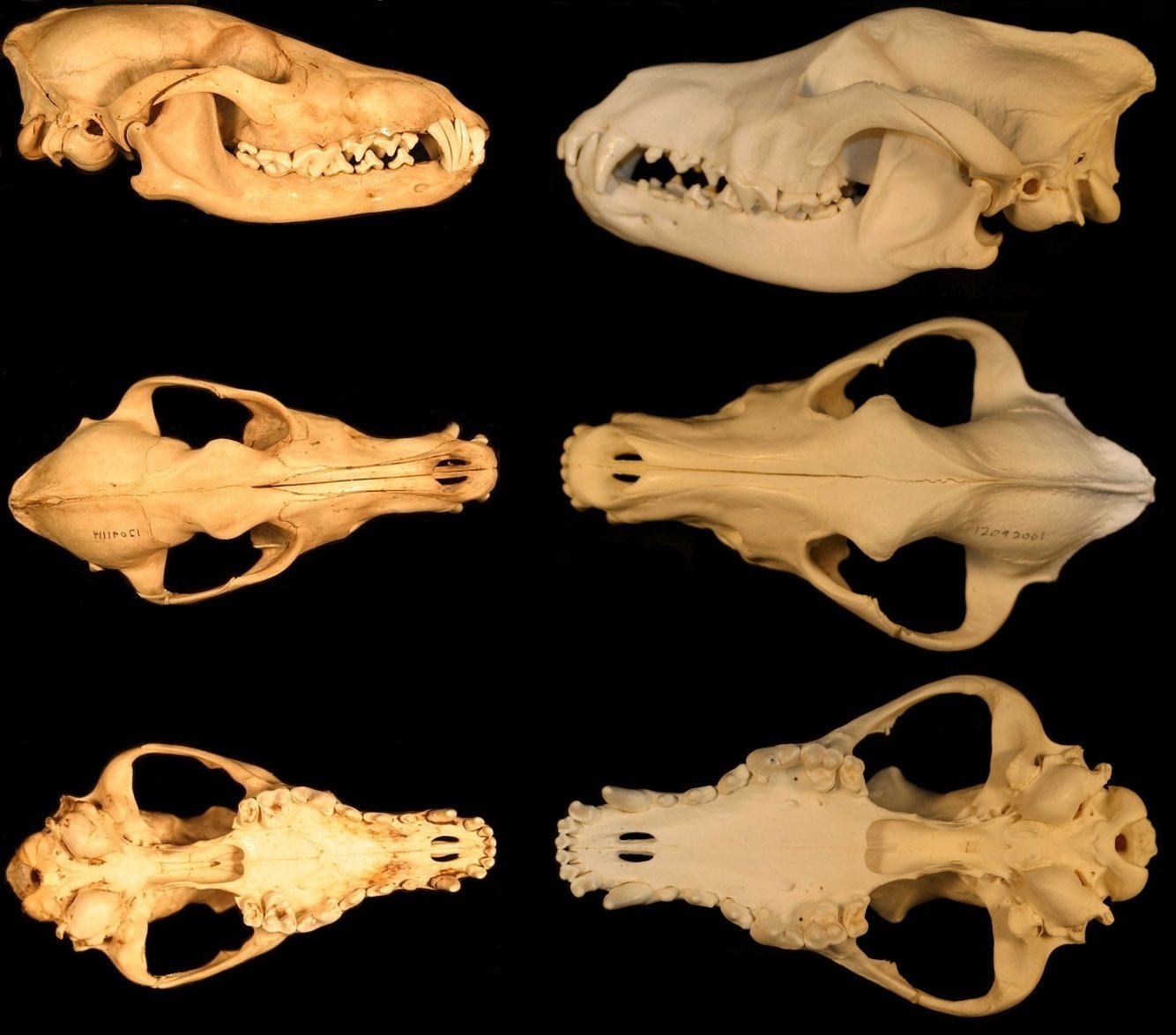
That gap is wide enough to settle most finds, but not all. An unusually large coyote, a small wolf, a young animal or a hybrid can land in the space between, so a skull close to 200 or 225 millimeters needs the teeth and proportions as well as the ruler.
Coyote or fox?
Here a ruler goes a long way. The Maryland Department of Natural Resources Simplified Key to Furbearer Skulls sorts canid skulls by greatest length first. Over 200 millimeters is a coyote. Under 200, the key looks at the top of the skull, where two bony ridges run back from the eyes: ridges that meet in a V mean red fox, *Vulpes vulpes*, and ridges that form a U mean gray fox, *Urocyon cinereoargenteus*. The San Diego museum's comparison also covers the kit fox, *Vulpes velox*, and stresses that size, shape and teeth work together.
Maryland's key is a regional teaching tool, so treat a damaged, young or unusual skull with care. The California Department of Fish and Wildlife also compares coyotes, foxes and wolves, in a note dated August 10, 2023. For the fox side in full, including the V and U ridges, read how to identify a fox skull.
Tap or hover a row to highlight it.
| Feature | Coyote, Canis latrans | Red fox, Vulpes vulpes | Gray fox, Urocyon cinereoargenteus | Wolf, Canis lupus |
|---|---|---|---|---|
| FeatureTypical skull length | Coyote, Canis latransUsually over 160 mm, rarely over 200 mm | Red fox, Vulpes vulpesUnder 200 mm | Gray fox, Urocyon cinereoargenteusUnder 200 mm | Wolf, Canis lupusUsually over 225 mm |
| FeatureRidges in Maryland's key | Coyote, Canis latransNot used as the fox split | Red fox, Vulpes vulpesV-shaped | Gray fox, Urocyon cinereoargenteusU-shaped | Wolf, Canis lupusLarger overall |
| FeatureRostrum | Coyote, Canis latransLong and narrow | Red fox, Vulpes vulpesSmaller, more pointed | Gray fox, Urocyon cinereoargenteusShorter relative to coyote | Wolf, Canis lupusLong and sturdy |
| FeatureTeeth | Coyote, Canis latrans42 total | Red fox, Vulpes vulpesCanid teeth | Gray fox, Urocyon cinereoargenteusCanid teeth | Wolf, Canis lupusCanid teeth, larger skull |
| FeatureMain caution | Coyote, Canis latransDog and coyote hybrids exist | Red fox, Vulpes vulpesJuveniles can be confused with coyote pups | Gray fox, Urocyon cinereoargenteusRegional occurrence matters | Wolf, Canis lupusJuveniles and unusually large coyotes complicate size |
A step-by-step check
Lay the skull on a table in good light with a ruler, and wear gloves if it is not completely clean. Then work through the clues in order.
Is it a coyote skull? A step-by-step check
Tap a card to bring it forward.
- Measure the length: Snout tip to back of skull. Coyotes usually run over 160 mm and rarely over 200; wolves usually over 225.
- Look at the muzzle: A coyote's is long and narrow; a dog's is often heavier and broader.
- Check the lower tooth row: A nearly straight row fits a coyote.
- Count the teeth: If the skull is complete, a coyote has 42.
- Do the palate test: Upper tooth row about 3.1 times the palate width suggests coyote; below 2.7 suggests dog.
- Look at the top: Under 200 mm with V or U ridges points to a red or gray fox.
- Compare: Check the skull against a museum specimen or a state skull key.
If the skull is much shorter and broader, with wide, crushing molars instead of blades, you are probably holding a raccoon, and the raccoon skull story covers that one. If it is far bigger than any coyote, the bear skull story may be the next place to look.
What the coyote means, and to whom
A coyote skull has no single meaning. What Coyote stands for depends on whose stories you are reading, and the clearest accounts come from particular nations and periods.
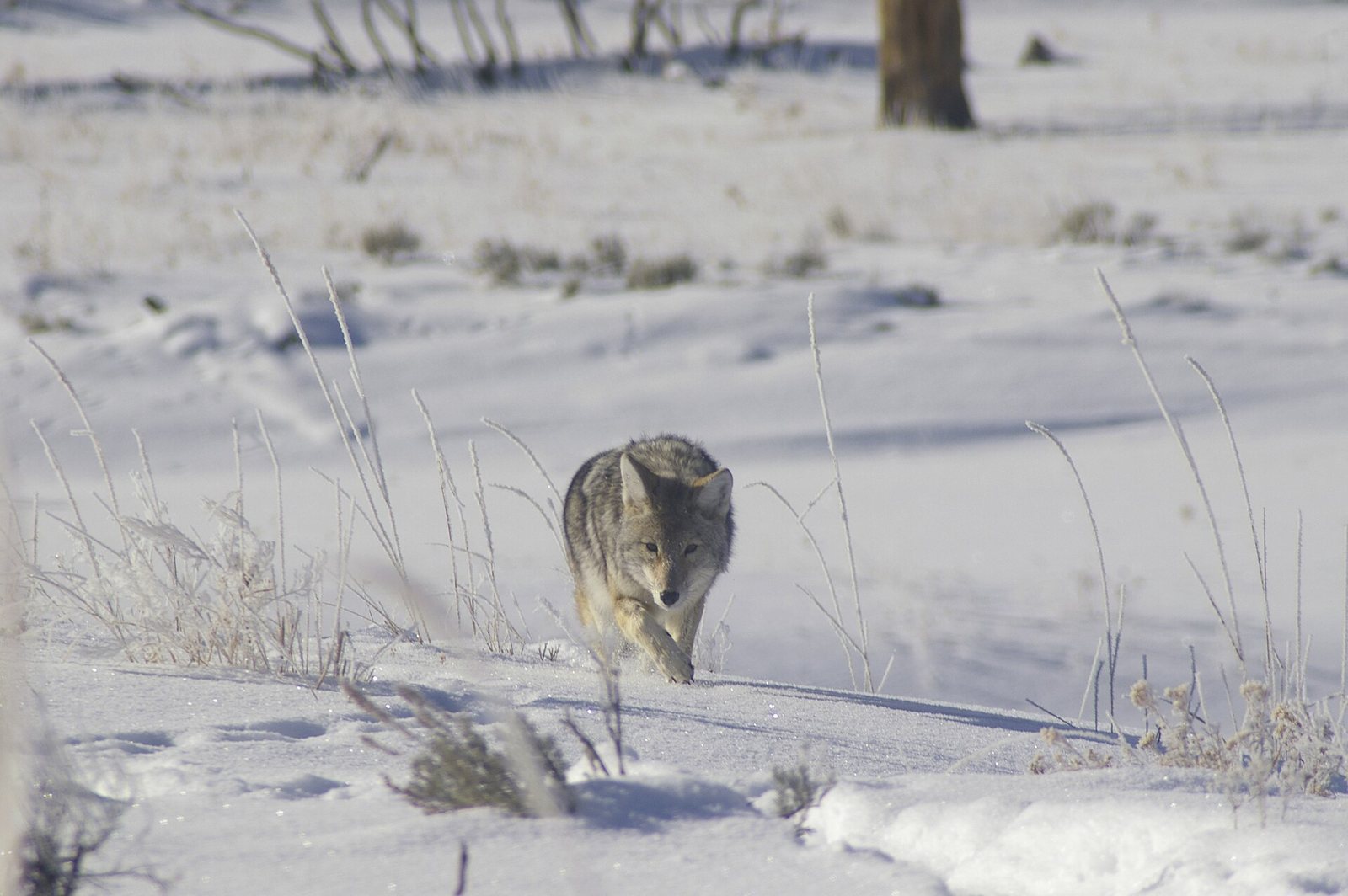
On the Great Plains, the University of Nebraska's Encyclopedia of the Great Plains names Coyote as a major trickster figure. It also names other tricksters who are distinct figures in their own nations, not Coyote under another name: Old Man among the Crow and Blackfoot, Iktomi among the Lakota and Veeho among the Cheyenne. The trickster, the encyclopedia explains, can be comic, selfish, deceptive, boundary-crossing, destructive or creative, and the stories often teach limits by showing the consequences when the trickster ignores them.
Among the Navajo, Coyote stories are part of oral tradition. The Heritage Language Resource Center describes Navajo Coyote stories as tales used to instruct children and guide conduct, traditionally told during the winter season, October through February, and asks that they be treated with cultural respect. Those stories belong to the people who tell them. For readers who want them from Navajo editors, the Smithsonian holds a copy of *Coyote Stories of the Navajo People*, edited by Robert Roessel Jr. and Dillon Platero and illustrated by George Mitchell.
In central Mexico, the Mexica knew Huehuecóyotl, whose name means "Old Coyote" or "Very Ancient Coyote." In a 1999 study published through UNAM, the scholar Guilhem Olivier describes Huehuecóyotl in sixteenth-century sources as a musician, dancer, warrior, fire thief and trickster, linked with the Otomí and with Tezcatlipoca. An article in the Mexican journal *Historia y Grafía* describes him as a pre-Hispanic deity associated with dance, music, sexuality and metamorphosis.
These are documented traditions, each tied to a people, a place and a time. They do not hand every coyote skull a spiritual meaning. A coyote skull tattoo or a skull on a ranch-house wall today carries whatever meaning its owner gives it, which is a modern, personal reading rather than an ancient one. For how skull imagery picks up meaning in ink, see skull tattoo meaning, and for the long view, skull symbolism.
Coyote skull quiz
Answer every question to check.
Keeping or selling a coyote skull
Treat this as general information, not legal advice: coyote rules are set state by state and country by country, and they are updated.
Rules depend on the state, the land manager and how the animal came to be dead. Texas is one example. Texas Parks and Wildlife's nongame rules for September 1, 2026 through August 31, 2027 classify coyotes as nongame animals that may be taken on private property by lawful means, with a hunting license. The department's commercial nongame permit FAQs prohibit collecting nongame wildlife from public land, public water, public roads and rights-of-way for commercial purposes, and say coyotes may be taken and sold without a nongame permit when the hunting license and other rules are met.
A skull you pick up is not automatically covered by the rules for a legally harvested animal. Public parks, federal lands, tribal lands and private property can each have their own restrictions, and a clean skull is not automatically legal to sell or carry across state lines. Before you remove or keep one, work out who manages the land and confirm the rule with that land manager and the state wildlife agency. Our story on what to do when you find an animal skull covers the federal laws and other state examples, and how to clean an animal skull picks up once you know it is yours to handle. We do not deal in real skulls of any kind.
Coyote skull questions, answered
A few more points about coyote skulls.
What does a coyote skull look like?
A coyote skull is long and narrow, with a long snout, prominent canines, a well-developed crest along the top and 42 teeth. Seen from above, it lacks the V or U ridge pattern that Maryland's key uses to name a red or gray fox.
Can you tell a coyote skull from a dog skull just by looking?
Often, but not always. Coyotes tend to have longer, narrower muzzles and thinner bones, but mixed-breed dogs and coyote and dog hybrids can look in between, so the tooth-row and palate measurement is the better check.
How much is a coyote skull worth?
There is no set price. Value depends on legal provenance, completeness, the teeth, cleaning, damage, preparation and local demand, and a skull picked up in the wild may have no lawful resale value until the possession and sale rules for that state and land are confirmed. Prices posted on forums are informal and are not a valuation.
Are coyote skulls legal to keep?
That depends on the state and on the land where the skull lay, so you cannot assume so. Ask the state wildlife agency and the land manager before you take it home.
Where to go next
If your skull turns out to be a fox, the fox skull story takes over, with the V and U ridges in detail. If it is short and broad, try the raccoon skull. And before any skull goes on a shelf, what to do when you find an animal skull is the page to read.
Terms in this story
Tap a term to see what it means.
Canis latrans. The scientific name of the coyote.
---