

No. 087
How to Identify a Raccoon Skull and Tell It From a Cat, Opossum or Fox
The quickest way to tell whether you are holding a raccoon skull is to count the teeth and then look at the snout and the back teeth. A common raccoon, *Procyon lotor*, usually has 40 teeth, a short, broad snout, a large braincase, moderately long canines and wide, rounded molars made for crushing. A Virginia opossum has 50 teeth, a long, pointed snout and a tall bony crest along the top of the head. A house cat has about 30 teeth and a very short face. A red fox has 42 teeth, a long, narrow snout and sharp, blade-like cheek teeth. Teeth and shape tell you far more than size or color, so start there.
What a raccoon skull looks like
Raccoons belong to the family Procyonidae, and Animal Diversity Web's account of the family describes the skull well. The rostrum, the snout part of the skull, is relatively short and broad, and the braincase behind it is large. The canines are moderately long and oval in cross-section. The molars are wide and low-cusped, the kind zoologists call bunodont, and the skull has no strongly developed carnassial blades, the scissor-like shearing teeth that true meat-eaters use to slice.
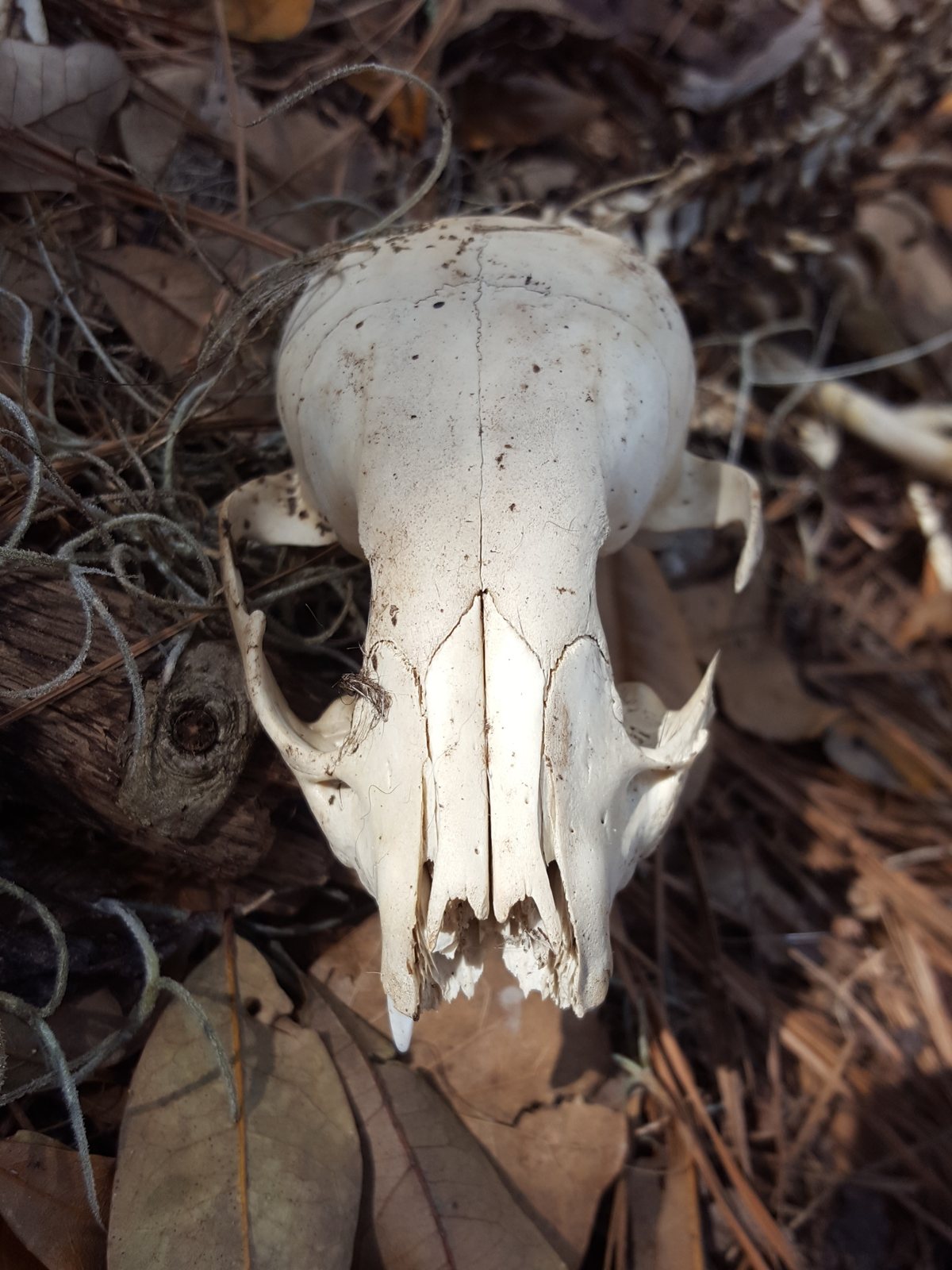
That mix of teeth says a lot about how a raccoon lives. The Smithsonian National Museum of Natural History points to the combination of canines and wide molars as the mark of an omnivore, an animal that eats a bit of everything. Its guide to reading a raccoon skull labels the mandible (lower jaw), the cranium, the nasal passage, the orbit (eye socket) and each kind of tooth, which makes it a handy reference to keep open beside your skull.
The tooth count comes from the raccoon's dental formula, 3/3, 1/1, 4/4, 2/2. Read it as three incisors, one canine, four premolars and two molars on each side of the upper jaw and the same on each side of the lower jaw, for 40 in all. The Maryland Department of Natural Resources key to mammal skulls identifies raccoons as skulls under 200 millimeters long with six or more upper cheek teeth and 40 to 42 teeth in total, and it notes a short nose, a larger braincase and a small bony point behind the eye socket, the post-orbital process, near the middle of the skull. For a sense of scale, a thesis from the Universidad Nacional Autónoma de México illustrates a *Procyon lotor* skull at about 113 millimeters.
Turn the skull over, too. The underside shows the hard bony palate and the two rows of teeth, and comparing that view with a museum specimen is one of the best ways to settle a doubt. A natural history museum or a university mammal collection can often help confirm an identification. If your skull is broken or missing teeth, be careful: size alone may not be enough to name it with confidence.
Raccoon or cat?
This is the comparison people ask about most, because both skulls have short faces. The difference is in the teeth. A domestic cat, *Felis catus*, normally has 30 adult teeth, according to Animal Diversity Web's account of the cat family, against about 40 in a raccoon. A cat's skull has a short rostrum and a short row of teeth, with large carnassials and reduced cheek teeth, because cats are built to slice meat rather than grind.
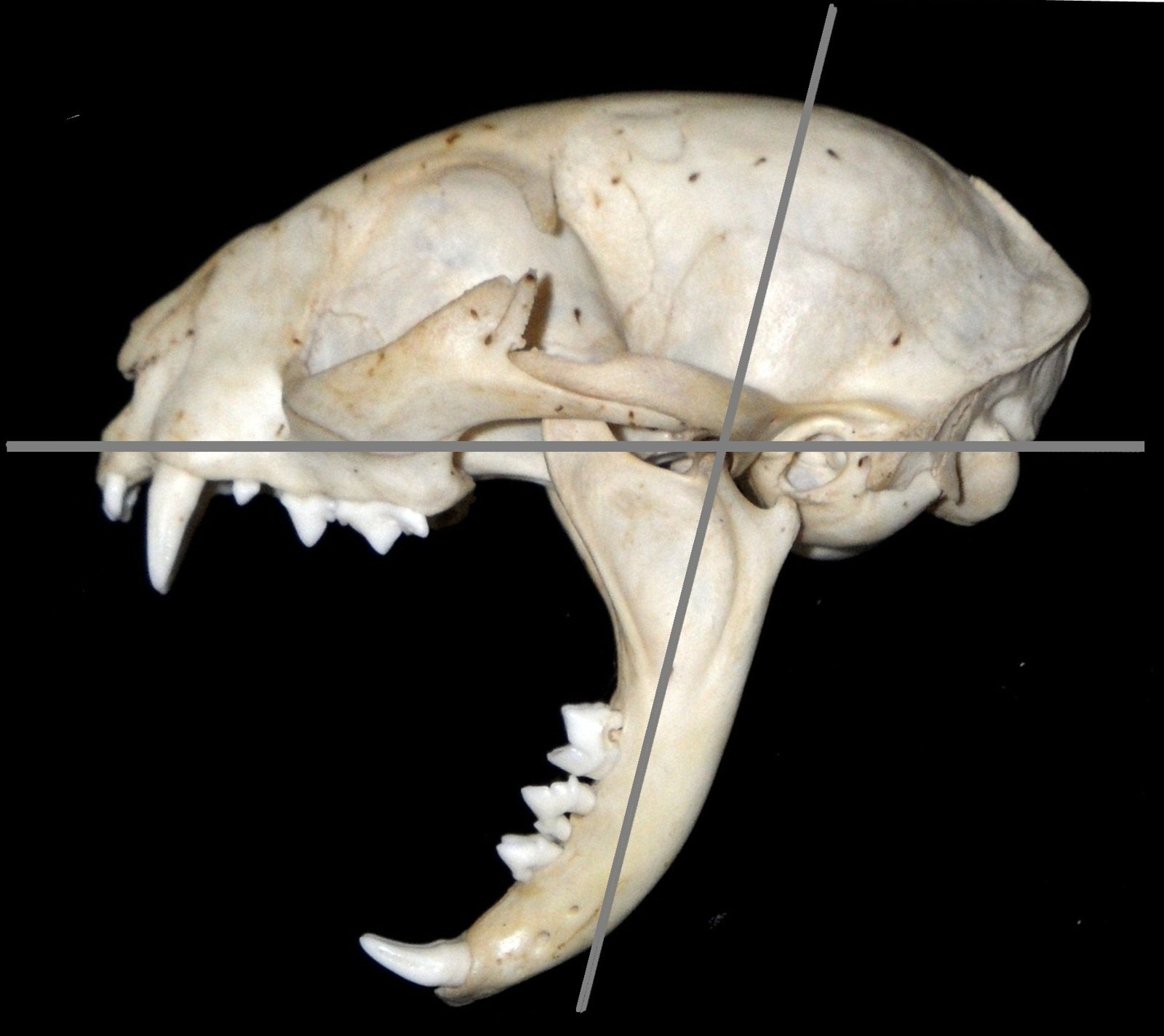
Maryland's key adds a neat detail to look for: house cats have a short nose and a small, peg-like upper molar sitting behind the premolars. A raccoon's cheek teeth are broader and sturdier, built for crushing and grinding a mixed diet, as Virginia Tech Extension also describes. Maryland gives house cat skulls a length of about 77 to 101 millimeters, so the two can overlap in size, which is another reason to trust the teeth over the ruler.
Raccoon or opossum?
An opossum skull is easier to tell apart once you know what to look for. The Virginia opossum, *Didelphis virginiana*, belongs to the family Didelphidae, and Animal Diversity Web gives it 50 teeth, the most of any of the four animals here. That includes five upper incisors and four lower incisors on each side, a crowd of small front teeth no raccoon has.
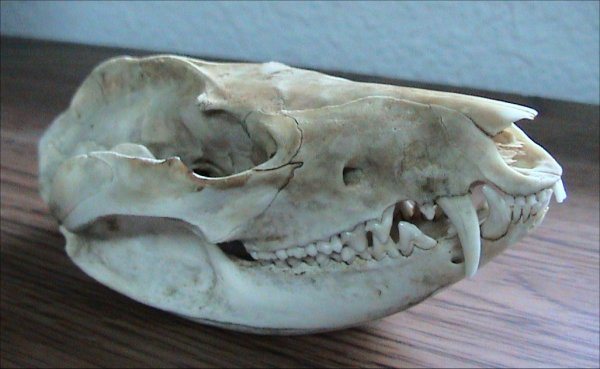
The shape is different too. An opossum skull typically has a long, pointed snout, a small braincase and a well-developed sagittal crest, a ridge of bone running along the top of the skull where jaw muscles attach. Maryland's key uses exactly that pair of clues, five upper and four lower incisors plus a large sagittal crest, to pick out an opossum. A raccoon, by comparison, has a shorter, broader face, about 40 teeth and those wide crushing molars.
Raccoon or fox?
A fox skull looks longer and leaner. The red fox, *Vulpes vulpes*, has a longer, narrower snout and a row of teeth that runs more than half the length of the skull, according to Animal Diversity Web. Its dental formula is 3/3, 1/1, 4/4, 2/3, for 42 teeth, just two more than a raccoon, so counting alone can be close. The giveaway is the carnassials: in a fox, the upper fourth premolar and the lower first molar form prominent shearing blades. The fox's cheek teeth are pointed, made for piercing and slicing, although its molars can do some crushing.
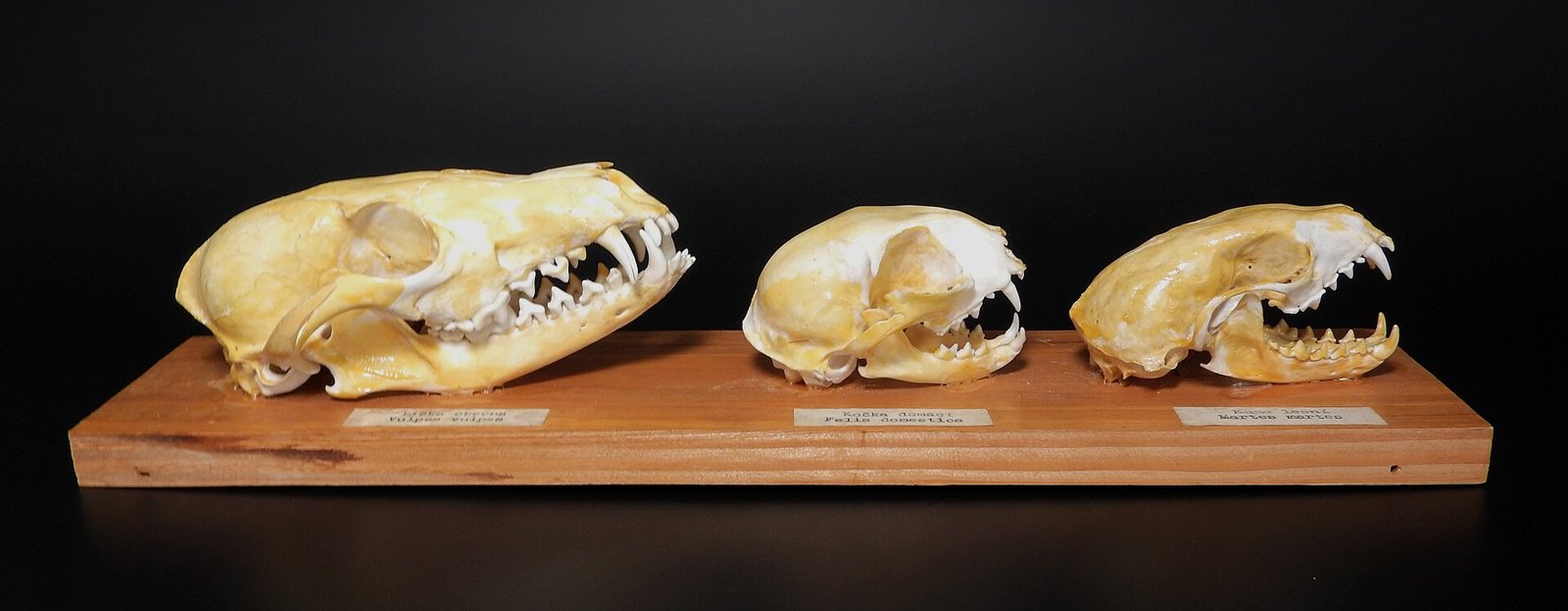
A raccoon skull is shorter and broader, with wider, rounder molars and much less specialized carnassials. If the back teeth look like little hills, think raccoon. If they look like blades, think fox.
Tap or hover a row to highlight it.
| Feature | Raccoon, Procyon lotor | Domestic cat, Felis catus | Virginia opossum, Didelphis virginiana | Red fox, Vulpes vulpes |
|---|---|---|---|---|
| FeatureAdult teeth | Raccoon, Procyon lotorAbout 40 | Domestic cat, Felis catus30 | Virginia opossum, Didelphis virginiana50 | Red fox, Vulpes vulpes42 |
| FeatureSnout | Raccoon, Procyon lotorShort and broad | Domestic cat, Felis catusShort and rounded | Virginia opossum, Didelphis virginianaLong and pointed | Red fox, Vulpes vulpesLong and narrow |
| FeatureCheek teeth | Raccoon, Procyon lotorBroad, rounded crushing molars | Domestic cat, Felis catusReduced, sharp shearing teeth | Virginia opossum, Didelphis virginianaMany teeth, large canines | Red fox, Vulpes vulpesPointed premolars and carnassials |
| FeatureSkull clues | Raccoon, Procyon lotorUnder 200 mm in Maryland's key | Domestic cat, Felis catusHouse cat skull 77 to 101 mm in Maryland's key | Virginia opossum, Didelphis virginianaSmall braincase, well-developed sagittal crest | Red fox, Vulpes vulpesLong skull, tooth row over half its length |
A step-by-step check for your skull
Put the skull on a table in good light and work through it in order. You do not need special tools, though a ruler and a magnifying glass help.
Is it a raccoon skull? A quick check
Tap a card to bring it forward.
- Count the teeth: If the skull is complete, count every tooth, upper and lower. About 40 points to raccoon, 50 to opossum, 30 to cat and 42 to red fox.
- Check the front teeth: Five upper incisors on each side means opossum.
- Look at the snout: Long and narrow with blade-like back teeth suggests fox. A long, pointed snout with a tall crest suggests opossum.
- Look at the face: A very short, round face with 30 teeth and a tiny peg-like upper molar suggests cat.
- Look at the molars: About 40 teeth, a short broad face and wide, rounded molars suggest raccoon.
- Measure and note: Measure the skull and write down where it came from, but never rely on size alone.
If you are still unsure after all that, the classic "housecat or raccoon?" question is a fair one to take to a natural history museum or a university mammal collection, where people can compare your skull with labeled specimens. The same goes for a skull that might belong to an animal outside these four, such as a dog.
Can you keep a raccoon skull?
This section is general information, not legal advice. Laws differ by state and by country, and they can change.
In the United States the rules depend on the state, the landowner, the park system, the species and whether the animal was legally taken or simply turned up dead. Raccoons are often regulated as furbearers. Texas Parks and Wildlife, for example, lists raccoons as fur-bearing animals and says a person with a hunting license may take and possess a furbearer or its parts when it is not being sold or exchanged. Texas also says that nuisance furbearers taken under the nuisance-animal exception may not be kept except by licensed trappers during lawful periods.
Illinois gives a different example. The Illinois Department of Natural Resources says a raccoon skull picked up on private property may be kept with the landowner's permission, but may not be taken from Illinois state parks. City parks, nature preserves and forest preserves can have their own rules, and Illinois requires a scientific permit to keep the skull for use in a classroom.
Those are two states out of fifty. Before you keep, move, sell or display a skull, confirm the rule with the wildlife agency for your state, the manager of the land where it turned up or the US Fish and Wildlife Service. Our page on what to do when you find an animal skull covers the general rules and who to ask. We Dig Skulls does not buy or sell real skulls.
The raccoon skull in Spanish
If you are searching or asking in Spanish, the raccoon is the mapache, the ordinary common name for *Procyon lotor* in Mexico. Opossums are zarigüeyas, and in Mexico the name tlacuache is common too. Asked in Spanish, the question of what a raccoon skull looks like gets the same answer: a short, broad skull with about 40 teeth, moderate canines and wide back teeth for crushing food.
Where to see good comparison skulls
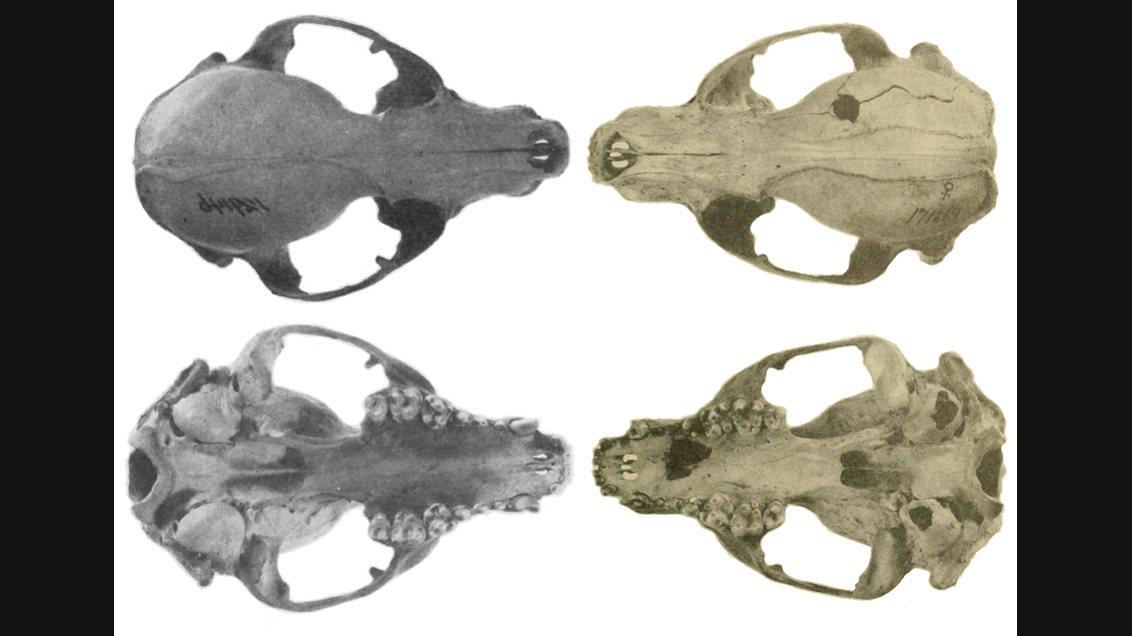
The Smithsonian's raccoon skull guide is the best place to start, and the museum also has a common raccoon specimen record with skull images. The Naturalis Biodiversity Center in the Netherlands has shared a view of the underside of a raccoon skull, from the subspecies *Procyon lotor hernandezii*, which is useful for checking the palate and tooth rows. For a bit of history, the 1950 US Fish and Wildlife Service publication *Raccoons of North and Middle America* by Edward A. Goldman and Hartley H. T. Jackson includes public-domain drawings_P._lotor_&_P._cancrivorus.png) comparing the common raccoon's skull with that of the crab-eating raccoon. And photographer Alex Abair has shared a clear photo of a common raccoon skull on Wikimedia Commons.
Questions people ask about raccoon skulls
What does a raccoon skull look like?
A raccoon skull is short and broad, with a large braincase, about 40 teeth, moderately long canines and wide, rounded molars. It has a small bony point behind each eye socket near the middle of the skull, and it lacks the sharp shearing blades of a cat or fox.
How many teeth does a raccoon skull have?
An adult raccoon normally has 40 teeth. Each side of each jaw holds three incisors, one canine, four premolars and two molars, written as 3/3, 1/1, 4/4, 2/2. Maryland's skull key allows 40 to 42 when identifying a raccoon.
Raccoon skull vs opossum skull: how do you tell them apart?
Count the front teeth: an opossum has five upper and four lower incisors on each side and 50 teeth in all, while a raccoon has about 40. The opossum also has a long, pointed snout and a tall sagittal crest along the top of the skull.
Raccoon skull vs cat skull: what is the difference?
A cat skull has about 30 adult teeth and a raccoon about 40. The cat has large shearing carnassials and a small peg-like upper molar, while the raccoon has broad, rounded cheek teeth for crushing.
Raccoon skull vs fox skull: how can you tell?
A red fox skull has a longer, narrower snout, 42 teeth and a tooth row running more than half the length of the skull. Its back teeth include blade-like carnassials, where a raccoon's are wide and rounded.
Can you name the skull?
Answer every question to check.
Read the teeth, then decide
A raccoon skull gives itself away through its teeth: about forty of them, with wide, rounded molars behind a short, broad snout. Once you have counted, checked the front teeth and looked for blades, most small skulls sort themselves out. If yours turns out to be something else entirely, our pages on deer skull meaning and bird skull meaning look at two more skulls people pick up outdoors, and the hippo skull shows just how strange a skull can look next to the animal that wore it.
Terms in this story
Tap a term to see what it means.
Procyon lotor. The scientific name of the common raccoon, called mapache in Spanish.
---