

No. 097
Did Elephant Skulls Inspire the Cyclops Legend?
Possibly, but nobody can prove it. The idea that elephant skulls inspired the Cyclops is a modern hypothesis, first put forward by the Austrian palaeontologist Othenio Abel in 1914 and later taken up by Adrienne Mayor in *The First Fossil Hunters* (2000). The resemblance is real: the big hole in the middle of an elephant skull is the nasal opening where the trunk attached, while the eye sockets sit off to the sides. Dwarf elephant fossils really did lie on Mediterranean islands such as Sicily, Crete and Cyprus. What is missing is any surviving ancient text or image in which a Greek person looks at an elephant skull and calls it a Cyclops (Marra, 2007).
So, the photo that made you wonder is a good reason to wonder. The rest of the story covers what the skull actually shows, which fossils were lying around, who connected them to the legend, and why many scholars are not convinced.
What that big hole in an elephant skull really is
That single opening in the middle of the face is not an eye socket. It is the elephant's enlarged nasal aperture and nasal cavity, the bony frame where the trunk attaches. The real eye sockets are positioned on the sides of the skull, where they are easy to miss in a front-on photo (Todd, *The Anatomical Record*, 2010).
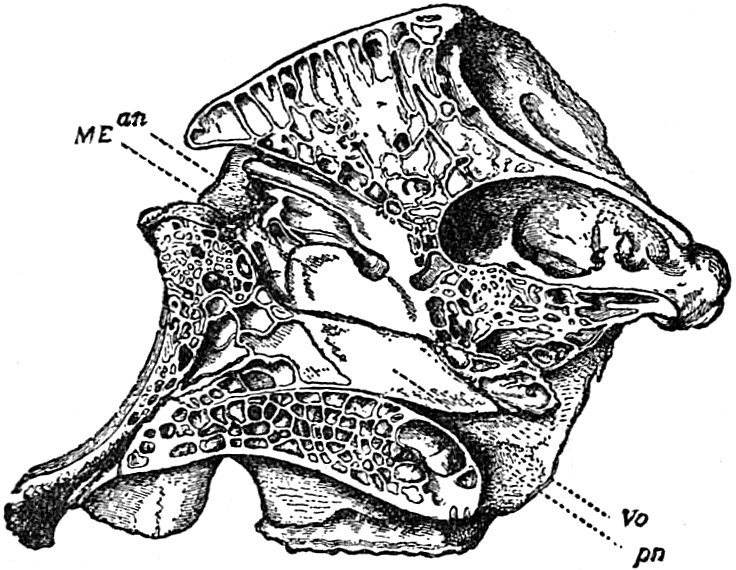
Todd's 2010 study of the skulls of modern African and Asian elephants identifies the external nares, the outer nasal openings, and the nasal cavity behind them. Elephant skulls are also heavily pneumatized, which means they are full of internal air spaces. That keeps a very large skull lighter than it looks while preserving its strength.
To a human eye, the effect is striking. We are used to skulls with two eye sockets above a small nose hole, like our own. An elephant skull reverses the proportions: a huge central opening and two eye sockets tucked away on the sides. Look at it straight on and your brain reads the biggest hole as the eye. Our own skulls play a similar trick, since the nose is cartilage and leaves only a hole behind, as our human skull facts explain.
The dwarf elephants of Sicily, Crete and Cyprus
The hypothesis depends on the Greeks having elephant skulls to look at, and the Mediterranean islands supplied them. Dwarf elephant fossils are documented on Sicily, Crete and Cyprus, among other islands.
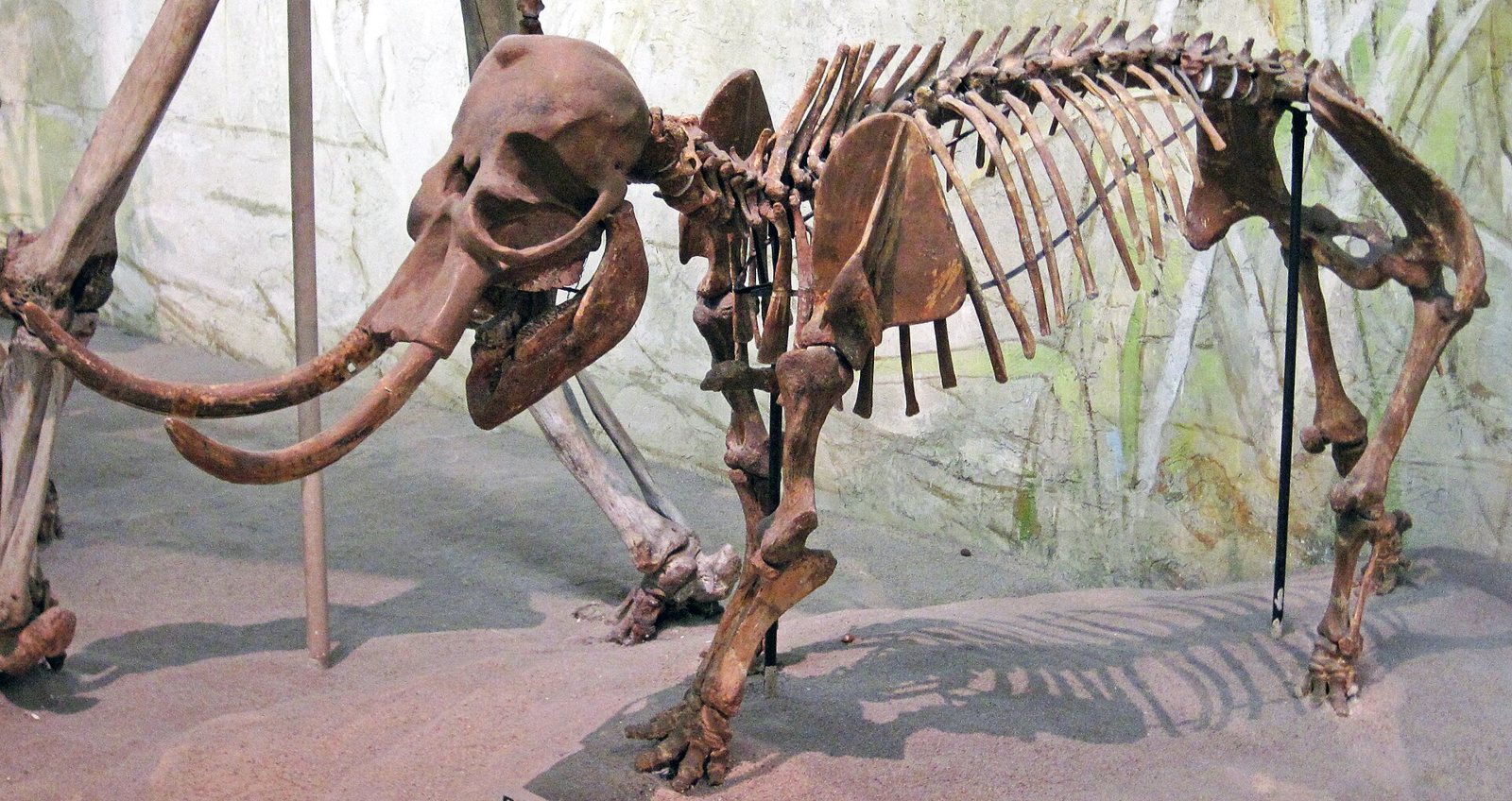
On Sicily, the smallest form, *Palaeoloxodon falconeri*, stood about 1 metre tall, as a study in *Scientific Reports* describes (Scientific Reports). At Spinagallo Cave near Syracuse, excavators recovered more than 2,000 of its bones in 1958 and 1960. Herridge and colleagues later dated the cave using uranium-thorium dating of speleothems (mineral formations that grow in caves) and optically stimulated luminescence dating of the fossil-bearing sediments and calcite coatings on the fossils. Their work places the Spinagallo deposits in the late Middle Pleistocene, with an age discussed around 350,000 years. An older estimate by amino-acid racemization gave about 455,000 years, plus or minus 90,000, but the authors note problems with those older methods (Herridge et al.).
Crete had its own fossil elephants, including the very small *Mammuthus creticus* and a larger dwarf form later named *Elephas antiquus creutzburgi*. Scientists still disagree about how to classify the Cretan record (Crete fossil elephant study).
Cyprus had *Palaeoloxodon cypriotes*, an extremely small elephant found nowhere else, described as dating from the latest Pleistocene to the early Holocene. A second, larger form, *Palaeoloxodon xylophagou*, is associated with the late Middle Pleistocene, about 243,000 to 191,000 years ago (Cyprus cranial study).
The dates and species names are not settled across all three islands. The Sicilian chronology is the most directly measured, while some older dates and identifications elsewhere remain disputed. If you want to know how scientists put ages on bones in the first place, our story on how old bones are dated covers the main methods.
Tap or hover a row to highlight it.
| Island | Species | What the studies give |
|---|---|---|
| IslandSicily | SpeciesPalaeoloxodon falconeri | What the studies giveAbout 1 metre tall; Spinagallo Cave deposits around 350,000 years old (U-Th and OSL dating) |
| IslandCrete | SpeciesMammuthus creticus | What the studies giveA very small dwarf mammoth; classification disputed |
| IslandCrete | SpeciesElephas antiquus creutzburgi | What the studies giveA larger dwarf form; classification disputed |
| IslandCyprus | SpeciesPalaeoloxodon cypriotes | What the studies giveExtremely small; latest Pleistocene to early Holocene |
| IslandCyprus | SpeciesPalaeoloxodon xylophagou | What the studies giveA larger form; about 243,000 to 191,000 years ago |
Othenio Abel's idea in 1914
In 1914 the Austrian palaeontologist Othenio Abel proposed that fossil skulls of Mediterranean dwarf elephants could have been taken for the remains of one-eyed giants. His reasoning was visual. The central nasal opening is much larger than a human eye socket, so a skull like that could look like the head of an enormous creature with one eye in the middle of its face (Kalantzis, Tsiamis and Poulakou-Rebelakou, 2013).
It is an appealing idea because it starts from something anyone can see. Put an elephant skull next to an ancient description of a Cyclops, and the match is hard to unsee.
Adrienne Mayor and The First Fossil Hunters
The idea reached a wide audience through Adrienne Mayor's book *The First Fossil Hunters: Dinosaurs, Mammoths, and Myth in Greek and Roman Times*, first published in 2000 (JSTOR record). Mayor accepted the general possibility that fossils shaped some ancient monster traditions.
She also exposed a weak spot in Abel's version. Abel had claimed that the Greek philosopher Empedocles identified elephant fossils as the remains of Cyclopes. Mayor showed that this claim has no basis in surviving records (Witton and colleagues). The supposed ancient witness turned out not to exist, which left the hypothesis resting on resemblance alone.
The Cyclops in Homer and Hesiod
There is not one Cyclops tradition in ancient Greek poetry but at least two, and they describe quite different beings.
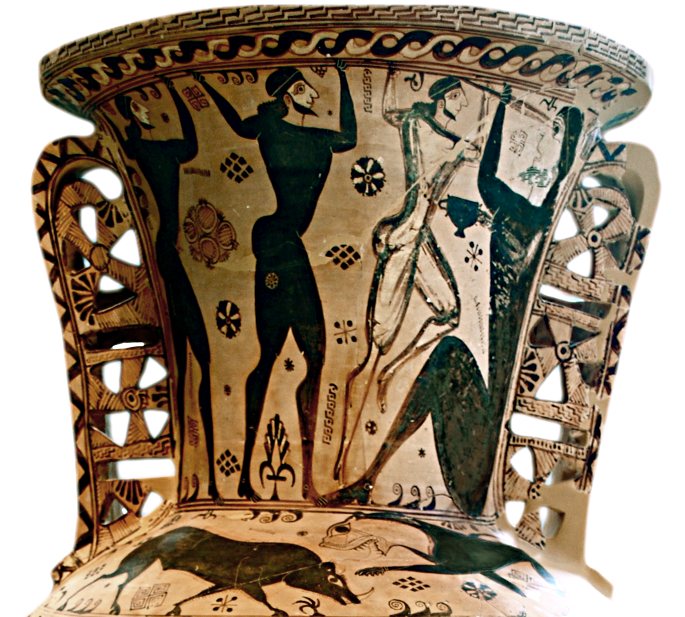
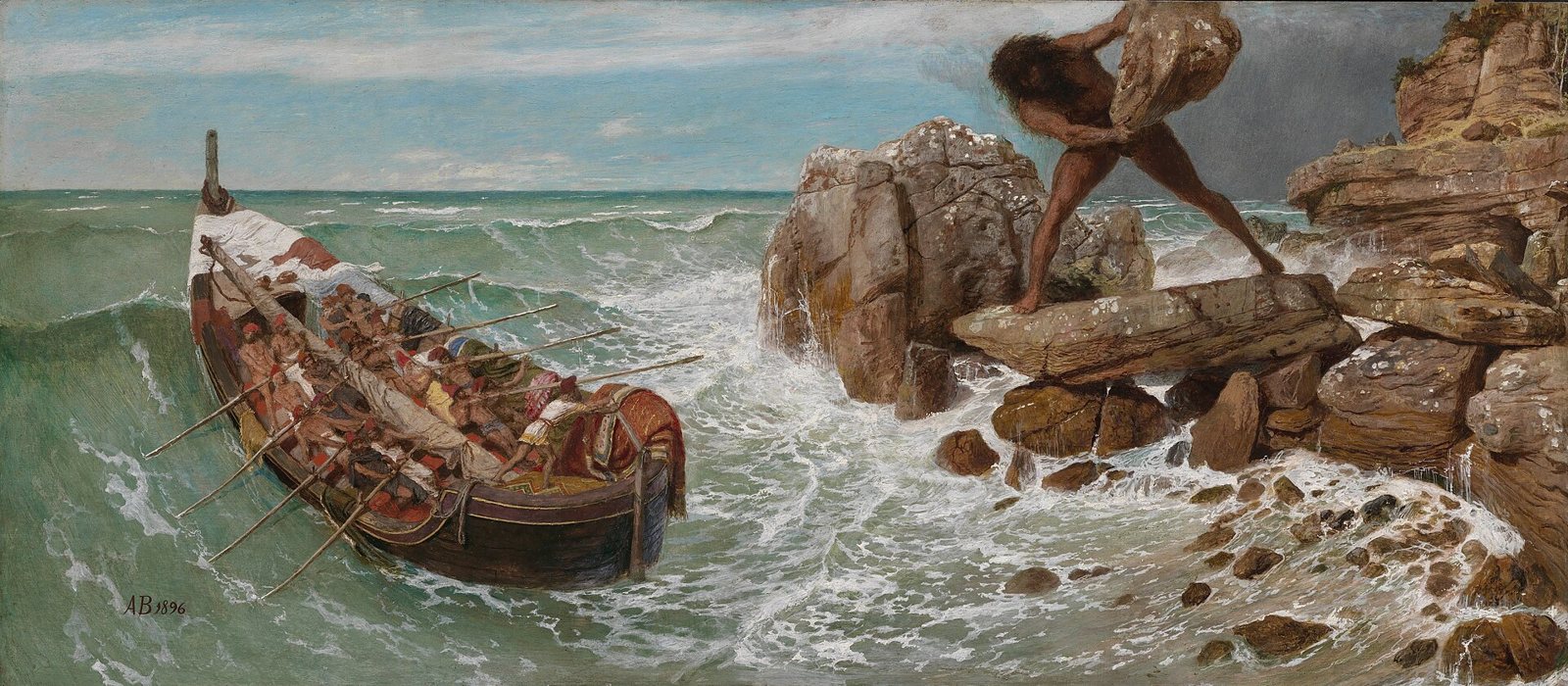
Homer's *Odyssey*, generally dated to the late eighth or early seventh century BCE, gives us Polyphemus, the cannibal Cyclops, a giant who lives in a cave, herds sheep and is finally blinded by Odysseus. In the English translation on Perseus, the Cyclopes are "the one-eyed children of ocean's god" (Homer, *Odyssey*, Perseus Digital Library).
Hesiod's *Theogony*, usually dated to the seventh century BCE, tells a different story. His three Cyclopes, Brontes, Steropes and Arges, are children of Gaia and Ouranos and divine smiths who forged Zeus's thunderbolts, not cave-dwelling shepherds. Hesiod says they were like the gods "in all other respects," except that "a single eye was fixed in the middle of their foreheads" (Hesiod, *Theogony*, Center for Hellenic Studies).
That line from Hesiod is the one people tend to hold up beside an elephant skull, and the fit is tempting. Neither poem, though, says anything about fossil skulls. They are descriptions of mythic beings, and they leave their origins unexplained.
From Homer to the critics: the Cyclops and the elephant skull
Tap or hover a step to follow the order.
Middle Pleistocene
Dwarf elephant populations live on Mediterranean islands, including Sicily and Crete.
Late eighth or early seventh century BCE
Homer's Odyssey presents Polyphemus and the Cyclopes.
Seventh century BCE
Hesiod's Theogony describes Brontes, Steropes and Arges as one-eyed divine smiths.
1914
Othenio Abel proposes that dwarf elephant skulls inspired the Cyclops image.
1958 and 1960
More than 2,000 dwarf elephant bones are excavated at Spinagallo Cave, Sicily.
2000
Adrienne Mayor publishes The First Fossil Hunters.
2007
A.C. Marra concludes that the fossil connection cannot be proved from ancient literary evidence.
What the critics say
Critics of the idea agree that elephant skulls look like one-eyed faces. What they question is the historical link between those skulls and the legend.
A.C. Marra, in a 2007 study titled "Cyclopes and elephants; a palaeontological myth," concludes that no unequivocal ancient literary evidence derives the Polyphemus story from fossil elephants. Marra allows that fossils in Sicilian caves could have influenced later retellings, but says the hypothesis cannot be proved (Marra, 2007).
Mercedes Aguirre and Richard Buxton argue that the fossil explanation lacks direct ancient evidence and is effectively unfalsifiable, meaning there is no way to test it and show it wrong. Mark Witton and Richard Hing point out that elephant fossils and one-eyed monsters both turn up in many parts of the world, and that ancient texts and art give no special weight to a Sicilian connection (Witton and colleagues).
Peter Gainsford, writing for the Society for Classical Studies, adds another angle. The story of a hero trapped in a giant's cave who blinds him to escape resembles a widespread folktale told in Europe, Syria and North African Berber traditions (Gainsford, Society for Classical Studies). If the plot was already traveling as a folktale, it did not need a skull to get started.
There is also a medical explanation that some writers raise. Cyclopia is a rare congenital condition in which a baby develops a single central eye or fused eyes. It could account for the image of a one-eyed face without any fossils, though it does not prove that the legend came from such births either (Kalantzis, Tsiamis and Poulakou-Rebelakou, 2013).
Put together, the scholars' view comes out like this: the elephant skull is a real and striking match for the Cyclops's face, the fossils were really there, and, as Marra allows, they could have influenced later retellings of the story. It is not a proven origin.
Where to look at these skulls
If you want to see the "one eye" for yourself, the clearest view is the cross-section of an African elephant skull printed in the 1911 *Encyclopaedia Britannica*, which Wikimedia Commons lists as public domain in the United States. For a dwarf elephant, there is a photograph of a pygmy elephant skeleton cast by Ninjatacoshell from January 2009, licensed CC BY-SA 3.0 (Wikimedia Commons). Those two are the ones to use if you want to share an image. MUSE, the Museo delle Scienze in Trento, Italy, holds a replica skull of *Palaeoloxodon falconeri*.
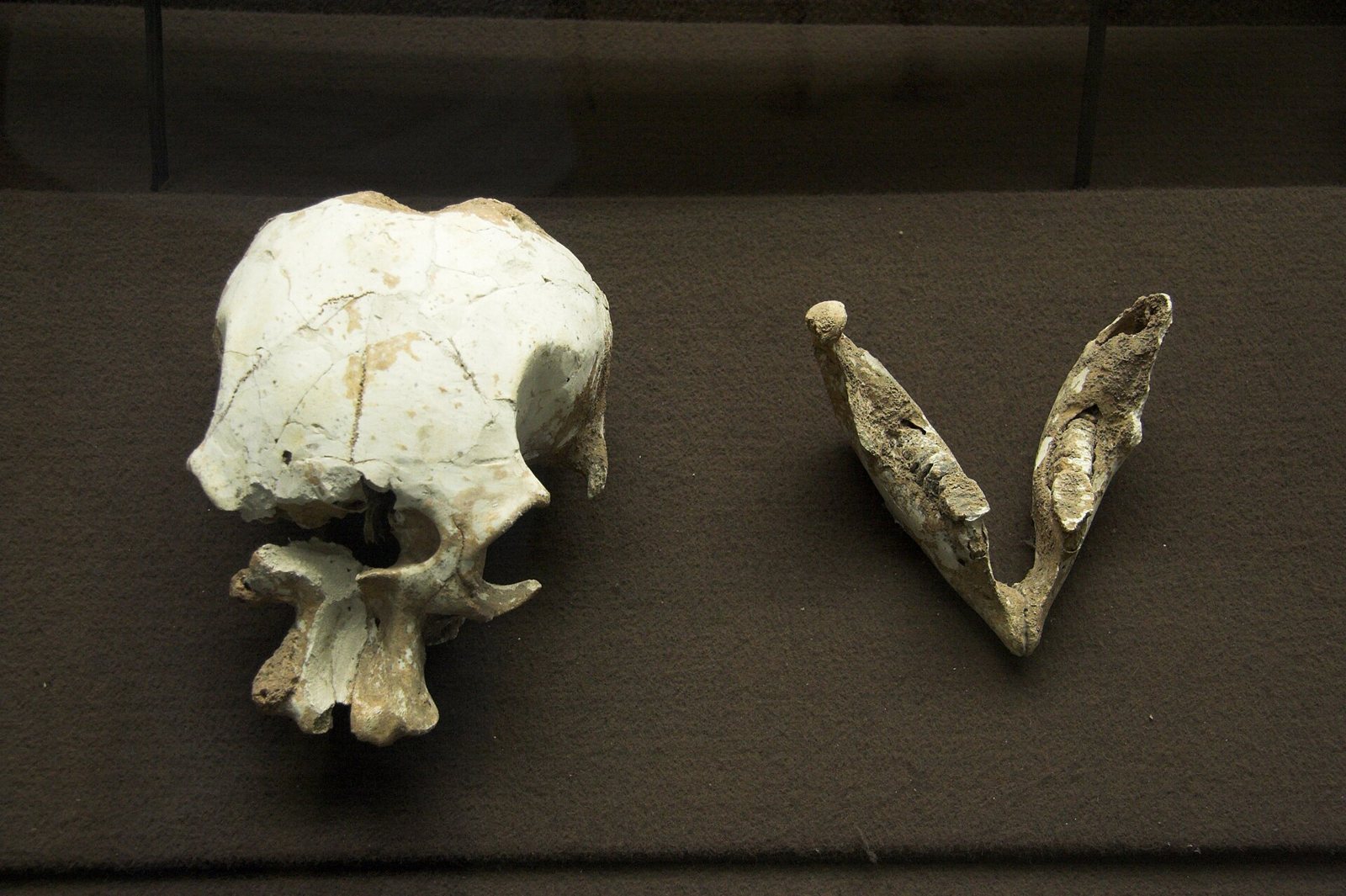
Elephants are not the only large animals with skulls that surprise people. Our story on the hippo skull looks at another one.
Questions people ask about elephant skulls and the Cyclops
These are the questions that come up most about the elephant skull and the one-eyed giant.
Did elephant skulls inspire the Cyclops legend?
Elephant skulls may have inspired the Cyclops legend, but it is unproven. The idea began with Othenio Abel in 1914, and it rests on a real resemblance and real fossils, not on any ancient account. Scholars such as A.C. Marra, Mercedes Aguirre and Richard Buxton argue that it cannot be tested or confirmed.
Why does an elephant skull have one hole?
An elephant skull has one big hole because its nasal opening, where the trunk attaches, sits in the middle of the face and is far larger than the eye sockets. The eye sockets are on the sides, so from the front the skull seems to have a single giant eye.
Is there fossil evidence for the Cyclops?
There is fossil evidence of dwarf elephants on Mediterranean islands, but not of the Cyclops. More than 2,000 bones of *Palaeoloxodon falconeri* came out of Spinagallo Cave in Sicily alone. What does not survive is an ancient record linking those bones to the giant.
Why do Cyclopes have one eye?
Cyclopes have one eye because that is how the Greek poets described them: Hesiod says a single eye was fixed in the middle of their foreheads. Why the poets imagined them that way is the open question, and elephant skulls, folktales and cyclopia are all explanations people have proposed.
Where did the Cyclops legend come from?
The Cyclops legend reaches us through Homer's *Odyssey* and Hesiod's *Theogony*, both from the eighth to seventh centuries BCE. Peter Gainsford notes that Polyphemus's cave story resembles a folktale also told in Europe, Syria and North Africa, so the plot itself may not have needed one island's fossils to exist.
Test yourself on the Cyclops and the elephant skull
Elephant skulls and the Cyclops: how much do you know?
Answer every question to check.
A skull that keeps the question open
An elephant skull really does stare back with one enormous "eye," and dwarf elephants really did leave their bones on Sicily, Crete and Cyprus. That is enough to make the Cyclops theory worth knowing, and not enough to make it fact. The nice thing about this one is that you can hold both halves at once: a real skull, a real legend, and a gap between them that nobody has closed.
Terms in this story
Tap a term to see what it means.
Nasal aperture. The bony opening for the nose. In an elephant skull it is the large central hole where the trunk attached.
---