

No. 094
The Skeleton Flower: The White Petals That Turn Clear in the Rain
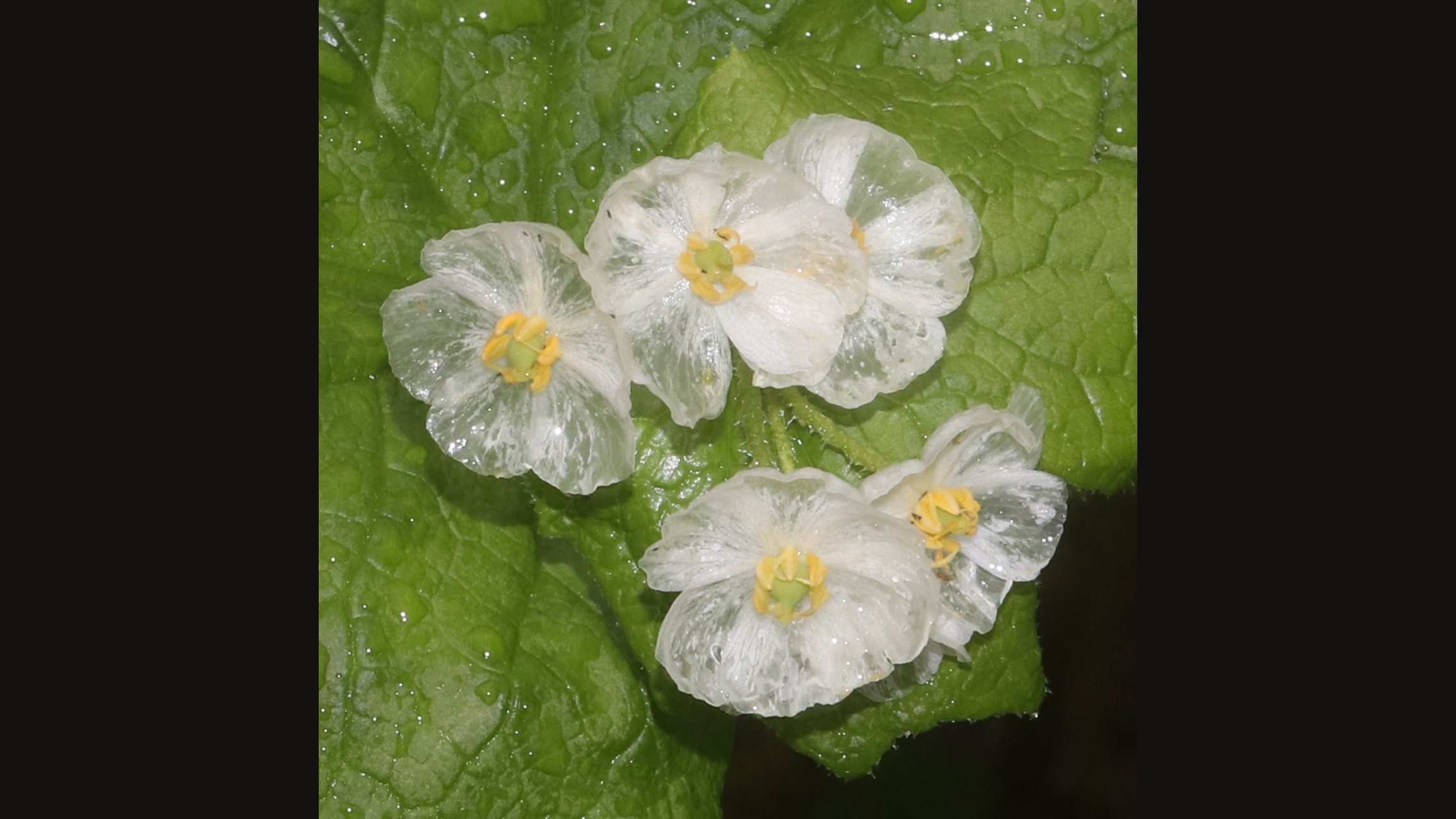
Yes, the flower in that video is real. The skeleton flower is usually *Diphylleia grayi*, a woodland perennial in the barberry family, Berberidaceae, that grows wild in the cool mountain forests of Japan and on Sakhalin. In Japanese it is called sankayō, written 山荷葉. Its petals are white when dry, but after a long, steady rain they turn as clear as glass, because water fills tiny air spaces inside the petal and light stops scattering. The veins stay visible, which gives the flower its skeleton look, and as the petals dry, the white comes back. It is a small flower that dresses up as a skeleton every time the weather turns wet, and then changes back when the sun comes out.
What the plant is and where it grows
*Diphylleia grayi* was named by the botanist F. Schmidt, and Kew's Plants of the World Online records the name as published in 1868. It is a perennial, so the same plant comes back year after year, with large leaves held up like umbrellas and small clusters of white flowers above them.
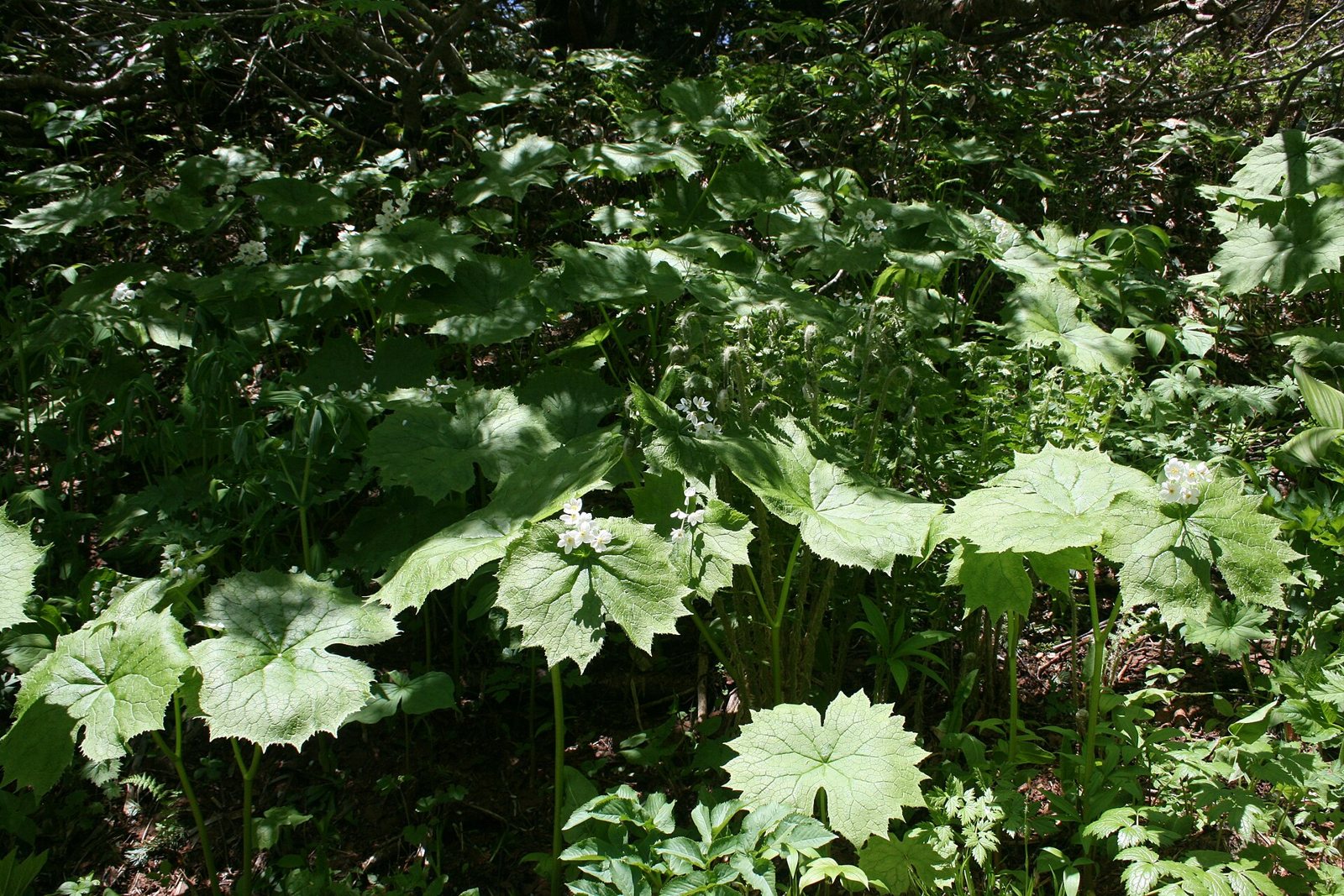
In the wild it keeps to cool, moist places: woodland, mountain slopes and the banks of streams. The Okayama University of Science botanical garden places it from central Honshu north through Hokkaido and into Sakhalin. Tsubasa Toji of Nihon University, who wrote the scientific report on its glass-like petals, describes it as endemic to Japan and Sakhalin and growing mostly in central Japan. The Japanese Environment Ministry's species record lists sightings such as one in Hokkaido, along with conservation-status entries by prefecture.
If you have read that the skeleton flower also grows in China, that comes from a mix-up between relatives. China has its own species, *Diphylleia sinensis*. *D. grayi*, the one in most of the videos, belongs to Japan and Sakhalin.
Why the petals turn clear in the rain
The trick is in how the petal is built. A dry petal of *Diphylleia grayi* has a loose cellular structure full of air-filled spaces. Air and petal tissue bend light differently (scientists say they have different refractive indexes), so every time light passes from tissue into air and back again, it bounces off in a new direction. All that scattering is what our eyes read as white.
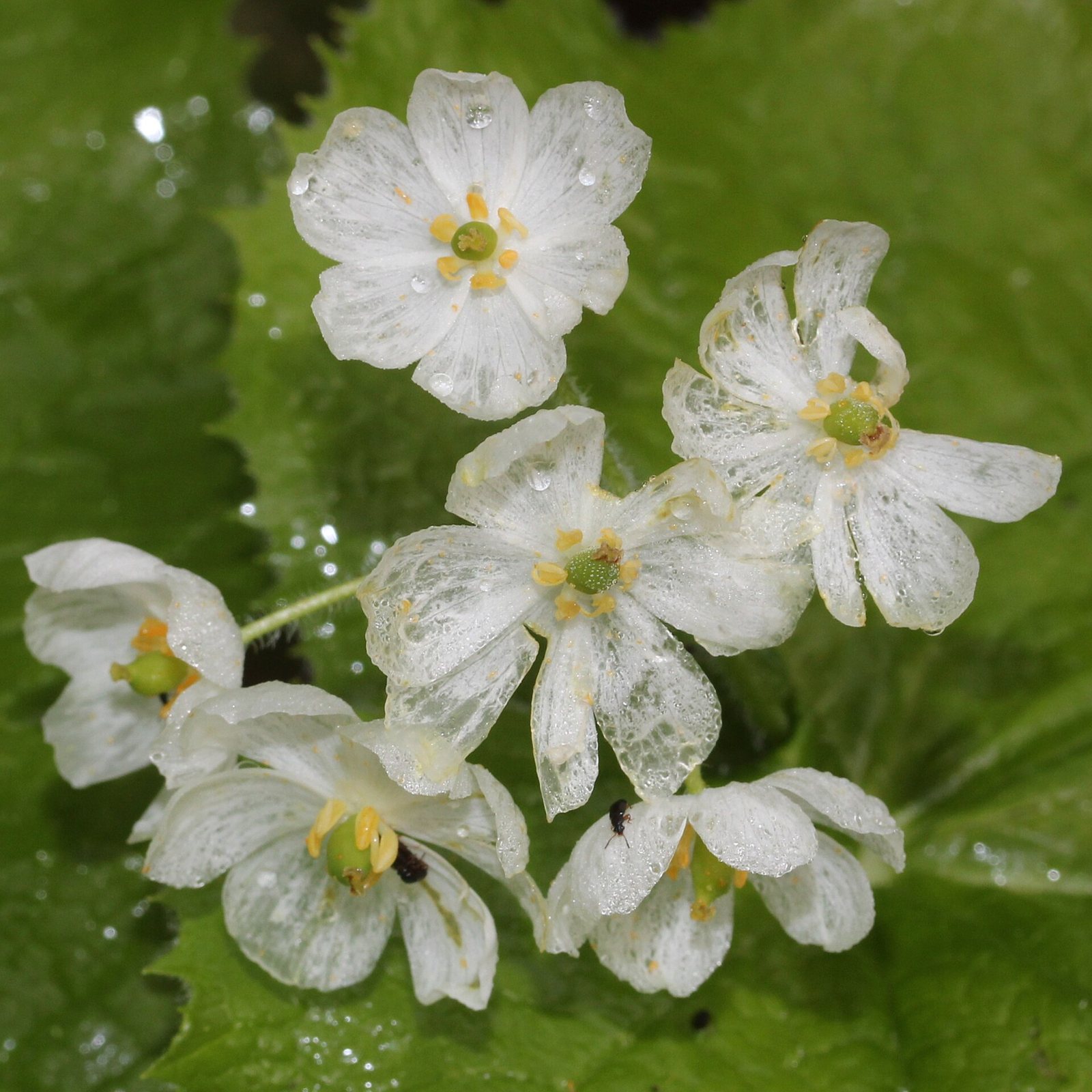
When rain soaks the petal, water fills those air spaces. Water bends light much more like the petal tissue does, so the difference shrinks. Light scatters less and passes through the petal more directly, and the petal starts to look transparent. What is left to see are the veins running through it, the fine network that gives the flower its common name. A 2024 review in Light Management with Natural Materials sums up the process as reversible refractive-index matching: the water matches the tissue, the petal clears, and when the water leaves, it clouds over again.
As the petal dries, air moves back into the spaces, the scattering returns and the flower is white once more. Nothing has been bleached or damaged. The same flower can go clear and white again with the weather.
How much rain it takes, and how long it lasts
The change is slower than a time-lapse makes it look. Toji reported that continuous light rain for about a day may be needed before the petals turn transparent. A quick shower is not enough. Once the petals are clear, they can stay that way for a while after the rain stops, then slowly turn white again as they dry.
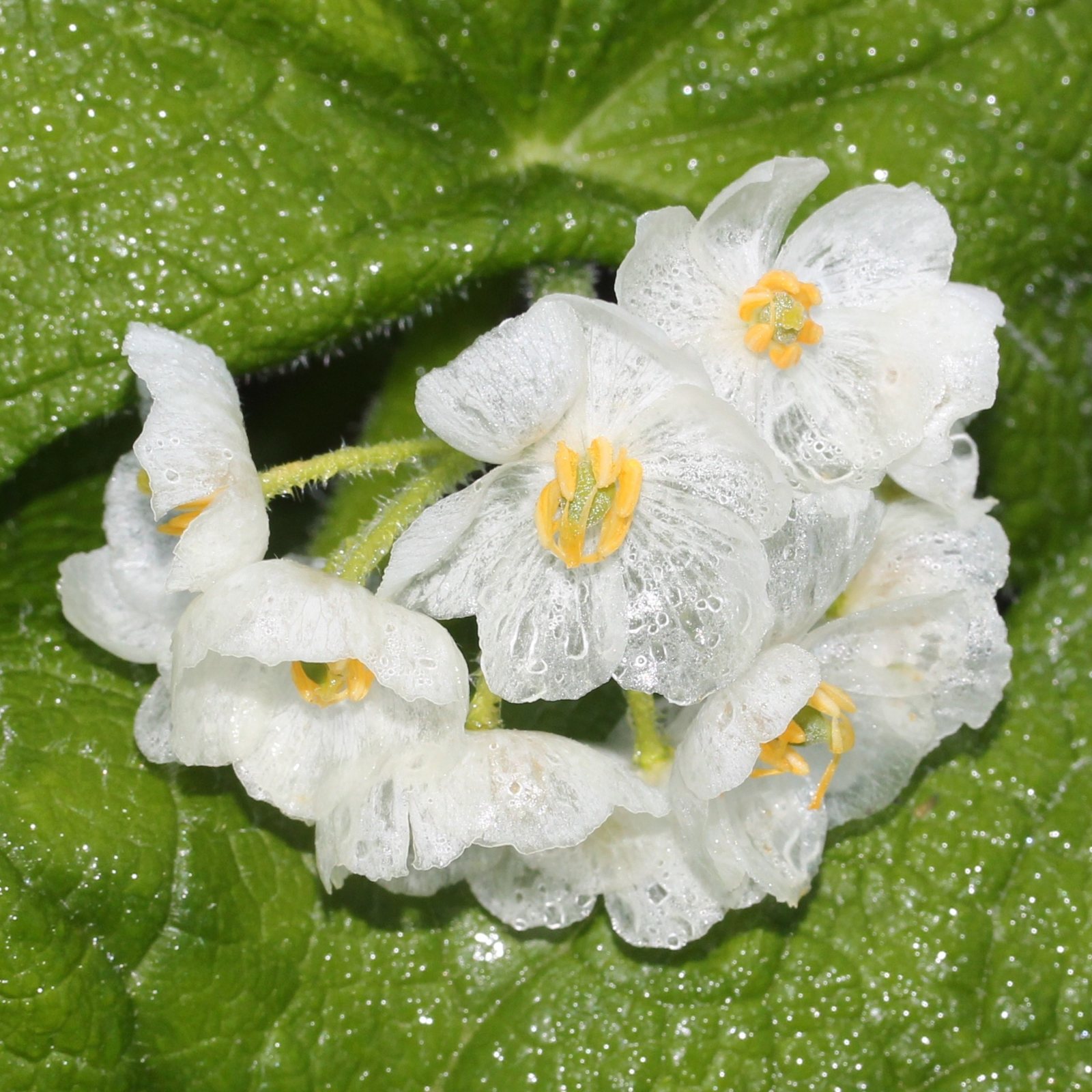
Toji observed it in Nagano, Japan, in June 2022, during the East Asian rainy season known as Tsuyu, and the report appeared in *Frontiers in Ecology and the Environment* in November 2023. The timing makes sense: early summer in the Japanese mountains brings exactly the long, soft rain the flower needs.
People sometimes ask whether the flower disappears. It does not. The petals lose their white, but the veins stay visible and the plant is still right there. What has changed is only the way light moves through the petals.
The effect has caught the attention of materials scientists too. Researchers writing in ACS Applied Nano Materials have studied the flower's reversible change in light scattering as a model for materials that turn transparent when they get wet.
The skeleton flower, from its name to the science
Tap or hover a step to follow the order.
1868
Kew records the first publication of the name Diphylleia grayi by F. Schmidt.
June 2022
Tsubasa Toji observes the glass-like petals in Nagano, Japan, during the rainy season known as Tsuyu.
November 2023
Toji's report appears in Frontiers in Ecology and the Environment.
2024
A review article describes the optical change as reversible refractive-index matching.
The skeleton flower's relatives
Toji counts three recognized species in the genus *Diphylleia*. Besides *D. grayi* in Japan and Sakhalin, there is *Diphylleia sinensis* in central China and *Diphylleia cymosa*, commonly called umbrella leaf, in the southern Appalachian Mountains of the United States. The Appalachian plant grows in mountain seepages, along stream banks and in moist woodland. The North Carolina Extension Gardener Plant Toolbox now files it under the name *Podophyllum cymosum*, with *Diphylleia cymosa* as its former name, so you may see either name on a plant label.
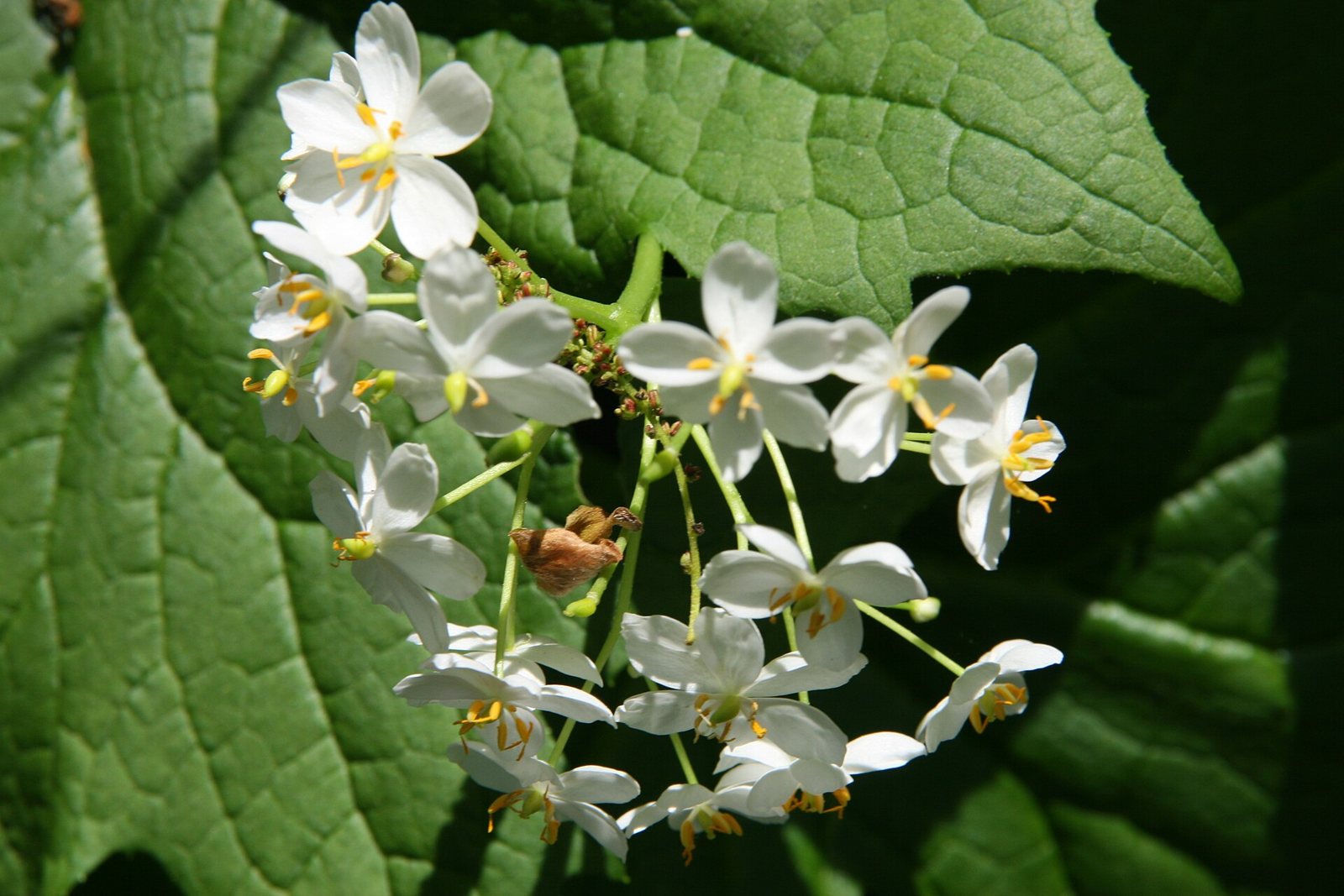
The catch for anyone hoping to see the glass effect in North Carolina or Tennessee: Toji says it is not known whether the Chinese and Appalachian species also turn transparent in the rain. The clear petals are documented for *D. grayi*, the Japanese skeleton flower, and that is the species to look for if the effect is what you are after.
Tap or hover a row to highlight it.
| Species | Common name | Where it grows wild | Clear petals in rain |
|---|---|---|---|
| SpeciesDiphylleia grayi | Common nameSkeleton flower, sankayō | Where it grows wildJapan and Sakhalin | Clear petals in rainYes, described by Toji in Japan |
| SpeciesDiphylleia sinensis | Common nameChinese umbrella leaf | Where it grows wildCentral China | Clear petals in rainNot known |
| SpeciesDiphylleia cymosa (Podophyllum cymosum) | Common nameUmbrella leaf | Where it grows wildSouthern Appalachian Mountains | Clear petals in rainNot known |
Can you grow a skeleton flower at home?
You can grow these plants if you can give them a cool, shaded, steadily moist corner. They are woodland plants, so a hot, sunny flower bed is the wrong home for them. Think of the floor of a damp forest instead.
Most garden guidance in the United States and Britain is written for the Appalachian umbrella leaf, *Diphylleia cymosa*. The Royal Horticultural Society recommends full or partial shade, moist soil rich in humus and shelter from drying winds, and gives it a UK H5 rating. The zone ranges vary a little by garden:
- The Chicago Botanic Garden lists it for USDA Zones 4 through 7, in partial shade.
- North Carolina Extension lists Zones 5a through 7b, with dappled or deep shade and occasionally wet soil.
- The Native Plant Trust lists Zones 4 through 8, in part shade.
For the true skeleton flower, *Diphylleia grayi*, public garden advice is thinner. The safest route is a nursery-grown plant from a specialist supplier, with the same cool shade, rich soil and steady moisture. Confirm the species on the label and ask the nursery or a botanical garden near you whether it will cope with your local climate. Never dig a plant from the wild; buy one that was raised for sale.
And if you end up with *D. cymosa* instead, enjoy it for its big umbrella leaves and white flowers, but do not count on glass petals after a storm. That effect has only been confirmed for the Japanese species.
What a skeleton flower needs
Tap a card to bring it forward.
- Shade: Full or partial shade, like a woodland floor, never a hot sunny bed.
- Soil: Moist, humus-rich soil that does not dry out.
- Water: Steady moisture through the growing season.
- Shelter: Protection from drying winds.
- Climate: Cool conditions; for the Appalachian umbrella leaf, roughly USDA Zones 4 to 8 depending on the garden.
- The right plant: A nursery-grown Diphylleia grayi from a specialist supplier, with the species confirmed on the label.
The name sankayō, and what the flower means
The Japanese name sankayō has nothing to do with skeletons. The Okayama University of Science garden explains that 山 means "mountain" and 荷葉 means "lotus leaf," so the name describes a mountain plant whose broad leaves look like the leaves of a lotus. The English name skeleton flower comes from the way the clear, wet petals show their veins.
Modern Japanese flower-language guides, part of the tradition called hanakotoba, give the flower meanings of "affection," "happiness" and "free-spirited," according to Flower-db. These are modern associations from florists and flower guides rather than an old religious or regional custom, and the clear petals themselves are a matter of light and water, not a symbol handed down through history.
The flower has picked up personal meanings too. Fans of Jonghyun, the late SHINee singer, have talked about why *Diphylleia grayi* appears in one of his songs, reading it as love, loss or being unseen. Those are fan readings, and they say more about how a flower that turns invisible in the rain stays in people's minds than about the plant itself.
On a skull-loving site, the appeal is easy to see. A flower whose white petals fall away to show the structure underneath belongs in the same family of curiosities as the snapdragon seed pods that look like tiny skulls, where nature happens to borrow the look of a skeleton. If you like that kind of thing in your garden and on your shirt, our Garden Crew skull tee puts skulls among the plants.
Seeing one in the wild
In Japan the skeleton flower grows in mountain woodlands, and the photographs on Wikimedia Commons give a sense of where: a bud on Mount Haku, a flowering plant at Ozegahara in Gunma, fruit on Mount Chō in Nagano. Toji's glass-petal observation came in Nagano in June, during the rainy season. Trails, seasons and access rules differ from park to park, so check current conditions with the park or local authority before planning a trip, and leave the plants where they grow.
Questions people ask about the skeleton flower
Is the skeleton flower real?
Yes. It is *Diphylleia grayi*, a real woodland perennial from Japan and Sakhalin, and its petals really do turn clear after about a day of steady light rain. Tsubasa Toji of Nihon University described the effect from plants in Nagano in 2023.
Where does the skeleton flower grow?
The skeleton flower grows wild mainly in Japan, from central Honshu north through Hokkaido, and on Sakhalin, in cool, moist woods and along mountain streams. Its relative *Diphylleia sinensis* grows in central China, and *Diphylleia cymosa* grows in the southern Appalachian Mountains of the United States.
What does the skeleton flower mean?
In modern Japanese flower language, sankayō is linked with "affection," "happiness" and being "free-spirited." These meanings come from modern florists and flower guides rather than an ancient tradition. The name skeleton flower simply describes the veined, see-through petals.
Does the skeleton flower disappear when it turns clear?
No, it only looks that way in some photos. The petals lose their white color, but the veins stay visible and the flower is still there. As it dries, the white returns.
Where can I buy a skeleton flower?
Look for a nursery-grown *Diphylleia grayi* from a specialist supplier of woodland or Japanese plants. Check that the label names the species, since the Appalachian umbrella leaf is sold too and its petals are not known to turn clear. Never take plants from the wild.
Is the skeleton flower poisonous?
Treat it like any garden plant you do not know well and do not eat any part of it. Keep it out of reach of children and pets that chew leaves. For a question about a specific plant, ask your local extension service or poison control.
How well do you know the skeleton flower?
Answer every question to check.
A flower worth waiting out the rain for
The skeleton flower is one of those things that looks like a special effect and turns out to be plain physics: air, water, light and a petal built just loosely enough to let them play. It needs a day of soft rain, a shady mountain wood and a bit of patience, and then it shows you its bones. If skulls and skeletons in unexpected places are your thing, there is more where this came from, from the meaning of skull symbols around the world to the seed pods that grin back at gardeners.
Terms in this story
Tap a term to see what it means.
Perennial. A plant that lives for more than two years and comes back each growing season, like Diphylleia grayi.
---