No. 019
Do Witches Use Skulls? What a Skull Means in Witchcraft and on an Altar
Some contemporary witches and Pagans do use skulls, usually on an altar, where a skull can stand for death, ancestors, the underworld or the turning of the year. Plenty of others never touch one and set out candles, photographs, bread and flowers instead. A skull has no single meaning in witchcraft. What it means belongs to the practitioner and the tradition, and the same bone-white shape can be an ancestor, a seasonal marker or simply a favorite decoration. Below is who uses skulls and how, what they can mean, what other altars hold instead, whether a skull has to be real, and what the historical record actually shows.
Who uses skulls today, and how
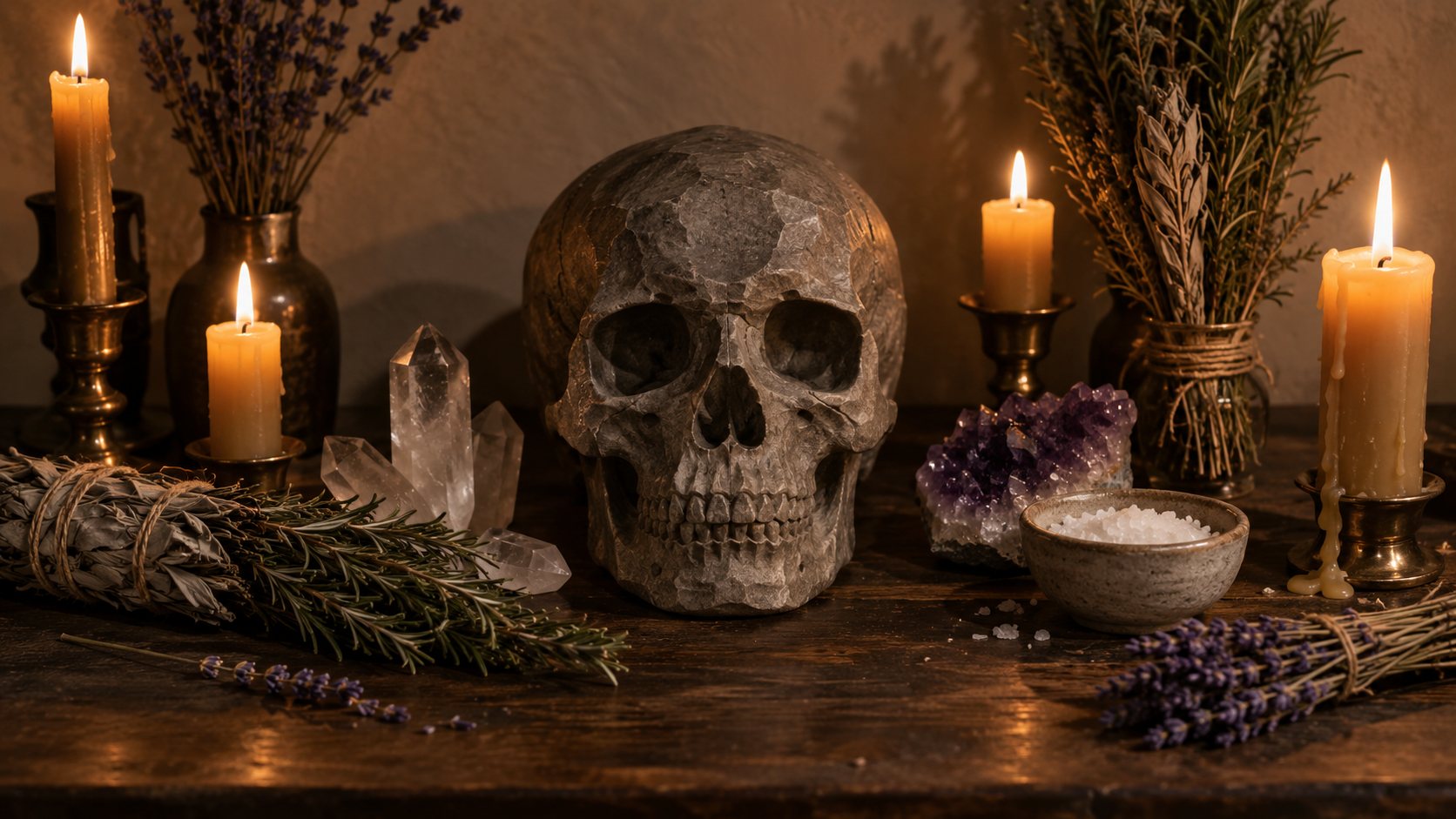
People who describe themselves as witches follow many paths, and skulls turn up in some of them as a choice rather than a rule. Practitioners and scholars describe several uses. A skull can be an altar object that stands for death, ancestors, the underworld or mortality. It can be a Samhain or Halloween decoration. It can sit beside photographs, candles, food, water and belongings as part of remembering a relative. An animal skull can be tied to that animal's life or to a nature-based practice. A replica can stand in for the real thing, and a skull can simply represent death and rebirth without being literal remains.
Historian Ronald Hutton describes Wicca, in a Gresham College lecture on modern Pagan witchcraft, as the oldest and most influential tradition of modern Pagan witchcraft. Yet altar objects within these traditions vary. Jennifer Sloan's 2007 ethnographic study of a Neo-Pagan group in Florida, The Gendered Wiccan Altar, found that groups used different ritual objects and that altar requirements varied by tradition and personal preference.
One documented example comes from Edmonton, Canada. A University of South Africa dissertation by C. de Klerk describes a 2007 Samhain altar at the Edmonton Open Circle. Skulls there represented the dead, the ancestors who had passed into the next life. They sat alongside candles, incense, pumpkins, antlers and a cauldron. A practitioner guide on ancestor work, Grimoire, describes altars as personal spaces that may hold photographs, gifts of food, candles or bones.
What a skull can mean on an altar
Ask ten practitioners and you may hear ten answers, but several meanings come up again and again. A skull can stand for mortality and the certainty of death, or for the end of a cycle. It can mean ancestors and remembrance, or the underworld and the in-between places. In a triple-goddess scheme, it can belong to the Crone, the aged aspect associated with death and darkness. It can mean change, death and rebirth. And it can work as a memento mori, a prompt to live with death in mind; if that phrase is new, our story on what memento mori means gives its history.
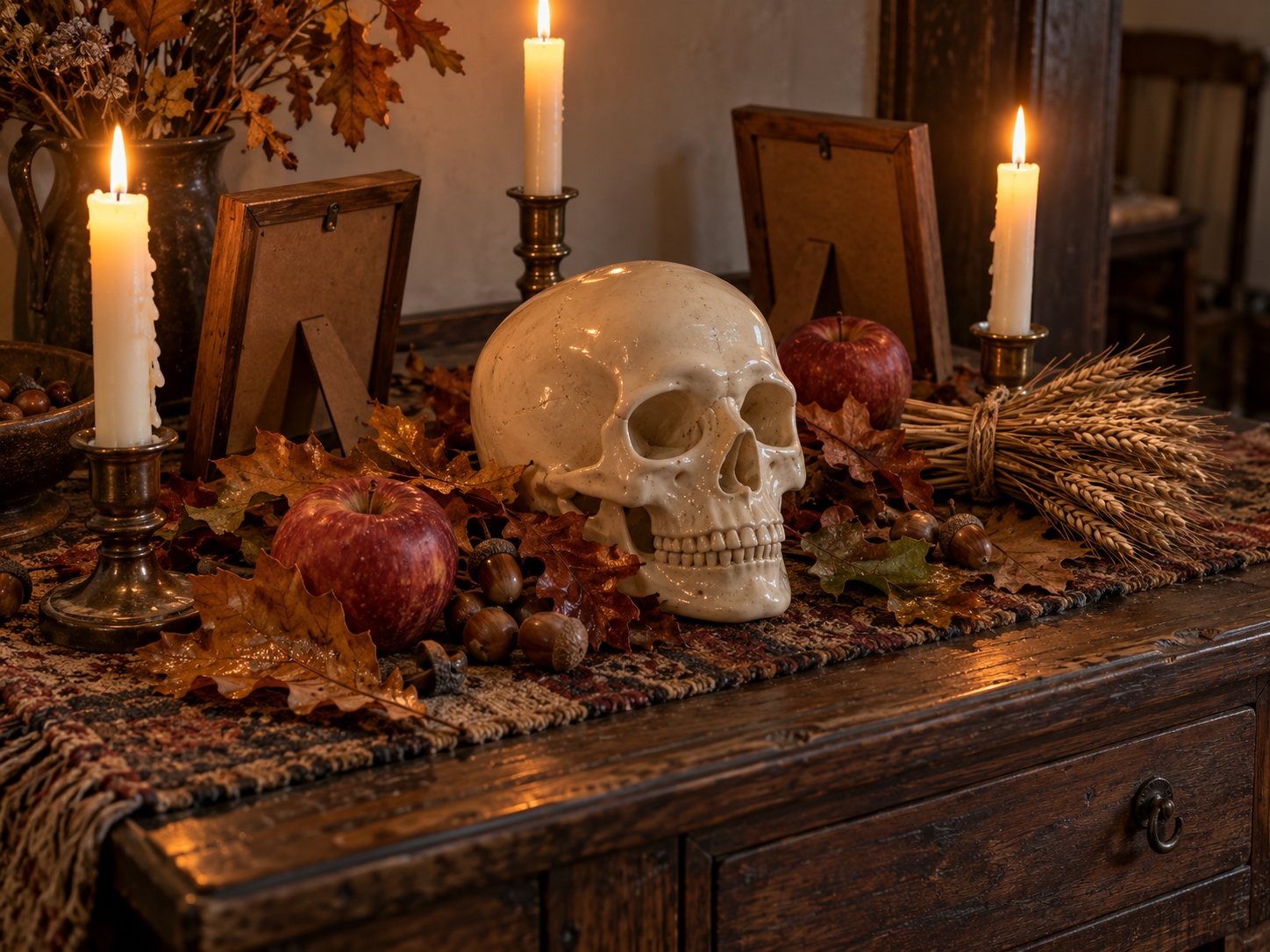
Samhain gives many of these meanings their season. Modern Wiccans and Pagans commonly celebrate it around October 31 or November 1, and contemporary practitioner material describes it as a time to remember the dead, honor ancestors, mark the end of summer and prepare for winter. That material places the Crone and her aged consort in the season's mix of death, darkness and change.
These are modern religious interpretations. They do not show that ancient Celtic people put skulls on Samhain altars, and they are not claims about any ancient practice. A skull on an altar also does not, on its own, identify the altar as Wiccan, as witchcraft or as anything sinister. In public Wiccan discussions, some practitioners call skulls symbols of ancestors, the underworld or the balance between life and death, while others say they are optional and a matter of taste.
Altars with no skulls at all
If you have seen skull-heavy altars online, it is easy to assume they are standard. They are not. Many Wiccan, Pagan and modern witchcraft altars hold no skull, and what they hold instead is just as varied:
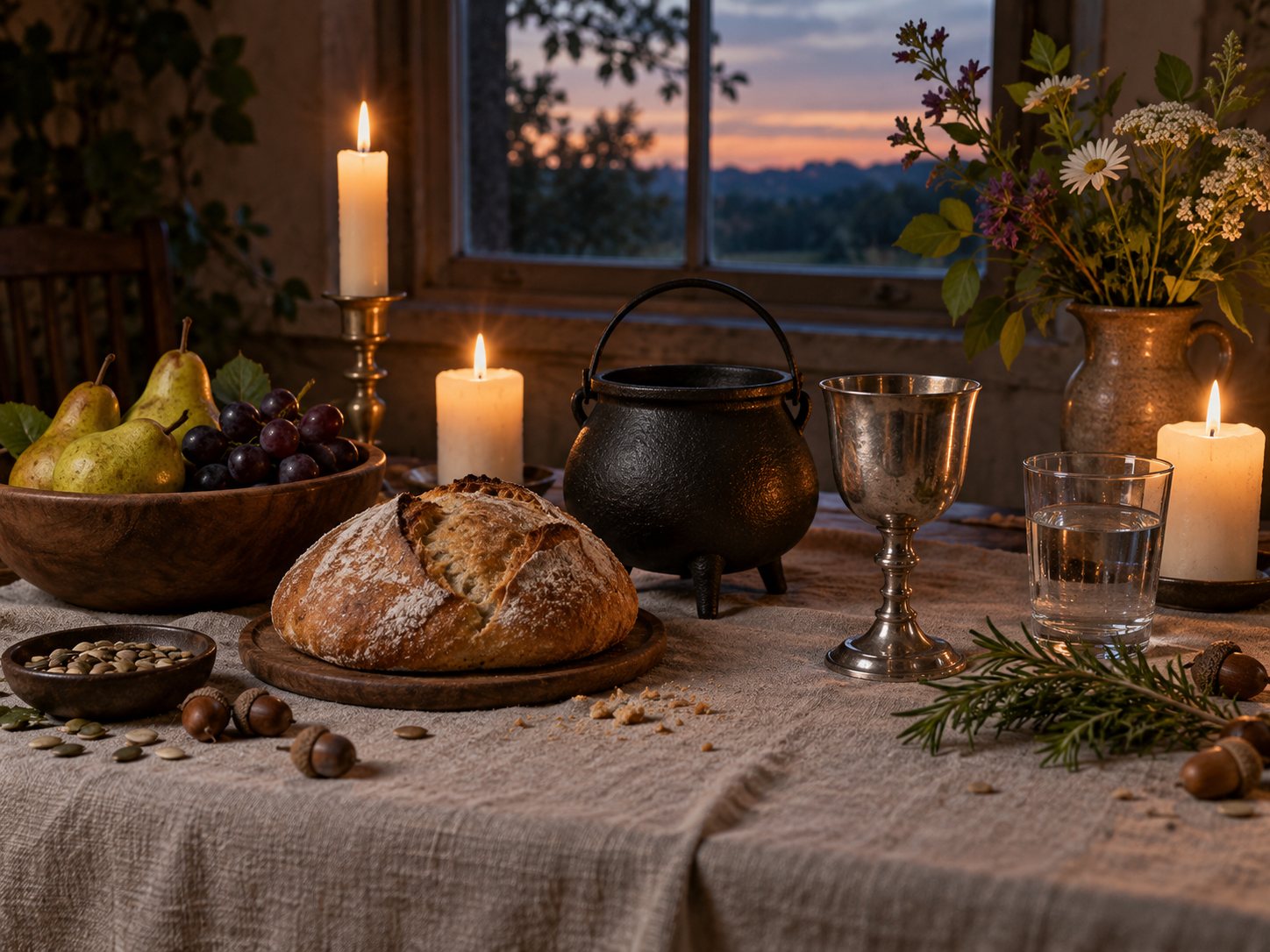
- Candles for a deity, the season, the ancestors or an intention.
- Photographs and written names of relatives who have died.
- Gifts of food, water, fruit, bread or flowers.
- Herbs, leaves, seeds, acorns and other natural objects.
- A cauldron, chalice, athame, pentacle, incense, salt and symbols of the elements.
- Statues or images of deities.
- A personal object that belonged to an ancestor.
- A symbolic or artificial skull, for someone who wants the image without real remains.
A Samhain ritual guide tied to Wiccan practice lists candles, food, photographs, mementos, incense, a cauldron and seasonal objects without requiring a skull. The useful distinction is between one practitioner's altar and a rule for everyone.
Real skulls or replicas
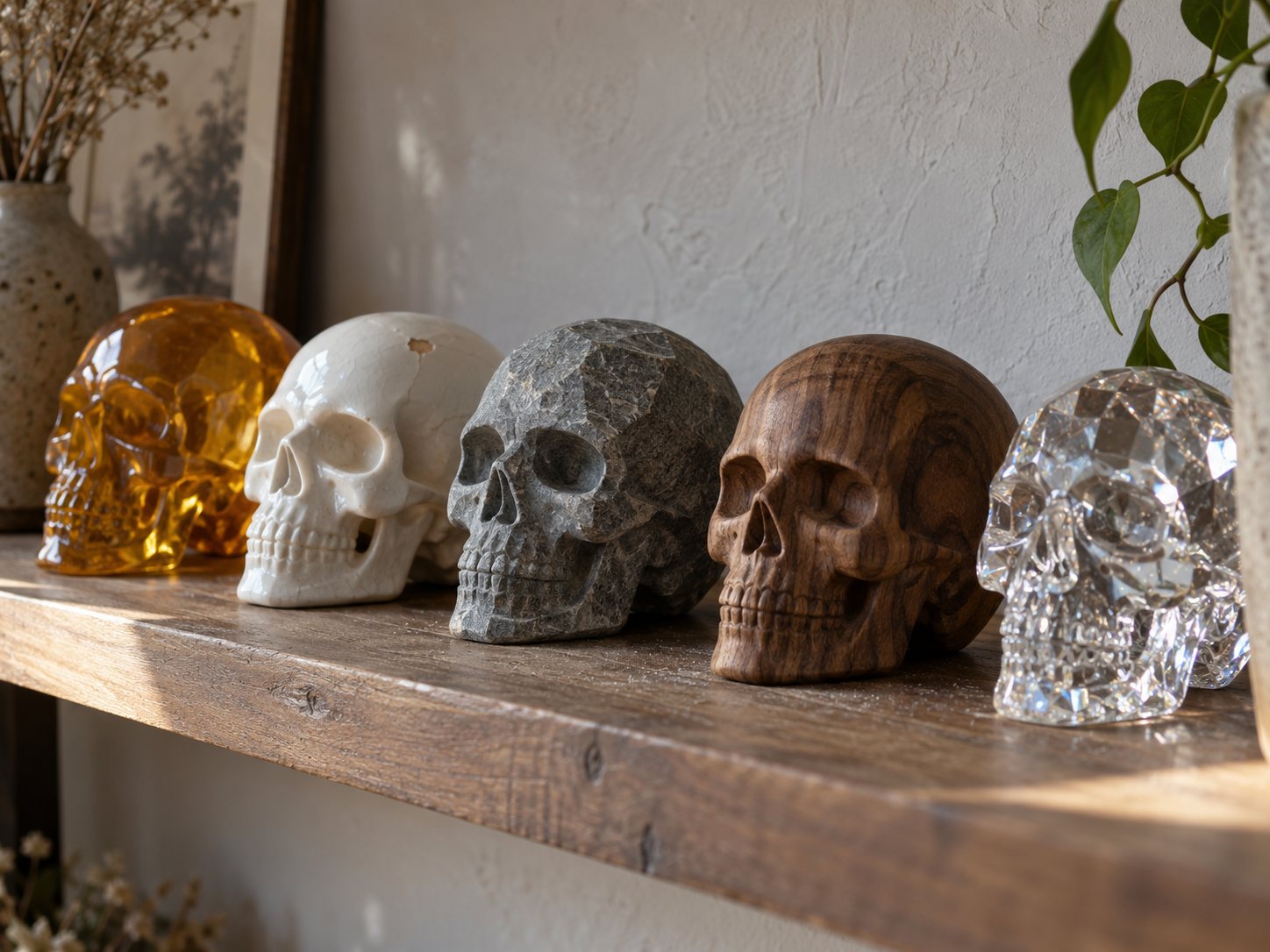
For a lot of people the skull on the altar is not real. Replicas in resin, ceramic, stone, wood, metal or plastic carry the symbolism with no remains involved, and many contemporary practitioners use animal skulls, crystal or stone carvings, ceramic pieces, resin copies, candles or other symbolic stand-ins.
Animal remains are not automatically legal to collect or own. The rules can depend on the species, the location, whether the animal was protected, whether the remains came from public land and whether they cross a border. NOAA Fisheries says some bones from non-endangered marine mammals may be collected under specific conditions, that protected species parts may need permits, that an old bone is not necessarily a fossil, and that international movement may need CITES permits. If you have come across a skull outdoors, our story on what to do when you find an animal skull goes through identification and the rules.
Human remains call for a higher level of care, and laws differ by place. The Metropolitan Museum of Art's policy says human remains must be handled with dignity, in consultation where appropriate with descendant communities, and in compliance with local, state and federal law. In the United States, the Native American Graves Protection and Repatriation Act, known as NAGPRA, applies specifically to Native American ancestral remains and cultural items. The U.S. Department of the Interior says illegally trafficked human remains and cultural items can be taken into federal custody, and that covered museums and federal agencies must consult tribes and return eligible remains and items. In England, Wales and Northern Ireland, buried human remains have legal protection, as the UK government's guidance for museums explains.
For a personal altar, a replica, a photograph, a drawing or another symbolic object is the simplest choice. Anyone thinking about real remains should confirm the species, provenance, ownership, transport rules and display rules with the relevant wildlife, museum, cemetery or legal authority first. This page cannot say what is lawful in your location.
Skulls on altars that are not witchcraft
A skull on an altar does not always point to witchcraft, and two museum objects show why.
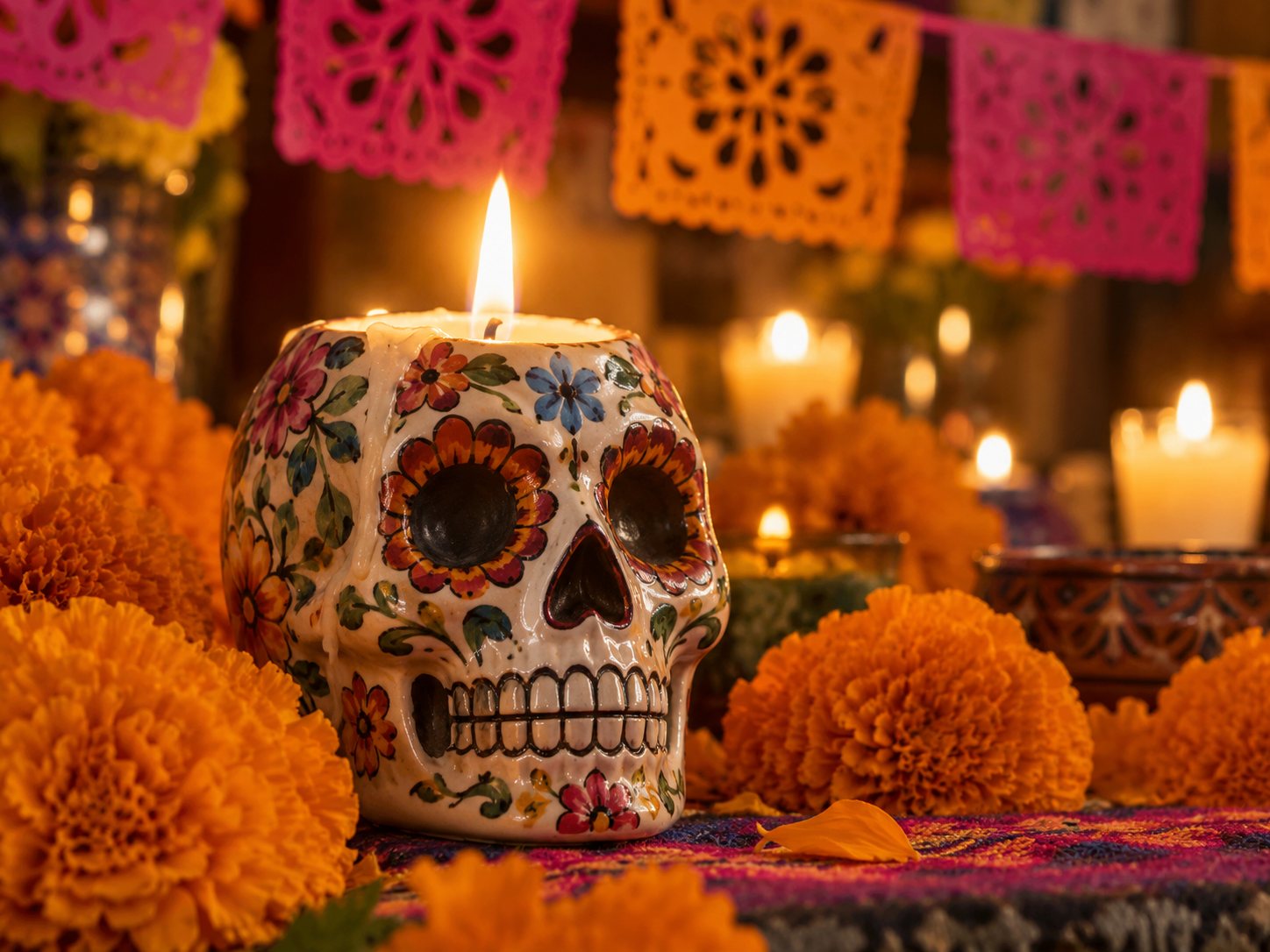
A Mexican skull candle holder in the Wake Forest University Lam Museum belongs to Día de Muertos ofrenda practice. The museum explains that candles on an ofrenda honor deceased relatives and ancestors and help light the way for returning spirits. That is a remembrance tradition with its own customs, and our guide to Día de Muertos tells the larger story.
A Tibetan skull cup from the eighteenth or nineteenth century, held by the Walters Art Museum, is made from human bone for tantric Buddhist ritual. The museum identifies its symbolism as death, impermanence, wisdom and emptiness. It is a separate religious tradition, not witchcraft, and the story of the kapala skull cup looks at it closely.
Hoodoo, also called conjure or rootwork, is a different case again. It is an African American folk-magic tradition shaped by African, Native American, European and Christian influences. It is its own tradition, not another name for Wicca, and its practices vary by community and practitioner.
What the historical record shows
Early modern witch trials were legal prosecutions built on accusations, testimony, reputation, confessions, alleged harm and supposed signs such as the Devil's mark. In late sixteenth and seventeenth century England, the Library of Congress describes a test called swimming a witch, in which an accused person was tied and dunked and floating was treated as a sign of guilt. In early modern Scotland, trial records show that rumor, reputation, alleged speech and alleged actions could all enter a case. The surviving records document accusations and court procedure. They do not show skulls as a standard tool of accused witches.
Skulls do appear elsewhere in European folk life. Researchers have documented horse skulls hidden beneath floors, in walls and near hearths in Ireland, Britain, Scandinavia and parts of North America. JSTOR Daily's report on Irish dance floors quotes Barry O'Reilly, who linked some Irish examples to acoustics: the skull's large cavity could act as a sound box beneath dancing feet. Eamonn P. Kelly, a curator at the National Museum of Ireland, discussed beliefs that horses could see ghosts or evil spirits. In Massachusetts, historian M. Chris Manning interpreted a horse skull hidden in a house tied to the Bryant family, who moved in during 1848, as part of a commemorative or foundation ritual. These were customs of particular places and periods. They are not a single witch tradition, and they should not be relabeled as witchcraft.
Older magic used skulls in other ways. A study in the Harvard Theological Review traces necromancy in Greek and Roman sources, from Circe helping Odysseus consult the prophet Teiresias in the Odyssey to Greek magical papyri written between the second century BCE and the fifth century CE. The Roman writer Claudius Aelianus tells of King Cleomenes I of Sparta consulting the preserved head of a dead companion, a story that belongs to ancient literary tradition and not to any general Greek rule. The same article connects skull deposits in Celtic regions with wells, springs and shafts, and it cautions that "Celtic skull worship" is too broad a label. A nineteenth-century British account, in a paper on cunning-folk in the medical marketplace, mentions "Oil of Man," a substance said to be distilled from the skulls of men who had recently been hanged or killed violently. It shows that skull-related folk beliefs existed in Britain, but it does not describe a standard rite.
None of these examples shows that witches in general kept skulls on altars, and none is evidence of what any modern practitioner does.
Skulls and witchcraft in context
Tap or hover a step to follow the order.
Second century BCE to fifth century CE
Greek magical papyri include skull-related necromantic material
Late second to early third century CE
Claudius Aelianus records the story of Cleomenes consulting a preserved head
c. 930
The Laws of Aethelstan mention the cold-water ordeal, later associated with witch swimming, per the Library of Congress
1848
The Bryant family moves into the Massachusetts house with the concealed horse skull
Nineteenth century
British accounts mention "Oil of Man"
2007
An Edmonton Open Circle Samhain altar uses skulls to represent dead ancestors
Skulls and witchcraft quiz
Answer every question to check.
Quick answers about skulls and witchcraft
What do skulls mean in witchcraft?
They can mean death, mortality, rebirth, ancestors or the boundary between the living and the dead, but no single meaning is shared by all witches. A practitioner's own tradition and purpose set the meaning, and many leave skulls out altogether.
What do skulls represent in witchcraft?
In documented magical and folk-religious settings they can represent mortality, the dead, ancestors, the underworld, ritual power or the change from life to death and back. On a modern altar that might be an ancestor, a seasonal image, a nudge about mortality or a personal decoration.
Do witches use real skulls?
Some do not, and many use replicas, animal skulls, carved stone or crystal, ceramic or resin instead. No universal practice of using real human skulls exists among modern witches. Real human remains raise legal, ethical and cultural-property questions, so anyone considering them should confirm the rules with the proper authority.
What does a skull on an altar mean?
It can mean remembrance of ancestors, awareness of mortality, the balance of life and death, an underworld theme or a personal link to a spirit or tradition. It does not have one fixed meaning, and it does not by itself make an altar Wiccan or tell you anything about the person who set it up.
Are skulls required on Wiccan altars?
No. Wiccan altar objects vary by tradition and practitioner, and many altars have no skull at all.
Where to go next
If the idea of a skull as a prompt to live well appeals to you, start with the story of memento mori and then read about the wider symbolism of skulls. Readers curious about the Mexican remembrance tradition mentioned above will want the guide to Día de Muertos.
Our Memento Mori skull tee is a shirt for people who like a skull as a nudge to make the days count.