

No. 104
Caput Mortuum: The Skull in Alchemy and the Paint Color
*Caput mortuum* is Latin for "dead head." In alchemy it named the fixed residue left at the bottom of the vessel after an operation such as distillation, sublimation or calcination, once the lighter, wanted material had been driven off. The little skull you see on alchemy charts is that name drawn literally: a dead head for the dead head.
In paint, caput mortuum names something else again: a dark red, violet or purple-brown iron oxide pigment, today usually made synthetically. The two meanings share a name and a skull, and the paint has a famous, and very different, neighbor in mummy brown.
What caput mortuum meant to an alchemist
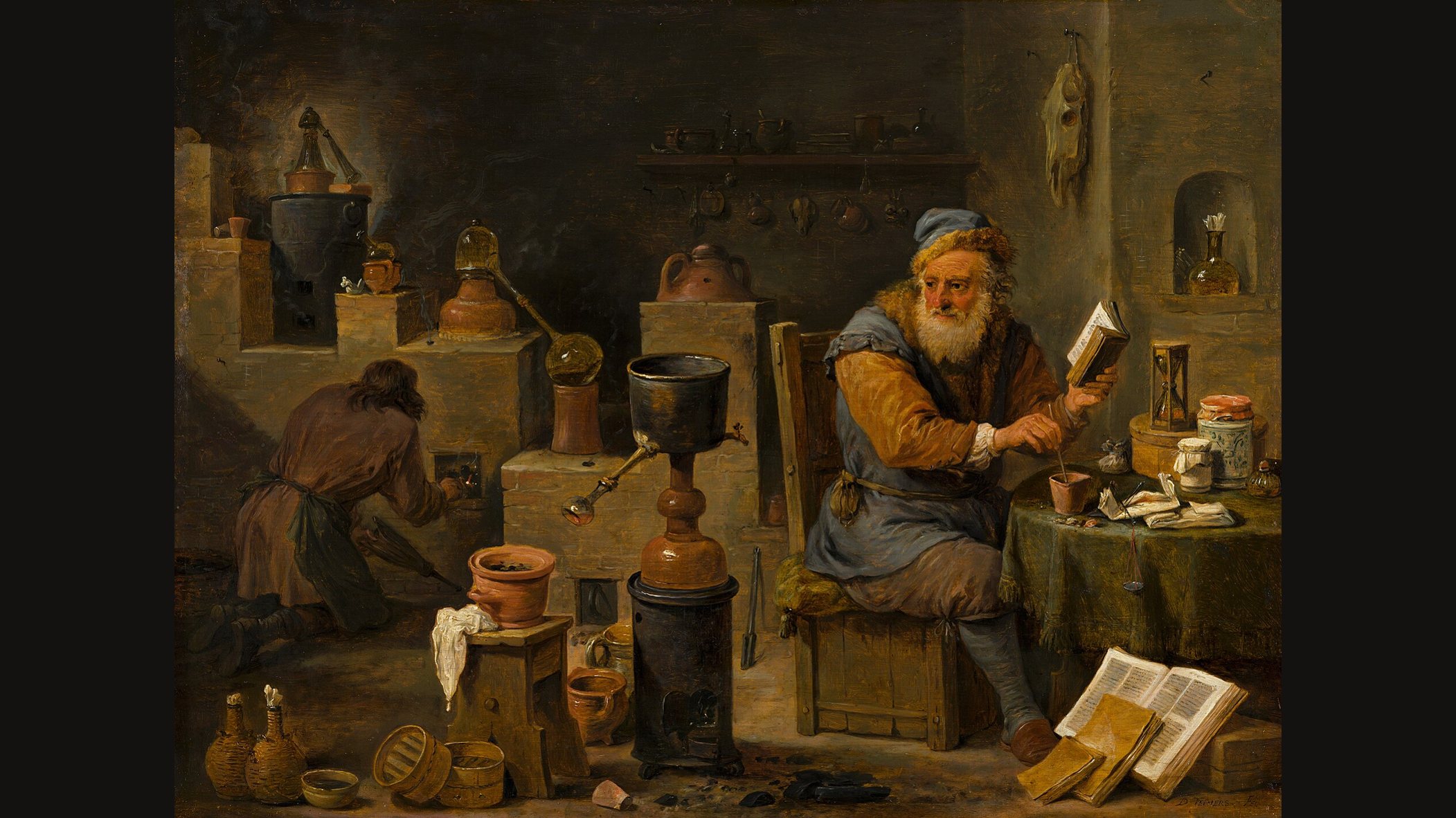
Alchemy was a hands-on business of heating and distilling. The historian of science Lawrence M. Principe of Johns Hopkins University places it within the practical history of early modern chemistry, as work done at the bench with real materials.
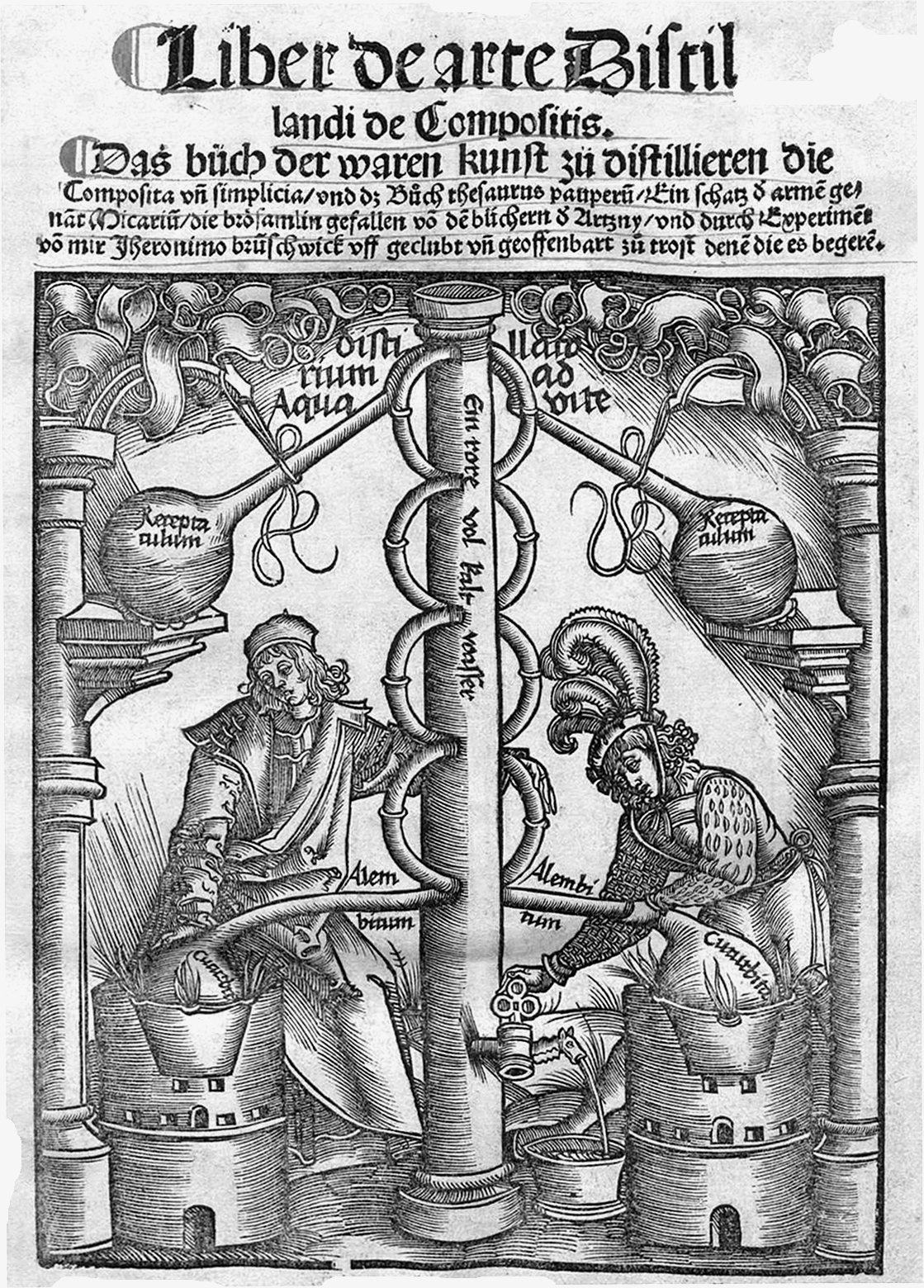
In that work, many operations split a substance into parts. When you distilled, sublimed or calcined something, the volatile part rose or was carried away, and something fixed stayed behind. That leftover was the caput mortuum. A historical lexicon summarized by the U.S. Government Publishing Office gives the term as "dead head" or "worthless remains."
"Worthless" here describes the residue's place in the operation, the exhausted matter left once the alchemist had taken what they wanted. It does not mean that every residue was thrown away or had no further use. It was dead in the sense that the life of the process had gone out of it. The name was gloomy enough on its own; the skull came along as a pun on it.
Why the symbol is a skull
The caput mortuum sign is a visual pun. Take the Latin name at its word, a dead head, and you get a human skull. The overview of alchemical signs in Hanegraaff's *Dictionary of Gnosis and Western Esotericism* identifies the death's-head image as a logogram, a sign standing for a word, derived from caput mortuum, the residue of distillation.
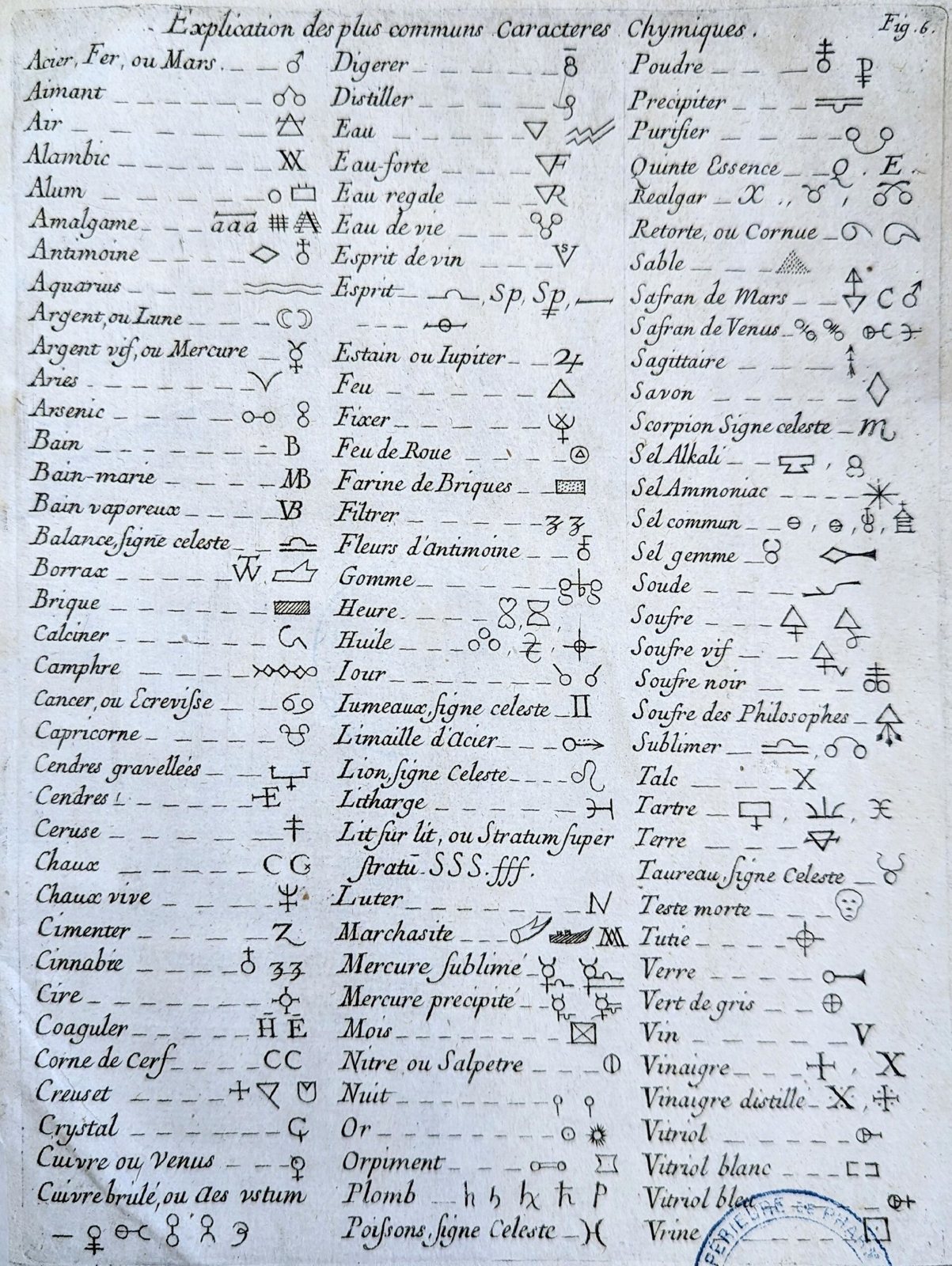
The idea is old. A study published through the University of Kent discusses a 14th-century drawing in the *Miscellanea d'Alchimia*, a manuscript held by the Biblioteca Medicea Laurenziana in Florence, in which a skull is labelled as, or works as, a caput mortuum.
The neat little skull glyph you can find online is a modern redrawing. The version on Wikimedia Commons, drawn by its author, Salmanazar, and released into the public domain, is a clean, reusable symbol, but it is not proof that every alchemist drew the same skull. Alchemical signs varied from author to author, text to text and period to period, so if you are trying to identify a skull on an old chart, the chart's own key and its date matter more than any one standard version.
Caput mortuum the paint color
On a paint tube, caput mortuum is an iron oxide pigment. The Swedish National Heritage Board, Riksantikvarieämbetet, describes it as producing dark red and violet colors with high opacity and high lightfastness, meaning it covers well and holds its color in light. It also notes that modern iron oxide pigments are generally manufactured synthetically.
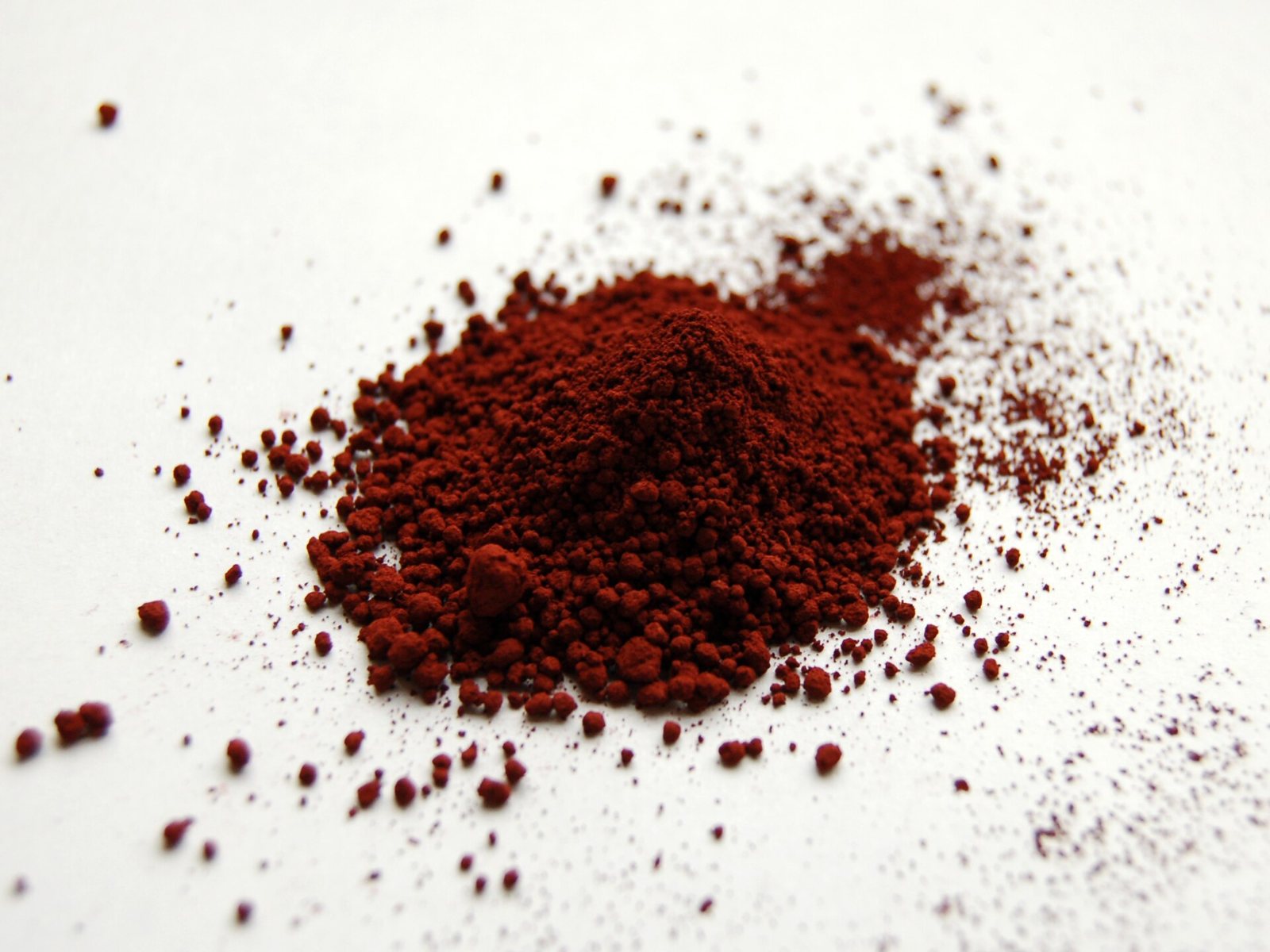
The Museum of Fine Arts, Boston keeps a conservation database called CAMEO, which calls caput mortuum an obsolete name for a reddish-brown material made by calcining, or strongly heating, red iron oxide. It lists related names that painters will recognize: Pigment Red 101, cardinal purple, Venetian red, colcothar and Mars violet. The paint maker and supplier Jackson's Art describes the color as a brownish purple and separates pigment made from natural hematite from synthetic iron oxide.
So, what color is caput mortuum? A deep reddish brown, purple brown, dark red or violet, depending on the iron oxide and how the maker prepared it. It is a family of pigments sharing a name rather than one exact shade. If you are trying to match a color you have seen, compare the maker's own swatch or technical sheet, because one brand's caput mortuum can sit noticeably redder or more violet than another's.
The skull connection is in the name: the pigment carries the alchemist's word for the dark matter left at the bottom of the vessel, though the paint you buy today comes from iron oxide, not from an alchemist's flask.
Caput mortuum at a glance
Tap a card to bring it forward.
- The name: Latin for "dead head."
- In alchemy: The fixed residue left after distillation, sublimation or calcination.
- The symbol: A skull, a literal drawing of the name, with designs that varied by author and period.
- In paint: An iron oxide pigment in dark red, violet or purple brown, usually made synthetically today.
- Related names: Pigment Red 101, cardinal purple, Venetian red, colcothar and Mars violet, per CAMEO.
Is caput mortuum made from mummies?
Modern caput mortuum paint is an iron oxide pigment, usually synthetic, and it is not made from mummies. The question comes up because of a different historical pigment, mummy brown, and because the two names were sometimes confused or overlapped in the paint trade.
Mummy brown has a much darker history. According to CAMEO's entry on mummy, it was a dark brown bituminous pigment made in the 16th and 17th centuries by grinding up fragments of Egyptian mummies that had been embalmed with asphaltum or bitumen. In the 19th century painters used it as a transparent brown for oil painting and glazing. CAMEO also records that substitutes, such as Vandyke brown and bituminous earth pigments, were sold under the name "mummy," so not every tube labelled that way held what the label suggested.
Those mummies were people. They had been embalmed and laid to rest, and their remains were broken up and sold as a raw material. The conservator Sally Woodcock, in her 1996 article in *The Conservator*, "Body colour: The misuse of mummy", treats the trade as an exploitative one that damaged archaeological remains. The pigment largely disappeared by the early 20th century. To understand how much work went into preparing those bodies in the first place, read our story on how Egyptian mummies were made.
Tap or hover a row to highlight it.
| Feature | Caput mortuum | Mummy brown |
|---|---|---|
| FeatureMade from | Caput mortuumIron oxide, usually synthetic today | Mummy brownGround fragments of Egyptian mummies embalmed with asphaltum or bitumen |
| FeatureColor | Caput mortuumDark red, violet or reddish brown | Mummy brownDark brown |
| FeatureHandling | Caput mortuumHigh opacity | Mummy brownTransparent, used for glazing |
| FeatureWhen | Caput mortuumName obsolete per CAMEO; iron oxide pigments made today | Mummy brownMade in the 16th and 17th centuries, used in the 19th |
| FeatureToday | Caput mortuumSold as an iron oxide pigment | Mummy brownLargely disappeared by the early 20th century |
The alchemist's skull and the vanitas skull
The skull turns up in another famous place in European art: the vanitas still life, where it stands for death and the shortness of life. It is easy to assume the two skulls are the same symbol. They are related in theme, both using a skull to call up death or what is left at the end, but they come from different worlds.
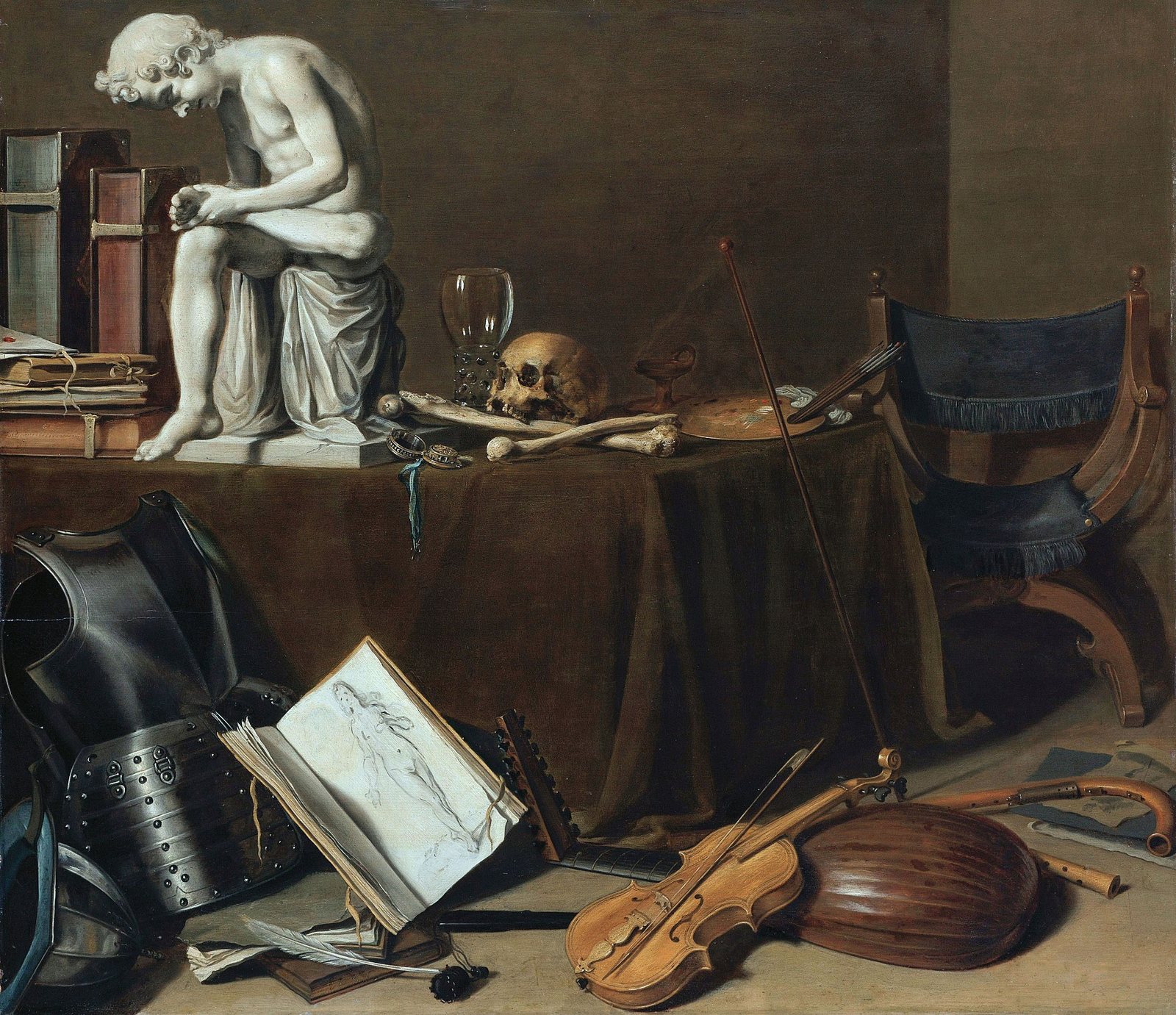
In 1698 the Dutch painter Herman Henstenburgh made a *Memento Mori* that sets a skull beside an overturned hourglass, an extinguished candle and bones, to remind viewers that life is brief and death is certain. The Rijksmuseum reads the skull and the "Memento Mori" inscription in Pieter Claesz's *Vanitas Still Life with the Spinario* as a comment on the passing of life, art, science and worldly achievement.
Those skulls carry a moral message about mortality. The alchemist's skull is a label for a leftover in a vessel. A skull in a Dutch still life should not be read as the caput mortuum sign, and the caput mortuum glyph on a chart is not a vanitas warning. For more on the paintings, see our story on vanitas paintings, and for the objects in Henstenburgh's painting, read about the skull and hourglass and the skull and candle.
Caput mortuum through time
Tap or hover a step to follow the order.
Medieval and early modern alchemy
Caput mortuum names the fixed residue left after operations such as distillation or sublimation.
14th century
A drawing in the Miscellanea d'Alchimia, now in Florence, includes a skull linked with caput mortuum.
16th and 17th centuries
Mummy brown is made from fragments of Egyptian mummies as a dark brown bituminous pigment.
1698
Herman Henstenburgh paints a Dutch vanitas Memento Mori with a skull, bones, candle and hourglass.
Modern period
Caput mortuum is generally a synthetic iron oxide pigment ranging from dark red to violet.
How well do you know caput mortuum?
Answer every question to check.
Caput mortuum questions, answered
A few more questions come up once the name and the color are clear.
What other names does the pigment go by?
CAMEO lists Pigment Red 101, cardinal purple, Venetian red, colcothar and Mars violet among the names associated with caput mortuum. These are related iron oxide pigments and names, so check the maker's label when you need an exact shade.
Is there one standard caput mortuum symbol?
No single version was used by every alchemist. Signs varied by author, text and period, and the tidy skull glyph common online is a modern redrawing, released into the public domain on Wikimedia Commons.
Is caput mortuum the same as Mars violet?
CAMEO lists Mars violet among the names related to caput mortuum, but a related name is not proof that two products are identical. The safest way to compare them is to look at each maker's own color information.
Where to go next
The skull has carried many meanings, and caput mortuum shows just how far apart they can sit, from an alchemist's flask to a painter's palette. For the wider story of what skulls stand for, read our story on skull symbolism, and for the tradition behind the vanitas skull, start with what memento mori means. Prayer beads carved with skulls carried the same idea into everyday devotion, told in our story on skull rosary meaning.
Terms in this story
Tap a term to see what it means.
Caput mortuum. Latin for "dead head"; in alchemy the fixed residue left after an operation, and in paint an iron oxide pigment.
---