

No. 068
Skull Candle Meaning: Ofrendas, Memento Mori, Folk Magic and Decor
What a skull candle means depends on where it is burning. On a Halloween shelf or a gothic mantel, it is a seasonal or stylistic piece about mortality and a bit of macabre fun. In European memento mori art, a skull beside a candle reminds the viewer that a life burns down like a wick. In some folk-magic practice, practitioners describe a skull candle as a figure candle for the head, the mind and a person's thoughts. And on a Día de Muertos ofrenda, the meaning sits in the light itself, which the Mexico City government describes as faith, hope and a flame that guides the dead home.
The shape alone does not tell you which of these you are looking at. The setting, the words or images on the candle, and the person who lit it do. Below is each tradition in turn, with dates and places, followed by how to burn one safely.
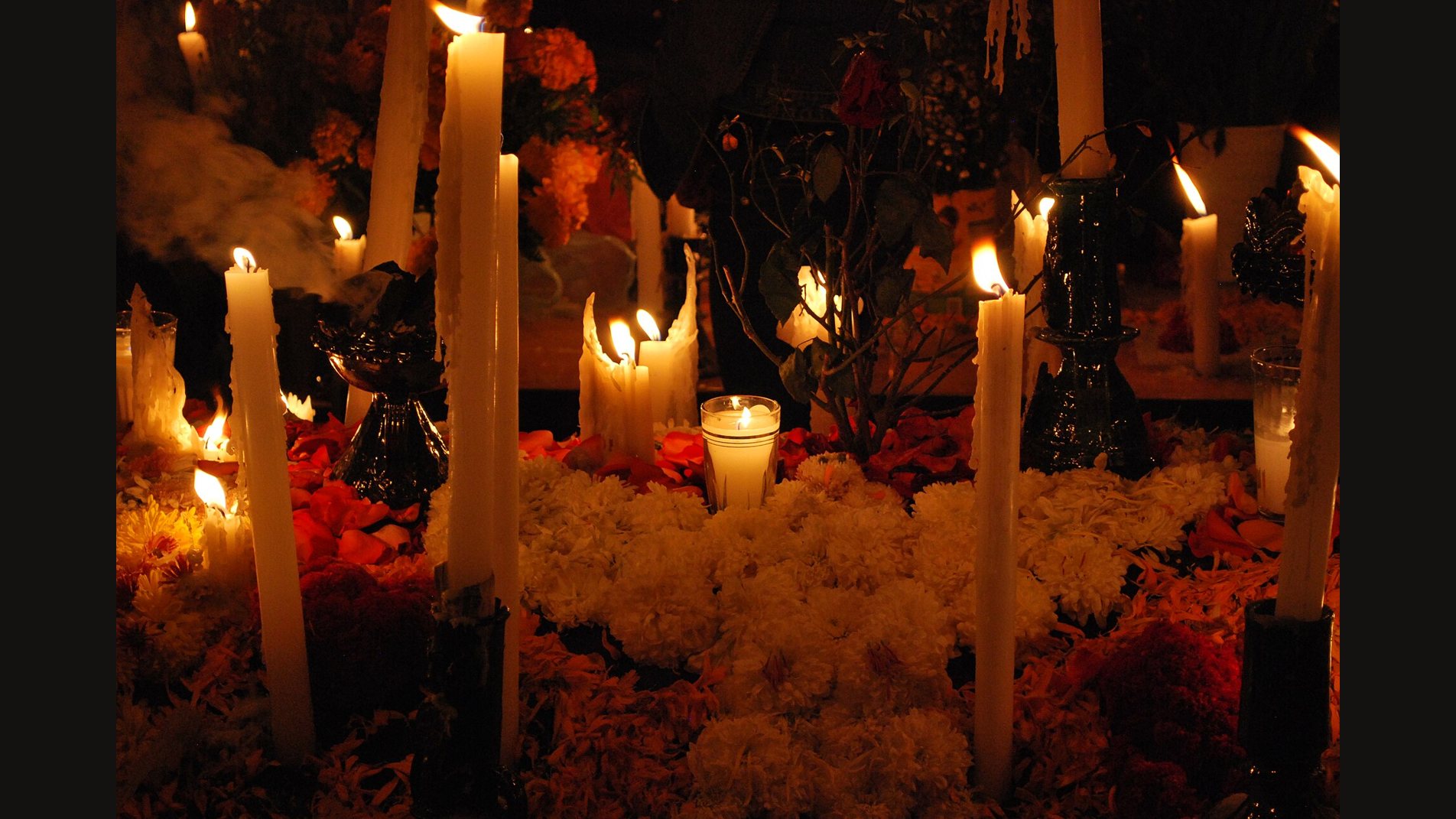
Candlelight on a Día de Muertos ofrenda
On an ofrenda, the altar families set up for Día de Muertos, candles carry some of the clearest meaning of anything on the table. The Mexico City government's guide to ofrendas says candles provide light, faith and hope. They guide deceased visitors toward home and light their way back after they have visited the living. In some communities, the same guide notes, each candle stands for a particular person who has died.
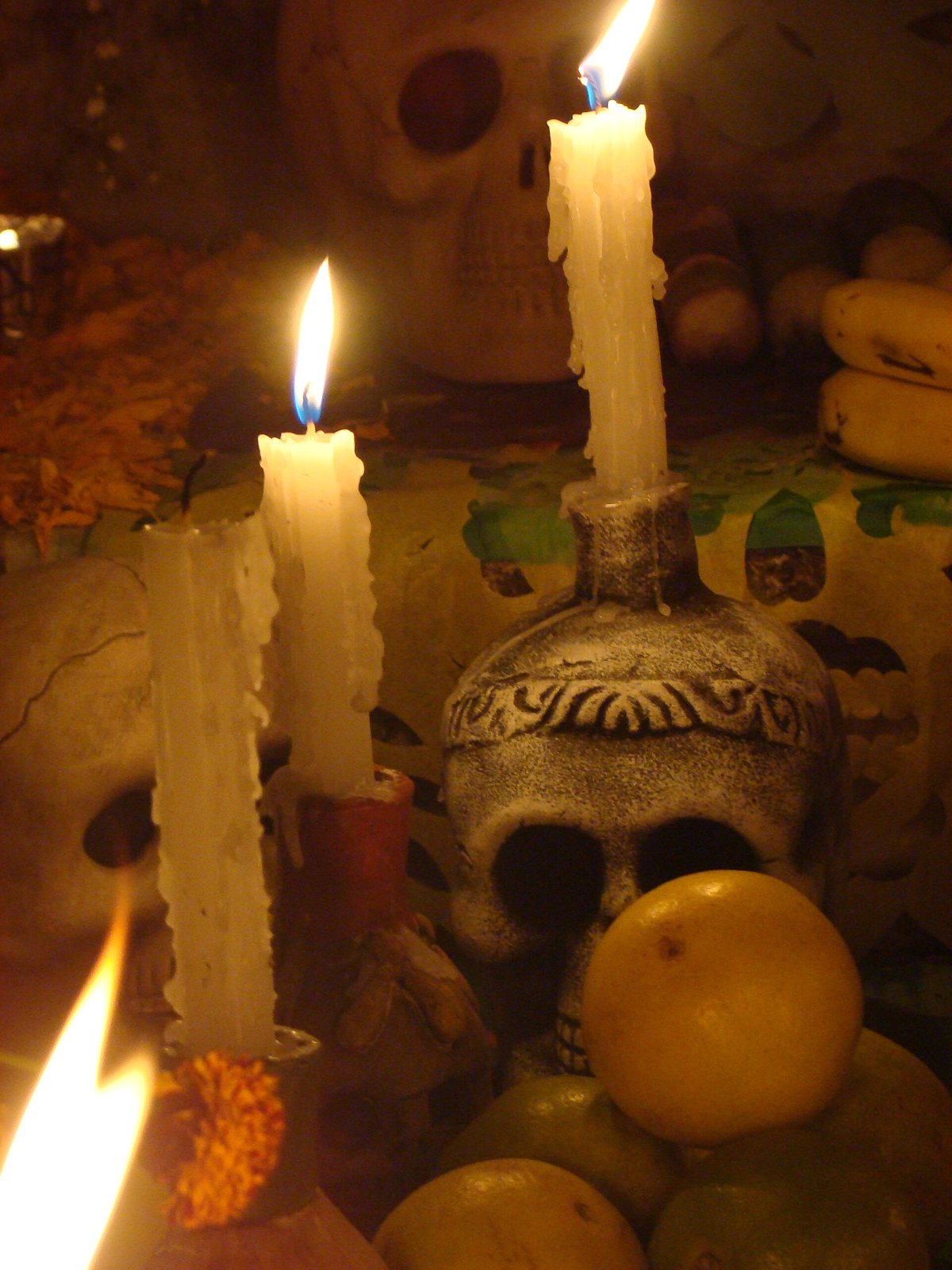
Candles share the ofrenda with food, flowers, copal incense and other things chosen for the people being remembered, and practices vary from one community and household to the next. A skull-shaped candle on an ofrenda is a household's own choice rather than a required element. The documented meaning belongs to the light, whatever shape the wax happens to take.
If you are setting up an altar of your own, our guide on how to make an ofrenda walks through the elements, and Día de Muertos tells the larger story of the celebration. Skulls appear on ofrendas in other forms too, and sugar skulls has the history of the sweetest of them.
Skull candles at Halloween and in gothic decor
The molded skull candle on a Halloween shelf is a modern novelty or seasonal object, and it has at least one small moment of official fame. In a 2003 candle classification decision by the U.S. Department of Commerce, the retailer Meijer described a molded skull candle as a Halloween novelty candle. The Department then studied whether the skull design could be recognized from several angles, and in the end treated that particular candle as an ordinary molded column rather than a Halloween novelty. Somewhere in the federal record, a skull was filed as a column.
In gothic decor, a skull candle can carry theatrical darkness, mortality, horror or simply a macabre look. Those readings belong to the decorator, the designer or the person who chose it for the room, not to a single tradition. A black skull candle on a bookshelf may be saying nothing more than "I like this," which is a perfectly good thing for a candle to say. Our stories on skeletons and Halloween, gothic skull meaning and skull home decor cover the decorating side of the skull.
The skull and the candle in memento mori art
Long before molded wax skulls, European artists put real candles and painted skulls side by side. In the memento mori and vanitas traditions, the skull reminds the viewer of mortality, and a burning or snuffed candle suggests how long a life lasts. Our stories on what memento mori means and vanitas paintings follow those traditions in full.
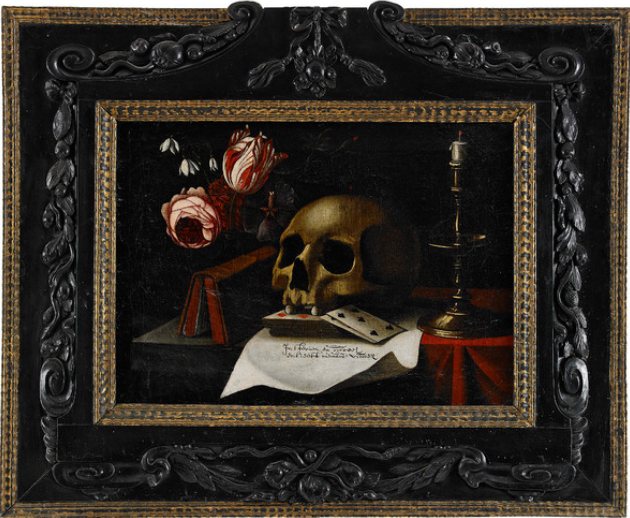
Museums keep the pairing in view. The Museum of Modern Art identifies the candle in Pablo Picasso's *Goat Skull and Bottle*, made in Vallauris, France, in 1951 and cast in bronze in 1954, as a memento mori, a reminder of mortality. The British Museum records a German watch case shaped like a skull, made around 1660 to 1670, and describes the miniature skull as a memento mori symbol with a long history reaching back to the medieval period.
The same museum holds a French ivory memento mori pendant of about 1600, attributed to Christoph Harrich, and a 1612 to 1615 engraving by Simon van de Passe showing a skull with an hourglass and flowers. Together they show a long link between skulls, flames, time and mortality, though they do not give every modern skull candle that meaning. The hourglass has its own story in skull and hourglass meaning.
Skulls and candles through time
Tap or hover a step to follow the order.
About 1600
A French ivory memento mori pendant, attributed to Christoph Harrich, is made
1612 to 1615
Simon van de Passe engraves a skull with an hourglass and flowers
About 1660 to 1670
A German skull-shaped watch case is made as a memento mori
1951
Picasso makes Goat Skull and Bottle in Vallauris
1954
Goat Skull and Bottle is cast in bronze
2001
Doña Queta sets up a public Santa Muerte altar outside her home in Tepito, Mexico City
2003
The U.S. Department of Commerce rules on Meijer's molded skull candle
Skull candles in folk magic, as practitioners describe them
In some folk-magic practice, practitioners describe a skull candle as a figure candle, a candle shaped to stand for something specific. In their accounts, the skull represents a head, the mind, thoughts, or a particular person whose attention is being addressed. The uses practitioners name include influence, communication, mental healing, ancestral wisdom and reflection on mortality.
Those are the practitioners' own descriptions of their practice, not meanings shared by everyone who lights a skull candle. A skull candle on its own does not belong to any of these practices. For more on how skulls appear on modern altars, and where they do not, our story on skulls in witchcraft goes further.
Santa Muerte devotion and its candles
Santa Muerte devotion is a separate practice with its own devotees and its own ways. Anthropologists Kate Kingsbury and Andrew Chesnut, in "Holy Death in the Time of Coronavirus", describe a devotion with no single governing church or standard ritual. Many devotees keep home altars, sometimes with only a small image or a votive candle, alongside gifts such as water, flowers, food, alcohol and cigarettes.
One public altar in Mexico City has a well-documented beginning. In Tepito, Mexico City, Enriqueta Romero, known as Doña Queta, moved her Santa Muerte altar from her kitchen to the street outside her home in November 2001, after neighbors began leaving flowers and votive candles there, Kingsbury and Chesnut write.
Candle colors carry meanings that vary among devotees. Kingsbury and Chesnut document red candles for love, passion and lust; white for cleansing, blessing, peace and harmony; and black for protection, with associations in some settings with black magic and vengeance. These are votive candles, and a candle shaped like a skull is not automatically a Santa Muerte candle. The image on it, its wording, the altar it sits on and the devotee's own explanation are what place it in the devotion. Our story on Santa Muerte tells more about the devotion and its history.
Tap or hover a row to highlight it.
| Setting | Documented meaning or use | Place and period |
|---|---|---|
| SettingCandles on a Día de Muertos ofrenda | Documented meaning or useFaith, hope and light guiding deceased visitors home | Place and periodMexico City, as the city government describes it today |
| SettingSanta Muerte votive candles | Documented meaning or useRed for love and passion, white for cleansing and blessing, black for protection, varying among devotees | Place and periodMexico, contemporary devotion documented by Kingsbury and Chesnut |
| SettingThe candle in Picasso's Goat Skull and Bottle | Documented meaning or useMemento mori, a reminder of mortality | Place and periodVallauris, 1951, cast in bronze 1954, per MoMA |
| SettingA skull-shaped watch case | Documented meaning or useMemento mori and the fleeting nature of life | Place and periodGermany, about 1660 to 1670, per the British Museum |
What a black skull candle means
A black skull candle carries different meanings in different hands. In Santa Muerte devotion, as Kingsbury and Chesnut document it, some devotees tie black votives to protection, and in some settings to black magic and vengeance. Other folk-magic practitioners may assign black to protection, removal or banishing.
In gothic decor, a black skull candle may simply be a color choice that suits the room. So, the meaning belongs to the person who lit it, and if you were given one, asking the giver is the surest way to know what they meant by it.
Burning one safely
Whatever a skull candle means to you, it is still an open flame, and the National Fire Protection Association treats it the same as any other candle. A flame can ignite anything combustible nearby, so keep the candle at least 1 foot, or 30 centimeters, from anything that can burn, and set it in a sturdy, heat-resistant holder on an uncluttered surface. Keep it away from curtains, paper, books, bedding, decorations, children, pets, drafts and loose clothing.
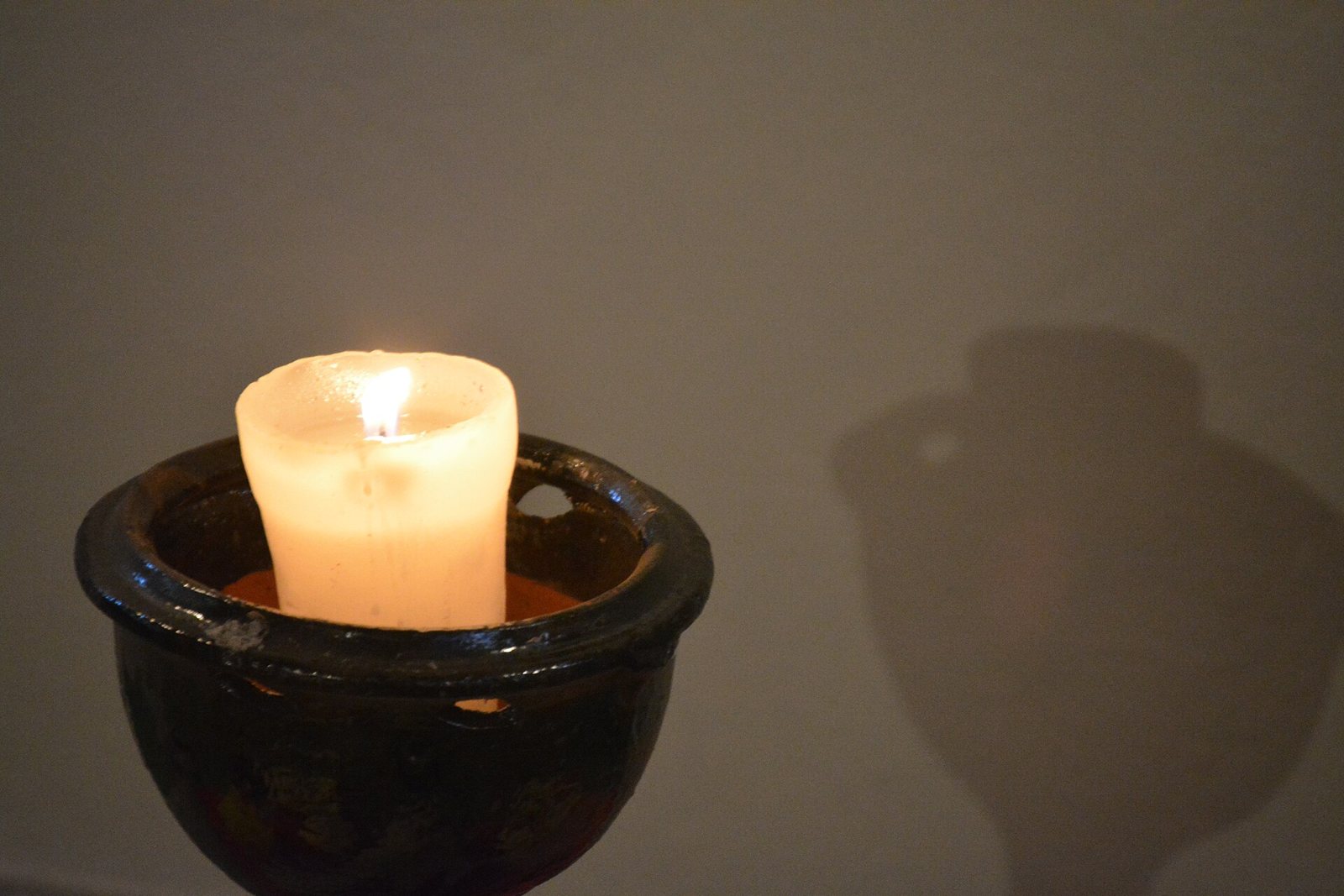
Never leave a burning candle unattended, and put it out before you leave the room or go to sleep. The NFPA's detailed guidance adds that you should trim the wick to about 1/4 inch before lighting, follow the maker's burn-time instructions and avoid burning a candle all the way down. Use a snuffer rather than water, because water can make hot wax splatter and glass break. On altars and shrines, keep candles in sturdy, noncombustible holders and under adult supervision. NFPA also suggests flameless candles, which give an ofrenda or a mantel the look without the flame.
Before you light a skull candle
Tap a card to bring it forward.
- Clearance: Keep it at least 1 foot, or 30 centimeters, from anything that can burn.
- Holder: Use a sturdy, heat-resistant holder on an uncluttered surface.
- Surroundings: Keep it away from curtains, paper, books, bedding, decorations, drafts and loose clothing.
- Children and pets: Keep the flame out of their reach.
- Wick: Trim it to about 1/4 inch before burning, and follow the maker's burn-time instructions.
- Never unattended: Put it out before leaving the room or going to sleep, and do not burn it all the way down.
- Putting it out: Use a snuffer, not water, which can splatter hot wax and break glass.
- Altars and shrines: Use noncombustible holders and keep candles under adult supervision, or choose a flameless candle.
How well do you know the skull candle?
Answer every question to check.
Questions about skull candles
A few more short answers for anyone with a skull candle in hand.
What is a skull candle used for?
It depends on the setting: decoration for Halloween or a gothic look, a figure candle in some folk-magic practice as practitioners describe it, or one candle among many on a devotional altar. The shape alone does not identify a practice, so the surroundings and the person using it tell you which.
Is a skull candle a Santa Muerte candle?
Not automatically; the Santa Muerte home altars Kingsbury and Chesnut describe hold images and votive candles, and the image, wording and altar tell you whether a candle belongs to the devotion. A plain skull-shaped candle can belong to Halloween, gothic decor or something else entirely.
Is it safe to burn a skull candle?
Yes, with the same care as any candle, following the NFPA's guidance. Keep it a foot from anything that can burn, in a sturdy holder, never unattended, and consider a flameless version for crowded altars and shelves.
Can a skull candle go on a Día de Muertos ofrenda?
Yes, if that is the household's choice, since ofrenda practices vary by community and household. What the Mexico City government describes as meaningful is the light, which stands for faith and hope and guides the dead home.
Where to go next
If the candle on your table sits on an ofrenda, start with how to make an ofrenda. If it belongs to a still life or a memento mori shelf, what memento mori means is the next stop, and for the skull's wider range of meanings, see what a skull symbolizes. Candles are not the only thing a skull gets paired with, either: skull and butterfly meaning follows another pairing from Greek art to tattoos.
Terms in this story
Tap a term to see what it means.
Ofrenda. The altar families set up for Día de Muertos, with candles, food, flowers and copal for the people being remembered.
---