

No. 025
Mictlantecuhtli: The Mexica Lord of the Dead and the Road to Mictlan
Mictlantecuhtli was the lord of Mictlan, the land of the dead, in the religion of the Mexica, the people often called the Aztecs, in central Mexico during the Late Postclassic period, especially the fifteenth and early sixteenth centuries. He ruled with a female counterpart, Mictecacihuatl, also called Mictlancíhuatl, and Mexica artists showed him as a skeleton or a body partly decayed. Colonial-era Nahua accounts say Mictlan was where people who died ordinary deaths went, after a hard four-year passage through nine stages. People who died other kinds of death went somewhere else entirely.
If you met him as the clawed skeleton in a photo from the Templo Mayor, on a tattoo or in Día de Muertos art, what follows covers who he was, how the Mexica made his image, and what they believed happened to the dead.
The lord and lady of Mictlan
The names explain themselves once translated. Mictlantecuhtli means roughly "Lord of Mictlan," and Mictecacihuatl roughly "Lady of the Dead." The Florentine Codex names the two together in its third book, on folio 23v, where they preside over Mictlan as a pair. That pairing matters: the Mexica land of the dead had a king and a queen, not a lone ruler.
The setting matters too. Everything here belongs to Mexica religion in central Mexico in the century or so before the Spanish conquest, centered on Tenochtitlan, today's Mexico City. Other Mesoamerican peoples, such as the Classic Maya, had their own death gods, which you can meet in our tour of gods of death.
How the Mexica made his image
Mictlantecuhtli is easiest to understand object by object.
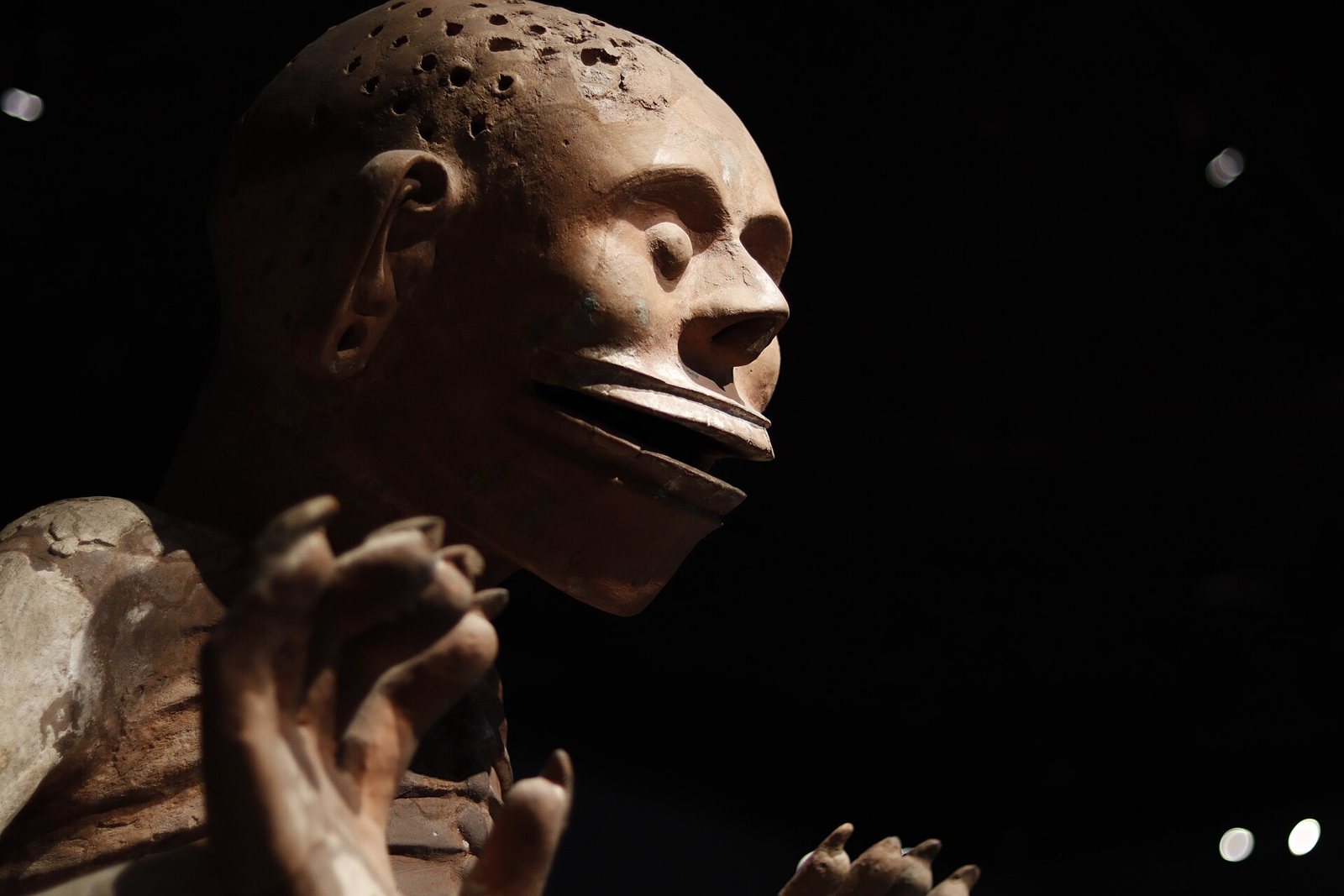
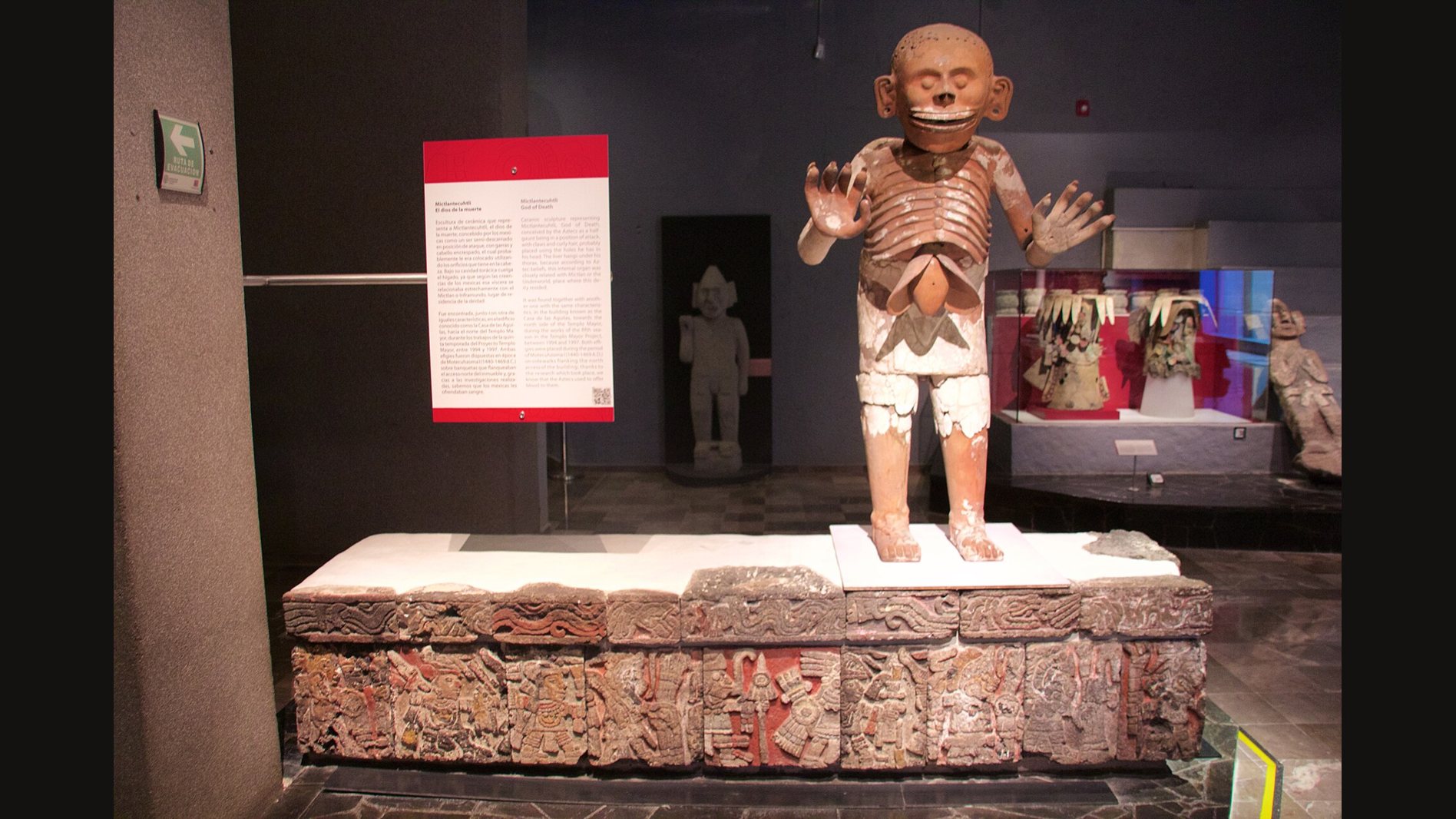
The most famous is the life-size ceramic figure found in the House of the Eagles, a ceremonial building in the sacred precinct of Tenochtitlan, just north of the Templo Mayor. It is now displayed in the Museo del Templo Mayor in Mexico City, and INAH, Mexico's national institute of anthropology and history, identifies it as Mictlantecuhtli, the god of death. He raises claw-like hands, his ribs are exposed, his body looks skeletal or flayed, and an internal organ is rendered prominently. The museum connects the figure with Mexica ritual and funeral symbolism, though what each anatomical detail meant remains a matter of interpretation rather than a literal scene from a myth.
The Walters Art Museum holds a Mexica wooden mask of Mictlantecuhtli made around 1450 to 1521. It has a skull-like face with reddish cheek marks that the museum reads as signs of decay. There is a practical detail too: the mask has no eye holes, so the Walters suggests it was probably attached to a statue and not worn by a person.
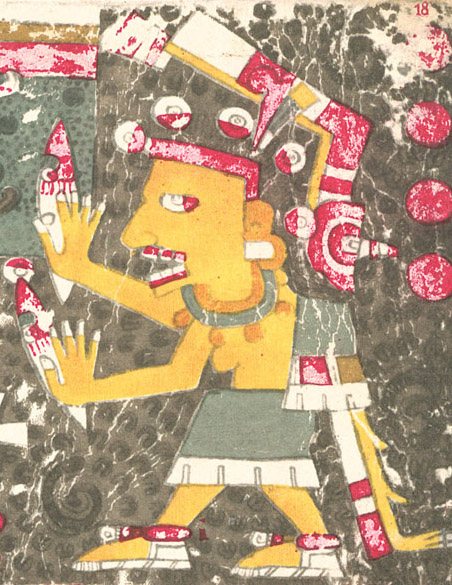
In the Codex Borgia, a painted manuscript from Central Mexico made before the conquest or soon after it, Mictlantecuhtli appears with a skeletal body, bared teeth, dark or decaying markings and attributes tied to death. The scholar Yassin Álvarez published an iconographic study of these Borgia images in 2015. A codex like this is not a portrait book, so its details are best read as symbols rather than a biography.
The Metropolitan Museum of Art holds a Mexica object titled *Tecpatl (Mictlantecuhtli, Lord of the Underworld)*, dated 1502 to 1520 and made of flint, obsidian and pigments. A tecpatl is a ritual knife, and the Met explains that such knives could be treated as living embodiments of gods. In other words, a blade could be Mictlantecuhtli, not just carry his image.
Who went to Mictlan, and who went elsewhere
Here the Mexica idea of the afterlife differs most from the heaven and hell many readers grew up with. In the account the Florentine Codex gives of Mexica belief, where you went after death depended mainly on how you died, not on a moral judgment of your life.
People who died ordinary deaths, from illness or old age, went to Mictlan and faced the long passage through it. People who died by drowning, by lightning or from certain causes tied to water went to Tlalocan, the domain of the rain god Tláloc, described as a fertile, pleasant place of rain, green growth and plenty. Warriors who died in battle or through sacrifice joined the sun on its path across the sky. Women who died in childbirth were also tied to the sun, because giving birth was treated as a kind of combat; they were known as cihuateteo or cihuapipiltin, terms that vary from one account to another.
So, Mictlan was one destination among several, and it is a mistake to imagine every Mexica soul walking through all nine of its stages. These categories come to us through colonial descriptions of Mexica cosmology, which is worth keeping in mind as we follow the road itself.
The four-year road and its nine stages
The best-known account describes a difficult passage that took the dead four years, through nine stages or obstacles, before they reached the deepest region of Mictlan. The stages are usually listed like this.
The nine stages on the road to Mictlan
Tap a card to bring it forward.
- 1. The river: A place where the dead cross a river.
- 2. The meeting mountains: A place where mountains come together.
- 3. The obsidian mountain: The obsidian mountain.
- 4. The obsidian wind: The place of the obsidian wind.
- 5. The banners: A place where banners or flags are raised.
- 6. The arrows: A place where people are pierced by arrows.
- 7. The devoured hearts: A place where hearts are devoured.
- 8. The obsidian place: The obsidian place of the dead.
- 9. The place with no smoke hole: The place where smoke has no outlet.
Two colonial manuscripts carry most of this. The Florentine Codex was compiled by the Franciscan friar Bernardino de Sahagún with Nahua collaborators and completed in 1577 at the Imperial Colegio de la Santa Cruz in Tlatelolco. It gives the main written account of the passage. Codex Vaticanus A, also called Codex Ríos, gives a pictorial, diagram-like version of the underworld's stages.
Both were made after the conquest, so neither is a surviving Mexica book in its original form. The Florentine Codex is precious because it keeps a great deal of testimony in Nahuatl from Nahua speakers, but it was produced in a Franciscan Christian setting, and its Spanish explanations and organization reflect Sahagún and his team. Codex Vaticanus A also shows European manuscript features. Scholars therefore read both critically, comparing the text, the images, the language and the archaeology, rather than treating either as a transcript of one fixed Mexica doctrine.
The dog at the river
The dead did not have to cross alone. Nahua traditions connect dogs with the passage to Mictlan. Xolotl, a god associated with dogs and a companion of Quetzalcoatl, was linked with death, change and crossing between worlds. The xoloitzcuintli, the Mexican hairless dog, was associated with helping the dead past obstacles on the way, and the Museo Nacional de Antropología describes Mexican dogs, including xoloitzcuintlis, tlalchichis and other native types, as companions of the dead on their way to Mictlan.
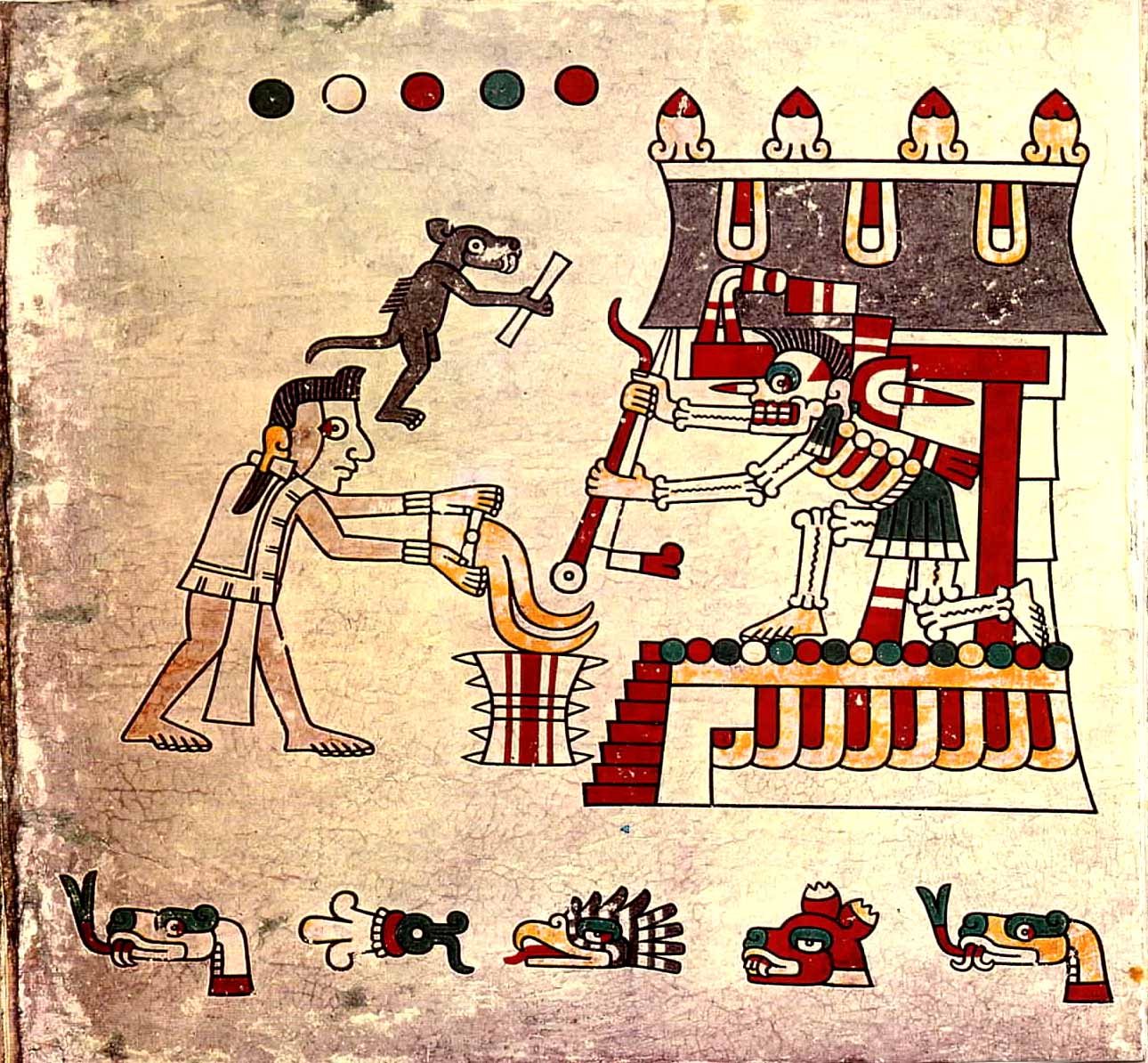
The Codex Laud, on its page 26, shows a dead person approaching Mictlantecuhtli with the spirit of a dog nearby, according to the magazine Arqueología Mexicana. Archaeologists have also interpreted dog burials in light of these traditions. You may have heard that the dog decides whether to help depending on how the person treated animals in life. That detail is common in modern retellings, but it is not a firmly documented Mexica teaching, so it is best enjoyed as a modern telling rather than repeated as ancient belief.
Death and new life
Mictlantecuhtli was not only about endings. In the myth of Quetzalcoatl's trip to Mictlan, as the Walters Art Museum recounts, the bones of earlier humans were taken out of the land of the dead and used to create a new humanity. In that story, the land he ruled held the bones new life was made from.
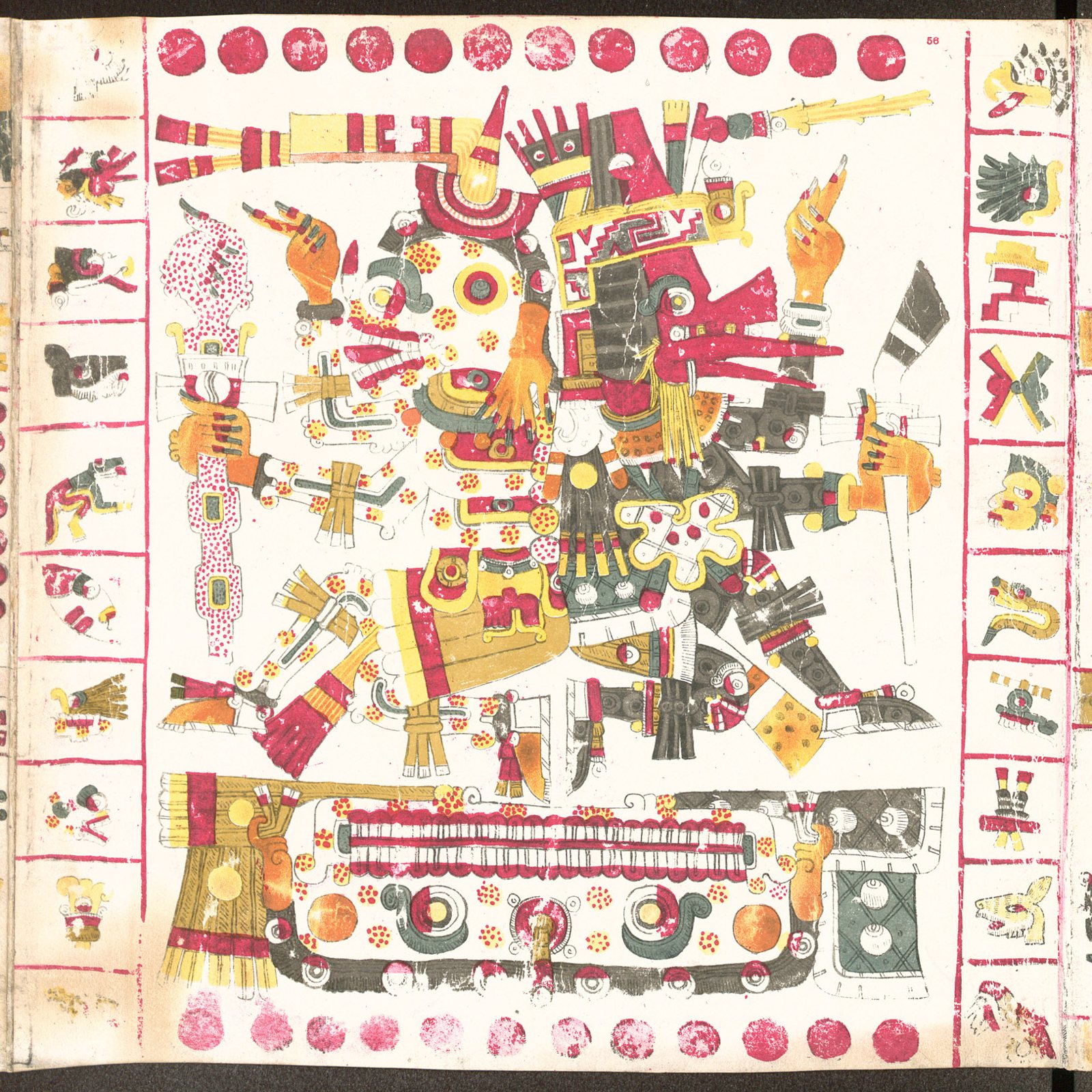
Museums lean on that idea when they explain his image. INAH has presented Mictlantecuhtli as part of the ancient Mexican link between death and regeneration, and educators at the Oakland Museum of California describe skeletal imagery, including the Codex Borgia, as part of a cycle in which death and life complete each other. Read that way, his bones and decay were not simply meant to frighten. They could express the way death feeds new life.
Mictlantecuhtli today
You can find him now in contemporary Mexican art, museum education, exhibitions, sculpture, tattoos, graphic design and Día de Muertos imagery, where he works as a recognizable skeletal lord of the dead. Artists drawn to skulls, bones, decay and regeneration have plenty to work with.
That modern presence is different from Mexica religion. Día de Muertos is not an unchanged survival of worship directed to Mictlantecuhtli. UNESCO, which proclaimed the Indigenous festivity dedicated to the dead in 2003 and inscribed it on its list in 2008, describes it as a set of living traditions kept by different communities in Mexico, combining Indigenous practice with Catholic observances introduced in the sixteenth century. UNESCO describes communities using flowers, candles, food and paths between homes and cemeteries, and Mexican government material stresses that each town has its own ofrendas, rules and ways of speaking with the dead. The Secretaría de Cultura has presented ofrendas from twenty Indigenous communities, each with its own worldview and tradition. Oaxaca, Michoacán, the Huasteca and Mexico City do not keep identical customs, and the differences are traced region by region in Día de Muertos by region. If you would like to build an altar of your own, see how to make an ofrenda.
Mictlantecuhtli in objects and records
Tap or hover a step to follow the order.
About 1400 to 1521
The House of the Eagles and its life-size ceramic Mictlantecuhtli stand in Tenochtitlan.
About 1450 to 1521
Mexica artists make the wooden mask of Mictlantecuhtli now at the Walters Art Museum.
1502 to 1520
A Mexica ritual knife identified as Mictlantecuhtli is made, now at the Metropolitan Museum of Art.
1577
The Florentine Codex is completed at the Imperial Colegio de la Santa Cruz in Tlatelolco.
2003 and 2008
UNESCO proclaims and then inscribes the Indigenous festivity dedicated to the dead.
Mictlantecuhtli and Mictlan quiz
Answer every question to check.
Quick answers about Mictlantecuhtli
Three questions come up again and again, in English and in Spanish.
What does Mictlantecuhtli symbolize?
Mictlantecuhtli symbolized rule over the dead and the underworld for the Mexica, and his imagery also belongs to a wider cycle linking death, decay, ancestry and new life. Museum interpretations stress that his bones were not only images of horror; they could express the link between death and new life. His exact meaning shifts with the object and the account.
Is Mictlantecuhtli still worshiped today?
Mictlantecuhtli belongs to the religious world of central Mexico before and just after the conquest, and today's Día de Muertos is not continued worship of him. Día de Muertos practices are living, varied traditions of remembrance shaped by Indigenous, Catholic, local and family histories. Some individuals and groups may personally revere Mexica deities, but that is their own practice and not something to assume of all Mexicans or all Día de Muertos observances.
What is Mictlan, and how many levels does it have?
Mictlan is the land of the dead in Mexica religion, and the most cited colonial accounts give it nine levels or stages, crossed over four years. The obstacles include a river, mountains that come together and an obsidian wind. The nine-stage scheme comes mainly from the Florentine Codex and Codex Vaticanus A, colonial sources that keep Indigenous material and are read critically by historians.
Where to go next
Mictlantecuhtli sits beside other rulers of the dead in our tour of gods of death. For the Mexica capital's racks of skulls, read about the tzompantli, and for what a skull means on a Día de Muertos altar today, see calavera meaning. The skeletal folk saint many people confuse with him is a separate, modern devotion, told in our story on Santa Muerte.