

No. 026
Santa Muerte: Who She Is, What She Means and How Devotees Honor Her
Santa Muerte, "Holy Death," is the skeletal woman in a long robe, often holding a scythe and a globe, who is the center of a Mexican folk-saint devotion. Her devotees, in Mexico and in Mexican communities in the United States and elsewhere, pray to her for protection, healing, justice, love, prosperity and safe passage through danger and death. They call her by close, familiar names such as *la Flaquita*, the Skinny Lady, and *la Niña Blanca*, the White Girl. She is not a saint recognized by the Catholic Church, and no single authority runs the devotion; it lives in home altars, street shrines and neighborhood chapels.
If you have seen her on a candle at the corner store, on a relative's altar or in a tattoo, what follows covers who she is to the people who pray to her, how her devotion became public, what her colors and objects mean to devotees, and what the Church and the Mexican government have said.
Who she is to her devotees
The anthropologist Roberto Garcés Marrero, writing about devotees in Mexico City, records the many names they use for her: *la Flaquita* or *la Flaca*, *la Niña Blanca*, *la Santísima Muerte*, *la Santa*, *la Señora*, *la Patrona* and *la Madrina*. *La Madrina* means godmother, *la Patrona* patroness and *la Señora* the lady.
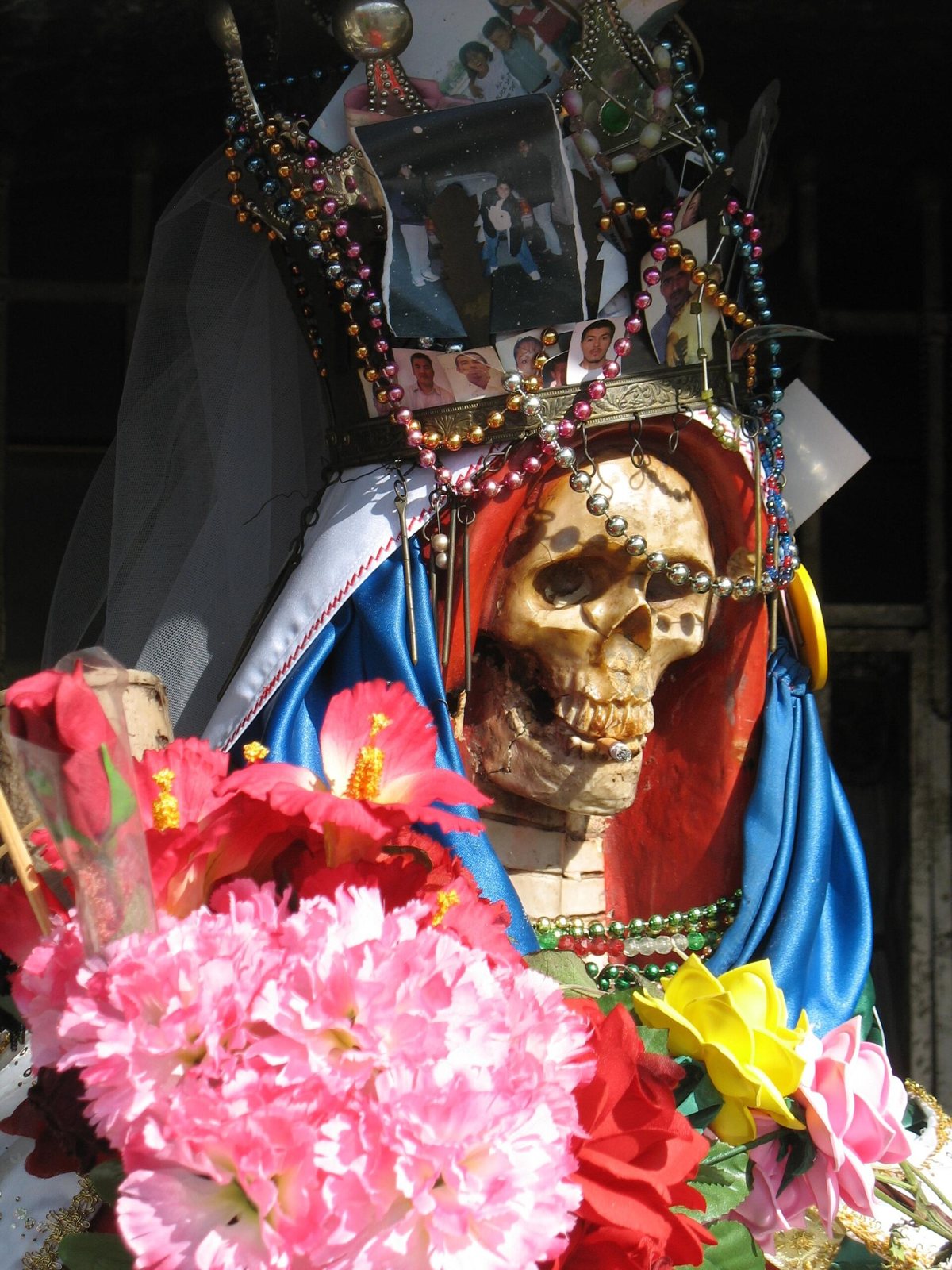
The scholar Andrew Chesnut describes her as a folk saint who personifies death and who is often represented as a female Grim Reaper. That comparison is about how she looks, not about where she comes from. What devotees bring to her are ordinary, serious needs: healing and health, protection, safe passage through danger, justice, work, love, prosperity and help through hard times. A folk saint, in this sense, is a figure people venerate through their own prayers and altars outside the official list of saints of the Church.
How the devotion became public
The history of Santa Muerte is not settled into one agreed account, and the parts that are documented point to Mexico City in the late twentieth century. Older Catholic images of death and Mexican traditions of remembering the dead are part of the background, but they are a different thing from a continuous, recorded line of Santa Muerte devotion reaching back to the colonial period, and that longer line should be treated with caution unless a specific archival record is cited.
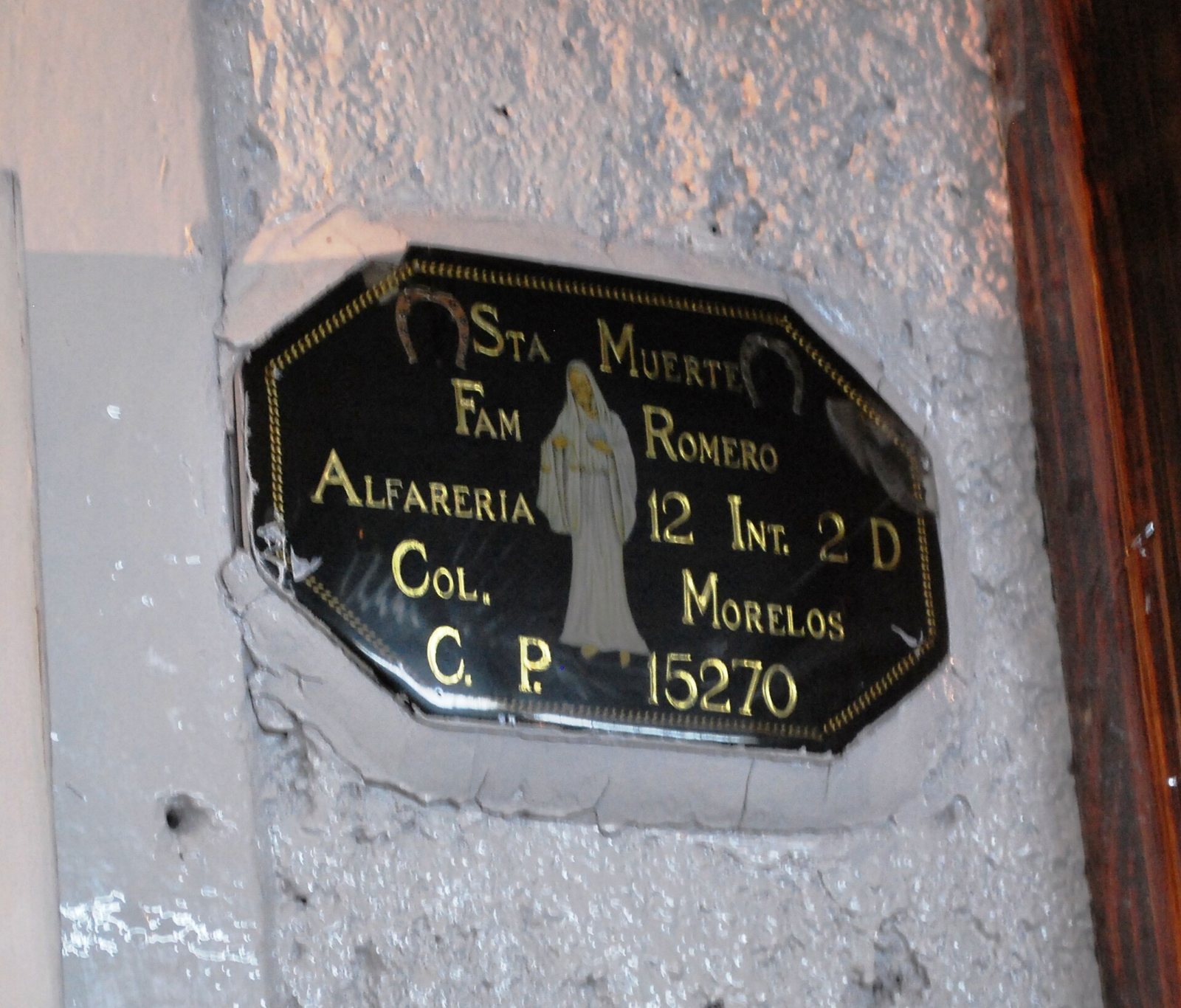
What is recorded is this. The anthropologist Juan Antonio Flores Martos reports a small family altar in the Mexico City neighborhood of Tepito by the 1960s, associated with the family of Enriqueta Romero. For decades it stayed mostly private. Garcés Marrero describes the devotion spreading into Mexico City through migration from surrounding states in the mid-twentieth century and becoming far more visible from the 1990s onward.
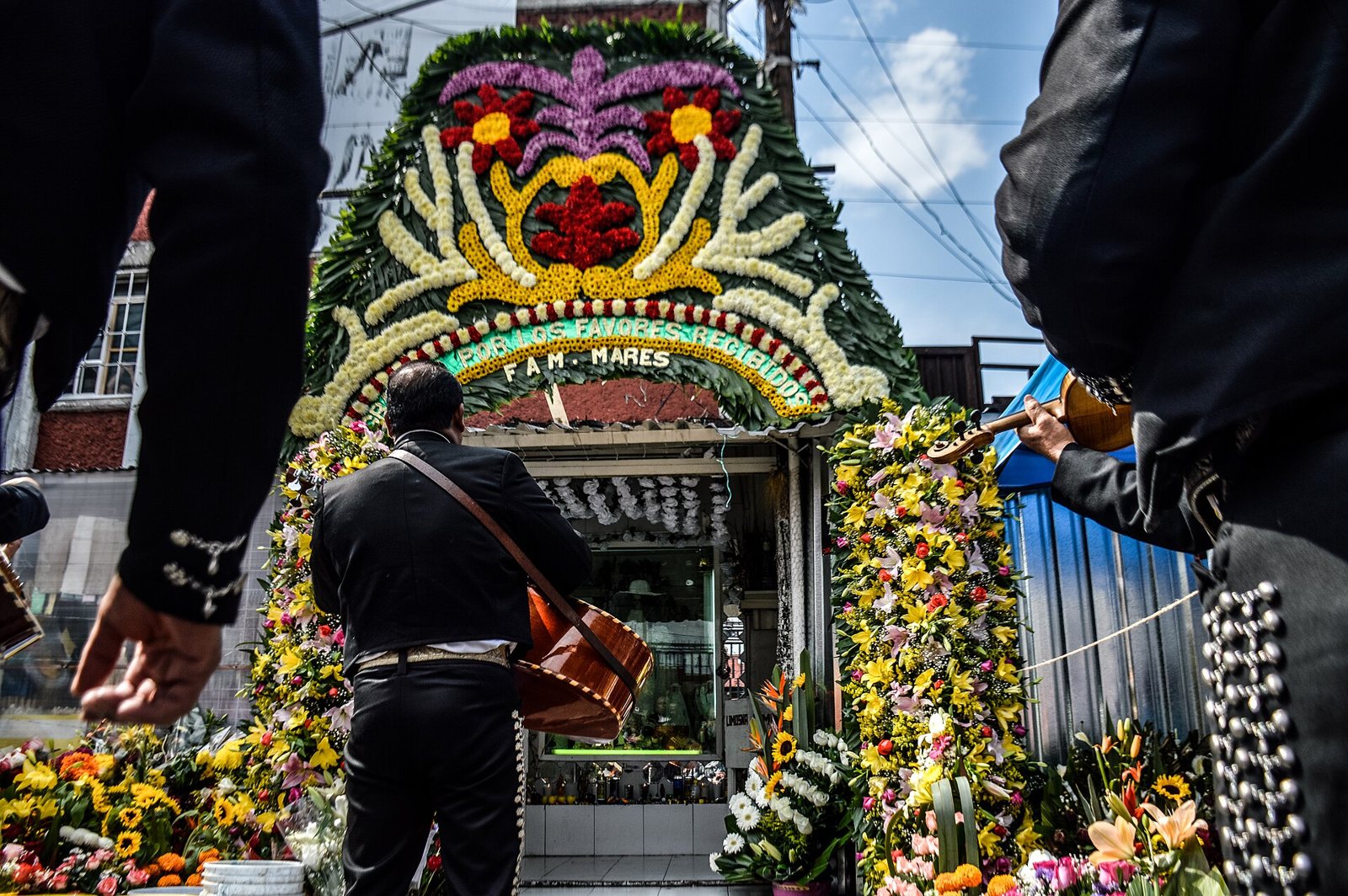
The turning point came in 2001. Enriqueta Romero, known as Doña Queta, placed a life-size image of Santa Muerte outside her home at 12 Alfarería Street in Tepito. Accounts date the day the image went public to October 31 or November 1, 2001. The anthropologist Laura Roush, who studied the altar, dates the congregation's monthly prayer service to September 2001. That monthly rosary turned a family devotion into a public, shared one, and studies describe rapid growth of the devotion in Mexico and the United States after the 1990s and especially after 2001.
Santa Muerte devotion in public life
Tap or hover a step to follow the order.
1960s
Accounts associate a private family altar in Tepito with Enriqueta Romero's family.
September 2001
Laura Roush dates the Alfarería Street congregation's monthly prayer service to this time.
October 31 or November 1, 2001
Doña Queta places a life-size Santa Muerte image outside her home at 12 Alfarería Street.
April 30, 2005
The Secretaría de Gobernación cancels the registration of the Iglesia Católica Tradicional México-Estados Unidos.
April 24, 2024
The Conferencia del Episcopado Mexicano calls for rejection of "cultos distorsionados como el de la Santa Muerte."
The robe colors and what she holds
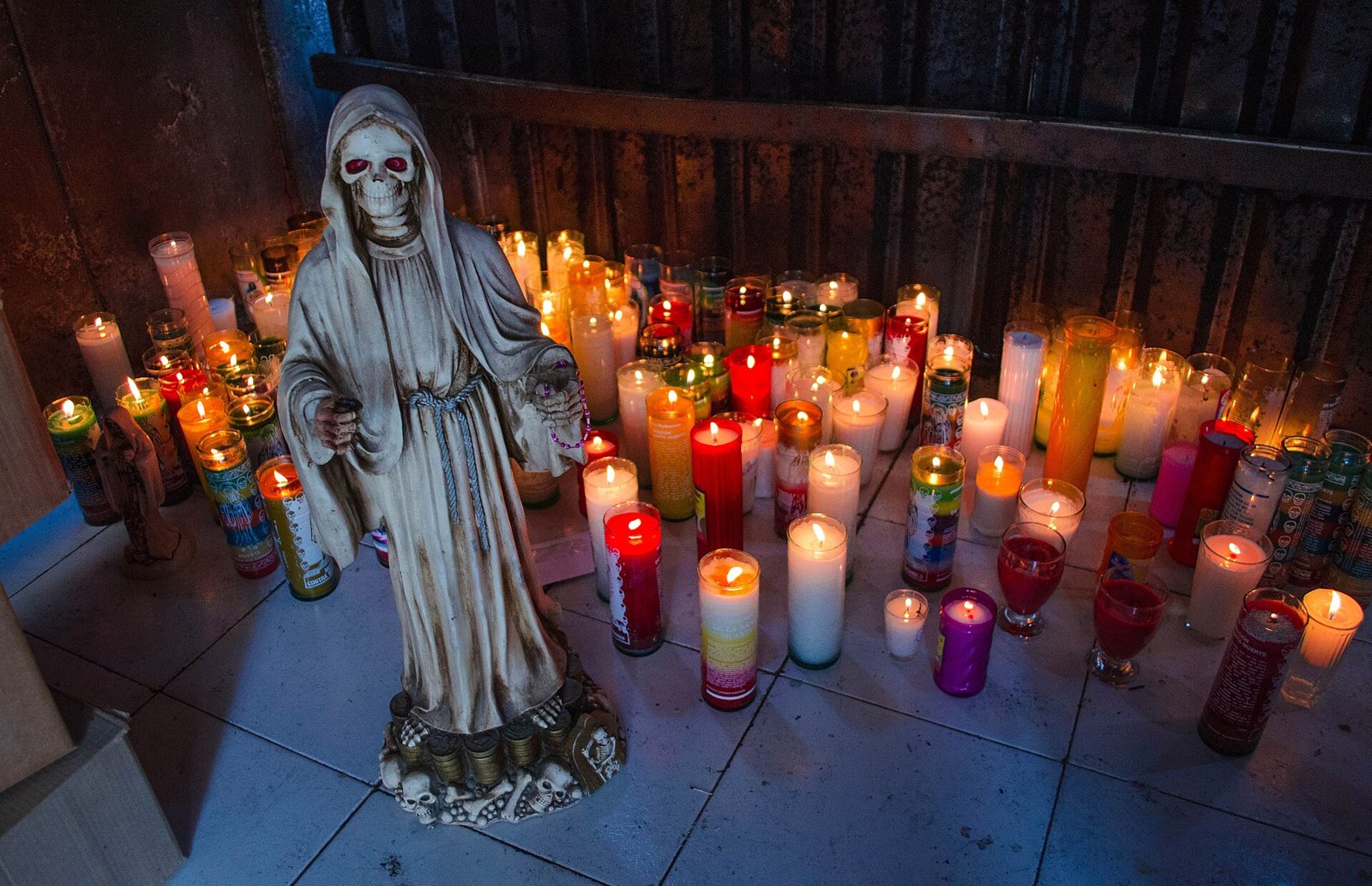
Her robe comes in many colors, and devotees often choose an image, a candle or a robe by color according to what they are asking for. Meanings vary by altar, region and devotional tradition, so treat the list below as common associations rather than fixed rules that every devotee shares.
Common meanings of Santa Muerte's robe colors
Tap a card to bring it forward.
- White: Purity, gratitude, peace and protection.
- Red: Love, passion and relationships.
- Green: Justice and legal matters, or health or money, depending on the devotee.
- Gold or yellow: Prosperity, abundance and material success.
- Black: Protection, strength and defense against danger.
- Purple: Healing, spiritual matters and inner change.
- Blue: Wisdom, calm and mental or emotional matters.
The objects in her hands carry meaning too. The scythe is associated with death's inevitability, with cutting away obstacles and with the harvest of life. The globe stands for death's reach over the whole world. Scales, which appear in some images, are associated with justice, balance and impartiality. An owl, in other images, is linked by some devotees with wisdom, seeing in the dark and carrying messages between worlds. These are devotional interpretations, and a devotee in one city may explain them differently from one in another.
So, what does Santa Muerte symbolize overall? For many devotees she stands for the fact that death comes to everyone equally, and alongside that, for protection, healing, justice, change and help when a person feels exposed or vulnerable. The meaning shifts with the person, the image, the robe color and the setting.
How devotees honor her
Devotion to Santa Muerte happens in three main places: home altars, public shrines and neighborhood chapels. People pray, say the rosary, keep novenas, nine days of prayer for a petition, and light candles. On her altars they leave water, flowers, fruit, sweets and food, as well as cigarettes, alcohol, money, jewelry and written notes of thanks.
There is no single church or leader that sets these customs, so practice differs from one devotee and one altar to the next. A household altar and a street shrine may share a lot and still do things differently. If you are visiting a shrine or a relative's altar, the people who keep it are the ones to ask about what is welcome.
The Tepito rosary and the days devotees gather
At Doña Queta's altar on Alfarería Street, a public rosary is held on the first day of every month, a practice Roush dates to 2001. The shrine's largest yearly gathering falls around November 1, the anniversary of the day the image went public.
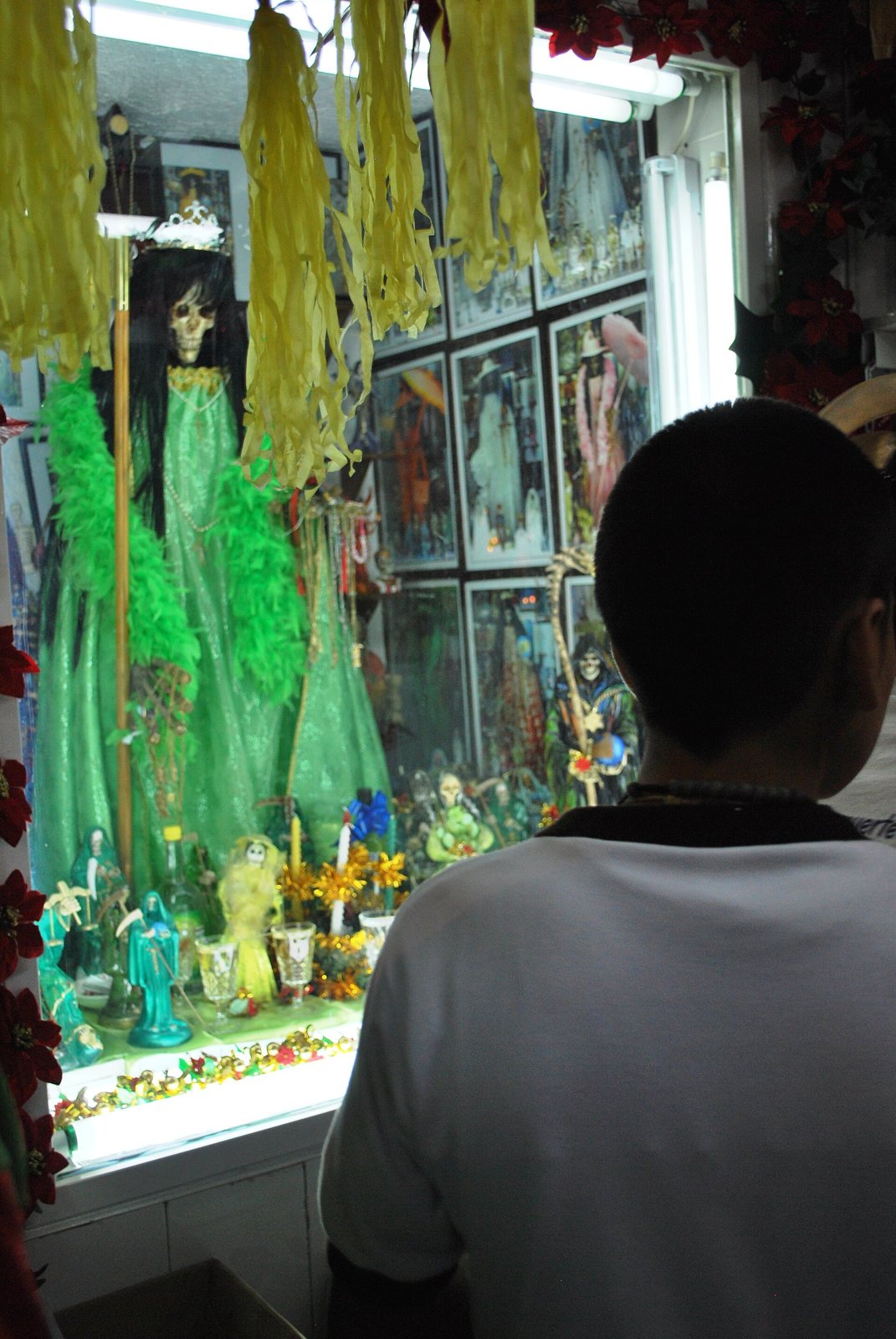
Many devotees also observe November 2. In the Catholic calendar, November 1 is All Saints' Day and November 2 is All Souls' Day, as the Arquidiócesis de León notes, and November 2 is also a central day of Día de Muertos in Mexico, when families remember their own dead. Some devotees mark August 15 or other dates. The devotion has no single, universally recognized feast day, so the dates you hear depend on the community and the shrine.
What the Catholic Church and the Mexican government have said
The Roman Catholic Church does not recognize Santa Muerte as a saint. In April 2024 the Conferencia del Episcopado Mexicano, the conference of Mexico's Catholic bishops, called for rejection of "cultos distorsionados como el de la Santa Muerte," distorted forms of worship such as that of Santa Muerte, and described the devotion as lacking a basis in Catholic doctrine or theology. The Arquidiócesis de Guadalajara carried the statement's context in its June 2024 bulletin, and the Arquidiócesis de León reported the position again on February 19, 2026.
The Mexican government's action has been about legal registration, not about what people may believe. On April 30, 2005, as El Universal reported, Mexico's Secretaría de Gobernación canceled the registration of the Iglesia Católica Tradicional México-Estados Unidos, a church association connected with Santa Muerte, saying it had "desvió gravemente los fines establecidos en sus estatutos," that it had seriously departed from the purposes set out in its statutes. The same report said the government affirmed respect for freedom of belief, and an official stated that the cancellation concerned the association's registered purpose, not a ban on what citizens could believe.
These are the positions of a church and a government. Many devotees, for their part, approach her as a protective and just figure, and scholars describe many different communities and practices rather than one verdict that fits all of them.
How she differs from the Grim Reaper and the Mexica gods
Santa Muerte shares a skeleton, a robe and often a scythe with the European figure of Death, which is why "female Grim Reaper" is a common description. The two are still different things. The Grim Reaper is a personification of death from European art, with a history you can follow in our story on the Grim Reaper's origin. Santa Muerte is the focus of a living devotion with named devotees, altars, prayers and petitions.
She is also not the Mexica goddess Mictecacíhuatl or her consort Mictlantecuhtli, the rulers of the land of the dead in Aztec religion. Scholars discuss Indigenous, Catholic and European influences on her imagery, but she is a modern devotion and not an ancient deity under a new name. For the wider family of death figures around the world, see gods of death.
Santa Muerte quiz
Answer every question to check.
Quick answers about Santa Muerte
These are the questions people ask most often, in English and in Spanish.
Is Santa Muerte good or bad?
There is no single answer, because devotees, the Church and scholars see her differently. Many devotees approach her as a protective and just figure who receives petitions for health, work, love, safety or justice, while Catholic authorities reject the devotion on theological grounds. Scholars describe many different communities of devotees rather than giving all of them one moral verdict.
What does Santa Muerte symbolize?
She symbolizes death's universality and inevitability, and for her devotees also protection, healing, justice, equality and help in vulnerable moments. Robe colors add specific meanings, such as red for love or green for justice, and those meanings vary by altar.
Is the Grim Reaper the same as Santa Muerte?
No, they share skeletal imagery, a robe and often a scythe, but they are different figures. The Grim Reaper is a European and North American personification of death, while Santa Muerte is the focus of a living Mexican folk-saint devotion with devotees, altars and prayers.
What is Santa Muerte, and what do people pray to her for?
Santa Muerte is a female skeletal figure venerated by devotees in Mexico and in the Mexican diaspora. People ask her for protection, health, justice, love, work, prosperity and help in difficult times, and the practices and meanings change with the community and the person.
What day is Santa Muerte celebrated?
There is no single official day for the whole devotion. Doña Queta's public altar in Tepito draws its largest crowds on November 1, the anniversary of its 2001 opening, and holds a rosary on the first of every month; others observe November 2, August 15 or other dates.
Where to go next
Santa Muerte is easier to understand next to the other ways people have given death a face. Read the Grim Reaper's origin for the European figure she is often compared with, Mictlantecuhtli for the Mexica lord of the dead, and Día de Muertos for the family remembrance held on the same autumn days. For Christian uses of the skull, see skulls in Christianity.