

No. 066
Skull and Hourglass Meaning: Time and Death in One Image
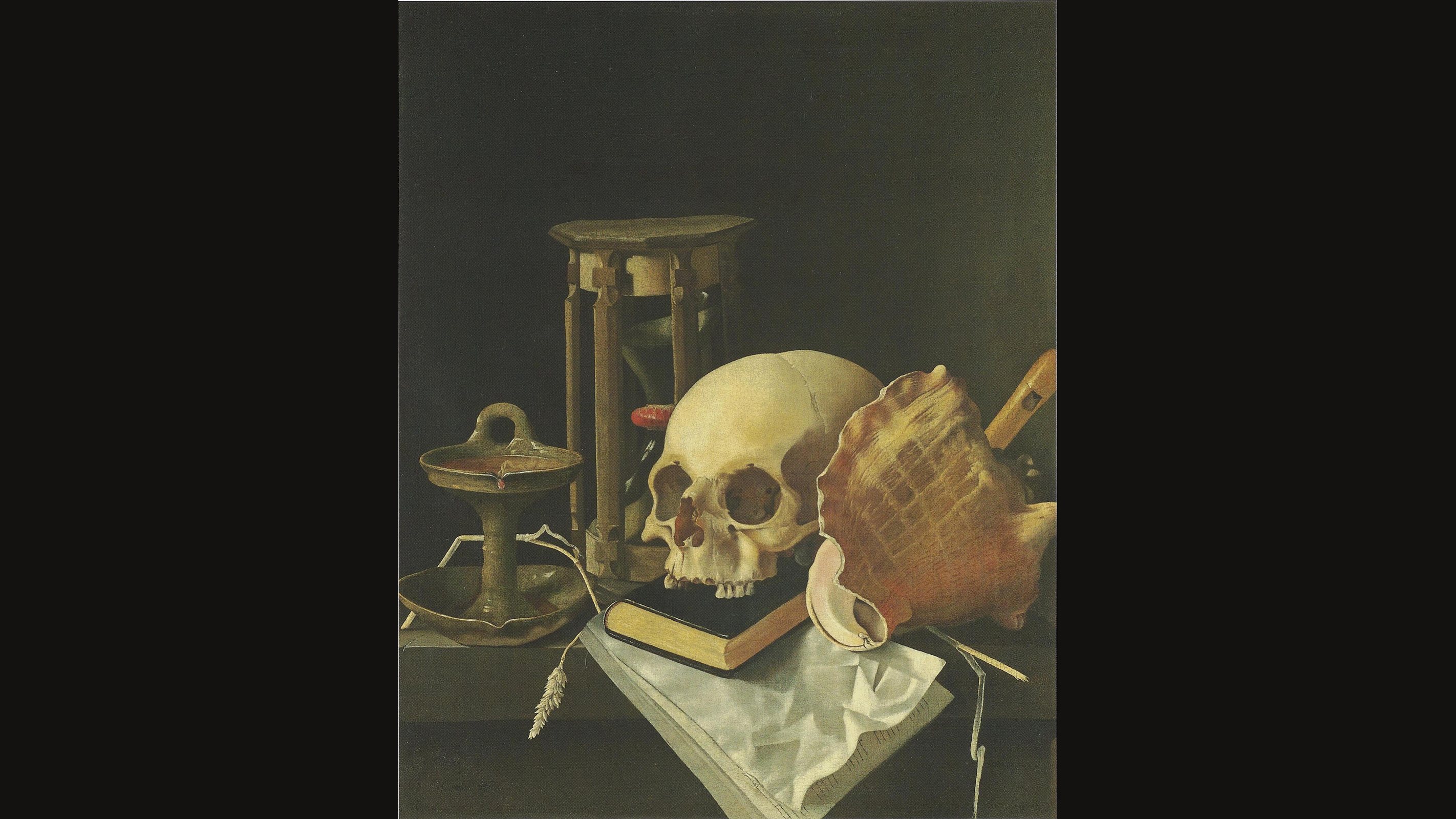
A skull with an hourglass beside it says that life is short and death is certain. The skull stands for death, and the hourglass shows the limited time a life has, with the sand visibly running out. That is how the pair works in European memento mori and vanitas art, where The Metropolitan Museum of Art reads such objects as signs of life's brevity, and on early New England gravestones, where Boston's gravestone guide says the carvings asked passers-by to think about mortality.
The exact reading of one stone, painting, flag or tattoo still depends on where it is, when it was made, what else is carved or painted around it and, for a tattoo, what the wearer intends. So, here is the pairing in each of the places you are likely to have met it, one at a time.
On early New England gravestones
If you saw the skull and hourglass on a weathered slate in an old burying ground, you were looking at a Puritan death's head. In seventeenth- and eighteenth-century New England, gravestones commonly carried a stylized skull, usually with wings or crossed bones. Boston.gov's guide to gravestone iconography describes the death's head as a non-religious symbol and says the epitaphs beneath it urged viewers to contemplate mortality and the brevity of life. Hourglasses sometimes joined it, adding time to the message, and some of those hourglasses had wings of their own.
On Cape Cod, most stones from about 1600 to 1750 feature winged skulls, according to the Heritage Museums & Gardens. The same museum adds a useful caution: what the wings meant to the people who chose them is uncertain. The carving is clear; the thoughts of the family who paid for it are harder to recover.
One stone puts all the pieces together. The Jonathan Freeman gravestone on Cape Cod, dated 1714, combines a winged death's head, an hourglass and crossbones, as the Yale-New Haven Teachers Institute records in its study of death and dying in Puritan New England. Each of these markers was set up for a real person by a real family.
For anyone who wants to read the stones more closely, Allan I. Ludwig's *Graven Images* is a major study of New England stonecarving and its symbols. The carvers who cut these faces, and the slow change from skulls to winged cherubs on later stones, are the subject of our story on what a winged skull means.
The winged hourglass: time flies
The hourglass on a gravestone sometimes grows wings, and when it does, it is saying *tempus fugit*, Latin for "time flies." A winged hourglass without any human figure carries that reading on New England stones and in later memorial art, as the Boston guide and Tattoo History Atlas both note. The wings make the hourglass a little more urgent: the sand is not just running out, it is leaving fast.
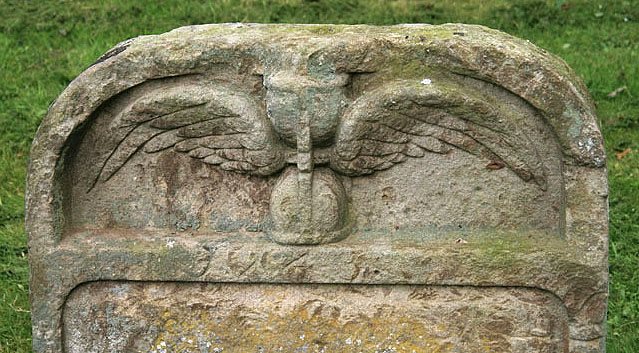
The winged hourglass was at home on Scottish stones too. A 1740 gravestone at Channelkirk Churchyard in Scotland bears a winged hourglass, photographed by Walter Baxter. The description with his photograph says the hourglass's position was read in two ways: upright for time running out for the passer-by, and lying on its side for time having run out for the person buried there. That is one reading attached to one stone, and it is a lovely one, but it is not a rule you can apply to every hourglass you meet.
In Dutch and Flemish vanitas still lifes
If your skull and hourglass hang in a museum, they belong to the painting tradition called vanitas. In European memento mori and vanitas art, the skull represents death, while the hourglass makes the passing, limited supply of human time visible. Seventeenth-century Dutch and Flemish still lifes often set the two among other short-lived things: extinguished candles, wilting flowers, soap bubbles, books and watches. Every object on the table is something that ends.
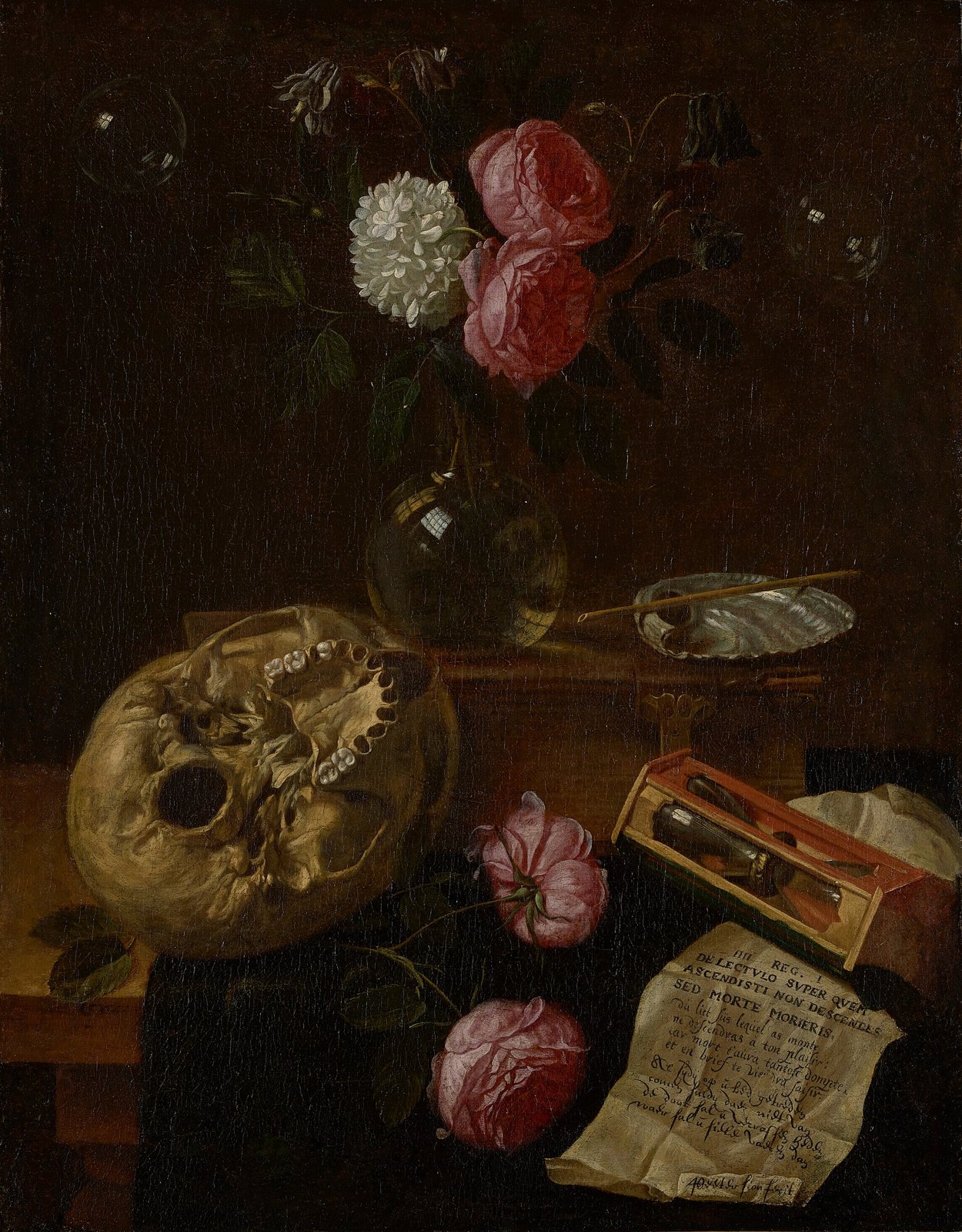
One of the earliest is a painting by Jacques de Gheyn II. The Met dates his *Vanitas Still Life* to 1603 and describes it as one of the earliest independent vanitas still lifes, reading its skull and the objects around it as signs of life's brevity and human folly. From there the pairing became a standard part of the painter's kit, often right there in the title. Peeter Sion's seventeenth-century *Vanitas with hourglass and skull*, Adriaen Coorte's *Vanitas Still Life with skull and hourglass* and Nicolaes van Verendael's 1680 *Vanitas still life with flowers, a skull, hourglass, conch shell and silver jug* all name the pair outright. Verendael's title reads almost like an inventory of everything a collector could lose.
Two more works show how close the hourglass stays to the skull. Herman Henstenburgh's 1698 *Memento Mori*, documented by the UNESCO Virtual Museum, lays a skull beside an overturned hourglass, an extinguished candle and bones, and Hendrick Hondius's 1626 print at the Rijksmuseum carries the titles *Memento Mori* and *Finis Coronat Opus*. Both are described in our story on what memento mori means, and the wider genre has its own page on vanitas paintings. The extinguished candle that keeps turning up beside the hourglass has a story of its own in skull and candle meaning, and if you like your vanitas with a visual trick, see the illusion in All Is Vanity.
Father Time carries the hourglass too
The hourglass also has an owner in European art: Father Time. He developed as an allegorical figure who combines an old man, wings, an hourglass and often a scythe. The Getty Iconography Authority describes him as a personification of time whose hourglass represents time's constant forward movement. Renaissance artists gave him his wings, while the scythe came to stand for time cutting down life.
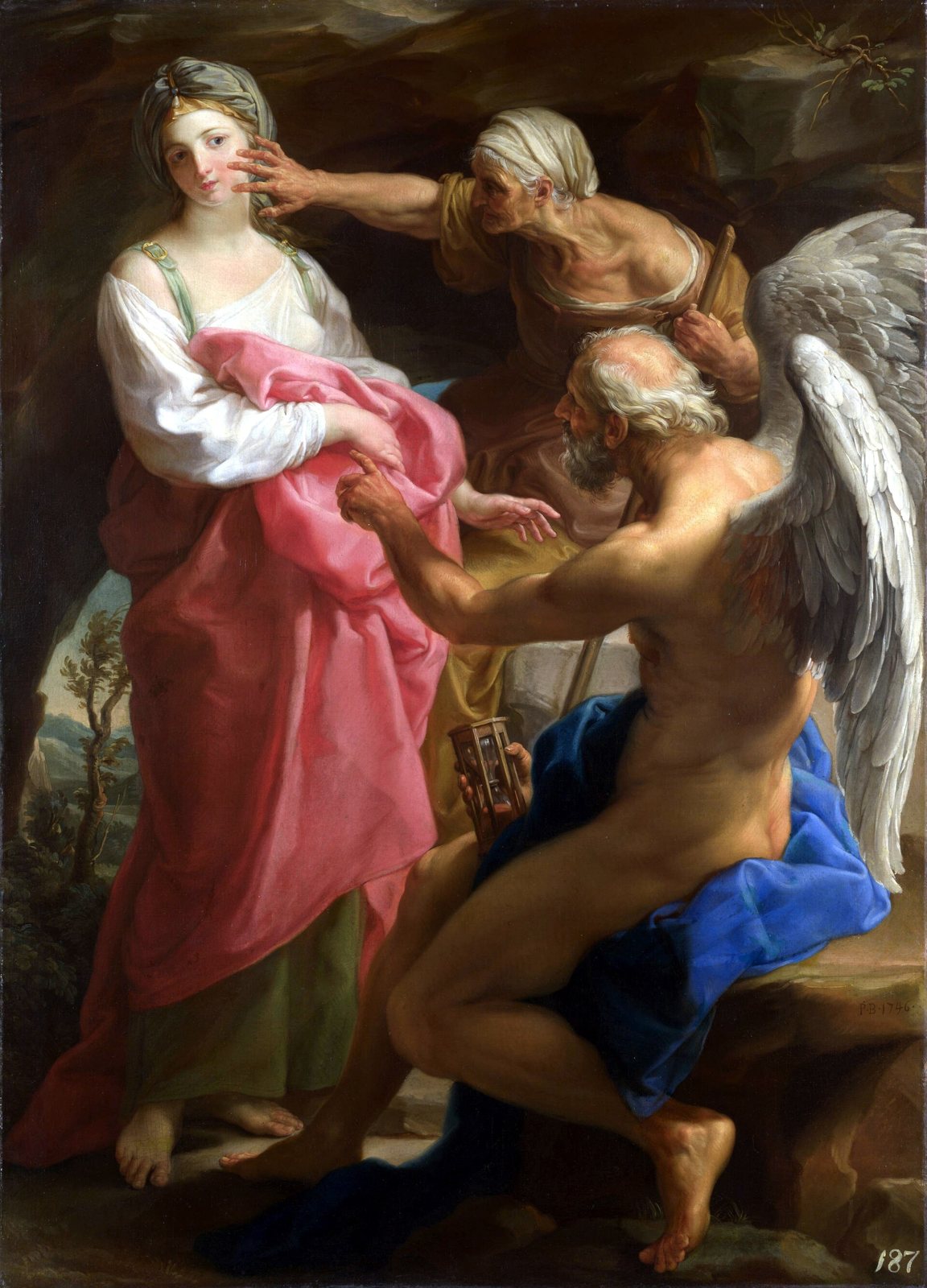
The Seattle Art Museum connects the winged figure to Renaissance allegory and says he tells viewers that age and death come for everyone. A carving of Old Father Time from about 1750, now at the London Museum, holds a scythe and an hourglass, and the museum interprets the pair as the inevitability of passing time and death. In Pompeo Batoni's 1746 painting *Time orders Old Age to destroy Beauty*, at the National Gallery in London, winged Time appears with his hourglass.
So, when a skull and hourglass appear together, the hourglass often carries Father Time's meaning into the scene even when he is not there in person. Death took up the same props as he became a character in his own right, a story told in our page on the Grim Reaper's origin.
On pirate flags
The skull and hourglass also sailed under black flags in the early eighteenth century. Royal Museums Greenwich identifies the hourglass as a common European death symbol and says some Jolly Rogers included one alongside a skull or skeleton.

The first recorded black Jolly Roger is commonly associated with the Breton pirate Emmanuel Wynne in 1700. According to the World History Encyclopedia, his flag reportedly showed a skull, crossed bones and an hourglass during an engagement off Santiago. A pirate flag had a practical job: to frighten a merchant crew into surrendering without a fight. On a flag like that, the hourglass was a deadline. Your time to give up is running out, and the skull tells you what happens after.
Pirate flags varied by captain and by period, though, so the meaning of any single historical flag should not be assumed from another. The fuller story of the black flag is in our page on the Jolly Roger, and the skull with crossed bones, from ships to poison bottles, has its own history in skull and crossbones.
The skull and hourglass through time
Tap or hover a step to follow the order.
1603
Jacques de Gheyn II paints Vanitas Still Life, one of the earliest independent vanitas still lifes, according to The Met.
1626
Hendrick Hondius publishes a vanitas print with a skull and hourglass, titled Memento Mori and Finis Coronat Opus.
1680
Nicolaes van Verendael paints a vanitas still life with flowers, a skull, an hourglass, a conch shell and a silver jug.
1698
Herman Henstenburgh paints a skull beside an overturned hourglass, an extinguished candle and bones.
1700
Off Santiago, the pirate Emmanuel Wynne is associated with a black flag showing a skull, crossed bones and an hourglass.
1714
The Jonathan Freeman gravestone on Cape Cod combines a winged death's head, an hourglass and crossbones.
1740
A gravestone at Channelkirk Churchyard in Scotland bears a winged hourglass.
1746
Pompeo Batoni paints winged Time with an hourglass in Time orders Old Age to destroy Beauty.
About 1750
A London carving shows Old Father Time with a scythe and an hourglass.
Skull and hourglass tattoos today
A skull and hourglass tattoo usually draws on that same old vocabulary: the skull for mortality and the hourglass for time draining away. Apollo Tattoo, a Los Angeles studio, sums it up neatly: the skull says "what" and the hourglass says "when." The studio also stresses that wearers attach their own meanings, such as grief, urgency, patience, personal change or remembrance of someone.
The design has a traceable family tree. Tattoo History Atlas, edited by John J. Mayo III, follows the modern motif from European vanitas art through New England gravestone carving to American traditional tattoo flash, the ready-made designs a customer picks from in a tattoo shop. A skull and hourglass on a forearm is, in a sense, a distant cousin of the slate in the burying ground.
That lineage frames the design without fixing its meaning. One person wears it for a specific loss, another for a birthday or a life transition, another as a philosophical nudge to use their time well, and another because the two shapes simply look good together. The person wearing it is the authority on what theirs means. If you are thinking about one, our guides to skull tattoo meaning and memento mori tattoos cover the wider choices.
How to read the one in front of you
Whatever brought you here, a few questions will get you closer to what your particular skull and hourglass is saying. The pairing has a shared core, death and limited time, but the community, place and period around it shape the rest, as the Heritage Museums & Gardens and Apollo Tattoo both point out in their own settings.
Reading a skull and hourglass
Tap a card to bring it forward.
- Where it is: A gravestone, a still-life painting, a pirate flag and a tattoo each come from a different tradition.
- The date: A New England stone from the 1600s or 1700s points to the Puritan death's head; a painting from the 1600s points to Dutch and Flemish vanitas.
- What surrounds it: Wings on the hourglass suggest time flies; a scythe points to Father Time; crossbones, candles, flowers and bubbles each add their own note about endings.
- The community and place: A Cape Cod burying ground, a Dutch painter's studio and a pirate ship off Santiago used the pair for different reasons.
- The wearer: For a tattoo, the person wearing it decides the meaning, so ask them.
Skull and hourglass quiz
Answer every question to check.
Questions people ask about the skull and hourglass
These are the questions that come up most once people start looking closely at the design.
Why would someone get a skull and hourglass tattoo?
People get a skull and hourglass tattoo for many personal reasons, and Apollo Tattoo lists grief, urgency, patience, personal change and remembrance among them. Others choose it to mark a specific loss, a birthday or a turning point in life, or as a daily nudge to live deliberately. Some simply like how the two shapes look together.
How can I tell what someone's skull and hourglass tattoo means?
The surest way to know what someone's skull and hourglass tattoo means is to ask them. The design's history in vanitas painting, gravestone carving and tattoo flash tells you where it comes from, but the wearer decides what it says for them. Details such as dates, names, flowers or lettering beside it are often the clearest clue.
Is the skull and hourglass a pirate symbol?
The skull and hourglass is partly a pirate symbol, since some early eighteenth-century Jolly Rogers carried it and Emmanuel Wynne's flag of 1700 is commonly associated with it. The pairing is older and wider than piracy, though. It was already at home in vanitas painting by 1603 and was carved on New England gravestones in the same decades the pirates were flying it.
Does a skull and hourglass always mean the same thing?
A skull and hourglass does not always mean the same thing, although it almost always involves death and limited time. The Heritage Museums & Gardens points out that even the wings on Cape Cod stones carry an uncertain meaning, and a pirate's deadline, a painter's meditation and a tattoo for a lost parent are very different messages. The setting and the people behind the image fill in the rest.
Where to go next
The skull and hourglass is one small piece of a much larger conversation people have carried on with skulls for centuries. For the idea that ties the painters and the stonecarvers together, start with what memento mori means, and for the full range of what a skull can say in different times and places, see skull symbolism.
Terms in this story
Tap a term to see what it means.
Death's head. The stylized skull, often winged or with crossed bones, carved on seventeenth- and eighteenth-century New England gravestones. Boston's gravestone guide calls it a non-religious symbol of mortality.
---