

No. 023
What Does a Winged Skull Mean? New England Gravestones, Tattoos and Insignia
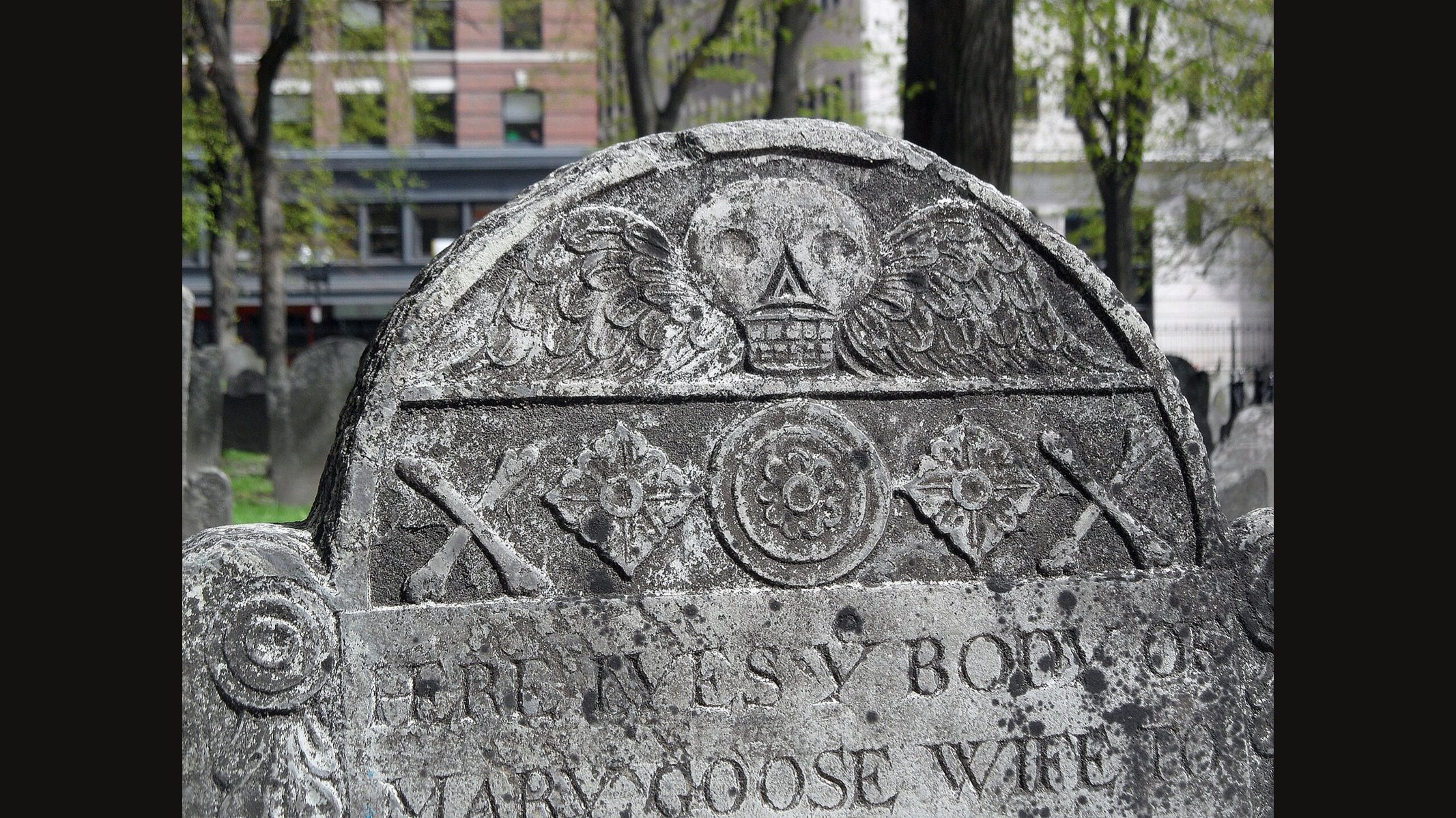
On a seventeenth- or eighteenth-century New England gravestone, a winged skull is a death's head, and it means memento mori: a reminder of physical death and of how short earthly life is. Boston's official gravestone guide calls it a nonreligious Puritan symbol, and the Connecticut State Historic Preservation Office reads winged death heads the same way, as a reminder of mortality. Some historians also read the wings as the soul moving beyond the body. On a tattoo, a patch or an old squadron badge, the meaning belongs to the wearer, the unit or the club. So, the first step is working out which kind of winged skull is in front of you.
The death's head on Puritan gravestones
The carving most people meet first is on an old marker in a colonial burying ground: a skull with a wing spreading out on each side. New Englanders of the period called it a death's head. According to Boston Parks, it was a nonreligious Puritan symbol, and it often shared the stone with hourglasses, coffins, crossed bones and solemn epitaphs. All of those carry the same message: time runs out, and the body ends.
That is the meaning historians agree on most firmly. The Connecticut State Historic Preservation Office, in the Connecticut History overview of the state's cemeteries, likewise treats winged death heads as a reminder of mortality, the Puritan version of a much older idea you can read more about in what memento mori means.
The wings are where interpretation comes in. Some historians and preservation bodies connect them with spiritual regeneration, or with the soul leaving the body and rising. That reading fits later stones especially well, but it is an interpretation attached to particular communities and periods, not a code that works on every carving. The surest way to read a single stone is to look at it whole: its date, its inscription, the burying ground it stands in and the regional style of the carver.
Dated stones you can point to
The death's head is not a vague "old" image. It sits on dated markers, many of them carved for people whose names and death years are still readable.
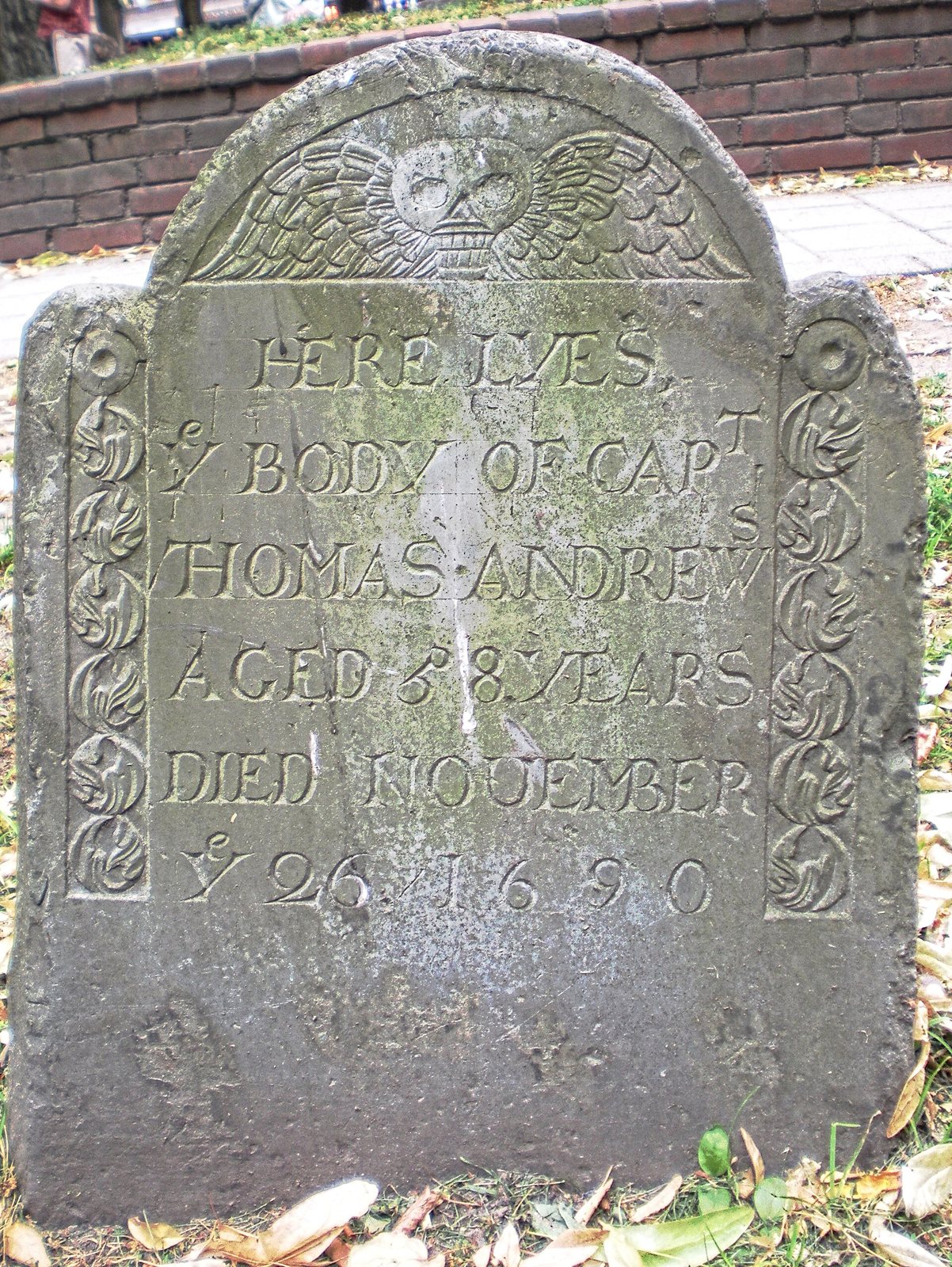
In Massachusetts, death's-head carvings appear on seventeenth- and eighteenth-century stones in Boston's burying grounds. In Milton, the town's historical gravestone study records eighteenth-century winged skulls in Purchase Cemetery and one unusual case from 1799: a stone for Mary Bates whose skull appears to have been recut into a cherubic face. It is a small, clear sign of changing fashion reaching back to alter an older marker.
The Sands Cemetery records give three dated examples in one family plot. The stones for Mary Sands, who died in 1724, Robert Sands, who died in 1735, and Edward Sands, who died in 1746, all carry winged death's heads and are attributed to Nathanial or Caleb Lamson.
Connecticut has its own run of dates. The Stonington Cemetery National Register nomination documents earlier death-head designs at Wequetequock Burial Ground in Stonington, and later winged-head stones in the Phelps Burial Ground on markers dated 1754, 1755, 1760, 1761, 1763 and 1786.
The winged skull in dated examples
Tap or hover a step to follow the order.
Seventeenth century
Death's heads, often winged or paired with bones, appear on Puritan gravestones in Boston burying grounds as a memento mori.
1724, 1735 and 1746
Winged death's-head stones for Mary, Robert and Edward Sands, attributed to Nathanial or Caleb Lamson.
About 1740 to 1760
In the Deetz and Dethlefsen model, cherubs or soul effigies become more common.
1754 to 1786
Winged-head stones in the Phelps Burial Ground in Stonington, Connecticut.
1799
A Milton, Massachusetts, stone for Mary Bates appears to have had its skull recut into a cherubic face.
Late eighteenth to early nineteenth century
Urn and willow designs become common neoclassical mourning motifs.
July 1942
Corporal Joseph Pumphrey designs the 85th Fighter Squadron's "Flying Skull."
Late 1942 to February 1943
The 490th Bombardment Squadron adopts its winged-skull design and flies it in combat on B-25 Mitchell bombers.
The carvers behind the faces
Every one of these skulls was cut by a person, and New England historians have spent decades putting names to the hands. Connecticut historical societies, many of them relying on James A. Slater's 1987 study, name the Stanclift family of Middletown, the Thomas Johnson family, the Manning family, Gershom Bartlett of Bolton, Aaron Haskins, Daniel Ritter, Peter Buckland, and the Loomis and Collins families.
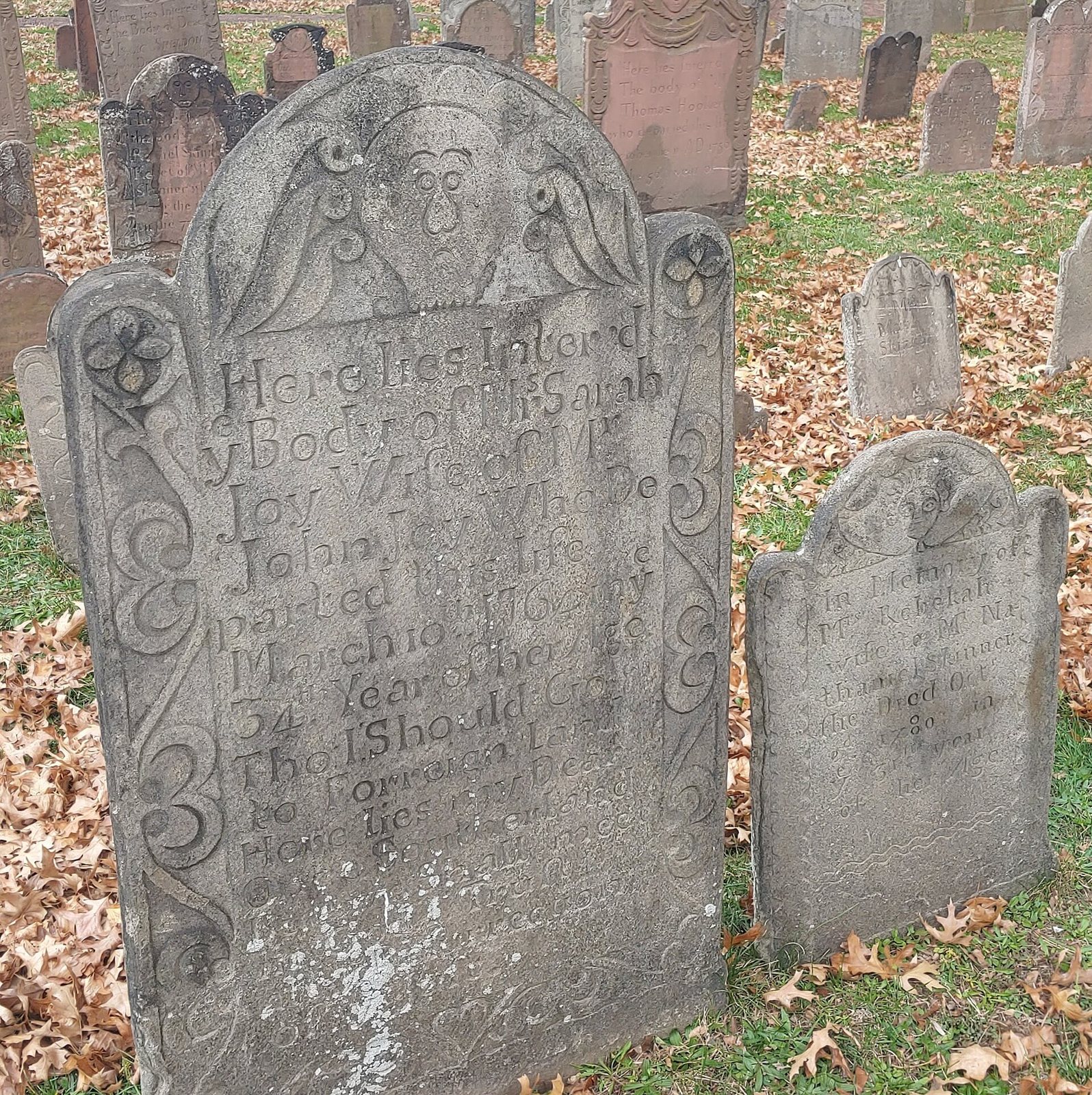
The Mannings were Josiah Manning and his sons Rockwell and Frederick. The Stonington National Register nomination counts them among the major eastern Connecticut producers of eighteenth-century winged-head stones, and their work stands alongside the Stevens family's in the Phelps Burial Ground.
Gershom Bartlett is the carver whose personality comes through most clearly in stone. The Bolton Historical Society identifies more than fifty of his stones in Bolton's cemeteries, recognizable by their distinctive faces, noses, eyebrows, teeth and crowns. Once you have seen a few, his winged faces are hard to mistake for anyone else's, which is a fine thing to be able to say about any carver.
Massachusetts had its own shops. Milton's study names Henry Christian Geyer, Caleb Lamson, the Pratt family shop, the Dwight shop, William Park, Barney Leonard, David Linkon, the Soule workshop, James New, and apprentices connected with William Mumford's Boston shop. The Lamson name, as the Sands stones show, travels with some of the most classic winged death's heads in the region.
From skull to cherub to urn and willow
If you walk an old burying ground from its oldest corner to its newest, the faces change. The best-known explanation comes from two archaeologists, James Deetz and Edwin Dethlefsen. Their 1966 study of Massachusetts gravestones, and their 1967 article "Death's Head, Cherub, Urn and Willow," treated the designs as archaeological evidence of changing religious and social attitudes.
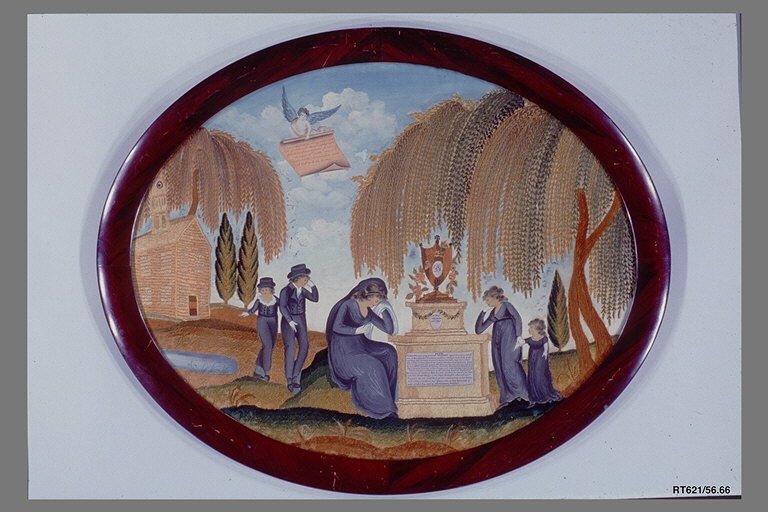
In their sequence, the death's head belongs to seventeenth- and early eighteenth-century Puritanism. Cherubs, also called soul effigies, become more common between about 1740 and 1760: a winged human face where the skull used to be. Then, in the late eighteenth and early nineteenth centuries, urn-and-willow designs replace many of the earlier forms. By the early 1800s, Connecticut writers describe urns and weeping willows as increasingly common neoclassical and romantic motifs.
The sequence is a model, and it has exceptions. Boston's guide notes that death's heads and cherubs continued side by side well into the late eighteenth century, and that the cherub did not simply replace the death's head everywhere. Connecticut's National Register nomination describes the winged head, or soul effigy, as a form between the skull and a more human spiritual image, which is exactly what the recut Milton stone looks like in a single object.
Tap or hover a row to highlight it.
| Period | Motif | Supported reading |
|---|---|---|
| PeriodSeventeenth century | MotifDeath's head, often winged or paired with bones | Supported readingPuritan memento mori and contemplation of mortality |
| PeriodAbout 1740 to 1760, in the Deetz and Dethlefsen model | MotifCherub or soul effigy | Supported readingA more human spiritual image tied by those scholars to changing religious attitudes |
| PeriodLate eighteenth to early nineteenth century | MotifUrn and willow | Supported readingNeoclassical mourning and changing funerary taste |
Winged skulls in the air: squadron insignia
In the twentieth century the winged skull left the graveyard and went to war, and there its meaning changed completely. On a squadron badge it stood for combat identity, not remembrance of the dead.
The 85th Fighter Squadron's "Flying Skull" was designed by Corporal Joseph Pumphrey in July 1942. It shows a white death's head with yellow wings, and the squadron's own history says it symbolized winged death and destruction against the enemies of the United States.
The 490th Bombardment Squadron adopted its own winged-skull design in late 1942. Eugene Clay designed it for Colonel James A. Philpott, and it went onto the squadron's B-25 Mitchell bombers in the China-Burma-India theater, flying in combat from February 1943. The 341st Bomb Group commander approved it, though the USAAF never officially did. Like many unit badges of the period, it worked as a local emblem of the squadron's identity.
Winged skull tattoos and motorcycle badges
A winged skull tattoo has no single fixed meaning. Depending on the wearer, it can stand for mortality, remembrance, freedom, danger, spiritual passage, motorcycle culture, military service or a personal memorial for someone who died.
Two threads of history feed into the modern design. One is sailor tattooing: the National Park Service's history of maritime tattoos traces how twentieth-century flash spread through artists such as Norman "Sailor Jerry" Collins in Honolulu. The other is the motorcycle. A 2016 WIRED piece on tattoo meanings describes Harley-Davidson's winged-skull logo as a 1930s motorcycle emblem that motorcycle gangs later adopted. The skulls riders wear have their own longer story in biker skull meaning.
Neither thread ties back neatly to the Puritan stones, and a tattoo shop's explanation of a design does not tell you what a 1740 carver intended. Treat the meaning of a tattoo as the wearer's own, unless the design can be tied to a named artist, a dated flash sheet or a specific community. The details around the skull do most of the work: lettering, the kind of wings, weapons, flowers, banners and club insignia all change what it says. If you are thinking about one for yourself, the wider guide to skull tattoo meaning and the one on memento mori tattoos are good places to start, and the simplest way to understand someone else's is still to ask them.
How to read a winged skull you have seen
Tap a card to bring it forward.
- Where it is: A gravestone, a squadron badge, a club patch and a tattoo each carry different meanings.
- The date: On a stone, the death year places it in the death's head, cherub or urn and willow period.
- The inscription: Epitaphs and names around the carving tell you who it was cut for and how the family wanted them remembered.
- The burying ground and carver: Regional styles, such as Gershom Bartlett's faces in Bolton, help identify who made it.
- The surrounding symbols: Hourglasses, coffins and bones point to mortality; lettering, weapons, banners and club insignia change a tattoo or patch.
- The wearer: For a tattoo, the wearer's own explanation is the meaning that counts.
Where to see winged death's heads in Connecticut
Connecticut's historical societies have documented many of these carvings, and plenty of them still stand where they were set. Cal Hewitt, who runs We Dig Skulls, grew up in New Haven, Connecticut, so these are home-state stones for us. Places with documented early gravestone art include:
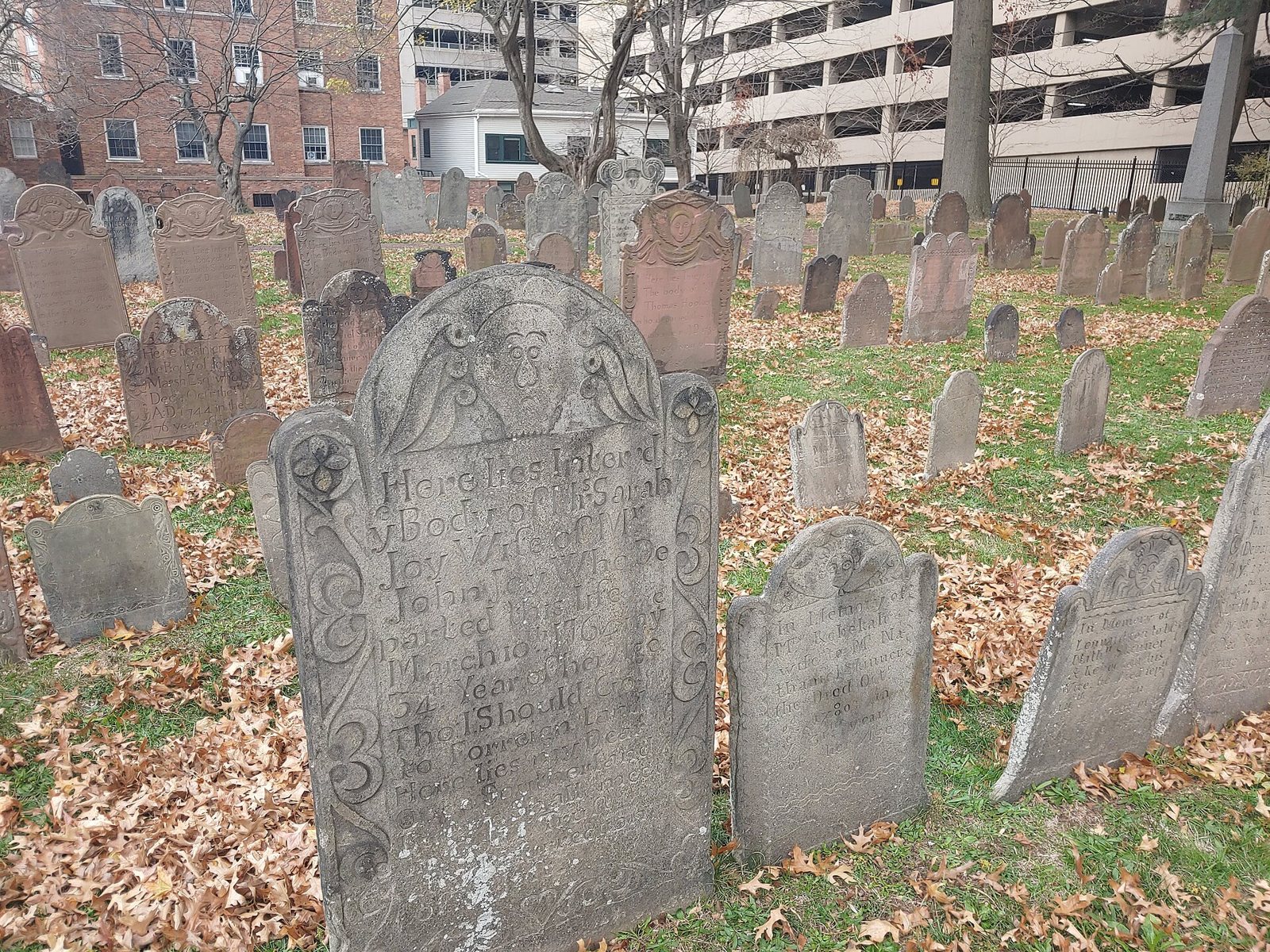
- Hartford's Ancient Burying Ground, the city's oldest historic site, where Connecticut History notes the change from death's-head carvings to more human-looking angel or soul-effigy faces.
- Wequetequock Burial Ground and Phelps Burial Ground in Stonington, with earlier winged-skull designs at Wequetequock and eighteenth-century winged-head stones by the Stevens and Manning families at Phelps.
- Bolton Center Cemetery, where work by Gershom Bartlett, the Manning family, Aaron Haskins, Daniel Ritter and other carvers is documented.
- Nathan Hale Cemetery, Grant Hill Cemetery and South Street Cemetery in Coventry, where the Coventry Historical Society records soul effigies, urn-and-willow stones, and work by the Bartlett, Manning, Loomis, Collins and Haskins families.
- Colchester Burying Ground, whose readable markers run from 1728 to 1869 and include work associated with Gershom Bartlett, Josiah Manning, Obadiah Wheeler and John Isham, according to the Colchester Historical Society.
These are working burial places for real families, and the stones are fragile. Follow each cemetery's access rules, do not touch or trace the stones, and confirm opening or tour information with the historical society or cemetery association that cares for the site. New Haven's own historic burial ground is covered in our story on Grove Street Cemetery.
Winged skull quiz
Answer every question to check.
Questions people ask about winged skulls
What does a skeleton with wings represent?
A skeleton or skull with wings usually joins mortality with movement, ascent or the soul's passage, but the exact meaning depends on who made it and when. On seventeenth- and eighteenth-century New England gravestones it was a memento mori, while later winged faces were read as soul effigies. On military insignia from 1942 it meant winged death aimed at an enemy.
What does a winged skull mean on a gravestone?
On a gravestone, a winged skull most securely means a reminder of death and the shortness of earthly life. In Puritan New England, Boston's guide describes it as a nonreligious mortality symbol. Reading the date, inscription and carver's style alongside it tells you more about the person it was carved for.
What does a winged skull tattoo mean?
A winged skull tattoo means what its wearer intends, most often mortality, remembrance, freedom, danger, motorcycle culture, military identity or a personal memorial. The lettering, banners, weapons, flowers and club insignia around it shape the message, so two winged skulls on two arms can say very different things.
Do the wings on a skull represent the soul or heaven?
The wings can represent the soul rising, and some historians and preservation bodies read them as spiritual regeneration. That reading is an interpretation tied to particular communities and periods, and it fits the later soul-effigy faces more closely than the stark early death's heads, which Boston's guide treats as nonreligious mortality symbols.
Why do old New England gravestones have wings?
Old New England gravestones have wings because the carvers' standard designs, first the death's head and then the cherub or soul effigy, were winged. James Deetz and Edwin Dethlefsen linked the shift from skulls to winged faces between about 1740 and 1760 to changing religious attitudes, though Boston's guide shows both designs were carved side by side late into the eighteenth century.
Where to go next
The winged death's head is one regional voice in a very old conversation about death. For the idea underneath it, read what memento mori means, and for New Haven's own historic graves, the story of Grove Street Cemetery. If the reminder on those Puritan stones is one you would rather wear than carve, our Memento Mori skull tee carries the same thought on a shirt.
Terms in this story
Tap a term to see what it means.
Death's head. The older New England name for a carved skull, often winged, on a gravestone. In Puritan burying grounds it served as a memento mori.