No. 014
What Does the Skull and Crossbones Mean? Gravestones, Pirates, Poison and Badges
The skull and crossbones had a job long before pirates picked it up: it reminded people of death. It's documented on Cape Cod gravestones from 1703, on a pirate ensign described in 1700, on poison labels from about the 1850s, on a British cavalry badge from 1759 and on a US Navy squadron's insignia from January 1943. So, which meaning you're looking at depends on where you met it, and the same drawing can be a gravestone's reminder, a pirate's threat, a chemical warning or a unit's badge. The sections below give each place its date and its named record.
Gravestones: the oldest job
Skull imagery was established in European *memento mori* art by the early sixteenth century. Albrecht Dürer's 1503 engraving *Coat of Arms with a Skull*, at the Metropolitan Museum of Art, uses a skull as a reminder of death, though it doesn't show the standard crossed-bones arrangement. The Science Museum Group holds a probably nineteenth-century European wooden memento mori skull with crossed bones, and explains that such objects reminded the living of death and life's fragility.
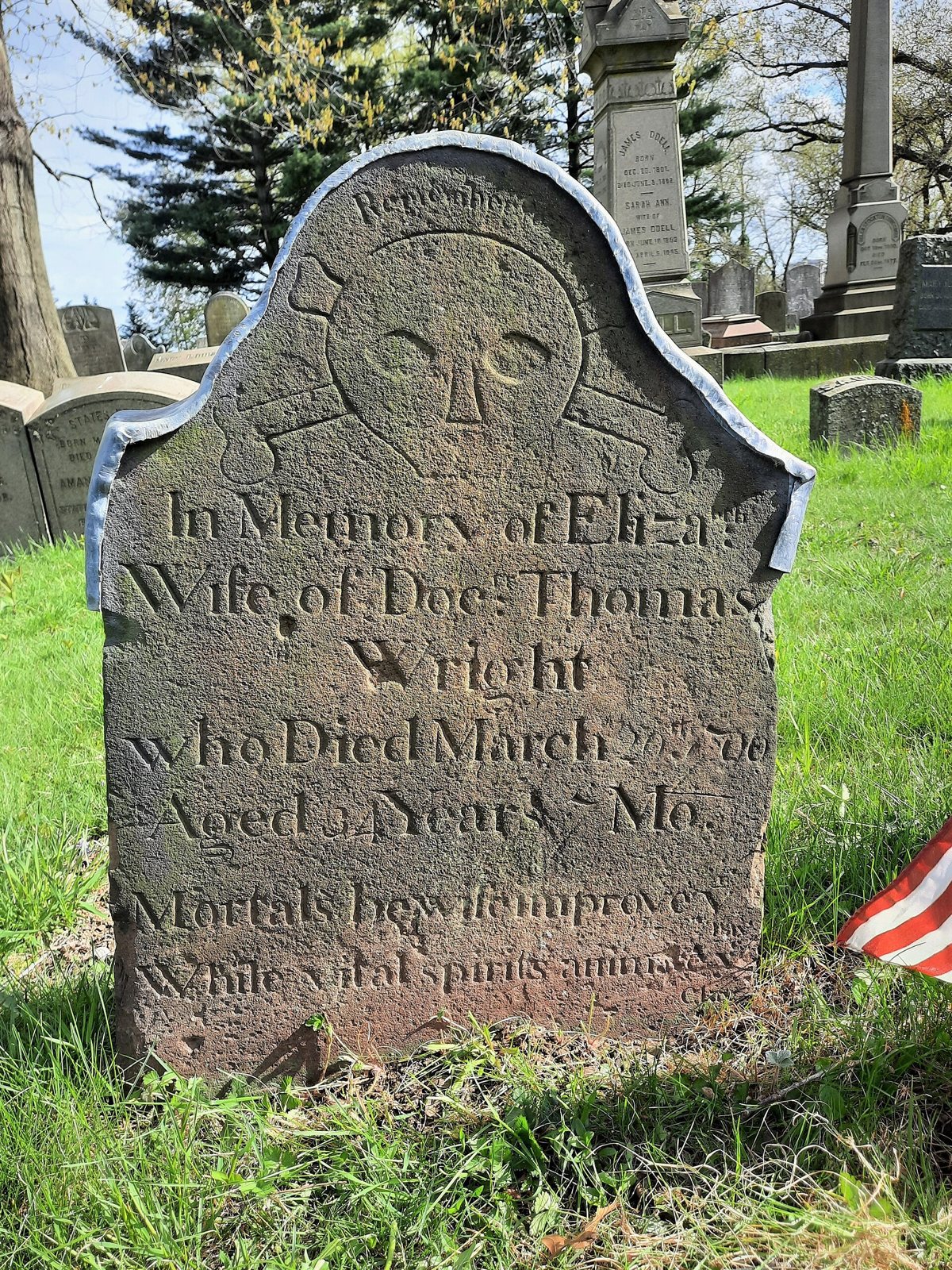
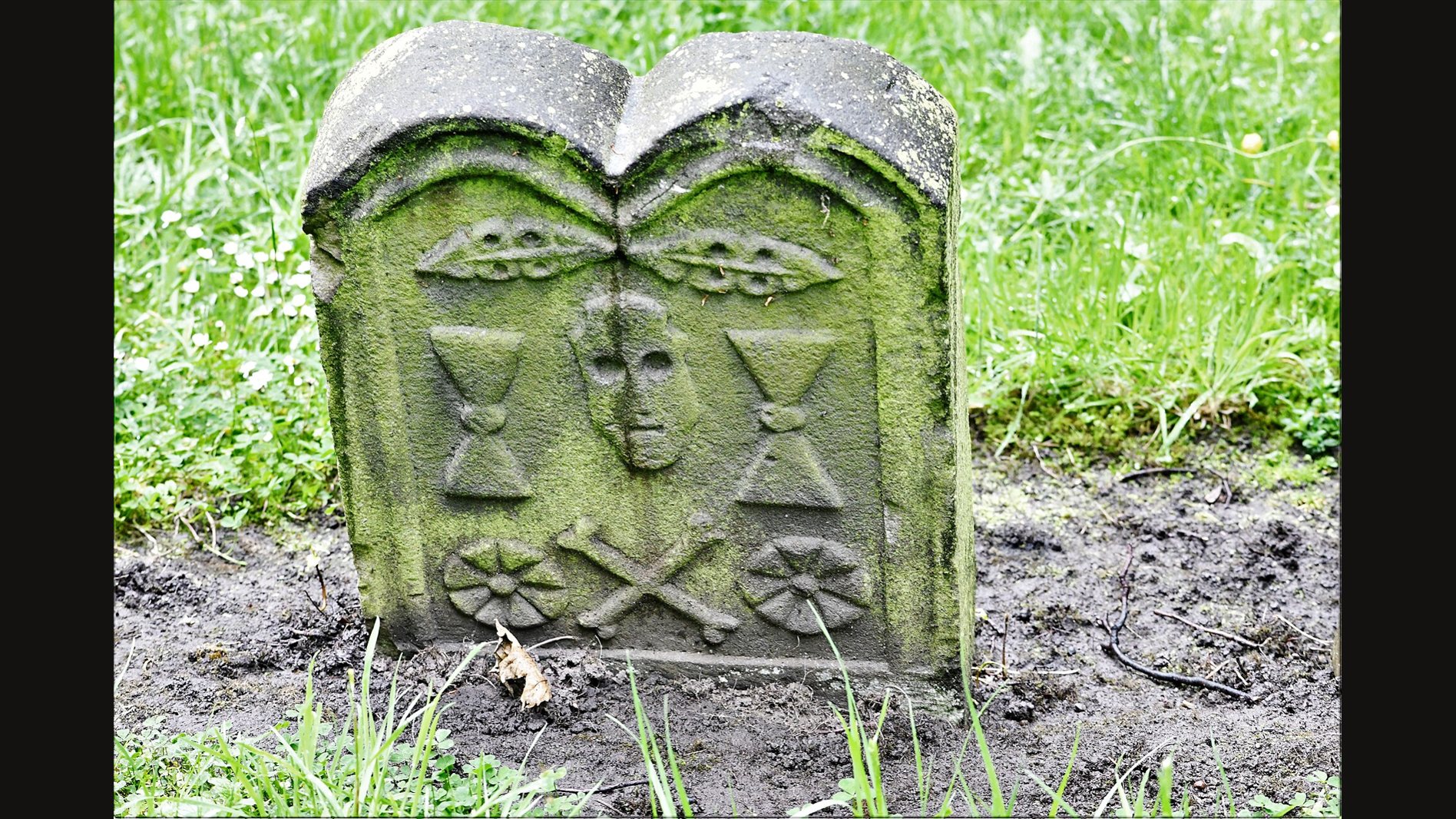
On gravestones the combination turns up in the early 1700s. A study from the Yale New Haven Teachers Institute documents Cape Cod stones with crossbones and winged skulls dating from 1703 to 1718 or 1719, including stones for John Sunderlin, Abigail Otis and Mary Doane, probably carved by the Lamson family of carvers. At Saint Paul's Church National Historic Site in Eastchester, New York, the gravestone of Elizabeth Wright, dated 1766, carries a skull and crossbones that the National Park Service reads as a reminder of mortality and an urging to improve one's conduct, within the Protestant cemetery culture of the later eighteenth century. The City of Boston's guide to its burying grounds says seventeenth-century "death's head" carvings, sometimes winged or crossed with bones, encouraged viewers to think about the fleeting nature of earthly life. Eighteenth-century examples are photographed in a churchyard at Bexley, England, and at Greyfriars Kirkyard in Edinburgh.
A skull and crossbones on a grave isn't evidence that the person was a pirate. The pirate reading is a later association, and an individual stone is best read with its date, inscription and cemetery. Elsewhere in the world, INAH documents skull-and-crossbones imagery on the Altar de los Cráneos at Chichén Itzá, which is pre-Hispanic ritual architecture and a separate tradition from the European one.
Pirate flags
The earliest clearly documented skull-and-crossbones pirate flag belongs to Emanuel Wynn in 1700. Captain John Cranby of HMS *Poole* reported meeting Wynn near Brava in the Cape Verde Islands on July 18, 1700, and described a black ensign bearing "cross bones, a death's head, and an hour glass," according to British Admiralty records. The National Maritime Museum notes that pirate flags weren't standardized, and that surviving flags from the Golden Age of Piracy are very rare, so historians rely mainly on eyewitness accounts, newspapers and books. One important later book is Captain Charles Johnson's *A General History of the Pyrates*, published in 1724, which contains descriptions and illustrations.
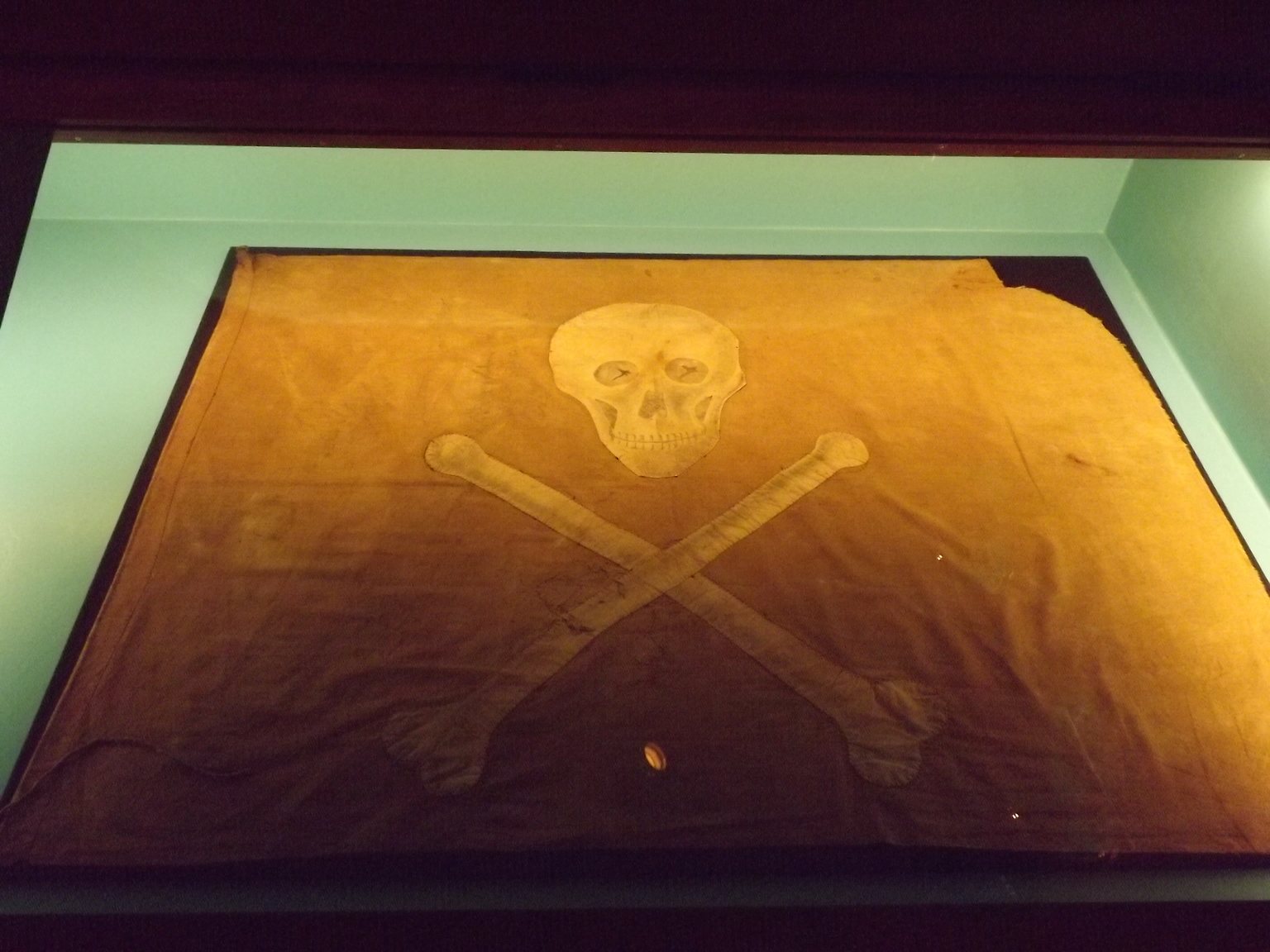
The design became common among several pirates in the 1710s and 1720s, with plenty of variation. Flags could show skeletons, hourglasses, hearts, spears or swords. "Jolly Roger" was probably a broader name than the modern black flag with a white skull and crossbones, since the museum notes the name in accounts of Bartholomew Roberts in 1721 and Francis Spriggs in 1723, though neither flag had the standard design. The 1720 trial of Calico Jack Rackham helped tie pirates to the image, though his flag is described as a skull with crossed swords. Illustrated adventure books and films later folded many designs into one familiar emblem. The full story is in the guide to the Jolly Roger pirate flag.
Poison and chemical labels
On a bottle, the skull and crossbones has an American paper trail. New York State passed a law in 1829 requiring poisonous substances to carry the word "Poison," and the American Pharmaceutical Association recommended the death's-head symbol in 1853. The New York Academy of Medicine says skull-and-crossbones poison labels began appearing around the 1850s. A Philadelphia Museum of Art poison bottle from the 1880s lists several warning methods, including pointed surfaces, unusual shapes, cobalt-blue glass and skull-and-crossbones markings.
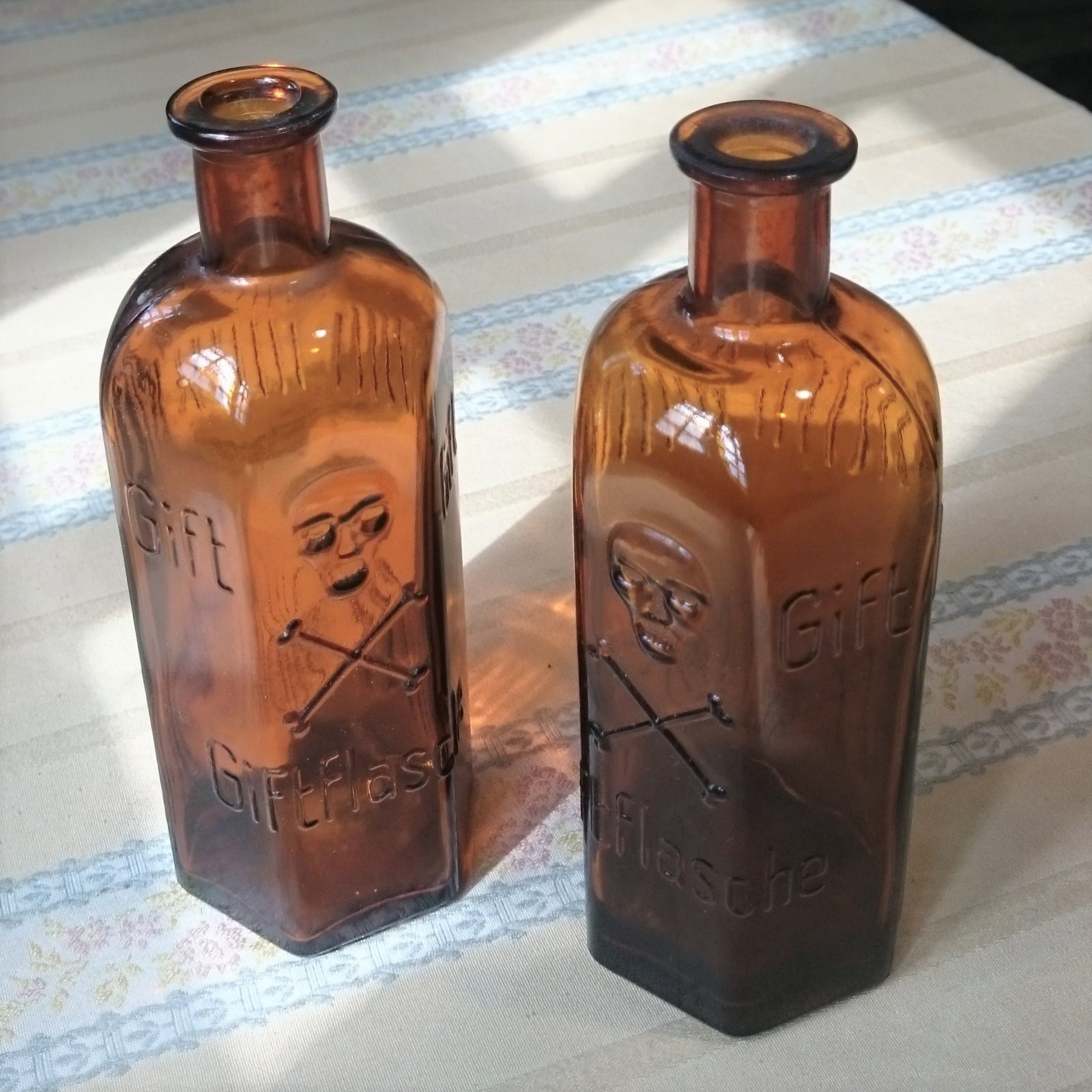
The symbol didn't always scare people. In the 1970s, Pittsburgh health officials promoted Mr. Yuk because some children associated the traditional poison symbol with the Pittsburgh Pirates baseball team instead of danger, according to the New York Academy of Medicine.
The modern chemical version comes from the United Nations Globally Harmonized System, or GHS, whose pictogram GHS06 marks acute toxicity, generally categories 1, 2 and 3 for oral, dermal or inhalation exposure. In the United States, OSHA adopted a revised Hazard Communication Standard in 2012, required worker training on the new labels by December 1, 2013, and began full compliance for chemical manufacturers and employers in 2015. OSHA's pictogram is a black skull and crossbones on a white background inside a red diamond frame, and its regulation attaches the symbol to statements such as "Fatal if swallowed," "Toxic if swallowed" and the matching skin and inhalation hazards. ANSI Z535.3-2022 is the current US standard for designing and evaluating safety symbols in general.
This is a chemical-safety meaning, and it isn't a universal meaning for every skull image. The symbol doesn't mean that every chemical bearing it is equally dangerous, and it isn't a general symbol for healthcare, medicine or hospitals. The precise hazard is given by the signal word, hazard statement and precautionary statements on the whole label, so the label as a whole is what to read.
Tap or hover a row to highlight it.
| Context | Place and period | Meaning or function |
|---|---|---|
| ContextMemento mori gravestone | Place and periodCape Cod, Massachusetts, 1703 to 1718/19 | Meaning or functionMortality and remembrance |
| ContextColonial cemetery | Place and periodEastchester, New York, 1766 | Meaning or functionMortality and moral warning |
| ContextBurying grounds | Place and periodBoston and Puritan New England, seventeenth and eighteenth centuries | Meaning or functionDeath's head and contemplation of earthly life |
| ContextPirate flag | Place and periodCape Verde Islands, 1700 | Meaning or functionA threatening ensign associated with death |
| ContextPoison bottle | Place and periodNew York and the United States, 1829 to the 1880s | Meaning or functionWarning for poisonous contents |
| ContextMilitary badge | Place and periodBritish 17th Light Dragoons, from 1759 | Meaning or functionDeath or Glory regimental identity |
| ContextChemical label | Place and periodInternational GHS and US OSHA, 2012 onward | Meaning or functionAcute toxicity |
| ContextPolitical printing | Place and periodPhiladelphia, October 31, 1765 | Meaning or functionProtest of the Stamp Act |
Badges and banners
Armies and navies took up the death's head for their own reasons. The British 17th Light Dragoons, later the 17th Lancers, adopted a death's-head badge in 1759 after Colonel Hale returned from Quebec with news of General James Wolfe's death. The badge carried the motto "Death or Glory," and the regiment became lancers in the 1820s, according to the National Army Museum. Prussian and other German cavalry units used variations of the *Totenkopf* in the eighteenth and nineteenth centuries, and the traditions differed by regiment.
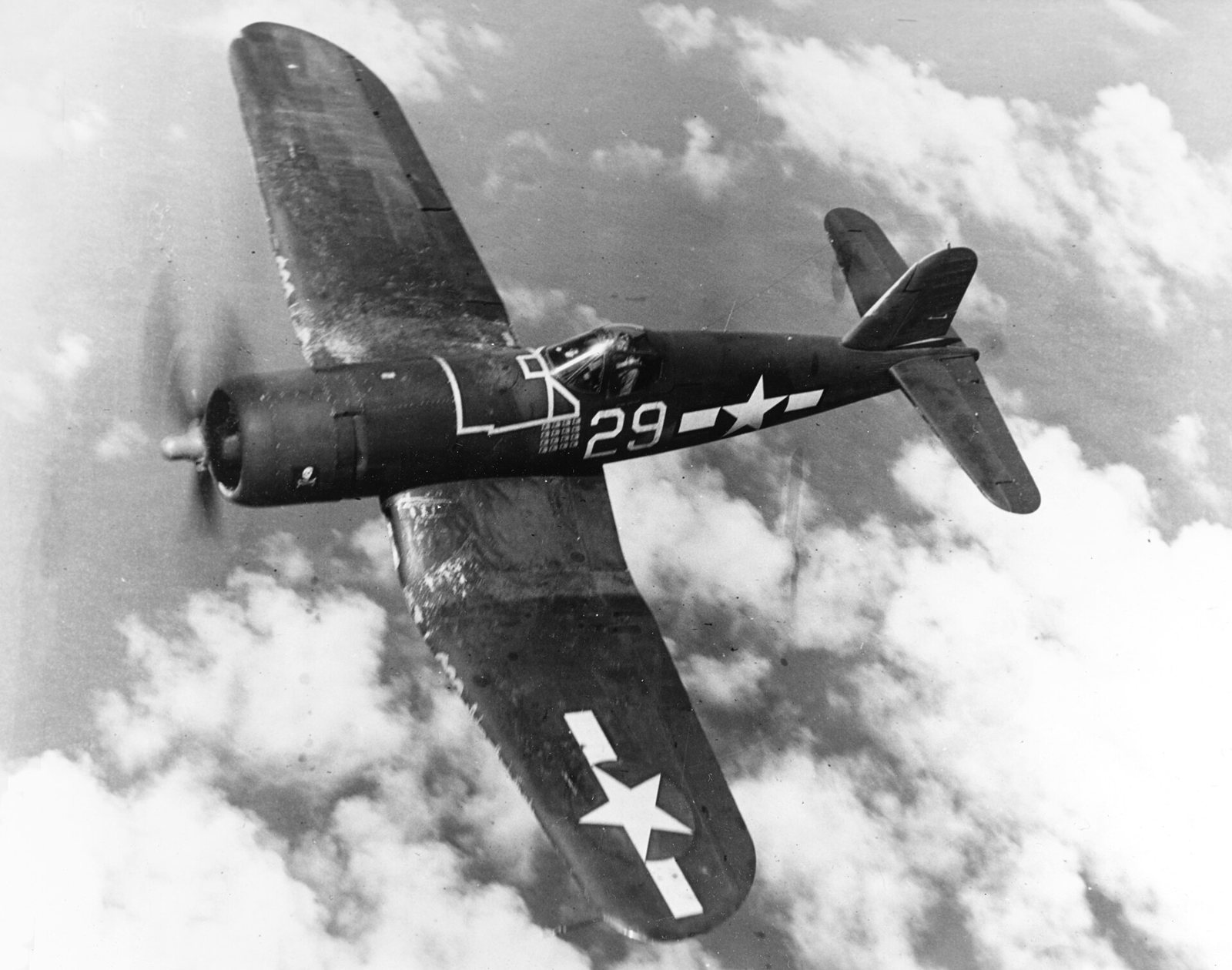
In January 1943, the US Navy fighter squadron VF-17 adopted a skull-and-crossbones insignia for its F4U Corsairs, and later units including VF-84 and VFA-103 kept up the "Jolly Rogers" tradition. The Smithsonian holds an insignia record identified as VF-17's Jolly Rogers emblem. Politics used the image too. On October 31, 1765, the Philadelphia printer William Bradford designed the front page of the *Pennsylvania Journal* as a tombstone with a skull and crossbones to protest the British Stamp Act, which the Library of Congress calls the "Tombstone Edition."
One use needs plain words. The SS Death's-Head Units guarded concentration camps, according to the United States Holocaust Memorial Museum, and the Waffen-SS 3rd SS "Totenkopf" Division used its own death's-head design in World War II. The Anti-Defamation League says neo-Nazis and white supremacists later revived this particular *Totenkopf* as a hate symbol, and it stresses that not every skull and crossbones is extremist. A British regimental badge, a US Navy squadron emblem, a pirate flag and an SS *Totenkopf* are historically distinct. The exact design, the accompanying text and colors, the unit's history and the symbols around it are what tell you which one you're looking at.
The symbol today
Fashion picked it up in London. In 1972, Vivienne Westwood and Malcolm McLaren renamed their shop "Too Fast to Live, Too Young to Die" and used a skull-and-crossbones identity within the punk and anti-establishment scene, a fashion setting that wasn't a continuation of any pirate flag. Orlando Pirates Football Club in Johannesburg adopted the emblem about 23 years after the club's founding. The club's own history says officials chose it after watching a pirate film and linking the image with fierceness.
Fiction keeps it alive too. In Eiichiro Oda's *One Piece*, which Toei Animation describes as a pirate adventure first released as an anime in 1999, every crew has its own Jolly Roger, and the Straw Hat crew's flag adds Luffy's straw hat to the skull-and-crossbones motif. Games often use it as a faction marker or a danger icon, which is fictional or commercial unless it's tied to a specific historical flag or unit. For wearable versions, see skull rings and skull tattoo meanings.
Reading one when you meet it
A few habits settle most cases. On a gravestone, look at the date, the inscription and the other carvings, since winged skulls, hourglasses and scythes belong to the same vocabulary of mortality. On a bottle or drum, read the entire label, because the signal word and hazard statement carry the specifics. On a flag or badge, find out which crew, regiment or unit it belongs to. On a shirt, the meaning belongs to the designer and the wearer, as the tour of what a skull symbolizes explains.
If the gravestone side of the story is the part that gets you, our Memento Mori skull tee leans on it, with a vanitas-style engraving of a skull beside an hourglass and an olive branch, MEMENTO MORI above and USE THE DAY WELL below.
The skull and crossbones through time
Tap or hover a step to follow the order.
1503
Dürer's Coat of Arms with a Skull
July 1700
Emanuel Wynn's flag described near the Cape Verde Islands
1703 to 1718/19
Cape Cod gravestones with crossbones and winged skulls
1720
Calico Jack Rackham's trial
1724
Charles Johnson publishes A General History of the Pyrates
1759
The British 17th Light Dragoons adopt the death's-head badge
October 31, 1765
The Pennsylvania Journal's Tombstone Edition
1829
New York requires poisonous substances to carry the word Poison
Around 1850
Skull-and-crossbones poison labels appear
January 1943
US Navy VF-17 flies the Jolly Rogers insignia
1970s
Pittsburgh develops Mr. Yuk
1972
Westwood and McLaren's "Too Fast to Live, Too Young to Die" shop
2012
OSHA publishes its GHS-aligned Hazard Communication Standard
2015
Full compliance with the revised OSHA label rules begins
Test your skull and crossbones knowledge
Answer every question to check.
Quick answers
These short answers cover the questions people ask most.
What does the skull and crossbones hazard symbol mean?
The skull and crossbones hazard symbol warns that a substance can cause acute toxicity, including serious poisoning or death. In the United States, OSHA uses the red-diamond pictogram for chemicals classified as acutely toxic if swallowed, inhaled or absorbed through the skin. The exact danger appears in the hazard statement, such as "Fatal if inhaled" or "Toxic if swallowed," and the meaning belongs to chemical safety, not to every skull image.
What does the skull and crossbones flag symbolize?
On an early eighteenth-century pirate flag, the skull and crossbones communicated a threat of death and helped identify a pirate crew before or during an attack. The black flag wasn't universal, and historical pirate flags used many different designs. Emanuel Wynn's flag in July 1700, with crossbones, a death's head and an hourglass, is a documented example.
What is the spiritual meaning of the skull and bones symbol?
There is no single spiritual meaning. In seventeenth- and eighteenth-century Boston and other Puritan New England communities, skulls, winged skulls and crossed bones on gravestones were "death's head" or memento mori imagery that reminded viewers of bodily death and the shortness of life. Some winged skulls are read as combining physical death with spiritual regeneration, but that reading belongs to the funerary setting and doesn't apply to every skull and crossbones.
What does skull and crossbones mean in healthcare and on chemicals?
On chemicals, the skull and crossbones means acute toxicity, so exposure by swallowing, inhalation or skin contact may be toxic or fatal. In healthcare, toxicology and poison-control settings the image can refer to poison or poisoning, but it isn't a general symbol for healthcare, medicine or hospitals. The label's signal word, hazard statement and precautionary instructions carry the details.
Is the skull and crossbones always a pirate symbol?
No, the skull and crossbones isn't always a pirate symbol. It appears on gravestones, poison labels and military badges, and gravestones with the motif from colonial New England belong to memento mori funerary art and aren't pirate graves. The pirate meaning is one of several, tied to flags like Emanuel Wynn's in 1700.
Where to go next
For the wider tour of skull meanings, what a skull symbolizes sets this symbol beside the others, and the Jolly Roger story follows the pirate flags in more detail.