

No. 111
Turtle Skull Identification: Sea Turtle, Snapper or Tortoise, and Can You Keep It?
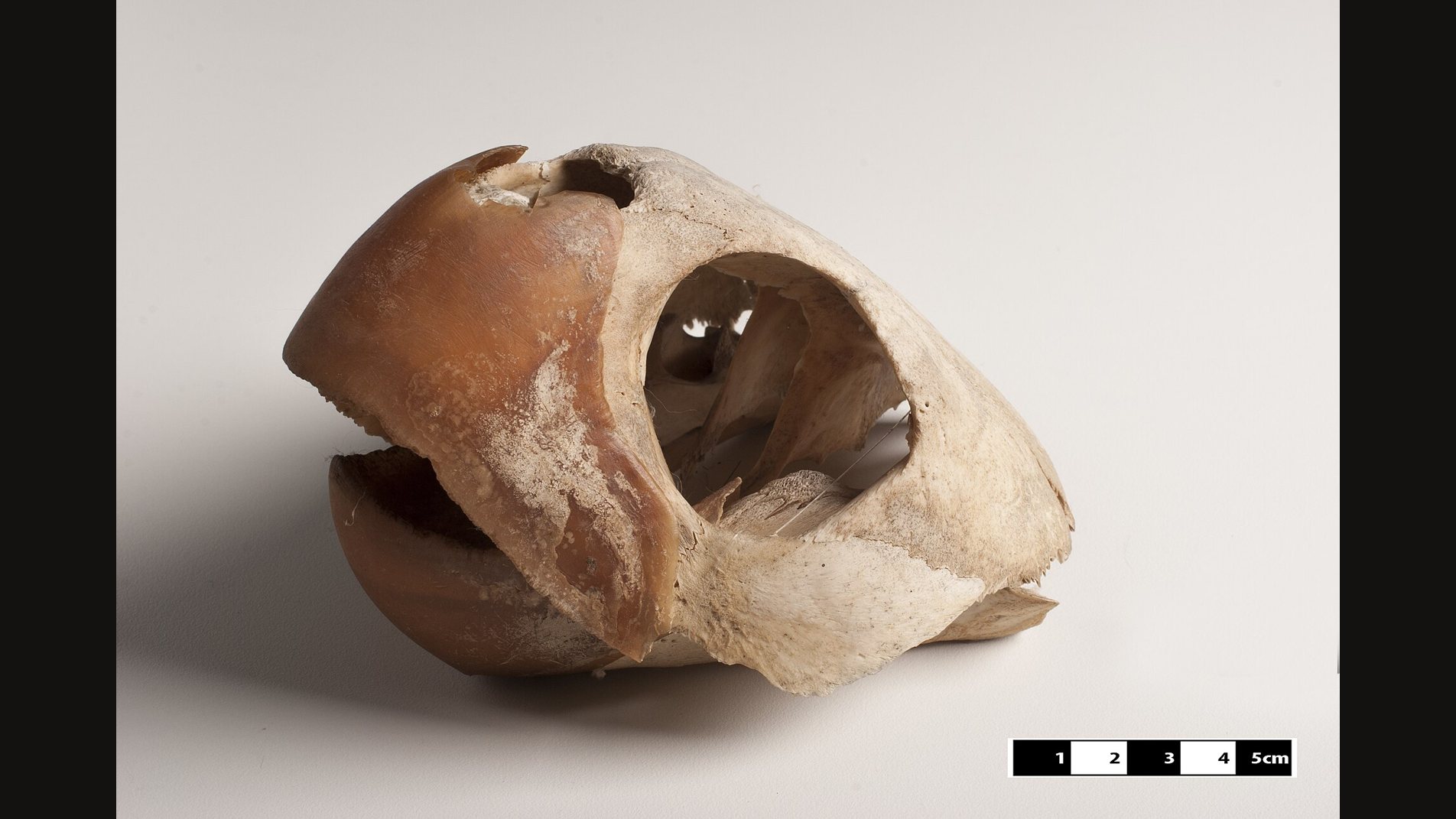
A compact, heavy skull with no teeth at all and a sharp, beak-like edge along the jaws is a turtle or tortoise skull. The shape of that jaw, the snout and the overall size point you to the group. A large skull with a hooked upper jaw suggests a snapping turtle, while a rounded or elongated skull washed up on a beach may belong to a sea turtle.
If it is a sea turtle skull on a U.S. beach, the answer to "can I keep it?" is no. NOAA Fisheries says parts of species listed under the Endangered Species Act, sea turtles included, may not be collected without a permit or other authorization. Take a photo, note exactly where it lies and call the local sea turtle stranding network. For a freshwater turtle or tortoise skull, the rules depend on your state and on who owns the land.
What makes a turtle skull a turtle skull
The first thing to notice is what is missing. Modern turtles have no teeth. Instead, the jaws are covered by a keratin sheath called the rhamphotheca, the turtle's beak. The Smithsonian Institution's Q?rius record for the common snapping turtle explains that the shape of this beak follows diet. Tortoises may have serrated cutting edges, snapping turtles have sharp cutting edges, and musk turtles that eat molluscs have broad, flat edges for crushing shells.
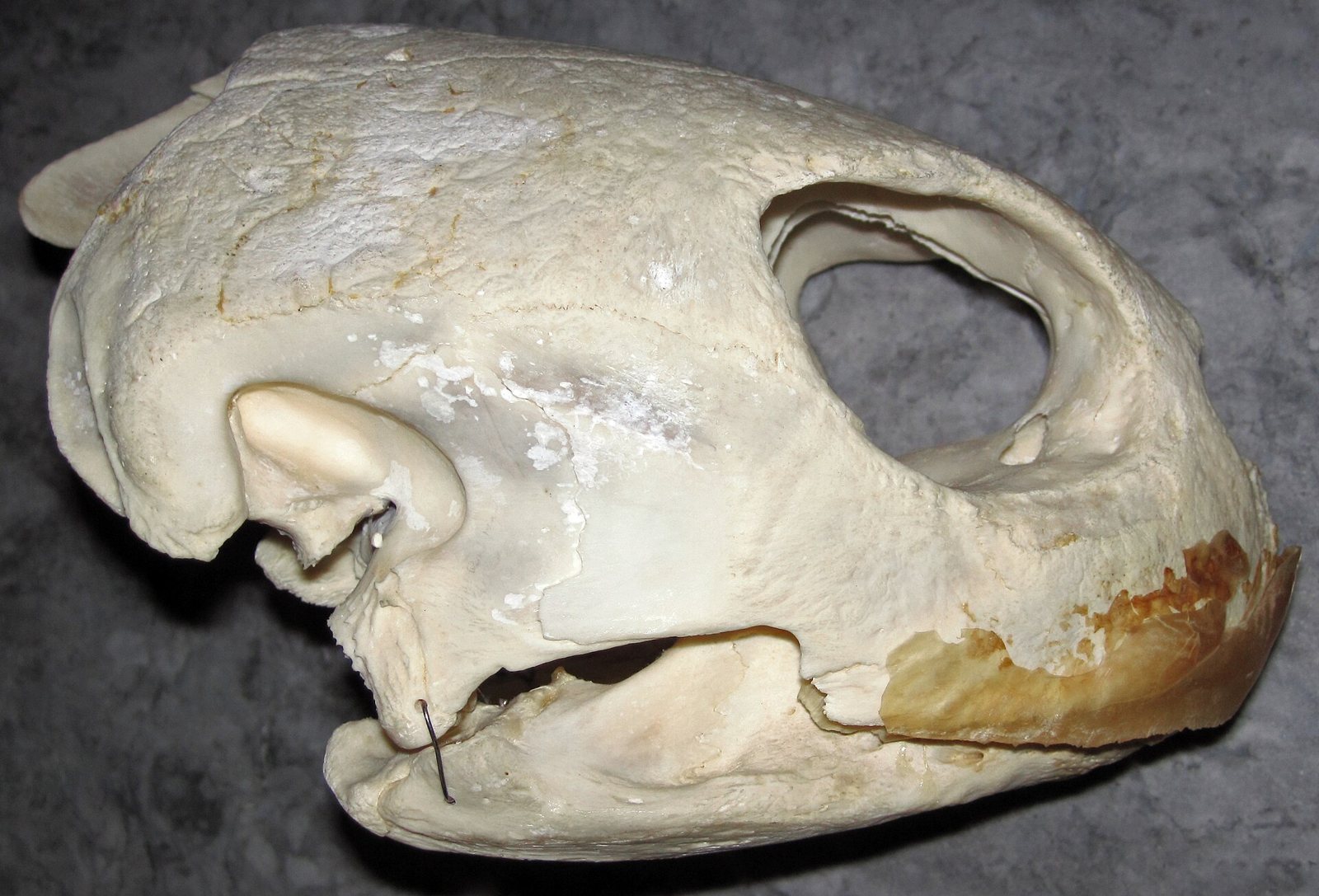
Behind the beak sits a thick, rigid bony skull with large eye sockets and openings for the nostrils. Pick one up and it feels solid and weighty for its size.
There is one catch for anyone holding a dried skull. The keratin beak can peel away or rot off after death, leaving only the bare jaw bones. Those bones do not always look beak-like on their own, so a skull without its sheath can be harder to read at first glance. Run a finger along the jaw edge: no sockets and no teeth, from front to back, is still the giveaway.
Turtles were not always toothless. The Smithsonian notes that the ancient turtle *Odontochelys* had teeth along the edge of its jaw, and that modern turtles lost them over the course of evolution.
Sea turtle, freshwater turtle or tortoise?
A skull on its own can usually tell you the group. Naming the exact species is harder, and often needs a regional identification key, a scale for measuring, the place where the skull turned up and, ideally, the shell or lower jaw that came with it.
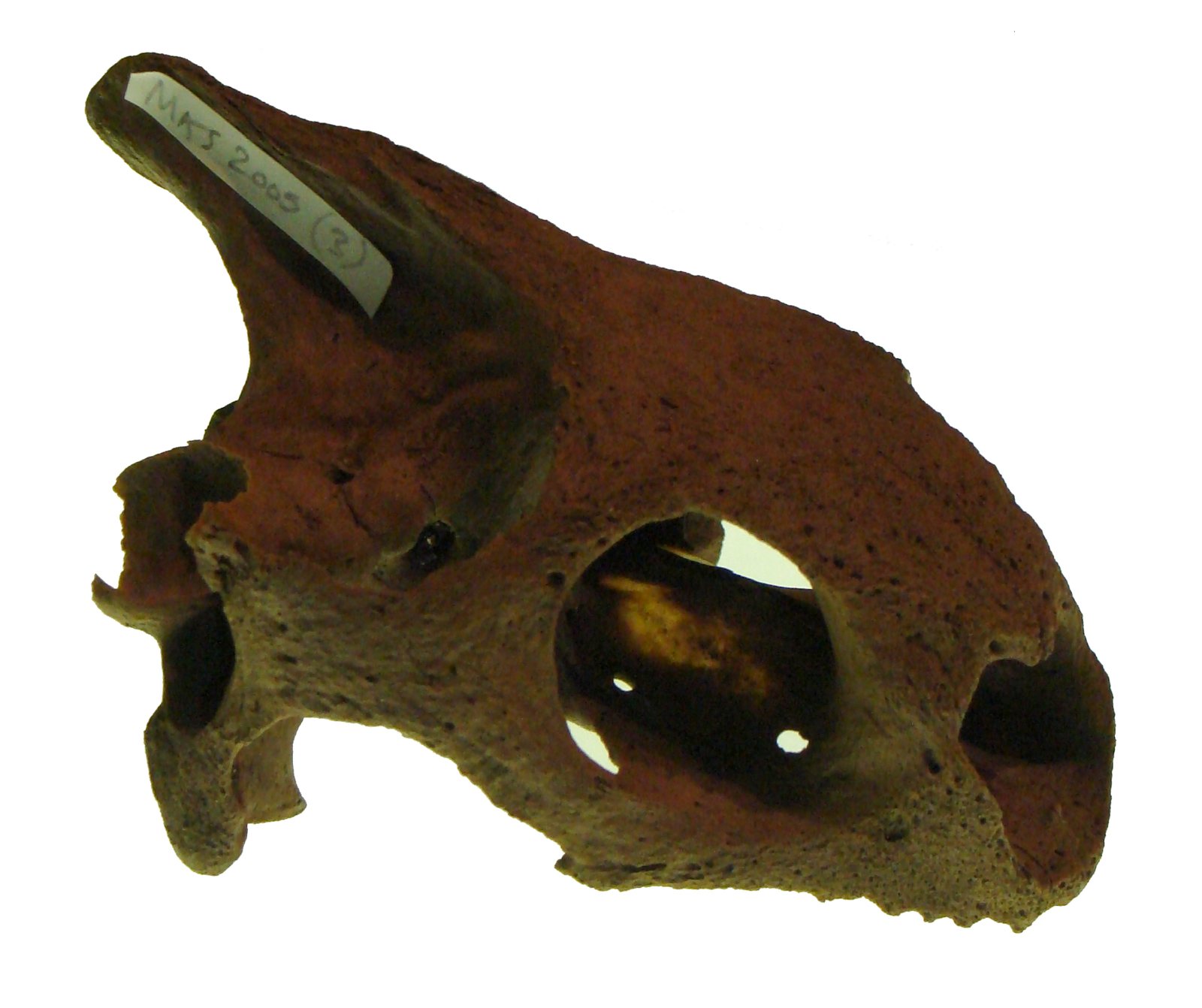
Sea turtle skulls tend to be rounded or elongated, depending on the species. The South Carolina Department of Natural Resources skull key for sea turtles separates species by looking closely at the snout, the premaxillae and maxillae (the bones of the upper jaw), the palate, the chewing surface of the jaw and the temporal region at the back of the skull. In other words, the outline alone is not enough; the details underneath do the work. The department's Anatomy of Sea Turtles describes three of the species the key covers:
- The green turtle, *Chelonia mydas*, has a rounded skull, a short snout and shallow notches at the back of the skull roof, called parietal notches.
- The loggerhead, *Caretta caretta*, has a broad, heavy skull and strong jaws.
- The hawksbill, *Eretmochelys imbricata*, has a narrow, hawk-like beak, a feature NOAA Fisheries' Pacific Islands sea turtle FAQ also uses to tell it apart.
Freshwater turtles vary a great deal. At one end sits the broad, hooked skull of a snapping turtle; at the other, the long, narrow skulls of some softshell turtles. Land tortoises generally have sturdy skulls and strong, often serrated jaw coverings adapted for plant food.
These comparisons will get you to a likely group. A museum or a wildlife agency can take it further.
The snapping turtle's hooked skull
If your skull came from a pond or a riverbank and has a big hooked jaw, the common snapping turtle, *Chelydra serpentina*, is a strong candidate. It is a large freshwater turtle with a large skull, a hooked upper jaw and slightly indented temporal margins at the back. The University of Texas Digimorph description of *Chelydra serpentina* adds finer anatomical details: no contact between the parietal and squamosal bones at the back of the skull, no connection between the maxilla and the quadratojugal bone of the cheek, and a stapes, the small ear bone, enclosed by the quadrate bone.
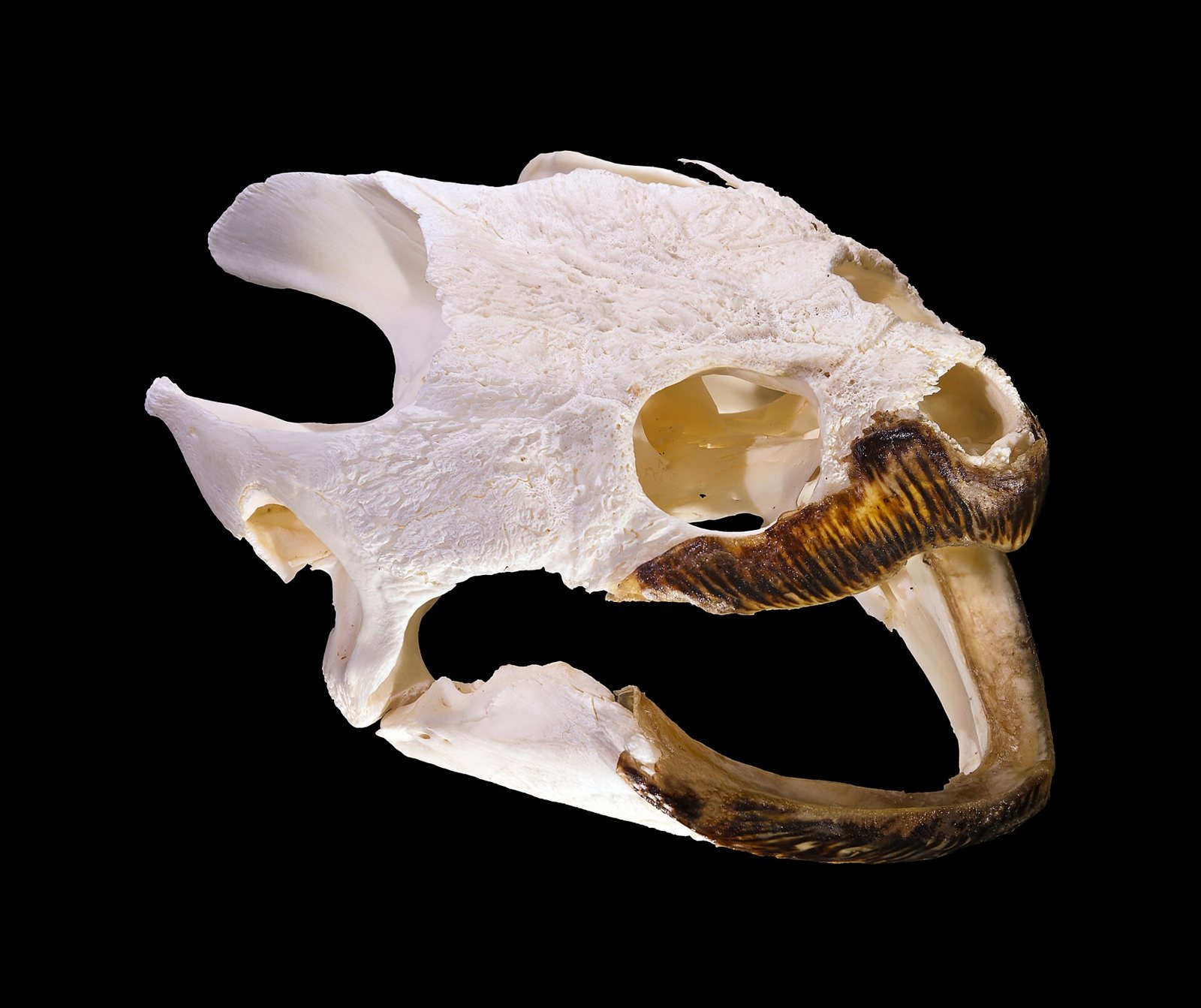
That hooked jaw gives the skull an oddly birdlike look. The CITES identification guide to turtle skulls (*Guía de identificación de cráneos de tortugas*) notes that snapping turtle skulls can look avian because of the hook, although the turtle's bones are comparatively thick and heavy, so the weight in your hand is a useful clue.
Before calling it a common snapper, compare it with the alligator snapping turtle, *Macrochelys temminckii*, and with local specimens, because the two share the same broad pattern. If you have the shell as well, it helps. The common snapping turtle lacks the extra row of scutes, called supramarginal scutes, that the alligator snapping turtle has along the sides of its shell. Size gives a rough guide, too. The common snapping turtle can reach about 20 to 47 centimeters in carapace length, and the Maryland Department of Natural Resources) lists a typical adult shell of 8 to 14 inches.
Reading the skull in your hand
Start with good photographs. Shoot the skull from the side, from the top and from underneath, with a ruler beside it for scale. Then look at each part in turn: the snout, the jaw edge, the palate, the eye sockets, the temporal margins at the back and the overall proportions. Write down where it lay, on which beach or by which pond, the date, and whether a shell or lower jaw was nearby. Several turtle skulls share the same broad pattern, so that location and any shell can matter as much as the skull itself.
Turtle skull identification checklist
Tap a card to bring it forward.
- No teeth and a keratin jaw edge: Points to a turtle or tortoise.
- Large skull and hooked upper jaw: Points to the snapping turtle group.
- Rounded skull, short snout, shallow parietal notches: Fits the green turtle, Chelonia mydas, in the sea turtle key.
- Narrow, hawk-like beak: Fits the hawksbill, Eretmochelys imbricata.
- A sea turtle skull on a beach: Photograph it and contact a stranding network; do not collect it.
A photo can narrow things down, but it often cannot settle the species on its own. For a firm name, take your photographs, with the scale and location notes, to a natural history museum, a university vertebrate collection or your state wildlife agency.
A closed skull with an open past
Look at the side of a turtle skull, behind the eye, and you will see solid bone where many reptiles have windows. Scientists traditionally called the modern turtle skull anapsid, meaning it lacks the two large openings in the temple region found in a typical diapsid reptile skull.
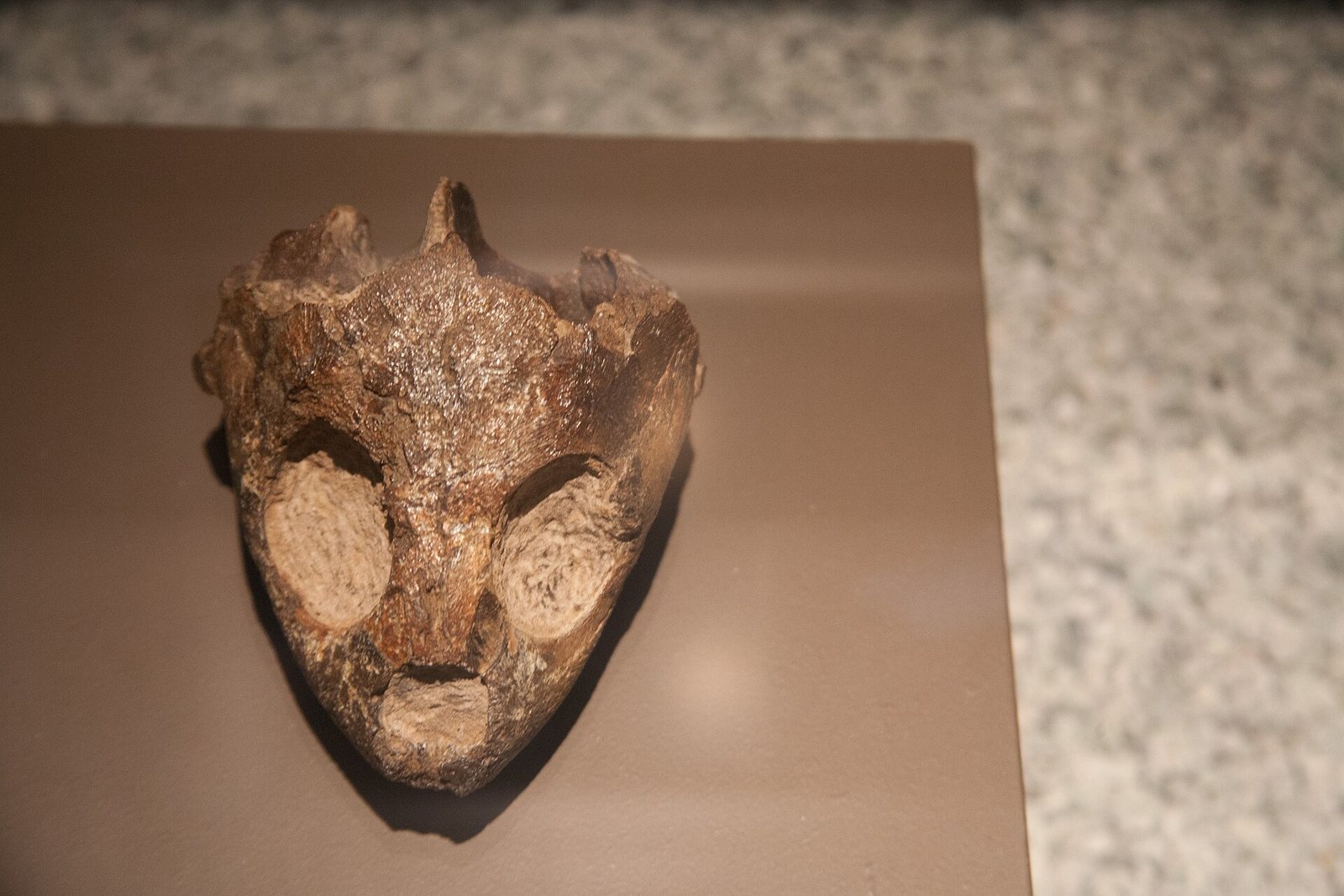
Fossils and molecular studies changed the question. In 2015, Bever, Lyson, Field and Bhullar reported in *Nature* that *Eunotosaurus africanus*, an animal about 260 million years old from what is now South Africa, was an early stem turtle with a diapsid skull that was in the process of becoming secondarily anapsid. Put simply, the openings were closing up. A year later, Schoch and Sues wrote in *The diapsid origin of turtles* that the closed skull evolved late in the turtle stem group, and that turtles came from diapsid reptiles rather than from the older parareptile lineage. Tyler Lyson and Gabriel Bever's review, *Origin and Evolution of the Turtle Body Plan*, in the *Annual Review of Ecology, Evolution, and Systematics*, places the skull within the story of the whole turtle body.
The careful way to put it: modern turtles have a closed temporal region, and their deeper ancestors were most likely diapsid reptiles with open skulls. The solid bone you are holding was sealed over a very long time.
How the turtle skull got its shape
Tap or hover a step to follow the order.
About 260 million years ago
Eunotosaurus africanus lived in what is now South Africa, with a diapsid skull interpreted as becoming secondarily anapsid.
Triassic to Holocene
Turtles leave a fossil record spanning this whole interval.
2015
Bever, Lyson, Field and Bhullar publish their study of the origin of the turtle skull in Nature.
2016
Schoch and Sues argue that the closed skull evolved late in the turtle stem group.
A sea turtle skull on the beach: what to do next
All sea turtles in U.S. waters are listed as endangered or threatened under the Endangered Species Act. NOAA Fisheries' page on protected species parts says parts of ESA-listed species, including sea turtles, may not be collected without a permit or other authorization. A skull counts as a part, and so do a shell, a bone or any other hard piece. The U.S. Fish and Wildlife Service endangered species permits FAQ covers the same ground for collection and possession under the Act.
So, leave it where it is. Do not take it home, clean it or ship it. Instead:
- Photograph it from a safe distance.
- Note the beach and the exact location.
- Contact the local sea turtle stranding network.
NOAA keeps a directory of sea turtle stranding coordinators, updated October 7, 2026. As of that update, the numbers include the Florida Fish and Wildlife Conservation Commission at (888) 404-3922, North Carolina at (252) 241-7367 and Texas at (866) 887-8535. On the Pacific coast, NOAA's West Coast stranding map, updated December 19, 2025, points callers to its authorized network, and the West Coast regional hotline is (866) 767-6114. Numbers change, so confirm the current one for your beach in NOAA's directory before you call. NOAA also explains how to report dead or injured sea turtles.
Outside the United States, the same instinct applies. If you came across a turtle skull on a beach in Costa Rica or anywhere else abroad, contact the national wildlife or fisheries authority there before you move it, and above all before you try to carry it across a border.
Keeping a freshwater turtle or tortoise skull
> General information only, not legal advice. Wildlife law is set state by state and country by country, and it changes.
A snapping turtle skull from a pond or a tortoise skull from the desert is not covered by the sea turtle rule above, but that does not make it automatically yours. What you may keep depends on the species, the state, whether you are in a park or on a public beach, and who owns the land. Before you take a non-sea-turtle skull home, check with your state wildlife agency, the park authority or the land manager for that spot.
Our story on what to do when you find an animal skull goes through the federal and state rules that can apply and who to ask. Once you know a skull is yours to handle, how to clean an animal skull takes it from there. Real turtle skulls and shells are never part of what we sell.
Turtle skull questions
A few more answers for the skull on your table.
Do turtles have teeth?
No, modern turtles have no teeth; they cut, tear or crush food with a keratin beak over the jaw bones. The ancient turtle *Odontochelys* still had teeth, and the Smithsonian notes that modern turtles lost theirs during evolution.
Is it illegal to keep a sea turtle skull?
In the United States, yes: a sea turtle skull may not be collected without a permit or other authorization, according to NOAA Fisheries. That holds for a skull lying loose on the beach, not only for a living turtle. Report it to the stranding network instead.
What does a turtle skull look like?
A turtle skull is compact and heavy, with toothless jaws covered in life by a keratin beak. Its shape changes with the species: the CITES identification guide notes that snapping turtles have a large skull and a hooked upper jaw, while sea turtles have shapes specialized for cutting, crushing or catching food.
Can I bring a turtle skull home from a trip abroad?
Contact the local wildlife or fisheries authority before moving it across a border, because rules differ by country and by place. A sea turtle skull should be left where it lies and reported.
Turtle skull quiz
Answer every question to check.
Where to go next
If your skull has a hooked beak and you are still wondering whether it might be a bird, bird skull meaning looks at those light, beaked skulls, and native bird parts carry federal protection of their own. If it turns out to have teeth after all, the alligator skull and snake skull stories cover the other reptiles you might meet by the water. And if there is any doubt at all about what you are holding, start with how to tell a human skull from an animal skull.
Terms in this story
Tap a term to see what it means.
Rhamphotheca. The keratin sheath over a turtle's jaw bones that forms its beak. It can come away from a dried skull.
---